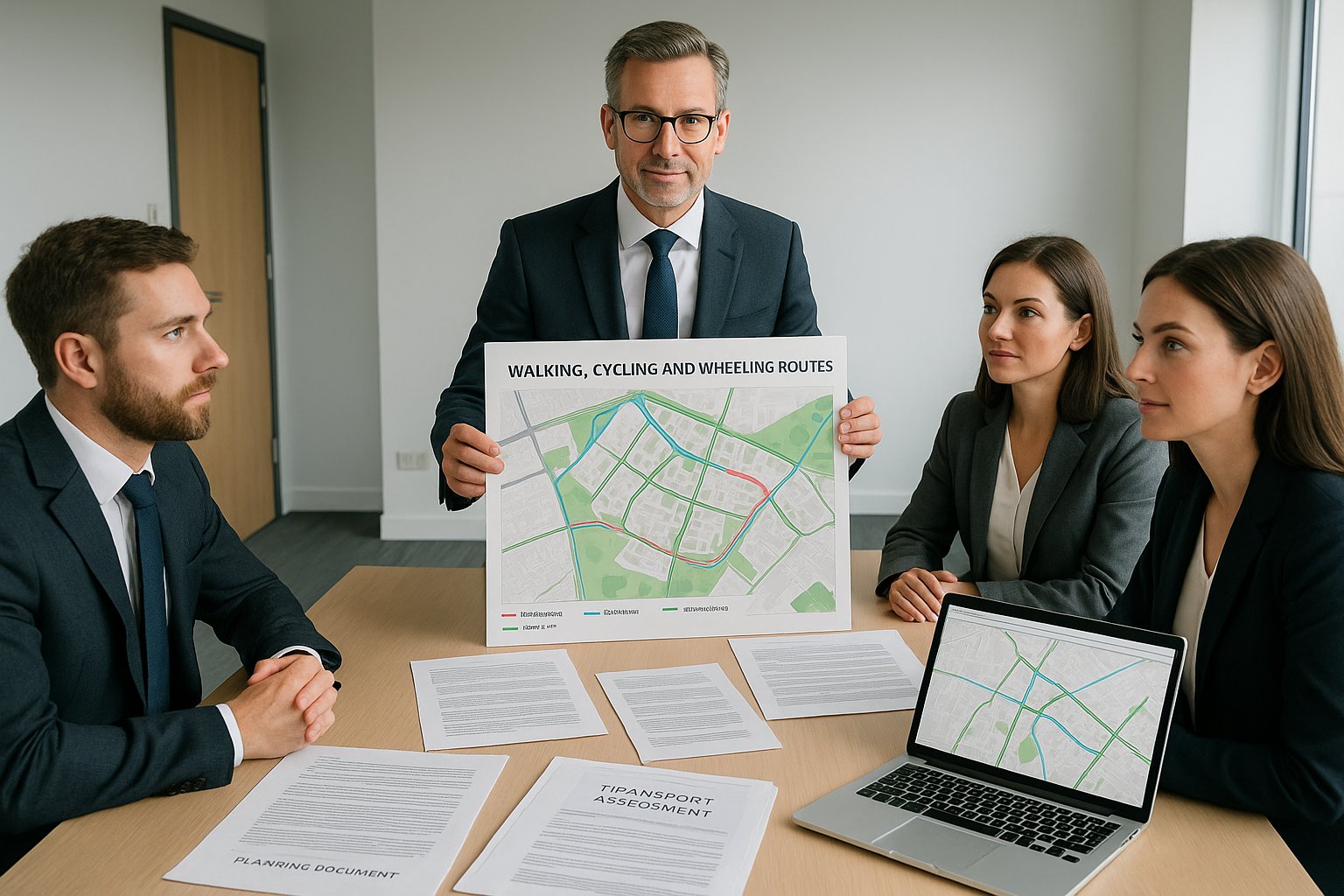
Planning applications are getting tougher on transport, not looser. Across the UK, local planning authorities increasingly expect development proposals to show how people will walk, cycle and wheel safely, not just how cars will get in and out. That shift has made active travel consultants far more important than they were even a few years ago.
For architects, planners, developers, surveyors and councils, this is no longer a side issue. Active travel evidence now sits close to the heart of whether a scheme is considered sustainable, accessible and policy-compliant. If a layout severs pedestrian routes, ignores local cycling networks or leaves inclusive access unresolved, objections can arrive quickly. And once they do, programmes slip.
We see this in practice across transport planning work: early, credible active travel input can tighten a scheme, improve its planning narrative and reduce avoidable back-and-forth with highways officers and consultees. It can also make Transport Assessments and Travel Plans much more convincing, because the promised mode shift is supported by real infrastructure and realistic site analysis.
In this text, we look at what active travel consultants actually do, where their evidence fits within modern planning policy, when projects typically need specialist input, and what local authorities tend to scrutinise most closely in 2026. The aim is simple: help project teams understand how expert active travel advice can strengthen planning applications before problems become expensive.
What Active Travel Consultants Do In The Planning Process
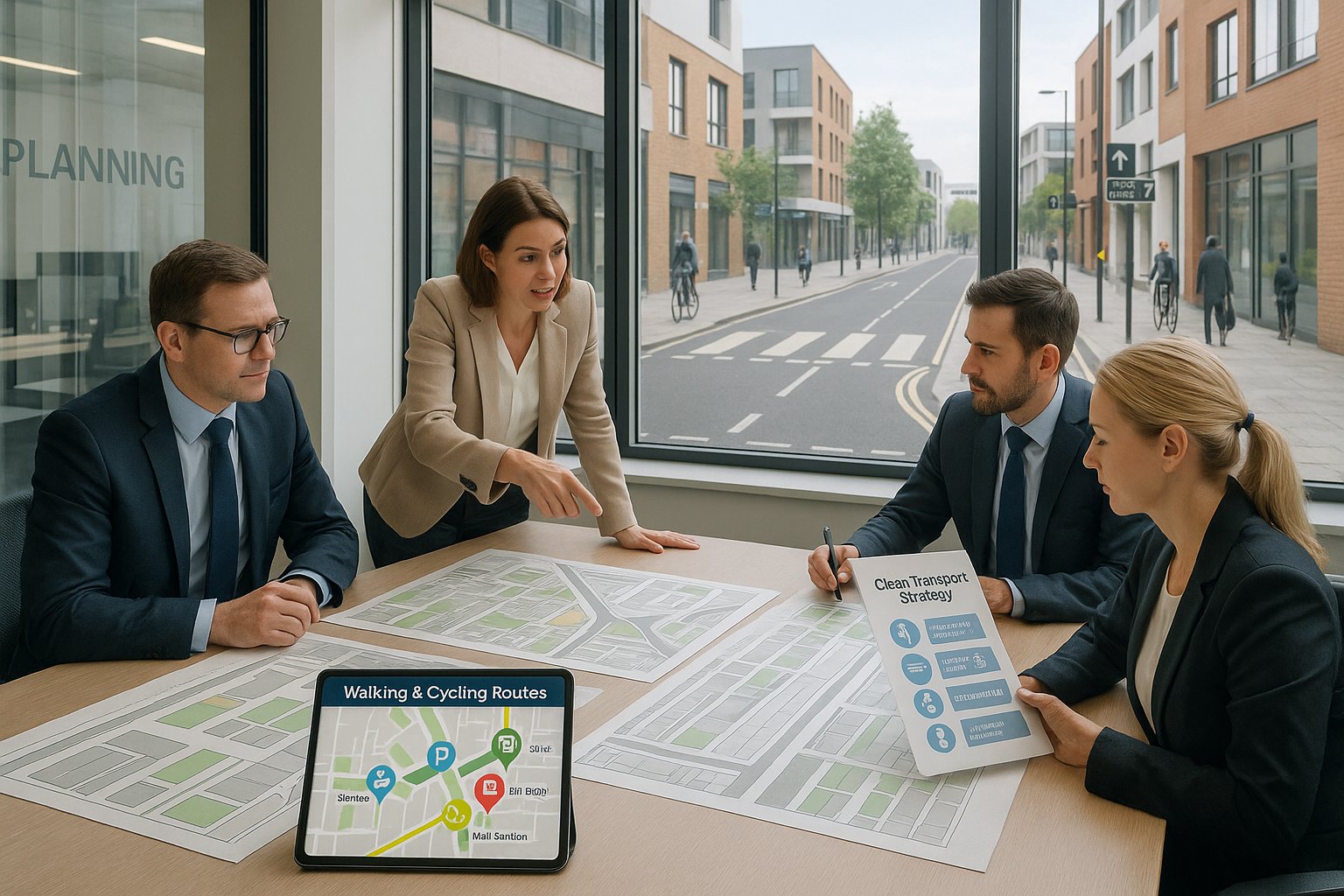
Active travel consultants are transport planning specialists focused on walking, cycling and wheeling within the built environment. In planning terms, their role is partly technical and partly strategic. They assess whether a development genuinely supports sustainable movement, and they help shape the evidence needed to show that it does.
That usually starts early. On better-run projects, active travel input informs masterplanning, access strategy, internal street hierarchy and links beyond the red line boundary. Rather than treating walking and cycling as a late add-on, consultants examine how people are likely to move to schools, shops, bus stops, stations, town centres and open space. The question is practical: are those journeys safe, direct, legible and attractive enough to be used?
They also contribute to formal planning documents. Depending on the scheme, that may include Transport Assessments, Transport Statements, Travel Plans, Design and Access Statements, active travel strategies and junction or crossing reviews. Their analysis often covers permeability, route quality, severance, accessibility, personal security, gradients and inclusive design.
Just as importantly, active travel consultants help development teams make reasonable recommendations. That might involve upgraded crossings, protected cycle provision, better wayfinding, secure cycle parking, filtered permeability or phased off-site improvements. At firms such as ML Traffic, this type of advice tends to work best when tied closely to local authority thresholds, planning policy and the wider transport case, not presented in isolation.
How Active Travel Fits Into Modern Planning Policy
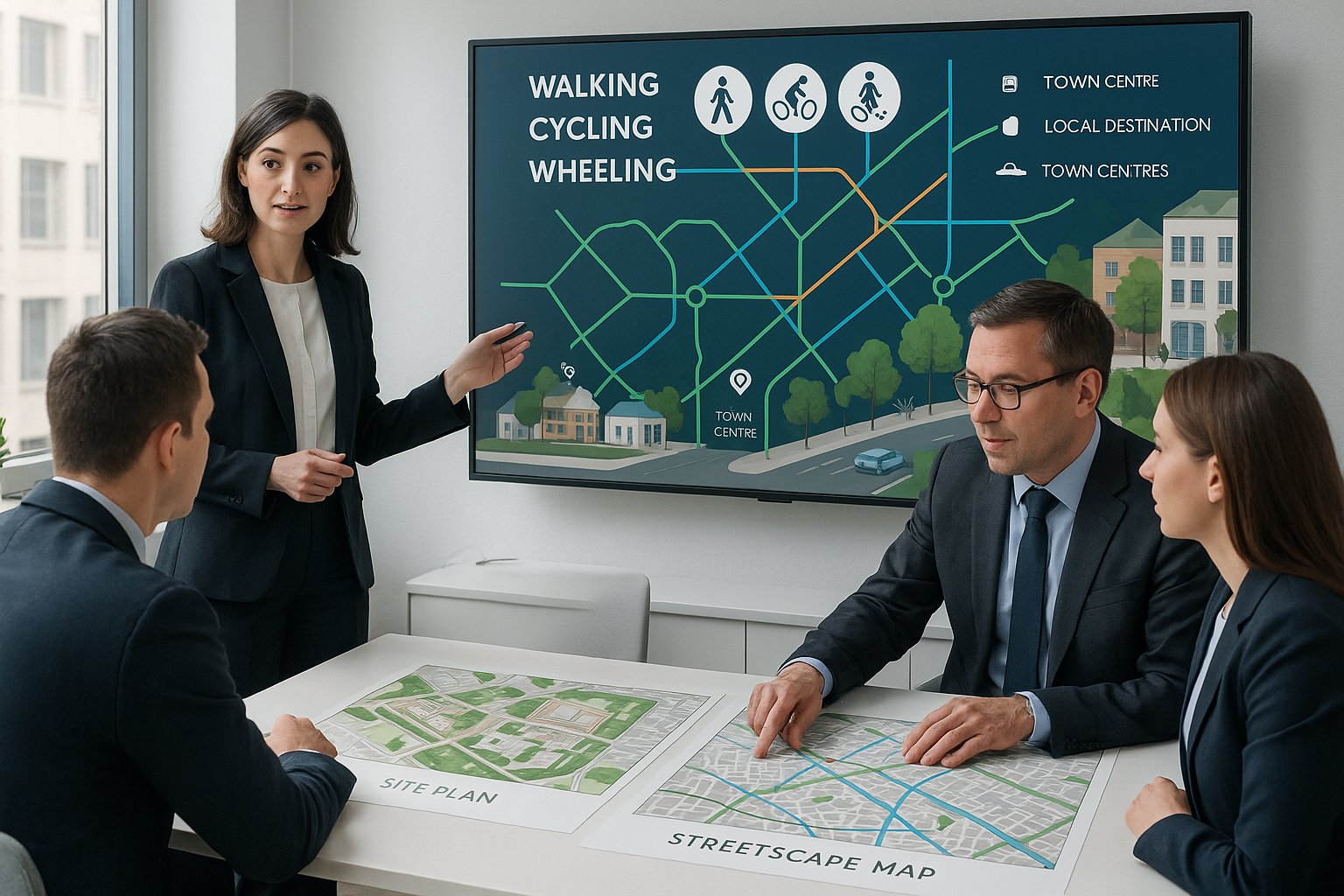
Planning policy has moved decisively toward active travel. In 2026, most decision-makers expect development to do more than avoid severe highway impacts: they expect it to support healthier, lower-carbon and more inclusive travel choices. That expectation runs through national guidance, local plans, design codes, Local Cycling and Walking Infrastructure Plans (LCWIPs) and transport strategies.
The broad policy direction is clear enough. Walking, cycling and wheeling are increasingly placed at the top of the mode hierarchy, especially for short local trips. That means proposals are judged not only on vehicle access and parking, but on whether they help shift journeys away from private car use where that is realistic. In urban and edge-of-centre locations, this can be decisive.
For applicants, the practical implication is straightforward: active travel has to be embedded in the planning story. A development that claims sustainability while offering weak pedestrian routes, indirect cycle access or poor links to public transport looks inconsistent. Conversely, a scheme that shows coherent active travel provision is often easier to defend in planning, because the transport evidence aligns with wider objectives around placemaking, health, accessibility and emissions reduction.
National And Local Policy Expectations
National and devolved guidance sets the tone. Documents such as Manual for Streets, Gear Change, and Scotland’s Cycling by Design all point in a similar direction: networks should be safe, coherent, direct and usable by a wide range of people, not just confident cyclists. Inclusive design matters too. Provision should work for people walking with prams, using wheelchairs or mobility aids, or making short local trips with children.
At local level, policy is often even more specific. Councils may set requirements for cycle parking, end-of-trip facilities, crossing improvements, pedestrian links, internal permeability, public realm quality and connections to adopted or proposed active travel routes. Some authorities lean heavily on supplementary planning documents, design guides or LCWIPs when reviewing applications.
That means applicants can’t rely on generic claims. We need to show that the proposal responds to the actual local policy framework, not just national slogans. A planning application is much stronger when it demonstrates a clear read-across from policy wording to site design and mitigation.
Links To Sustainable Development, Accessibility, And Mode Shift
Active travel sits at the intersection of several planning priorities. It supports sustainable development by reducing reliance on private vehicles, helping to cut congestion and transport emissions. It supports public health by making everyday movement easier. And it supports accessibility by improving how people reach work, education, healthcare, public transport and town centres.
Mode shift is the term that crops up repeatedly, but it only carries weight when backed by credible conditions on the ground. People do not switch from driving because a Travel Plan asks nicely. They switch when routes feel safe, continuous and convenient enough to compete with the car for local journeys.
That is why active travel evidence matters so much. It translates broad policy goals into something testable: can a person reasonably walk, cycle or wheel from this site to key destinations? If the answer is yes, and the design supports it, the planning case becomes far more robust.
When A Development May Need Active Travel Input

Not every planning application needs a standalone active travel study, but many schemes benefit from specialist input far earlier than teams first assume. In practice, the need usually grows with scale, trip generation, policy sensitivity and the complexity of local movement patterns.
Larger residential schemes are an obvious example. Once a site starts generating meaningful numbers of school, shopping, leisure and commuter trips, officers will want to understand how those movements can happen without defaulting to the private car. Mixed-use development raises similar questions, especially where internal streets, public realm and links to nearby centres need careful handling.
Employment sites, education uses, healthcare facilities, regeneration areas and town-centre proposals also commonly need active travel input. These schemes often involve varied user groups, peak-period demand, accessibility obligations and pressure on nearby walking and cycling networks. Even where the red line boundary is tidy, the real planning issue may sit just outside it, a missing crossing, poor connection to a bus stop, or an intimidating junction that undermines sustainable travel claims.
If a Transport Assessment or Travel Plan is required, active travel advice is often sensible as a companion piece. It gives those documents a firmer foundation and helps avoid the rather common problem of optimistic mode share assumptions unsupported by site conditions.
Common Site Types And Planning Triggers
Certain project types recur again and again: urban extensions, denser housing schemes, retail and leisure parks, schools, hospitals, office developments and major regeneration sites. These often trigger scrutiny because they create substantial person trips, not simply vehicle movements.
Planning triggers vary by authority, but common ones include local thresholds for Transport Assessments, schemes near constrained junctions, proposals affecting existing rights of way, sites in centres earmarked for mode shift, and developments near schools, stations or strategic cycle corridors. Applications in areas with known severance issues or collision concerns also tend to attract closer attention.
In plain terms, if active travel is likely to be a material consideration at determination stage, it is worth addressing proactively rather than waiting for a consultee response to expose the gap.
What Active Travel Consultants Assess On A Site
A proper active travel assessment looks beyond the site access bellmouth. It examines the real experience of getting to and from the development on foot, by cycle and by wheeling device. That includes both infrastructure and behaviour: what routes exist, what people are likely to use, and where the friction points are.
Typically, consultants review footways, crossing points, junction geometry, cycle facilities, carriageway conditions, vehicle speeds, visibility, gradients, lighting, passive surveillance and wayfinding. They identify barriers such as severance from busy roads, indirect routes, poor-quality surfaces, missing dropped kerbs or awkward interfaces between pedestrians and traffic.
Desire lines are central to the analysis. It is not enough to show that a path exists somewhere nearby. We need to understand whether key destinations, schools, local centres, bus stops, railway stations, parks, employment areas and health services, are reached by routes that ordinary users would realistically choose.
The best assessments also consider deliverability. If there is a missing link or safety issue, can it be addressed on-site, through minor off-site works, via a Section 278 agreement, or through a phased package of measures? That practical layer matters because planning officers and highways teams are looking for solutions, not just diagnosis.
Walking, Cycling, Accessibility, And Connections To Local Networks
Walking and cycling cannot be assessed in isolation from wider networks. A development may have excellent internal streets but still perform poorly if it connects badly to existing or planned routes. For that reason, consultants normally map local and strategic links, including LCWIP corridors, rights of way, greenways, public transport nodes and town-centre routes.
Accessibility is equally important. In 2026, inclusive design expectations are firmer, and rightly so. Routes should work for people who wheel as well as walk, whether that means wheelchair users, mobility scooter users, parents with buggies or anyone moving more slowly or needing more space. Width, gradient, surfacing, crossing design, rest opportunities and kerb treatment can all become material issues.
This is where detail makes the difference. A route that appears acceptable on a plan can fail in practice because of a narrow pinch point, poor tactile provision, a staggered crossing, or a dark underpass people avoid after 5pm. Good active travel consultants notice those things. And planning officers usually do too.
How Active Travel Evidence Supports Transport Assessments And Travel Plans
Transport Assessments and Travel Plans are stronger when active travel evidence sits underneath them rather than beside them. Without that evidence, a familiar weakness appears: the documents talk about sustainable travel aspirations, but the site appraisal does not prove that those aspirations are achievable.
Active travel analysis helps establish realistic mode share assumptions. If there are safe routes to nearby schools, shops, bus stops and stations, it becomes easier to justify lower car-driver trip rates or a more ambitious Travel Plan. If those routes are poor, the assessment can identify mitigation that makes the assumptions more credible.
It also supports the argument that a development is acceptable in transport terms. Planning decisions rarely turn on highway capacity alone. Officers are entitled to ask whether the site promotes sustainable transport, whether it accords with local policy, and whether its users will have genuine travel choices. Detailed walking, cycling and wheeling evidence answers those questions directly.
There is a strategic benefit too. Good active travel input gives consistency across the application set. The site layout, access drawings, TA narrative, Travel Plan measures and design justification all point in the same direction. That coherence reduces opportunities for objection and helps the project team respond more confidently if questions arise during determination.
In our experience, this is especially valuable on schemes where local authorities are cautious about parking levels, trip generation or broader sustainability claims. Evidence-led active travel work turns a general ambition into a defendable planning case.
Key Design And Infrastructure Recommendations
The recommendations that emerge from active travel work are usually quite practical. They are not abstract policy statements: they are the nuts and bolts of making a site usable without a car.
Common measures include continuous footways, direct pedestrian links, safer side-road crossings, protected or low-stress cycle routes, reduced traffic speeds and better junction treatment. On larger schemes, filtered permeability can be particularly effective, allowing walking and cycling movements to remain direct while limiting unnecessary through-traffic by private vehicle.
Cycle parking is another area where schemes still fall short. Secure, convenient and well-located parking matters more than applicants sometimes think, and for employment or education uses, showers, lockers and changing space can materially improve uptake. Wayfinding, lighting and natural surveillance also deserve attention. If a route feels confusing or unsafe, people simply won’t use it.
Off-site measures can be just as important as on-site design. A new crossing, a widened footway, a short shared-use connection, a dropped kerb upgrade or better links to a bus stop can change the whole transport picture of a development. Often, it is the small missing piece that undermines the larger strategy.
The strongest recommendations are proportionate and specific to the site. They respond to identified barriers, tie back to policy expectations and can be delivered through realistic planning or highway mechanisms. That combination is what makes them persuasive.
Frequent Issues That Delay Approval Or Trigger Objections
Most active travel objections are not caused by a lack of warm words. They arise because the evidence exposes a mismatch between what the application claims and what the place will actually feel like to use.
Poor external links are a common problem. A site may show internal footways and cycle parking, but if the route to the nearest school, bus stop or local centre requires crossing a fast road with inadequate facilities, the sustainability case weakens quickly. The same applies where cycle access depends on mixing with high traffic volumes on hostile roads.
Inclusive access is another recurring issue. Missing dropped kerbs, narrow paths, steep gradients, awkward crossing arrangements and inaccessible connections can trigger concern from highways officers, access officers and local groups. These matters are not cosmetic. They go to whether the development serves all users fairly.
Applications also run into trouble when parking provision dominates the design and mode shift measures feel tokenistic. A Travel Plan cannot compensate for a layout that has clearly been designed around car dependency. Councils are increasingly alert to that.
Then there is the red line trap: assuming that because a problem sits outside the application boundary, it need not be addressed. In reality, missing links and nearby barriers are often exactly what consultees focus on. If they affect whether the site can function sustainably, they are planning issues.
The fix, usually, is not dramatic. It is early scrutiny, honest appraisal and mitigation that deals with the real-world route experience before objections harden.
Choosing Active Travel Consultants For A Planning Application
Choosing the right consultant is partly about technical skill and partly about planning judgement. A team may understand cycling design in theory, but if it cannot translate that into concise planning evidence, negotiate proportionate mitigation and align with local authority expectations, the output may not move the application forward.
We would look first for UK planning experience. That means familiarity with Transport Assessments, Travel Plans, local validation requirements, planning conditions, Section 106 and Section 278 processes, and the way highways and planning officers typically review active travel material. A consultant should understand the policy environment, but also how decisions are really made.
Track record matters. Have they supported successful planning approvals? Have they worked on schemes similar in type and scale to yours? Can they demonstrate practical understanding of active travel design, inclusive access and links to wider transport evidence? Those questions tell you more than a polished brochure ever will.
It is also worth checking how they work with the rest of the team. The best active travel consultants collaborate well with architects, town planners, highway engineers and legal advisers. They identify issues early, communicate clearly and avoid producing siloed advice that clashes with the wider application package.
For many applicants, speed and precision matter as much as depth. That is one reason specialist transport consultancies such as ML Traffic can add value: the work is tailored to planning thresholds, local authority context and decision-critical issues rather than padded with unnecessary reporting. In a busy application programme, that focus counts for a lot.
Conclusion
Active travel consultants now play a much more central role in planning applications than many project teams still assume. Their work helps show that a development is not only accessible on paper, but genuinely capable of supporting walking, cycling and wheeling in everyday use.
That matters because policy expectations have shifted. Councils and consultees increasingly look for coherent active travel networks, inclusive design and credible mode shift evidence, not just acceptable vehicle access. Where those elements are missing, delay and objection become much more likely.
When active travel input is brought in early, it can sharpen layouts, strengthen Transport Assessments and Travel Plans, and reduce planning risk across the board. For architects, planners, developers and public-sector teams alike, the benefit is fairly simple: better evidence, better design decisions, and a better chance of securing permission without avoidable friction.
In 2026, that is not a niche advantage. It is part of competent planning.
Active Travel Consultants – Frequently Asked Questions
What role do active travel consultants play in modern UK planning applications?
Active travel consultants specialise in walking, cycling and wheeling transport planning. They assess and advise on sustainable movement, inclusive access and safe infrastructure, helping developments align with local and national policies to support mode shift and secure planning approval.
When should a development project engage active travel consultants?
Projects generating significant trips—like larger residential, mixed-use, employment, education or healthcare sites—should seek active travel input early. This ensures walking, cycling and wheeling considerations inform masterplanning, access, and transport assessments for better planning outcomes.
How do active travel consultants support Transport Assessments and Travel Plans?
They provide evidence-based analysis of walking, cycling and wheeling routes to establish realistic mode share assumptions and recommend mitigation measures. This strengthens the sustainability case and demonstrates credible travel choices, helping reduce objections and delays in approvals.
What common issues caused by lack of active travel input can delay planning approvals?
Delays often stem from poor or unsafe pedestrian and cycle links, inadequate inclusive access for wheeling users, missing connections to public transport or local networks, and over-reliance on car parking with weak mode shift measures in Travel Plans.
What key design features do active travel consultants typically recommend for new developments?
Consultants typically advise continuous, direct footways and cycleways, safe crossings, reduced traffic speeds, filtered permeability, secure cycle parking, end-of-trip facilities, effective wayfinding, and inclusive design meeting accessibility standards for all users, including those wheeling.
Why is inclusive design important in active travel consultancy for planning?
Inclusive design ensures routes and infrastructure accommodate diverse users, including wheelchair and mobility aid users, parents with buggies, and those with limited mobility. This complies with policy expectations, supports equitable access, and avoids objections relating to accessibility in planning reviews.