If you’re promoting a scheme in Sydenham, transport can become the issue that quietly decides whether an application moves smoothly or stalls in queries, redesigns and objections. That’s true for a modest infill plot as much as for a mixed-use scheme near a station. Access, servicing, parking pressure, walking routes, cycle provision, bus operations and junction capacity all sit under a planning microscope in this part of south-east London.
A Traffic Engineer in Sydenham helps turn those concerns into structured technical evidence. In practice, that means we test whether a proposal can be accessed safely, whether it fits policy, whether it creates a material impact on the local network, and what mitigation is sensible if risks are identified. In Sydenham, that work has to reflect a real local context: constrained Victorian streets, busy bus corridors, rail station activity, controlled parking, and increasingly policy-led emphasis on sustainable travel.
For architects, planners, surveyors, developers, lawyers and local authorities, the value is rarely just in producing a report. It’s in getting the right advice early enough to shape the design, avoid avoidable objections and present a robust case to the planning and highway authority. This guide explains where transport engineering fits into the planning process in Sydenham, what reports may be needed, and how early, planning-focused input can improve the prospects of a faster, stronger application.
Key Takeaways
- A Traffic Engineer in Sydenham provides essential technical evidence showing that planning proposals can be accessed safely and comply with local transport policies.
- Early transport advice helps shape designs to avoid objections, reduce delays, and present robust planning applications tailored to Sydenham’s specific challenges.
- Transport Statements suit smaller developments, while larger or more complex schemes often require in-depth Transport Assessments with modelling and mitigation testing.
- Local transport constraints in Sydenham, such as narrow Victorian streets and high parking pressure, demand detailed analysis of access, servicing, and pedestrian safety.
- Good transport reports should align with national, London-wide, and borough-specific policies, reflecting Sydenham’s controlled parking and sustainable travel focus.
- Preparing thorough site information before engaging a Traffic Engineer ensures faster, more accurate guidance and better-targeted reports for planning authorities.
What A Traffic Engineer In Sydenham Does For Planning And Development Projects
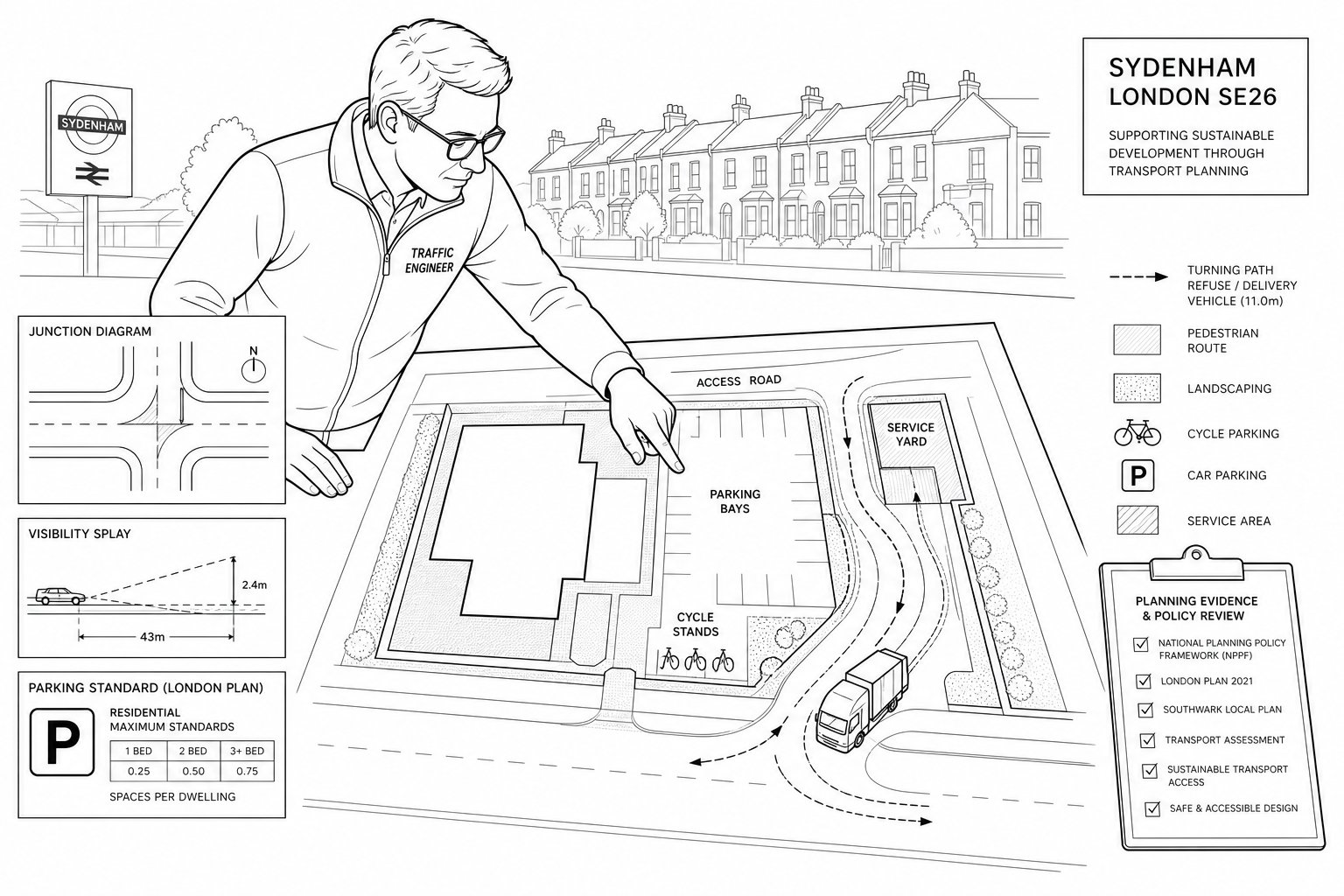
A Traffic Engineer in Sydenham supports planning applications by showing, in evidence rather than assumption, that a development can function safely and acceptably in transport terms. That sounds simple. It usually isn’t.
We typically start by reviewing the proposal itself: the land use, scale, access arrangement, likely travel demand, parking strategy, servicing needs and relationship to surrounding streets. In Sydenham, the detail matters. A scheme that looks perfectly workable on a broad red-line plan can become problematic once refuse tracking, cycle parking access, delivery activity or visibility constraints are examined properly.
From there, our role is partly analytical and partly strategic. We assess likely effects against the framework that decision-makers actually use: the NPPF, London Plan policies, borough development management policies, parking standards, cycle standards and highway design guidance. We also look at how officers are likely to view the scheme in practice, which is often just as important as the policy wording itself.
That might involve forecasting trips, checking junction performance, reviewing collision history, assessing overspill parking risk, testing service yard manoeuvres, or advising on a Travel Plan. On more constrained sites, we may recommend access amendments, servicing restrictions, revised layouts or targeted mitigation before the design is locked in.
For teams wanting wider context around Traffic Engineering Consultants: What, the underlying principle is the same: good transport advice is not just report production. It’s design support aimed at making the application more defensible.
How Local Transport Constraints In Sydenham Shape Planning Decisions
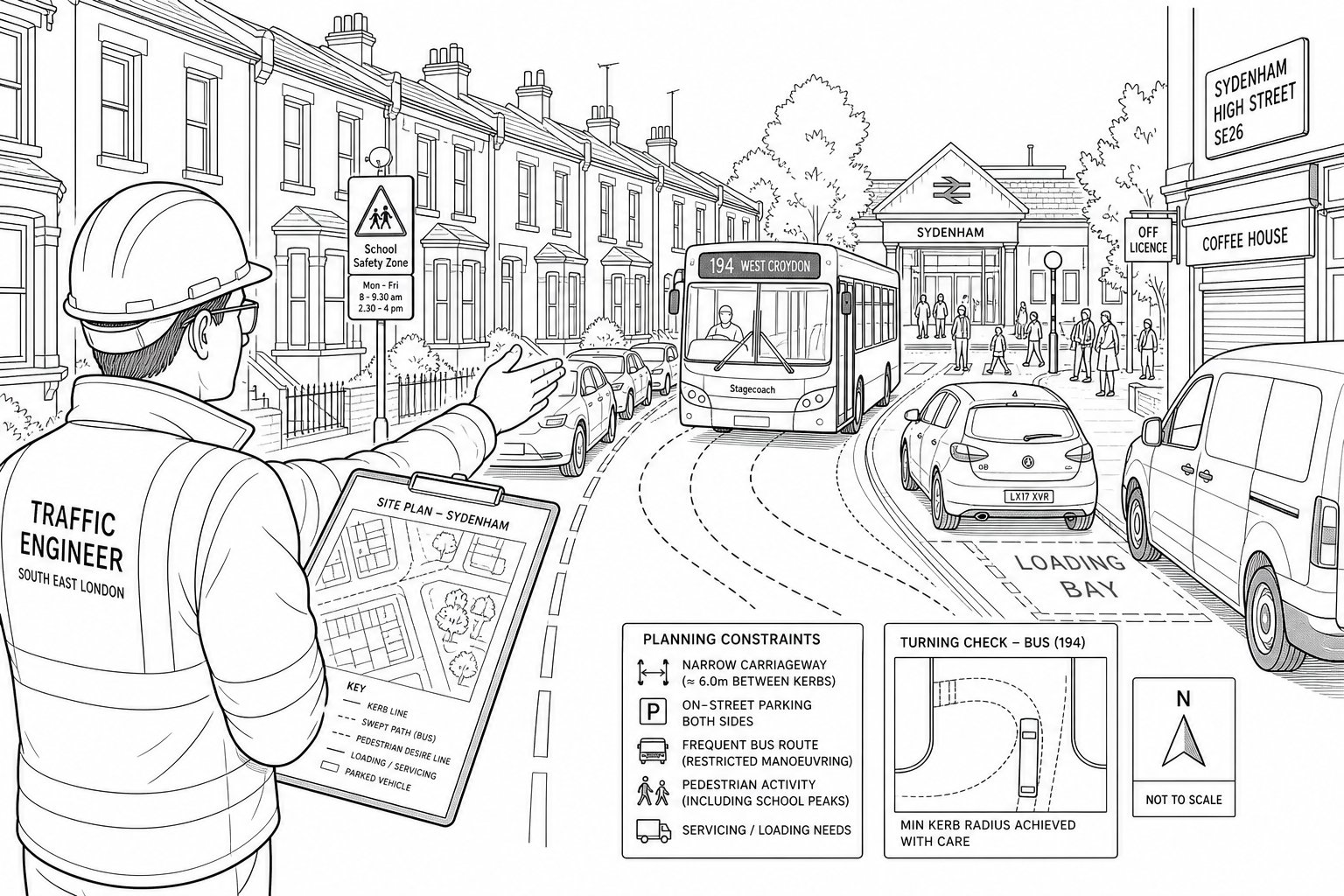
Sydenham sits within a transport context that is recognisably London but very locally specific. Planning decisions are shaped by the interaction between rail accessibility, bus movement, older street patterns and residential parking pressure. If that mix is underestimated, transport comments arrive late and hard.
The area includes constrained Victorian streets, narrow carriageways, frequent frontage activity and sections where on-street parking materially affects movement. Near Sydenham, Lower Sydenham and Penge stations, proposals may also need to account for station-related activity, pedestrian concentration and peak-period kerbside pressure. Then there’s the policy layer: boroughs in the wider catchment may apply controlled parking, school-street measures, low-traffic neighbourhood interventions and healthy-streets priorities in slightly different ways.
That means a development is not assessed in a vacuum. Officers will ask whether the site’s access works with actual local conditions, not idealised drawings. Is the crossover too close to parking stress? Will servicing interrupt a bus corridor? Are pedestrians likely to be pushed into conflict at a corner? Is car parking oversupplied, or underprovided in a way that simply exports the problem onto nearby streets?
We often frame this at the outset so the design team can respond early. Broader planning-led practice discussed in Traffic Engineering and Transportation is especially relevant in places like Sydenham, where transport constraints are rarely dramatic in isolation but can become decisive when combined.
Typical Issues Reviewed On Sites Near Town Centres, Schools, And Residential Streets
Town-centre sites tend to raise questions about servicing first. Can deliveries occur without blocking traffic or bus movement? Is there lawful, safe loading space? How do pedestrians, cyclists and short-stay visitors move around the frontage? Public realm and crossing activity often become as important as raw traffic generation.
Near schools, the focus shifts. Drop-off and pick-up behaviour, walking routes, school-street restrictions, visibility at crossings and vehicle speeds all come under scrutiny. A small development beside a school can trigger disproportionately strong concern if it appears to worsen already tense peak-period conditions.
Residential streets usually bring a different cluster of issues: overspill parking, refuse access, turning heads, road safety, and whether larger vehicles can enter and leave in forward gear. In Sydenham, where some streets feel generous on plan but are effectively narrowed by parked vehicles, swept path checks and on-site observations are often indispensable.
When A Transport Assessment Or Transport Statement Is Needed
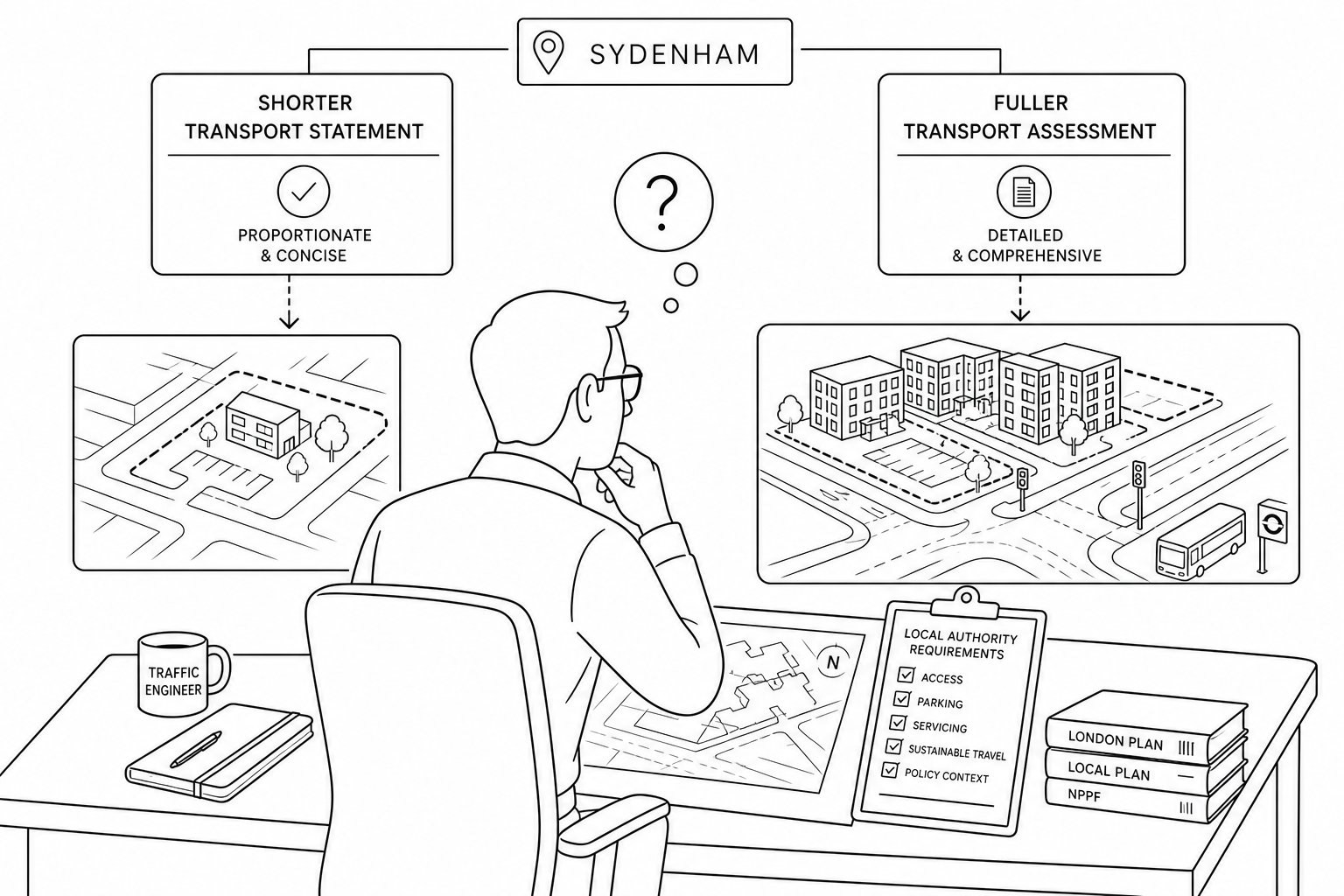
One of the most common early questions is whether a scheme needs a Transport Statement (TS) or a fuller Transport Assessment (TA). The answer depends on scale, transport sensitivity and local policy expectations rather than a single universal threshold.
In broad terms, a TS suits smaller to medium developments where trip generation is likely to be modest and network effects limited. It provides a concise but structured review of existing conditions, site accessibility, access arrangements, parking, servicing and likely transport impacts. For many infill, conversion, small residential and modest commercial schemes in Sydenham, a well-pitched TS is the right tool.
A TA is usually needed where proposals are larger, more complex, located on a sensitive corridor, near stressed junctions, or likely to affect public transport capacity or highway operation more materially. It follows the logic of the Department for Transport’s guidance and is typically expected when impacts need deeper evidence, modelling or mitigation testing.
Local authority validation requirements matter here. So do pre-application conversations. We’ve seen schemes that technically looked like TS candidates but were better served by a proportionate TA because a borough officer had particular concern around access, servicing or cumulative impact.
That judgement call is part of the value of early advice. A weakly scoped report can waste weeks. A proportionate, policy-aware report can shorten determination by answering the real questions first. This is where experience across borough expectations and Highway And Traffic Engineering workstreams becomes genuinely useful.
How Trip Generation, Junction Impact, And Highway Safety Are Assessed
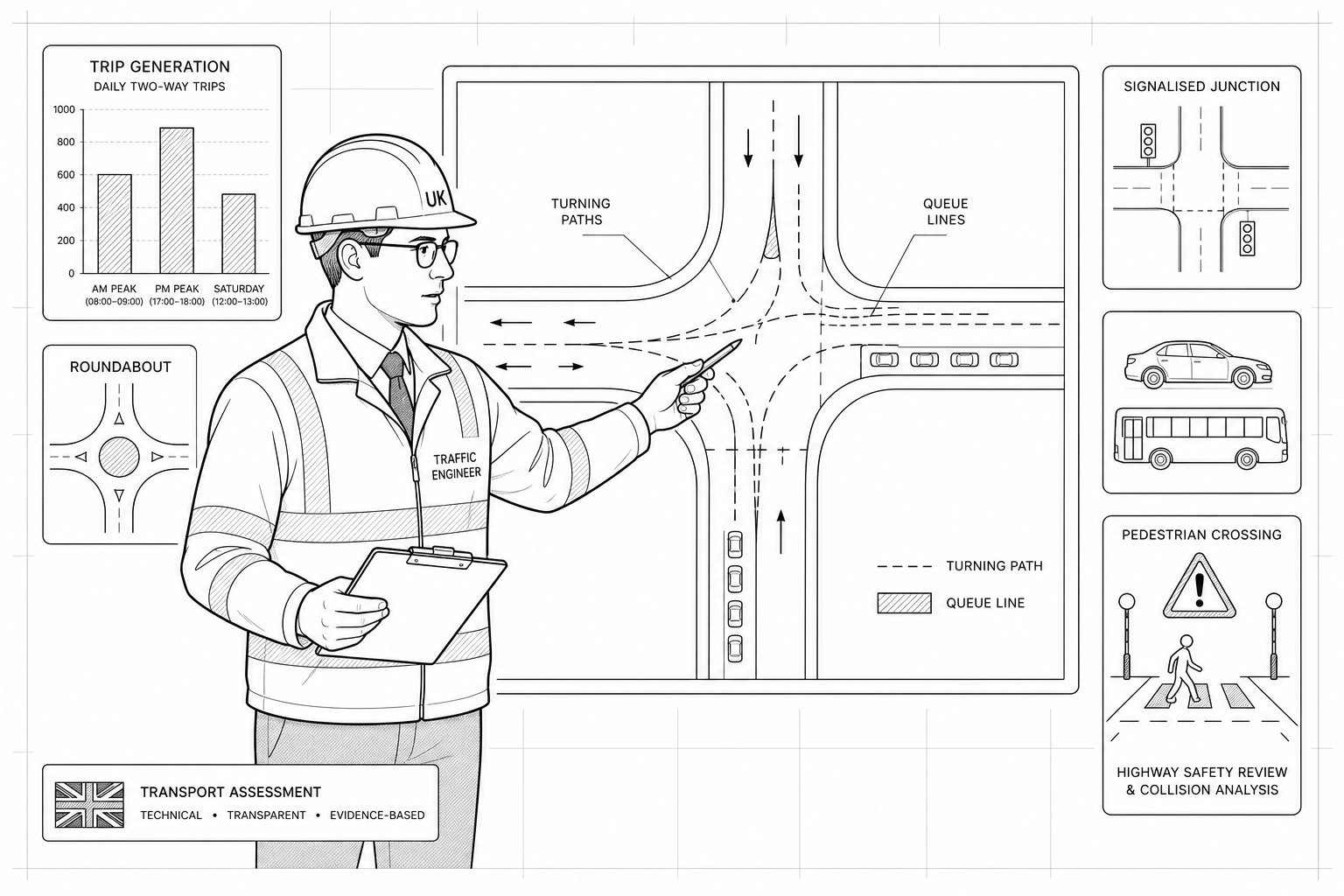
Transport evidence stands or falls on method. In Sydenham, where objections often focus on “extra traffic”, “worse parking” or “unsafe access”, it’s important that forecasts and conclusions are transparent, proportionate and defensible.
Trip generation is commonly estimated using TRICS or comparable databases, then adjusted to reflect local circumstances. That means considering PTAL, nearby stations, bus accessibility, London travel patterns, local car ownership and the nature of the proposed use. A car-lite flatted scheme near rail services should not be assessed in the same way as a lower-density edge-of-centre use with more operational traffic.
Junction impact is then reviewed where necessary using recognised tools such as PICADY, ARCADY, LINSIG, TRANSYT, VISSIM or Synchro, depending on junction type and complexity. The core test is usually comparative: what happens with and without development? Are queues materially different? Do reserve capacities or delay levels worsen to a degree that planning concern is justified? Sometimes the answer is plainly no. Sometimes a small design or signal adjustment makes the difference.
Highway safety is assessed through site review, geometry testing and collision analysis, often using the most recent three to five years of STATS19 data. We look for patterns rather than isolated incidents: shunts at a junction approach, pedestrian casualties near crossings, turning conflicts, speeding concerns or visibility limitations.
The point isn’t to drown a scheme in modelling. It’s to use the right level of technical work to answer the likely planning questions clearly, in line with sound Traffic Engineering: Your practice.
Key Planning Documents And Local Authority Requirements That May Apply
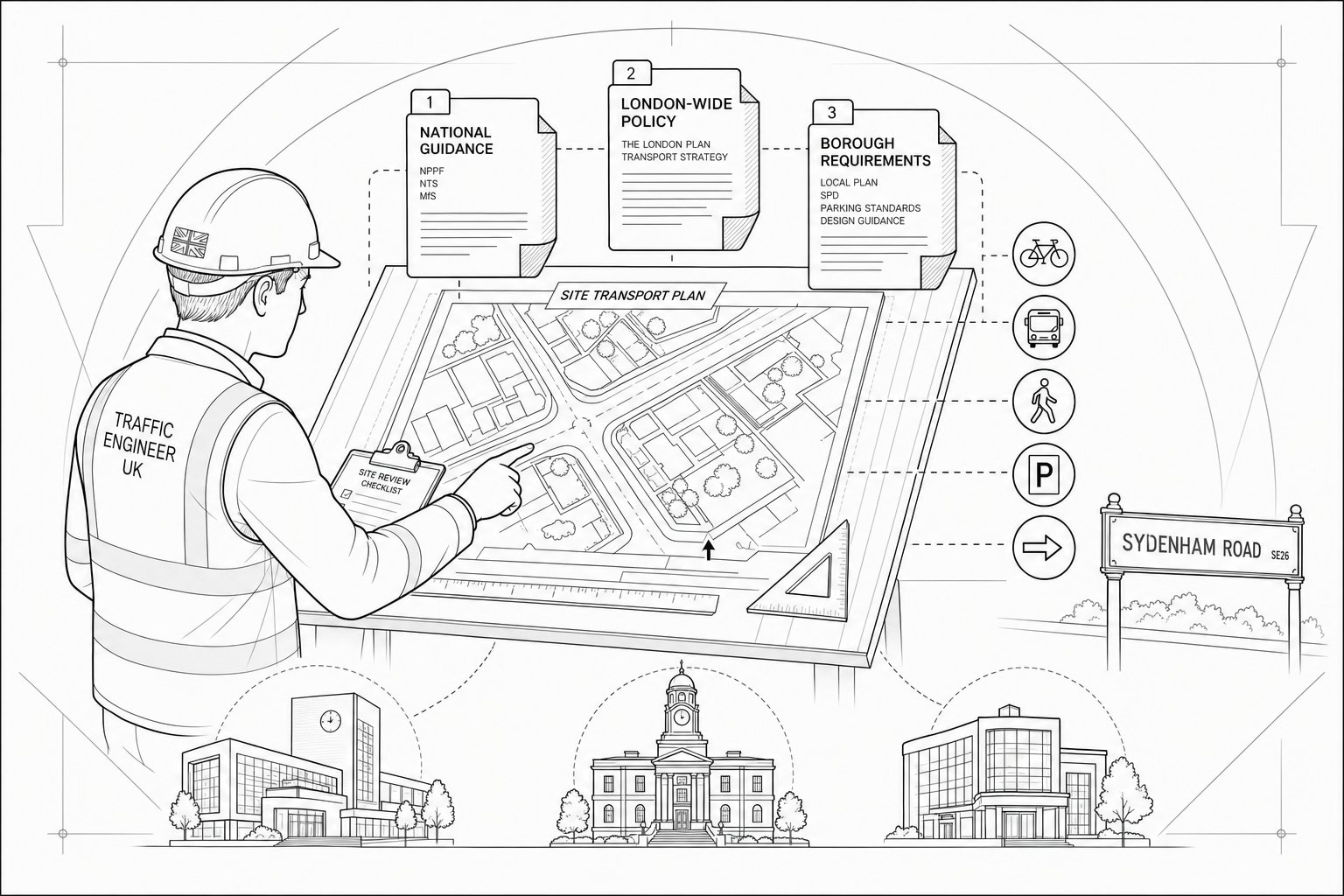
Transport planning in Sydenham sits within a layered policy framework. We usually need to align a proposal with national guidance, London-wide policy and the requirements of the relevant borough, which may be Lewisham, Southwark or Bromley depending on the site and transport interface.
At national level, the National Planning Policy Framework remains central, particularly the familiar tests around safe and suitable access and whether any residual cumulative impacts on the road network would be severe. Department for Transport guidance and relevant circulars may also inform approach and scope.
At London level, the London Plan, Mayor’s Transport Strategy and TfL guidance are often highly influential. Healthy Streets principles, mode shift expectations, cycle parking standards, accessibility and car parking restraint can all shape officer expectations from the outset. In practical terms, proposals that rely too heavily on private car assumptions often struggle.
At borough level, the Local Plan, development management policies, parking standards, cycle standards and street design guidance become more site-specific. Lewisham’s highway design expectations, Southwark’s streets and servicing considerations, or Bromley’s parking and access approach may each change the emphasis of the report.
Then there are the technical references: Manual for Streets, TSRGD, and where relevant, DMRB. We use these not as box-ticking citations but as the standards behind actual design decisions. Teams seeking a wider capital-wide perspective often benefit from the context set out in Traffic Engineer In London:, especially where borough and TfL interests overlap.
Supporting Different Project Types, From Small Schemes To Larger Developments
The transport issues attached to a project in Sydenham vary enormously by use type and scale. A sensible report for a householder-style scheme is nothing like the package needed for a denser station-adjacent redevelopment.
For small residential schemes, HMOs, infill plots and conversions, the recurring questions are usually access, parking, refuse collection, cycle parking and whether the proposal would intensify pressure on an already constrained street. These cases are often won or lost on detail rather than volume.
For flatted or mixed-use developments near stations, the transport conversation broadens. Officers may look more closely at sustainable mode share, car-free or car-lite justification, blue badge provision, servicing strategy, cycle storage quality, public transport accessibility and cumulative effects around busy corridors.
School expansions and community uses bring highly time-specific trip patterns. Peak spreading, safeguarding walking routes, gate management and interaction with school-street controls can become central. A technically small increase in trips can still be a practical issue if all movement lands within a tight fifteen-minute window.
Retail, food-and-beverage and light-industrial uses often raise servicing and operational transport issues first. Delivery frequency, vehicle sizes, kerbside loading, waste collection, routing and evening activity all matter. In that space, Commercial Traffic Engineering principles are often more relevant than purely residential benchmarks.
Across all of these, the aim is the same: tailor the evidence to the actual planning risks of the scheme, not to a generic template.
Common Reports Prepared By A Traffic Engineer In Sydenham
A Traffic Engineer in Sydenham may prepare one report or a coordinated package, depending on the proposal and the authority’s likely concerns. The strongest submissions are usually proportionate: enough technical detail to answer real issues, but not a padded bundle that obscures the key points.
Transport Statements, Transport Assessments, And Travel Plans
Transport Statements are commonly used for smaller schemes. They set out baseline transport conditions, access arrangements, parking and cycle provision, servicing assumptions, trip generation and an overall view of likely impact. The best TS documents are concise, but they still need to be evidence-led.
Transport Assessments go further. They may include multi-modal accessibility review, person trip generation, distribution and assignment, junction modelling, collision analysis, mitigation testing and a more developed policy appraisal. For larger or more sensitive applications, that depth is not optional.
Travel Plans sit alongside either document where sustainable travel measures need to be formalised. A good Travel Plan is practical rather than aspirational. It identifies realistic measures, clear responsibilities, mode share targets where appropriate, and monitoring arrangements the authority can actually work with.
The discipline behind these reports overlaps with broader Traffic Engineer In planning support work in other urban contexts, but Sydenham often demands especially careful local framing around rail accessibility, constrained streets and parking sensitivity.
Delivery And Servicing Reviews, Swept Path Analysis, And Parking Assessments
Delivery and servicing reviews examine the day-to-day operation of a site. What vehicle types are expected? When do they arrive? Where do they wait, load or reverse? How are waste collections handled? If a site depends on informal kerbside assumptions, officers will usually spot it.
Swept path analysis tests whether vehicles can safely enter, manoeuvre and leave the site. Using software such as AutoTrack or AutoTURN, we check cars, refuse vehicles, emergency access and service vehicles against actual geometry. On tight urban plots, this can trigger design amendments surprisingly early.
Parking assessments look at supply, likely demand, policy compliance and overspill risk. Depending on the project, they may include parking stress surveys, car ownership benchmarking, disabled parking review, cycle parking quality checks and management measures. In Sydenham, parking evidence often needs to engage honestly with existing pressure on surrounding streets rather than hand-wave it away.
How Early Transport Advice Can Reduce Delays And Planning Objections
Early transport advice is rarely the glamorous part of project inception, but it is often where time is either saved or quietly lost. Once architectural drawings are fixed and a planning statement is drafted, transport flaws become much more expensive to correct.
When we are brought in at feasibility or pre-application stage, we can identify likely pinch points before they harden into formal objections. That might be an access width that won’t work for refuse vehicles, a parking ratio that is out of step with local policy, or a servicing arrangement that clashes with a bus lane or school-street timing. None of those are impossible problems. They are just far easier to solve before the design team is emotionally and financially invested in the wrong layout.
Early input also improves conversations with highway officers and, where relevant, TfL. A focused pre-app submission that already addresses transport risk tends to get more useful feedback than one that asks broad questions without evidence. On larger schemes, this can feed into Planning Performance Agreements and more efficient issue resolution.
And there’s a softer benefit: credibility. When a proposal arrives with a transport strategy that feels thought-through, objections often narrow to specific points rather than broad resistance. That is one reason we favour planning-led advice over reactive report writing, an approach reflected in Traffic Engineer In Leeds: style early-stage support on comparable projects.
What To Prepare Before Instructing A Traffic Engineer
A strong instruction usually begins with good information. We can often move quickly, but speed is much easier when the basics are clear from day one.
The essentials normally include a site location plan, any topographical survey, and the latest architectural drawings showing layout, floor areas, access points and land use mix. A schedule of accommodation helps, particularly on residential schemes where unit mix affects trip generation and parking assumptions. If the development is phased, even a provisional build-out timeline is useful.
Existing-use information matters too. If there is a lawful use on site, its current trip pattern, parking arrangement and servicing activity may provide an important baseline. Likewise, previous planning decisions, refusal reasons, appeal findings and pre-application responses can save a lot of duplicated effort. Sometimes the key to a successful transport strategy is hidden in a single paragraph from an earlier highways response.
We also advise clients to share anything that reveals operational reality rather than just design intent: known delivery constraints, waste collection arrangements, local parking complaints, neighbour concerns, or photographs from peak periods. Those practical clues often shape the scope of work better than the red-line boundary does.
For a practice such as Traffic Engineer in Sydenham support under the wider ML Traffic approach, concise and accurate upfront information usually means quicker scoping, fewer revisions and reports that are better targeted to the authority’s likely concerns.
Conclusion
In Sydenham, transport is rarely a side issue. It is often one of the clearest tests of whether a scheme is genuinely workable in planning terms. A well-judged traffic engineer’s role is to show that a proposal can operate safely, fit policy expectations and avoid severe impact on the local highway and public transport network.
That means combining technical analysis with local judgement: understanding constrained streets, station catchments, bus movement, parking pressure, servicing realities and borough-specific policy requirements. It also means knowing when a concise statement is enough, when a fuller assessment is needed, and when design changes should come before report drafting.
For architects, planners, lawyers, surveyors, developers and councils, the practical takeaway is simple. Early, planning-focused transport input usually produces better schemes and stronger applications. And in a place like Sydenham, that can make the difference between a report that merely accompanies an application and one that genuinely helps secure permission.
Frequently Asked Questions About Traffic Engineering in Sydenham
What role does a traffic engineer play in planning applications in Sydenham?
A traffic engineer in Sydenham provides technical evidence to show that a development proposal can be accessed safely, fits local and London-wide policies, and avoids significant impact on nearby transport networks, helping to streamline planning approvals.
How do local transport constraints in Sydenham affect development planning?
Transport constraints such as narrow Victorian streets, bus corridor sensitivity, station activity, and controlled parking zones shape planning decisions by requiring developments to address access safety, parking pressure, servicing, and sustainable travel to mitigate local impacts.
When is a Transport Assessment required instead of a Transport Statement in Sydenham?
A Transport Assessment (TA) is necessary for larger or more complex developments affecting sensitive junctions, strategic roads or public transport capacity, whereas smaller schemes with modest trip generation typically require only a Transport Statement (TS).
How is trip generation estimated for developments in Sydenham?
Trip generation is estimated using TRICS or similar databases and adjusted for local factors such as public transport accessibility (PTAL), car ownership levels, and likely mode share to reflect Sydenham’s specific travel patterns and sustainable transport policies.
What common reports does a traffic engineer prepare for planning applications in Sydenham?
Common reports include Transport Statements for smaller projects, Transport Assessments for major schemes, Travel Plans to promote sustainable travel, Delivery and Servicing Plans, Car Park Management Plans, and detailed analyses like swept path and parking assessments.
How can early engagement with a traffic engineer benefit a development project in Sydenham?
Early transport advice helps identify access, parking, and servicing risks before design finalisation, enabling cost-effective changes, smoother negotiations with highway authorities and TfL, reducing objections, and increasing the chance of faster planning approval.