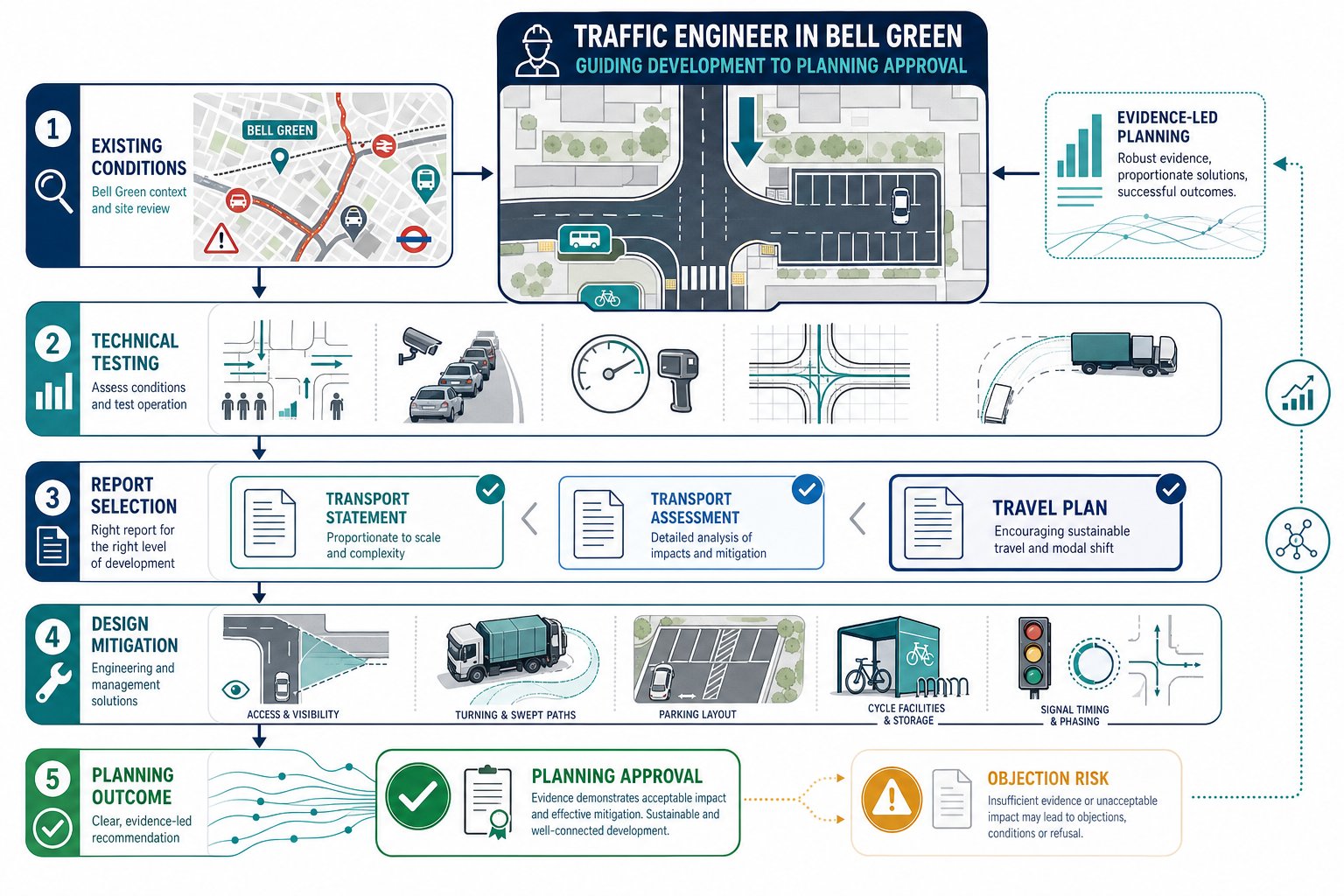
Planning risk in Bell Green rarely comes from one dramatic issue. More often, it builds quietly: an access that looks acceptable on a sketch but fails a visibility check, parking that appears generous until servicing is tested, or a junction impact that seems modest until the highway authority asks for peak-hour modelling and committed development data. That is where a traffic engineer in Bell Green becomes central to the planning case.
For architects, planners, developers and local authorities, transport input is not just a supporting document added near submission. It shapes whether a site can function safely, whether a proposal aligns with policy, and whether objections can be answered with evidence rather than assumption. In practice, the transport strategy often influences layout, unit mix, servicing arrangements, trip forecasts and mitigation design long before the application pack is finalised.
In Bell Green, local context matters. Existing traffic conditions, nearby junction performance, bus accessibility, walking links, cycling routes, on-street parking pressure and road safety history all affect what the planning authority will expect. A proportionate scheme may only need a concise Transport Statement. A more demanding site may require a detailed Transport Assessment, Travel Plan, swept path analysis, junction modelling and highway negotiations.
In this guide, we explain what a traffic engineer does in Bell Green, which applications usually need transport input, how reports are prepared, and when to bring us in so the planning strategy works from the start rather than being repaired later.
Key Takeaways
- A traffic engineer in Bell Green plays a critical role in ensuring development proposals are safe, efficient, and aligned with local planning policy by analysing access, parking, and junction impacts.
- Local transport strategies in Bell Green must consider existing traffic conditions, public transport accessibility, walking and cycling links, and local authority expectations to secure planning approval.
- Planning applications with complex access, parking, or traffic impacts commonly require tailored transport input such as Transport Statements, Assessments, or Travel Plans.
- Early involvement of a traffic engineer in Bell Green projects can prevent costly redesigns, support informed layout decisions, and streamline planning submissions.
- Practical solutions to local transport issues include junction capacity modelling, visibility improvements, parking design optimisation, and servicing arrangements tailored to Bell Green’s context.
- Integrated collaboration between traffic engineers, architects, planners, and developers enhances design quality and increases the likelihood of smooth approvals in Bell Green developments.
What A Traffic Engineer Does In Bell Green
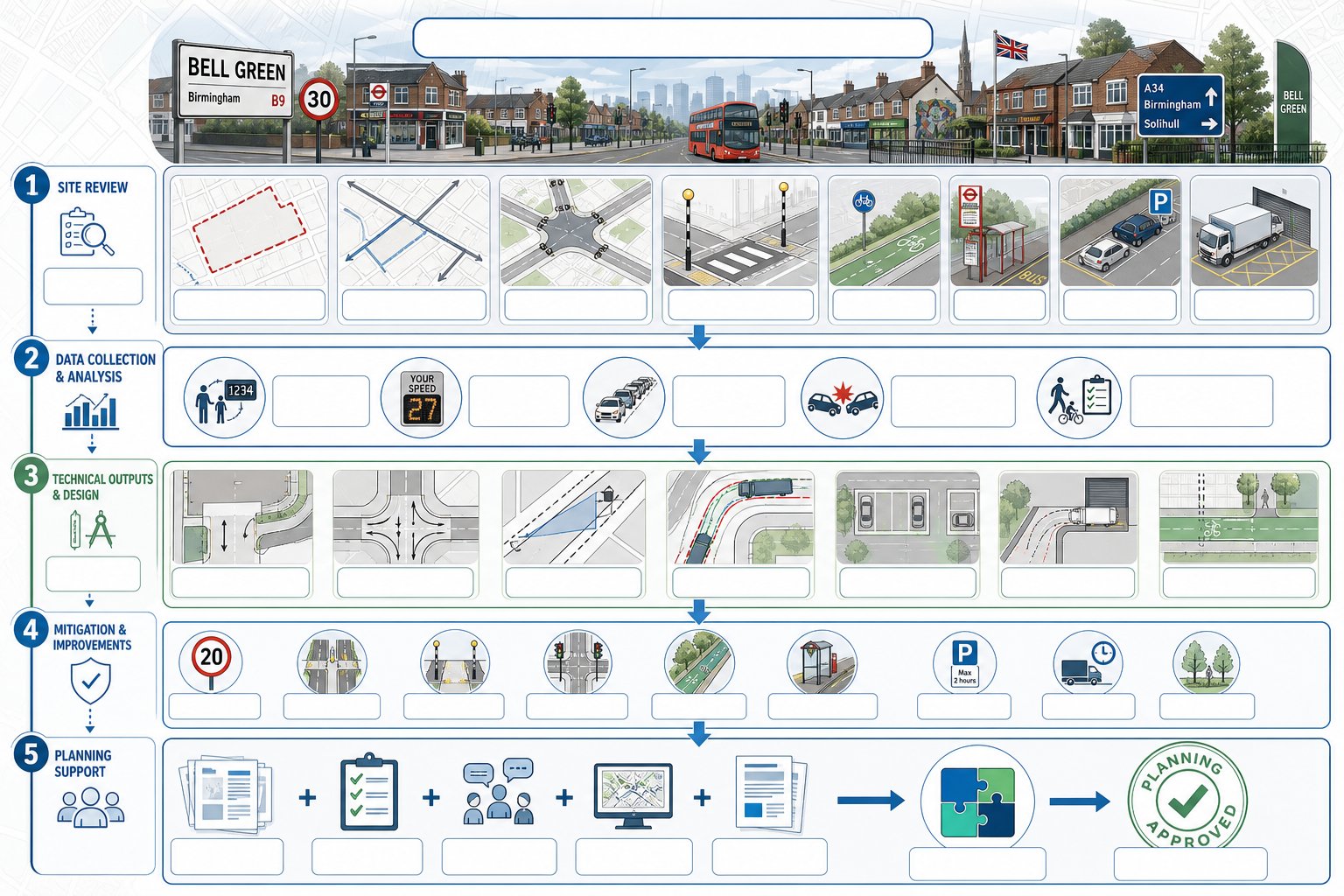
A traffic engineer in Bell Green assesses how a proposed development interacts with the surrounding transport network and whether it can be accommodated safely, efficiently and in line with planning policy. That sounds simple on paper. In reality, it involves a mix of technical analysis, local judgement and coordination with the wider consultant team.
Our role usually starts with the basics: understanding the land use, scale, access strategy and likely trip generation. We review the site in context, looking at the adjacent highway, nearby junctions, pedestrian crossing points, cycle links, bus stops, parking conditions and servicing constraints. From there, we decide what level of reporting is proportionate and what surveys or modelling will be needed.
On many schemes, we collect and interpret traffic counts, queue observations, speed data, collision records and active travel conditions. We then translate that evidence into planning documents, access drawings, junction assessments and mitigation proposals. In broader terms, that is the same discipline described in Traffic Engineering: Your Complete, but Bell Green projects need local calibration rather than a generic template.
We also advise on practical design issues: whether visibility splays can be achieved, whether refuse vehicles can turn within the site, whether parking is likely to operate effectively, and whether deliveries will conflict with pedestrian movement. If concerns arise from the highway authority, we help answer them with evidence and revised proposals rather than broad reassurance. That is often the difference between a transport report that merely exists and one that genuinely supports planning success.
Why Bell Green Sites Need A Local Transport Strategy
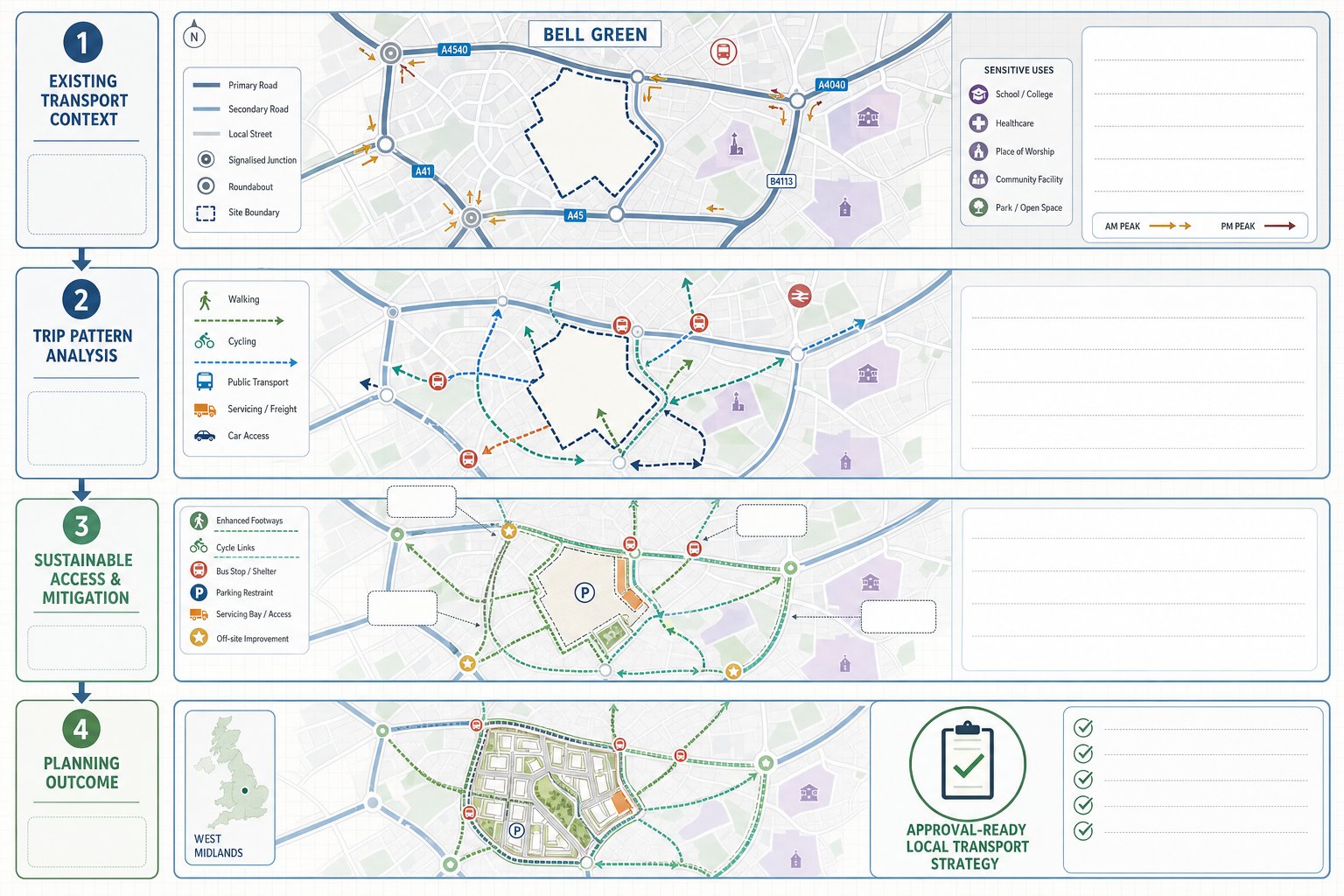
A local transport strategy does more than satisfy a validation checklist. It explains how a Bell Green development will connect to the surrounding network, how people are expected to travel to and from the site, and what measures will be used to manage impact. Without that narrative, even a well-designed scheme can appear under-tested.
National policy pushes developments toward sustainable travel, safe access and proportionate mitigation. Local decision-making then adds another layer: authority expectations on parking restraint, active travel links, bus accessibility, servicing practice and cumulative traffic impact. Bell Green sites are rarely judged in isolation. Officers will look at surrounding road conditions, nearby sensitive uses, existing peak-hour pressure and whether the proposal strengthens or weakens local movement patterns.
A proper local strategy hence ties together several strands. It sets out the existing transport context. It explains likely trip patterns. It demonstrates that walking, cycling and public transport are realistic choices where appropriate. And it identifies any off-site works, management measures or contributions needed to make the scheme acceptable.
That local framing is why broad transport advice is useful, but place-specific advice matters more. Our approach often combines the wider principles found in Traffic Engineering and Transportation with detailed understanding of Bell Green constraints, policy thresholds and authority preferences. In planning terms, a transport strategy is the bridge between a site layout and an approval-worthy application.
Planning Applications That Commonly Require Traffic Input
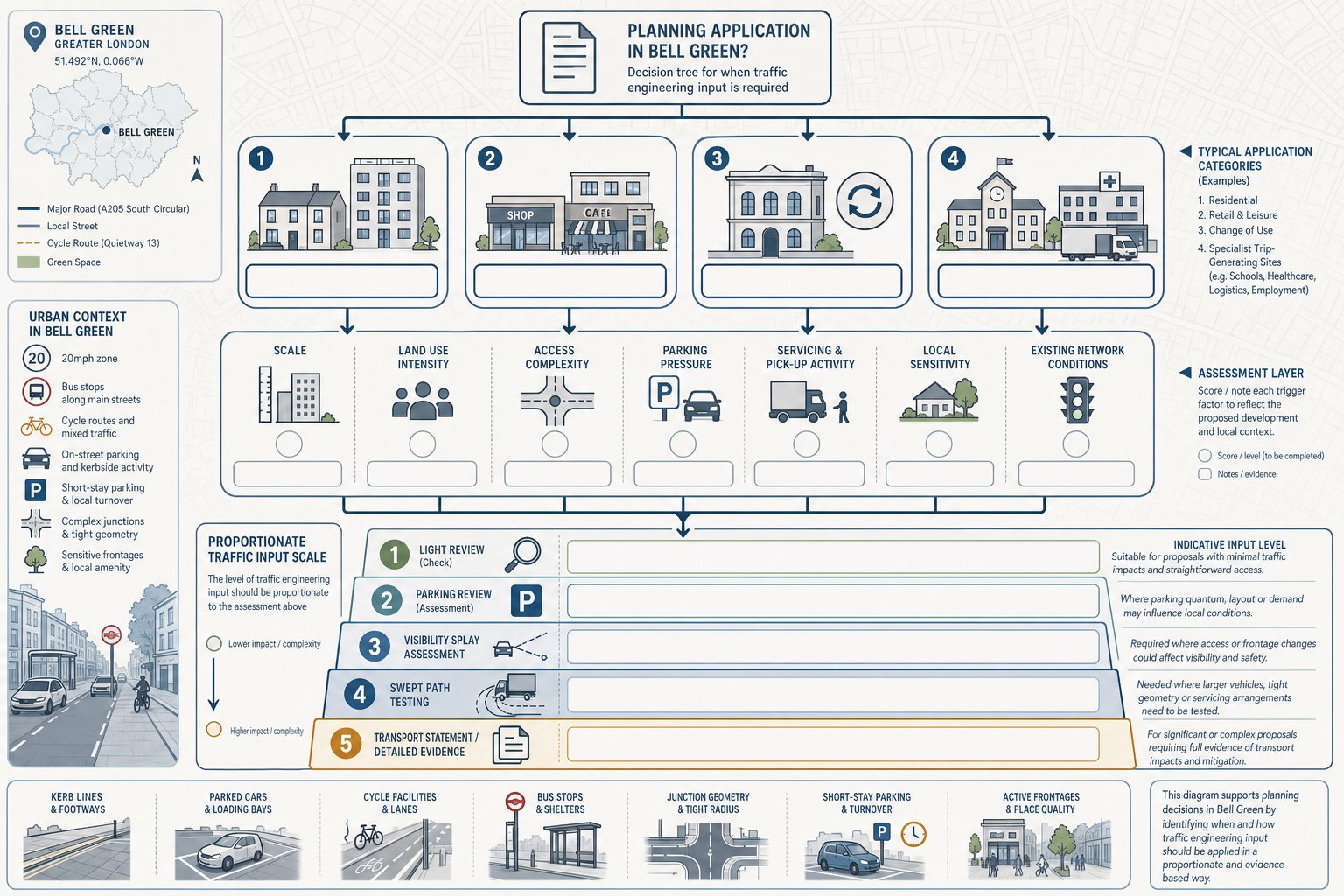
Not every planning application in Bell Green needs a full transport evidence package, but many need at least some level of traffic input. The trigger is not only scale. Use type, access complexity, local sensitivity and existing network conditions matter just as much.
Residential development is a common example. A single dwelling on a straightforward frontage may only raise access and parking questions. But multi-unit housing, flats, student accommodation, care uses or redevelopment of constrained urban plots can quickly require a Transport Statement, swept path testing, visibility checks and detailed parking justification.
Retail, food, leisure and mixed-use schemes often attract close scrutiny because traffic demand can be concentrated at specific times and short-stay parking turnover can affect neighbouring streets. Drive-throughs, last-mile logistics, schools, nurseries, healthcare uses and employment sites also tend to generate transport questions early, especially where servicing or pick-up activity could spill onto the highway.
Change-of-use applications are another area where applicants sometimes underestimate the need for traffic input. A site may already be in active use, but if the new use changes trip rates, delivery patterns, staff numbers, opening hours or parking demand, the transport position may need to be reassessed.
For many clients, the practical question is less “is transport relevant?” and more “how much analysis is proportionate?” That is where early review helps. Our experience aligns with the broader planning role set out in Highway And Traffic Engineering: establishing the right evidence level before the application becomes overdesigned, under-supported, or both.
Transport Statements, Transport Assessments, And Travel Plans Explained
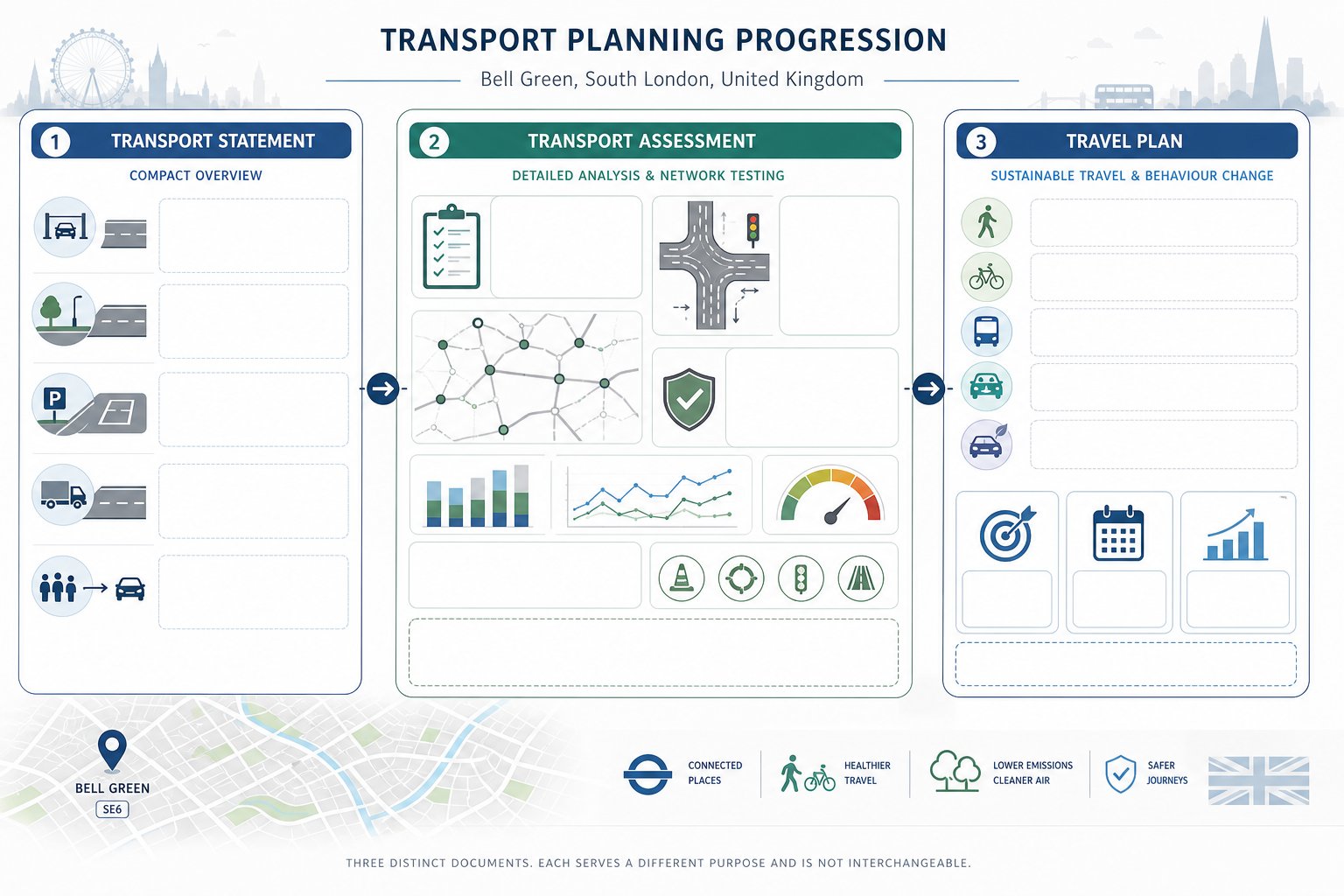
These three documents are related, but they are not interchangeable.
A Transport Statement (TS) is generally used for smaller or lower-impact developments. It provides a concise review of site access, local transport conditions, likely trip generation, parking, servicing and any straightforward mitigation. The emphasis is proportionate analysis. A good TS is brief, but not thin.
A Transport Assessment (TA) is more detailed and is normally required where impacts may be material. It typically includes baseline surveys, future-year traffic growth, junction assessments, sustainable travel review, road safety context, committed development analysis and a mitigation package. A TA is expected to demonstrate not just what traffic a site generates, but whether the surrounding network can absorb it and on what terms.
A Travel Plan (TP) sits alongside either document when mode choice is an important issue. It sets out how the development will encourage walking, cycling, public transport use, car sharing and sometimes low-emission travel. It includes measures, targets, responsibilities and monitoring. In Bell Green, a Travel Plan can be particularly important where parking is constrained or where the planning authority expects stronger sustainability credentials.
The challenge is choosing the right document at the right stage. Too little detail invites objections. Too much, too early, can waste time and budget. We usually advise clients on this at the outset, often drawing on the more general framework explained in Traffic Engineering Consultants: What and then adapting it to local thresholds, the site context and the likely planning route.
How Parking, Access, And Servicing Are Assessed
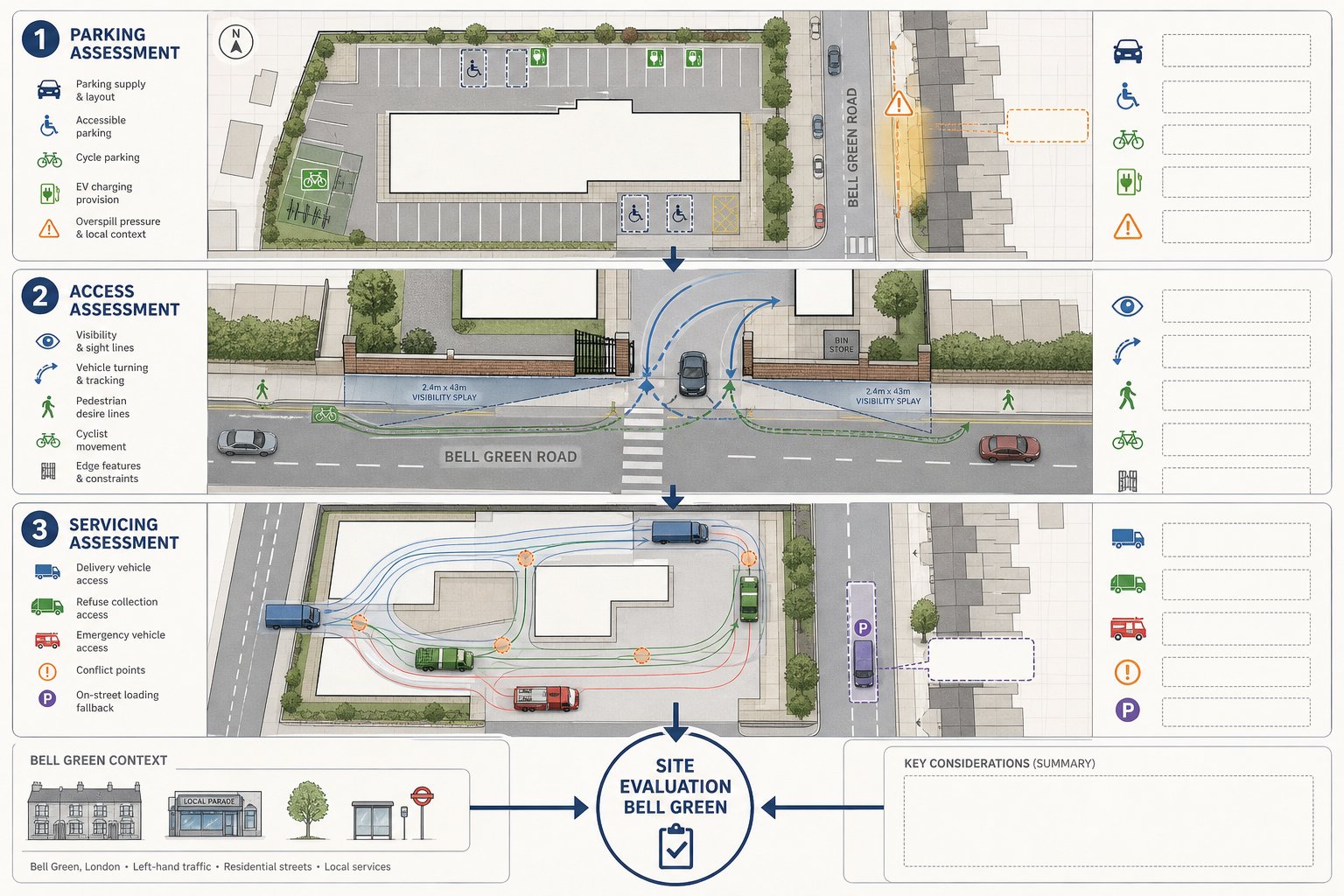
Parking, access and servicing can make or break a Bell Green planning application because they turn policy into something physical. A site either works operationally, or it does not.
Parking assessment starts with local standards, but it should not end there. We review the proposed quantum, layout efficiency, disabled provision, cycle parking, electric vehicle charging expectations and likely overspill risk. In some locations, demand will be influenced by PTAL-style accessibility thinking, nearby controlled parking restrictions, existing kerbside pressure and the actual character of the end users. A scheme with technically policy-compliant parking can still face objection if the design is awkward or likely to displace vehicles onto already stressed streets.
Access assessment looks at visibility, geometry, gradients, pedestrian crossing desire lines and interaction with cyclists. We check whether vehicles can enter and leave safely, whether turning movements are realistic, and whether the access sits comfortably within the street hierarchy. Small drafting decisions matter here. A gate position, a wall height or a bin store can change the safety picture.
Servicing is often where late-stage problems emerge. Deliveries, refuse collection and emergency access all need to be tested. Swept path analysis is used to confirm that the right vehicles can manoeuvre within the site without unsafe reversing or conflict. If servicing cannot be resolved internally, we assess whether on-street activity is feasible and lawful. Planning officers and highway engineers tend to focus sharply on this point, for good reason: badly resolved servicing can undermine an otherwise sound scheme.
Junction Capacity And Highway Impact Analysis
Where a Bell Green development is expected to generate noticeable vehicle movements, junction capacity analysis becomes a core part of the planning evidence. The aim is not to prove that a development adds zero traffic, that is rarely realistic, but to show whether the local highway network can continue to operate within acceptable limits, and what mitigation is needed if it cannot.
The process usually begins with traffic surveys at relevant junctions and site frontages. We establish baseline conditions, identify the true peak periods and review queueing, delay and turning patterns. From there, we forecast development traffic, apply background growth, include committed developments where appropriate and test future scenarios.
Recognised modelling tools are then used to assess capacity and performance. Depending on the junction type, that may involve priority junction software, signal modelling or wider network review. We look at practical indicators such as ratio of flow to capacity, queue lengths, reserve capacity and delay. But numbers alone are not enough. A model needs to reflect how the junction actually behaves on site.
Mitigation might include signal timing changes, lane reallocation, local widening, ghost islands, staging adjustments or changes to site access arrangements. Sometimes the answer is not a major engineering intervention at all: it may be a revised land use mix or altered servicing times.
Our work in Bell Green often benefits from lessons seen in comparable urban contexts, including schemes requiring the sort of local authority liaison discussed in Traffic Engineer In London:. The principle is the same: robust forecasting, credible modelling and mitigation that is buildable, not theoretical.
Key Local Factors That Can Influence Bell Green Developments
Bell Green is not assessed as an abstract transport exercise. Local factors shape what is acceptable, what is likely to be challenged, and what level of evidence the authority will expect.
One obvious factor is existing congestion. If nearby junctions already experience notable peak-hour delay, even modest development traffic can attract attention. Equally, a site on a route with relatively free flow may still be problematic if access is awkward or if turning traffic interrupts a bus corridor or pedestrian movement.
Road safety history matters as well. Collision data does not automatically prevent development, but it can shift the burden of proof. A new access near a location with recorded turning collisions, speed-related incidents or pedestrian injury patterns will need careful design and a convincing safety rationale.
Public transport accessibility is another local influence. Where bus links are strong and walk connections are direct, lower parking provision and stronger Travel Plan commitments may be acceptable. Where connectivity is poorer, the authority may expect a different parking balance or more evidence on likely mode share.
Then there is on-street reality: informal parking habits, school-run pressure, loading activity, constrained footways and nearby committed developments. These are often more influential in committee discussions than applicants expect. They are also why generic reports struggle. A Bell Green transport case needs to acknowledge what local people, ward members and officers already know from lived experience.
That local lens is one reason our reports are built around place-specific observations rather than standard text. It sounds obvious. Yet a surprising number of planning delays begin with documents that could have been written for almost anywhere.
Working With Architects, Planning Consultants, And Developers
Transport input works best when it is integrated early with architecture, planning and development strategy. If we are brought in only to justify a fixed layout, options narrow quickly. If we are involved while the scheme is still flexible, transport evidence can improve the design rather than merely defend it.
With architects, we usually focus on access geometry, internal circulation, parking layout, cycle provision, refuse collection, delivery routes and how the frontage meets the street. A few metres moved in the right direction can avoid a major planning issue later.
With planning consultants, the collaboration is more strategic. We align the transport narrative with policy, local authority expectations, consultation strategy and the likely level of committee scrutiny. If the planning case is built around sustainable travel, town centre accessibility or low-car living, the transport evidence has to support that line credibly.
Developers and landowners often need commercial clarity: what level of report is needed, what surveys will cost, whether mitigation is likely, and how transport risk might affect programme. Straight answers matter here. Delayed advice is expensive advice.
Because we work within planning teams rather than beside them, our reports are designed to slot into wider submissions efficiently. That practical coordination is a recurring theme across our Traffic Engineer In Birmingham: and regional project work too. Different authorities have different nuances, but the same lesson keeps coming up: the strongest planning applications are usually the ones where transport, design and planning strategy were developed together, not in sequence.
The Typical Process From Site Review To Planning Submission
Most Bell Green projects follow a recognisable transport planning process, even though the level of detail varies by site and use.
We begin with an initial review of the proposal, available drawings, planning context and likely transport risks. That first stage tells us whether the key issue is access, parking, junction impact, servicing, sustainable travel, or some combination of all five.
Next comes site review and baseline evidence gathering. We visit the location, identify nearby junctions and sensitive receptors, and determine what surveys are needed. Depending on the scheme, that could include traffic turning counts, queue surveys, speed data, parking beat surveys, pedestrian and cycle observations, or collision analysis.
Where appropriate, we advise on pre-application engagement with the highway authority. Not every project needs formal pre-app discussion, but for more sensitive sites it can be invaluable. It helps flush out authority expectations before the design is too far advanced.
We then carry out modelling, access testing, parking review and mitigation design. Draft findings feed back into the layout and planning strategy. Once the scheme is stable, we prepare the Transport Statement or Assessment, Travel Plan and any supporting appendices or drawings.
Finally, we support the submission by responding to authority comments and, if needed, revising the package. In our experience at ML Traffic, speed matters, but only if accuracy is intact. That balance of concise reporting and local authority-ready analysis is central to how we work.
Information Usually Needed To Prepare A Transport Report
The quality of a transport report depends heavily on the information available at the start. We usually ask for the red-line boundary, proposed use, floorspace or unit numbers, site layout, access proposals, parking schedule and any design constraints already identified.
We also need context data: traffic surveys if available, accident records, speed information, nearby junction details, background growth assumptions and any committed developments likely to influence the network. If the architect has tested multiple layouts, it is useful to understand those options early rather than after one has been treated as fixed.
Other helpful material includes planning history, delivery and servicing assumptions, refuse strategy, expected staff numbers, operational hours and any sustainability commitments that may inform mode share or Travel Plan measures. The more precise the inputs, the more proportionate and defensible the output tends to be.
Common Transport Planning Issues And How They Are Resolved
Most transport objections in Bell Green fall into a manageable number of categories. The good news is that they are often solvable, provided they are identified early enough.
Capacity concerns are common where a site adds turning traffic onto a stressed junction or corridor. The response may involve junction reconfiguration, optimisation of signal timings, restricting certain manoeuvres, phasing development, or revisiting the land use intensity. Sometimes a more realistic trip distribution exercise resolves an issue that initially looked severe.
Road safety concerns usually centre on visibility, turning movements, pedestrian conflict or speeding traffic. Solutions might include repositioning the access, improving splays, adjusting boundary treatment, introducing crossings, traffic calming or changing the internal layout so vehicles do not reverse into dangerous positions.
Parking objections can be especially emotive because they are felt locally and argued publicly. Here, design quality matters as much as quantity. We may revise bay numbers, improve turning space, strengthen cycle facilities, add parking management measures or support a lower parking provision with a better Travel Plan and stronger accessibility evidence.
Servicing problems are often solved through timed delivery windows, revised tracking geometry, loading management or a different refuse collection arrangement. And policy mismatch issues can usually be addressed by tightening the report logic so that the transport evidence aligns with the planning story.
This kind of problem-solving is exactly why specialist input matters. The wider discipline is covered in Traffic Engineer In Manchester:, but in Bell Green the winning formula is usually the same: identify the real issue, test the practical options, and present a solution the authority can actually support.
When To Instruct A Traffic Engineer For A Bell Green Project
The short answer is earlier than most project teams initially think.
If a Bell Green site has constrained access, limited frontage, nearby congestion, sensitive neighbouring uses, or a development quantum likely to generate more than a modest amount of traffic, transport advice should be sought before the layout is fixed. Waiting until the planning pack is nearly complete often leads to awkward redesign, delayed surveys, avoidable highway objections and, occasionally, a complete rethink of access strategy.
Early instruction gives us room to test options properly. We can advise whether one access point is preferable to another, whether parking expectations are realistic, whether servicing can work internally, and whether a Transport Statement is likely to be enough or a fuller Transport Assessment will be expected. That shapes programme, budget and consultant coordination.
It also helps with pre-acquisition and due diligence work. Developers and land promoters often need a quick but informed view on transport risk before committing to a scheme. A relatively modest piece of early advice can prevent a far more expensive problem later.
As a rule, we recommend appointing a traffic engineer as soon as the red line, broad land use and access ideas are being explored. Certainly do it before those ideas harden into a planning layout. In Bell Green, where local constraints can quickly turn into planning objections, early transport input is usually cheaper, faster and more persuasive than late-stage repair work.
Conclusion
A strong planning application in Bell Green depends on more than a compliant drawing set. It depends on proving that the development can be accessed safely, serviced practically, parked sensibly and integrated into the local transport network without unacceptable impact. That proof has to be proportionate, evidence-based and tailored to the site.
For that reason, involving a traffic engineer in Bell Green at the right stage is not an administrative extra. It is often one of the decisions that determines whether a proposal moves smoothly through planning or gets slowed by avoidable transport objections. From early access advice to full Transport Assessments, junction modelling and Travel Plans, the value lies in identifying issues before they become fixed in the scheme.
When transport strategy, site design and planning narrative are developed together, projects are simply stronger. And in a location where local highway context matters as much as policy wording, that joined-up approach gives applicants a far better chance of securing consent with fewer surprises along the way.
Frequently Asked Questions about Traffic Engineering in Bell Green
What does a traffic engineer do in Bell Green?
A traffic engineer in Bell Green assesses how a development impacts the local transport network, conducts traffic and safety analysis, advises on access and parking design, and supports planning applications with technical and local knowledge.
Why is a local transport strategy important for Bell Green developments?
A local transport strategy demonstrates how a development connects with local roads, public transport, and walking or cycling routes, ensuring sustainable travel and managing congestion and safety in line with planning policies.
Which Bell Green planning applications typically need traffic input?
Residential projects with multiple units, retail, leisure, schools, healthcare, logistics, and mixed-use developments commonly require traffic assessments to address access, parking, and network impact.
How are parking, access, and servicing evaluated for Bell Green planning proposals?
Assessments check if parking meets local standards and demand, access visibility and safety for all users, and whether servicing vehicles can operate safely without disrupting pedestrians or traffic flow.
When should I engage a traffic engineer for a Bell Green development?
It is best to involve a traffic engineer early, ideally when site layout or access options are being considered, to avoid costly redesign or objections during planning submission.
What is the difference between a Transport Statement, Transport Assessment, and Travel Plan?
A Transport Statement provides a brief review for small schemes, a Transport Assessment offers detailed traffic impact analysis for larger projects, and a Travel Plan outlines measures to encourage sustainable travel modes for the development.