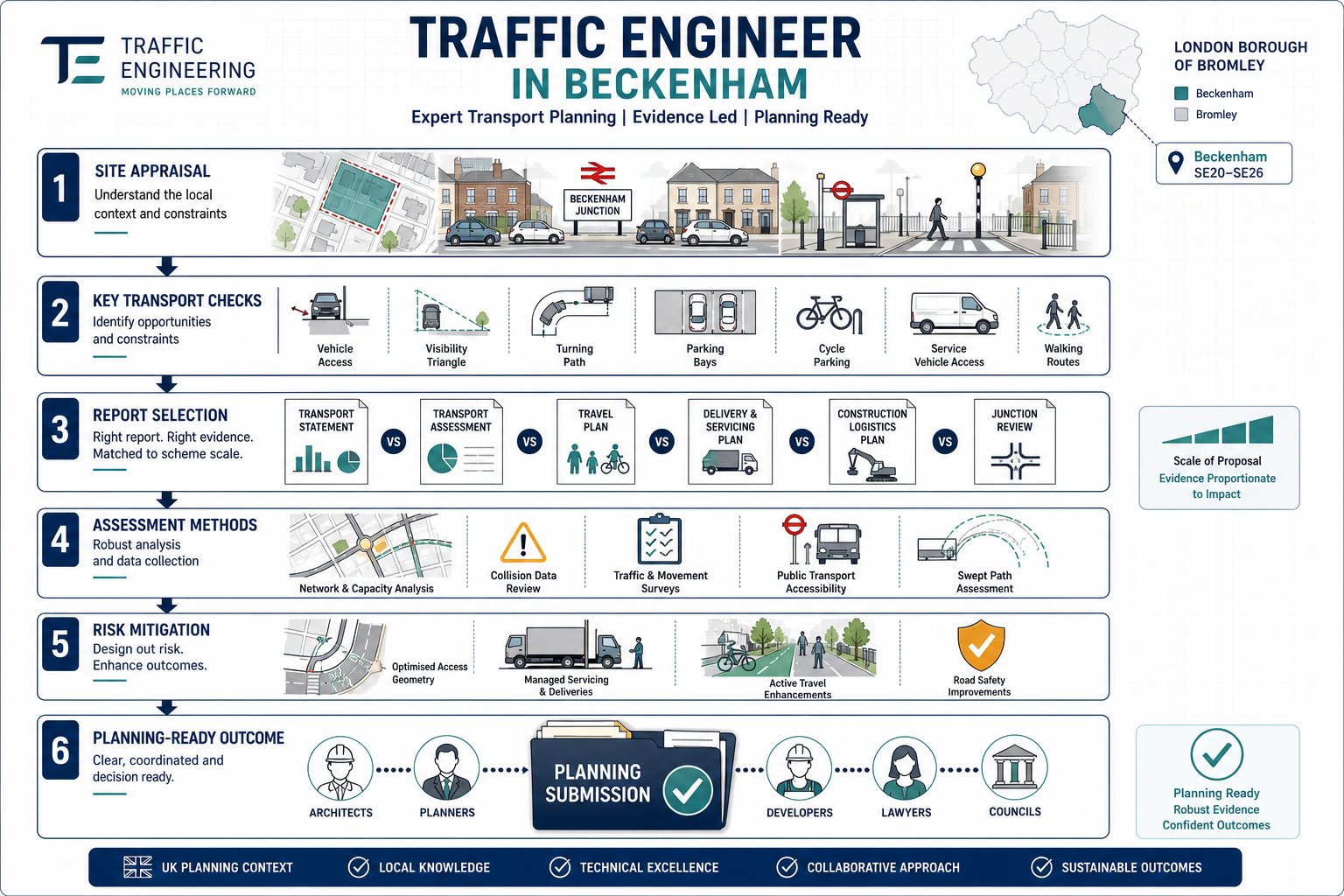
A planning application in Beckenham can look straightforward on paper and still run into transport problems surprisingly fast. A modest flatted scheme may trigger parking objections. A new access might raise visibility concerns. A town-centre proposal near Beckenham Junction can invite questions about servicing, pedestrian movement, cycle access, or cumulative impact on already busy streets. In practice, transport is often one of the issues that determines whether a scheme feels workable to a planning officer, highways team, local members, and sometimes Transport for London.
That’s why the role of a Traffic Engineer in Beckenham matters well beyond traffic counts and technical drawings. We use transport evidence to show that a proposal can operate safely, fit local policy, and respond to the real conditions on the ground in the London Borough of Bromley. That means looking at access, parking, servicing, road safety, public transport, walkability, and the way people actually move around the area.
For architects, planners, surveyors, developers, lawyers, and councils, the goal is rarely to produce paperwork for its own sake. The goal is to submit the right level of transport support at the right stage, avoid predictable objections, and keep the scheme moving. In this guide, we set out what transport engineering input usually involves in Beckenham, which reports are commonly needed, and how to make that input useful from the very start.
Key Takeaways
- A Traffic Engineer in Beckenham plays a crucial role in ensuring development proposals safely integrate with local transport conditions and comply with Bromley Council and London Plan policies.
- Early involvement of a traffic engineer during the planning process helps shape access, parking, servicing, and sustainable travel measures, reducing objections and costly redesigns later on.
- Transport engineering reports such as Transport Statements, Transport Assessments, and Delivery and Servicing Plans should be carefully tailored to the scale and transport sensitivities of the proposed development in Beckenham.
- Considering local factors like parking stress, pedestrian safety, and bus and tram services is essential for transport assessments to be credible and effective in Beckenham’s planning context.
- Engaging an experienced traffic engineer with local policy knowledge and practical judgement improves the likelihood of a smooth planning approval process for Beckenham developments.
- Accurate site assessments combining evidence and professional judgement address key issues like visibility, vehicle tracking, and trip generation, supporting viable and policy-compliant planning submissions.
Why Transport Engineering Matters For Development In Beckenham
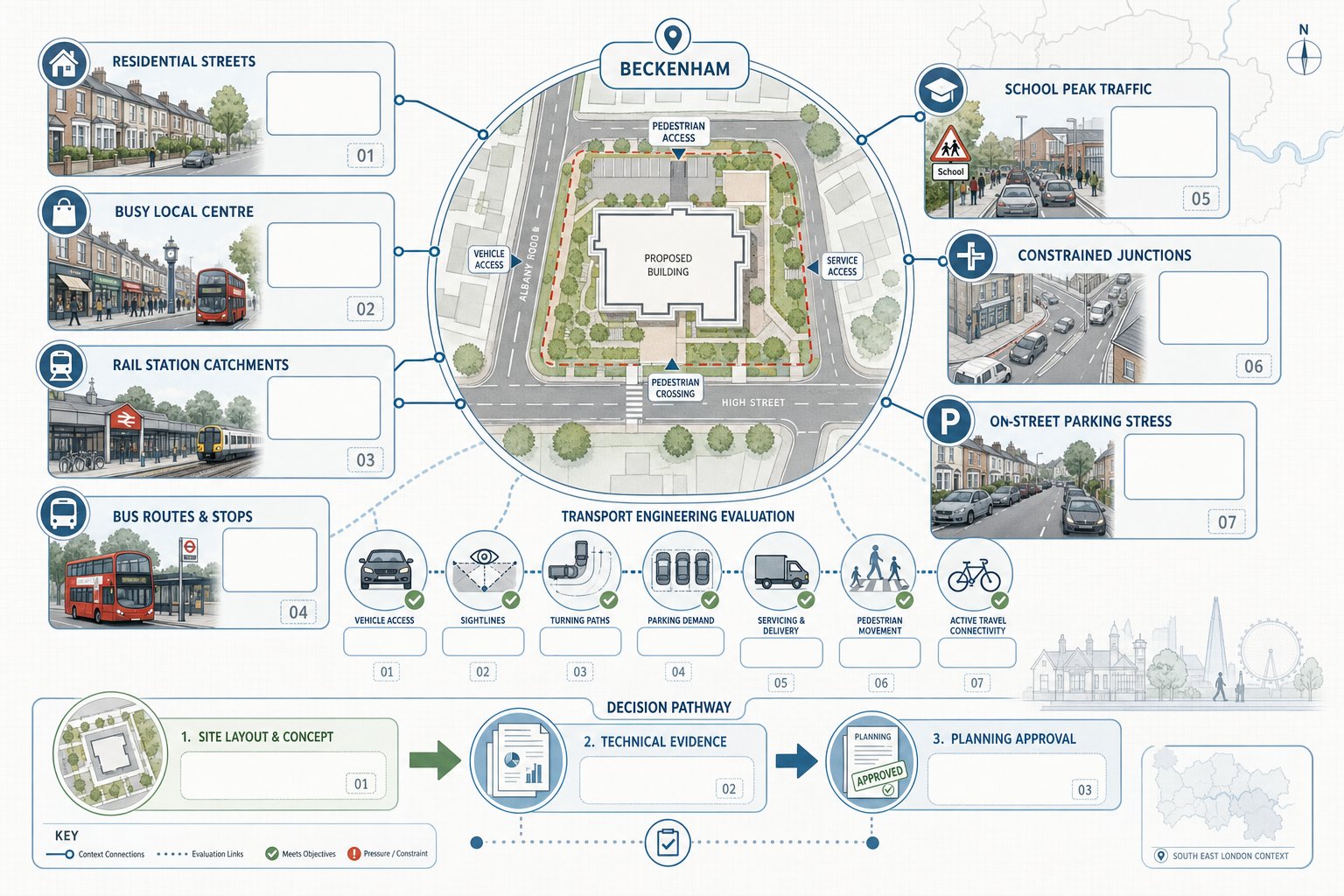
Beckenham sits in a part of south-east London where development pressures meet a fairly sensitive transport context. There are established residential streets, busy local centres, station catchments, bus routes, school traffic peaks, constrained junctions, and varying levels of on-street parking stress. So even schemes that are not large in scale can attract detailed scrutiny.
Transport engineering matters because Bromley Council and, in some cases, TfL are not just asking whether a development can physically fit on a site. They are asking whether it can function safely and acceptably within the wider network. That includes vehicle access, visibility, turning, parking demand, servicing activity, pedestrian conditions, and the impact on sustainable travel choices.
The policy backdrop is important. The London Plan places real emphasis on mode shift, active travel, and car-lite development in locations with good public transport accessibility. Bromley’s local planning approach adds another layer through parking standards, local network considerations, and highway safety expectations. A proposal that ignores those points can quickly look undercooked.
This is where properly targeted transport input helps. Our role is to translate a site layout into evidence: whether the access works, whether parking is realistic, whether trip generation is material, and what mitigation may be needed. In broader terms, Traffic Engineering and Transportation is often the bridge between a viable design concept and a planning submission that stands up to technical review.
Who Typically Needs A Traffic Engineer For A Planning Application
The short answer: more applicants than they first assume.
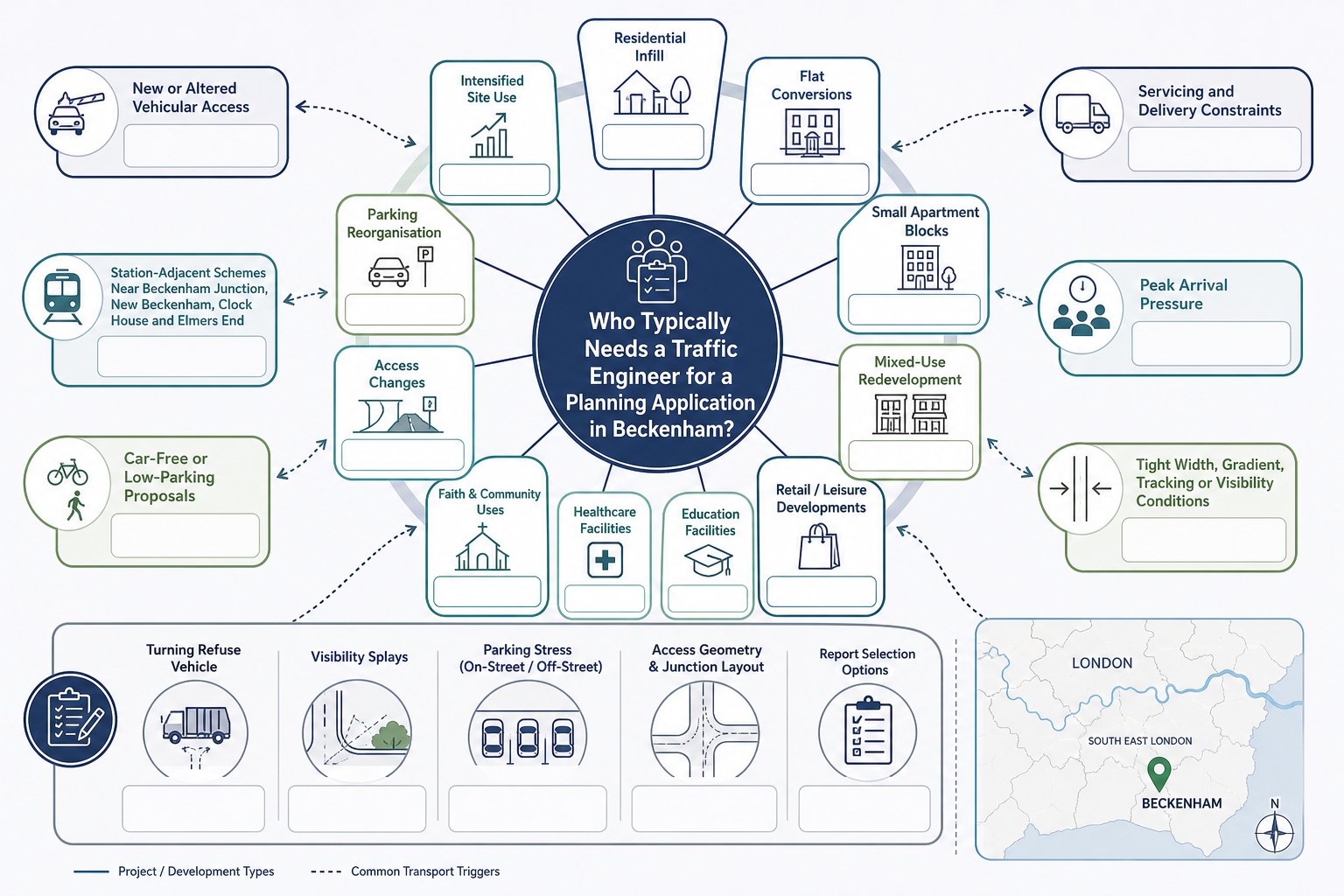
In Beckenham, we’re often instructed on proposals that are not huge by London standards but still have transport sensitivities. Residential infill schemes, conversions to flats, small apartment blocks, mixed-use redevelopments, retail units, education uses, clinics, and faith-related developments can all benefit from transport input. The same applies where a proposal changes the way a site is accessed, reorganises parking, or intensifies use enough to raise questions from highways officers.
A traffic engineer is particularly useful where the planning balance may turn on practical transport issues rather than on principle alone. For example, a site may be acceptable in land-use terms, but the scheme could stall because the refuse vehicle cannot turn, the visibility splays are substandard, or the parking strategy doesn’t reflect local stress. Those are often solvable issues if identified early.
We also support professional teams who simply want confidence before submission. Architects may need access geometry tested before fixing the layout. Planning consultants may want to know whether a Transport Statement is enough or whether a Transport Assessment is more realistic. Solicitors acting on appeals or due diligence matters may need a technical view on highway implications. That broader role is one reason clients often look for experienced Traffic Engineering Consultants: not just report writers.
Common Project Types That Require Transport Input
Common triggers in Beckenham include:
- new or altered vehicular access onto the public highway
- residential schemes near stations such as Beckenham Junction, New Beckenham, Clock House, or Elmers End
- car-free or low-parking proposals in locations where local objection on parking is predictable
- mixed-use schemes with delivery, servicing, or time-restricted frontage issues
- education, healthcare, and community uses with concentrated peak arrivals
- larger householder or backland schemes where width, gradients, tracking, or visibility are tight
In plain terms, if access, movement, parking, or traffic impact could become a talking point in determination, transport input is usually worth having before that talking point becomes an objection.
Key Transport Reports Used In Beckenham Planning Submissions
Not every scheme needs the same level of evidence. One of the most useful things we do is match the report to the scale and risk profile of the project. Over-reporting can waste time and fees: under-reporting can leave a submission exposed.
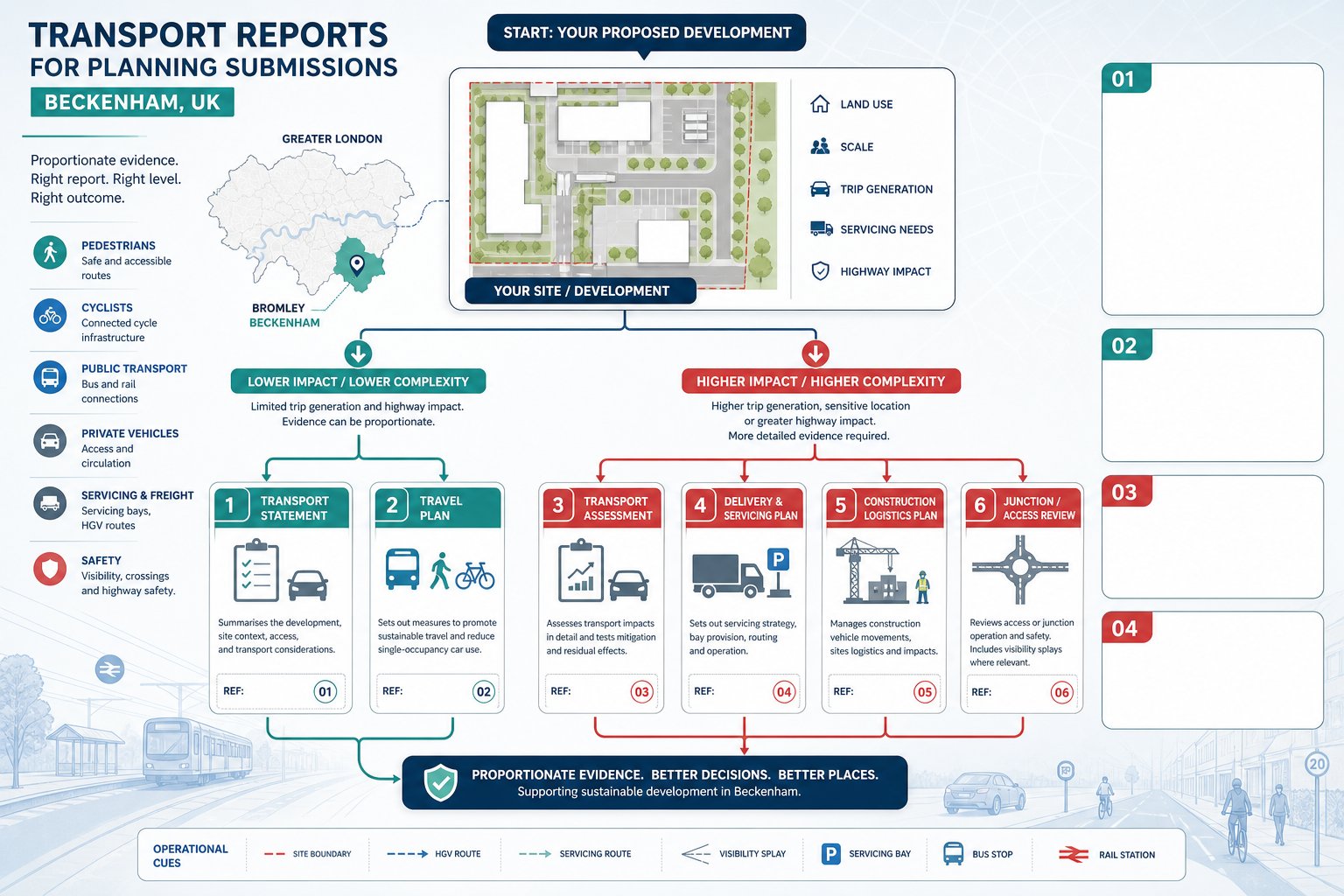
In Beckenham, the core reports usually fall into a familiar set: Transport Statements, Transport Assessments, Travel Plans, Delivery and Servicing Plans, Construction Logistics Plans, and access or junction reviews. The right combination depends on the size of the development, the type of use, local sensitivity, and whether Bromley or TfL are likely to focus on operational details.
A good transport report is not simply a template filled in with site data. It should explain why the level of analysis is proportionate, what assumptions have been used, and how the development responds to local policy and local network conditions. That’s especially important in London boroughs where officers expect both technical accuracy and policy awareness.
For larger or more complex schemes, related technical work may also extend into modelling, swept path analysis, parking surveys, road safety review, or mitigation design. The important thing is that the planning submission tells one coherent story rather than presenting disconnected appendices.
Transport Statements, Transport Assessments, And Travel Plans
A Transport Statement (TS) is typically used for smaller or lower-impact developments. It usually covers the site context, access arrangements, local transport conditions, parking provision, sustainable travel opportunities, trip generation in proportionate form, and any highway safety observations. A TS is concise by design, but it still needs to be specific to the site.
A Transport Assessment (TA) goes further. It is normally appropriate where a proposal has greater trip generation, more material junction implications, or a more sensitive policy context. A TA may include detailed forecast traffic, distribution and assignment, junction capacity analysis, cumulative effects, and mitigation proposals. In Beckenham, that can be relevant where a scheme sits close to constrained junctions or where peak-period impacts are likely to be tested.
A Travel Plan supports sustainable travel objectives by setting out measures, targets, and monitoring arrangements. For residential schemes this may focus on reducing car dependency through cycle parking, travel information, car club provision, and public transport accessibility. For employment or education uses, it may include staff travel surveys, incentives, coordinator arrangements, and review periods.
The distinction between TS and TA is not just about scale. It is about whether the authority needs reassurance or evidence at a more analytical level. That judgement benefits from local experience and from a realistic sense of what Bromley is likely to ask for.
Delivery And Servicing, Construction Logistics, And Junction Reviews
A Delivery and Servicing Plan (DSP) is often essential where servicing activity could affect nearby residents, bus movements, frontage operation, or highway safety. It explains what vehicles are expected, how often they arrive, where they stop, whether on-site turning is available, and whether routing or timing controls are needed.
A Construction Logistics Plan (CLP) deals with the temporary but very real impacts of the build phase. In Beckenham, this can matter a lot near schools, stations, narrower roads, or places with limited kerbside space. A well-prepared CLP addresses HGV routes, delivery timing, workforce travel, site hoarding interface, banksman arrangements, and vulnerable road user safety.
A junction or access review may be prepared as a standalone note or folded into a wider TS or TA. It usually looks at access width, geometry, visibility splays, gradient, tracking, collision patterns, interaction with pedestrians and cyclists, and whether any highway alterations are needed. For projects involving access design, we often draw on the same practical principles discussed in access design highway work: can vehicles enter and leave safely, and can that safety be demonstrated clearly enough for the planning file.
Local Planning And Highway Considerations In Beckenham
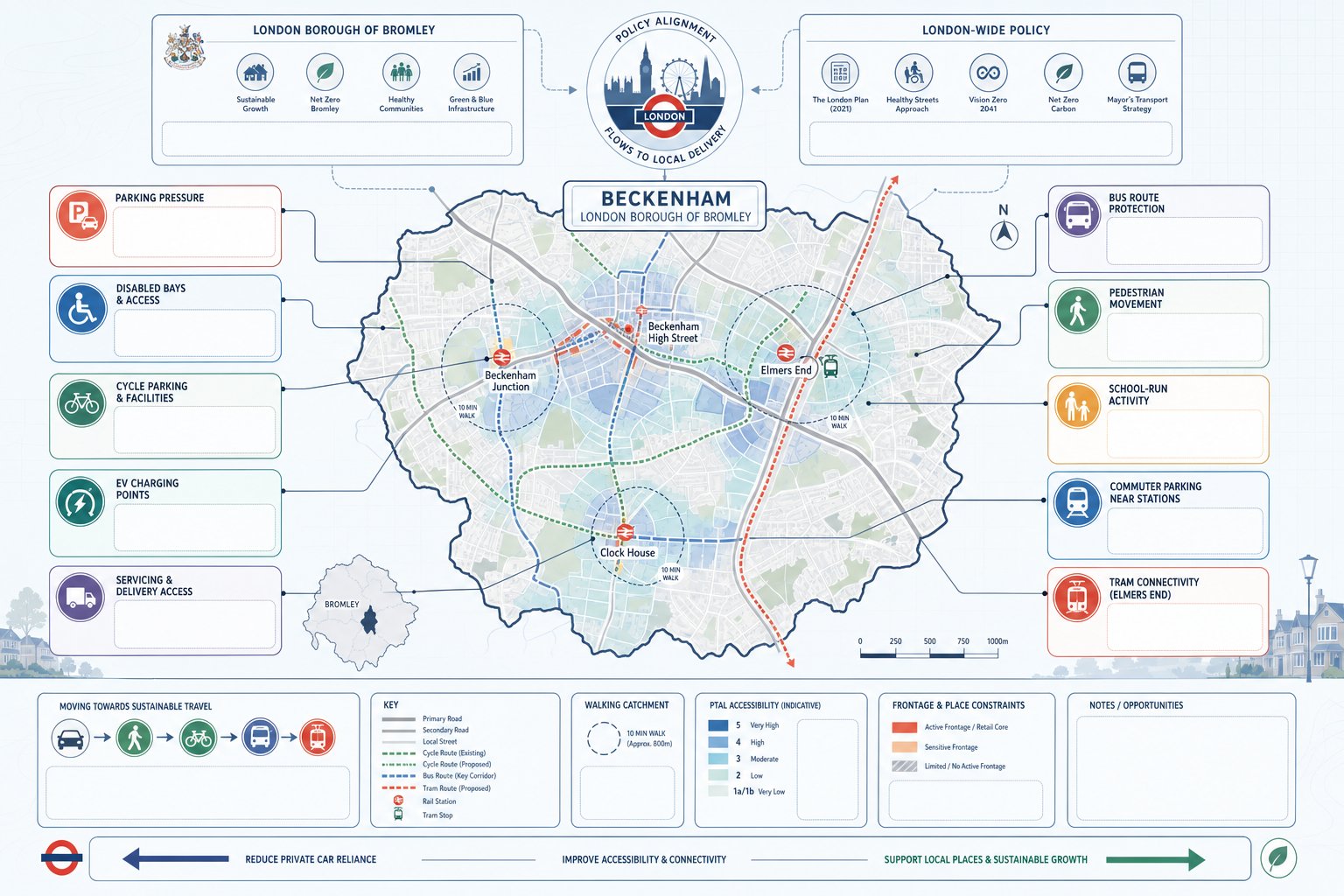
Local context is where many transport submissions either gain credibility or lose it.
Beckenham falls within the London Borough of Bromley, so transport evidence needs to respond to both borough-level expectations and London-wide policy. In practical terms, that means understanding parking standards, disabled parking needs, cycle provision, EV charging, servicing requirements, and the London Plan’s direction of travel toward sustainable modes and reduced reliance on private car use in accessible locations.
But policy wording is only half the story. The other half is how places in and around Beckenham actually operate. Streets near the town centre and station areas can experience pressure from commuter parking, deliveries, school-run activity, and pedestrian flows. Bus route protection may be important. Around Elmers End, tram connectivity becomes a relevant transport advantage but also part of the local movement picture. On some residential roads, seemingly small changes in access or parking can attract strong neighbour concern.
That is why local transport advice should not be generic London advice with the borough name swapped in. A submission should speak to the realities of the immediate area: the PTAL context, local walking catchments, likely parking displacement concerns, frontage constraints, and any nearby network sensitivities.
Where schemes have broader strategic issues, a more general Traffic Engineer In London perspective can help frame the policy position. But in Beckenham, the strongest planning support usually comes from combining that wider London understanding with street-level local analysis.
How A Traffic Engineer Assesses A Site And Its Surroundings
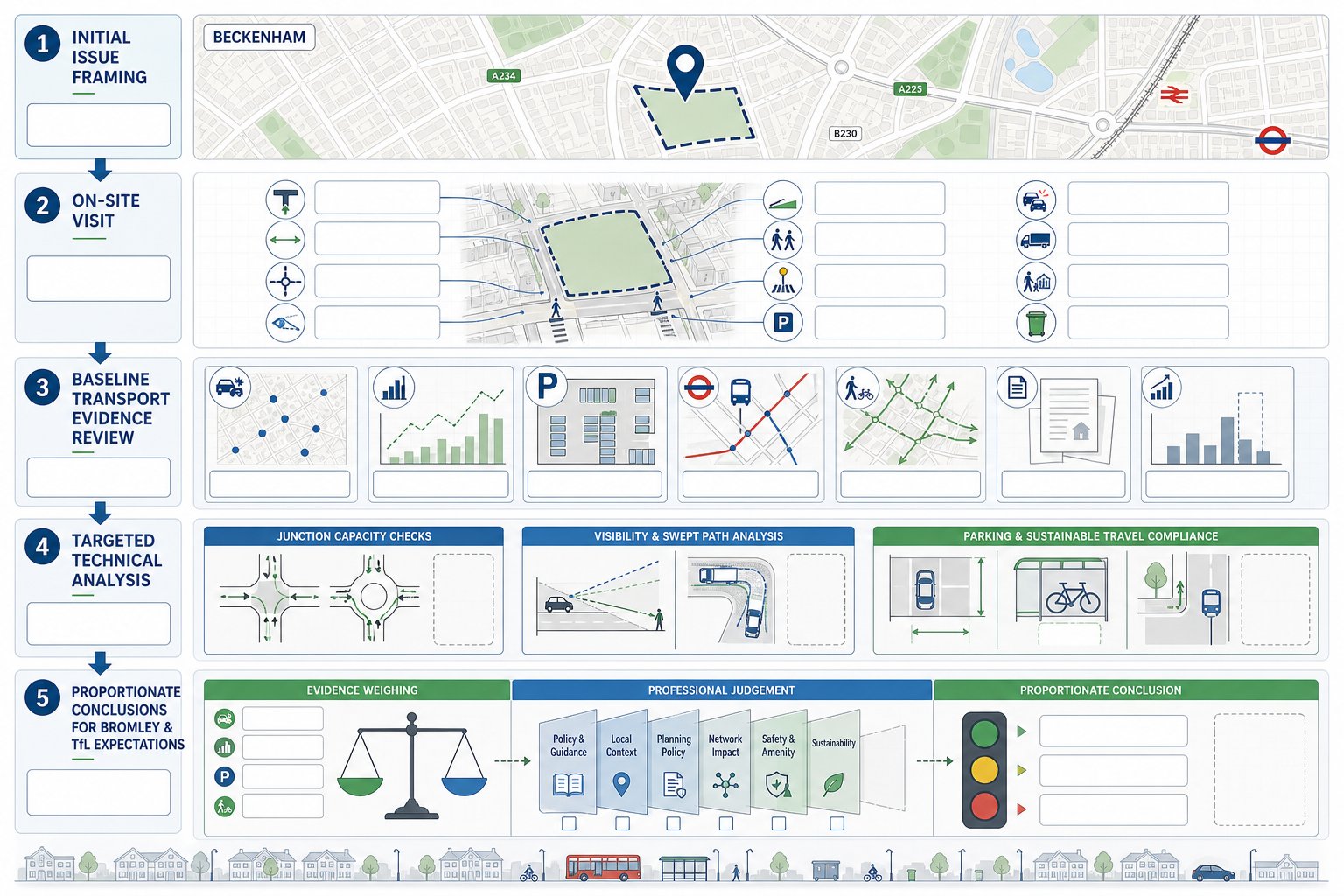
A proper site assessment starts long before the report is written. We begin by asking a simple question: what are the transport issues most likely to matter here? That shapes everything that follows.
The first step is usually a site visit. We review the access arrangement, street width, junction proximity, visibility, gradients, footway conditions, crossing opportunities, nearby land uses, signs of parking stress, servicing behaviour, and any practical constraints that never show up properly on a desktop map. A quick site walk can reveal a lot, for instance, whether cars already overhang footways, whether refuse collection appears difficult, or whether school peak conditions are likely to change the picture entirely.
We then examine baseline transport conditions using the tools appropriate to the scheme. That may include collision data, traffic flow information, parking surveys, public transport accessibility, local walking and cycling links, and planning history in the area. For trip generation, TRICS is commonly used as an evidence base, though professional judgement remains essential when selecting sites and adjusting for London context.
Where junction performance could become an issue, we may undertake capacity checks or more detailed modelling. Where access is the main concern, visibility and swept path analysis may be more important than forecast traffic volumes. And where policy compliance is central, parking and sustainable travel review may carry the most weight.
This balance between evidence and judgement is central to good Highway And Traffic Engineering. A site is not assessed by running every possible analysis. It is assessed by identifying the questions Bromley or TfL are most likely to ask, then answering them clearly and proportionately.
Access, Parking, Servicing, And Highway Safety Considerations
These four issues sit at the heart of many planning discussions in Beckenham because they are tangible, local, and often contentious.
Access has to work geometrically and safely. That means suitable width, acceptable gradients, adequate visibility, and no awkward interaction with pedestrians, cyclists, or nearby junction movements. New accesses or intensified use of existing ones are often examined closely, especially on roads with parked vehicles, street trees, or constrained footways.
Parking needs to be policy-aware and realistic. Too little parking can trigger displacement concerns: too much can conflict with London Plan principles or undermine a site’s design quality. The right answer depends on location, PTAL, development type, unit mix, disabled provision, cycle parking, EV charging, and local parking stress evidence. A well-argued parking strategy traffic approach can be the difference between a scheme that looks balanced and one that appears either overprovided or naïve.
Servicing is often underestimated. Refuse collection, parcel deliveries, maintenance vehicles, and occasional larger service vehicles all need to be considered. If they cannot enter, stop, turn, or leave in a safe and lawful way, objections usually follow.
Highway safety is the unifying test. Bromley and TfL will want confidence that the proposal does not create unacceptable risk and does not result in severe residual cumulative impact. Collision history, visibility, turning, conflict points, and likely operational behaviour all matter. In many cases, the technical issue is not whether a design is theoretically possible, but whether it will work reliably in day-to-day use, and whether that can be demonstrated convincingly.
When To Appoint A Traffic Engineer During The Planning Process
Earlier than most teams think.
The best time to involve a traffic engineer is usually at pre-application stage, or even before a layout is fixed. That gives us room to help shape the scheme rather than simply defend it. If access, parking, servicing, bin collection, cycle storage, or sustainable travel measures are designed in from the beginning, the final planning package is almost always stronger.
By contrast, when transport input starts only after drawings are settled, the process becomes more reactive. We may identify a visibility problem that now affects the frontage design, or discover that refuse tracking does not work within the basement ramp geometry, or conclude that a low-parking strategy needs supporting measures that the layout does not currently provide. None of those issues is impossible to solve, but late changes tend to cost more and delay submission.
Early advice is especially valuable where the site is near a station, on a bus route, close to a school, or on a road with known local parking pressure. Those are exactly the situations where transport comments tend to arrive quickly from consultees and neighbours alike.
For developers working across multiple schemes, this is one reason integrated Commercial Traffic Engineering support can add value. The transport strategy is not an appendix at the end: it is part of the project’s risk management from the start.
What To Prepare Before Requesting Transport Engineering Support
A little preparation makes transport advice faster, sharper, and more cost-effective.
At minimum, we normally need the red-line boundary, a draft site layout, and a basic schedule of proposed uses and quantum, for example, number of units, floor areas, bedrooms, servicing assumptions, or expected staff numbers depending on the scheme. If access changes are proposed, existing and proposed drawings are particularly helpful.
It also helps to share any pre-application advice already received from Bromley Council or TfL, along with comments from other consultants. A highways concern raised in a pre-app letter should shape the transport scope from day one, not get rediscovered halfway through drafting.
Known local issues are worth flagging too. If neighbours have previously objected on parking overspill, rat-running, school congestion, or delivery activity, we would rather know that upfront. Those concerns may not always be technically decisive, but they often influence how evidence should be framed.
Other useful materials include topographical surveys, swept path requirements, collision history if already obtained, nearby planning references, and any design constraints affecting visibility or turning. On tighter programmes, a concise brief can save real time.
From our side, the aim is always to produce concise, accurate reporting matched to local thresholds and likely planning questions. That practical approach is very much aligned with the broader principles set out in Traffic Engineering: Your: focus on safety, usability, and evidence that planning officers can act on.
Choosing A Traffic Engineer For Beckenham Projects
Not all transport consultants are interchangeable, and in Beckenham that matters.
A strong appointment should bring three things together: technical competence, local policy awareness, and commercial pragmatism. It is not enough to know how to produce a Transport Statement in abstract terms. The consultant should understand how Bromley is likely to review parking, access, servicing, sustainable travel, and localised highway safety issues. They should also be comfortable working in a London planning environment where TfL standards or comments may be relevant.
Experience with a wide range of report types is important: TS, TA, Travel Plans, DSPs, CLPs, junction analysis, swept path work, and road safety-led design review. So is the ability to advise honestly on scope. Some of the best project outcomes come from saying, early on, that a full TA is unnecessary, or, equally, that a short note will not be enough.
We would also look for clarity of communication. Planning teams need reports that are technically robust but readable by officers, clients, architects, and sometimes committee members. Fast turnaround matters, but speed without judgement is not much use.
For Beckenham projects specifically, we think the ideal consultant is one who can move easily between local street conditions, Bromley policy expectations, and wider London transport principles. That combination tends to produce submissions that are leaner, more defensible, and easier to progress through determination.
Conclusion
In Beckenham, transport engineering is rarely just a supporting technical exercise. It often shapes whether a proposal appears safe, credible, and policy-compliant in the eyes of the planning authority. Access design, parking provision, servicing arrangements, trip generation, road safety, and sustainable travel all feed directly into that judgement.
Our experience is that the most successful schemes address those issues early, proportionately, and with a clear understanding of Bromley and London policy context. When transport advice is brought in at the right time, it can prevent avoidable redesign, answer predictable objections before they arise, and give the wider consultant team much firmer ground to stand on.
For architects, planners, developers, surveyors, lawyers, and councils working on Beckenham sites in 2026, the value of a specialist traffic engineer lies in turning local transport constraints into workable planning solutions, not just producing a report, but helping the scheme make sense in the real world.
Frequently Asked Questions About Traffic Engineering in Beckenham
Why is a traffic engineer important for planning applications in Beckenham?
A traffic engineer in Beckenham ensures development proposals meet local transport policies, including highway safety, parking, access, and sustainable travel requirements set by Bromley Council and TfL, helping prevent objections and delays in planning approval.
What types of developments in Beckenham typically require transport engineering input?
Transport engineering is often needed for residential infill, flat conversions, mixed-use schemes, retail units, schools, healthcare, and any project altering access, parking, or increasing traffic near busy areas like Beckenham Junction or Elmers End.
What transport reports are commonly required for Beckenham planning submissions?
Key reports include Transport Statements for smaller schemes, Transport Assessments for larger developments, Travel Plans to promote sustainable travel, Delivery and Servicing Plans, Construction Logistics Plans, and junction or access reviews tailored to the project’s scale and sensitivity.
When is the best time to involve a traffic engineer in a Beckenham development project?
Engaging a traffic engineer at the pre-application stage or before finalising site layout allows transport considerations like access design, parking, and servicing to be integrated early, reducing costly redesigns and objections later in the planning process.
How does a traffic engineer assess the transport conditions of a development site in Beckenham?
Assessment includes site visits to check access geometry, visibility, and local constraints, analysing traffic flows, collision data, parking stress, and public transport accessibility, using tools like TRICS for trip generation and junction capacity analysis as needed.
What local policies influence transport engineering for developments in Beckenham?
Developments must comply with Bromley Local Plan parking standards and the London Plan’s emphasis on car-lite, sustainable travel solutions, protecting bus routes and tram links, and ensuring pedestrian and cyclist safety within the London Borough of Bromley.