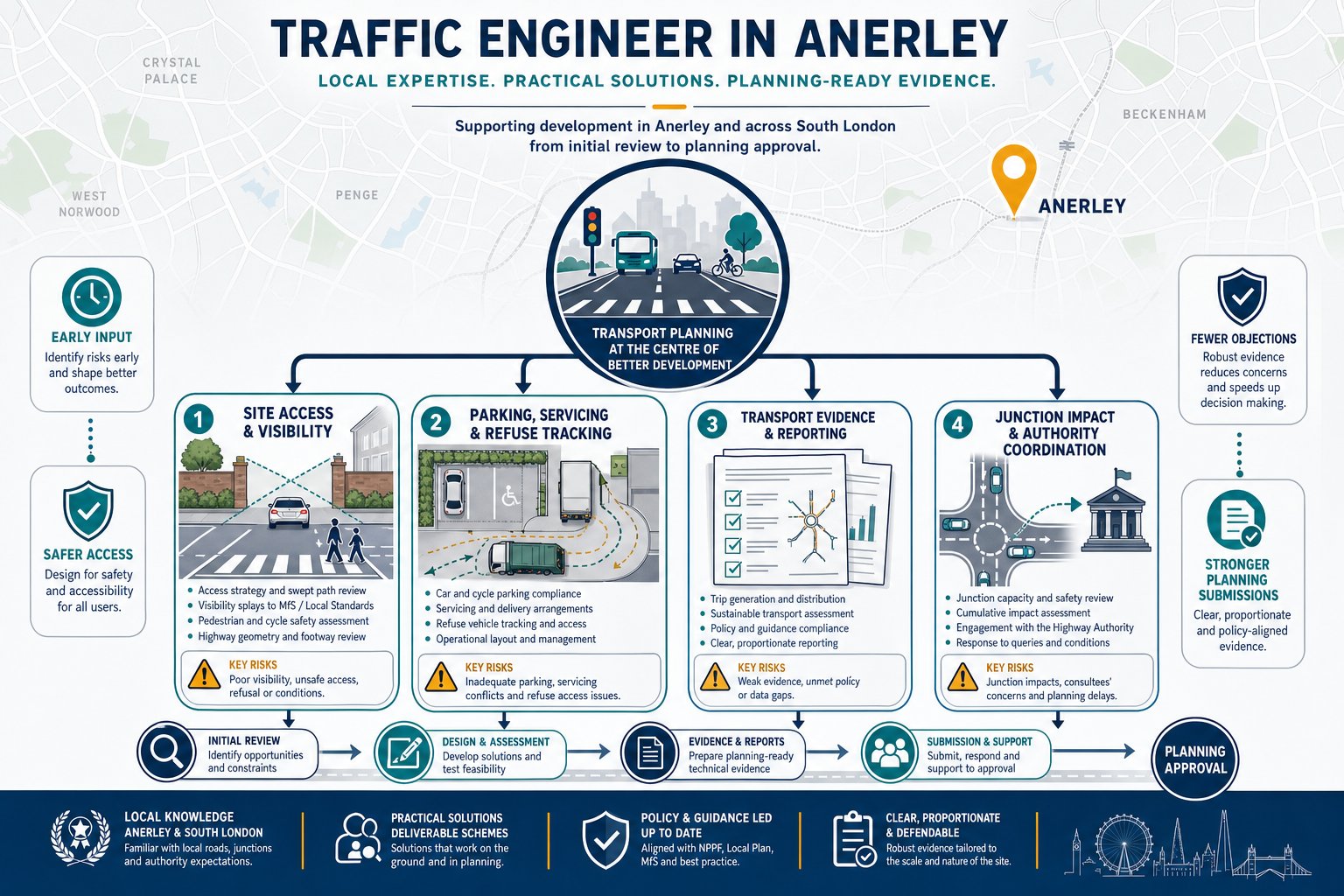
Planning applications rarely fail because of architecture alone. More often, they slow down on practical questions: can vehicles enter and leave safely, where will deliveries turn, will parking work in reality, and does the local highway network absorb the extra demand without creating a problem for everyone else? In Anerley, those questions matter even more because development often sits within a constrained urban street pattern, close to existing homes, shops, stations and busy movement corridors.
That is where a Traffic Engineer in Anerley becomes valuable. We help turn transport risk into clear, proportionate evidence that planning officers, highway teams, architects and developers can actually use. For some schemes, that means a concise technical note dealing with one issue properly. For others, it means a full transport assessment, junction modelling, swept path work, access checks and design revisions before the application goes in.
Our role is not simply to produce a report. It is to understand how a proposal will function day to day, anticipate objections early, and shape a stronger planning submission from the start. For architects, planners, solicitors, surveyors, builders and local authorities, that usually translates into fewer late surprises, more robust negotiations and a better chance of keeping the programme on track. The sections below set out what traffic engineering support in Anerley typically involves, when it is needed, and how the right local strategy can make applications faster and more resilient in 2026.
Key Takeaways
- A Traffic Engineer in Anerley plays a crucial role in ensuring safe vehicle access, parking, and servicing arrangements to support successful planning applications.
- Tailored local transport strategies are essential in Anerley due to its constrained urban layout, helping to create proportionate and effective transport evidence.
- Traffic assessments vary in scope from technical notes to full Transport Assessments, with the choice depending on the development’s size, impact, and local authority requirements.
- Early involvement of a Traffic Engineer can identify and solve access, parking, or servicing issues before submission, reducing delays and objections.
- Effective swept path analysis and junction modelling demonstrate practical vehicle movement and traffic impact, strengthening planning submissions.
- Selecting a Traffic Engineer with local experience and responsive communication ensures concise, relevant transport evidence aligned with planning strategies.
What A Traffic Engineer In Anerley Does For Planning And Development Projects
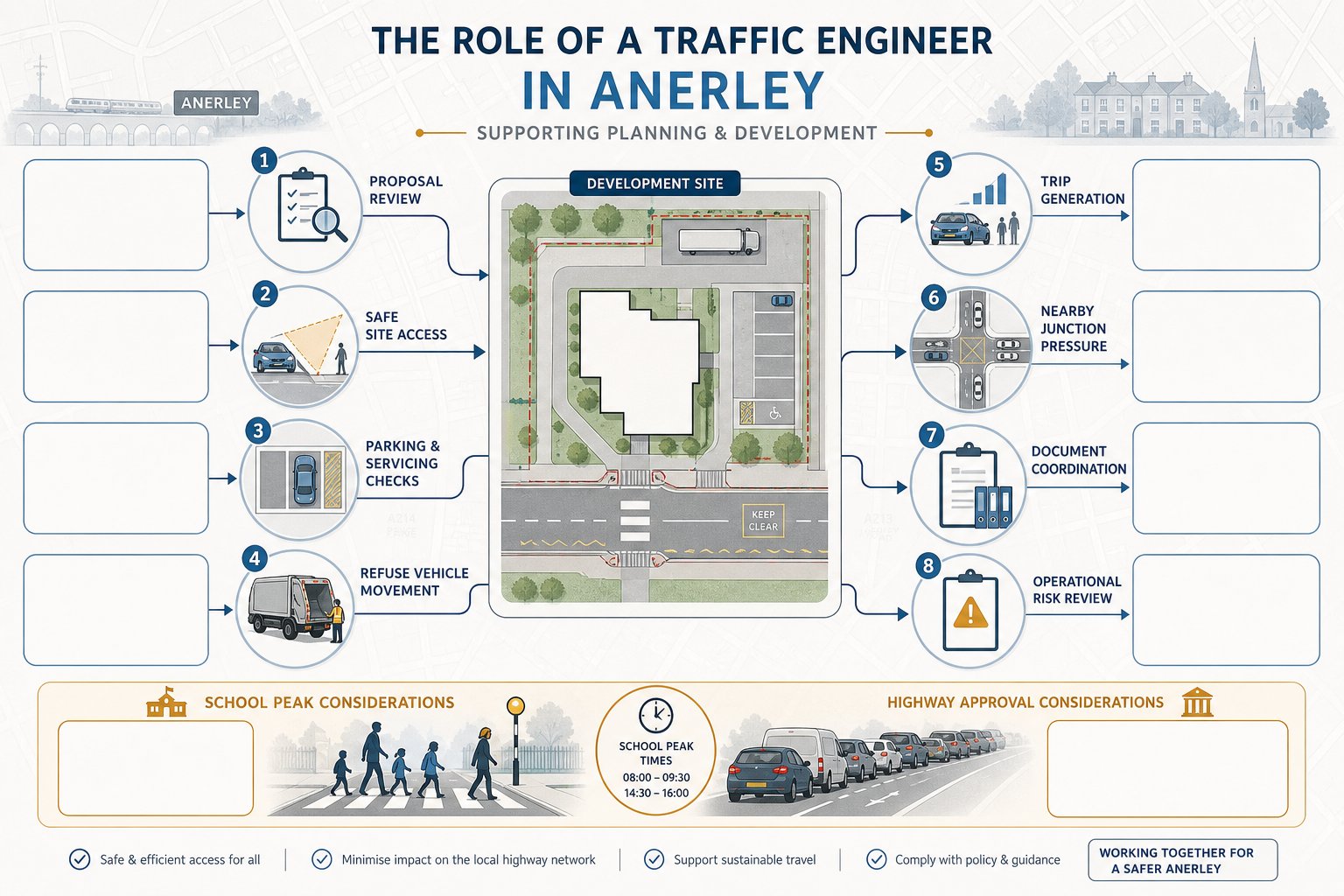
A traffic engineer working on an Anerley scheme sits at the point where design, planning policy and highway operation meet. In practical terms, we review the proposal, test whether the site can be accessed safely, assess likely transport effects, and prepare technical evidence that supports the planning case.
That can include reviewing site layouts, checking parking and servicing arrangements, advising on refuse collection strategy, estimating likely trip generation, and assessing whether nearby junctions are likely to come under pressure. We also coordinate with project teams so that transport evidence matches the drawings, design statement and planning narrative. It sounds obvious, but a surprising number of objections start with inconsistency between documents.
For development teams that need broader context, work often sits alongside the kind of planning support discussed in Traffic Engineering and Transportation guidance and more specialist advice from Traffic Engineering Consultants: focused on development risk.
A good Traffic Engineer in Anerley is not only modelling numbers. We are asking operational questions: how does a van reverse here, where do pedestrians wait, what happens at school peak, and will the highway officer accept the proposed visibility? Those details are often the difference between a clean application and a prolonged negotiation.
Why Anerley Sites Need A Local Transport And Highways Strategy
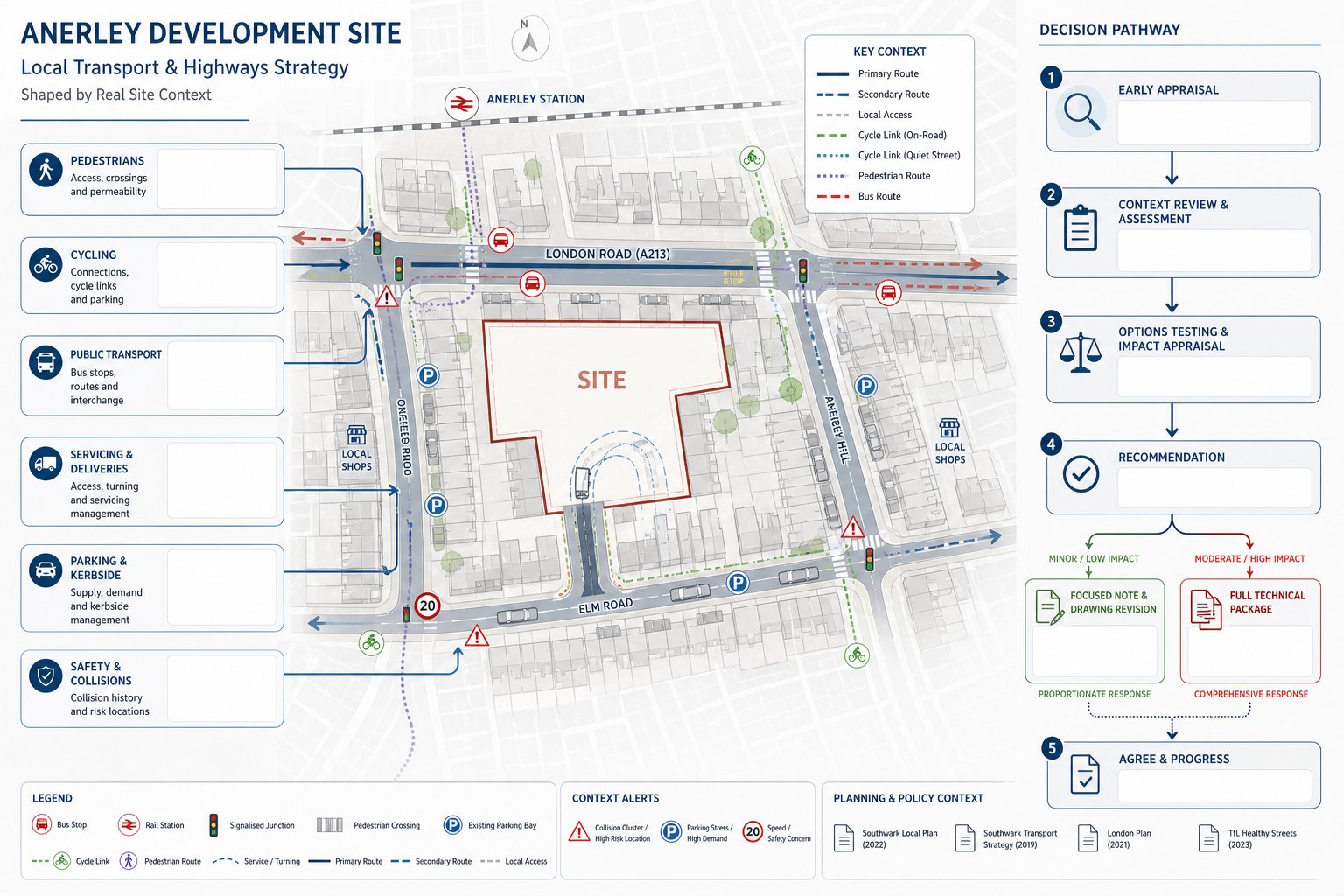
Anerley is not the sort of place where generic transport wording works well. Sites tend to be shaped by constrained frontages, existing on-street demand, nearby public transport, mixed residential and commercial activity, and local sensitivity to safety and overspill parking. That means the transport case needs to respond to the actual location, not a template.
A local highways strategy helps establish the right level of evidence from the outset. We look at the surrounding road hierarchy, access constraints, collision context where relevant, likely servicing demands, sustainable travel opportunities and the expectations of the determining authority. If a development is likely to trigger detailed questions on access, parking stress or turning movements, it is better to know that before the planning pack is assembled.
This is especially important where a site appears modest on paper but sits in a tight urban context. A small infill scheme with poor access geometry can attract more transport scrutiny than a larger site with straightforward frontage conditions. Local strategy is really about proportionality: enough evidence to satisfy planning and highway concerns without overcomplicating the submission.
We often find that early appraisal narrows the brief sensibly. Some projects need a full technical package. Others need one focused note, a drawing revision and a clear transport planning rationale. Either way, the local context in Anerley should drive the method.
Planning Applications That Commonly Require Traffic Engineering Input
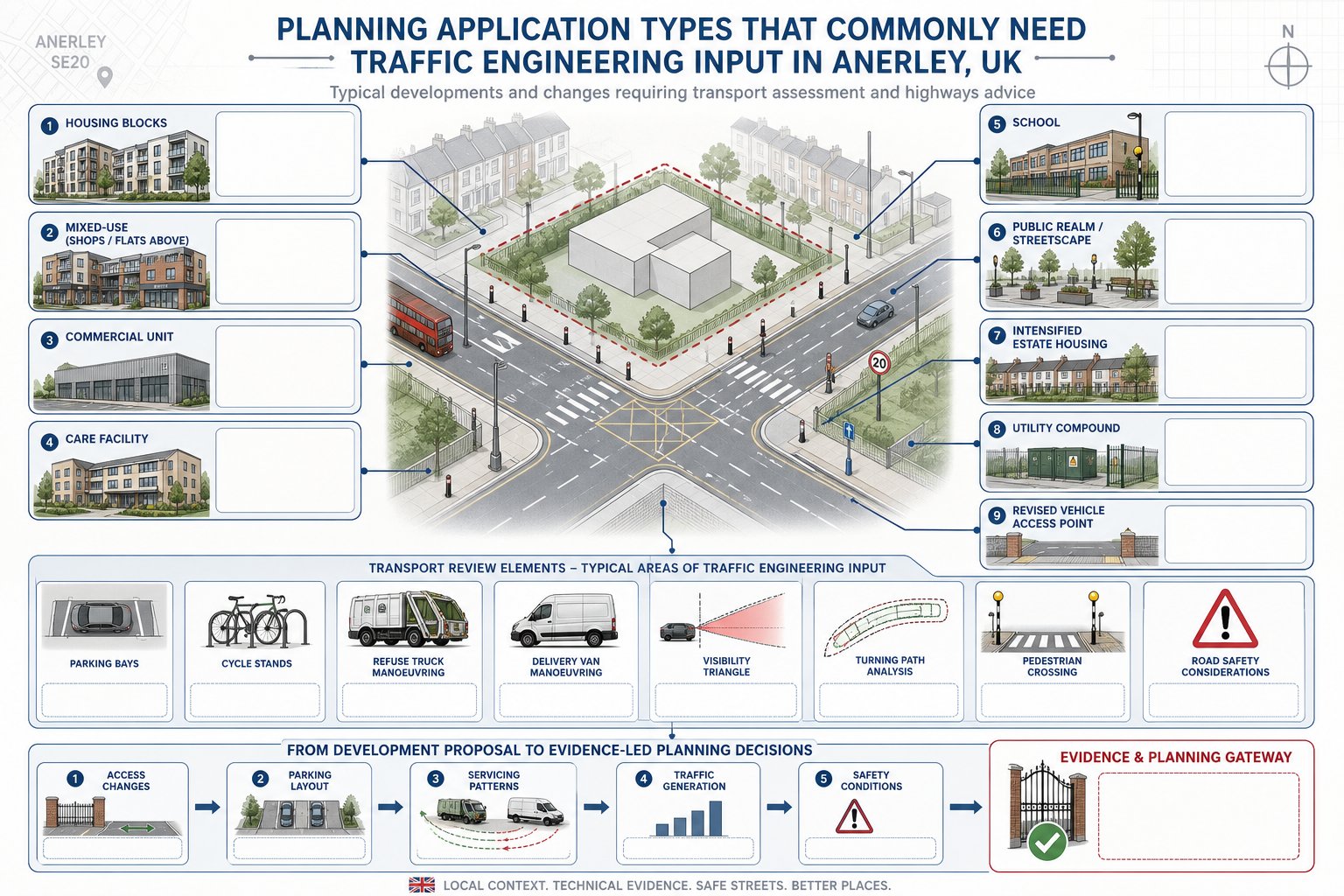
Traffic engineering input is commonly required wherever a proposal changes how people, vehicles or service activity interact with the highway. In Anerley, that regularly includes residential developments, mixed-use schemes, commercial premises, care uses, education-related projects, public realm works, estate intensification, utility sites and access alterations.
Housing schemes are a frequent example. Even modest residential proposals can raise questions about parking provision, cycle parking, bin collection, visibility splays and whether larger vehicles can enter and leave in forward gear. Mixed-use or commercial schemes add another layer because delivery activity, staff travel patterns and peak-hour trip profiles are often less straightforward.
On business-led developments, issues covered in Commercial Traffic Engineering often become central, especially where servicing windows, customer parking or fleet access could affect nearby roads. At a wider level, the role described by Highway And Traffic Engineering support becomes relevant whenever design must align with planning and highway authority expectations.
Not every application needs a long report. But once a scheme changes access, parking layout, servicing patterns, traffic generation or road safety conditions, a Traffic Engineer in Anerley can usually add value by defining the evidence needed and keeping transport issues from becoming the reason a decision drifts.
Transport Assessments, Statements And Technical Notes Explained
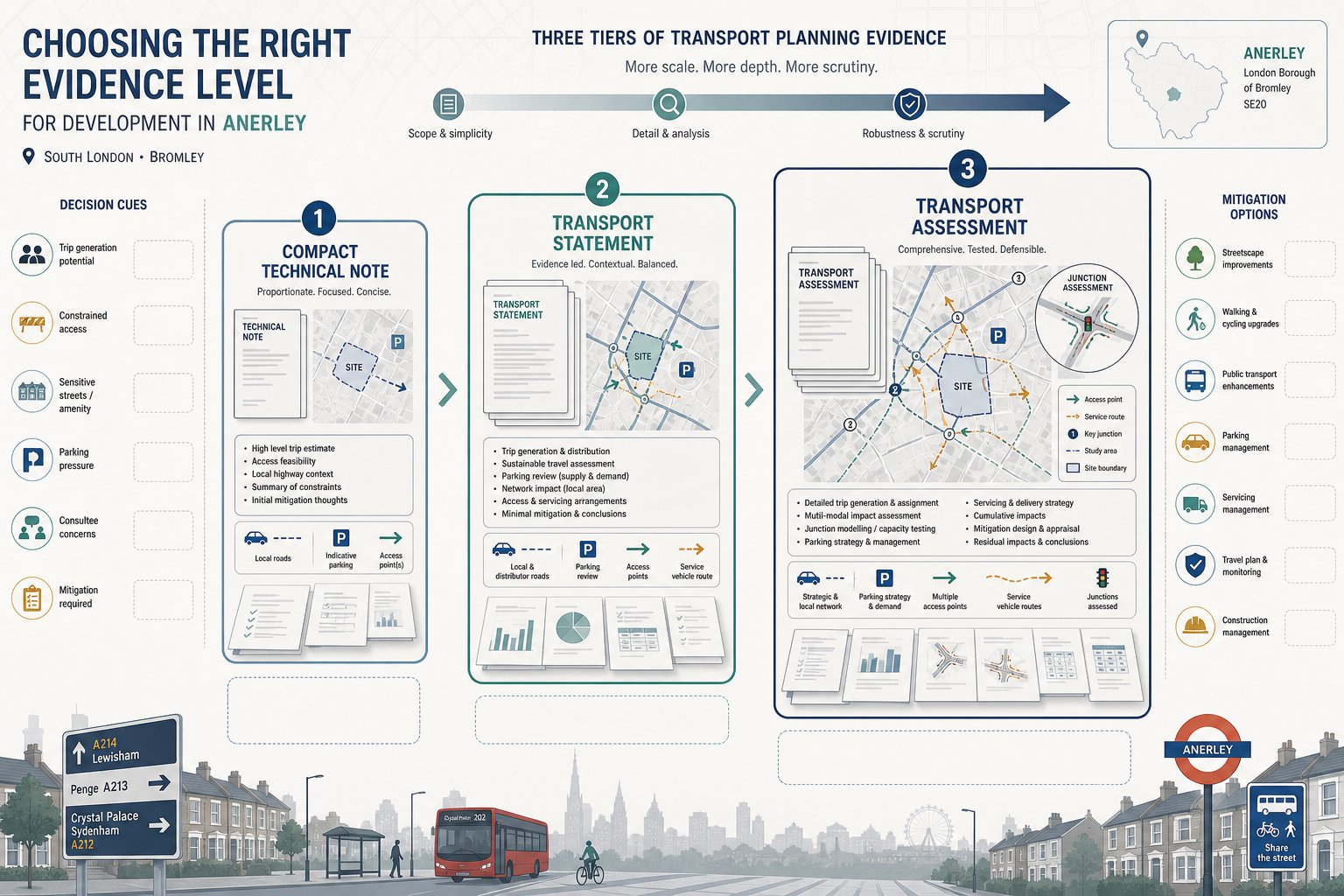
Transport documents are often described as if they are interchangeable. They are not. The main difference is scale, depth and purpose.
A Transport Assessment is the fuller evidence base. It is generally used for schemes with a material transport impact, where decision-makers need a detailed understanding of trip generation, modal context, servicing, access performance, parking implications and, in some cases, junction modelling and mitigation.
A Transport Statement is lighter-touch. It still needs to be credible and site-specific, but it is usually proportionate to a smaller or lower-impact proposal. It commonly summarises the development, site accessibility, expected trip levels, access arrangements and parking or servicing matters without the same degree of modelling.
A technical note is narrower again. We use technical notes to deal with a defined issue such as swept path clarification, a response to consultee comments, a parking update, or an amendment to a previously submitted scheme.
The right choice depends on local thresholds, proposal type and site sensitivity. Using too little evidence risks objection. Using far too much can waste time and fee without improving the planning position. That balance is where an experienced Traffic Engineer in Anerley is useful.
When A Transport Assessment Is Usually Needed
A Transport Assessment is usually the right route where a proposal is likely to create a noticeable transport effect or where the authority will expect detailed justification. Typical triggers include higher trip generation, constrained access, sensitive surrounding conditions, likely impact on junction operation, or the need for mitigation such as visibility changes, parking control or travel planning measures.
It is also common where a planning officer or highway authority has already flagged concerns, or where a development team needs robust evidence to support appeal, negotiation or pre-application strategy. A TA should not simply be longer than a TS: it should answer deeper questions with proper technical backing.
When A Transport Statement May Be More Appropriate
A Transport Statement may be more appropriate where the expected impacts are limited and can be explained proportionately. Smaller residential infill developments, changes of use with modest trip effects, or schemes with straightforward access and parking arrangements often fall into this category.
The key word is proportionate. A shorter report still needs solid assumptions, a clear description of local conditions and enough evidence to show the proposal will function safely and acceptably. A weak statement is not a saving. It simply moves the argument into post-submission queries, which is usually slower and more expensive.
Key Traffic Engineering Services For Anerley Developments
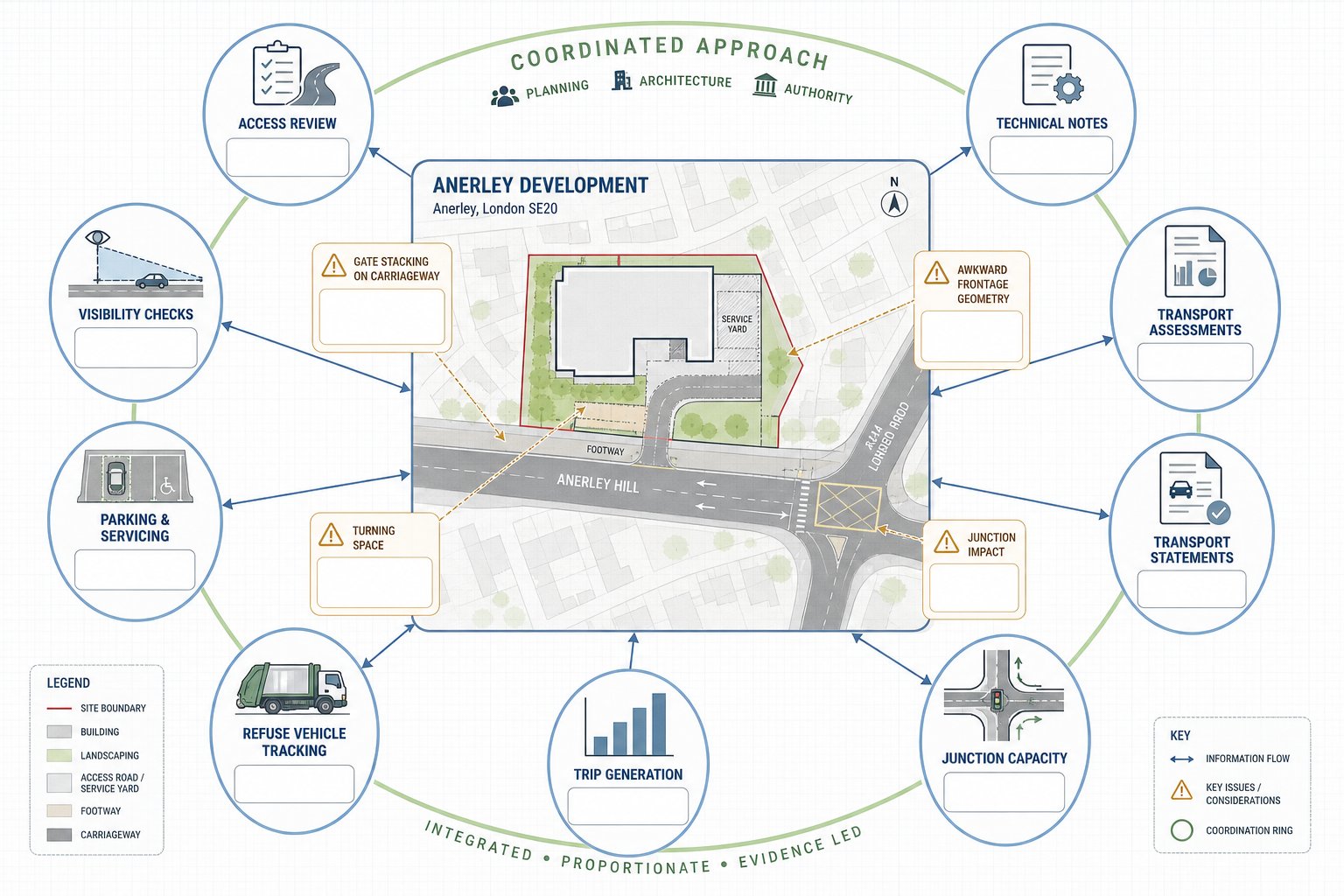
For most Anerley developments, the core traffic engineering service is not one isolated task but a package tailored to the application risks. We typically support projects with site access review, visibility checks, parking and servicing analysis, refuse strategy, trip generation, junction capacity work, transport statements, transport assessments and targeted technical notes.
The exact scope depends on what could realistically delay consent. Sometimes the main issue is whether a delivery vehicle can turn within the site. Sometimes it is whether an intensified use will materially affect a nearby junction. On another project, the problem may be simpler: the access gate position is wrong and causes a stacking issue on the carriageway.
Specialist inputs can also be tightly focused. access design highway work, for instance, becomes central where frontage constraints or geometry make entry and exit awkward. Likewise, a well-judged parking strategy traffic approach can resolve issues that would otherwise trigger neighbour concern or officer queries.
The real value is coordination. We align technical work with the planning strategy, architectural layout and authority expectations, so the submission reads as one coherent case rather than a bundle of disconnected reports.
Access Design, Visibility And Highway Safety Considerations
Access design is one of the first things highway officers look at because it immediately affects safety and practicality. If the access is poorly positioned, too narrow, badly aligned or lacking appropriate visibility, the application can run into difficulty regardless of the scheme’s other merits.
In Anerley, access issues often arise on constrained urban frontages where footways are busy, kerbside activity is high, and visibility can be influenced by parking, boundary treatments, street furniture or road curvature. We test whether vehicles can enter and leave safely, whether pedestrian movement is protected, and whether the geometry suits the expected vehicle types.
Visibility is not just a drawing exercise. The important question is whether sight lines are realistic in the way the street operates day to day. That means understanding how parking behaviour, loading activity and local street conditions affect the usable visibility envelope, not simply the ideal one shown on plan.
Safety considerations also include interaction with cyclists, refuse operations, gate positions, vehicle waiting space and whether drivers can emerge with enough confidence and control. Where a design falls short, early revisions are usually far cheaper than defending a marginal solution after submission.
Good access design is often quiet work. Nobody notices it when it is right. Everyone notices it when it is wrong.
Parking, Servicing And Refuse Vehicle Swept Path Analysis
Parking and servicing tend to be where planning proposals meet real-world behaviour. A layout may look efficient on paper, yet fail the moment a delivery van arrives, a refuse vehicle needs to turn, or a resident tries to reverse out without a clear line of sight.
That is why swept path analysis matters. Using vehicle tracking, we test whether cars, vans, service vehicles and refuse vehicles can manoeuvre within the site and at the site access without conflict, excessive overrun or unsafe reversing. On tighter urban schemes in Anerley, this is often one of the most persuasive pieces of evidence in the planning file because it shows operation rather than just describing it.
Parking review goes beyond counting bays. We assess bay dimensions, aisle widths, turning practicality, disabled provision where relevant, cycle integration, and whether the arrangement supports likely user behaviour. A technically compliant parking area that nobody can use conveniently is not really compliant in planning terms.
Servicing needs the same realism. We ask when vehicles arrive, where they wait, whether loading blocks access or footways, and if refuse collection can happen without awkward highway conflict. Where the answer is no, we refine the layout, servicing plan or management assumptions.
For many schemes, these details decide whether the application feels workable to the local authority.
Junction Capacity, Trip Generation And Traffic Impact Modelling
When a proposal is likely to add noticeable traffic, we need to move from assumption to evidence. That usually starts with trip generation: estimating how many person trips and vehicle trips the development is likely to create, at what times, and by which modes. We use recognised data sources, local context and professional judgement to avoid overstatement or understatement.
From there, we consider assignment and impact. Which routes will vehicles take? Which junctions are most likely to experience added pressure? Are those changes material in planning terms, or comfortably within what the network can absorb? Where needed, we carry out junction capacity assessments or other modelling to test queueing, delay and operational performance.
This work is especially important when development sits near already busy corridors or priority junctions where a small increase at the wrong time can prompt concern from officers or residents. It is also useful where a scheme’s impact is likely to be less severe than objectors assume: robust modelling can narrow the debate quickly.
The point is not to produce complicated graphics for their own sake. It is to answer a simple planning question: will this development cause an unacceptable impact on the highway network, and if not, can we show that clearly? If mitigation is needed, modelling also helps identify what is proportionate and defensible.
Working With Bromley And Other Local Highway And Planning Requirements
Anerley schemes do not sit in a vacuum. Transport submissions need to align with the expectations of the local planning authority, highway authority processes, adopted standards and the practical preferences of case officers and reviewers. In this area, understanding Bromley-related requirements and neighbouring authority interfaces can save a lot of wasted motion.
That means scoping the right report type, using proportionate evidence, and making sure transport advice is consistent with drawings, design and supporting planning material. It also means recognising that the technical answer alone is not always enough. Presentation matters. Officers need a clear audit trail from proposal to impact to conclusion.
Where project teams need wider context beyond one site, broader local authority insight similar to that covered in Traffic Engineer In London: can help frame expectations across urban borough conditions, while the principles in Traffic Engineering: Your support consistent technical reasoning.
We also find that local compliance is often about anticipation. If a scheme is likely to raise a visibility, servicing or overspill concern, it is better to address it head-on in the submission than wait for a consultee response. That tends to produce faster, cleaner progress through the application stage.
How Early Traffic Engineering Input Helps Avoid Delays And Objections
The cheapest transport problem to fix is the one identified before anyone has committed to the layout. Once drawings are coordinated, planning statements drafted and expectations set with a client, even a small access or servicing issue can cause disproportionate delay.
Early traffic engineering input helps because it turns unknowns into a scoped task list. We can identify whether the scheme is likely to need a Transport Statement or full Assessment, whether the access geometry is viable, whether parking provision is likely to be challenged, and whether swept path or junction modelling should be built into the programme rather than treated as a last-minute add-on.
This early stage is also where we can suggest practical design changes with very little pain: shifting a gate, widening an aisle, relocating bins, altering bay orientation, or changing servicing assumptions. Those are simple moves at concept stage and awkward moves three weeks before submission.
And there is a strategic advantage. Applications that address predictable transport concerns upfront tend to attract fewer requests for clarification and fewer objections based on incomplete evidence. That does not guarantee approval, of course, but it often improves the quality of discussion with officers and reduces the chance that transport becomes the issue that stalls everything else.
In a tight programme, that matters more than people sometimes realise.
Choosing The Right Traffic Engineer In Anerley For Your Project
Choosing the right consultant is partly about technical capability and partly about judgement. You need someone who can prepare the relevant report, but also someone who understands how planning applications succeed in practice: proportionate evidence, clear drawings, realistic assumptions and communication that makes life easier for planners and highway officers.
For Anerley projects, we would look for five things. First, proven experience in development transport work rather than only general highway design. Second, confidence with access, parking, servicing and swept path issues, because those are common pressure points on urban sites. Third, the ability to carry out or interpret trip generation and junction analysis where needed. Fourth, familiarity with local authority expectations and report thresholds. And fifth, the discipline to keep advice concise, accurate and aligned with the planning strategy.
Programme matters too. Planning teams rarely have months to spare, so responsiveness and report turnaround are not trivial extras: they are part of the service. With more than 30 years of experience and a focus on concise, accurate reporting tailored to authority requirements, our approach is built around that reality.
A strong Traffic Engineer in Anerley should leave the wider team feeling clearer about risk, not more buried in paperwork. That is usually the best sign you have chosen well.
For architects, planners, lawyers and developers, the right transport input is rarely about producing the thickest report. It is about producing the right evidence at the right time, in the right format, so the scheme can move forward with fewer avoidable obstacles.
Frequently Asked Questions About Traffic Engineering in Anerley
What services does a Traffic Engineer in Anerley provide for planning projects?
A Traffic Engineer in Anerley reviews proposals to ensure safe access, evaluates parking and servicing needs, estimates trip generation, and prepares transport evidence aligned with planning policies to support development applications effectively.
Why is a local transport and highways strategy important for developments in Anerley?
Because Anerley has constrained urban streets and mixed uses, a local strategy ensures transport evidence is tailored to site specifics like access, parking, and traffic impacts, preventing generic, ineffective submissions and reducing delays.
When is a Transport Assessment needed instead of a Transport Statement for Anerley developments?
A Transport Assessment is required when a development is expected to cause significant transport effects such as higher trip generation or junction impacts, requiring detailed analysis, whereas a Transport Statement suffices for smaller, lower-impact schemes.
How does early traffic engineering input benefit planning applications in Anerley?
Early input identifies access, parking, and evidence needs at the design stage, allowing simple layout changes that reduce objections and delays, helping keep planning programmes on track and applications cleaner.
What roles do swept path analysis and parking strategy play in Anerley developments?
Swept path analysis verifies that vehicles, including refuse trucks, can safely manoeuvre onsite, while parking strategy reviews ensure bay dimensions and layouts meet user needs and planning standards, preventing operational issues and objections.
How can I choose the right Traffic Engineer in Anerley for my project?
Select an engineer with proven development transport experience, local authority knowledge, strong skills in access and parking design, trip generation and junction modelling, plus timely, concise reporting aligned with planning strategies.