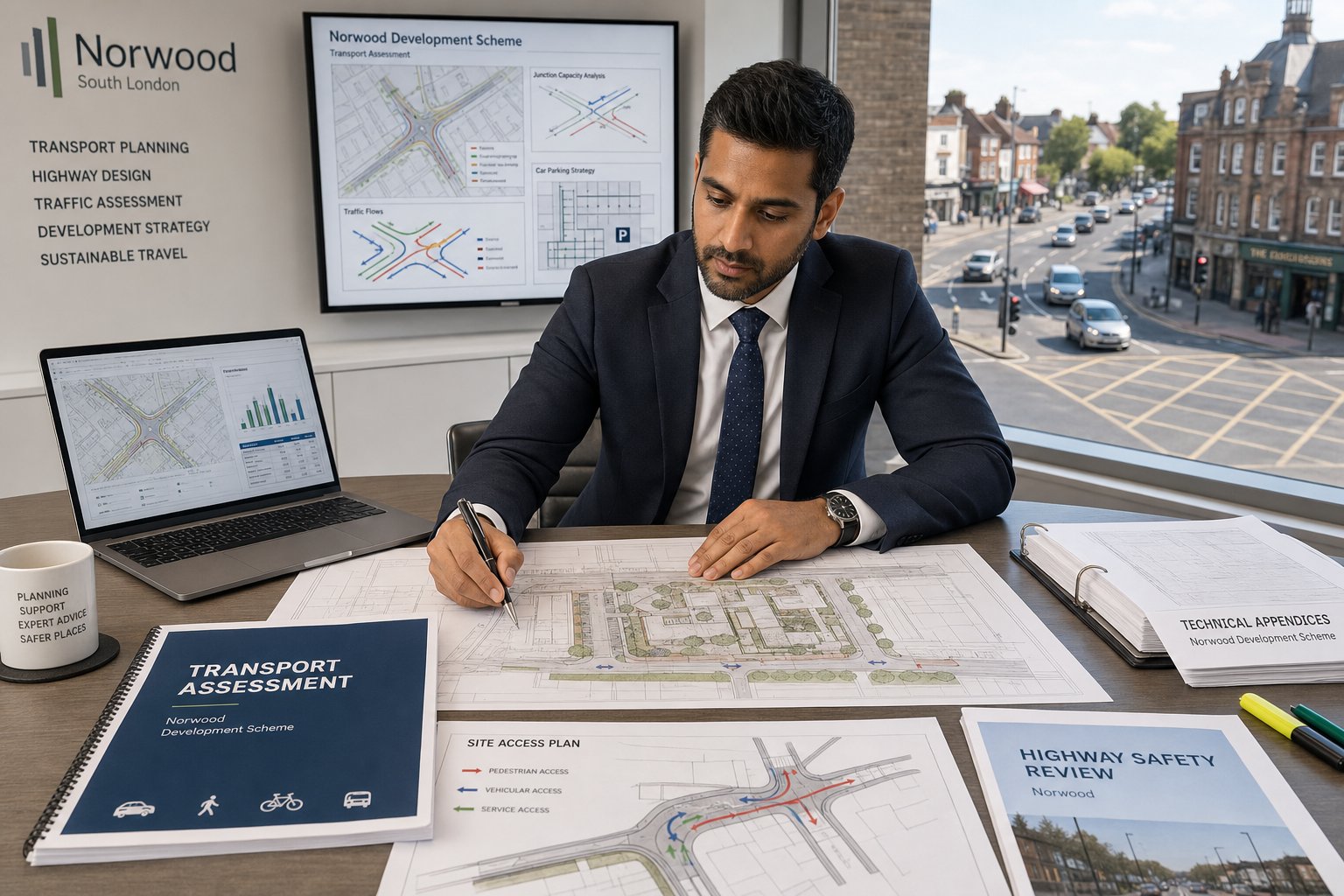
Planning in Norwood can look straightforward on a layout plan and become much less straightforward the moment highways comments arrive. A modest residential infill, a change of use, a new access point, or a mixed-use scheme near a busy corridor can all trigger transport questions that affect programme, design, and eventually whether permission is granted. That is where a traffic engineer in Norwood becomes central to the planning team rather than a late-stage add-on.
We work with architects, planners, surveyors, developers and legal teams who need clear transport advice that is technically sound and practical. In simple terms, our role is to show how a proposal will function on the local network, whether it can be accessed safely, how much traffic it is likely to generate, and what evidence is needed to satisfy planning and highway officers. In Norwood, local context matters a lot: constrained streets, established parking pressure, school-run peaks, servicing limits, and junction performance can all shape the right strategy.
In this guide, we set out what a traffic engineer in Norwood actually does, when transport input is needed, which reports may be required, and how early advice can shorten the path from concept to submission. The aim is practical: help project teams understand what to commission, when to do it, and how to avoid common mistakes that slow applications down.
Key Takeaways
- A traffic engineer in Norwood plays a crucial role in planning by assessing local transport impacts, ensuring safe and practical access, and reducing planning risk.
- Early engagement with a traffic engineer can shape designs effectively, avoiding costly delays and objections during the planning process.
- Transport reports such as Transport Statements, Assessments, and Travel Plans must be proportionate and tailored to Norwood’s specific site constraints and highway conditions.
- Local factors like narrow streets, parking pressure, and junction performance heavily influence transport advice and must be realistically addressed in proposals.
- Selecting a traffic engineer with local knowledge and commercial awareness ensures efficient, clear communication with planning authorities and a focussed transport strategy.
- Coordinated and complete project information early on is key to preparing robust transport reports that meet local authority expectations and streamline consent.
What A Traffic Engineer In Norwood Does For Planning Applications

A traffic engineer in Norwood supports the planning process by testing whether a development can work safely and acceptably from a transport perspective. That usually starts with a policy and site review: we look at local plan requirements, parking standards, access constraints, road safety issues, sustainable travel opportunities, and the likely concerns of both planning and highway officers.
From there, we assess how people and vehicles will reach and use the site. That can include forecasting trip generation, reviewing parking layouts, checking visibility splays, testing junction operation, considering servicing and refuse movements, and identifying whether pedestrians and cyclists are being properly accommodated. On some schemes the work is concise: on others it becomes a detailed technical exercise with surveys, modelling and design iterations.
The output is normally a transport report, technical note, or drawing package that explains the proposal in evidence-led terms. We may also advise on mitigation, such as revised access geometry, a better parking arrangement, delivery controls, or Travel Plan measures. For teams wanting a broader overview of how these roles fit into planning, our piece on Traffic Engineering Consultants: What gives useful context.
In practice, the job is not just to write a report. It is to reduce planning risk by anticipating objections early and shaping the scheme before they become reasons for delay or refusal.
When Transport Input Is Needed For A Norwood Development
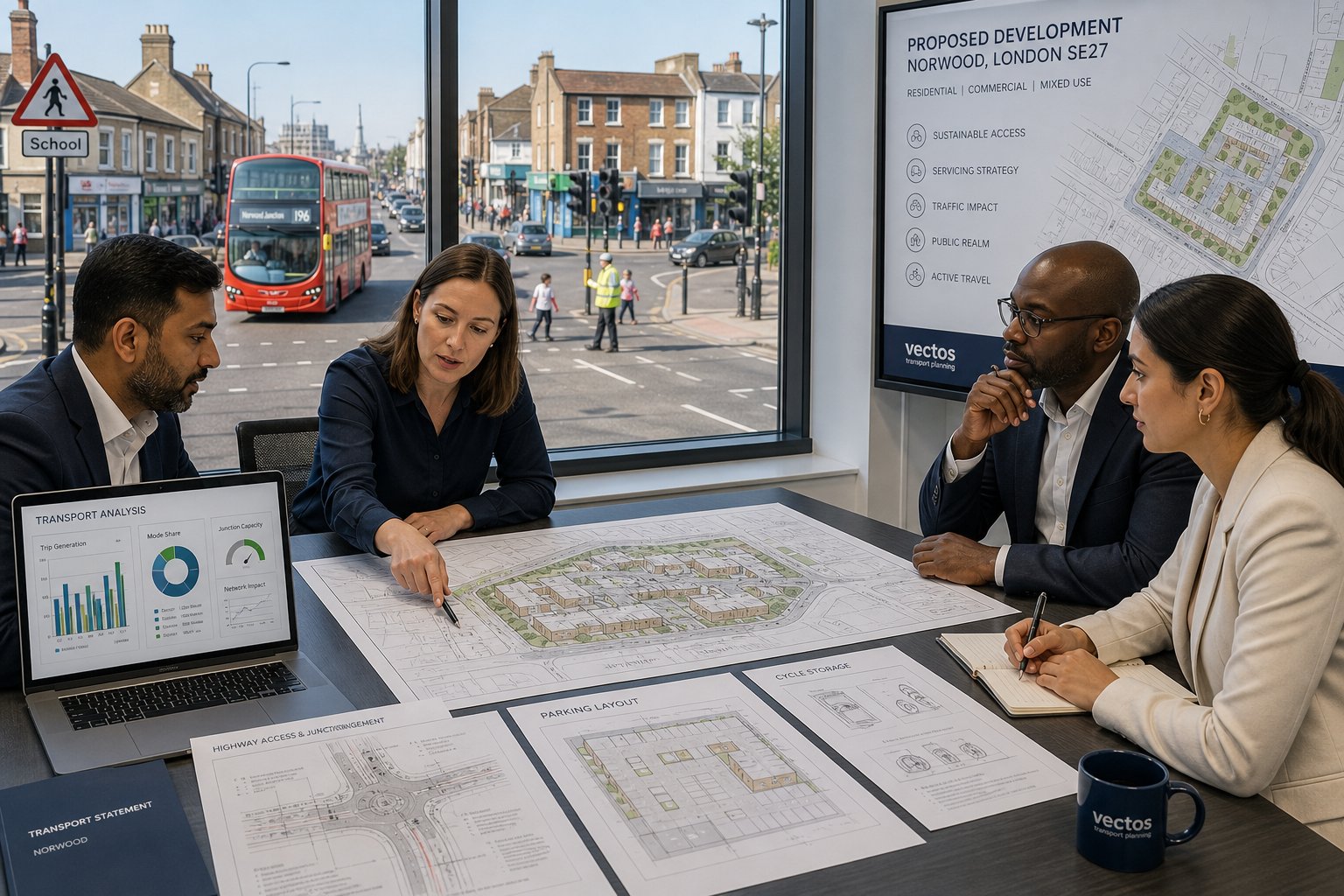
Transport input is needed whenever a proposal changes the way a site interacts with the highway network in a meaningful way. That might mean a brand-new vehicular access, a material uplift in traffic, extra servicing activity, more on-site parking demand, or a land use that creates movement at sensitive times of day. In Norwood, even a relatively small scheme can attract scrutiny if it sits on a constrained street, close to a school, beside a bus route, or near a junction already experiencing congestion.
We are often brought in when the planning team realises highways issues may become decisive. Frankly, that is better done before the layout is fixed. Early transport input can influence building line, access location, refuse strategy, cycle parking, and whether a proposal is best supported by a short note, a Transport Statement, or a more detailed package.
This is especially true for projects involving commercial activity, where servicing patterns and peak hour demand can be more sensitive than headline floor area suggests. Our wider discussion of Commercial Traffic Engineering In explores that in more detail.
Projects That Commonly Require Traffic Engineering Support
Typical schemes include residential developments, HMOs, apartment blocks, retail units, cafés and restaurants, healthcare uses, schools, employment sites, light industrial schemes, warehouses, and mixed-use projects. We also see transport input requested for refurbishments or changes of use where the footprint barely changes but trip rates, deliveries, or parking demand do.
A small site is not automatically a simple site. A five-unit scheme with poor visibility and no turning space may need more careful technical work than a larger but well-located proposal with an established access. That is why threshold-based assumptions alone rarely tell the whole story in Norwood.
How Norwood Site Constraints Shape Transport Advice
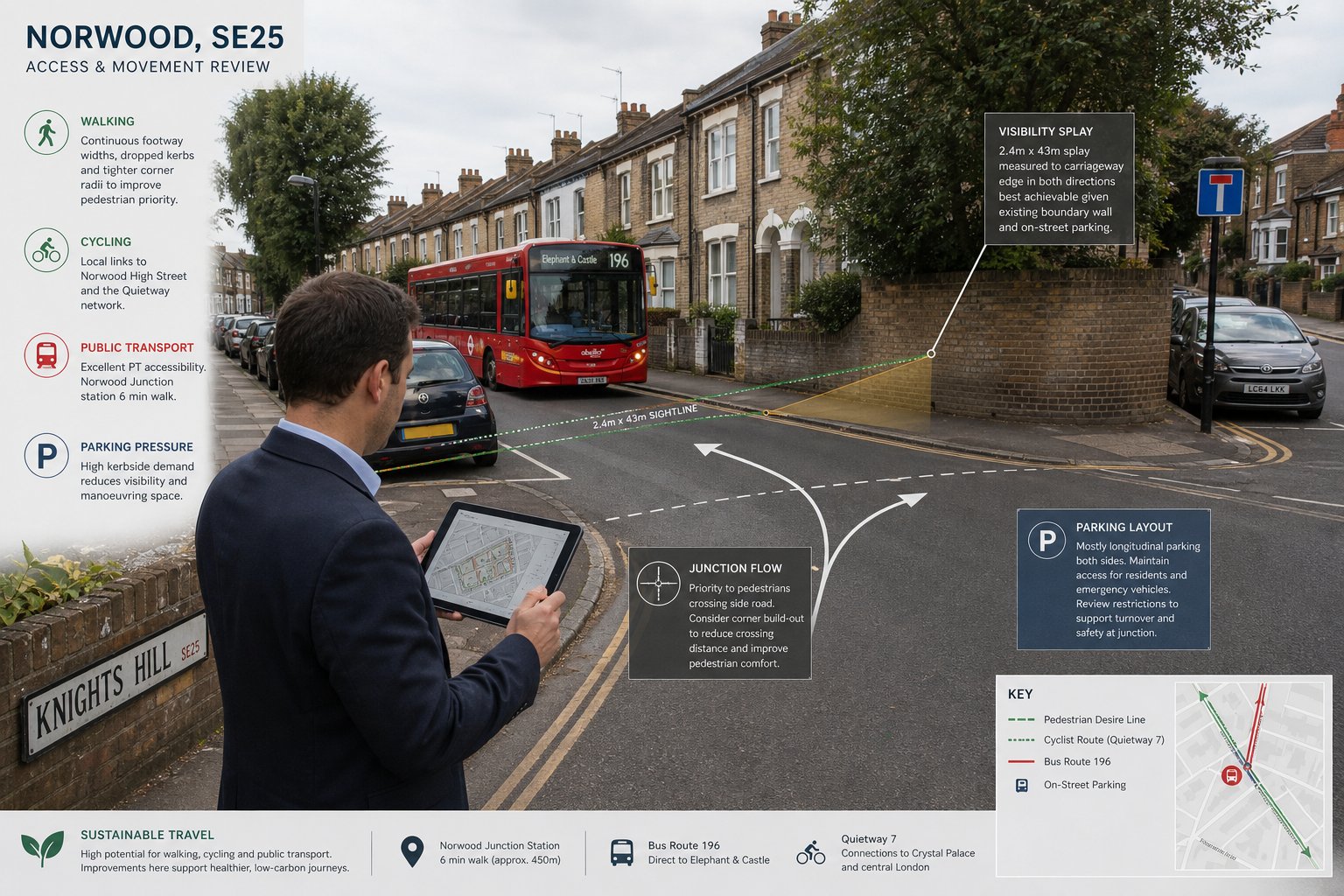
Transport advice in Norwood is heavily shaped by local physical conditions. Narrow carriageways, mature street frontages, on-street parking stress, shallow front setbacks, bus activity, and constrained corners can all limit what is achievable. We cannot treat transport planning as a generic template exercise: two sites on neighbouring roads can require very different recommendations.
Visibility is a common issue. Boundary walls, parked vehicles, gradients, and street curvature may affect whether an access can meet accepted standards or needs a design response. Parking is another frequent pressure point. Even where policy supports sustainable travel, officers will still expect a realistic explanation of how resident, visitor, and servicing demand has been considered. That is why a credible parking strategy traffic approach can make a real difference to an application.
Then there is junction context. If a site loads traffic onto an already stressed arm, broad statements about limited impact are unlikely to carry much weight without evidence. We also consider public transport accessibility, walking routes, and cycle connections. In a well-connected location, those factors may support reduced parking or stronger sustainable travel measures: in a less accessible pocket, they may not.
Good advice reflects those constraints honestly. The fastest route to consent is rarely the most optimistic one. It is usually the one that aligns design ambition with the realities of the local street network.
Key Planning And Highway Reports For Norwood Schemes
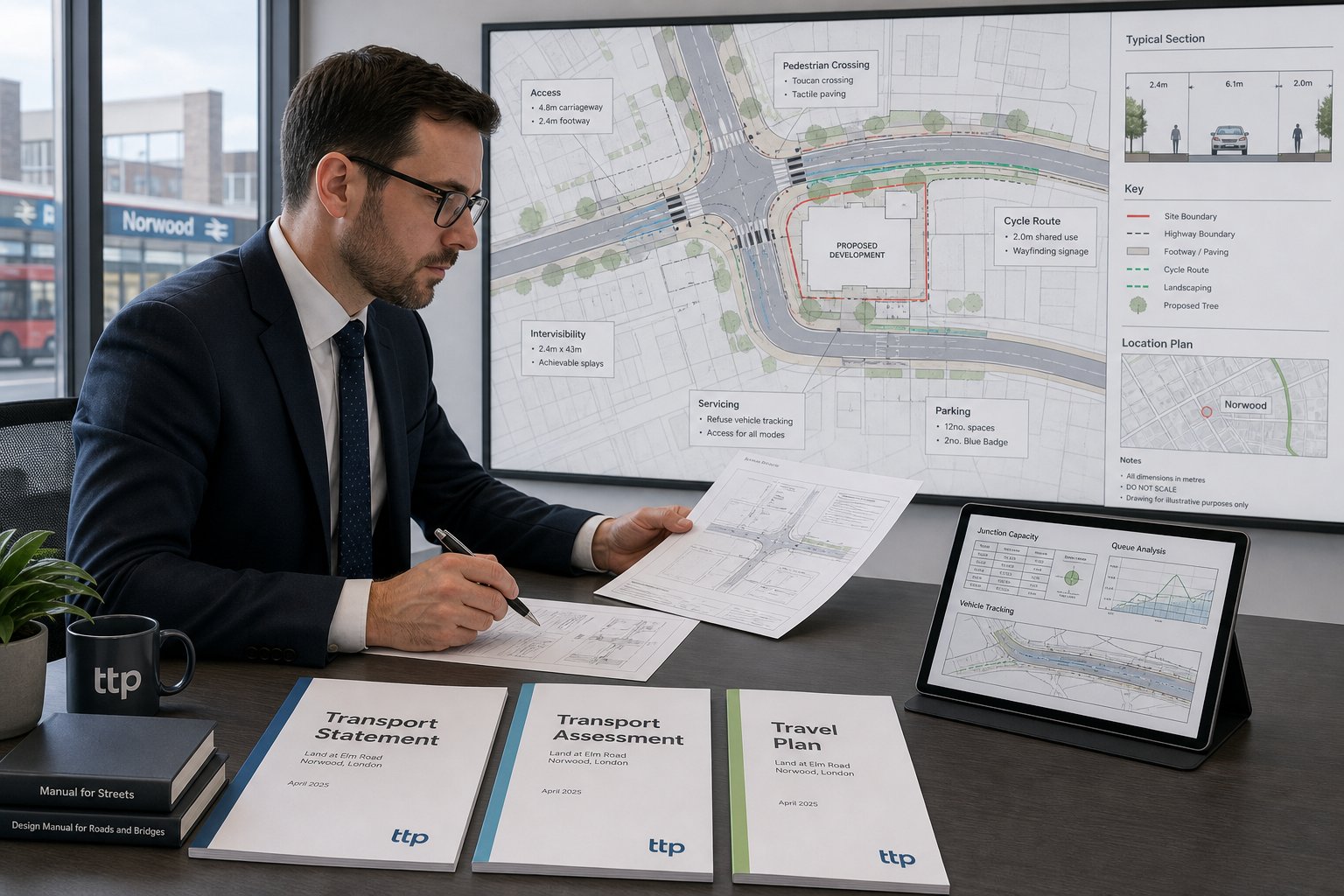
The right report depends on the type, scale and likely impact of the development. At the lighter end, a concise note may be enough to address parking, access, and trip generation. For many planning applications, though, the core transport documents are a Transport Statement, a Transport Assessment, and sometimes a Travel Plan. Supporting drawings or appendices often sit alongside them.
The distinction matters because local authorities expect the level of evidence to match the scale of the proposal. Under-scoping can lead to objections: over-scoping can waste time and budget. We hence advise teams early on what is proportionate and defensible.
Transport Statement Vs Transport Assessment Vs Travel Plan
A Transport Statement (TS) is usually used for smaller or lower-impact schemes. It provides a concise appraisal of existing conditions, access arrangements, likely trips, parking provision, servicing, and road safety considerations. It is meant to be focused rather than lightweight.
A Transport Assessment (TA) is more detailed. It is generally required where impacts could be material, where sensitive junctions are involved, or where officers need a fuller evidence base. A TA may include survey analysis, committed development review, distribution and assignment, junction modelling, and mitigation testing.
A Travel Plan (TP) is different again. It deals with behaviour rather than pure infrastructure capacity, setting out measures to encourage walking, cycling, public transport use, car sharing, and monitoring. For a broader explanation of how these disciplines overlap in development planning, our article on Traffic Engineering and is useful.
Junction Capacity, Vehicle Tracking, And Access Reviews
Many Norwood schemes need more than a headline transport report. Junction capacity assessments may be required to test whether nearby priority, signalised, or roundabout junctions can accommodate forecast demand. The exact method depends on local layout and authority expectations, but the principle is simple: quantify queues, delay and reserve capacity rather than rely on assumption.
Vehicle tracking is equally important where refuse vehicles, delivery vans, emergency appliances or larger service vehicles must enter, turn, and leave safely. A layout that works for a car can fail badly for a larger vehicle.
Access reviews bring these themes together. We examine geometry, gradients, intervisibility, pedestrian desire lines, cyclist interaction, and whether the proposed entrance arrangement is realistic in day-to-day operation. Detailed access design highway advice often becomes critical where space is tight.
Local Authority Expectations And Why Early Advice Matters
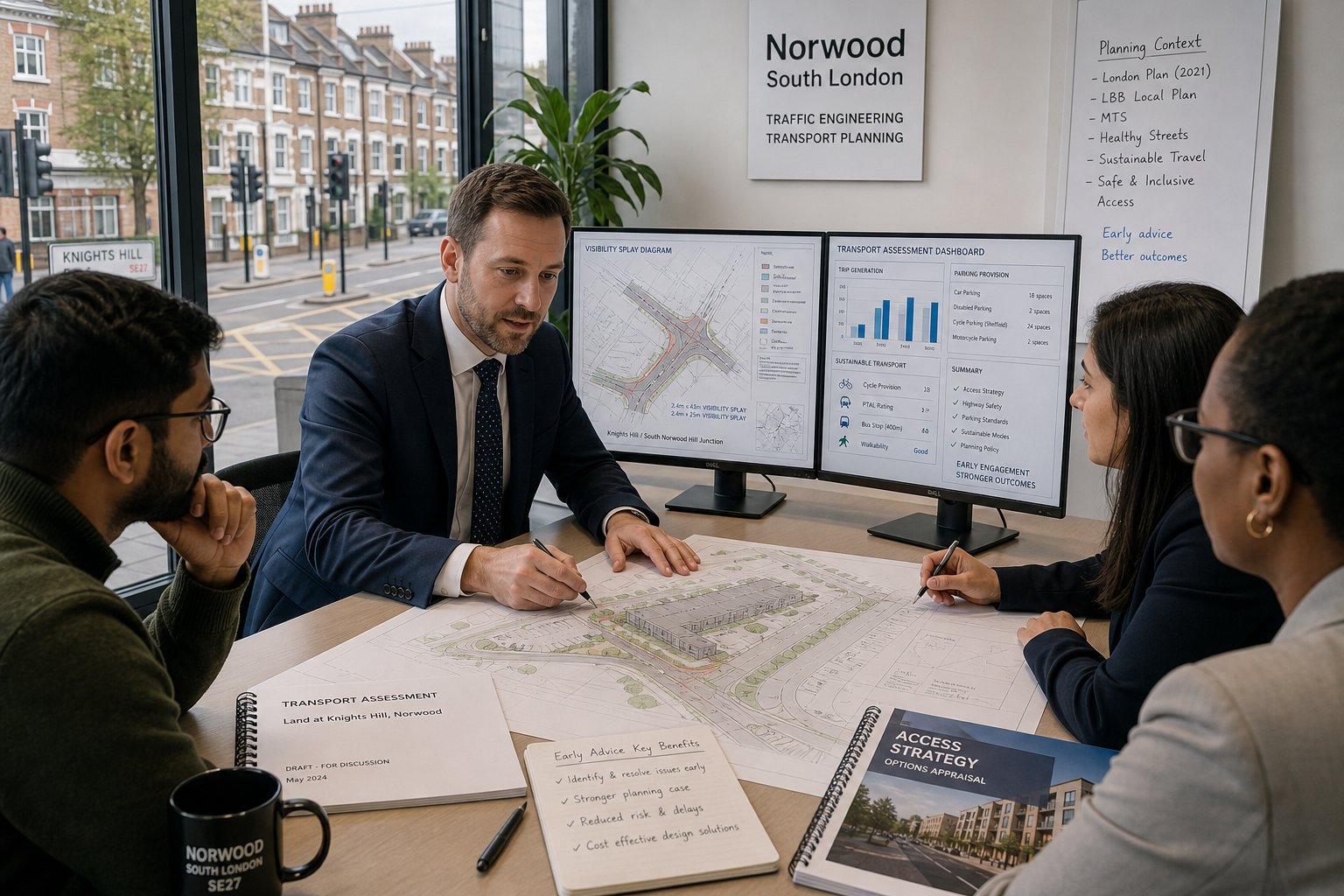
Local authority expectations are rarely limited to whether a site can physically be reached by car. Officers typically want to know whether the proposal accords with development plan policy, meets visibility and safety standards, provides appropriate parking and cycle facilities, avoids unacceptable impact on network operation, and supports sustainable travel in a believable way.
In and around Norwood, that means evidence needs to be local, proportionate and properly scoped. Authorities are alert to generic transport reports that could have been written for anywhere. They expect references to real street conditions, actual survey periods, and a clear explanation of why a chosen methodology suits the site.
Early advice matters because it lets us shape the design before poor assumptions harden into planning drawings. We can identify if a parking court will fail to track, if an access sits too close to a junction, if a basement ramp gradient is likely to raise concern, or if servicing should be controlled by condition and management plan. That saves redesign later.
It also helps with authority engagement. Where appropriate, pre-application discussion or scoping can narrow the issues and avoid producing either too little or too much technical work. Our overview of Highway And Traffic explains why planning success often depends on this blend of strategy and technical detail.
Done well, early transport input is not an extra cost bolted on to planning. It is one of the more reliable ways to protect programme and reduce uncertainty.
The Traffic Engineering Process From Initial Review To Submission
The process usually begins with an initial review of the site, drawings and proposed use. We look at red-line boundaries, likely trip generation, nearby constraints, planning history, and whether the key questions are access, parking, servicing, capacity, road safety, or all of the above. At this stage, we are often giving candid advice: what is likely to be acceptable, what may need redesign, and what level of reporting is proportionate.
Next comes scoping. That may involve agreeing survey requirements, deciding which junctions should be assessed, identifying vehicle types for tracking, and checking whether a Travel Plan or delivery strategy is likely to be expected. If needed, we support pre-application discussions so the transport evidence is aligned with officer expectations.
Then we move into data collection and technical analysis. Traffic counts, parking beat surveys, speed data, collision review, site observations and public transport assessment may all feed into the work. Once the evidence base is in place, we prepare the modelling, access checks, swept-path analysis and report drafting.
The final stage is submission support. That means producing the TS, TA or TP, issuing drawings, coordinating with architects and planners, and responding to statutory consultee comments. Our experience at Traffic Engineer In scale projects shows the same principle again and again: the cleaner the process upfront, the fewer surprises after validation.
It sounds linear on paper. In reality, there is usually some back-and-forth. Good teams plan for that rather than pretending otherwise.
Information Needed To Prepare A Robust Transport Report
A robust transport report depends on having the right project information early enough to use it properly. The essentials are straightforward but often arrive piecemeal: red-line boundary, site address, existing and proposed drawings, land use schedule, unit mix or floorspace, parking numbers, cycle provision, refuse strategy, servicing assumptions, and any known construction constraints.
We also need clarity on how the site will operate. Will deliveries be timed? Can refuse be collected within the site or from the highway? Is there a management company? Are disabled bays, EV charging, or secure cycle stores proposed? Where basement or rear servicing is involved, dimensions and levels matter more than teams sometimes expect.
Existing information is just as useful. Prior appeal decisions, planning officer comments, previous transport notes, speed surveys, parking surveys, and collision concerns can all help us scope work intelligently. So can architectural iterations. A transport report prepared against obsolete drawings is one of the easiest ways to create avoidable delay.
As a practical rule, we encourage design teams to issue a single coordinated pack before technical drafting starts. It sounds basic, but it saves hours of revision and makes the final submission more coherent. For a wider view of how transport evidence fits within planning strategy, our guide to Traffic Engineering: Your covers the fundamentals clearly.
The quality of the report usually reflects the quality of the inputs. Not glamorous, but true.
Common Reasons Transport Reports Are Delayed Or Challenged
Most transport reports are not delayed because the analysis itself is impossible. They are delayed because key assumptions change, critical information arrives late, or the evidence base is weaker than the proposal requires. We see the same patterns repeatedly.
Incomplete or outdated surveys are a major issue. If counts were undertaken in an unrepresentative period, if parking stress was measured too narrowly, or if layouts changed after surveys were commissioned, the authority may question reliability. Underestimating trip generation can be just as damaging. Officers quickly spot when rates feel selectively optimistic, especially on schemes with active frontages, school-related demand, or delivery-heavy uses.
Design compliance is another pressure point. Access widths, gradients, visibility splays, turning areas and pedestrian conflict need to align with accepted standards or be justified properly where departures are proposed. Vague statements such as “vehicles can manoeuvre comfortably” do not help without drawing-based evidence.
Late scope changes can unravel a report too. A revised unit mix, relocated bin store, altered parking ratio, or new servicing assumption may require fresh tracking, updated appendices, or changed conclusions. And sometimes the challenge is simply communication: the report may be technically correct but not written in a way that officers can follow quickly.
The fix is usually not more volume. It is better scoping, cleaner coordination and sharper explanation from the start.
Choosing A Traffic Engineer For Norwood Projects
Choosing the right consultant is partly about qualifications and partly about judgement. For Norwood projects, we would look for proven development planning experience, a clear understanding of local authority expectations, and the technical capability to handle the specific risks of the site. That includes junction assessment, vehicle tracking, parking analysis, access design review, and concise report writing.
Just as important is commercial awareness. A good traffic engineer should know when a short, focused case will do the job and when a more detailed assessment is essential. Over-engineering a straightforward scheme wastes time. Under-supporting a sensitive one can cost far more.
We also think communication matters more than many clients expect. The best technical work in the world will struggle if it cannot be explained clearly to planners, architects, applicants and officers. That is one reason ML Traffic emphasises concise, accurate reporting shaped by more than 30 years of experience and tailored to planning thresholds rather than copied from a standard template.
When reviewing options, ask practical questions. Has the consultant handled comparable urban sites? Do they understand local parking pressure and constrained accesses? Can they advise on layout before the planning package is fixed? Can they respond quickly to consultee comments? The answers usually tell you more than a glossy credentials page.
In short, choose someone who can de-risk the application, not just produce a document.
Conclusion
A traffic engineer in Norwood is there to do more than satisfy a technical planning requirement. Done properly, transport input helps shape the scheme, tests whether access and movement arrangements are genuinely workable, and gives planning officers a clear basis for concluding that highway safety and network impact have been addressed.
For architects, planners, surveyors, lawyers, builders and developers, the main lesson is simple: bring transport advice in early enough to influence the design, not merely defend it after the fact. In Norwood, where local street conditions can change the planning position quickly, that early clarity can save redesign, reduce objections and improve application timing.
Whether the project needs a concise Transport Statement or a more detailed assessment package, the strongest submissions are usually the ones built on realistic assumptions, coordinated drawings and local highways insight from the outset.
Frequently Asked Questions About Traffic Engineering in Norwood
What role does a traffic engineer in Norwood play in planning applications?
A traffic engineer in Norwood assesses how developments affect local highways and road safety. They review policies, traffic generation, parking, and access, producing evidence-based transport reports and design plans to satisfy planning and highway authorities. This reduces planning risks and supports successful applications.
When is transport input required for a development in Norwood?
Transport input is needed if a development introduces new or modified vehicle access, increases traffic, parking or servicing demand, or is situated in sensitive locations like near schools or congested junctions. Early transport advice can influence design and ensure compliance with local regulations.
What types of projects typically require traffic engineering support in Norwood?
Common projects include residential schemes, HMOs, retail and leisure facilities, healthcare sites, schools, employment zones, warehouses, and mixed-use developments. Even small changes like refurbishments or changes of use that alter trip generation or parking demand may require technical transport advice.
How do Norwood’s local site conditions influence traffic engineering advice?
Norwood’s narrow streets, parking pressure, visibility restrictions, gradients, bus activity, and congested junctions significantly shape transport recommendations. Good advice must align with these local constraints and consider sustainable travel options to produce realistic, workable access and parking strategies.
What are the differences between a Transport Statement, Transport Assessment, and Travel Plan?
A Transport Statement offers a concise review for smaller schemes covering access, trip generation, parking, and safety. A Transport Assessment delivers detailed modelling and junction analysis for larger projects. A Travel Plan focuses on behavioural measures to promote walking, cycling, and public transport use, supporting sustainable travel goals.
Why is early engagement with a traffic engineer important for Norwood developments?
Early involvement helps identify and address transport issues before finalising designs, avoiding costly redesign and delays. It supports appropriate scoping of reports and surveys, improves coordination with local authorities, and aligns proposals with policy and technical requirements, increasing the likelihood of timely planning approval.