
Planning in Worcester Park can look straightforward on a drawing and become far more complicated the moment transport is raised. A scheme may fit the site neatly, satisfy land use aims and still run into trouble because the access is substandard, parking is disputed, servicing is awkward, or the local highway authority is not convinced that extra trips can be safely absorbed. That is usually where a traffic engineer in Worcester Park becomes essential.
We work with architects, planning consultants, developers, solicitors, surveyors and public-sector teams to turn transport from a late-stage obstacle into an evidence-led part of the planning strategy. In practice, that means assessing how a proposal affects roads, junctions, pedestrians, cyclists, buses, servicing and road safety, then presenting those findings in a form that planning officers and highway officers can actually use.
In 2026, that role matters even more. Local authorities expect transport submissions to align with the National Planning Policy Framework, Manual for Streets, local validation requirements and increasingly detailed expectations around active travel, accessibility and healthy streets. A short, generic report rarely survives scrutiny.
The good news is that many transport issues can be resolved early, often before they become reasons for delay or refusal. The sections below explain where traffic engineering fits into Worcester Park development, when professional input is needed, and how a robust transport submission can improve the path to planning approval.
Key Takeaways
- A traffic engineer in Worcester Park is essential to address transport-related planning challenges such as access, parking, servicing, and road safety for smoother development approval.
- Early involvement of a traffic engineer helps integrate transport considerations into the design, preventing delays and costly redesigns during the planning process.
- Robust transport submissions must align with local authority requirements and include evidence-based assessments of access safety, junction capacity, parking, servicing, and sustainable travel.
- Transport reports in Worcester Park should be proportionate and locally tailored, using accurate surveys and addressing specific site contexts to withstand scrutiny and objections.
- Effective collaboration between traffic engineers, architects, planning consultants, and developers ensures transport strategy supports the overall planning and design objectives efficiently.
- Choosing an experienced traffic engineer with local knowledge and practical skills in access design and transport assessments significantly improves the likelihood of planning success.
Why Traffic Engineering Matters For Development In Worcester Park
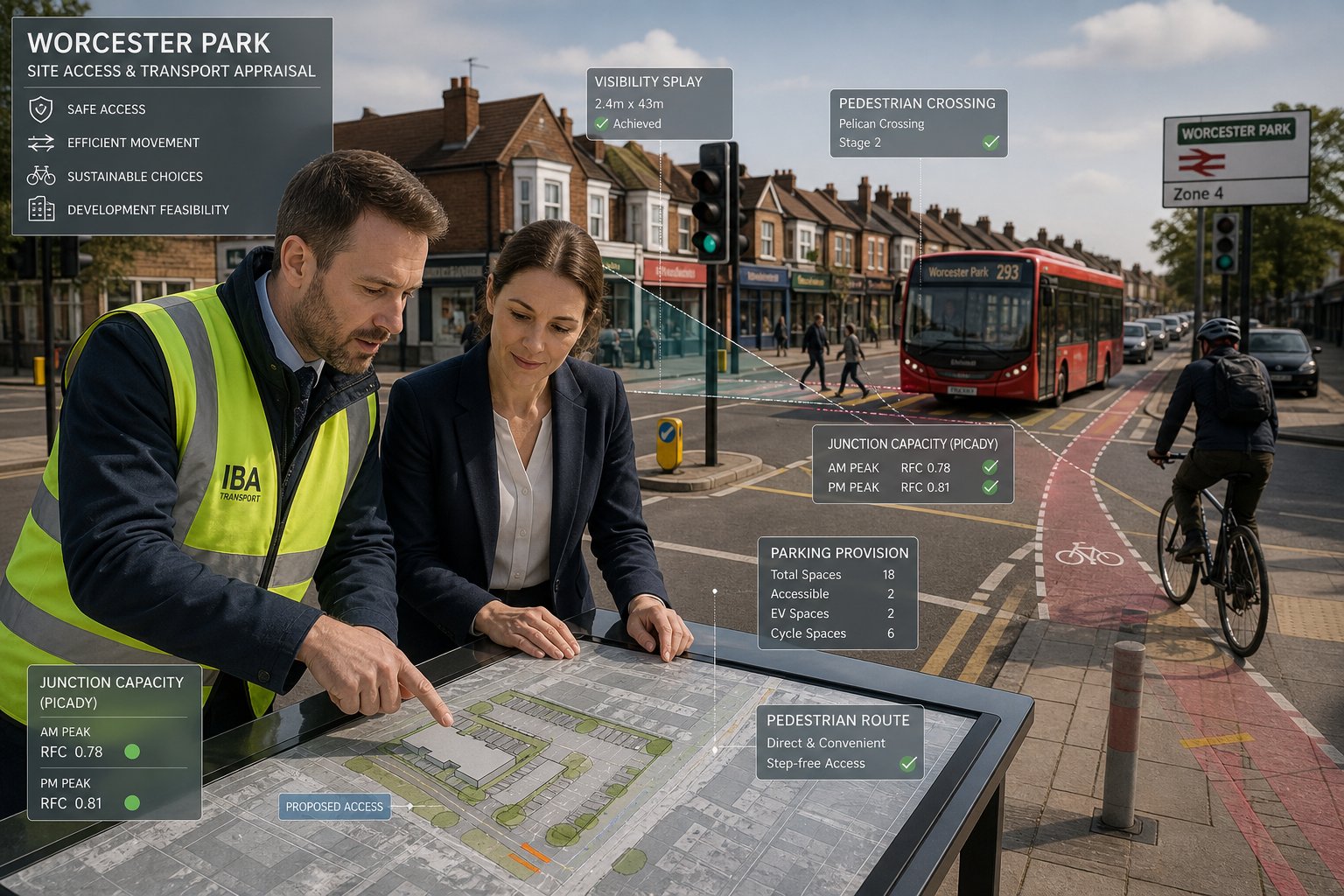
Traffic engineering matters because planning permission is not only about land use: it is also about movement. If a development cannot be accessed safely, does not provide workable servicing, creates unacceptable queuing, or undermines walking and cycling conditions, the application can quickly become vulnerable.
In Worcester Park, that tension is familiar. Schemes often sit within established streets where road widths, frontage activity, school travel patterns, bus movements and parking stress are already sensitive. Even relatively modest proposals can raise technical questions: Will vehicles enter and leave safely? Is the access geometry acceptable? Are visibility splays achievable? Will the junction operate within capacity? Does the proposal increase on-street pressure?
Our role is to answer those questions with evidence rather than assumption. A well-prepared transport submission demonstrates existing conditions, forecasts likely demand and tests whether impacts are severe in planning terms. It can also identify mitigation early, whether that is layout refinement, improved pedestrian links, servicing controls, revised parking provision or junction changes.
That practical problem-solving is one reason transport input often saves time overall. Instead of waiting for objections, the design team can shape the scheme around realistic highway constraints from the outset. Broader principles set out in Traffic Engineering: Your reports still apply locally, but Worcester Park projects benefit most when those principles are tied to the actual street network, authority expectations and site context.
Local Planning And Highway Considerations In Worcester Park
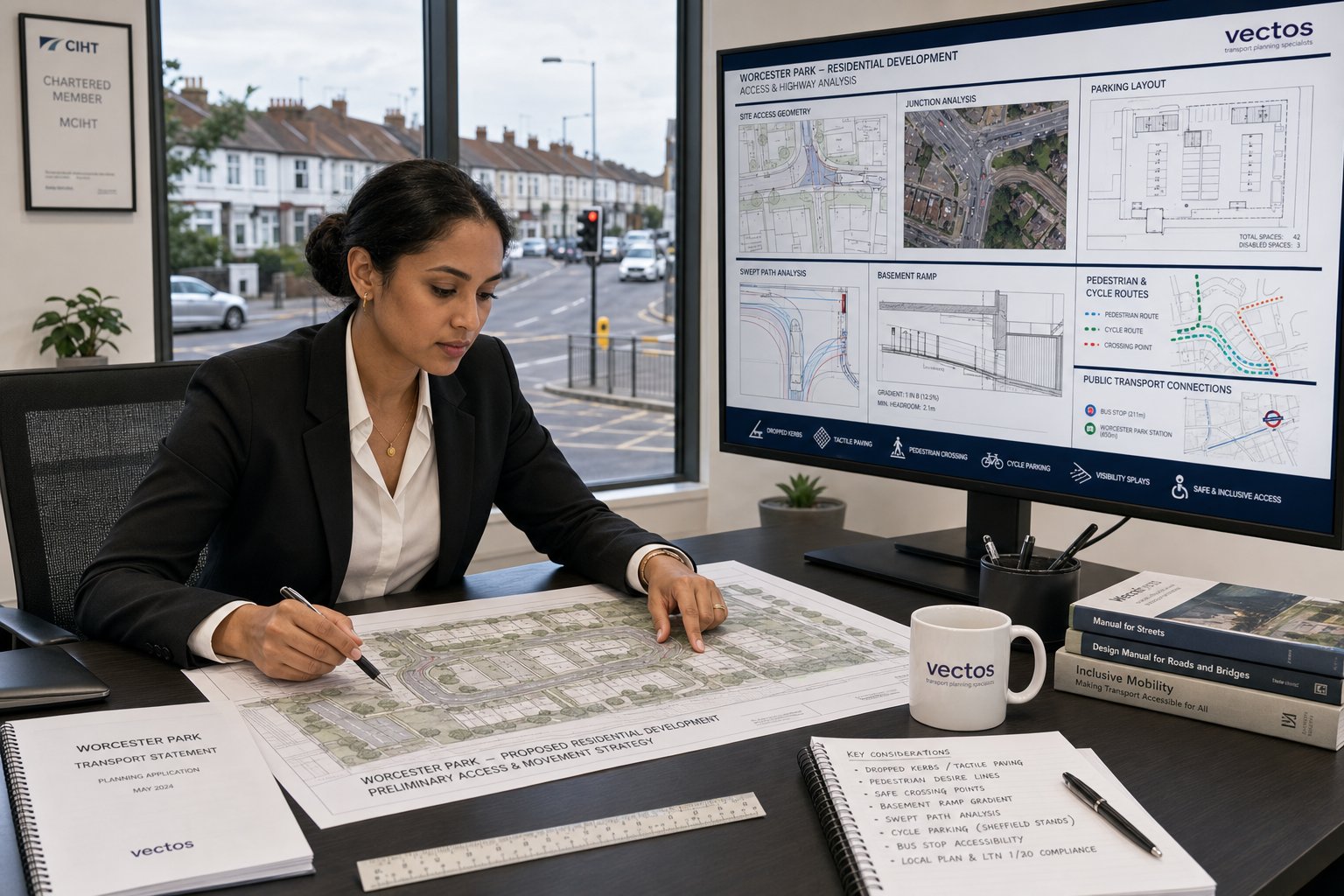
Worcester Park sits within a planning context that can involve different local authority expectations depending on the exact site location and highway interface, so transport advice needs to be locally alert rather than generic. That includes understanding local plan policies, parking standards, design guidance, adoption issues, disabled access requirements and the approach taken by the relevant highway authority when validating planning submissions.
The recurring themes are usually consistent. Officers want confidence on five points:
- safe and suitable access for all users
- acceptable impact on junction operation and network capacity
- compliant and realistic parking provision
- workable servicing, refuse collection and emergency access
- support for sustainable travel, particularly walking, cycling and public transport
In built-up suburban areas such as Worcester Park, there is often very little spare road space. That means small design choices matter. A gate position, a dropped kerb width, a turning head, or a basement ramp gradient can influence whether an application proceeds smoothly or gets pushed into several rounds of queries.
We hence prefer to review transport issues before layouts are fixed. Early checks on access design, swept paths, likely trip generation and local standards often reveal whether a proposal is aligned with policy expectations. Similar local-authority thinking appears across nearby projects discussed in Traffic Engineer In London:, but Worcester Park schemes still need a report tailored to the exact planning and highway geography of the site.
When A Traffic Engineer Is Needed For A Planning Application
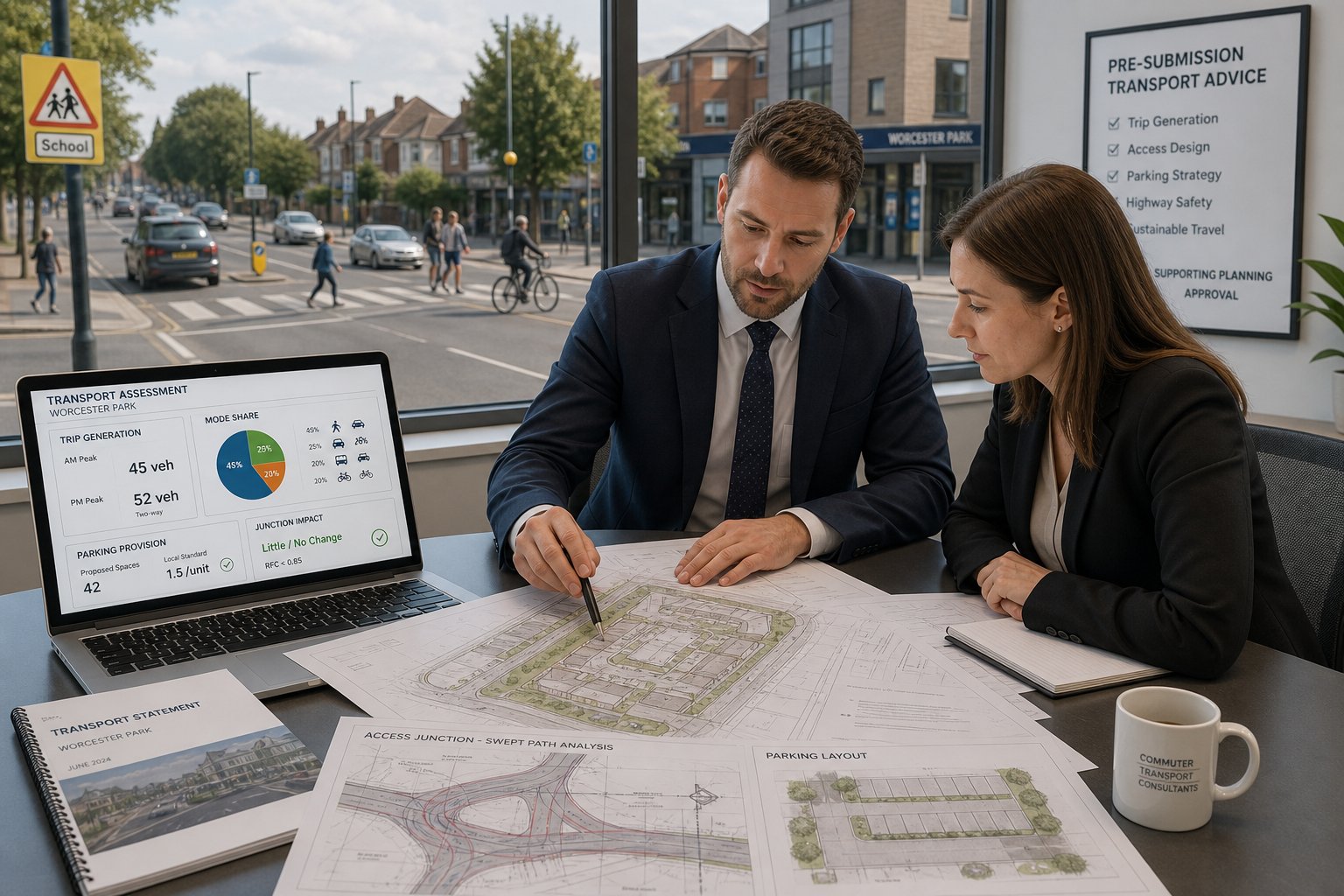
A traffic engineer is usually needed when a proposal is likely to change travel demand, alter highway access, affect parking or raise safety and capacity questions. In reality, that covers far more schemes than many applicants first assume.
We are commonly appointed where a development:
- creates a material increase in vehicle, cycle or pedestrian trips
- proposes a new or altered vehicular access
- removes, redistributes or intensifies parking
- sits close to a busy junction, school, parade or constrained road
- introduces servicing activity that could conflict with street conditions
- requires a Transport Statement, Transport Assessment or Travel Plan
The trigger is not only scale. A ten-unit scheme on a sensitive access can need more transport work than a larger proposal on a forgiving road. Equally, a change of use may appear modest in planning terms but still alter arrival patterns enough to concern the highway authority.
Professional input is especially valuable before submission. Once a refusal reason or technical objection is on file, the team is already reacting. Early advice allows us to frame the likely issues, agree surveys, review access geometry and support the wider planning strategy. For multidisciplinary projects, that mirrors the wider role described in Traffic Engineering Consultants:, but the threshold question is always local: what will this specific Worcester Park application need to prove?
Typical Projects That Require Transport Input
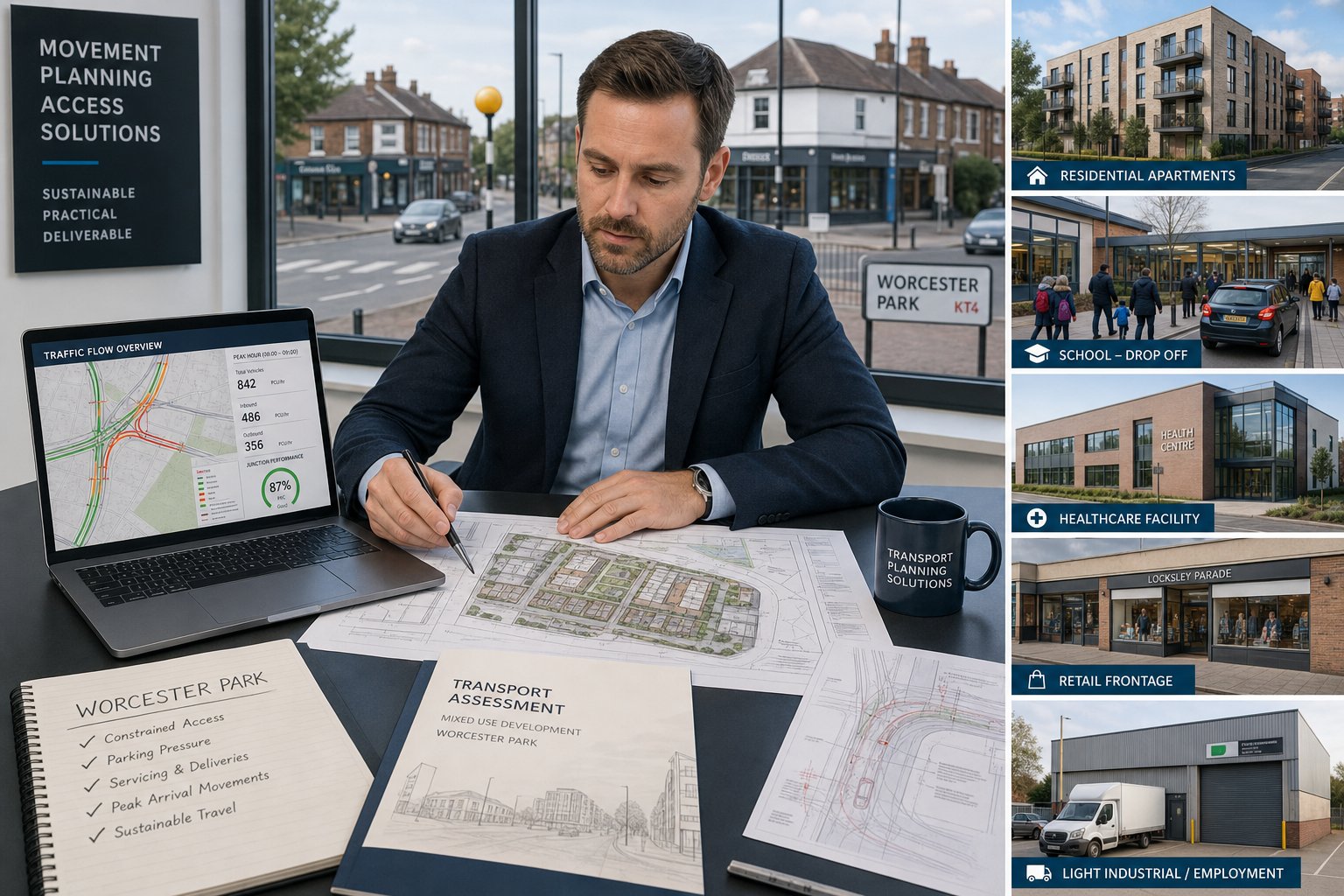
The list is broader than many clients expect. We regularly provide transport input for:
- residential infill, backland and apartment schemes
- larger housing developments and estate regeneration
- mixed-use proposals combining residential with retail or workspace
- retail and food-led changes of use
- schools, nurseries and education facilities
- healthcare and care-related schemes
- industrial, storage and distribution uses
- gyms, leisure and community buildings
- car park reconfiguration or redevelopment proposals
Residential projects are the most common, but not always the most demanding. Education and healthcare uses can produce sharp peaks in arrival activity. Commercial sites may involve larger vehicles, servicing windows and operational constraints. Changes of use often become contentious where parking demand appears to increase while on-site provision decreases.
And then there are the awkward sites: corner plots, one-way frontage roads, accesses near crossings, or developments where refuse vehicles need to reverse unless the layout is redesigned. These are precisely the schemes where transport engineering adds value early. We can often identify whether the issue is evidence, design, or both, and adjust the application package accordingly.
That is particularly important for developer-led work, where programme certainty matters. In sectors with more intensive movement patterns, the lessons in Commercial Traffic Engineering are often directly relevant to Worcester Park planning submissions.
Transport Statements, Transport Assessments And Travel Plans Explained
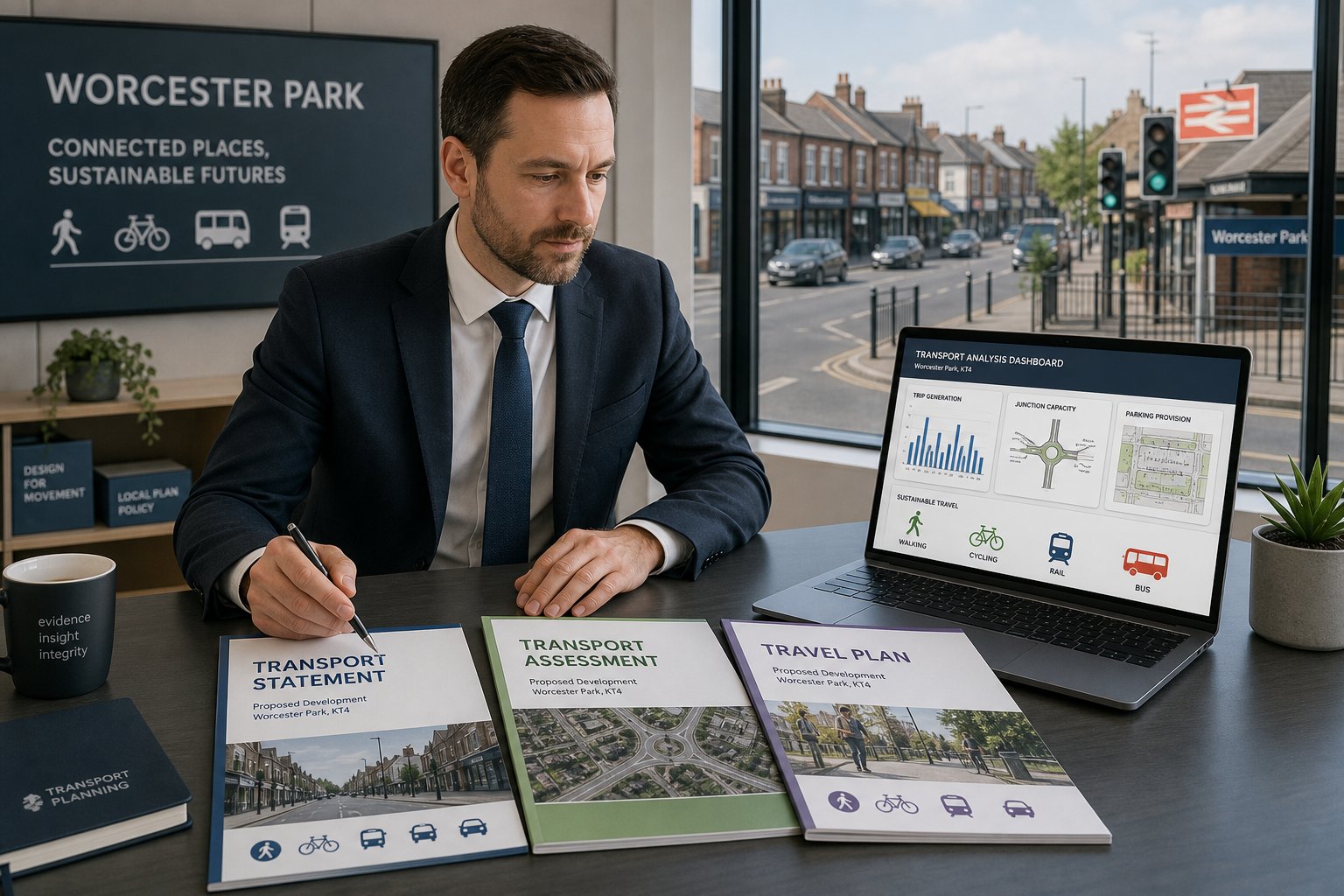
These documents are often mentioned together, but they serve different purposes.
A Transport Statement is usually prepared for smaller or less complex developments. It is a concise, evidence-based report explaining the existing transport context, site accessibility, expected trip generation, access arrangements, parking provision and likely network effects. A good TS is proportionate. It does not bury the authority in unnecessary modelling, but it still answers the obvious questions properly.
A Transport Assessment is more detailed and is generally required for larger schemes or sites with more complex impacts. A TA may include survey analysis, committed development review, junction capacity testing, distribution and assignment assumptions, mitigation proposals and a fuller assessment of sustainable travel opportunities. If a site could materially affect local junction performance or safety, a TA is often the right route.
A Travel Plan complements either document where sustainable travel behaviour needs to be actively managed. It sets out measures, targets, monitoring and responsibilities to encourage walking, cycling, public transport use and sometimes car-sharing or operational controls.
The key is proportionality. Over-reporting wastes time: under-reporting invites challenge. We structure each submission around the authority’s likely concerns and the scale of risk attached to the site. Similar approaches are used in city-specific work such as Traffic Engineer In Birmingham:, but the content always needs to match Worcester Park conditions rather than a template.
Highway Access Design And Visibility Requirements
Access design is one of the first things highway officers inspect, and with good reason. If vehicles cannot enter, exit, pass or turn safely, wider planning benefits often become secondary.
A proper access review considers more than simple width. We assess junction geometry, kerb radii, forward visibility, visibility splays, footway continuity, gradients, proximity to other junctions, pedestrian crossings, on-street parking interference and whether larger vehicles can use the access without overrunning or dangerous manoeuvres.
Guidance typically comes from Manual for Streets, Manual for Streets 2 where relevant, DMRB principles for more strategic interfaces, and local standards adopted by the authority. In suburban locations, but, real-world context matters just as much as textbook dimensions. Mature planting, boundary walls, bus stops, utility apparatus and informal parking can all affect whether a theoretically compliant access works in practice.
We hence combine standards review with site observation. It is surprising how often a layout that appears acceptable on a CAD drawing is compromised by an actual lamp column, a narrow footway or a visibility line blocked by parked vans.
Where access is tight, mitigation may include amended gate positions, altered carriageway width, a shared-surface approach, parking controls or a revised internal arrangement. Getting this right early is usually cheaper than defending a poor design after submission.
Junction Capacity And Trip Generation Assessments
When a scheme generates noticeable movement, the highway authority will want to know two things: how many trips it is likely to create, and whether nearby junctions can cope.
Trip generation is typically estimated using comparable survey databases, local observations, committed development context and professional judgement. For some schemes, especially changes of use, the key question is net change rather than total traffic. For others, the timing of arrivals and departures matters more than the daily total. School and healthcare projects are classic examples.
Those trips then need to be distributed and assigned across the road network in a way that is credible. If assumptions are unrealistic, the modelling will be challenged. If they are too conservative without explanation, the mitigation can become unnecessarily expensive.
Capacity testing may involve priority junction modelling, signal junction analysis, roundabout assessment, queue review and practical consideration of blocking back risk. We look at ratio of flow to capacity, delay, reserve capacity and queue length, but numbers alone do not tell the whole story. A junction can appear technically within capacity and still operate poorly because of pedestrian conflict, poor lane discipline or short stacking distance.
That is why we treat modelling as part of the narrative, not the whole narrative. Reports should explain what the figures mean for users on the ground and whether targeted mitigation is genuinely needed.
Parking, Servicing And Delivery Strategy For New Development
Parking can make or break suburban planning applications. Too little provision and neighbours worry about overspill. Too much and the authority may argue the scheme undermines sustainable travel or wastes developable land. The right answer is rarely a simple maximum or minimum figure copied from a standard.
We assess parking against local standards, land use, public transport accessibility, likely user profile, disabled bays, cycle storage, EV charging expectations and practical layout efficiency. That means asking whether spaces are usable, not just countable. Tight aisles, obstructed bays and awkward tandem arrangements may satisfy a schedule on paper while failing operationally.
Servicing needs the same level of realism. Deliveries, refuse collection, maintenance access and emergency vehicle routes must all be thought through. Swept-path analysis often becomes central here, particularly where larger vehicles need to enter constrained sites without reversing onto the highway or blocking traffic.
Management measures can also help. Timed deliveries, booking systems, concierge-controlled loading or smaller vehicle assumptions may be appropriate, but only if they are credible and enforceable.
Parking evidence is often stronger when it forms part of a wider strategy rather than a single drawing note. That broader approach is reflected in parking strategy traffic, and it is particularly useful for Worcester Park schemes where kerbside pressure already feels close to the edge.
Road Safety, Walking Routes And Cycling Considerations
Modern transport submissions are not only about cars. Highway officers and planners increasingly expect clear evidence that a development provides safe, suitable and attractive conditions for pedestrians, cyclists and other vulnerable users.
That begins with road safety. We review collision data, local highway features, crossing opportunities, visibility constraints, school routes, bus stop access and any history of turning conflicts or speeding concerns. If the proposal alters the highway or introduces a new access, a road safety audit may also be required at the appropriate stage.
Walking and cycling analysis should be practical, not tokenistic. Are footways continuous? Are crossing points direct or inconvenient? Can wheelchair users move comfortably between the site and local services? Is cycle parking secure and accessible? Does the route to the station or town centre involve barriers that reduce real uptake? Those questions matter because the NPPF emphasis on sustainable travel is increasingly interpreted through actual usability, not just map distance.
For Worcester Park projects, this often means balancing suburban car dependency with clear opportunities for mode shift on shorter local trips. Better frontage design, improved crossing provision, clearer pedestrian priority and decent cycle facilities can materially strengthen a planning case.
Where appropriate, these measures can also reduce pressure elsewhere by moderating trip generation and supporting a stronger Travel Plan narrative.
How Traffic Surveys And Local Data Inform A Robust Report
The quality of a transport report depends heavily on the quality of its evidence. Poor survey data leads to weak forecasting, shaky conclusions and predictable challenge from officers or objectors.
Depending on the site, we may use classified turning counts, automatic traffic counts, queue length surveys, pedestrian and cycle counts, parking beat surveys, speed surveys, servicing observations and public transport accessibility information. The survey scope has to match the questions being asked. If parking is contentious, a single daytime snapshot is rarely enough. If a school is nearby, term-time peak conditions matter. If a junction is close to capacity, queue and delay observations need to be robust.
Local knowledge is equally important. Survey numbers without context can mislead. Temporary roadworks, abnormal weather, rail disruption, holiday periods or unusual local events can distort results. We sense-check the dataset before building a planning case on it.
This is one reason concise, accurate reporting matters. At ML Traffic, we focus on evidence that is proportionate, current and clearly linked to the authority’s likely concerns, rather than producing pages of data no one will rely on. Comparable regional practice appears in Traffic Engineer In Bristol:, but the principle is universal: credible local data usually carries more weight than broad assumption.
Working With Architects, Planning Consultants And Developers
Transport engineering works best as part of the design and planning team, not as a last-minute add-on. When we are brought in at concept stage, we can help shape site layout, access points, parking strategy, refuse movements, cycle storage, pedestrian permeability and the likely scope of transport reporting before the application narrative hardens.
That early coordination helps everyone. Architects avoid spending time refining layouts that will later fail swept-path or visibility checks. Planning consultants can build transport evidence into the planning statement from the start. Developers gain a clearer view of risk, likely survey needs and whether mitigation should be costed into viability.
We also act as a technical bridge between disciplines. Lawyers may need transport evidence to support appeal strategy or planning obligations. Surveyors may want assurance that operational assumptions are realistic. Local authorities often respond better when the submission package feels coordinated rather than stitched together from separate consultant notes.
In practice, this collaborative role includes attending design meetings, reviewing evolving plans, responding to officer comments and refining documents as the application progresses. Fast, clear coordination can be the difference between a smooth determination and months of avoidable back-and-forth.
The point is simple: transport should inform design, not just explain it afterwards.
Common Reasons Transport Submissions Are Delayed Or Challenged
Most transport objections are not caused by extreme technical complexity. They usually arise because the submission leaves obvious gaps.
Common problems include:
- survey data collected at the wrong time or in insufficient detail
- failure to justify whether a TS or TA is the correct report type
- unsupported trip rates or weak distribution assumptions
- access drawings that do not match the architectural set
- parking layouts that are nominally compliant but operationally poor
- ignored road safety concerns or lack of collision review
- missing swept-path analysis for refuse or servicing vehicles
- Travel Plans that are generic and unmonitored
- failure to respond directly to pre-application or officer comments
Another frequent issue is tone. A defensive report that minimises every concern can be less persuasive than a balanced one that acknowledges constraints and addresses them clearly. Highway officers read these documents every day: they know when a submission is stretching the evidence.
We find that the strongest reports are proportionate, specific and candid. If there is a pinch point, explain it. If mitigation is needed, show it. If assumptions are conservative, justify them. That approach tends to resolve concerns faster than trying to argue around them.
Delays often begin long before validation, usually when the transport scope is underestimated. Fixing that early is far easier than repairing confidence later.
Choosing A Traffic Engineer For Worcester Park Projects
Choosing the right consultant is partly about qualifications and partly about judgement. For Worcester Park projects, we would look for a traffic engineer with strong UK development-control experience, a track record in Transport Statements and Transport Assessments, practical access design capability, familiarity with road safety issues and, crucially, an understanding of how local highway authorities actually review submissions.
That sounds obvious, but there is a difference between producing a technically correct report and producing one that helps a planning application move forward. Good transport advice is proportionate, timely and commercially aware. It should identify likely objections early, explain options plainly and avoid overcomplicating matters just to appear thorough.
We would also value responsiveness. Planning programmes rarely pause while consultants disappear for two weeks. Teams need clear advice, fast revisions and reports that align with the rest of the application set. Experience matters here. With more than 30 years in transport planning support, our focus is on concise reporting that addresses the relevant authority thresholds and real decision points rather than flooding clients with unnecessary technical volume.
A capable traffic engineer in Worcester Park should eventually make the scheme easier to approve, easier to defend and easier to deliver. If they cannot explain the transport risk in plain English, that is usually a warning sign.
The best appointment is rarely the cheapest fee on day one: it is the consultant whose work reduces delay, redesign and uncertainty across the whole planning process.
Frequently Asked Questions About Traffic Engineering in Worcester Park
What role does a traffic engineer play in Worcester Park development planning?
A traffic engineer in Worcester Park assesses how developments affect local roads, junctions, parking, and road safety, ensuring proposals meet planning policies like the National Planning Policy Framework and Manual for Streets, and helps secure planning approval by addressing transport concerns early.
When is it necessary to hire a traffic engineer for a planning application in Worcester Park?
Professional traffic engineering input is needed when a development increases vehicle or pedestrian trips, changes highway access, modifies parking, or is near busy junctions or sensitive areas. This typically requires preparing a Transport Statement or Transport Assessment to satisfy local authority requirements.
What are the differences between a Transport Statement, Transport Assessment, and Travel Plan?
A Transport Statement is a concise report for smaller or less complex developments outlining transport impacts. A Transport Assessment offers a detailed analysis with modelling for larger or more impactful schemes. A Travel Plan accompanies either to promote sustainable travel through measures and monitoring.
How do traffic engineers address parking and servicing issues in Worcester Park developments?
They evaluate parking provision against local standards considering user needs, EV charging, and operational usability, along with swept-path analyses for servicing and delivery vehicles to ensure safe access and minimise on-street obstruction, often integrating these into a broader parking strategy traffic approach.
What local planning and highway considerations affect traffic engineering in Worcester Park?
Traffic engineers must ensure developments provide safe access for all users, acceptable effects on junction capacity, compliant parking, workable servicing, and support for sustainable travel modes, while adhering to local plan policies and standards for design, disabled access, and road adoption.
How can early involvement of a traffic engineer benefit planning applications in Worcester Park?
Early engagement helps shape site layouts, access, parking, and transport reporting to pre-empt technical objections, align proposals with local highway authority expectations, and streamline the planning process, reducing delays and redesign costs for architects, developers, and planners.