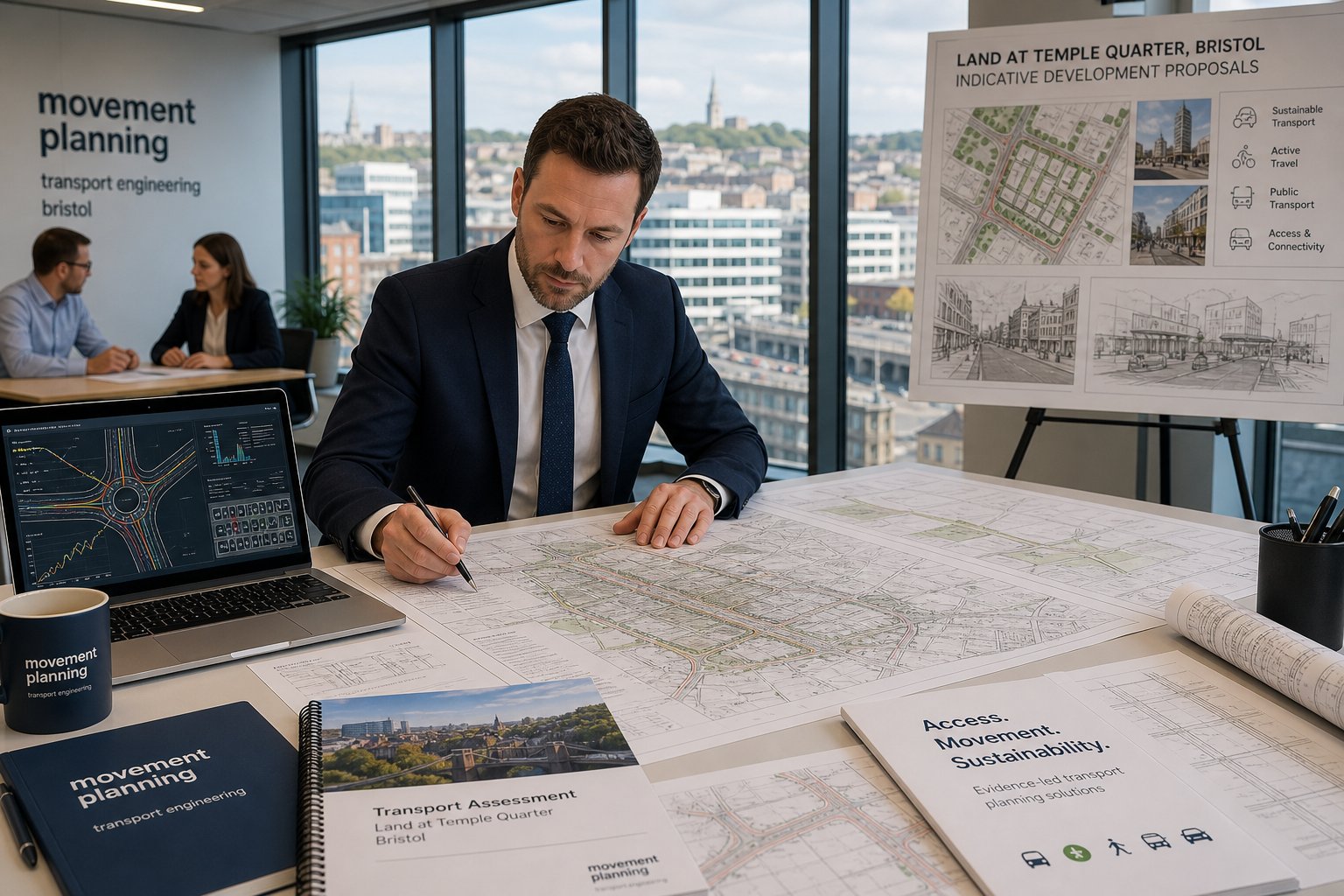
Planning in Bristol rarely fails because a drawing looks untidy. More often, schemes run into trouble because transport questions arrive late, feel under-evidenced, or don’t reflect how the city actually works on the ground. A site can look straightforward on paper, yet still raise difficult issues around access, parking restraint, deliveries, resident permits, walking routes, junction pressure, or emergency vehicle manoeuvring.
That is where a traffic engineer in Bristol earns their keep. We help turn transport from a planning risk into a structured, defensible part of the application. For architects, planners, surveyors, developers and legal teams, that usually means one thing: fewer surprises. We assess how a proposal interacts with the local highway network, whether the access works safely, what level of reporting is proportionate, and how Bristol City Council or other transport stakeholders are likely to read the evidence.
In a city with a constrained street pattern, a strong sustainable transport agenda, and close scrutiny of development impacts, generic reporting often isn’t enough. What matters is locally informed judgement backed by clear technical work. In this guide, we set out what a traffic engineer in Bristol actually does, which schemes typically need transport input, when reports such as Transport Assessments or Travel Plans are required, and how the right advice can help applications move faster and with less friction.
Key Takeaways
- A traffic engineer in Bristol provides essential, locally informed transport evidence that supports robust planning applications and reduces risks of delays.
- Early involvement of a traffic engineer ensures access, parking, servicing, and sustainable travel issues are addressed effectively before submission.
- Transport submissions in Bristol must reflect the city’s unique constraints and policies, including its street pattern, sustainable transport goals, and parking controls.
- Transport Assessments, Statements, and Travel Plans serve distinct roles and must be tailored to the scale and impact of the development in Bristol.
- Swept path analysis is critical for confirming safe vehicle manoeuvrability on constrained urban sites common in Bristol developments.
- Selecting a traffic engineer with local Bristol experience, planning-focused judgement, broad expertise, and strong communication skills significantly improves planning outcomes.
What A Traffic Engineer In Bristol Does For Planning And Development Projects
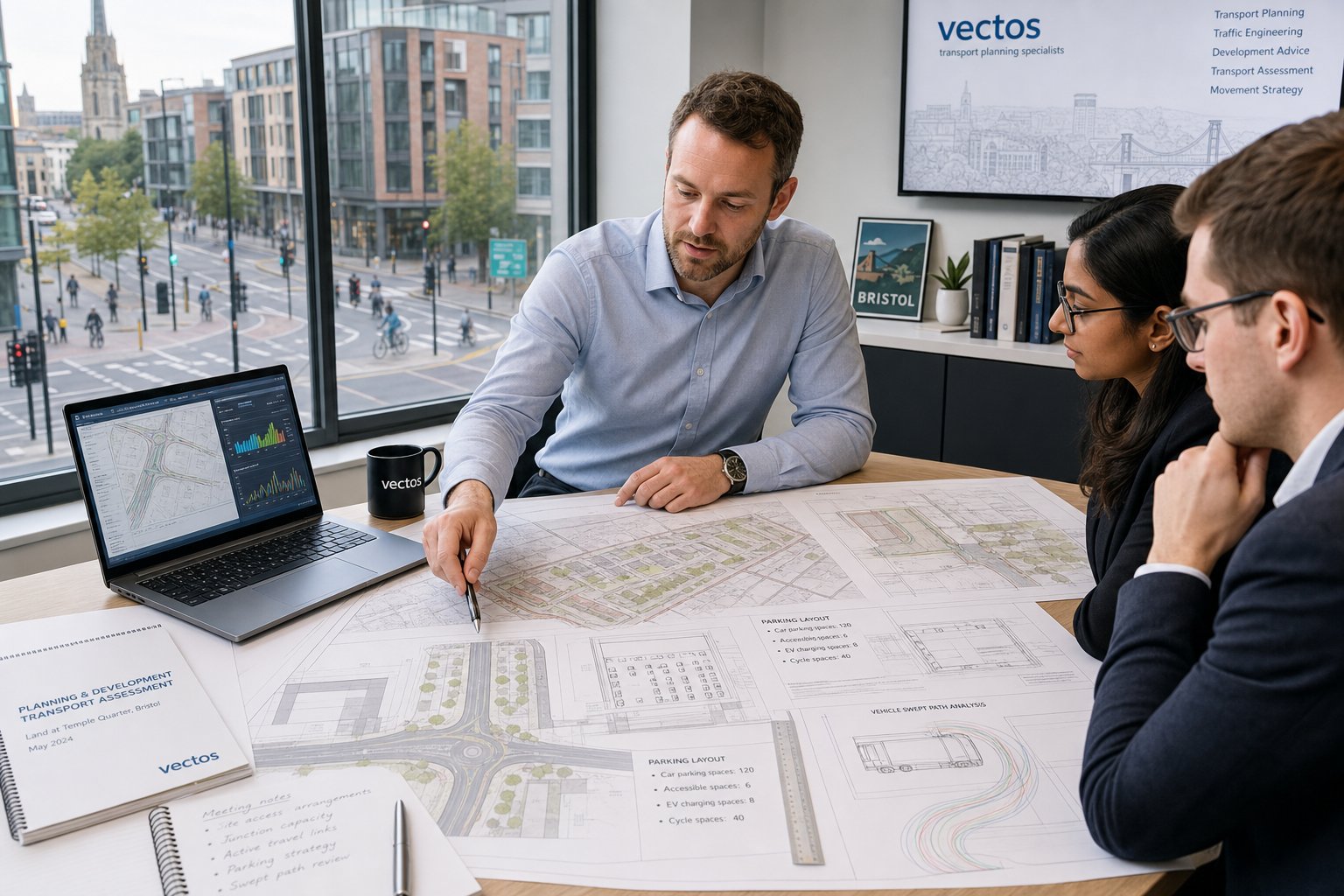
A traffic engineer in Bristol provides the technical transport evidence that sits behind a robust planning application. In practice, our role starts well before submission. We review the site, the surrounding street network, the likely trip patterns, and the policy context to decide what transport issues are likely to matter most.
That can include forecasting traffic generation, reviewing junction performance, checking whether the access arrangement is workable, and testing whether vehicles can enter and leave safely. It also includes softer but increasingly important questions: are walking and cycling routes credible, is the layout inclusive, does the scheme support sustainable travel, and is the parking approach aligned with local expectations rather than just national norms?
For some projects, we prepare concise technical notes. For others, we produce a full package of planning reports, such as a Transport Assessment, Transport Statement, Travel Plan, technical drawings, and swept path analysis. Much depends on scale, use class, site constraints and how sensitive the location is.
Our involvement often overlaps with wider design and planning teams. We work alongside architects on internal layouts, with planners on strategy, with solicitors where access rights or highway agreements matter, and with developers who need practical advice rather than textbook theory. That broader role is one reason many clients also look at how Traffic Engineering Consultants: What support planning decisions across different authority areas.
At its best, traffic engineering is not just about numbers. It is about translating transport risk into evidence a planning officer and highway authority can realistically rely on.
Why Bristol Developments Need Locally Informed Transport Advice
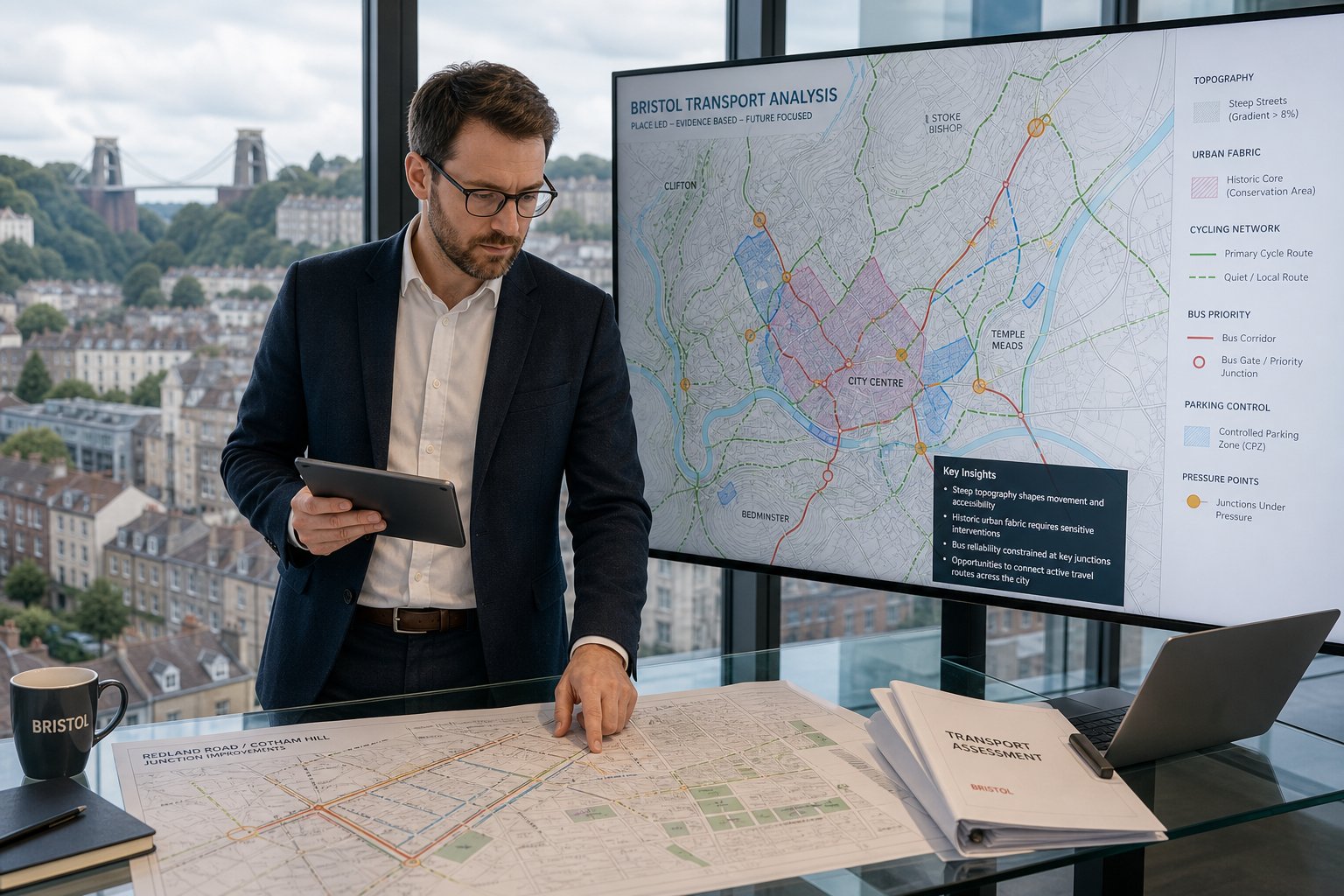
Bristol is not a place where generic assumptions travel well. The city’s steep topography, historic streets, dense neighbourhoods, controlled parking areas, Clean Air Zone, bus priorities and cycling ambitions all affect how a proposal should be assessed. A scheme that might be straightforward in a lower-density authority can become far more sensitive here.
Local knowledge matters in obvious ways, such as understanding likely traffic routes or when nearby junctions are already under pressure. But it also matters in less obvious ways. Officers will often expect transport submissions to reflect the lived reality of an area: whether a street already suffers from informal loading, whether schools create short but intense peaks, whether on-street parking stress is politically sensitive, or whether nearby walking links feel attractive enough to justify lower car use assumptions.
That is why a Bristol-focused approach tends to produce stronger planning material than a one-size-fits-all template. The thresholds for detailed reporting, the likely concerns of the local highway authority, and the acceptability of parking restraint all need local calibration. We often find that early judgement is as valuable as detailed modelling because it prevents teams from spending time on the wrong transport issues.
A useful comparison is how transport evidence changes between cities. Expectations that work for Traffic Engineer In London: projects or a Traffic Engineer In Birmingham: brief may not map neatly onto Bristol’s network or policy priorities.
Put simply, locally informed advice reduces planning risk because it replaces broad assumptions with place-specific evidence.
Bristol Transport Policy, Planning Context, And Local Authority Expectations
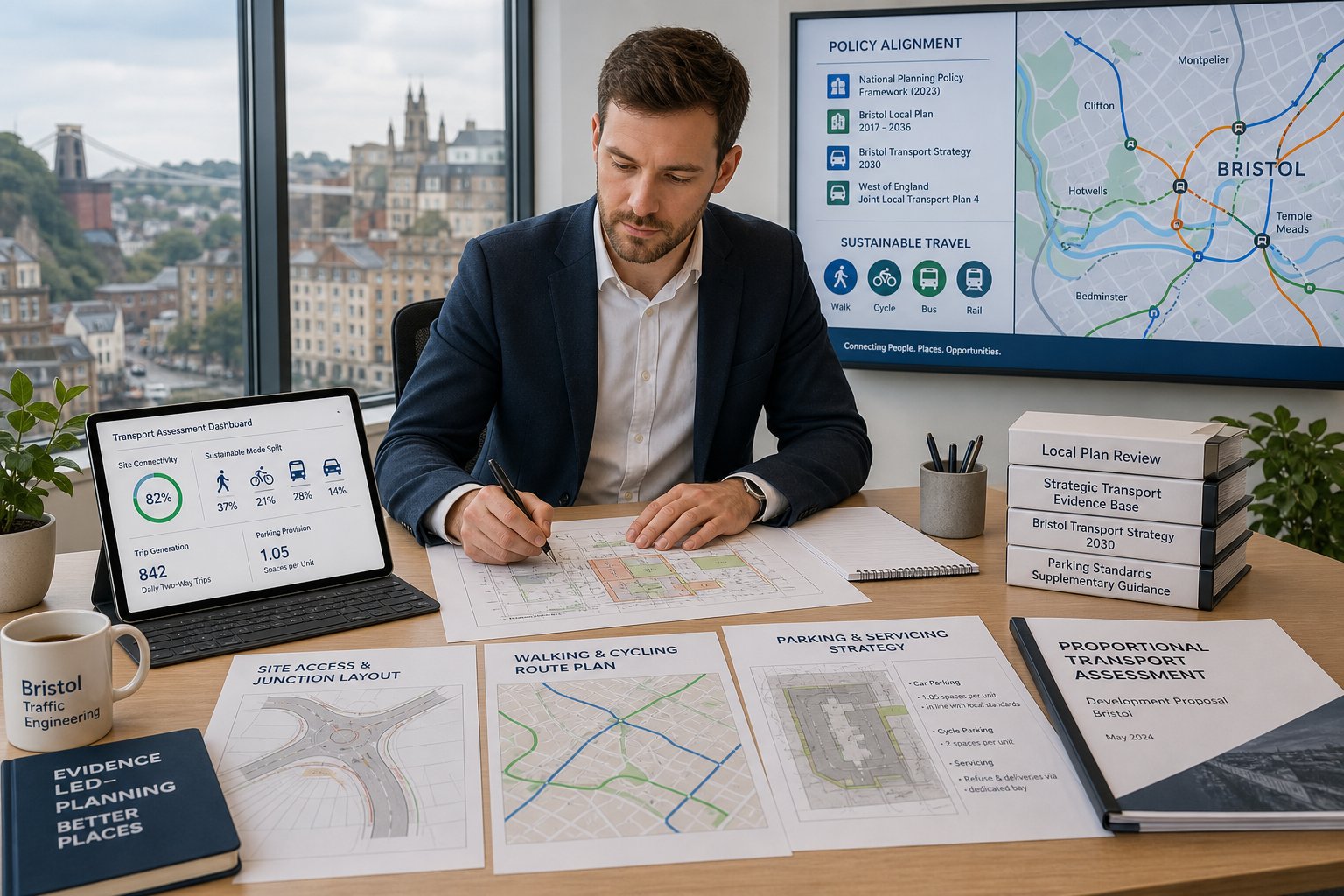
Transport planning in Bristol sits within a layered policy framework. At national level, the National Planning Policy Framework remains central, especially the tests around whether residual cumulative impacts on the road network would be severe and whether opportunities to promote walking, cycling and public transport have been taken.
Locally, Bristol City Council policy, the West of England Combined Authority transport agenda, parking guidance, and active travel priorities all influence what is likely to be considered acceptable. Depending on the proposal, we also need to align with Manual for Streets principles, inclusive design expectations, and in some cases DMRB-based approaches where strategic roads or more formal junction assessment methods are relevant.
What clients sometimes underestimate is that policy alignment is not a box-ticking exercise. Officers usually want to see that the transport evidence responds to the site’s actual context. If a report cites sustainable travel objectives but the pedestrian route to the nearest bus stop is poor, that mismatch will be noticed. If car parking is restrained but servicing is unresolved, that tension will surface too.
The local authority also expects proportionality. A modest scheme should not be buried under unnecessary modelling, but a larger or more impactful development does need transparent assumptions, suitable survey data, and mitigation that can realistically be delivered.
This is where structured, planning-led reporting helps. Our work often mirrors the discipline described in Highway And Traffic Engineering support: start with policy, test the site honestly, and then produce evidence that answers the authority’s likely questions before they become objections.
Common Projects That Require Traffic Engineering Input
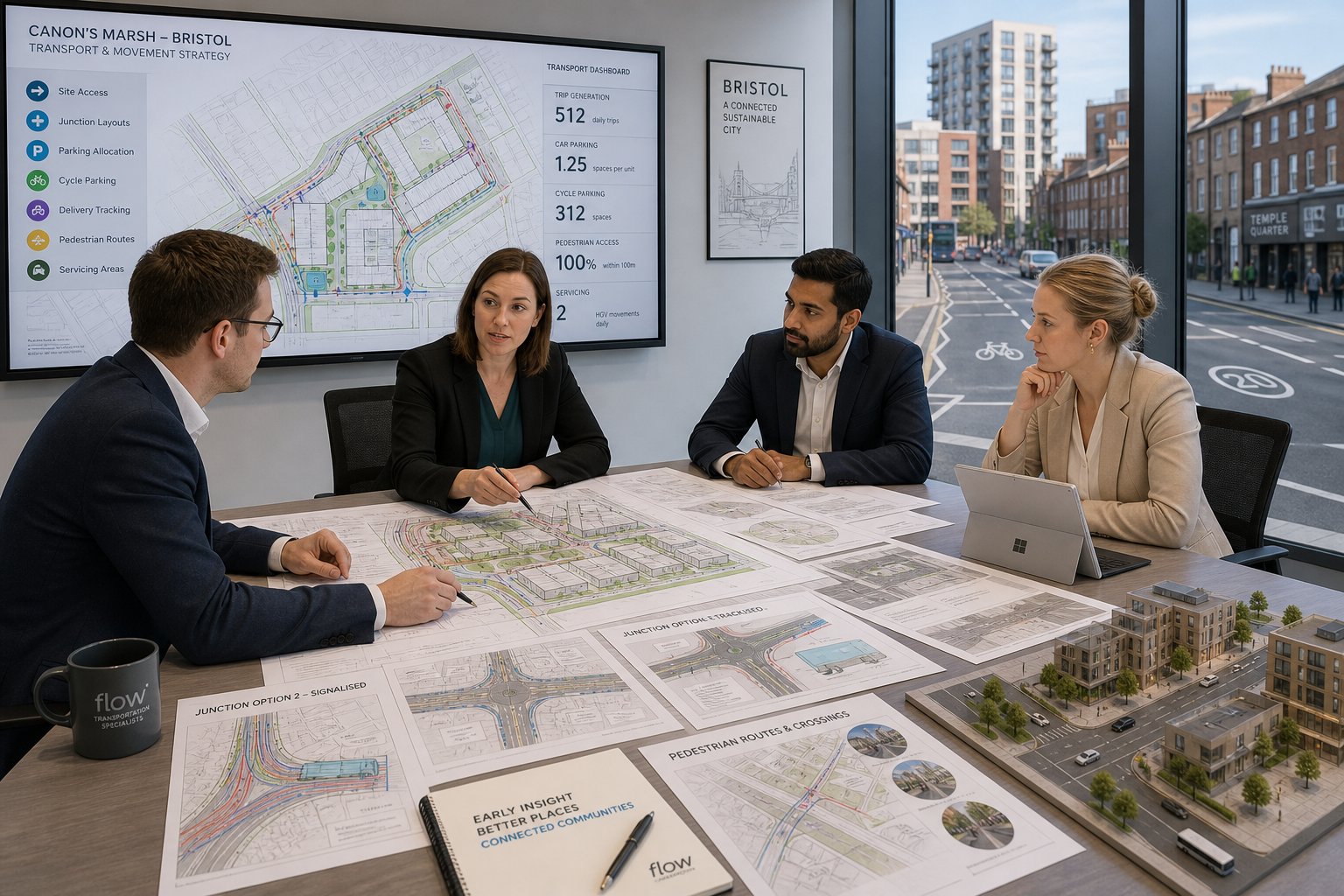
Not every development in Bristol needs a lengthy transport submission, but many schemes benefit from targeted traffic engineering input far earlier than teams expect. In our experience, the trigger is not just size. It is whether the proposal changes how people, vehicles or servicing activity interact with the site and surrounding highway network.
Residential Schemes
Residential projects are the most common example. That includes small infill plots, apartment blocks, purpose-built student accommodation, conversions, and larger edge-of-settlement or urban extension schemes. The key issues usually include access geometry, visibility, internal tracking, parking provision, cycle parking, refuse collection, emergency access, and whether the surrounding streets can absorb the scheme without unacceptable effects.
In Bristol, residential proposals also attract close attention on sustainable travel. Officers may scrutinise whether reduced parking is justified by location, whether pedestrian links are direct and usable, and whether family housing could create school-run pressures at nearby junctions. Even relatively small sites can become contentious where access is substandard or on-street parking is already strained.
Commercial, Mixed-Use, And Change-Of-Use Proposals
Commercial and mixed-use schemes bring a different transport profile. Retail, offices, leisure uses, industrial units, roadside development, and change-of-use proposals can alter trip rates, delivery patterns, peak timing, and parking demand quite sharply. What appears neutral in floorspace terms may still intensify servicing or introduce vehicle types the site cannot accommodate safely.
Change-of-use proposals are especially easy to underestimate. A lawful planning use might exist, but if the proposed occupier changes loading patterns, opening hours, customer dwell time or staff travel behaviour, transport implications can still be material. Mixed-use development adds another layer because shared access, shared servicing and multi-period demand need coherent management.
Across sectors, the right level of evidence should match the scale of the transport question rather than the optimism of the applicant.
Transport Assessments, Transport Statements, And Travel Plans Explained
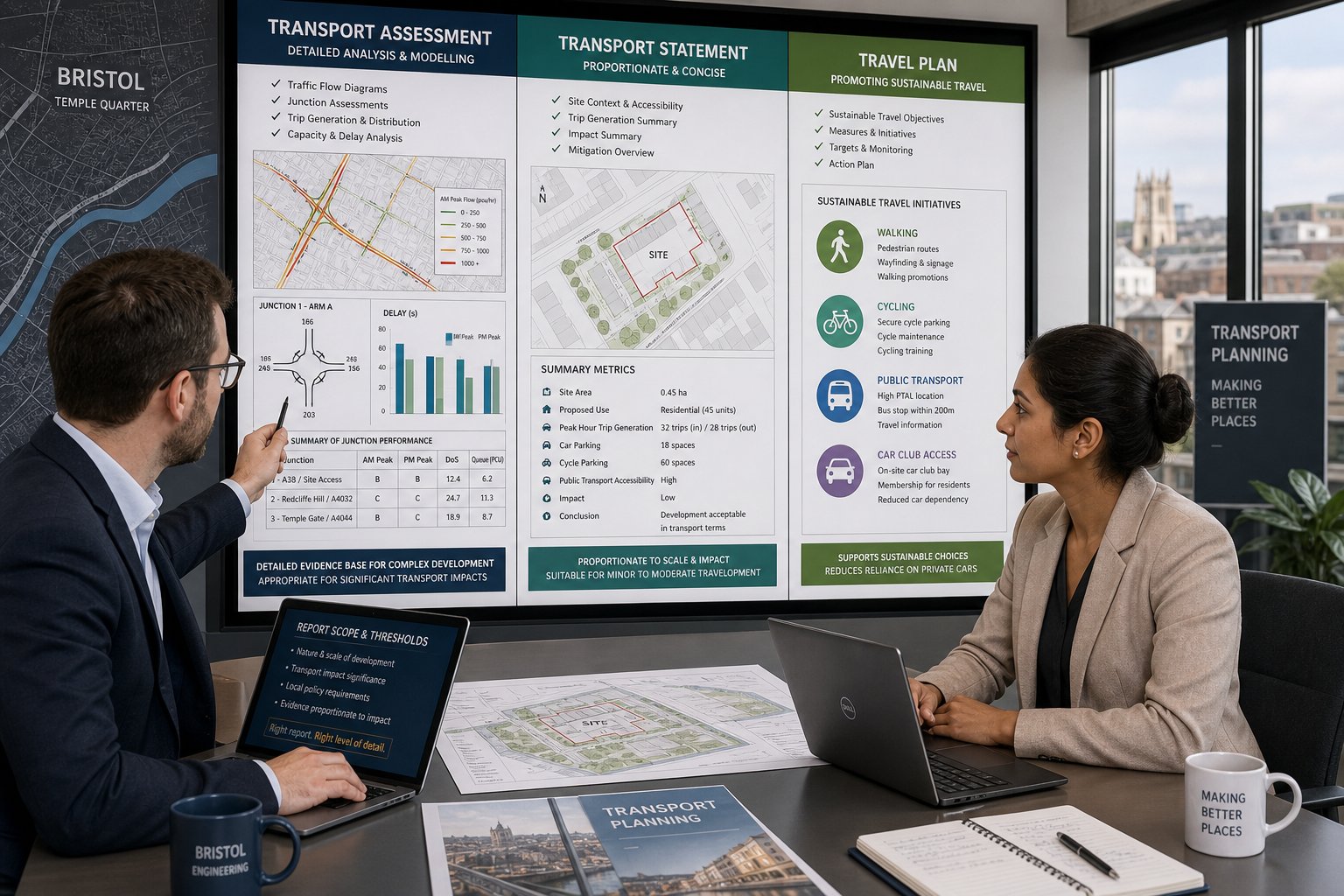
These documents are often grouped together, but they serve different functions.
A Transport Assessment is the more detailed option and is typically used for larger schemes or those likely to create notable transport effects. It usually includes existing conditions, site accessibility, traffic generation, distribution and assignment, potential junction assessment, parking and servicing review, and mitigation where needed. Depending on the scheme, it may rely on traffic counts, committed development review, collision data, and technical modelling.
A Transport Statement is lighter-touch and proportionate for smaller developments where the transport impacts are more limited. It still needs to be evidence-based, but it will usually be narrower in scope and less model-heavy than a full TA.
A Travel Plan is different again. It is not mainly about measuring impact: it is about influencing behaviour. It sets out how a development will encourage residents, staff or visitors to use sustainable modes through measures such as cycle facilities, public transport information, car club support, welcome packs, targets and monitoring.
The difficult part is not defining the documents. It is deciding which one is genuinely required. That judgement depends on local thresholds, the sensitivity of the road network, existing travel choices, and the authority’s likely concerns. A city-centre site with low parking may still need a robust strategy even if traffic generation is modest.
For teams wanting a fuller picture of report scope and thresholds, Traffic Engineer in Bristol discussions often focus on precisely that line between proportionate evidence and underpowered reporting.
When A Swept Path Analysis Or Vehicle Tracking Assessment Is Needed
Swept path analysis is one of those technical exercises that seems simple until it becomes the reason an application stalls. If a site has tight geometry, constrained frontage, awkward servicing space or a compact internal layout, the authority may want clear evidence that the design works for the vehicles that actually need to use it.
A swept path analysis, sometimes called vehicle tracking, tests whether a particular design vehicle can enter, manoeuvre within and leave the site safely. Typical cases include refuse vehicles turning within residential developments, fire appliance access, delivery vehicles reaching a service yard, or larger cars negotiating basement ramps and tight parking aisles.
In Bristol, this is especially relevant on constrained urban sites where building form, heritage constraints or narrow carriageways leave very little tolerance for design error. A drawing that looks passable at concept stage may fail once real turning movements are tested. Kerb overrun, conflict with pedestrian space, vehicles reversing too far, or pinch points at gates are all common problems.
The key is choosing the right design vehicle and testing the movement honestly. There is little value in tracking an idealised manoeuvre that depends on empty roads and perfect driver behaviour. We usually prefer to expose the awkward movement early, then adjust geometry before the design hardens.
That same practical approach is reflected across urban projects beyond Bristol, whether for a Traffic Engineer In Leeds: assignment or a denser metropolitan brief where servicing space is equally constrained.
Parking, Access, Servicing, And Highway Safety Considerations
These four topics often decide whether a scheme feels workable to a highway authority.
Parking is rarely just a numbers exercise. In Bristol, the amount of parking, its management, EV provision, disabled spaces, cycle storage and relationship to controlled parking zones can all affect acceptability. Too much parking may conflict with policy. Too little, without credible mitigation, can trigger concerns about overspill and neighbour impact.
Access design needs to work for all users, not just drivers. We review visibility splays, footway continuity, gradients, crossing points, internal circulation and whether vehicles can wait, pass or turn without creating risk. A single awkward access point can undermine an otherwise policy-compliant scheme.
Servicing is another frequent weak point. Deliveries, refuse collection, maintenance vehicles and emergency access all need a coherent strategy. If servicing happens on-street, teams need to be honest about how often, for how long, and with what effect on safety and traffic flow.
Highway safety underpins all of this. Collision history, conflict points, pedestrian desire lines, school routes, and changes to driver behaviour matter. Where off-site works are proposed, a Road Safety Audit may also be required.
Good transport engineering joins these topics up rather than treating them as separate checklists. The access width influences tracking, tracking influences servicing, servicing influences parking layout, and all of it affects safety. Similar cross-cutting issues appear on regional projects too, from a Traffic Engineer In Manchester: brief to compact city-centre redevelopments elsewhere.
How Traffic Engineering Supports A Smoother Planning Application Process
The best time to resolve transport issues is before they become formal objections. That sounds obvious, but many planning delays still happen because highway concerns are discovered after architecture, viability and programme decisions are already fixed.
Early traffic engineering support helps by identifying the likely pressure points first: whether an access is acceptable in principle, whether parking levels are defensible, whether a TA is needed, whether servicing can be accommodated, and whether any off-site mitigation is likely. Once those basics are clear, the rest of the team can design with fewer assumptions.
This also improves conversations with authorities. A well-prepared submission tends to answer the questions officers were already going to ask. It explains why the report scope is proportionate, shows that the scheme has been tested against local policy, and deals with practical matters such as vehicle movements and sustainable travel arrangements. That often leads to more focused consultation responses and fewer rounds of avoidable clarification.
There is also a negotiation benefit. When transport impacts are evidenced properly, it becomes easier to discuss planning conditions, Section 106 measures, or Section 278 works on a rational basis. Without that evidence, negotiations can drift into caution-driven requests that add cost and time.
For clients, smoother planning rarely means zero comments. It means fewer surprises, better-quality comments, and a stronger position from which to respond.
Choosing The Right Traffic Engineer For A Bristol Project
Not all transport consultants are interchangeable, and Bristol tends to expose the difference quickly. The right appointment is someone who understands both technical standards and the local planning culture around transport evidence.
We would look for four things.
First, a genuine Bristol and WECA track record. Local experience helps with scoping, realistic assumptions, and anticipating the kinds of concerns officers raise on access, parking restraint, active travel and servicing.
Second, planning-focused judgement. A technically capable engineer who cannot explain proportionality, defend assumptions, or align reports with the planning narrative may still leave a team exposed.
Third, range. Many projects need more than one output: a TS or TA, swept path analysis, Travel Plan, access review, visibility assessment, and liaison on highway works. A consultant who can cover that range cleanly usually creates less friction for the wider team.
Fourth, communication. The consultant should be able to deal confidently with planners, architects, solicitors, local highway officers, and sometimes National Highways, bus operators or drainage and safety specialists. Technical skill matters, but so does responsiveness.
That is why firms with long planning-led experience, including those behind Traffic Engineer In Liverpool: and comparable city-focused work, are often valued for concise reporting rather than oversized documents. In our own case, that same emphasis runs through the wider Traffic Engineer in Bristol support we provide: accurate scope, quick turnaround, and reports shaped to local authority expectations.
Conclusion
A strong planning application in Bristol needs more than a transport report with the right title. It needs evidence that reflects the city’s policies, street constraints, sustainable travel expectations and day-to-day operational realities. That is the real value of a locally experienced traffic engineer in Bristol.
When transport issues are scoped early and assessed properly, projects are easier to design, easier to explain and usually easier to negotiate. Access works better. Parking strategy is more defensible. Servicing is less of an afterthought. And the application stands a better chance of moving through consultation without avoidable transport objections.
For architects, planners, developers, lawyers and councils, the aim is not paperwork for its own sake. It is a submission that is proportionate, credible and robust enough to support approval. In a city as closely scrutinised as Bristol, that difference is rarely minor: it can shape the whole trajectory of the project.
Frequently Asked Questions About Traffic Engineers in Bristol
What role does a traffic engineer in Bristol play in planning applications?
A traffic engineer in Bristol provides technical transport evidence, including traffic forecasting, access design reviews, and preparing reports like Transport Assessments to ensure developments comply with local policies and mitigate transport risks effectively.
Why is local knowledge important for traffic engineering in Bristol?
Bristol’s unique constraints such as its historic street layout, Clean Air Zone, and controlled parking require traffic engineers to apply place-specific judgement to accurately assess trip patterns, parking demand, and sustainable travel, unlike generic approaches used elsewhere.
When is a Transport Assessment required for a Bristol development?
Larger or more impactful projects in Bristol need a detailed Transport Assessment covering traffic generation, junction performance, and mitigation measures, while smaller schemes may only require a lighter Transport Statement depending on local thresholds and road network sensitivity.
How does swept path analysis support planning applications in Bristol?
Swept path analysis tests if vehicles like refuse trucks and fire engines can safely manoeuvre on constrained sites. In Bristol’s tight urban layouts, this ensures access and servicing designs are feasible, preventing delays caused by inadequate vehicle tracking details.
What are key parking considerations for Bristol traffic engineers?
Traffic engineers must balance parking quantity with local policies, considering EV bays, disabled spaces, cycle storage, and the impact on nearby controlled parking zones to avoid overspill, ensuring parking strategies are both policy-compliant and context-sensitive.
How does early traffic engineering input improve planning outcomes in Bristol?
Early involvement helps identify transport issues before formal objections arise, allowing for proportionate reporting and realistic mitigation. This leads to clearer consultations, fewer delays, and more effective negotiation of planning conditions and infrastructure agreements.