
Bath is rarely a simple place to develop. A scheme that looks straightforward on a site plan can quickly become more complicated once access geometry, heritage streets, parking pressure, servicing routes, pedestrian movement and local junction performance are properly tested. That is exactly where a traffic engineer in Bath adds value.
For architects, planners, developers, surveyors, solicitors and local authorities, transport evidence is often the difference between a smooth planning process and a long exchange of objections, revisions and delayed decisions. We do not just measure traffic flows or produce a report to tick a box. We help shape development proposals so they stand up to scrutiny from Bath and North East Somerset decision-makers, while still working commercially and operationally for the client.
In practice, that means understanding how a proposal will affect access, parking, servicing, walking, cycling, public transport and the surrounding highway network. It also means knowing when a brief Transport Statement will do, when a full Transport Assessment is needed, and when a site’s real issue is not traffic volume at all but visibility, refuse collection, disabled parking, or an awkward service yard manoeuvre.
In this guide, we set out what a traffic engineer in Bath typically does for planning applications, what reports are commonly needed, when to bring transport input in, and how the process usually runs from feasibility through to decision in 2026.
Key Takeaways
- A traffic engineer in Bath offers essential local expertise by addressing site access, parking, servicing, and active travel within the city’s unique heritage and street constraints.
- Integrating transport strategy early in the design phase helps avoid planning delays and objections by ensuring practical access, realistic parking, and effective servicing arrangements.
- Transport reports such as Transport Assessments and Statements must be tailored to the scale and context of the development, reflecting Bath’s specific planning thresholds and local conditions.
- Early involvement of a traffic engineer can identify potential transport risks, improving planning application success by providing clear, evidence-based advice aligned with Bath and North East Somerset authority expectations.
- Effective traffic engineering coordinates with architects, planners, and developers to balance technical soundness with operational needs, ensuring practical, planning-ready proposals.
- Choosing a traffic engineer with relevant local experience, strong communication skills, and responsiveness is vital for smooth planning processes and timely decision-making in Bath developments.
What A Traffic Engineer In Bath Does For Planning Applications
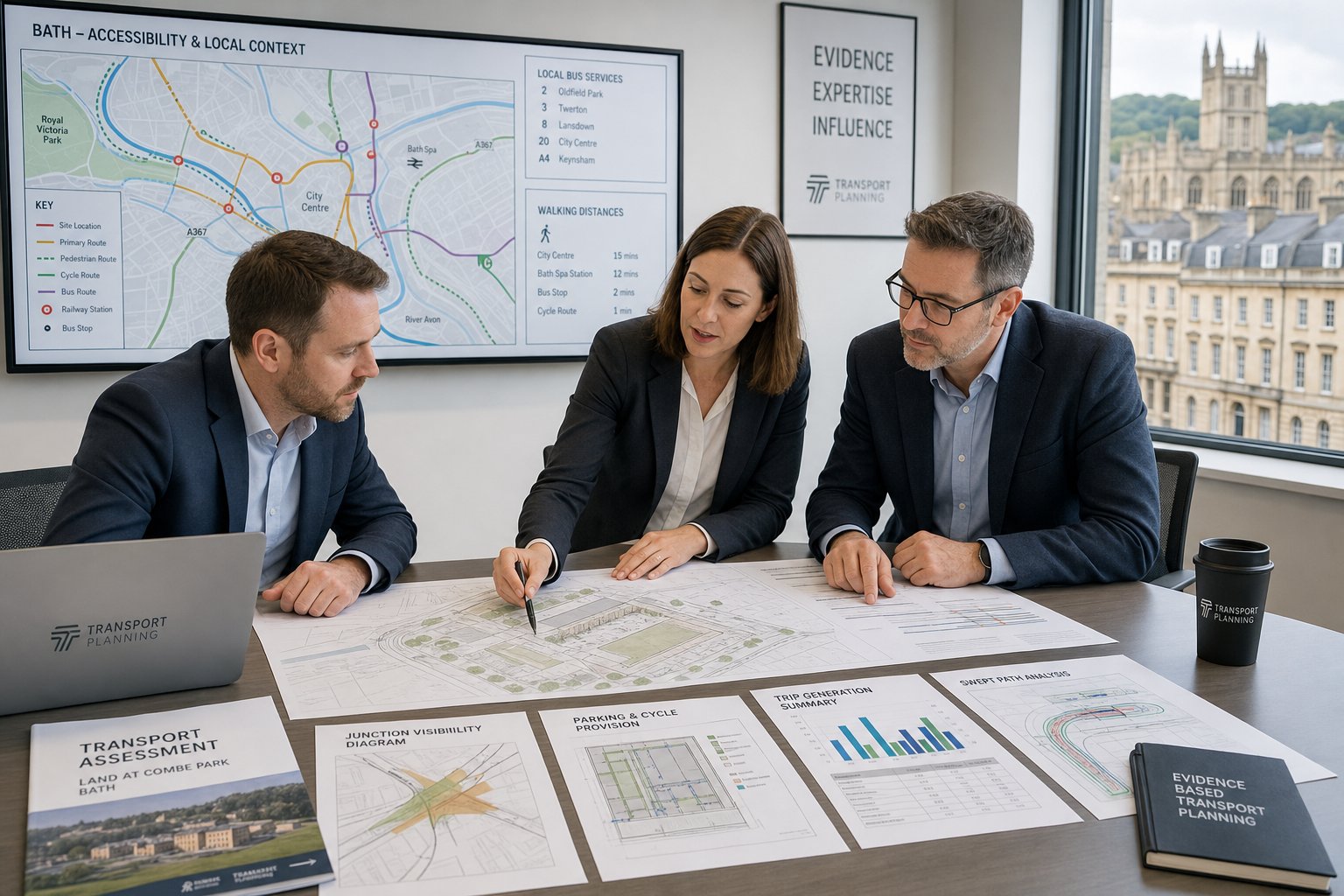
A traffic engineer in Bath supports the planning case by turning transport risk into clear, evidence-based advice. At the start of a project, we usually review the proposal, the site context, and the likely concerns of the planning authority and highway officers. That early review often saves time because it identifies the issues that are actually likely to matter, rather than the ones teams assume will matter.
For planning applications, our role commonly includes site access review, junction visibility checks, parking and cycle provision analysis, servicing assessments, trip generation forecasting, network impact review, and advice on walking, cycling and public transport links. We may also undertake swept path analysis, review collision records, assess whether a proposal is likely to trigger local transport policy concerns, and prepare mitigation options where impacts can be reduced.
Importantly, we also coordinate with the wider consultant team. A transport report is stronger when it reflects the architect’s layout, the planner’s strategy and the developer’s operational needs. That is why many project teams value broader input from Traffic Engineering Consultants: What and from specialist Highway And Traffic Engineering advisers when a scheme has more than one transport challenge.
In short, we help present a proposal in a way that is technically sound, locally aware and planning-ready.
Why Bath Developments Need A Local Transport And Highways Strategy
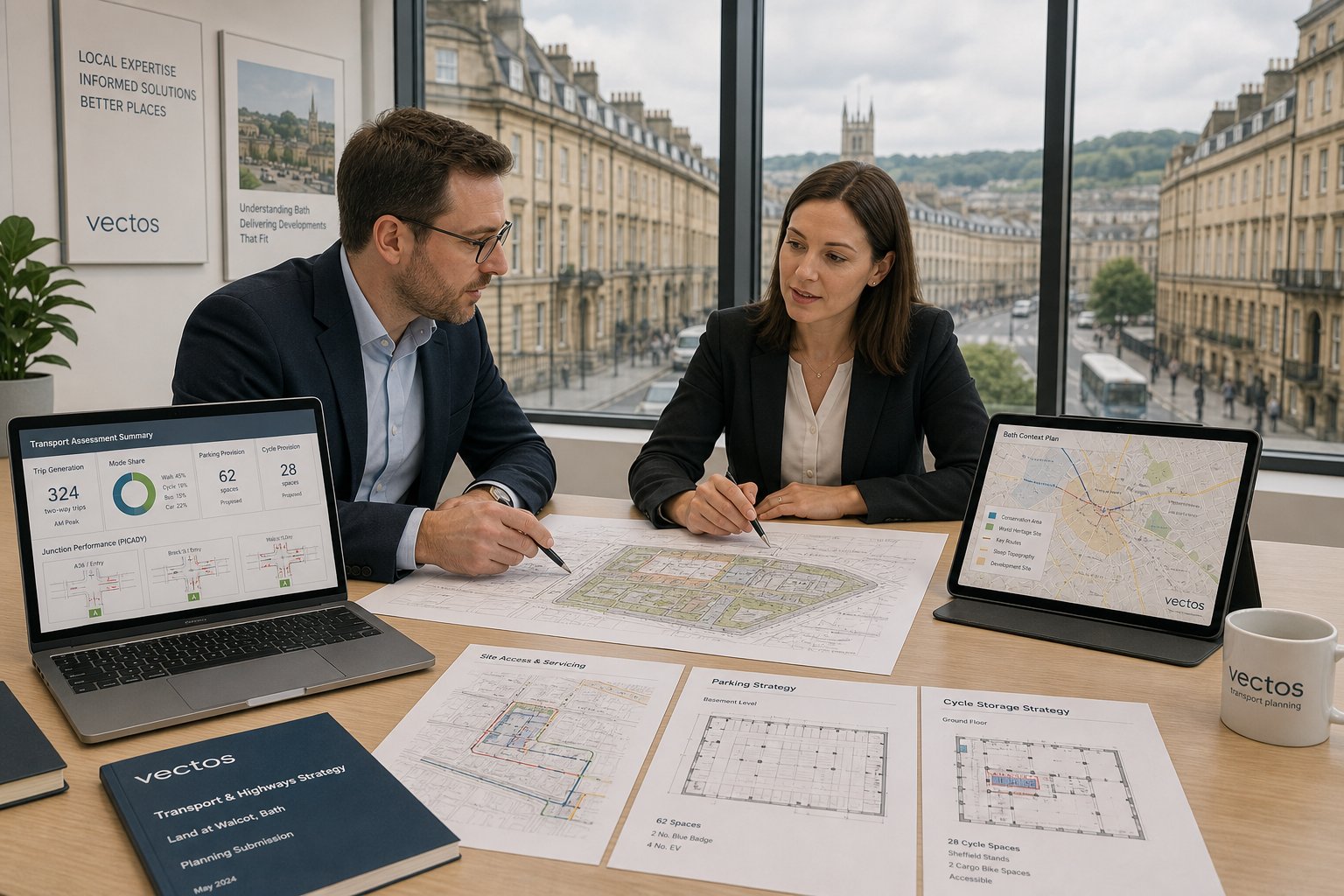
Bath is not a place where a generic transport approach works particularly well. Its urban form, constrained streets, heritage assets, topography and established travel patterns mean even modest developments can raise very specific highways and transport questions. A local strategy matters because the right answer for a city-centre conversion will not be the right answer for an edge-of-settlement residential scheme or a school expansion with peak-hour sensitivity.
We usually advise clients to treat transport strategy as part of the design process, not something bolted on just before submission. That means considering how vehicles enter and leave the site, whether servicing can happen safely, what level of parking is realistic, how cycle parking should be located, and whether walking routes are genuinely usable rather than technically shown on a drawing.
A Bath-focused strategy also helps with proportionality. Some schemes need a detailed package of transport evidence: others only need concise justification linked to local conditions and planning thresholds. Comparable work in nearby cities can be helpful for context, whether that is a Traffic Engineer In Bristol: approach to authority expectations or broader principles from Traffic Engineering and Transportation. But Bath still needs its own response.
That local strategy reduces avoidable objections and gives the whole team a stronger basis for application decisions and negotiation.
Key Transport Reports Often Required By Bath Planning Authorities

The transport documents required for a Bath planning application depend on scale, use, location and likely impact. Some proposals need only a short supporting note. Others require a fuller evidence package that demonstrates the transport effects of the development and explains why any impacts are acceptable or can be mitigated.
The key point is that these reports are not interchangeable. Each one has a different purpose, audience and level of technical detail. When prepared properly, they help officers and consultees understand not only what the development proposes, but how it will function day to day on the network.
In our experience, Bath and North East Somerset schemes most often involve Transport Assessments, Transport Statements, Travel Plans, parking reviews and access appraisals. The right mix depends on whether the proposal changes traffic movements materially, alters access arrangements, creates servicing pressure, or sits in a constrained area where active travel and parking become central planning issues.
Good reporting is also about judgement. We draw on established practice from wider Traffic Engineering: Your Complete guidance, but the document itself must stay tied to the actual site, the actual proposal and the local authority’s likely concerns.
Transport Assessments And Transport Statements
A Transport Assessment is usually the more detailed option. It is prepared where a development is likely to generate material transport effects and where the authority will expect robust analysis of trips, junction performance, sustainable travel opportunities and mitigation. That may involve baseline traffic data, trip forecasting, distribution and assignment, and an explanation of how the proposal interacts with the surrounding network.
A Transport Statement is typically more concise and is often suitable for smaller or less intensive developments. It still needs to be evidence-led. A short report with weak assumptions is not better than a fuller one: it is simply easier to challenge.
For Bath schemes, the choice between the two often turns on scale, access sensitivity and local context. A modest development on a constrained street can trigger more scrutiny than a larger one in a better-connected location.
Travel Plans, Parking Reviews, And Access Appraisals
Travel Plans set out how sustainable travel will be encouraged and monitored. For some developments, they are a core part of the planning response, especially where modal shift, staff travel behaviour, school travel or reduced car dependence forms part of the policy position.
Parking reviews test whether proposed provision is sensible rather than merely convenient on paper. That includes disabled bays, cycle parking, visitor demand, overspill risk and operational practicality. In Bath, parking often becomes one of the first issues neighbours and officers examine.
Access appraisals focus on whether a site can be safely and suitably reached by vehicles, pedestrians and cyclists. They often consider geometry, gradients, visibility, conflict points and the relationship with the public highway. If the access does not work, the rest of the application can quickly unravel.
When A Development In Bath Is Likely To Need Traffic Engineering Input
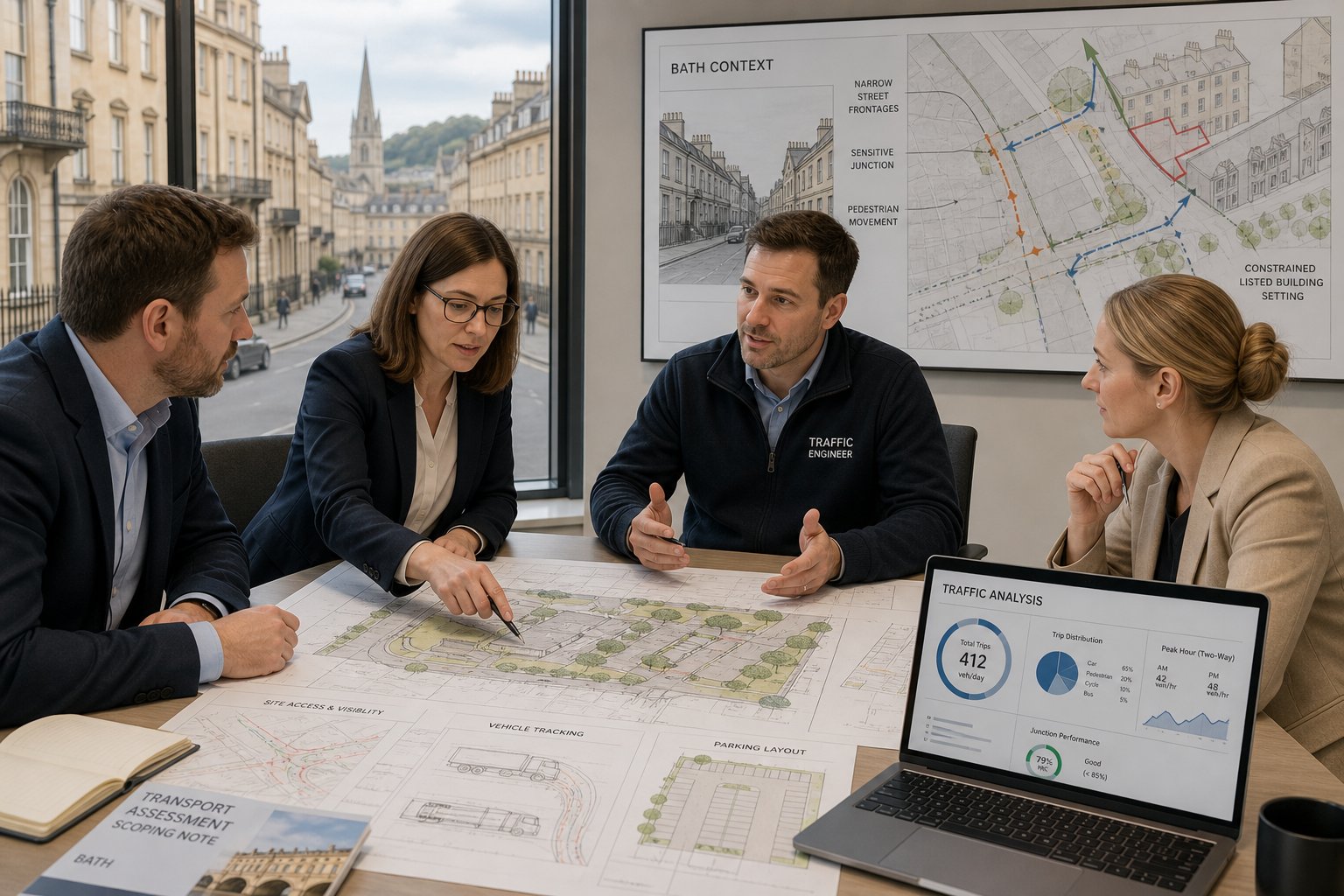
Not every scheme in Bath needs an extensive transport package, but many benefit from traffic engineering input much earlier than clients first expect. The clearest triggers are larger developments, changes in land use that alter trip patterns, new or modified accesses, notable parking demand, servicing constraints and proposals that may affect highway safety or local network performance.
We are often brought in after a design has already been developed, when a concern emerges around visibility, refuse vehicle tracking or inadequate parking. That can still be workable, but it is rarely the most efficient moment to start. Early input is especially useful where a site sits on a narrow street, near a sensitive junction, in an area with strong pedestrian movement, or where neighbours are likely to raise transport objections.
Bath developments that commonly need traffic engineering support include residential schemes, mixed-use developments, student accommodation, care uses, schools, employment sites, retail changes, and sites with constrained frontages or listed-building contexts. Even small proposals can require a careful transport response if the operational detail is awkward.
Broader benchmarks from a Traffic Engineer In Birmingham: or Traffic Engineer In Manchester: planning process can be useful for understanding common triggers, but Bath’s street conditions often make local judgement more important than generic size thresholds alone.
If a transport issue could influence layout, viability, committee perception or determination speed, that is usually the point to involve us.
Common Transport Planning Issues Across Bath And North East Somerset
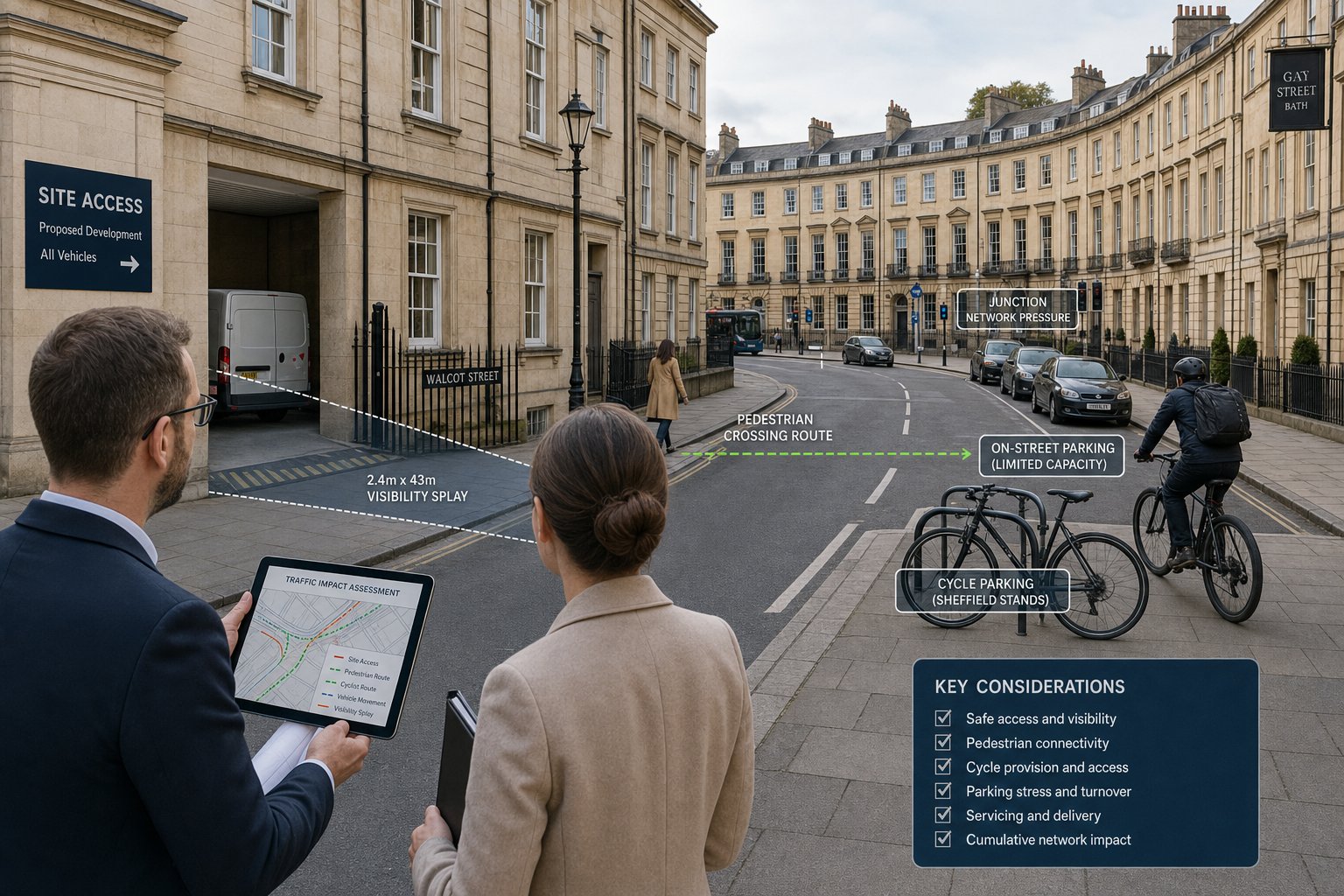
Bath and North East Somerset presents a familiar pattern: proposals are often technically feasible, but only once the detail is worked through carefully. The planning tension usually sits in the gap between what a drawing appears to allow and what can realistically operate on a constrained highway network.
In our work, the most common issues relate to access arrangements, visibility, road safety, parking pressure, servicing practicality, active travel provision and cumulative network effects. None of those topics exists in isolation. A tight access can affect refuse collection: reduced parking can increase overspill concern: a service bay can conflict with pedestrian comfort: a cycle store can be policy-compliant but functionally poor.
That is why transport planning in Bath tends to reward practical, site-specific analysis rather than generic statements of compliance. Authorities and consultees usually respond better to evidence that deals directly with the street, the manoeuvre, the likely travel pattern and the operational reality.
Access, Visibility, And Highway Safety Considerations
Access is often the first technical issue to test. Can vehicles enter and leave safely? Are visibility splays achievable without unrealistic assumptions? Do pedestrians have a clear route across the frontage? Is the junction arrangement legible for users who do not already know the site?
In Bath, frontages can be narrow, walls and buildings can limit sightlines, and gradients can complicate movement. Safety assessments may also need to consider vulnerable users, vehicle speeds, turning behaviour and whether a proposed access creates conflict with parking, loading or nearby junction activity.
The point is not to chase a perfect theoretical arrangement. It is to establish whether the access is safe and suitable in planning terms, and whether any changes to kerbs, markings, control measures or layout are needed.
Parking, Servicing, Active Travel, And Network Impact
Parking is rarely just about bay numbers. It is about how spaces are used, whether they are accessible, whether turnover is realistic, and whether under-provision will push demand onto already pressured streets. In Bath, that local sensitivity can be significant.
Servicing is another frequent weak point in applications. Delivery routes, refuse collection, turning space and loading positions need to work in ordinary operation, not just on a swept path drawing produced in isolation.
Active travel provision is increasingly central. We assess walkability, cycle parking quality, links to nearby facilities and whether a proposal genuinely supports lower-car travel choices. Network impact then pulls those threads together, considering whether generated trips, access movements or servicing activity create unacceptable effects on surrounding roads and junctions.
How Traffic Engineering Supports Architects, Planners, Developers, And Councils
Traffic engineering works best when it is integrated, not isolated. For architects, it helps ensure the site layout can function in practice. A visually neat plan is not enough if a refuse vehicle cannot turn, if cycle parking is inaccessible, or if visibility cannot be achieved at the proposed access. Early transport input can prevent redesign later.
For planning consultants and town planners, we provide technical evidence that supports the planning statement and responds to likely consultee concerns. That may mean a concise technical note, a full transport report, or input to planning conditions and negotiation wording. Solicitors and surveyors often value the same clarity, particularly where transport risk affects programme, land value or transaction timing.
Developers usually need two things at once: technical robustness and speed. The best support is not the longest report: it is the report that answers the right questions and aligns with the authority’s likely review points. That is very much the approach we take at ML Traffic, drawing on more than 30 years of experience to prepare concise, accurate transport evidence tailored to planning thresholds and local context.
Councils benefit too. Clear transport submissions reduce unnecessary back-and-forth and make it easier to identify the real planning issues. Similar principles apply across other authorities, whether in a Traffic Engineer In London: setting or through wider Traffic Engineer In support, but Bath still demands local reading of the site and policy context.
What To Prepare Before Instructing A Traffic Engineer In Bath
The better the starting information, the faster and cleaner the transport advice. Before instructing a traffic engineer in Bath, we recommend assembling the core project details in one place. That includes a clear site location plan, any proposed layout drawings, the development description, likely land use mix, unit numbers or floor areas, and the intended planning route.
It also helps to provide your current thinking on access points, parking numbers, cycle parking, servicing arrangements and operational needs. If there are expected delivery patterns, school peak concerns, shift changes or mobility considerations, those are worth flagging early. The same applies to any prior planning history, pre-application comments, local objections already raised, or known highway concerns.
For more detailed schemes, we may also need trip assumptions, opening hours, staff numbers, expected visitor demand and phasing information. None of this has to be final on day one. But without a working development description, transport advice becomes slower because too much hangs on later changes.
A useful briefing pack usually contains:
- Site address and red line boundary
- Proposed drawings and levels, where available
- Development quantum and use class information
- Initial parking and servicing proposals
- Known access constraints or neighbour concerns
- Target submission date and consultant team contacts
Good preparation does not just speed up reporting. It improves the quality of strategic advice before the application hardens around avoidable transport problems.
How The Traffic Engineering Process Typically Works From Feasibility To Decision
The process usually starts with feasibility. We review the site, the proposal and the likely planning context to identify whether transport is a key risk, a manageable issue or simply a matter of proportionate evidence. That early stage often includes a site visit, desktop review, access check and initial advice to the design team.
From there, the next steps depend on the scheme. We may collect or review traffic data, assess trip generation, examine parking and servicing demand, analyse collision patterns, and test access geometry or swept paths. The goal is to understand how the proposal will actually function, not merely how it looks in principle.
Once the technical picture is clear, we prepare the appropriate planning documents. That might be a Transport Statement, a Transport Assessment, a Travel Plan, an access note, or a package of coordinated reports. We then work with architects and planners to align the narrative, drawings and mitigation measures so the submission is consistent.
After submission, support often continues. Highway officers may raise questions on parking, visibility, cycle provision, servicing or trip assumptions. Timely responses matter. A well-prepared team can often resolve those points without unnecessary delay.
Most projects move through the following stages:
- Feasibility review and scope agreement
- Site appraisal and constraint identification
- Data gathering and technical assessment
- Report drafting and design coordination
- Mitigation refinement and submission support
- Responses during determination, and where needed, condition discharge
That structure is fairly standard, but in Bath the detail within each stage often makes the difference between a clean planning route and a prolonged one.
Choosing The Right Traffic Engineer In Bath For Your Project
Choosing the right consultant is partly about credentials, but mostly about fit. A traffic engineer in Bath should understand UK planning applications, transport reporting standards, highway authority expectations and the realities of multidisciplinary project teams. Just as important, they should know when to keep advice concise and when a site genuinely needs more detailed work.
We would usually suggest looking for five things. First, relevant planning experience rather than purely general highways experience. Second, strong report-writing, because technical analysis only helps if it is presented clearly. Third, local awareness of Bath and North East Somerset issues, including constrained streets, parking sensitivity and active travel expectations. Fourth, responsiveness: planning timetables rarely wait. And fifth, the ability to coordinate with architects, planners, surveyors and legal teams without turning every issue into a drama.
It is also worth asking practical questions. Who will write the report? Who will attend meetings? How quickly can site work be done? Has the consultant handled similar schemes recently? Can they advise on mitigation as well as assessment?
The right choice is usually the team that combines technical credibility with commercial awareness and plain-speaking advice. For most development projects, that blend matters more than flashy presentation. A good transport consultant helps the application move forward. A poor one simply adds another layer of paperwork.
When the brief is clear, the evidence is proportionate and the advice is locally grounded, transport engineering becomes what it should be: a planning tool that helps projects reach a sound decision.
Frequently Asked Questions about Traffic Engineering in Bath
What does a traffic engineer in Bath do for planning applications?
A traffic engineer in Bath assesses site access, parking, servicing, and transport impacts, preparing evidence-based advice and reports to help developments meet Bath and North East Somerset planning requirements and local highway constraints.
Why is a local transport strategy important for developments in Bath?
Bath’s unique urban form, heritage, and constrained streets require transport strategies tailored to local conditions, ensuring that access, parking, and active travel arrangements suit the specific site context and planning expectations.
What transport reports are commonly needed for planning in Bath?
Developers often need Transport Assessments, Transport Statements, Travel Plans, parking reviews, and access appraisals to demonstrate how a proposal impacts local traffic, parking, public transport, and highway safety.
When should I involve a traffic engineer in my Bath development project?
Early involvement is advisable, especially for larger schemes, changes in access, significant parking or servicing needs, or any proposal likely to raise highway safety or local network performance concerns.
How do traffic engineers support other professionals involved in Bath developments?
Traffic engineers provide technical evidence and design input that align with architects’ layouts, planners’ strategies, and developers’ operational needs, ensuring transport aspects are compliant and practical, facilitating smoother planning approvals.
What should I prepare before instructing a traffic engineer in Bath?
Gather site plans, development details including land use and unit numbers, initial access and parking proposals, servicing requirements, and any known constraints or previous planning feedback to enable efficient, tailored transport advice.