
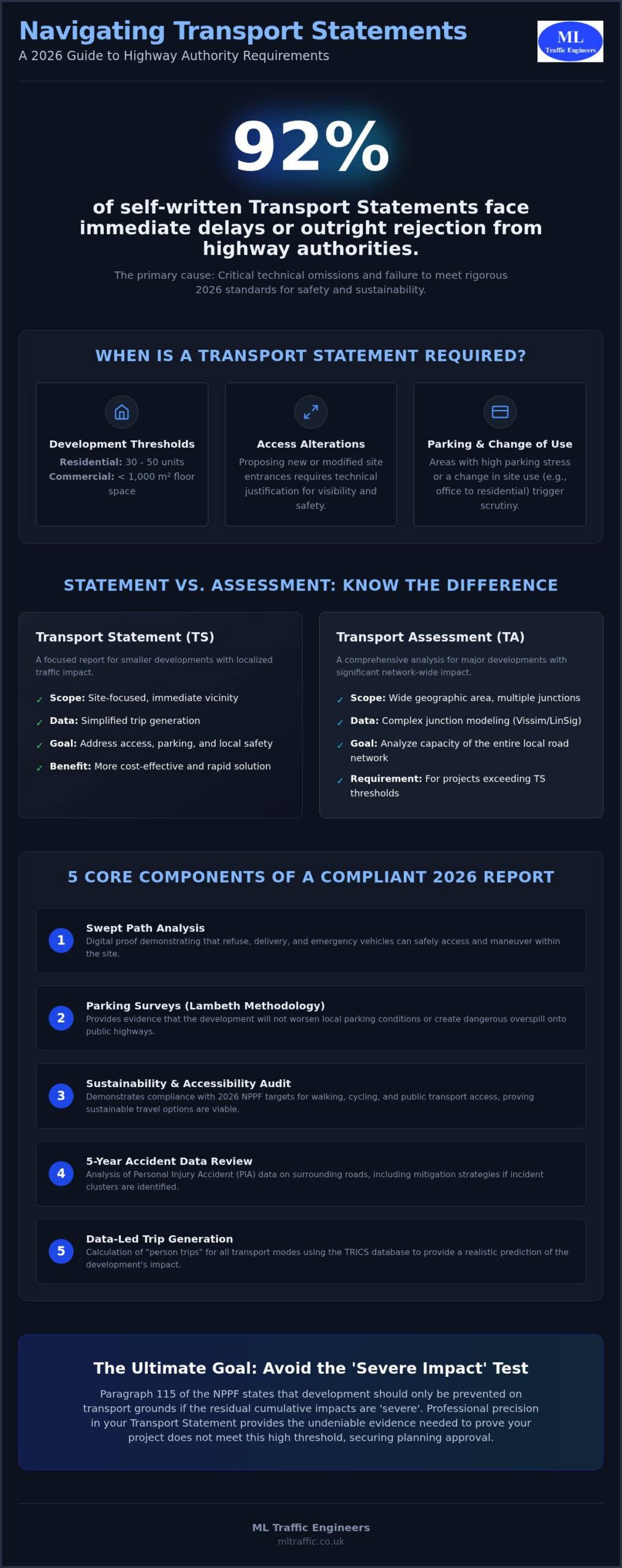
92% of self-written Transport Statements face immediate delays or rejection because of technical omissions. It’s a sobering statistic that highlights just how rigorous the planning process has become. Meeting the specific highway authority transport statement requirements in 2026 demands a level of precision that goes far beyond simple vehicle counts. Local Highway Authorities are tightening their scrutiny, and even minor developments now face intense pressure to prove their sustainability and safety from the outset.
You likely feel that the planning system is a moving target where technical data like Swept Path Analysis feels more like a barrier than a tool. It’s frustrating to see a project stalled by a request for information you didn’t know you needed. This guide provides a clear roadmap through the latest regulatory landscape to ensure your report passes without objection. We’ll examine the updated NPPF standards, explain how to avoid the “severe impact” designation, and outline exactly what authorities expect to see in a compliant, cost-effective submission.
Key Takeaways
- Identify the specific development thresholds and triggers that dictate highway authority transport statement requirements to avoid immediate validation delays.
- Learn how to utilize Swept Path Analysis and Lambeth Methodology parking surveys to provide the digital proof required for refuse and emergency vehicle access.
- Understand the 2026 NPPF updates and how to conduct a sustainability audit that demonstrates compliance with walking, cycling, and public transport accessibility targets.
- Master the pre-application engagement process to agree on the ‘Scope of Works’ early and effectively manage Regulation 25 requests for further information.
- Discover how professional precision in reporting reduces regulatory pressure and secures planning approval by proving a development’s impact is not ‘severe’.
What is a Transport Statement and When is it Required?
A Transport Statement (TS) is a technical report required for developments where the traffic impact is relatively low but still requires formal scrutiny. It forms a critical part of the broader transportation planning process by providing the Local Highway Authority (LHA) with the data needed to ensure road safety and network efficiency. Unlike larger projects that demand exhaustive modelling, a TS focuses primarily on the immediate vicinity of the site. It addresses access points, pedestrian safety, and whether local junctions can handle the predicted vehicle movements without causing “severe” cumulative impact under current 2026 standards.
The LHA uses these reports as a primary tool for protecting public safety. If a developer cannot demonstrate that a site is accessible for emergency vehicles or that it won’t lead to dangerous parking overspill, the application will likely face an objection. For residential developments, a Transport Statement is typically the standard requirement for sites containing between 30 and 50 units. If your project exceeds 50 units, or if it’s expected to generate more than 30 peak hour vehicle movements, the authority may request a full Assessment instead. For commercial retail or office spaces, the trigger usually sits under 1,000 square metres.
Transport Statement vs. Transport Assessment
The primary difference between these two documents lies in the geographic scope and technical depth. A Transport Statement is site-focused and uses simplified trip generation data to predict impact. Conversely, a Transport Assessment covers a wider geographic area and often requires complex junction modelling using software like Vissim or LinSig. For developers, a TS is a more cost-effective and rapid solution, provided the development falls below the authority’s major impact thresholds. This lighter-touch approach is designed for schemes that won’t fundamentally change the capacity of the local road network. If your project is larger or located in a high-density urban area, you should consult our Transport Assessment London guide to understand the additional modelling requirements.
Common Triggers for a Highway Authority Request
Understanding highway authority transport statement requirements means knowing what flags an application for review. Common triggers include:
- Access Alterations: Any proposal to create a new site entrance or significantly modify an existing one requires technical justification to ensure visibility splays are adequate.
- Parking Stress: If the site is in an area with high demand for kerbside space, the LHA will require evidence that the development won’t worsen local conditions. This often requires a survey using the Lambeth Methodology.
- Change of Use: Converting an office to residential units changes how and when people travel. With the 30% increase in light van movements seen in urban centres recently, authorities are particularly sensitive to how delivery and service vehicles, such as Fly Tyres Mobile Service, will access converted sites.
Core Requirements for a Compliant 2026 Transport Statement
A compliant report must align with national policy while addressing local constraints. The Core Requirements for a Compliant 2026 Transport Statement dictate that developers provide a data-led narrative. It isn’t enough to state that traffic will be minimal; you must prove it. This starts with calculating “person trips” using the TRICS database. Authorities expect to see trip generation figures based on comparable sites to ensure the predicted impact is realistic. By accounting for all modes of transport, including pedestrians and cyclists, you provide a comprehensive view of how the development will function.
Safety analysis is a non-negotiable component of highway authority transport statement requirements. You must include a five-year review of Personal Injury Accident (PIA) data for the roads immediately surrounding the site. If the data reveals a cluster of incidents, the highway authority will expect a robust mitigation strategy. This might involve physical improvements to the highway, such as better lighting or crossing points, or management measures aimed at reducing vehicle reliance. Proposing these measures early shows a commitment to professional integrity and public safety, which often smooths the path to approval; for insight into how legal specialists manage the fallout of road incidents, read more about Scotland Claims Injury Lawyers.
The NPPF ‘Severe Impact’ Test in 2026
Paragraph 115 of the National Planning Policy Framework (NPPF) remains the definitive benchmark for planning refusals. It states that development should only be prevented on highway grounds if the residual cumulative impacts on the road network would be severe. In 2026, the interpretation of “severe” has evolved. It no longer refers solely to junction delay or congestion. Local Highway Authorities (LHAs) now consider safety risks and the failure to provide for sustainable travel as part of this test. We use quantitative data to demonstrate that your development stays well below this threshold, preventing costly delays at the validation stage.
Sustainable Transport and Active Travel
National policy now prioritizes a “vision-led” approach to infrastructure. This means your Transport Statement must include a sustainability audit. We assess the “walkability” of your site and the quality of nearby cycling infrastructure. In urban areas, we often use PTAL (Public Transport Accessibility Level) scores to justify lower parking provisions. If your site has a low accessibility score, a robust Travel Plan becomes essential to mitigate vehicle use. Our London Travel Plans guide explains how these documents work in tandem to strengthen your submission. If you’re unsure how these technical tests apply to your specific site, our team can provide a preliminary technical assessment to identify potential hurdles early.
Technical Data: Swept Path Analysis and Parking Surveys
Technical precision serves as the backbone of any successful planning application. While policy alignment provides the framework, engineering evidence proves that a development is safe and functional. According to official government guidance, the technical data within a report must be proportionate to the size of the scheme. However, highway authority transport statement requirements almost always mandate specific digital proofs to ensure the site operates without compromising the public highway. This involves demonstrating that vehicles can enter, turn, and exit the site in a forward gear while maintaining clear sightlines for all road users.
Why Swept Path Analysis is Non-Negotiable
Swept Path Analysis (SPA) provides digital confirmation that large vehicles can navigate your site without striking kerbs, buildings, or parked cars. It’s a functional necessity for safety and operational efficiency. We utilize specialized software to simulate the movements of specific vehicles, such as a 12-metre refuse truck or a standard fire tender. If you cannot prove a fire engine can reach within 45 metres of every dwelling, the authority will likely object on safety grounds. This analysis is equally critical for waste management. Local councils will not collect refuse if their vehicles are forced into dangerous reversing manoeuvres or blocked by tight corners. Our Practical Guide to Swept Path Analysis details how these simulations prevent costly design revisions later in the project lifecycle.
Justifying Parking Levels in Urban Areas
Local authorities in 2026 frequently push for ‘car-free’ or ‘car-lite’ developments, especially in high-density areas. Developers must balance these policy goals against actual local demand to prevent parking overspill into neighbouring streets. Parking stress surveys provide the empirical evidence needed to justify your proposed parking provision. By conducting overnight surveys between 00:30 and 05:30, we measure the exact amount of kerbside space available within a 200-metre walking distance of the site. The Lambeth Methodology is the industry standard for London parking surveys and is widely accepted by LHAs across the UK as a robust framework for assessing capacity. It allows us to prove whether the public highway can safely absorb any residual parking demand without creating a nuisance or safety hazard.
Finally, we must address visibility splays and historical safety data. Proving safe sightlines for vehicles exiting the development is a fundamental aspect of highway authority transport statement requirements. We cross-reference these splays with a five-year review of collision data. If your site entrance is near a known accident cluster, we provide engineering solutions to ensure the development doesn’t exacerbate existing risks. This proactive approach reduces regulatory pressure and minimizes the risk of planning objections.
Securing planning permission involves more than just submitting a report. It requires a managed dialogue with the Local Highway Authority (LHA) to ensure every technical concern is addressed before it becomes a formal objection. Meeting the highway authority transport statement requirements effectively means positioning your project as a safe, sustainable addition to the local network. We act as the technical mediator in this process. We translate complex engineering data into the professional, policy-compliant language that planning officers expect to see.
The Pre-Application Advantage
Early engagement is the most effective way to prevent expensive redesigns later in the project lifecycle. We recommend agreeing on a ‘Scoping Note’ with the LHA before any traffic surveys or data collection begins. This document acts as a technical contract. It defines the parameters of the study, including which specific junctions need analysis and which trip generation rates are acceptable for the site’s use class. If the LHA disagrees with your initial scope, it’s better to resolve that conflict during the pre-application phase rather than facing a costly refusal after submission. This proactive approach locks in the requirements and provides a clear, documented pathway for the final submission.
From Statement to Construction: S278 Agreements
A successful Transport Statement doesn’t just secure planning approval; it sets the stage for the physical delivery of the scheme. If your development requires changes to the public highway, such as a new site entrance or a pedestrian crossing, these will be handled through a Section 278 (S278) agreement. The technical data and visibility splays in your statement inform the preliminary design of these works. Transitioning from the planning stage to the detailed engineering phase is much smoother when the initial report accounts for these functional necessities. For more information on navigating these requirements, see our buying guide for 2026 planning applications. We ensure that the initial assessments align with future S278 and Section 106 obligations, preventing technical conflicts during the construction phase.
LHA officers may still issue a ‘Regulation 25’ request for further information after your submission. This is often a sign that they need more clarity on a specific data point, such as parking stress or refuse vehicle tracking. We respond to these requests with technical precision and urgency. Our goal is to reduce the regulatory pressure on you by providing the exact data needed to withdraw an objection. If you need support with your current application, we provide a comprehensive transport planning service to move your project through to a successful decision.
ML Traffic Engineers UK understands that a Transport Statement is more than a technical hurdle. It’s a strategic document designed to protect your project’s timeline and budget. We provide precision reporting that meets the functional necessity of highway safety while navigating the specific highway authority transport statement requirements unique to your site’s location. Our team balances technical authority with a client-focused approach. We aim to reduce the regulatory pressure on you by managing every interaction with the planning office and highway engineers.
We specialize in the high-stakes data that often triggers objections. This includes detailed Swept Path Analysis for fire tenders and refuse vehicles. Proving that emergency services can access every part of your development is a non-negotiable standard. We use the latest industry software to provide digital proof of compliance. Our support doesn’t end at the planning submission. We manage the full project lifecycle. This moves from initial feasibility assessments through to the final execution of S278 agreements for off-site works.
Expertise in Intricate Regional Regulations
Our team maintains deep knowledge of London and England-wide highway authority standards. We don’t just follow general guidelines; we understand the specific nuances of different local boroughs. We strictly adhere to industry benchmarks like the TRICS database for trip generation and the Lambeth Methodology for parking stress surveys. This adherence to recognized standards provides a foundation of professional integrity that authorities trust. We have a proven track record of overcoming complex highway objections by providing the exact technical evidence needed to satisfy skeptical planning officers. By positioning ML Traffic Engineers UK as your partner, you gain an expert who understands intricate regional regulations so you don’t have to.
Ready to Start Your Transport Statement?
Time is often the most critical factor in a planning application. We maintain a rapid response capability to meet urgent deadlines without compromising on precision. If you’re facing a fast-moving project or a sudden request for further information from the council, we’re ready to act. You can explore our comprehensives resources to learn more about our methodology and the standards we uphold. When you’re ready to secure your planning approval, contact us to request a tailored quote for your specific project. We’ll ensure your submission meets all highway authority transport statement requirements with accuracy and speed.
Secure Your Planning Approval with Technical Precision
Meeting the highway authority transport statement requirements in 2026 demands more than a surface-level assessment. It requires a rigorous, data-led approach that addresses every technical nuance, from Swept Path Analysis for emergency vehicles to Lambeth Methodology parking surveys. By engaging with authorities early and aligning your project with the latest NPPF standards, you eliminate the risk of “severe impact” objections. Precision in these early stages ensures a smoother transition to the construction phase and long-term project success.
ML Traffic Engineers has provided this technical expertise since 2014. We specialize in navigating the complex regulatory environments of London Boroughs and local authorities across England. Our expert technical team handles the intricate data so you don’t have to, reducing regulatory pressure and securing reliable results. Don’t let technical omissions stall your development or lead to costly redesigns. We take pride in our adherence to standards and our ability to manage full project lifecycles.
Request a Professional Transport Statement Quote today to move your application forward with confidence. We’re ready to help you secure a compliant, objection-free planning decision.
Frequently Asked Questions
Is a Transport Statement a statutory requirement for all planning applications?
No, it’s not required for every application. It is triggered by the scale and location of the development. Local authorities set specific thresholds, often based on unit count or floor space. If your project generates significant vehicle movements or is in a sensitive area, the council will require it as part of the validation process. It’s essential to check local guidance to determine if your specific scheme meets the trigger points.
How long does it take to produce a compliant Transport Statement?
A standard report usually takes two to four weeks to complete. This timeline depends on the availability of traffic data and the complexity of the site. If new surveys or detailed Swept Path Analysis are required, the process may take longer. Early engagement with a consultant ensures that all highway authority transport statement requirements are met within your planning submission window. We prioritize rapid response to keep your project on schedule.
Can I write my own Transport Statement for a small development?
While you can technically write your own, it’s not recommended. 92% of self-written reports face delays or rejection due to technical omissions. LHAs require professional engineering data, such as TRICS trip generation and visibility splay analysis. Without these specific technical components, your application will likely fail the validation stage or face a formal objection. Professional reports provide the precision and technical authority that planning officers expect to see.
What happens if the Highway Authority objects to my Transport Statement?
An objection isn’t an automatic refusal. It usually indicates a need for further technical clarification or mitigation measures. You must respond to the officer’s concerns with specific data, often through a ‘Regulation 25’ request. We act as technical mediators to resolve these issues. Our team provides engineering solutions, such as revised access designs or parking surveys, to satisfy the authority’s safety and capacity standards and clear the path to approval.
How much does a Transport Statement cost in 2026?
Costs vary based on the project’s scale and technical requirements. Professional reports for minor developments typically reflect the complexity of the necessary data, such as junction modelling or parking stress surveys. While we don’t provide fixed pricing here, a high-quality report is a cost-effective investment. It protects you from the significant expense of planning delays or a full appeal process following a technical refusal. Precision at this stage saves money later.
What is the difference between a Transport Statement and a Travel Plan?
A Transport Statement assesses the physical impact of a development on the road network. In contrast, a Travel Plan is a management strategy designed to encourage sustainable transport use. While they serve different purposes, they often work together. The statement proves the site is safe and accessible. The plan demonstrates how you’ll reduce vehicle reliance to meet modern sustainability targets and local policy requirements for car-lite schemes.
Does a Transport Statement cover construction traffic impacts?
No, a Transport Statement focuses on the operational phase of the development once it’s occupied. Impact during the building phase is usually managed through a separate document. While the statement may briefly mention construction access, the LHA will typically request a dedicated management plan as a planning condition. This ensures heavy vehicle movements don’t disrupt local residents or damage infrastructure. We can help you navigate these separate requirements to ensure full compliance.
Will I need a Swept Path Analysis if I’m using an existing access point?
Yes, you often still need SPA. Even if the access point exists, a change in use or an increase in intensity may require proof that modern refuse or fire vehicles can safely navigate the site. Highway authority transport statement requirements frequently demand digital tracking to ensure that the increased traffic volume doesn’t lead to dangerous manoeuvres. It’s a functional necessity to prove that emergency services can access your site without obstruction.

Disclaimer
The content on mltraffic.co.uk, including all technical articles, guides, and resources, is provided for general informational and educational purposes only. It is not intended to constitute professional advice in traffic engineering, transportation planning, development approvals, or any other technical or legal field.
While ML Traffic Engineers makes every reasonable effort to ensure the accuracy, completeness, and timeliness of the information published, we do not provide any warranties or representations (express or implied) regarding its reliability, suitability, or availability for any particular purpose. Any reliance you place on the content is strictly at your own risk.
In no event shall ML Traffic Engineers, its directors, employees, authors, or affiliates be liable for any direct, indirect, incidental, special, consequential, or punitive damages (including, without limitation, loss of profits, data, or business opportunities) arising out of or in connection with the use of, or inability to use, any information provided on this website.
The articles and guides on this site are not a substitute for engaging a qualified, professional traffic engineer to assess your specific project requirements. For tailored advice, compliance assessments, or traffic engineering services, please contact a competent professional.
This disclaimer may be updated from time to time without notice. By accessing or using this website, you agree to be bound by the most current version of this disclaimer.