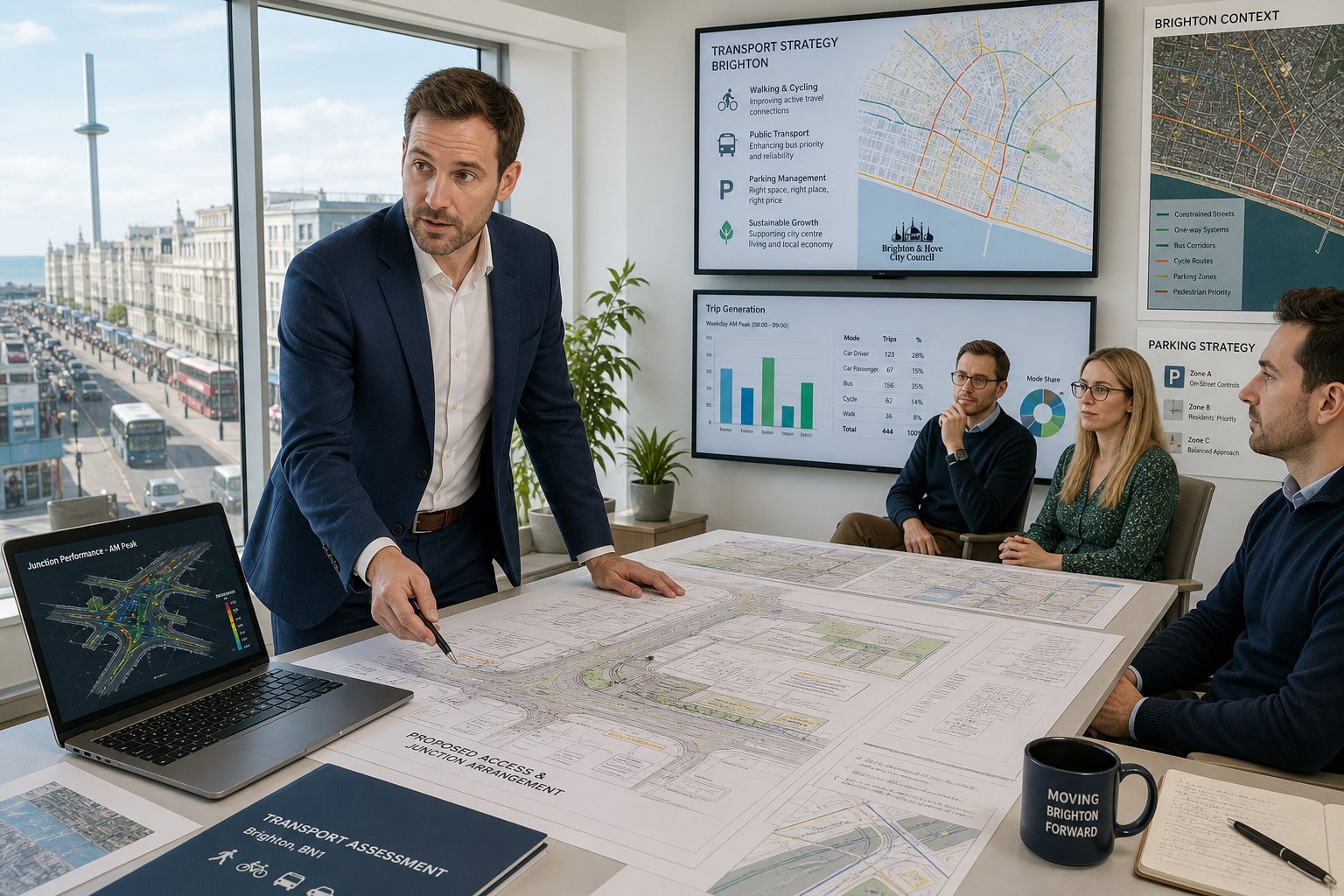
If you’re promoting development in Brighton, transport isn’t a side note you can tidy up at the end. It’s often one of the first things that determines whether a scheme moves smoothly through planning or gets stuck in rounds of highways comments, redesigns and delay. In a city where steep streets, constrained junctions, parking pressure and strong sustainable travel policies all collide, poor transport evidence tends to get noticed quickly.
That’s why working with a traffic engineer in Brighton matters. We’re not simply producing a report to satisfy a validation list. We’re testing whether a proposal can function in the real city: how people arrive, where servicing happens, whether visibility is acceptable, what local junctions are already struggling with, and how a development fits Brighton & Hove City Council’s expectations on walking, cycling, buses, car parking and mode shift.
For architects, planners, lawyers, surveyors, developers and councils, the value is practical. Good transport input helps shape site layouts early, identifies likely objections before submission and gives the planning team evidence that is proportionate, policy-aware and technically robust. In this text, we explain what a traffic engineer in Brighton actually does, when a Transport Assessment or Travel Plan is required, the local issues that influence approvals, and how to choose support that genuinely shortens the planning process rather than adding another layer of paperwork.
Key Takeaways
- Engaging a traffic engineer in Brighton is crucial for ensuring transport proposals align with local planning policies and avoid delays due to inadequate transport evidence.
- Transport assessments, statements, and travel plans must be tailored to the specific scale and impact of the development, reflecting Brighton’s unique constraints like steep streets and controlled parking zones.
- Early collaboration with a traffic engineer can optimise site layouts, addressing access, parking, servicing, and sustainable travel needs before finalising plans.
- Brighton’s local transport policies strongly prioritise reducing car dependency and supporting sustainable travel modes, which must be clearly incorporated in all planning submissions.
- Common causes of planning delays include submitting insufficient transport evidence, unrealistic trip generation assumptions, and ignoring local parking controls and servicing challenges.
- Choosing a traffic engineer experienced with Brighton & Hove’s local context and planning authority expectations increases the chance of a smooth and timely planning approval process.
What A Traffic Engineer In Brighton Does For Planning Applications
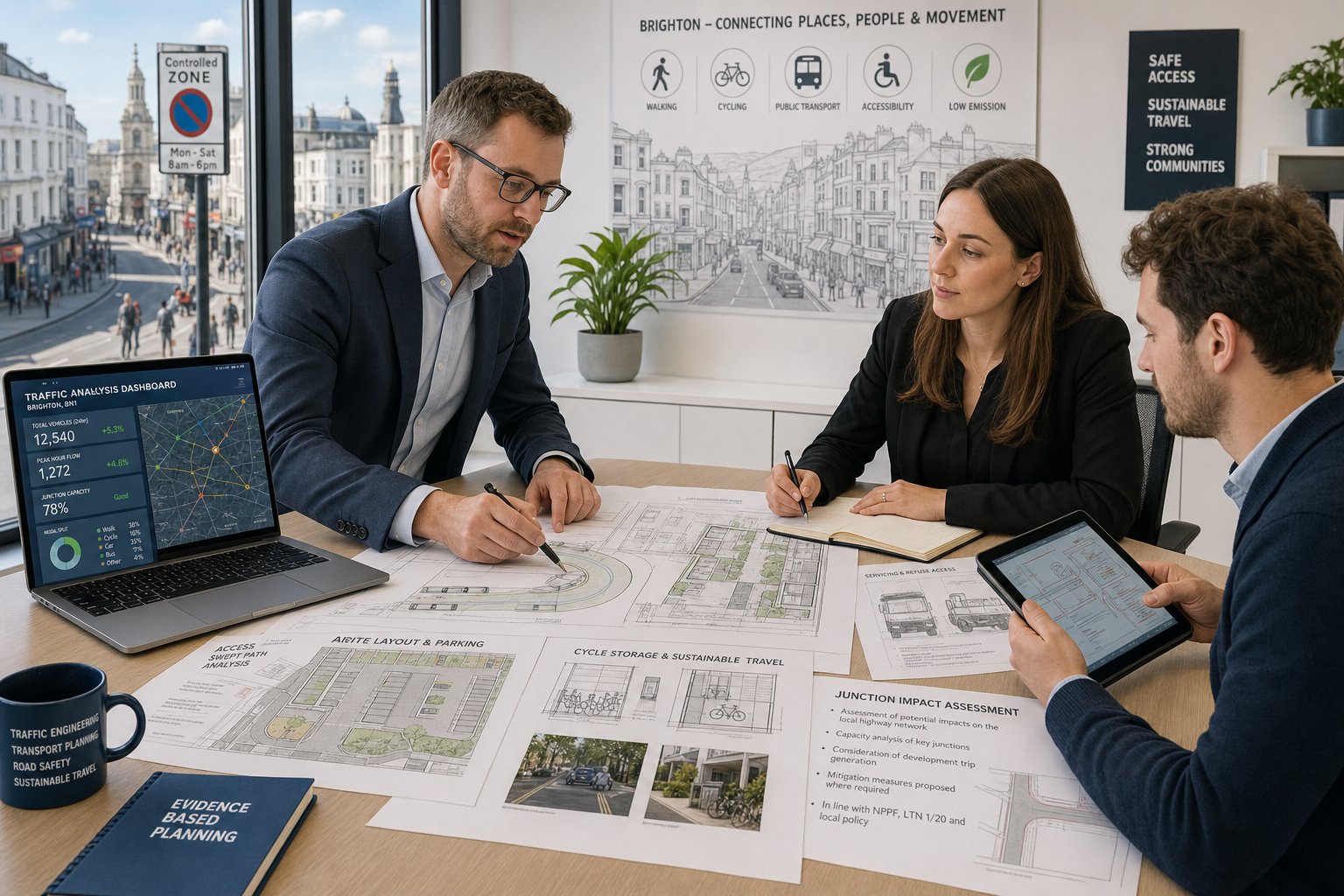
A traffic engineer in Brighton provides the transport evidence that sits behind a credible planning submission. That starts with understanding the site, the proposed land use and the authority’s likely concerns. We review access arrangements, vehicle swept paths, visibility splays, servicing, refuse collection, parking demand, cycle provision and likely effects on nearby streets and junctions.
In practice, our role is partly analytical and partly strategic. We assess whether the proposal is likely to create material traffic impacts, whether it supports sustainable travel, and whether the design itself works safely. We also advise the wider team on what should change before drawings are fixed. Sometimes that means moving an access point, reducing parking, introducing a servicing bay, or strengthening cycle storage and disabled parking provision.
For Brighton schemes, local judgment is especially important. The same development that might be straightforward elsewhere can become sensitive here because of one-way streets, narrow frontages, heavy pedestrian activity or controlled parking zones. That’s why transport work needs to be integrated early with architecture and planning, not bolted on after layouts are finalised.
We also prepare the technical documents that support pre-app, outline and full applications. On more complex schemes, that can involve the same coordinated thinking found across wider Traffic Engineering and Transportation work: evidence, policy interpretation and practical mitigation brought together in one planning-led package.
When A Transport Assessment, Transport Statement, Or Travel Plan Is Needed
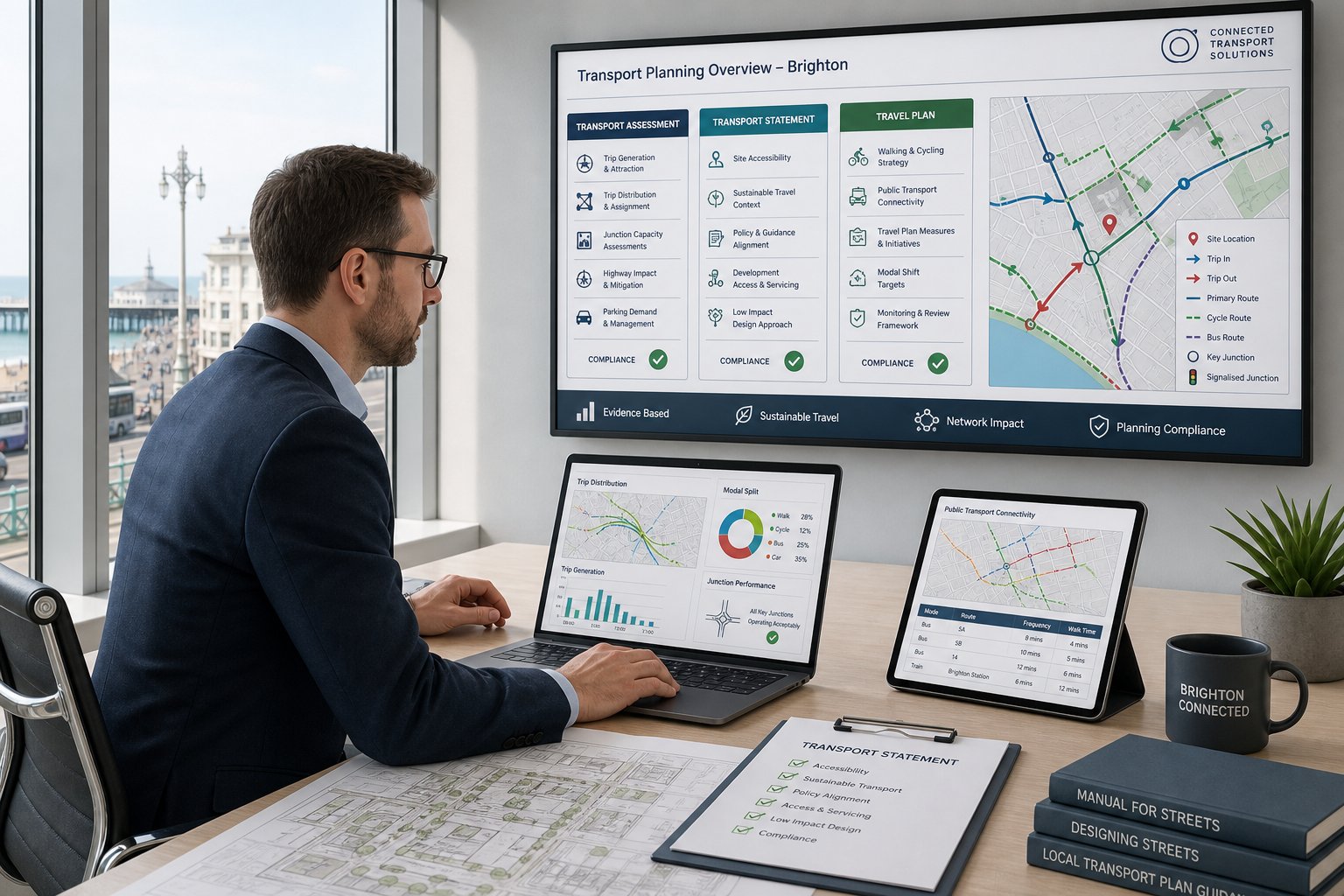
The right level of transport evidence depends on scale, use, location and likely impact. There isn’t a single national threshold that covers every site neatly, so professional judgement matters. As a rule, larger or more trip-intensive schemes usually require a Transport Assessment. Smaller schemes with noticeable but more limited effects may need a Transport Statement. And developments with regular staff, visitor or student movements often need a Travel Plan as well.
A Transport Assessment is the most detailed option. It examines baseline conditions, forecast trips, junction effects, access safety, sustainable transport opportunities and any mitigation needed to make the scheme acceptable. For Brighton, this often includes close scrutiny of walking routes, cycle links, bus accessibility and the interaction with parking controls.
A Transport Statement is generally shorter and more proportionate. It may be appropriate where impacts are modest, but the authority still needs evidence on access, servicing, parking and likely trip effects.
A Travel Plan is different. It focuses on behaviour: how residents, staff or visitors can be encouraged to use non-car modes through information, incentives, management measures and monitoring. Schools, offices, student accommodation, larger residential schemes and mixed-use developments commonly trigger this requirement.
In all cases, national policy, DfT guidance and local validation expectations matter. We usually advise clients to define the scope before submission, because over-reporting wastes money, while under-reporting often causes avoidable delay.
How Brighton And Hove Planning Context Shapes Transport Evidence
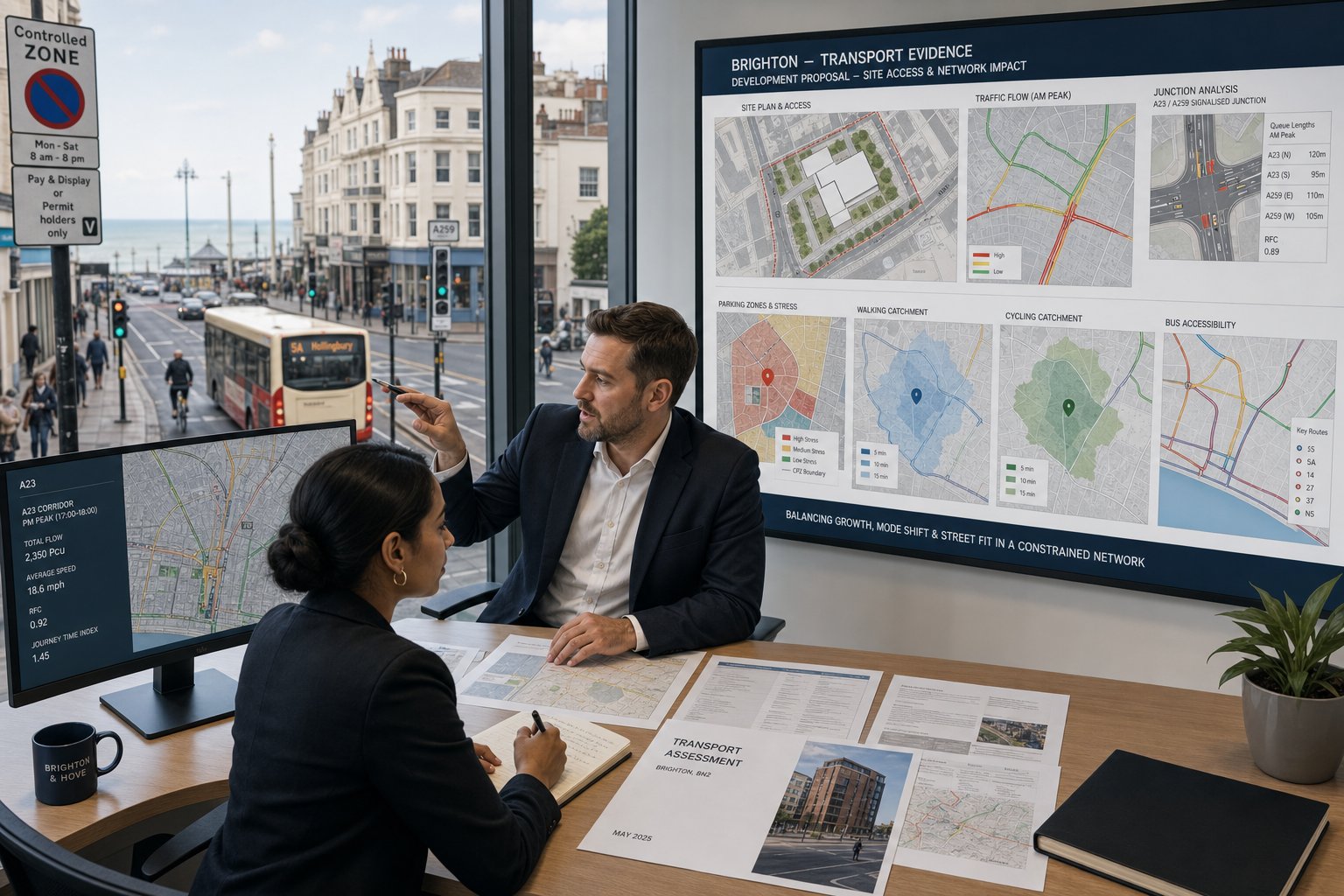
Brighton & Hove has a transport planning context that is much less forgiving than many authorities. The city’s policy direction is clear: reduce car dependency, support mode shift, and ensure new development works within a constrained urban network. That affects both what evidence is required and what conclusions are likely to be acceptable.
For example, parking strategies that might pass elsewhere can face resistance if they ignore local controlled parking arrangements or existing on-street stress. Access proposals that look adequate on a standard plan can become problematic when they sit on a steep road, near a school route, or within a tightly constrained historic street pattern. And trip generation assumptions need to reflect the city’s actual travel behaviour, not generic suburban comparisons.
This is where local knowledge helps. We frame transport evidence around Brighton & Hove City Council policy, the Local Plan, City Plan and Local Transport Plan priorities, rather than treating the report as a generic national template. That includes demonstrating realistic walking and cycling catchments, bus accessibility, compliance with local parking standards, and the case for car-lite or car-free approaches where appropriate.
The same planning-led discipline appears in work across other cities too, whether on a Traffic Engineer In London: project or elsewhere. But Brighton has its own texture, and submissions tend to perform better when the transport evidence recognises that from the outset.
Key Local Constraints That Affect Development In Brighton
Several local constraints come up again and again.
First, road capacity is limited on strategic corridors such as the A23 and A259, particularly where background congestion is already high. Even relatively modest increases in turning traffic can attract scrutiny if they affect signalised junction performance or bus reliability.
Second, controlled parking zones and on-street parking stress are major planning issues. A scheme that exports parking demand onto surrounding streets is unlikely to be viewed kindly unless the evidence is very strong and local controls are clearly understood.
Third, Brighton’s narrow streets, one-way systems, conservation areas and dense urban form can make access design awkward. Refuse collection, servicing and emergency access often become the hidden problem rather than the obvious one.
Finally, the seafront and city centre are highly sensitive environments with heavy pedestrian flows, seasonal variation and competing demands for road space. In those locations, transport evidence has to do more than prove capacity. It has to show that the proposal fits the street.
Typical Projects That Need Traffic Engineering Support
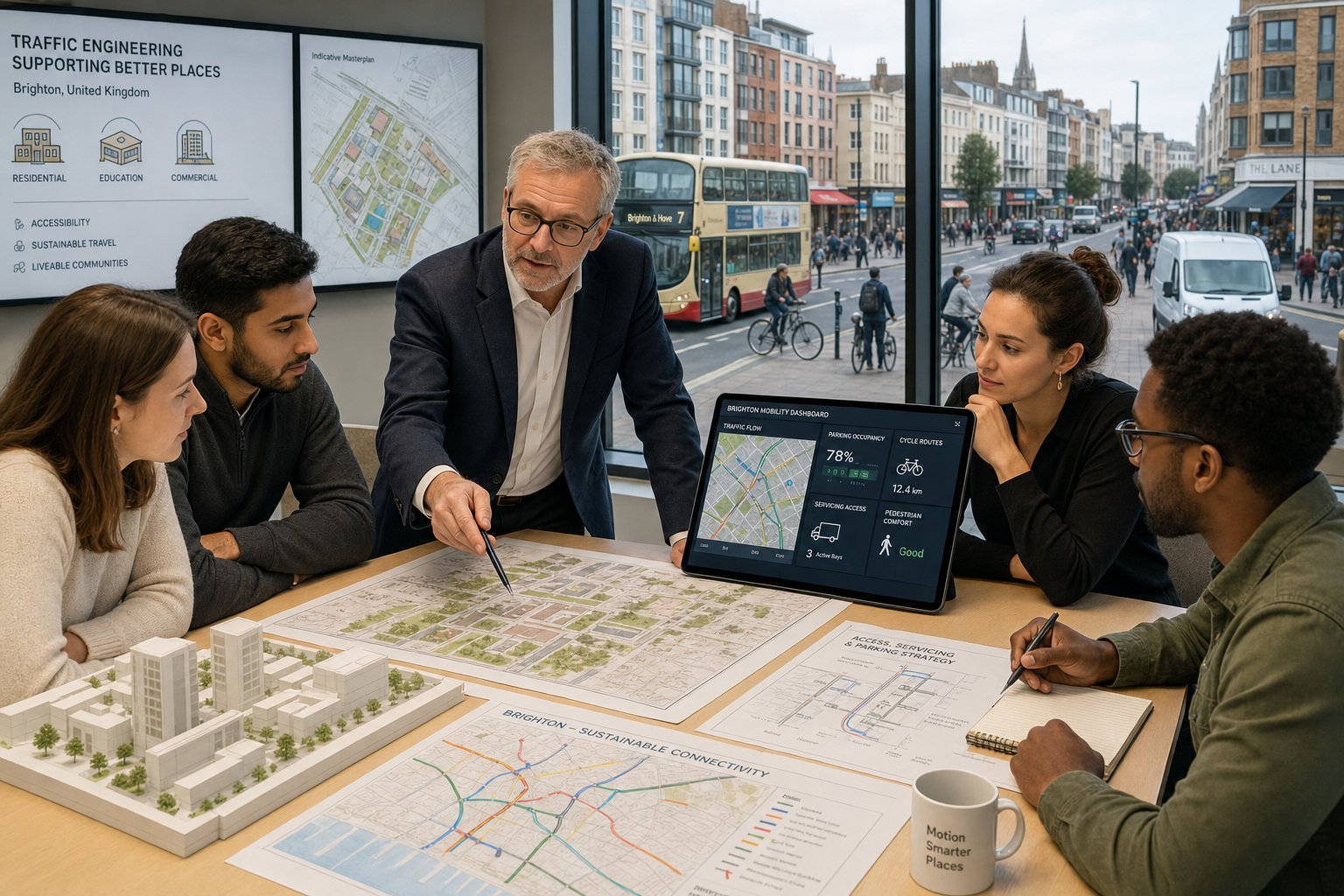
Not every planning application needs a full transport package, but a surprisingly wide range of projects benefit from traffic engineering input. In Brighton, even moderate schemes can raise access, servicing, parking or sustainable travel questions because the network is already tight and policy expectations are high.
We’re commonly instructed on developments where the transport issue is obvious, such as larger residential or mixed-use proposals, but also on schemes where the risk only becomes clear later: a change of use with higher turnover, a town-centre refurbishment with delivery implications, or a constrained infill site where vehicle movements have to work perfectly first time.
Early support is often the difference between a coordinated planning submission and a reactive one. If transport is left until highways comments arrive, the rest of the design team is usually forced to retrofit solutions into an already fixed layout.
That is one reason developers often compare experience across similar urban authorities. Lessons from a Traffic Engineer In Bristol: commission or another dense city can be useful, but Brighton-specific constraints still need their own response.
Residential, Mixed-Use, Education, And Commercial Schemes
Residential schemes form a large share of transport planning work in Brighton. That includes flats, houses, infill developments, HMOs, later living, student schemes and PBSA. The common questions are parking demand, car-free eligibility, cycle storage, refuse tracking, servicing and safe access on constrained plots.
Mixed-use schemes tend to be more complex because trip patterns overlap. Residential, retail, leisure or workspace elements may have different peak periods, servicing needs and travel characteristics. The interaction between active frontage, pedestrian movement and deliveries often matters as much as raw traffic numbers.
Education projects, schools, colleges and university-related development, need careful treatment because arrivals are highly peaked and often politically sensitive. Drop-off activity, walking routes, crossings and Travel Plans are central.
Commercial schemes such as offices, hotels, healthcare, retail and leisure uses can also trigger significant transport work, especially where parking ratios, servicing frequency or town-centre accessibility are under debate. Change-of-use proposals are a frequent pressure point because existing lawful use does not automatically mean transport impacts are neutral.
What Is Included In A Transport Engineering Report
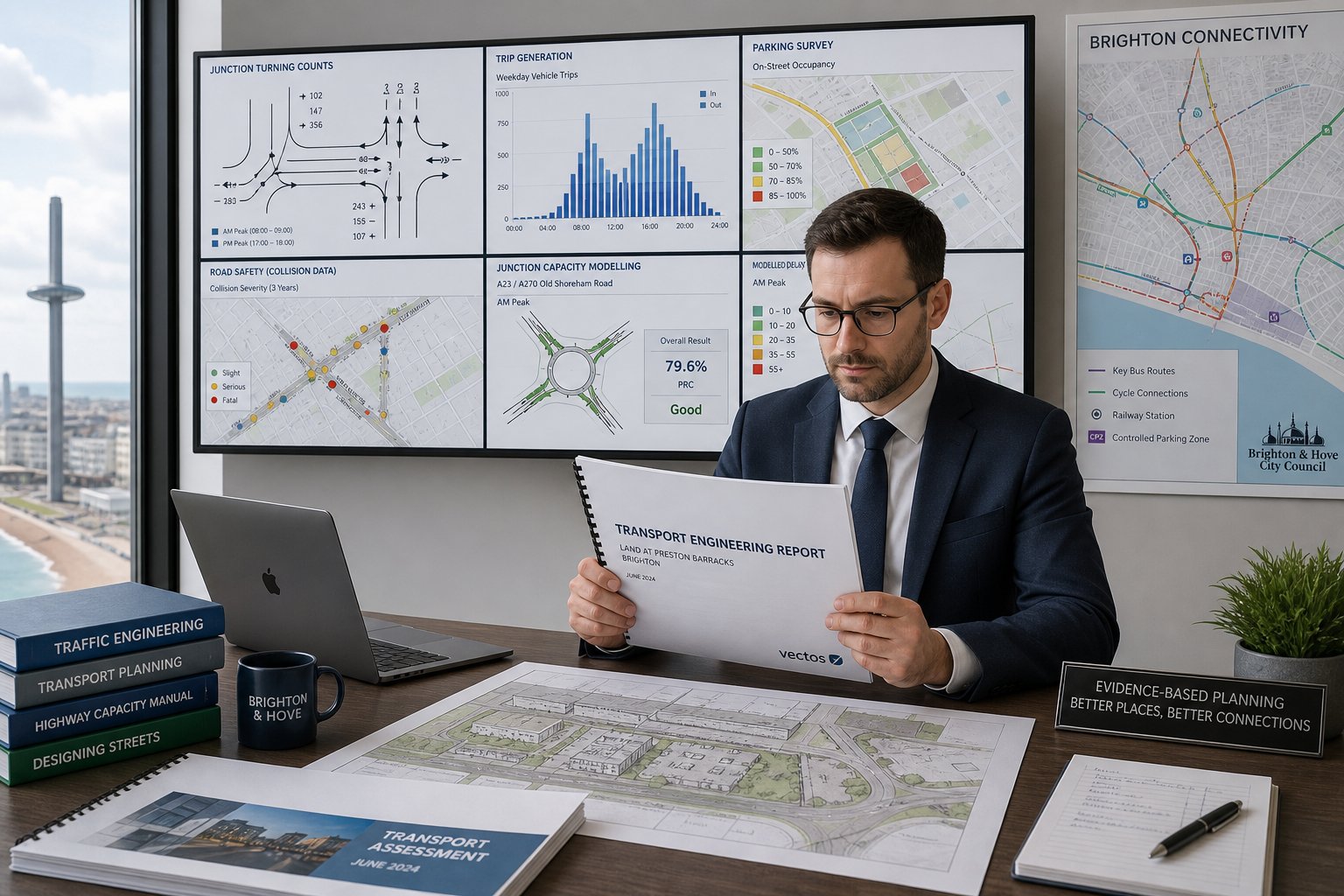
A well-prepared transport report should answer the authority’s real concerns, not bury them in boilerplate. The core structure usually begins with policy and site context, followed by baseline conditions, proposal details, transport impact analysis and any mitigation or management measures required.
We normally set out the surrounding highway network, public transport accessibility, walking and cycling connections, relevant planning history and the standards that apply to parking, servicing and layout. That context matters because it explains why the analysis has been scoped the way it has.
The technical content then depends on the scheme. A smaller proposal may need concise evidence on access, parking and trip effects. A larger one may require survey data, trip generation forecasting, junction capacity modelling, collision analysis, swept path drawings and a Travel Plan.
Quality matters as much as coverage. Brighton officers will usually spot generic assumptions quickly, especially where a report doesn’t reflect local parking controls, bus access, topography or the practical operation of nearby streets. So the strongest submissions are proportionate but specific.
This is broadly the same standard expected from experienced Traffic Engineering Consultants: teams anywhere: clear evidence, robust methodology and recommendations that are realistic to carry out.
Traffic Surveys, Trip Generation, Junction Capacity, And Parking Review
Most substantial reports include some combination of the following elements:
- Traffic surveys such as junction turning counts, queue observations, classified flows, speed data, parking beat surveys and servicing observations.
- Trip generation using TRICS or another suitable evidence base, adjusted where necessary for local mode share, car ownership and site context.
- Junction capacity analysis using tools like PICADY, ARCADY, LINSIG or, for more complex cases, microsimulation. The aim is to understand reserve capacity, delays and whether mitigation is needed.
- Parking review against local standards, existing demand and the development’s likely mode split.
- Road safety review, often drawing on collision records and design risk.
The key point is not the software: it’s whether the assumptions are defensible. A technically polished model built on weak trip rates or unrealistic modal assumptions won’t carry much weight for long.
How A Brighton Traffic Engineer Supports Architects, Planners, And Developers
Our best work often happens before the planning application is drafted. At that stage, we can help the team decide whether an access arrangement is viable, whether servicing can work on-site, how much parking is realistic, and whether the scheme is likely to trigger a Transport Assessment or Travel Plan. Those early choices can save weeks later.
For architects, transport input helps shape layouts that are both functional and policy-aware. Tracking requirements, visibility splays, bin collection strategy and cycle provision all affect the architecture more than people expect. For planners and lawyers, our role is to make sure the evidence is aligned with policy and capable of standing up to scrutiny. For developers, it’s usually about risk: what are the likely highways objections, and can we neutralise them before submission?
We also support pre-app discussions, prepare responses to consultation comments and negotiate with highways officers when issues arise. Sometimes the right answer is additional evidence: sometimes it’s a design amendment: sometimes it’s simply explaining why a proportionate approach is justified.
That collaborative process is consistent with broader planning support in cities such as Traffic Engineer In Manchester: settings, but in Brighton the premium on local nuance is higher. Small geometry changes, parking assumptions or servicing details can have an outsized effect on whether a scheme feels acceptable to the authority.
Common Transport Planning Issues That Delay Approval
Most transport-related delays are not caused by exotic modelling disputes. They come from ordinary problems that should have been identified earlier.
A common issue is simply submitting the wrong level of evidence. If a scheme clearly needs a Transport Statement, Transport Assessment or Travel Plan and none is provided, the application can stall immediately. The same happens when a report exists but is too thin to answer obvious questions on access, parking or peak-hour impact.
Another frequent problem is underestimating trip generation. Optimistic assumptions can unravel quickly if local officers consider the land use more intensive, the car mode share too low, or the surrounding junctions already close to capacity. Once credibility slips, everything else becomes harder.
Parking is another repeat offender. Proposals that ignore local standards, CPZ context, disabled provision, EV charging or cycle parking detail often attract avoidable objections. In Brighton, a vague parking strategy is rarely enough.
Design faults cause delay too: inadequate visibility, awkward servicing, refuse vehicles unable to enter or turn, conflict with pedestrian desire lines, or layouts that technically work on paper but not in day-to-day use. Add poor consideration of walking, cycling, bus access and inclusive design, and highways concerns can spread fast.
A more experienced team will usually spot these earlier, which is the practical value behind planning-led support similar to Traffic Engineer In Birmingham: or other city-focused transport advisory work.
How To Choose The Right Traffic Engineer In Brighton
Not all transport consultants are equally useful on a Brighton planning application. Technical competence matters, of course, but local planning judgment matters just as much.
We’d start with experience. Has the engineer worked on Brighton & Hove schemes of comparable type and scale? Residential infill, student housing, hotels, schools and town-centre mixed-use developments all raise different issues. Familiarity with BHCC policy, parking standards, validation expectations and the way highways comments are typically framed is a genuine advantage.
Next, look at scope and responsiveness. Can they advise at pre-app stage, procure the right surveys, carry out trip analysis, review junction capacity, draft a Travel Plan and respond quickly to consultation feedback? Planning timetables rarely leave much room for slow handovers.
It also helps to ask how they approach problem-solving. A good consultant doesn’t just list risks: they propose workable mitigation and understand how transport recommendations affect architecture, viability and planning strategy. If there’s a possibility of committee scrutiny or appeal, expert witness capability may matter too.
Finally, ask for evidence of successful outcomes, not just polished reports. A concise, accurate submission delivered quickly is usually more valuable than a long one delivered late. That principle sits behind our own approach at ML Traffic, and it’s one reason many clients look for teams with planning-focused experience across places such as Traffic Engineer In Leeds: and Traffic Engineer In Liverpool: as well as Brighton.
Conclusion
Using the right traffic engineer in Brighton can materially improve a planning application’s chances. Not because transport evidence guarantees consent, it doesn’t, but because it reduces uncertainty. It shows that access works, impacts have been assessed properly, parking and servicing have been thought through, and the proposal responds to Brighton & Hove’s policy direction rather than fighting it.
For architects, planners, developers, surveyors and legal teams, the benefit is straightforward: fewer surprises, fewer avoidable objections and a better chance of moving from design to approval without transport becoming the issue that slows everything down. In a city with constrained streets, strong sustainable travel expectations and very little tolerance for weak assumptions, that local transport insight is often what separates a merely submitted scheme from a genuinely planning-ready one.
Frequently Asked Questions About Traffic Engineers in Brighton
What does a traffic engineer in Brighton do for planning applications?
A traffic engineer in Brighton analyses site access, visibility, parking, servicing, and local junction impacts to prepare transport evidence supporting planning proposals aligned with Brighton & Hove City Council policies.
When is a Transport Assessment or Travel Plan required for developments in Brighton?
Larger or high-impact schemes require a detailed Transport Assessment, smaller projects typically need a Transport Statement, while regular staff or visitor movements like schools and offices often trigger a Travel Plan.
How do local Brighton planning policies affect transport evidence for developments?
Brighton’s policies promote reduced car dependency and sustainable travel, demanding transport evidence reflect steep streets, parking controls, and constrained networks to support walking, cycling, and public transport modes.
What common transport issues cause delays in Brighton planning approvals?
Delays often arise from missing or inadequate Transport Assessments or Travel Plans, underestimating trip generation, poor parking strategies, access design faults, and insufficient consideration of sustainable travel and disabled access.
What types of projects commonly need traffic engineering support in Brighton?
Traffic engineering is essential for residential, mixed-use, education, commercial developments, and change-of-use proposals that affect parking, access, servicing, or local road capacity within Brighton’s constrained network.
How can I choose the right traffic engineer for a Brighton development?
Select a chartered engineer with proven Brighton casework, familiarity with BHCC policies and parking standards, experience negotiating with local highways officers, and capability in traffic modelling and expert witness roles if needed.