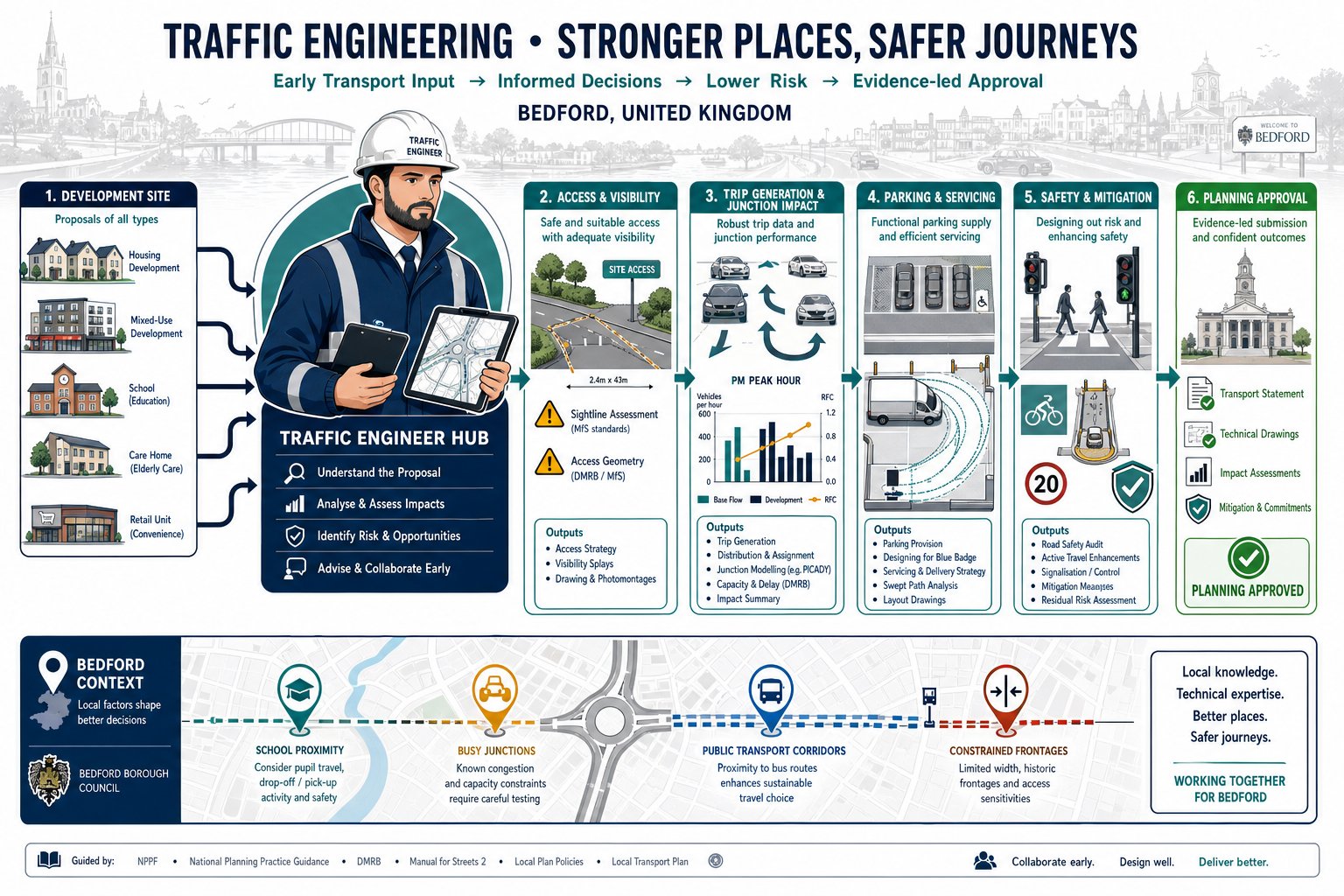
Planning applications rarely fail because a drawing looked untidy. More often, they run into trouble because the movement side of the scheme wasn’t properly nailed down early enough. A new access feels straightforward until visibility is questioned. A modest housing site looks acceptable until peak-hour trips are challenged. A town-centre proposal seems viable until servicing, parking, and pedestrian safety come under the microscope.
That’s where a traffic engineer in Bedford becomes central to the process. We help development teams turn transport risk into technical evidence: quantifying likely trips, testing junction performance, designing safe access, and giving planners and highway officers something robust enough to rely on. For architects, planners, lawyers, surveyors, developers, and councils, that support is often the difference between a smooth application and a long trail of transport objections.
In Bedford, that matters because local context always shapes the answer. A scheme near a school, on a constrained frontage, or close to a sensitive junction won’t be judged in the abstract. It will be judged on whether access is safe and suitable, whether impacts are severe, and whether mitigation is realistic. With over 30 years of experience, we’ve seen the same pattern again and again: the earlier transport input comes in, the more options a project usually keeps. This guide explains what a traffic engineer in Bedford actually does, when that input is needed, what reports are commonly required, and what the assessment process typically looks like in 2026.
Key Takeaways
- A traffic engineer in Bedford is essential for ensuring safe access, accurate trip forecasting, and robust transport evidence for planning applications.
- Early involvement of a traffic engineer in Bedford allows for flexible design options and reduces the risk of delays caused by transport objections.
- Transport assessments and statements must reflect Bedford’s local context including site constraints, nearby sensitive locations, and realistic impact mitigation.
- Common challenges addressed include access safety, visibility splays, parking adequacy, servicing logistics, and junction capacity.
- Successful applications align traffic engineering insights with planning policy, proving developments are safe, suitable, and have proportionate impacts on the highway network.
- Effective traffic engineering reports in Bedford streamline consents by conveying clear, evidence-based transport implications tailored to local conditions.
What A Traffic Engineer In Bedford Does For Development Projects
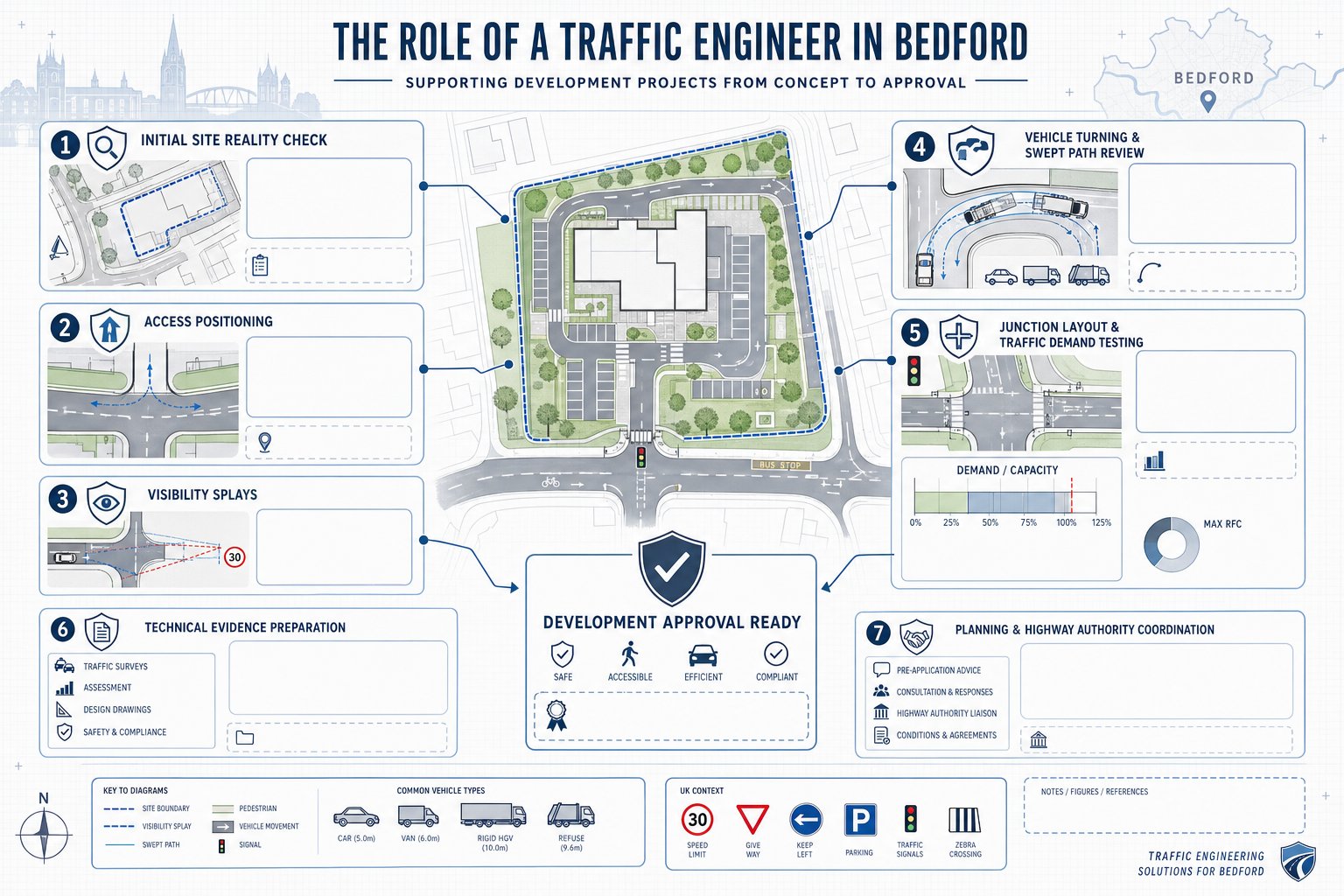
A traffic engineer in Bedford does far more than produce a single report at the end of design. In practice, we sit between planning strategy, technical highway requirements, and the physical constraints of the site. That means reviewing how a proposal connects to the highway, whether vehicle and pedestrian movements work safely, and whether the likely impact can be justified to the local authority.
At project level, our role often starts with a reality check. Is the proposed access in the right place? Are the visibility splays achievable within land control? Will refuse vehicles or delivery vans turn without awkward reversing? Does the junction layout reflect the expected traffic demand rather than just fitting neatly on a drawing? Those questions sound basic, but they’re exactly where avoidable delays tend to begin.
We also prepare or coordinate technical evidence. That can include traffic impact studies, junction capacity modelling, parking reviews, servicing assessments, swept path analysis, and road safety input. On schemes with off-site works, we may advise on signs, road markings, priority control, crossings, or signal implications. The broader discipline covered by Traffic Engineering Consultants: What is really about making a development legible and acceptable from a transport perspective.
Just as important, we help teams speak the same language as planners and highway officers. A strong planning submission needs more than optimism. It needs evidence that the proposal can operate safely and that any impacts are understood, proportionate, and, where necessary, mitigated.
When You Need Traffic Engineering Input For A Planning Application
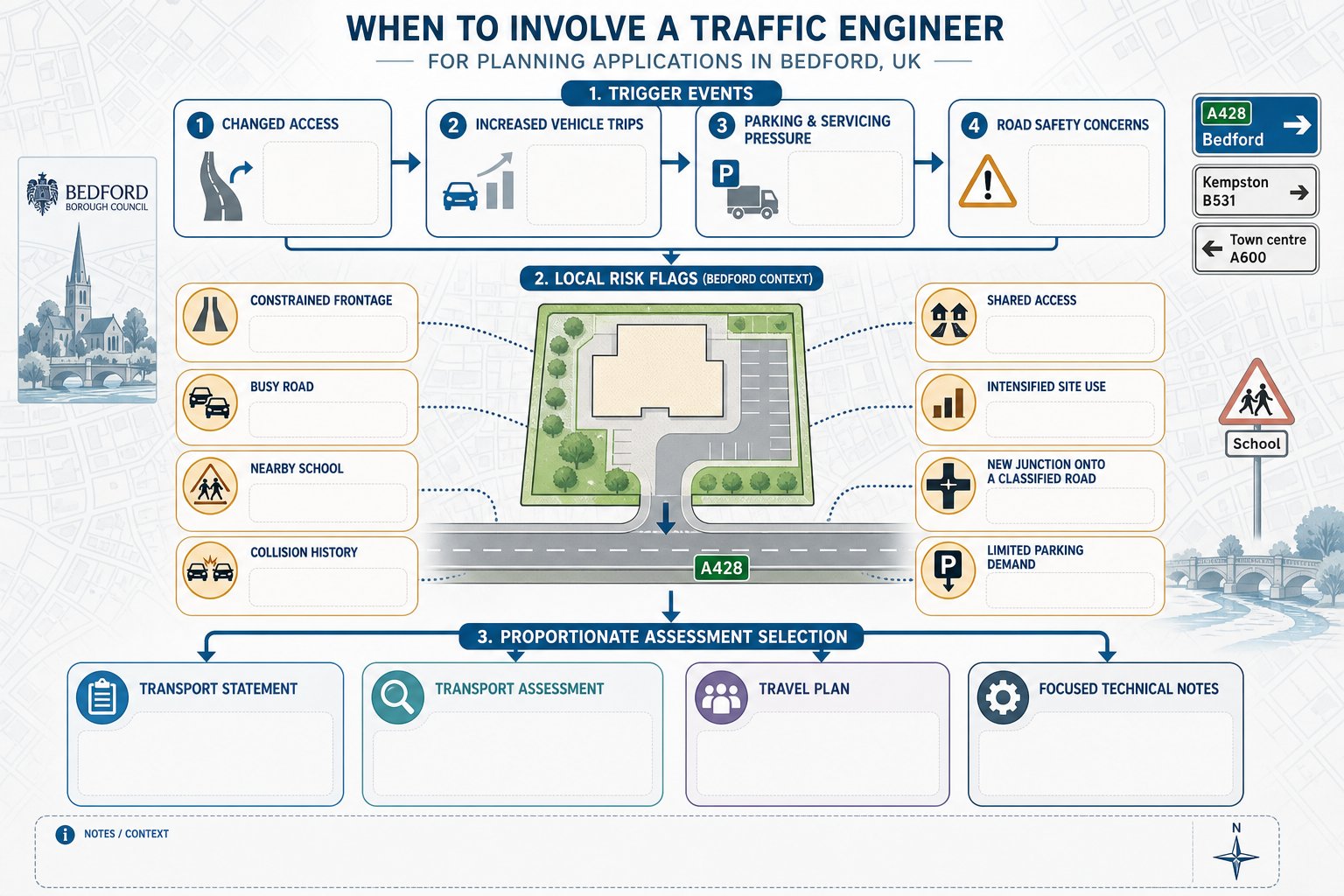
The short answer: earlier than most teams first assume. If a development changes access to the public highway, is likely to generate a noticeable number of vehicle trips, affects parking or servicing, or raises road safety concerns, traffic engineering input is usually sensible long before validation.
Sometimes the trigger is formal. A planning officer or the Local Highway Authority may request a Transport Assessment or Transport Statement. But waiting for that request can be risky. By that stage, the layout may already be fixed around assumptions that don’t hold up under scrutiny. We’d much rather test the likely issues while a scheme is still flexible.
There are some obvious flags. Constrained frontage. Busy road. Nearby school. Existing collision history. Shared access with another use. Intensification of an established site. New junction onto a classified road. Limited parking with high demand nearby. Any of those can move transport from a background topic to a determining issue.
For many clients, the value is not just in producing a report but in shaping the application strategy. Work in Highway And Traffic Engineering often starts with identifying whether a full TA, a TS, a Travel Plan, or more focused technical notes are likely to be proportionate. That early steer can save redesign costs later.
And in Bedford especially, proportionality matters. Not every project needs heavy modelling. But every project that touches the highway needs a defensible, policy-aware explanation of why the transport effects are acceptable.
Common Bedford Developments That Require Transport Assessments
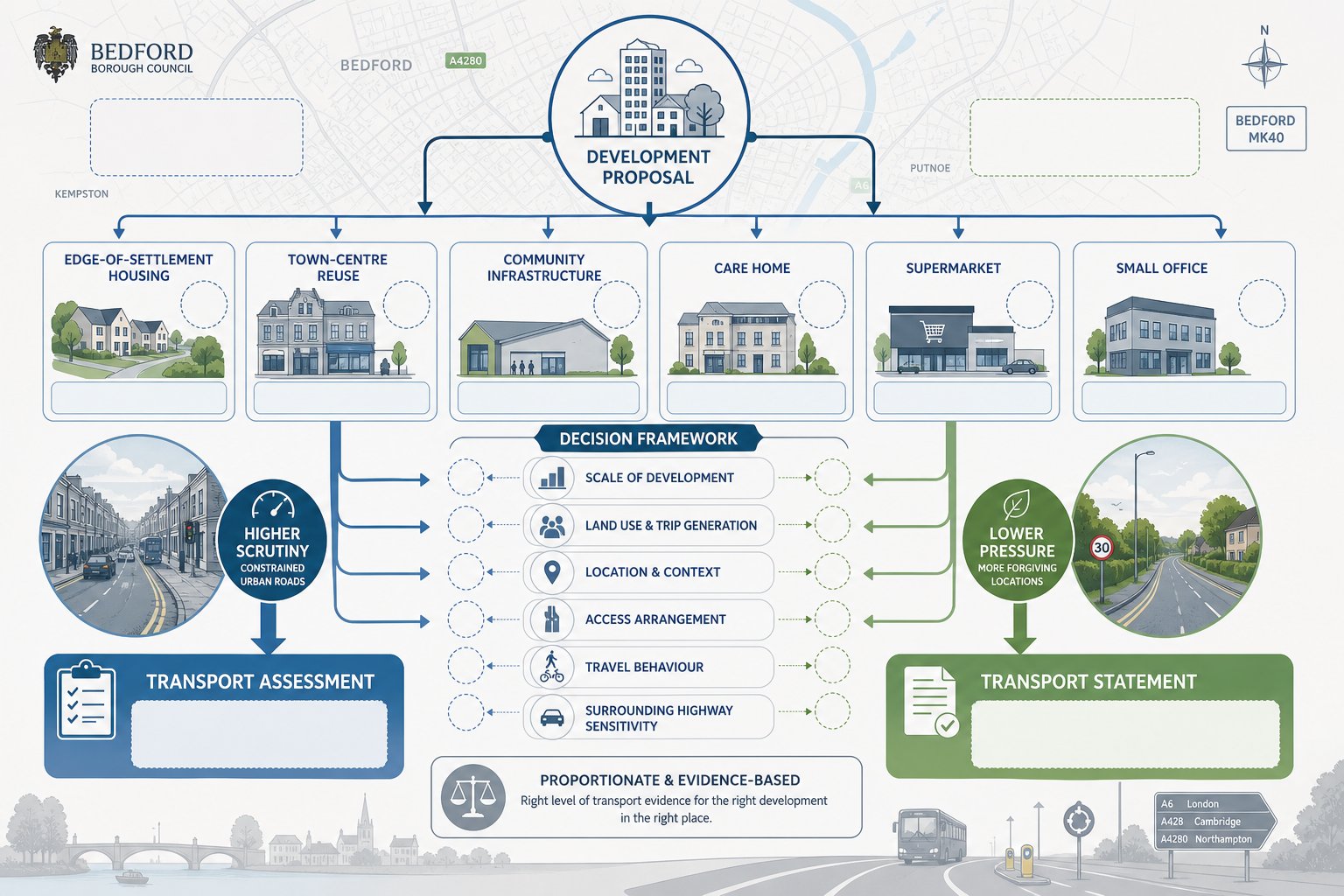
Bedford sees a broad mix of development types, from edge-of-settlement housing to town-centre reuse and community infrastructure. The common thread is simple: if a proposal changes how people and vehicles move, transport evidence may be needed.
Some schemes need a detailed Transport Assessment because the likely effect on the road network, access arrangement, or travel behaviour is substantial. Others only need a concise Transport Statement showing that impacts are limited and manageable. The right level depends on the scale, use, location, and sensitivity of the surrounding highway environment.
In our experience, two things matter most. First, the land use itself: a care home does not move like general housing, and a supermarket does not behave like a small office. Second, context: a modest proposal on a constrained urban road can attract more transport scrutiny than a larger one in a forgiving location. That’s why Bedford projects are rarely judged by unit count alone.
Below are the development categories where transport input most often becomes material.
Residential Schemes
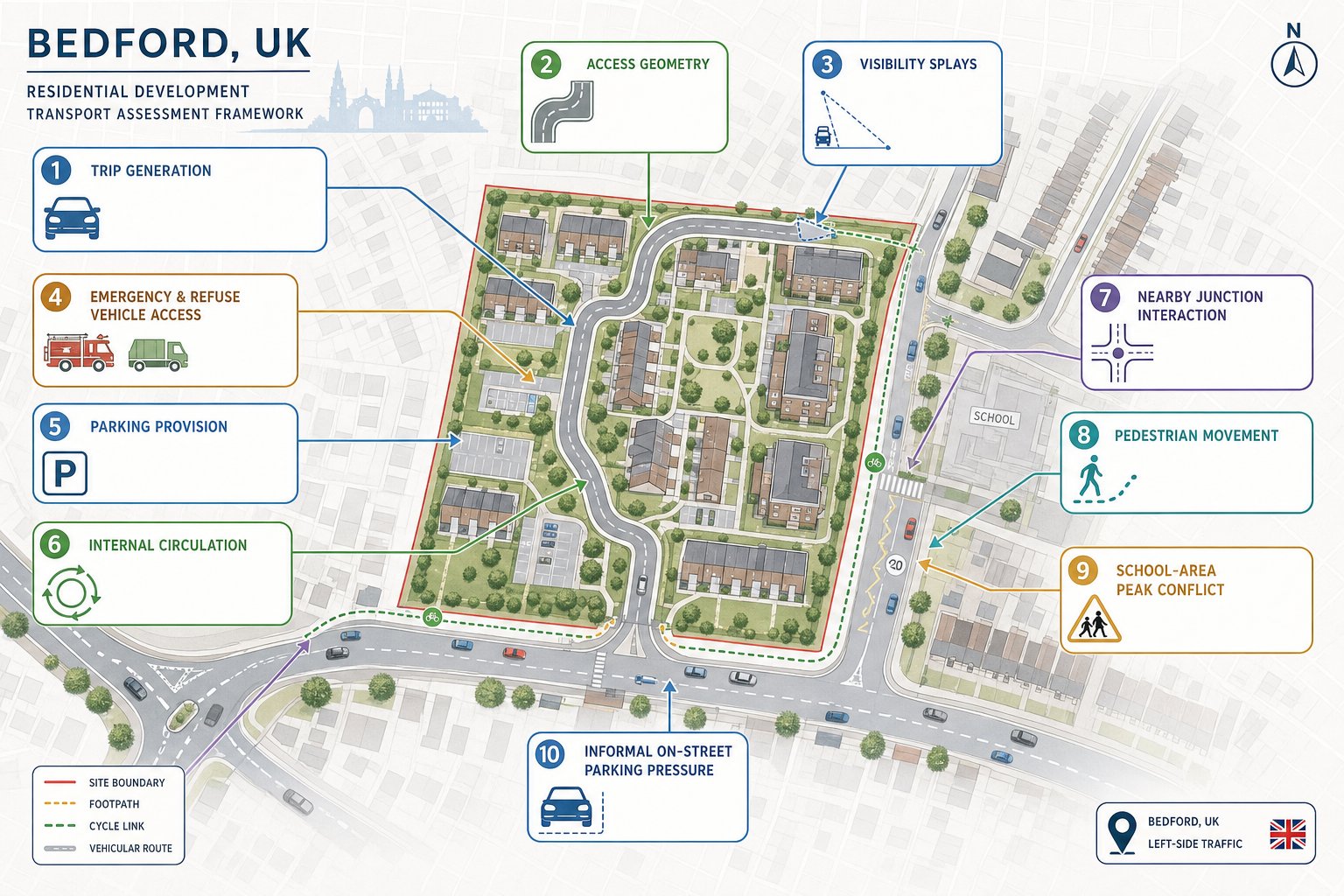
Residential development is probably the most familiar case, but it’s also where assumptions can go wrong fastest. New housing estates, apartment blocks, HMOs, extra care schemes, and care homes all create different traffic and parking patterns. A 20-unit suburban scheme may hinge on access geometry and driveway spacing: a town-centre flat development may be judged more heavily on servicing, cycle provision, and overspill parking.
For Bedford residential sites, we typically review trip generation, access design, visibility, emergency and refuse access, parking provision, internal circulation, and interaction with nearby junctions. Where a site sits close to schools or established residential streets, the authority may look closely at peak-hour conflict, informal parking behaviour, and pedestrian movement. Those details can decide whether a proposal feels acceptable in practice, not just in theory.
Residential schemes also benefit from early integration with layout design. A few metres lost to landscaping or boundary treatment can undermine visibility. Bin collection strategy can alter turning requirements. A slightly different access point can transform the capacity case. That’s why Traffic Engineering and Transportation planning shouldn’t be left until after the masterplan is effectively fixed.
The goal is straightforward: show that residents, visitors, service vehicles, and vulnerable road users can all use the site safely, while the surrounding network continues to operate within acceptable bounds.
Commercial, Mixed-Use, And Community Developments
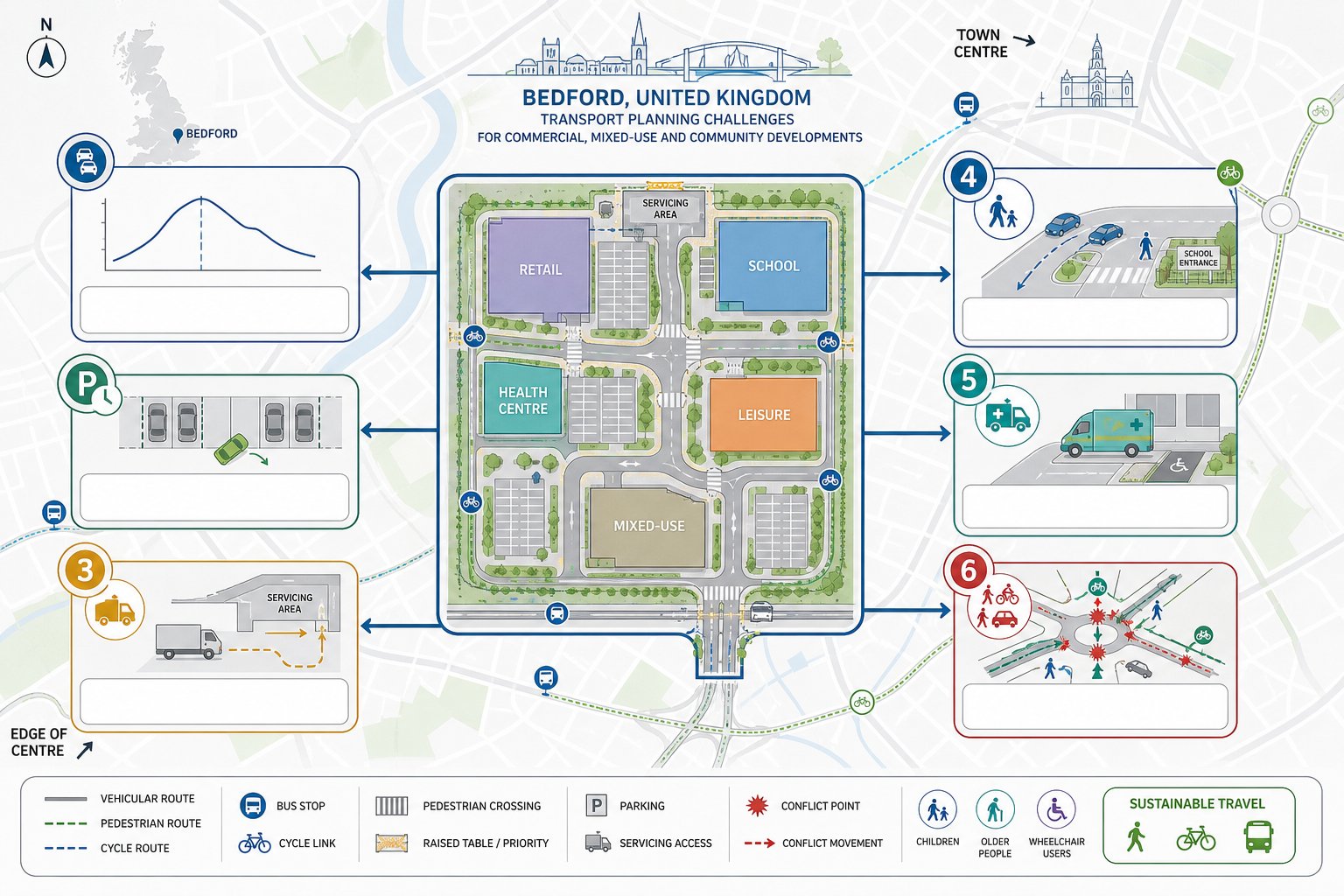
Commercial and community schemes often attract sharper transport scrutiny because their movement patterns can be more variable and more intense. Retail parks, supermarkets, industrial units, schools, health centres, leisure uses, and mixed-use regeneration sites all have the potential to create concentrated peaks, servicing demands, and complex access needs.
For example, a small convenience-led proposal may not generate dramatic traffic overall, yet short-stay parking turnover and delivery timing can become the dominant concern. A school may be acceptable on daily traffic numbers but problematic because of sharp drop-off peaks and pedestrian safety issues. A health facility may need close attention to ambulance movements, accessible parking, and pick-up activity. Mixed-use development adds another layer, because shared access and internal circulation have to work for multiple user groups without conflict.
This is where focused Commercial Traffic Engineering input becomes valuable. We’re not only asking how many trips a site produces, but when they occur, where they route, how they interact with servicing, and whether mitigation can be delivered credibly.
In Bedford, town-centre and edge-of-centre schemes can also trigger questions about sustainable travel, parking restraint, and cumulative impact. Community developments, meanwhile, may need a particularly careful explanation of accessibility for all users, including children, older people, and those with reduced mobility.
Key Traffic And Transport Reports Often Needed In Bedford
The report package for a Bedford application depends on the scale and transport sensitivity of the proposal, but several documents come up repeatedly.
A Transport Assessment (TA) is the fuller option, usually required where impacts may be material. It sets out baseline conditions, trip generation, distribution, junction effects, parking and servicing arrangements, accessibility, and any mitigation. A Transport Statement (TS) is lighter-touch and is generally used where impacts are expected to be limited, though it still needs to be evidence-led.
A Travel Plan may be requested for larger or more trip-intensive uses, especially where mode shift is realistic and policy support exists. It sets out measures to encourage walking, cycling, public transport use, car sharing, and ongoing monitoring.
Then there are the more drawing-led and technical pieces: access design, vehicle tracking, and visibility splay drawings: parking and servicing strategies: swept path analysis: and sometimes a Road Safety Audit with a designer’s response when off-site highway works are proposed. The wider principles behind Traffic Engineering: Your Complete guide these outputs, but each Bedford scheme needs tailoring to its own frontage, network, and planning context.
What matters most is coherence. A strong package doesn’t just tick boxes. It tells one consistent story: the site is accessible, the design is safe, the impact has been tested properly, and any mitigation is proportionate and deliverable.
How Local Planning And Highway Considerations Shape Bedford Projects
No transport report exists in a vacuum. In Bedford, applications sit within a framework of national planning policy, highway design standards, local parking requirements, street design expectations, and case-specific engineering judgement. That combination shapes both what gets asked for and how evidence is assessed.
At national level, the familiar tests still matter: developments should provide safe and suitable access for all users, and residual cumulative impacts on the road network should not be severe. In practice, those phrases do a lot of work. “Safe and suitable” brings in geometry, visibility, pedestrian crossing desire lines, vehicle conflict, and user behaviour. “Severe” demands more than a vague fear of congestion: it requires reasoned evidence. But local interpretation always matters.
Bedford projects can be strongly influenced by the character of the surrounding area. Historic streets, constrained urban frontages, school routes, bus corridors, and junctions already close to capacity can all tighten the authority’s focus. Parking is another recurring theme. Even where policy supports sustainable travel, under-provision has to be justified against real local conditions rather than aspiration alone.
We often find that successful schemes align transport thinking with planning strategy from the start. Insights from comparable work by a Traffic Engineer In Manchester: or a Traffic Engineer In Leeds: may be useful in methodology terms, but Bedford decisions still turn on local thresholds, officer expectations, and site-specific highway conditions.
That’s why local knowledge and proportionate judgement matter as much as the raw numbers.
Typical Traffic Engineering Issues That Can Affect An Application
Most transport objections are not mysterious. They usually stem from a handful of recurring issues that weren’t resolved early enough or weren’t evidenced clearly enough. In Bedford, we often see applications slowed by concerns over access safety, visibility, network impact, parking stress, and servicing practicality.
What catches teams out is that these issues are interconnected. A tight access may also weaken visibility. Reduced parking may increase on-street pressure. Low trip forecasts may undermine confidence in the whole submission if local officers consider them unrealistic. And once confidence in the transport case slips, even minor points can become harder to close out.
The most effective way to avoid that is simple: identify the likely pressure points before submission, test them properly, and make sure the design and reports tell the same story. The two issue groups below are where that scrutiny most often lands.
Access, Visibility, And Highway Safety
Access is often the first thing officers and highway engineers look at, because if vehicles can’t enter and leave safely, the rest of the transport case doesn’t get very far. In Bedford, common concerns include substandard junction geometry, awkward radii, poor alignment, excessive proximity to other junctions, and visibility splays compromised by walls, vegetation, parked cars, or land outside the applicant’s control.
Safety isn’t just about a vehicle crossing a kerb line neatly. It’s about how the access works in the real world. Are pedestrians likely to walk across it in large numbers? Is the site near a school gate or uncontrolled crossing? Will larger vehicles swing into opposing lanes? Does the layout create confusion between visitors, deliveries, and residents? Recent collision history nearby can also sharpen attention, especially if the proposal appears to add turning movements at an already sensitive point.
Where off-site works are proposed, the authority may require an audit trail through design review and potentially safety audit stages. Approached properly, that’s useful rather than burdensome. It forces the scheme team to confront practical risk before consent, not after it.
We’ve found that many “highway safety” objections are really design coordination problems in disguise. Resolve the geometry, prove the visibility, track the vehicles, and explain user interactions clearly, and the application usually becomes much easier to defend.
Trip Generation, Parking, And Impact On The Local Network
If access is the first test, trip generation is usually the second. Local authorities want to know whether a development’s traffic forecasts are robust, whether those trips are assigned sensibly across the network, and whether nearby junctions can absorb them without unacceptable delay or queueing.
This is where weak assumptions can damage an application quickly. Understated trip rates, selective survey use, or over-optimistic reductions for sustainable travel tend to stand out, especially on contentious sites. We prefer to be realistic from the start. A defensible forecast may not always produce the lowest number, but it gives officers confidence that the rest of the analysis can be trusted.
Parking and servicing are often part of the same conversation. Inadequate parking can displace demand onto nearby streets. Poorly arranged loading can block circulation or create reversing conflicts. A site can pass a junction model and still fail the practical test if vans have nowhere sensible to wait or turn. Work done by a Traffic Engineer In Bristol: may show similar patterns elsewhere, but in Bedford the judgement will still depend on local street conditions, enforcement realities, and the sensitivity of neighbouring uses.
Sometimes the solution is physical mitigation. Sometimes it’s layout revision, parking rebalancing, servicing controls, or a Travel Plan. The key is proving that the proposal will operate credibly once people actually start using it.
What To Expect From The Traffic Assessment Process
A good traffic assessment process is structured, but it shouldn’t feel mechanical. The aim is to build a clear evidence base, test the proposal proportionately, and resolve likely objections before they harden.
We usually begin with scoping. That means reviewing the site, understanding the development parameters, and agreeing, formally or informally, what level of assessment is appropriate. On more sensitive schemes, engaging early with the Local Highway Authority can save a lot of wasted effort.
Next comes the baseline: traffic surveys, site observations, parking accumulation if needed, and collision data review. Without a sound baseline, everything that follows is shakier than it looks.
Then we move into trip generation and distribution. We estimate how many vehicle trips the proposal is likely to create, when they occur, and where they’re likely to route. Depending on the development, that may involve database comparisons, first-principles judgement, committed development review, and sensitivity testing.
After that, we assess junction capacity and queueing, along with access operation, servicing, and non-car movement where relevant. If impacts arise, we develop mitigation: access amendments, local junction improvements, crossing provision, parking changes, or Travel Plan measures.
Finally, the findings are written into a report package and submitted with the application, followed by negotiation. That may involve responding to consultee comments, agreeing conditions, or discussing obligations under Section 106 or Section 278. The smoother schemes are usually the ones where transport evidence was used to shape the design, not simply defend it after the fact.
Conclusion
For Bedford development projects, transport isn’t a side note. It is often one of the practical tests that determines whether a scheme feels deliverable to planners, highway officers, and consultees. A traffic engineer in Bedford helps bridge that gap between concept and consent by testing access, forecasting impact, addressing safety, and producing the reports that planning decisions rely on.
Our view is simple: bring transport input in early, and most schemes gain better options. Layouts can be adjusted before they become expensive to change. Risks can be evidenced properly rather than argued vaguely. And the planning submission becomes more coherent because the design, the narrative, and the technical case all line up.
For architects, planners, lawyers, surveyors, developers, builders, and councils, that early clarity tends to save time later. In 2026, with scrutiny on highway safety, parking, cumulative impact, and policy compliance still high, a well-prepared transport case remains one of the smartest investments a project team can make.
Frequently Asked Questions about Traffic Engineering in Bedford
What does a traffic engineer in Bedford typically do for development projects?
A traffic engineer in Bedford assesses site access, junction safety, and vehicle movements, performs traffic impact studies and capacity analysis, and prepares technical evidence like Transport Assessments to support planning applications and ensure compliance with local policies.
When should I involve a traffic engineer for a planning application in Bedford?
Early involvement is crucial if the development affects public highway access, generates noticeable vehicle trips, impacts parking or servicing, or raises road safety concerns, often before formal requests from the Local Highway Authority or planning officers arise.
Which types of Bedford developments usually require a Transport Assessment or Statement?
Residential schemes such as housing estates and care homes, commercial and mixed-use sites like retail parks, schools, and health centres, especially where the proposal significantly changes movement patterns or access arrangements.
What are common traffic engineering issues that can delay planning approval in Bedford?
Issues often include substandard junction geometry, poor visibility splays, inadequate parking or servicing arrangements, underestimation of trip generation leading to congestion concerns, and safety problems near schools or sensitive junctions.
How does local planning policy influence traffic engineering assessments in Bedford?
Local policies require developments to demonstrate safe and suitable access, manage cumulative impact without severe congestion, and comply with parking, street design, and highway standards, with emphasis on local conditions like historic streets and school routes.
What is the typical process of a traffic assessment conducted by engineers in Bedford?
The process includes scoping with authorities, collecting baseline traffic and accident data, modelling trip generation and distribution, analysing junction capacity, designing access and mitigation measures, followed by report submission and negotiation of planning conditions.