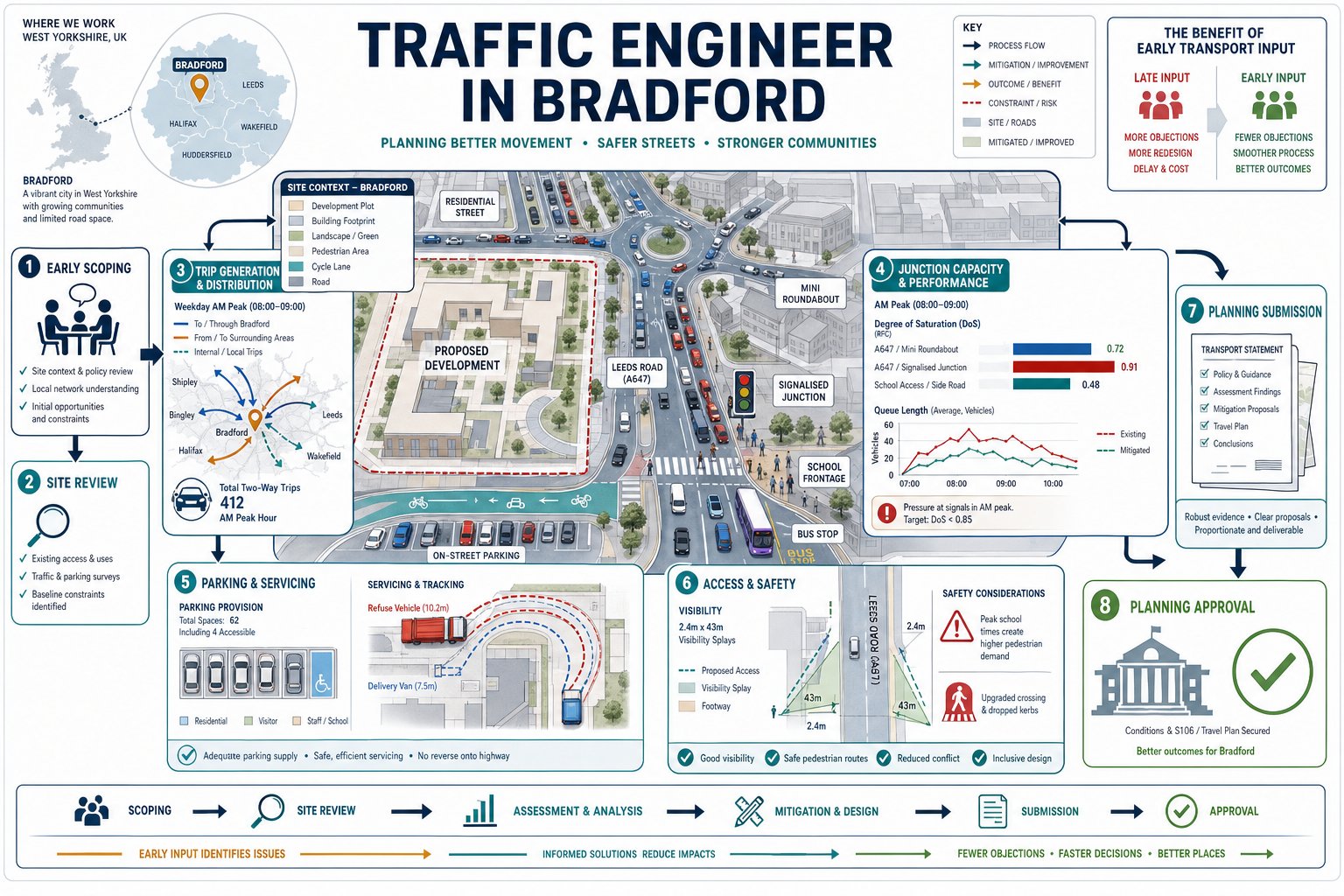
Planning applications in Bradford rarely succeed on architecture alone. But strong the design, the question that keeps coming back from highways officers, planners and committee members is simple: what will this scheme do to the road network, parking demand, servicing movements and safety conditions around the site?
That is where a traffic engineer in Bradford becomes central to the process rather than an afterthought. We’re not just talking about producing a report to tick a box. A well-scoped transport assessment or transport statement can identify problems early, shape the layout, justify trip assumptions, respond to local policy and, crucially, reduce the risk of avoidable highways objections.
In Bradford, that matters. The district includes dense urban corridors, suburban residential areas, town centres, school-fronted routes, constrained access points and locations already under pressure at peak times. Add local parking standards, active travel expectations and the need to align with national guidance, and transport input quickly becomes one of the most practical parts of a planning submission.
In this guide, we explain what a Bradford traffic engineer typically does, when transport evidence is needed, how Bradford’s planning context affects reporting requirements, and what to look for when appointing a consultant. For architects, planners, developers, surveyors, legal teams and local authorities, the aim is straightforward: better evidence, fewer surprises, and a stronger route to planning success.
Key Takeaways
- A traffic engineer in Bradford plays a vital role in assessing and managing a development’s impact on local roads, parking, servicing, and safety, ensuring compliance with both local and national planning policies.
- Early involvement of a traffic engineer helps refine site layouts, balance parking provision, and identify necessary mitigations, reducing the risk of costly highways objections and delays in planning approvals.
- Transport assessments or statements are essential depending on project scale and local sensitivity; many mid-sized and change-of-use developments in Bradford require detailed transport evidence due to complex local conditions.
- Bradford’s planning context demands transport reports tailored to specific site conditions such as congested corridors, proximity to schools, or town centres, rather than generic assessments.
- A comprehensive traffic engineering review covers trip generation, junction capacity, parking strategies, access design, and road safety, integrating diverse factors to present robust and clear evidence for planning authorities.
- Choosing a local, experienced traffic engineer who combines technical expertise with strong communication skills improves the likelihood of smooth planning processes and successful development outcomes in Bradford.
Why A Traffic Engineer Matters For Development Projects In Bradford
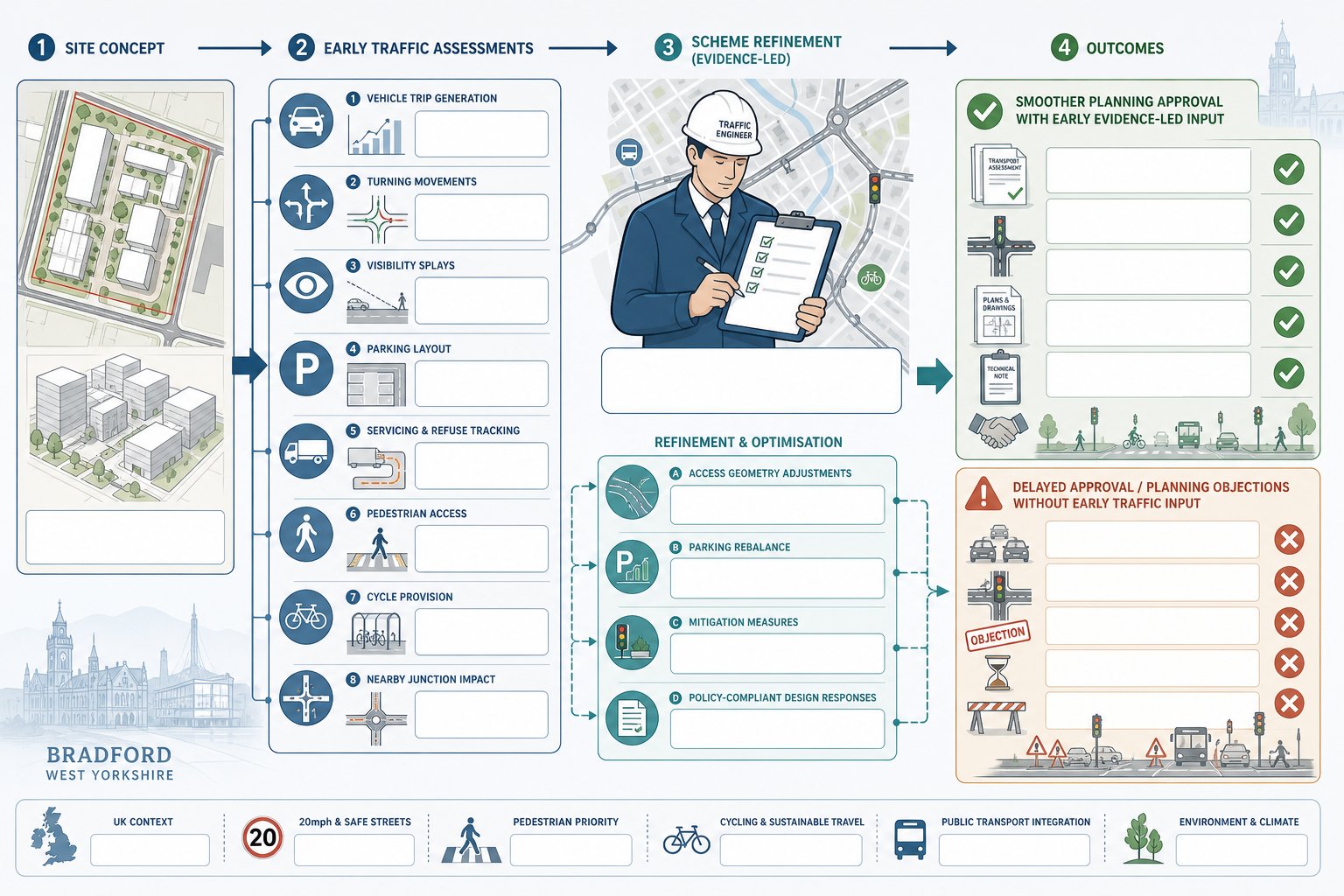
A traffic engineer in Bradford helps translate a development concept into something the planning system can test properly. That sounds obvious, but in practice it’s often the difference between a scheme that moves smoothly through consultation and one that stalls because highways concerns were left too late.
At planning stage, Bradford Council and its highways officers will want to know whether a proposal can operate safely and efficiently. They will look at vehicle trips, turning movements, visibility, parking, servicing, pedestrian access, cycle provision and the likely effect on nearby junctions. If those issues are not addressed with evidence, assumptions tend to be challenged. And once concerns become formal objections, resolving them usually costs more time and more money.
The value of early input is that transport advice can shape the scheme before the application is fixed. Access geometry can be refined. Parking can be rebalanced. Refuse tracking can be tested. Mitigation can be identified before an officer asks for it. In many cases, we find that transport work is most useful when it influences the site layout, not just when it documents it.
That is especially true for projects sitting on constrained plots, corridors with congestion at peak hours, or sites near schools, local centres and signalised junctions. A good engineer doesn’t simply report impacts: we help anticipate them and show how they can be managed in a policy-compliant way.
For teams comparing wider advisory support, Traffic Engineering Consultants: often become involved not only in assessment, but in strategy, negotiation and evidence-led mitigation. In a similar planning context across West Yorkshire, a Traffic Engineer In Leeds: role follows the same principle: establish impact clearly, align with local policy, and remove uncertainty before determination.
How Bradford’s Planning Context Shapes Transport Requirements
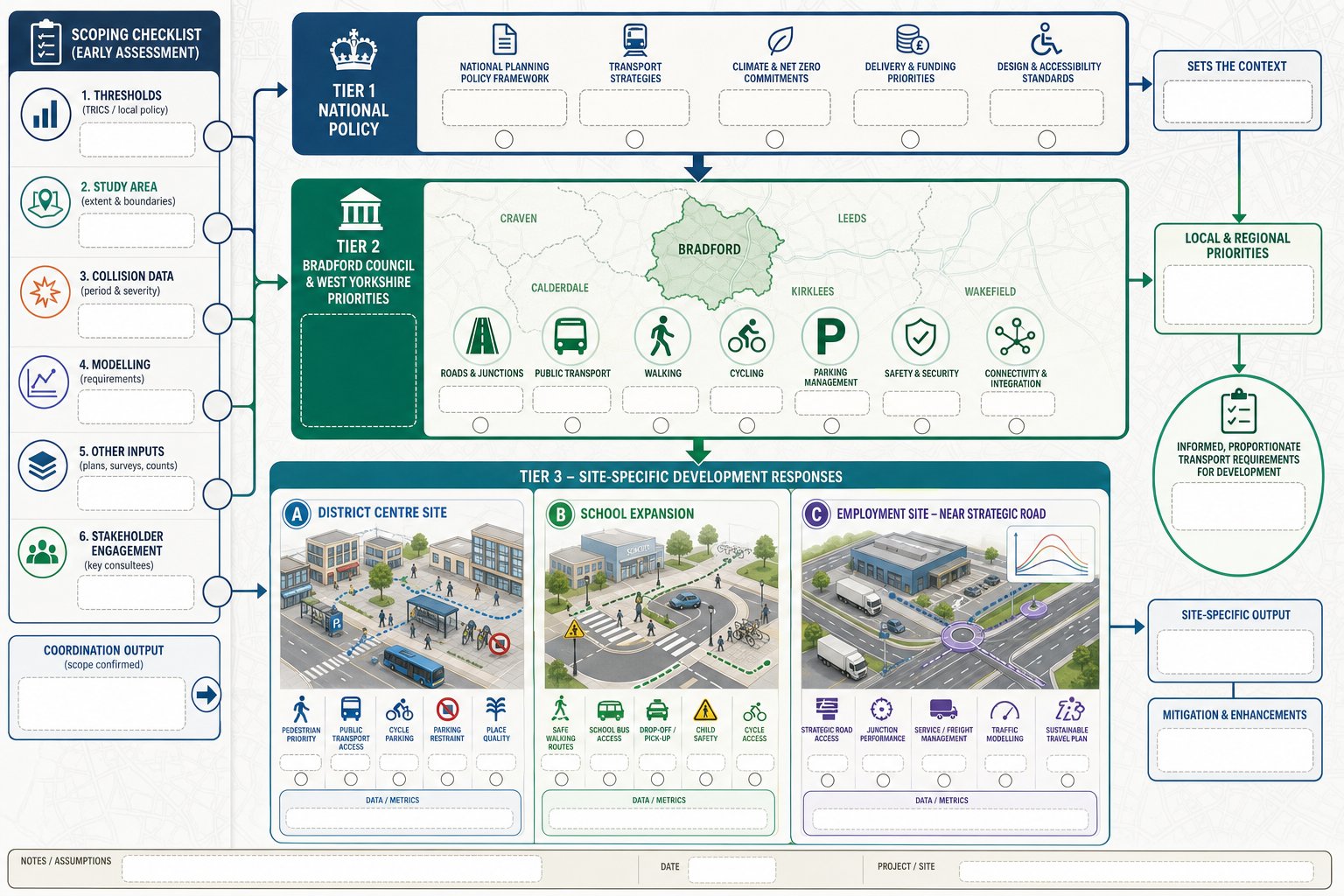
Bradford’s transport requirements are shaped by both local and wider policy layers. At the local level, Bradford Metropolitan District Council acts as planning and highway authority, so proposals need to respond to its development plan policies, parking expectations, access standards and place-specific concerns. At the wider level, schemes also sit within West Yorkshire transport priorities around bus reliability, active travel, connectivity and safer movement.
That means a traffic report for Bradford cannot be entirely generic. A technically correct transport statement still falls short if it does not speak to the local context. For example, a site near a district centre may need more emphasis on walking catchments, bus accessibility and realistic car parking demand. A school expansion may require a sharper focus on drop-off behaviour, crossing points and peak-time safety. An employment scheme near a strategic route may need more detailed junction modelling and servicing analysis.
National guidance still matters, of course. The National Planning Policy Framework supports development that offers safe and suitable access for all users, and it expects significant impacts on the transport network to be addressed. But local interpretation is where many applications succeed or struggle. Bradford officers will typically want evidence proportionate to the development, but proportionate does not mean superficial.
This is why scoping is so important. We usually advise agreeing the scope of assessment early, particularly where there is any uncertainty over thresholds, study area, collision data, or modelling requirements. Work grounded in Highway And Traffic Engineering principles tends to land better when it clearly reflects local roads, local movement patterns and the practical realities of Bradford streets rather than abstract textbook assumptions.
When A Transport Assessment Or Transport Statement Is Needed
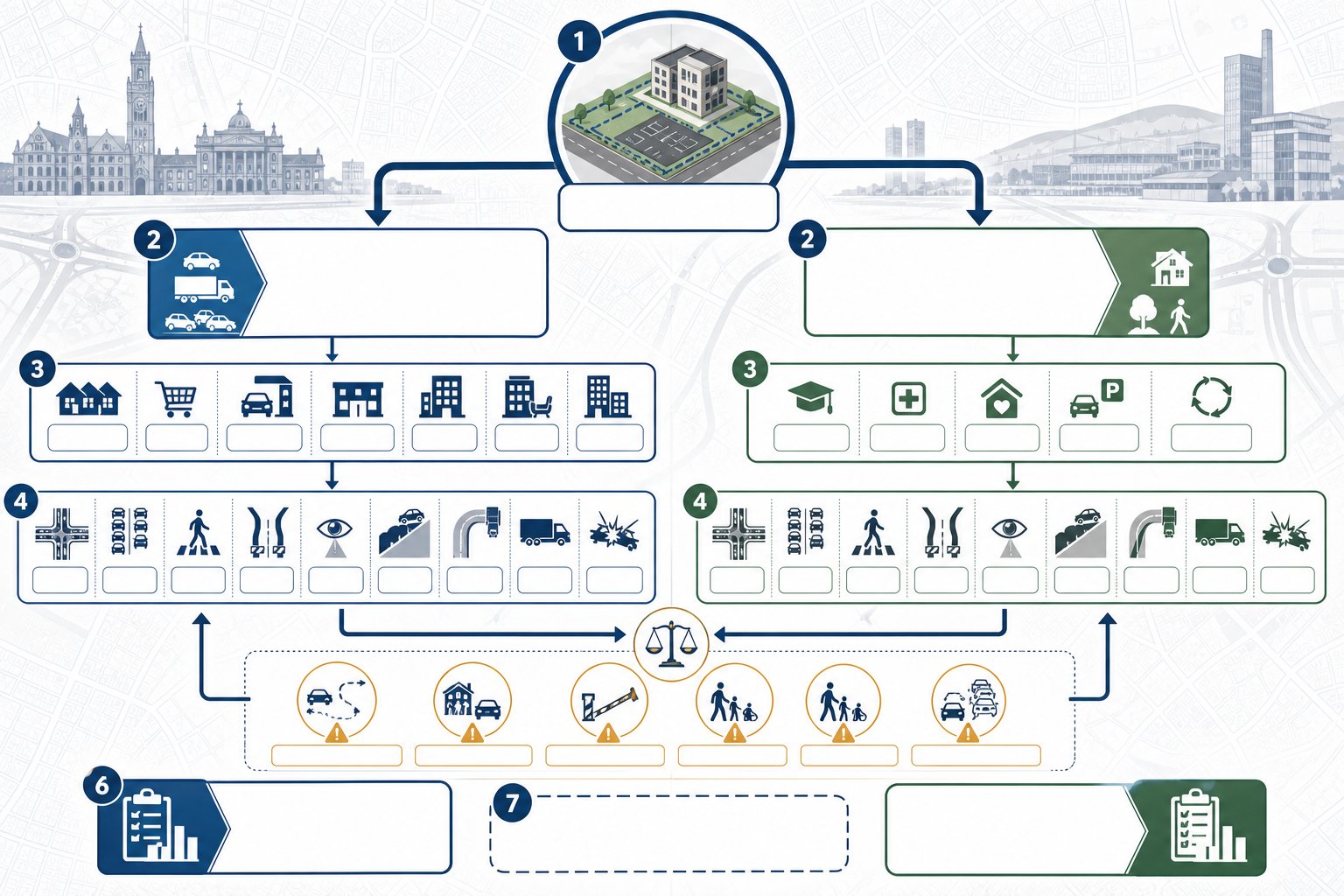
Not every planning application in Bradford needs a full Transport Assessment (TA), but many need more than a brief note saying the impact will be low. The usual question is proportionality: how much transport evidence is needed for the likely scale and intensity of the proposal?
Broadly, a Transport Assessment is used for larger or more traffic-intensive development. That can include substantial housing sites, retail proposals, employment uses, roadside food and beverage schemes, mixed-use developments and other applications where trip generation could materially affect the surrounding network. A Transport Statement is generally used for smaller proposals where impacts are more limited but still need structured evidence.
The line between the two is not always fixed by a single universal threshold. In reality, Bradford’s highways officers may consider land use, local sensitivity, road conditions, nearby junction stress, site constraints and whether the proposal involves vulnerable users. A small scheme on a difficult site can generate more scrutiny than a larger one in a less constrained location.
Pre-application discussion is often the sensible route. If the scope is agreed early, the planning team can avoid overproducing analysis in one area while missing something more important elsewhere. And where the application also needs a Travel Plan, access review or parking strategy, it is better to establish that upfront rather than retrofit it after consultation.
For broader context, Traffic Engineering and Transportation work often overlaps with land use planning much earlier than many project teams expect. That early coordination usually saves time later.
Typical Triggers For Planning Applications
Typical triggers include high trip-generating uses such as supermarkets, drive-thrus, roadside retail, trade counters and leisure formats with sharp peak-hour demand. Housing schemes can also trigger a TA or TS, particularly once they move beyond a modest scale or are located on roads with existing congestion, parking stress or limited pedestrian infrastructure.
Another common trigger is a constrained access arrangement. If visibility is tight, gradients are awkward, turning space is limited or servicing needs to be carefully managed, transport input is usually expected even where traffic generation itself is not exceptional. Similarly, a site with known collision history or one located close to schools, healthcare facilities or care uses will often attract a more detailed highways review.
Change-of-use applications are regularly underestimated. A building may already be in use, but if the proposed use materially changes trip patterns, peak timing, servicing demand or parking accumulation, the authority may still require transport evidence. We often see this with former office, industrial or community premises proposed for retail, education, food-led or health-related uses.
And then there’s local context: if neighbours already raise concerns about rat-running, school gate parking or blocked accesses, Bradford officers are unlikely to accept a light-touch submission without supporting analysis. In that sense, transport reporting is not just about size. It’s about risk, sensitivity and whether the development changes how the site interacts with the highway network.
What A Bradford Traffic Engineer Will Usually Assess
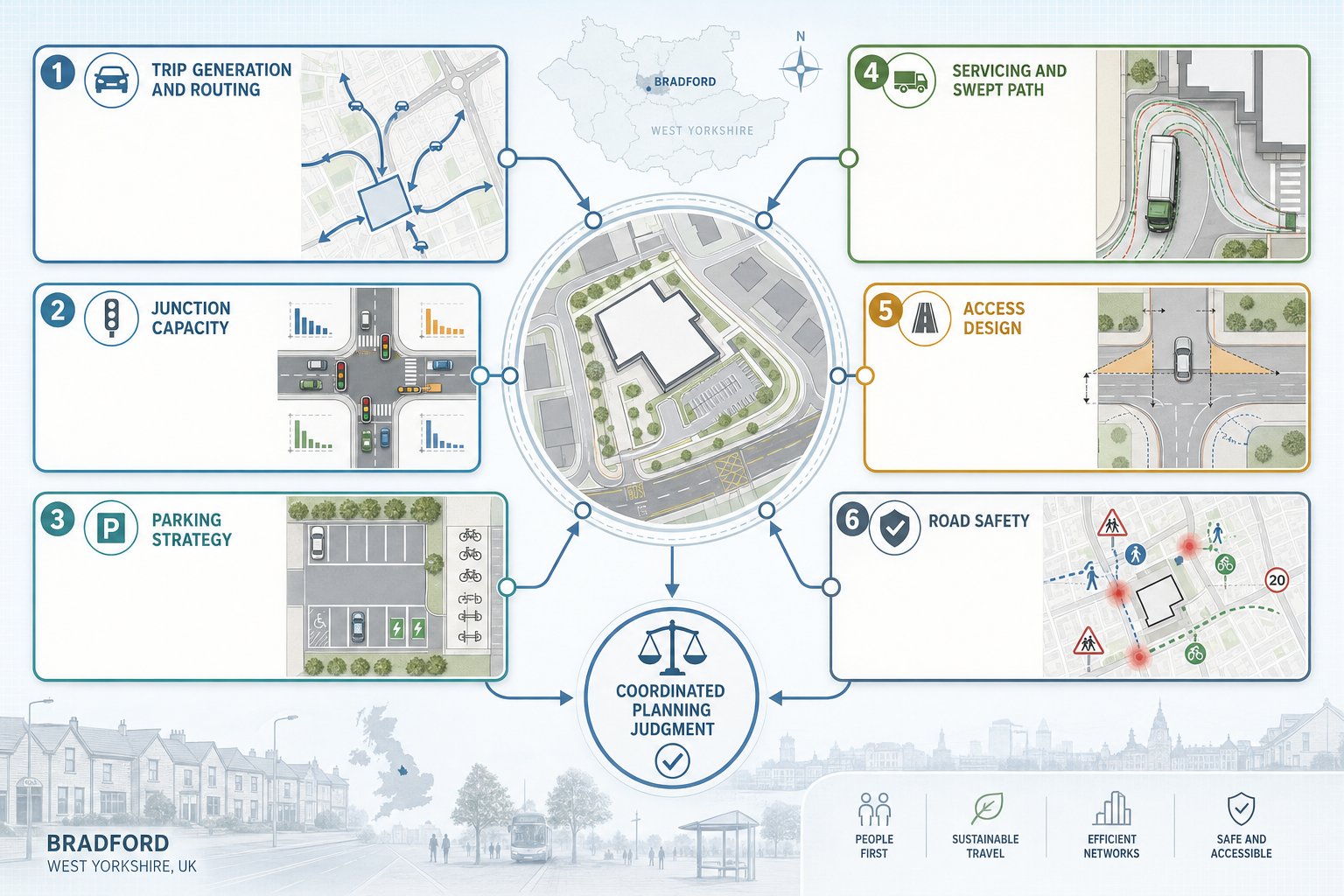
A Bradford traffic engineer will usually assess the proposal from several angles at once: how many trips it creates, where those trips are likely to go, whether nearby junctions can cope, whether vehicles can get in and out safely, whether parking and servicing are realistic, and whether the proposal supports sustainable travel.
That mix is important because planning decisions are rarely made on one metric alone. A junction might technically operate within capacity, but if servicing blocks manoeuvring space or pedestrian access is poor, highways concerns can remain. Equally, a site may have acceptable access visibility, but if parking is underprovided or badly arranged, displacement onto surrounding roads may become the real issue.
The right assessment is hence integrated rather than siloed. We usually combine observed local conditions, policy review, trip forecasting, swept path testing, road safety evidence and design checks into one narrative that answers the authority’s likely questions before they are formally asked. On stronger submissions, the technical work also helps the rest of the consultant team. Architects refine layout. Planners sharpen policy justification. Lawyers and land teams understand where obligations or off-site works may arise.
A lot of that comes down to clarity. Officers do not need pages of unnecessary theory: they need robust evidence tied to the actual Bradford site.
Trip Generation, Junction Capacity, And Highway Impact
Trip generation normally starts with establishing an evidence base for likely arrivals and departures by time period and mode. In UK practice, this often means using TRICS or comparable data sources, then sense-checking the findings against local context, existing travel patterns and the proposed development mix. That “sense-checking” matters more than many people think. A suburban infill housing site in Bradford should not be treated as if it behaves like a city-centre apartment block in another region.
Once trip rates are established, we look at distribution and assignment: where vehicles are likely to route on the surrounding network. The assessment area then follows from that. Key junctions are tested using tools such as PICADY, ARCADY, LINSIG or, for more complex cases, microsimulation platforms including VISSIM. The purpose is straightforward: estimate queues, delays, reserve capacity and whether the development creates a material adverse effect.
But numbers alone are not enough. The authority will also want to know whether any impact can be mitigated. Sometimes the answer is a ghost island right-turn lane, signal adjustment, improved lane discipline or a revised access arrangement. Sometimes it is operational rather than geometric, such as delivery timing or Travel Plan measures. On employment and retail projects, Commercial Traffic Engineering analysis often becomes central because peak trading patterns and servicing demand can affect junction performance in ways headline daily trip totals do not capture.
Parking, Servicing, Access, And Road Safety Considerations
Parking is where many seemingly straightforward applications become difficult. Bradford officers will usually expect parking provision to reflect local standards, operational need and the site’s accessibility by walking, cycling and public transport. Underproviding spaces without a credible justification can push overspill onto nearby streets. Overproviding them can undermine layout quality and sustainable travel arguments. The answer is rarely “as many spaces as we can fit.”
That is why a proper parking strategy traffic review is useful. We assess car parking, disabled bays, cycle parking, electric vehicle provision, loading areas, tracking for refuse and service vehicles, and whether the arrangement actually works day to day rather than merely fitting on a drawing.
Access design is equally critical. Visibility splays, carriageway width, radii, gradients, pedestrian crossing desire lines and internal turning all need to be checked against current standards and site conditions. A weak point here can unravel an otherwise acceptable proposal, which is why access design highway principles should be addressed early in concept design.
Road safety review brings another layer. We consider personal injury collision records, speed environment, likely conflict points, vulnerable road users and whether mitigation such as lining changes, crossing upgrades, traffic calming or visibility improvements may be required. In Bradford, especially around schools, local centres and busy distributor routes, these details often carry real weight in the planning balance.
Common Project Types That Need Traffic Engineering Input
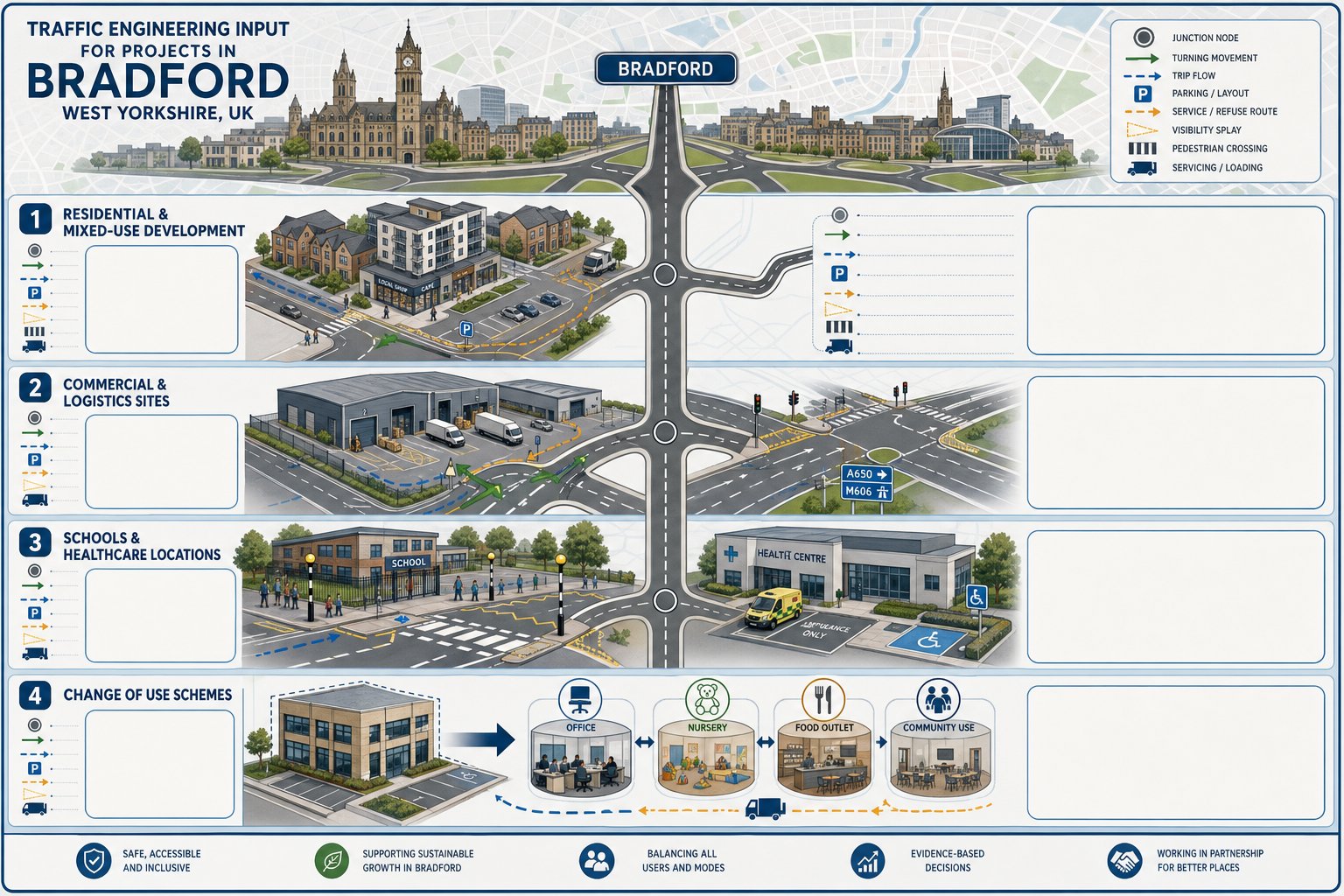
Traffic engineering input is needed across a wider range of planning applications than many clients first assume. Yes, large strategic developments obviously require it. But plenty of smaller or mid-sized schemes in Bradford also need transport evidence because their local impact is concentrated, sensitive or operationally awkward.
The common thread is not simply scale. It is whether the proposed development changes how people, vehicles and service activity interact with the local highway network. If the answer is yes, a traffic engineer usually has a role to play.
Residential, Mixed-Use, And Commercial Developments
Residential schemes are one of the most frequent triggers. Medium-sized housing developments, apartment proposals, extra care schemes and mixed-tenure layouts all raise questions around trip rates, parking demand, estate road design, refuse tracking and access visibility. On edge-of-settlement or suburban sites, the local road network may already be under pressure at school and commuter peaks, so junction testing becomes important quickly.
Mixed-use development adds another level of complexity because different land uses peak at different times. A scheme combining residential, commercial floorspace and local retail may benefit from internal trip capture, but it can also create overlapping parking and servicing demand. Those interactions need to be explained properly, not assumed away.
Commercial proposals in Bradford often draw detailed scrutiny where they sit on strategic corridors, near junctions with limited reserve capacity, or in areas where delivery traffic and customer turnover are both high. Business parks, industrial units, trade counters, logistics premises and roadside retail formats each behave differently. Good reporting reflects that. More general Traffic Engineering: Your Complete understanding is useful here, but project-specific evidence is what carries weight in a live planning application.
Schools, Healthcare Sites, And Change-Of-Use Applications
Schools and healthcare sites can be among the most sensitive applications from a highways perspective, even where total daily trip numbers are not huge. The issue is concentration. School arrivals and departures compress demand into short windows, often on streets already affected by informal parking, turning movements, crossing activity and neighbour concerns. A school expansion may hence need more detailed analysis than a larger residential proposal elsewhere.
Healthcare uses bring their own issues: patient arrivals, staff shift changes, ambulance or service access, blue badge provision, pharmacy collection patterns and a need for clear wayfinding on site. GP surgeries, clinics and health centres frequently generate parking stress if layouts are not carefully matched to operational reality.
Change-of-use applications are another category where transport input is often underestimated. A lawful existing use does not automatically mean a proposed new use is neutral from a traffic perspective. A former office converted to a nursery, clinic, food outlet or place of assembly may alter peak periods, dwell times, servicing frequency and parking behaviour substantially. We often advise treating these schemes cautiously, especially where the surrounding streets are already sensitive to congestion or informal parking. In practice, one of the quickest ways to attract avoidable objections is to assume that because a building already exists, transport evidence will not matter.
The Process Of Preparing A Transport Report For Bradford
The process normally starts with scoping. Before counts are commissioned or modelling assumptions are fixed, we establish what Bradford Council is likely to require: the likely form of report, the study area, relevant junctions, parking issues, sustainable travel expectations and whether a Travel Plan or road safety review should sit alongside the main submission. Getting this right early avoids the classic planning problem of producing too much of the wrong evidence.
Next comes data collection. Depending on the project, that may include classified turning counts, queue length observations, speed surveys, collision records, site visits, parking beat surveys, servicing observations and a review of walking, cycling and bus accessibility. The point is to understand how the network actually works, not how we assume it works from mapping alone.
We then assess trip generation, trip distribution and network assignment, followed by any required junction modelling. If access arrangements are being created or altered, geometry and swept path analysis are tested in parallel. Parking layouts, cycle provision, loading areas and internal circulation are checked against local guidance and operational practicality. This stage often involves back-and-forth with the design team, because the strongest applications come from transport and layout being developed together rather than in separate silos.
Where issues are identified, mitigation is considered. That might include revised access design, localised highway improvements, Travel Plan measures, operational controls, parking refinement or pedestrian upgrades. We then bring the work together into a concise Transport Assessment or Transport Statement that addresses likely officer questions directly. At firms with long-standing local authority experience, including teams with more than three decades in the field, the real value is often speed plus precision: reports that are proportionate, locally aware and prepared in a way that supports decision-making rather than burying it under unnecessary technical padding.
Choosing The Right Traffic Engineer For Your Application
Choosing the right consultant is not just about who can produce a report fastest, though turnaround matters. It is about who understands how Bradford applications are actually reviewed and what level of evidence is likely to resolve concerns before they escalate.
We would start with local and regional experience. A consultant who regularly works in Bradford and West Yorkshire is more likely to understand local parking expectations, common officer concerns, strategic movement priorities and the sort of mitigation that is realistic to secure. That local grounding often shows up in subtle ways: better scoping, more credible assumptions, and reports that answer practical planning questions rather than relying on generic boilerplate.
Technical capability matters too. The right traffic engineer should be comfortable with TA and TS preparation, junction modelling, access review, swept path analysis, road safety assessment and Travel Plan work. But software knowledge alone is not enough. What clients usually need is judgement: when to keep the analysis proportionate, when to push for more evidence, and how to explain conclusions clearly enough that planners, architects, lawyers and committee members can all follow them.
Communication is often the differentiator. A strong consultant can talk to highways officers, challenge unreasonable requests when justified, refine mitigation without becoming adversarial and, if necessary, support appeals or committee presentation with evidence that stands up.
In our experience, the best appointment is usually the team that combines technical depth with concise reporting and planning awareness. That is especially valuable when programmes are tight and transport work needs to slot neatly into a wider application strategy rather than becoming a project in its own right.
Conclusion
In Bradford, transport evidence is rarely a side issue. It sits close to the heart of whether a development is judged safe, practical and policy-compliant. A capable traffic engineer in Bradford helps answer the questions that planning officers, highways teams and local stakeholders are most likely to raise: how the site will be accessed, what traffic it will generate, whether nearby junctions can cope, and what mitigation is needed if they cannot.
For architects, planners, developers, surveyors and legal teams, the practical lesson is simple. Bring transport input in early, scope it properly, and use it to shape the scheme rather than defend it after the fact. That approach usually leads to clearer submissions, fewer late changes and a better chance of planning success.
In 2026, with policy expectations, active travel priorities and scrutiny of highway impact continuing to sharpen, early and locally informed transport advice is not optional on many Bradford schemes. It is one of the most reliable ways to turn a promising proposal into a deliverable one.
Frequently Asked Questions About Traffic Engineering in Bradford
What role does a traffic engineer play in Bradford planning applications?
A traffic engineer in Bradford assesses development impacts on the local road network, including trip generation, parking, servicing, and safety, ensuring proposals comply with Bradford Council’s transport policies to improve their chances of planning approval.
When is a Transport Assessment or Transport Statement required in Bradford?
Larger or more traffic-intensive developments, such as substantial housing or retail sites, generally require a Transport Assessment, while smaller proposals with limited impact need a Transport Statement. Scoping with Bradford Council helps determine the appropriate level of assessment.
How do Bradford’s local policies influence transport requirements for developments?
Bradford Metropolitan District Council’s Local Plan sets standards for parking, road safety, and sustainable travel modes. Developments must also align with West Yorkshire transport priorities like bus reliability and active travel, requiring tailored transport evidence reflecting local conditions.
What typical issues does a Bradford traffic engineer assess for development projects?
They evaluate trip generation and distribution, junction capacity and delays, parking and servicing layouts, access geometry, road safety records, and sustainable transport provisions to produce integrated, site-specific transport reports addressing Bradford’s planning requirements.
Why should developers appoint a local traffic engineer early in the planning process?
Early involvement allows transport input to shape site layout and access, identify mitigation measures, and ensure evidence aligns with local policies, reducing risk of highways objections and costly delays, improving the likelihood of smooth planning approval.
What types of developments commonly need traffic engineering input in Bradford?
Medium to large housing developments, mixed-use schemes, commercial projects near busy corridors, schools, healthcare sites, and change-of-use applications often require traffic engineering to address local highway impacts and comply with planning guidelines.