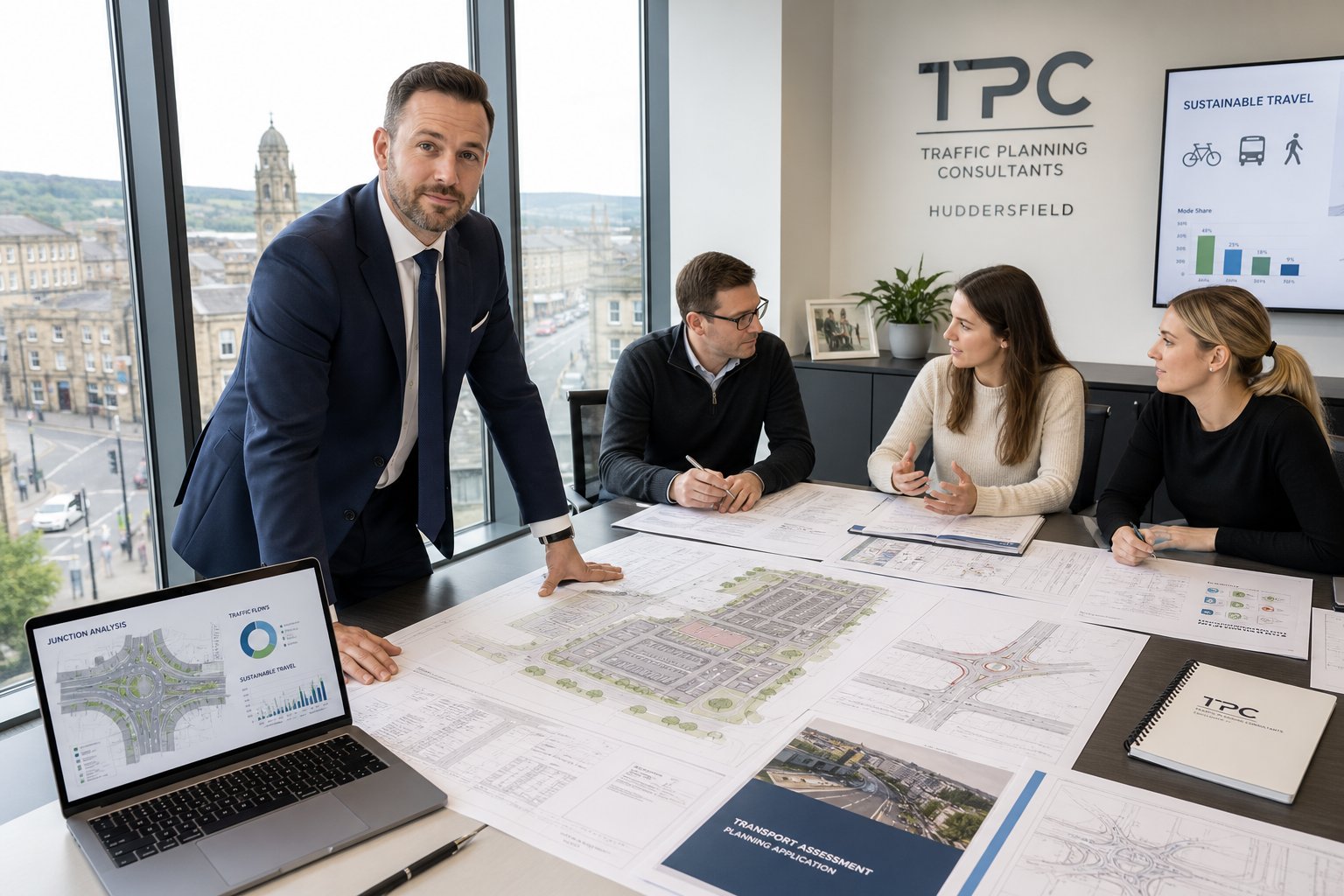
Planning applications rarely fail because of one dramatic flaw. More often, they slow down on the details: an access that feels under-tested, parking that doesn’t quite add up, servicing that looks awkward on paper, or transport evidence that arrives too late to reassure officers and consultees. In Huddersfield, where development proposals can sit within sensitive urban streets, suburban networks, village edges, or employment locations with specific highway constraints, those details matter.
That’s where a Traffic Engineer in Huddersfield becomes central to the planning process. We’re not just producing technical documents for the sake of it. We’re helping architects, planners, surveyors, developers, and legal teams show that a scheme works in transport terms before objections harden and review cycles multiply. Good traffic engineering gives decision-makers confidence: the site can be accessed safely, vehicle movements are understood, parking and servicing are workable, and sustainable travel has been considered properly.
At ML Traffic, we focus on concise, accurate reporting shaped around planning realities, not generic templates. With more than 30 years of experience, we understand that the strongest submissions usually come from getting the transport strategy right early. In the sections below, we explain what a traffic engineer does in Huddersfield planning projects, when transport input is needed, what reports may be required, and how to choose support that helps move an application forward rather than hold it back.
Key Takeaways
- A Traffic Engineer in Huddersfield plays a crucial role by ensuring development proposals are transport-ready, addressing access, parking, safety, and sustainable travel early in the planning process.
- Transport input is essential for many developments that alter traffic flows, parking, servicing, or road safety, with particular scrutiny on larger schemes and those in sensitive locations.
- Transport reports such as Transport Assessments, Statements, and Travel Plans must be proportionate, targeted, and locally relevant to satisfy Huddersfield’s planning and highway authorities.
- Key traffic engineering considerations include trip generation, access design, parking adequacy, servicing logistics, highway safety, and practical sustainable travel measures.
- Early and clear communication with local planners and highway officers helps avoid delays by addressing potential objections and aligning submissions with Huddersfield’s specific policies and expectations.
- Choosing the right traffic engineer involves prioritising planning focus, proportional advice, clear communication, local authority insight, and reliability to support smooth application progression.
What A Traffic Engineer Does In Huddersfield Planning Projects
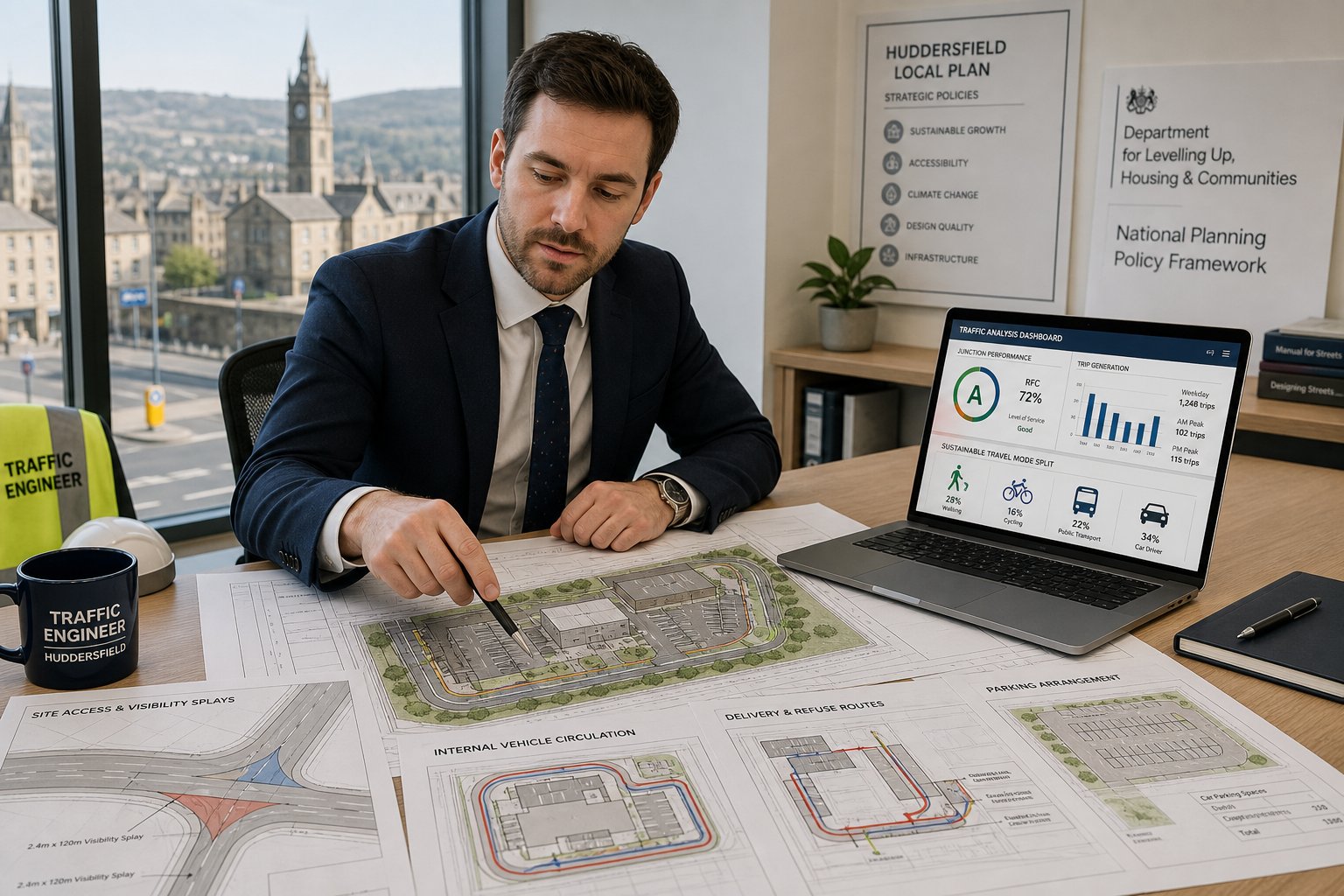
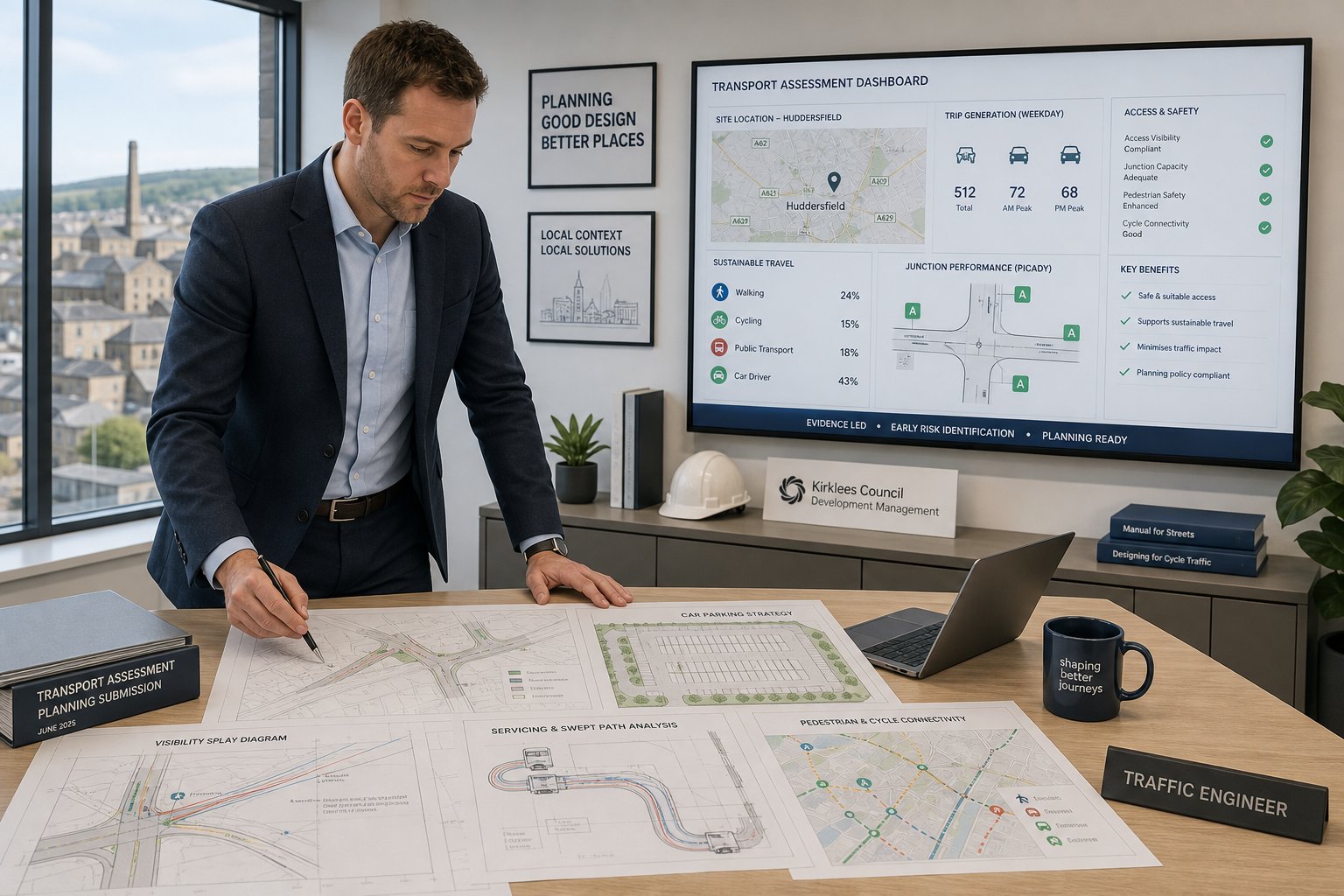
A traffic engineer’s role in a planning-led project is broader than many clients expect. Yes, we assess vehicle movements and highway impacts, but we also help shape the planning narrative around access, safety, parking, servicing, and sustainable travel. That means looking at how a proposal will actually function once built, not just whether a report can be submitted.
In practical terms, we review site access arrangements, likely trip generation, junction performance where relevant, visibility, internal layout, refuse and delivery movements, parking strategy, and links to walking, cycling, and public transport. We translate those findings into planning-ready evidence that officers and highway authorities can work with.
That planning interface matters. A technically correct report can still be unhelpful if it doesn’t answer the questions a local authority is likely to ask. Strong transport advice is targeted, proportionate, and clear. It identifies risk early, recommends mitigation where needed, and avoids unnecessary analysis where a lighter approach will do.
For many schemes, our job starts before an application is assembled. We often support teams in the same way wider Highway And Traffic Engineering advisers do: by clarifying what evidence is likely to be expected and what design changes could save time later. In Huddersfield, that can be the difference between a smooth validation process and a long exchange of avoidable technical queries.
When A Development In Huddersfield Needs Transport Input
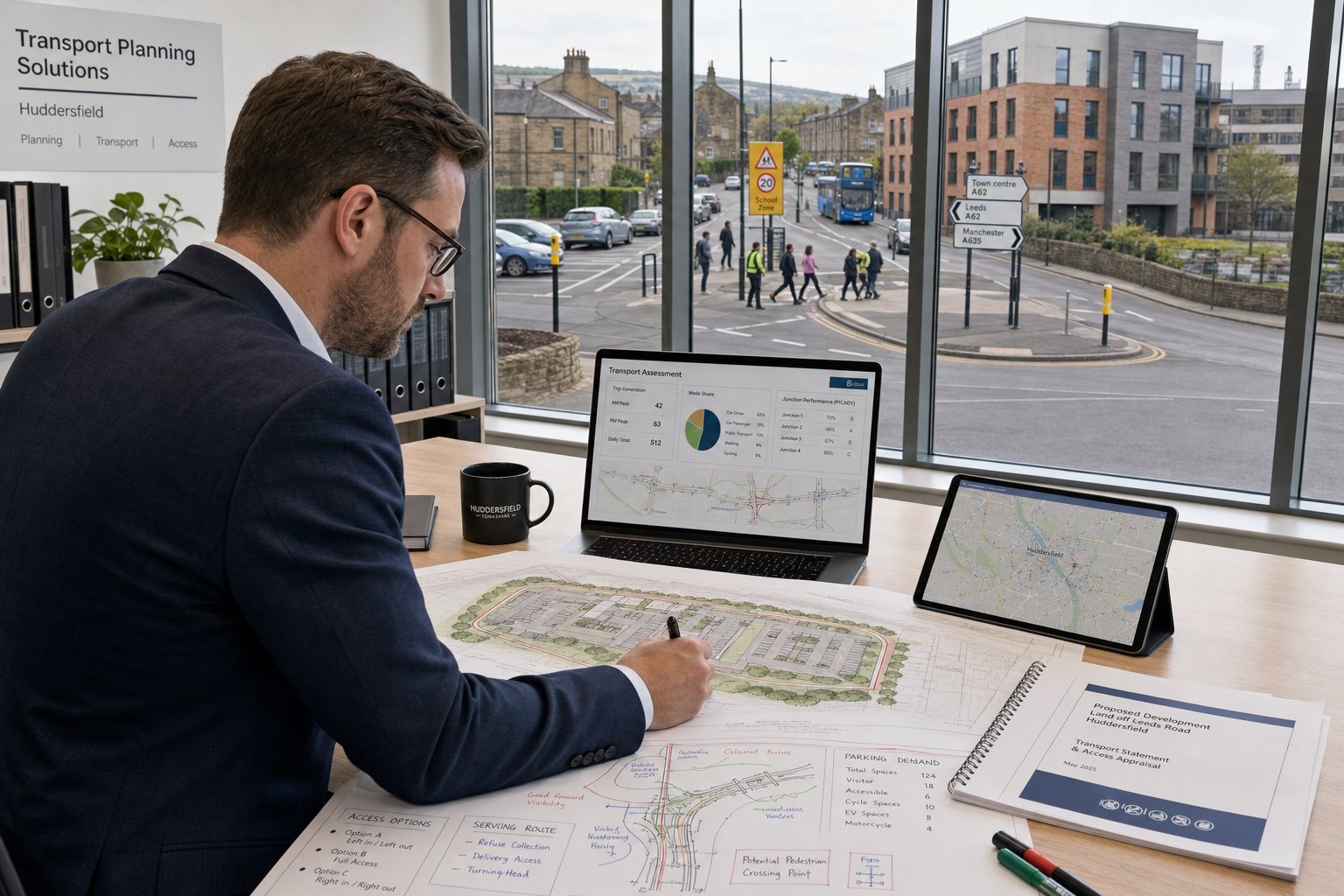
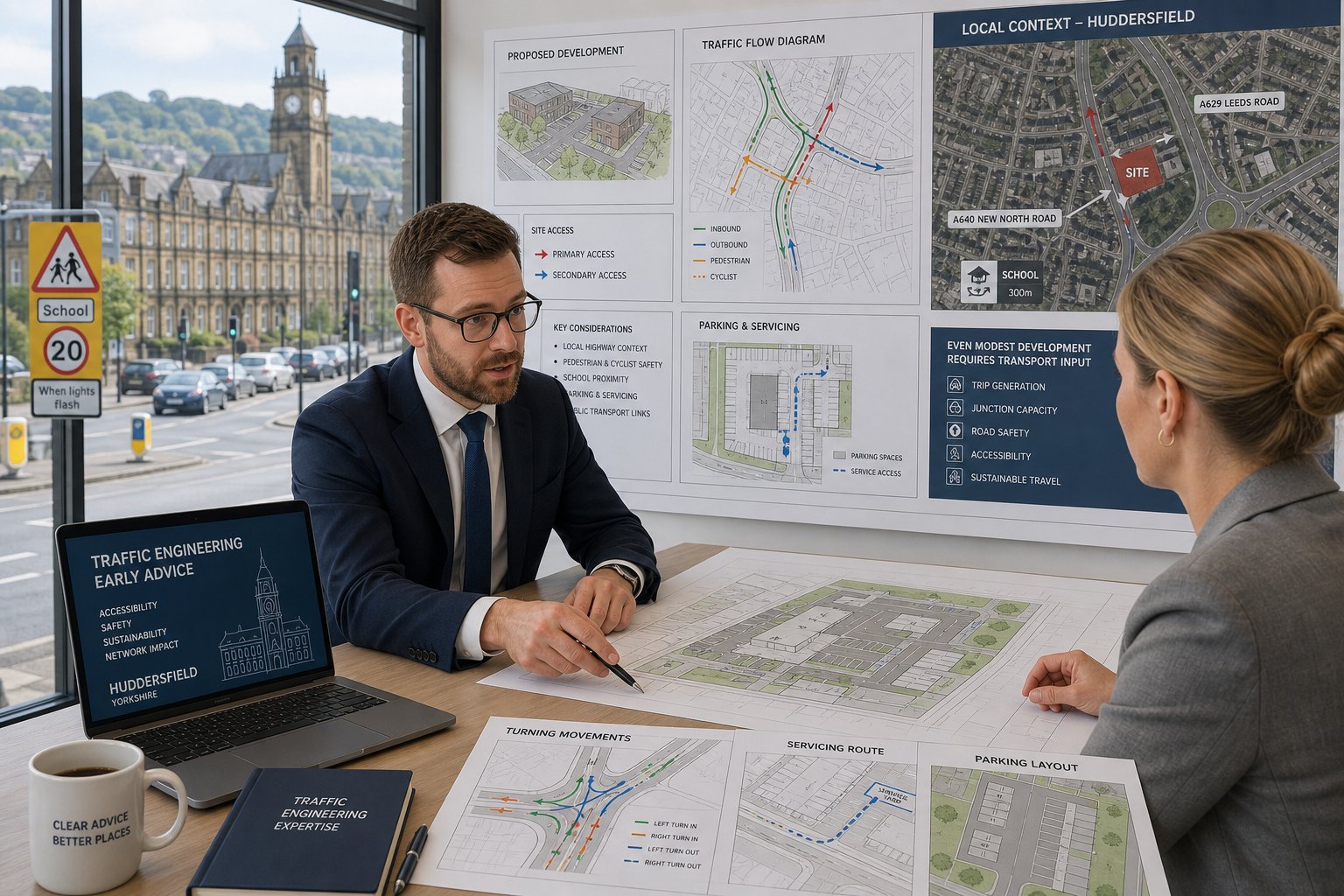
Not every application needs a full transport package. But many more schemes need transport input than people first assume. If a development changes traffic flows, introduces a new access, affects parking demand, alters servicing patterns, or raises road safety questions, transport input is usually sensible and often necessary.
The obvious triggers are larger developments: housing sites, commercial floorspace, industrial uses, schools, care facilities, roadside schemes, or mixed-use proposals. But smaller applications can also need review where the site is constrained, the surrounding highway network is sensitive, or there is a history of local concern about traffic, overspill parking, or junction safety.
In Huddersfield, context is everything. A modest proposal on a quiet, low-speed road may need only a concise statement. A similar-sized scheme on a busier route, near a school, on a bend, or with limited frontage may attract much closer scrutiny. Change-of-use applications can be particularly underestimated because trip rates, delivery activity, and parking demand can shift significantly even if the building footprint does not.
We usually advise clients to bring in transport support early where access design is still flexible. That early-stage input often prevents expensive redesign. It also aligns well with broader Traffic Engineering Consultants: planning support, where the goal is not just to respond to objections but to reduce the chance of them appearing in the first place.
Transport Assessments, Statements, And Travel Plans Explained
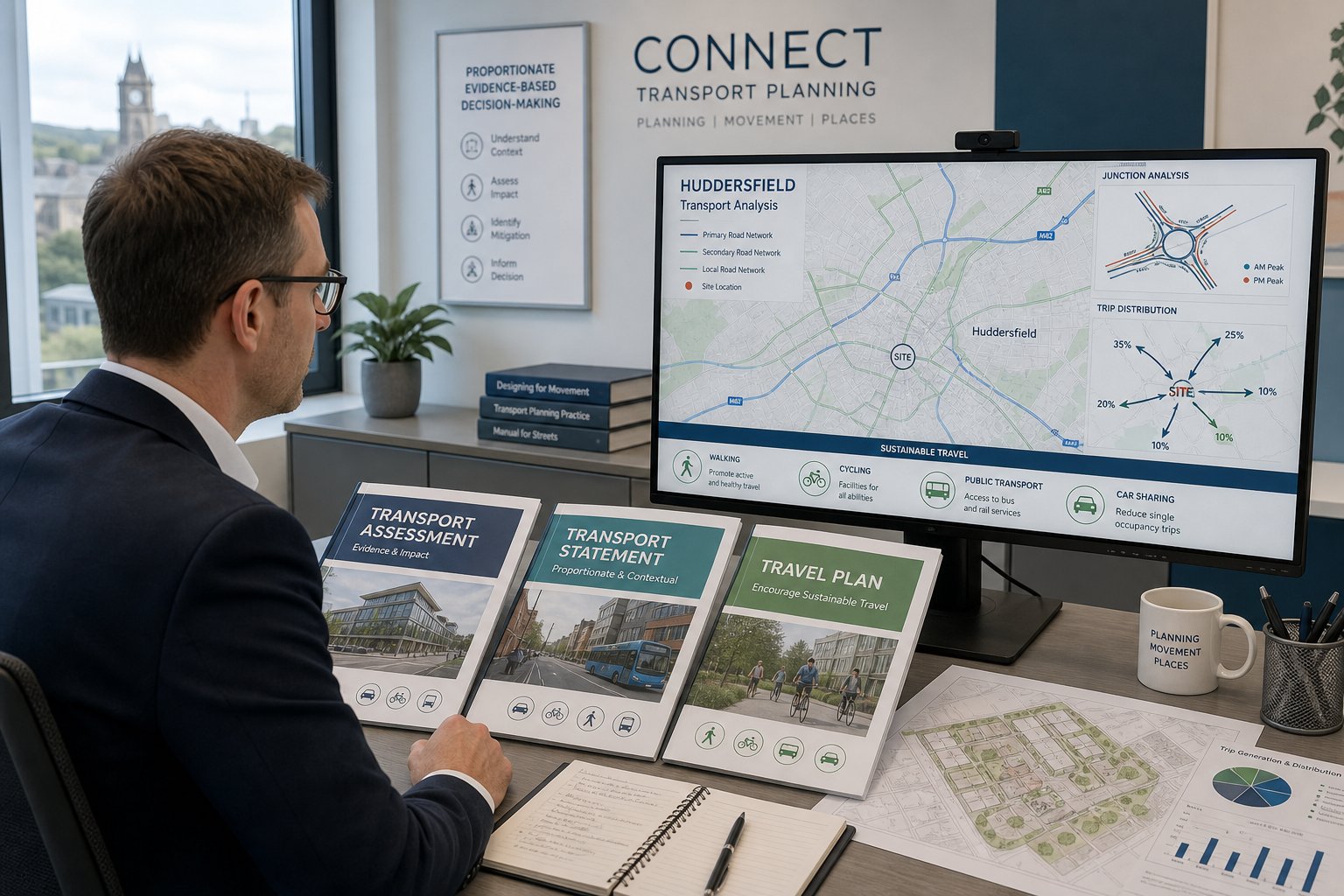
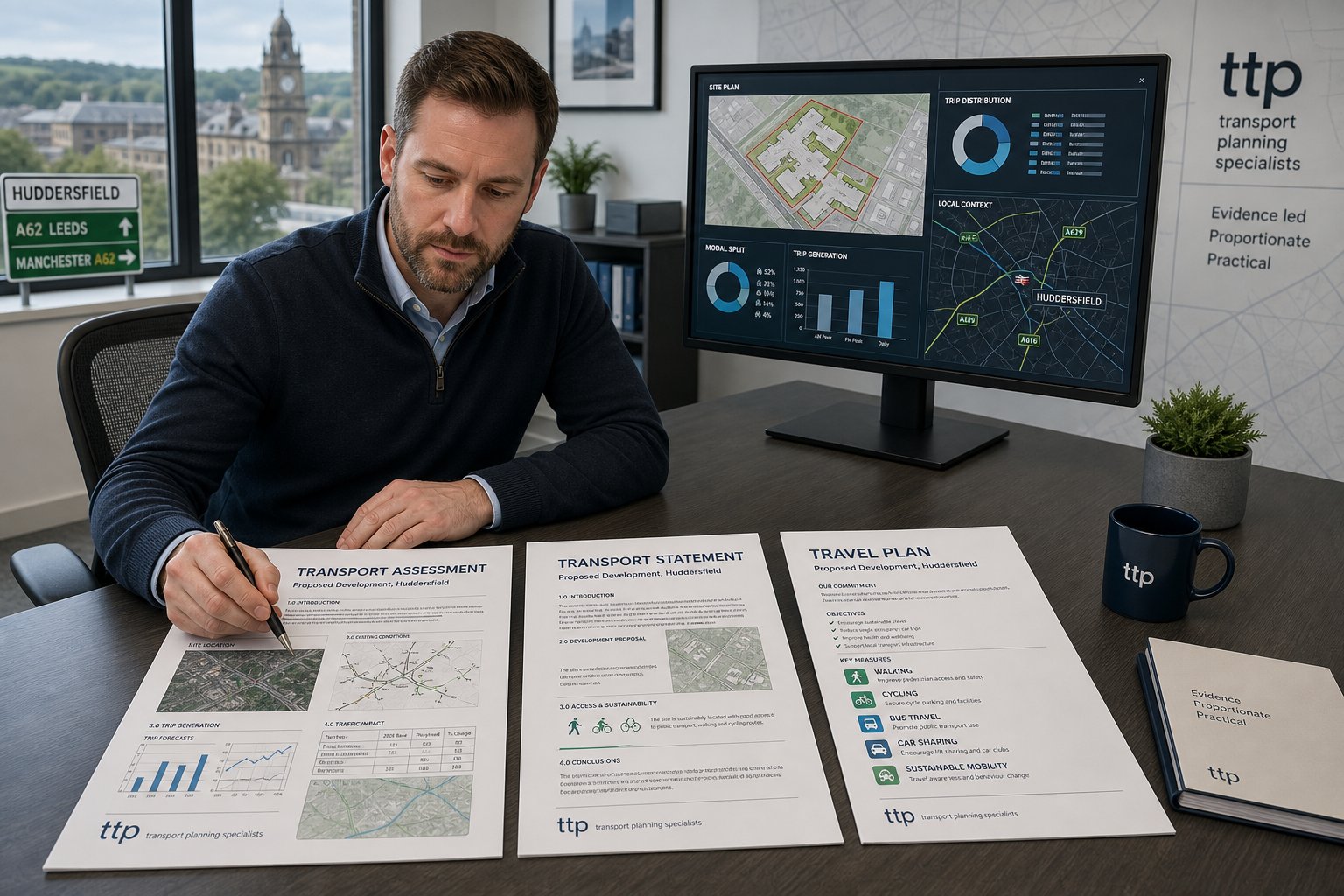
These three documents are related, but they do different jobs.
A Transport Assessment is the most detailed of the three. It is usually prepared for larger schemes or proposals with potentially material transport effects. It examines existing conditions, forecasts likely trips, considers distribution and assignment, reviews impact on the local network, and may assess junction capacity, accident records, accessibility, servicing, and mitigation. The point is to show, with evidence, whether the development would create a severe impact or whether issues can be managed acceptably.
A Transport Statement is lighter-touch. It is commonly used for smaller developments where the transport implications are more limited but still need to be explained. A good statement is not a cut-down assessment in disguise: it is a proportionate document that addresses the actual planning questions raised by the site.
A Travel Plan focuses on behaviour rather than pure highway capacity. It sets out measures to encourage sustainable travel, such as walking links, cycle parking, public transport information, shower facilities, car sharing, or monitoring arrangements. Councils often expect these for offices, schools, larger residential schemes, and employment uses.
The best report type depends on thresholds, local expectations, and the specifics of the proposal. In our work, proportionate reporting is key. The same principle sits behind Traffic Engineering and Transportation: technical evidence should answer the real planning issue, not overwhelm it with unnecessary pages.
How Local Highway And Planning Requirements Shape Transport Reports
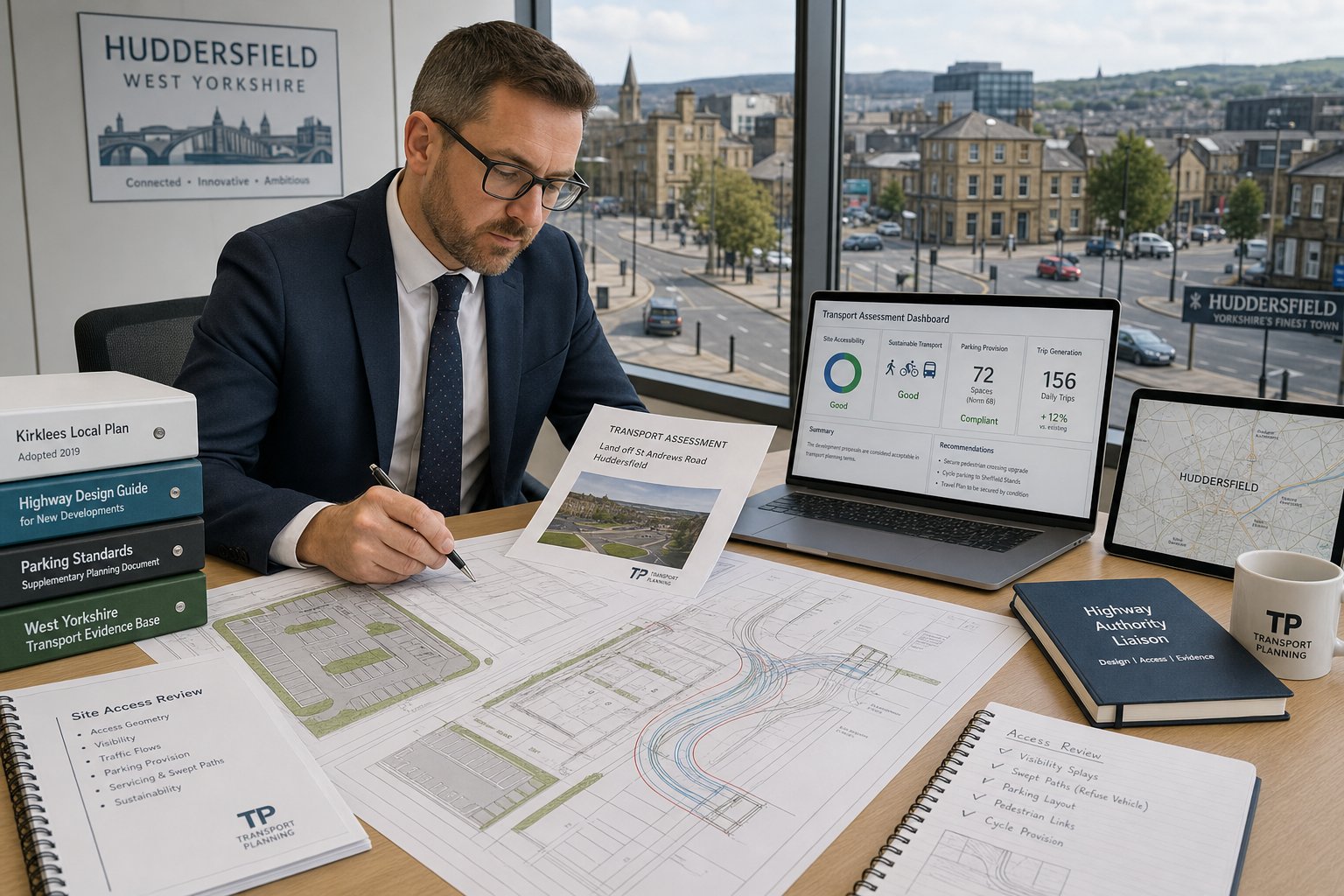
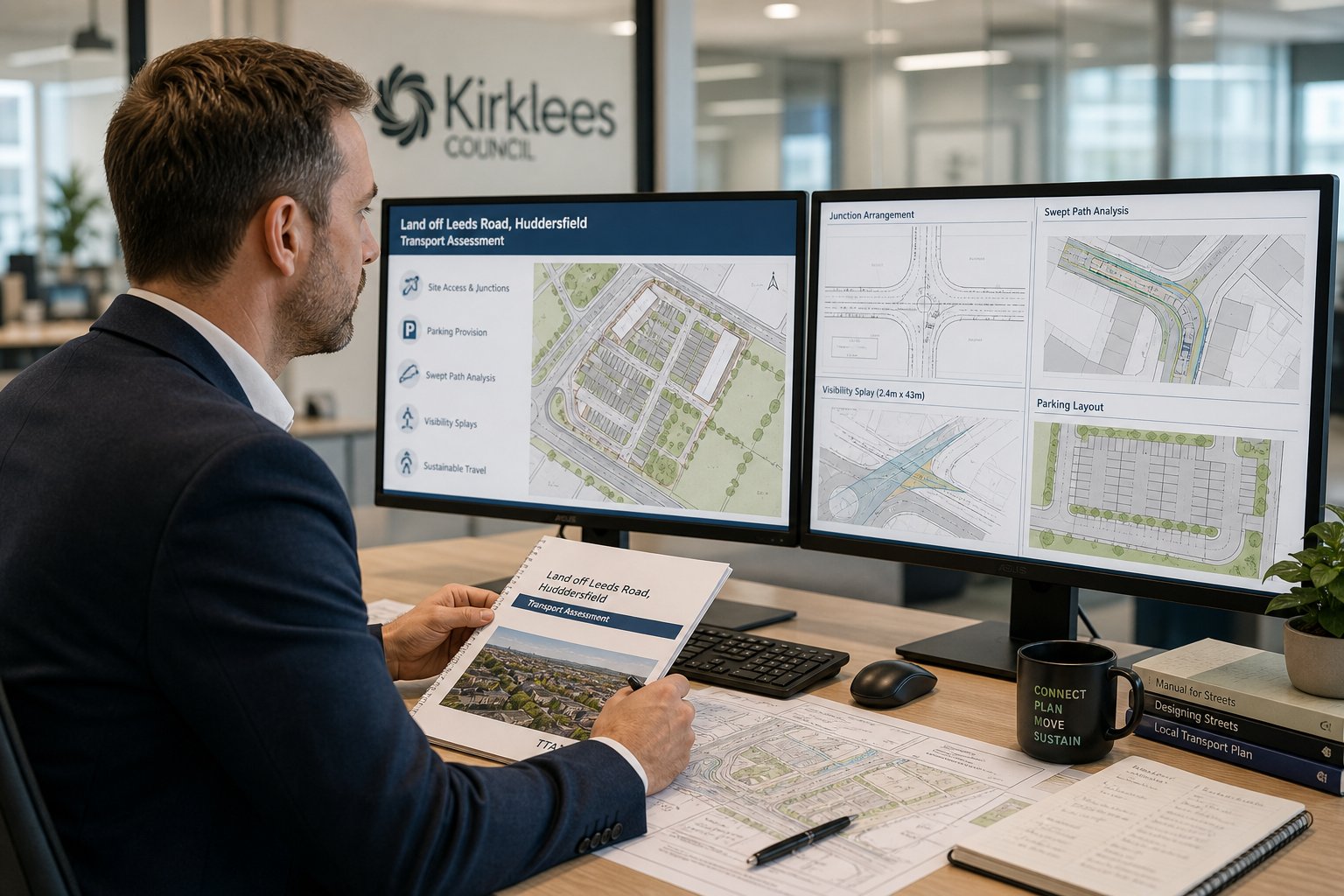
Transport reports are never written in a vacuum. In Huddersfield, as elsewhere, they need to reflect both national planning principles and local authority expectations. That means understanding what planners and highway officers will focus on, how they interpret policy, and what level of evidence they are likely to require.
At a local level, reports are shaped by questions such as:
- Is the access safe and suitable for the intended use?
- Are visibility splays achievable and maintainable?
- Is parking sufficient without over-provision?
- Can deliveries, refuse vehicles, and service traffic manoeuvre safely?
- Does the proposal support sustainable travel in a credible way?
- Would the development create unacceptable pressure on nearby streets or junctions?
The answer is not always more data. Often it is better judgement. A local highway authority usually wants a report that is specific, proportionate, and directly tied to the site. Generic commentary can be worse than saying less.
That’s why local planning awareness matters so much. We look at the development type, surrounding road hierarchy, land use context, likely officer concerns, and the practical standards likely to apply. Work in Huddersfield may share themes with nearby urban centres, but each authority area and site setting has its own emphasis. Even when comparing experience from a Traffic Engineer In Leeds: instruction, the detail still has to be recalibrated for local policy, geometry, and planning risk.
Common Development Types That Require Traffic Engineering Support
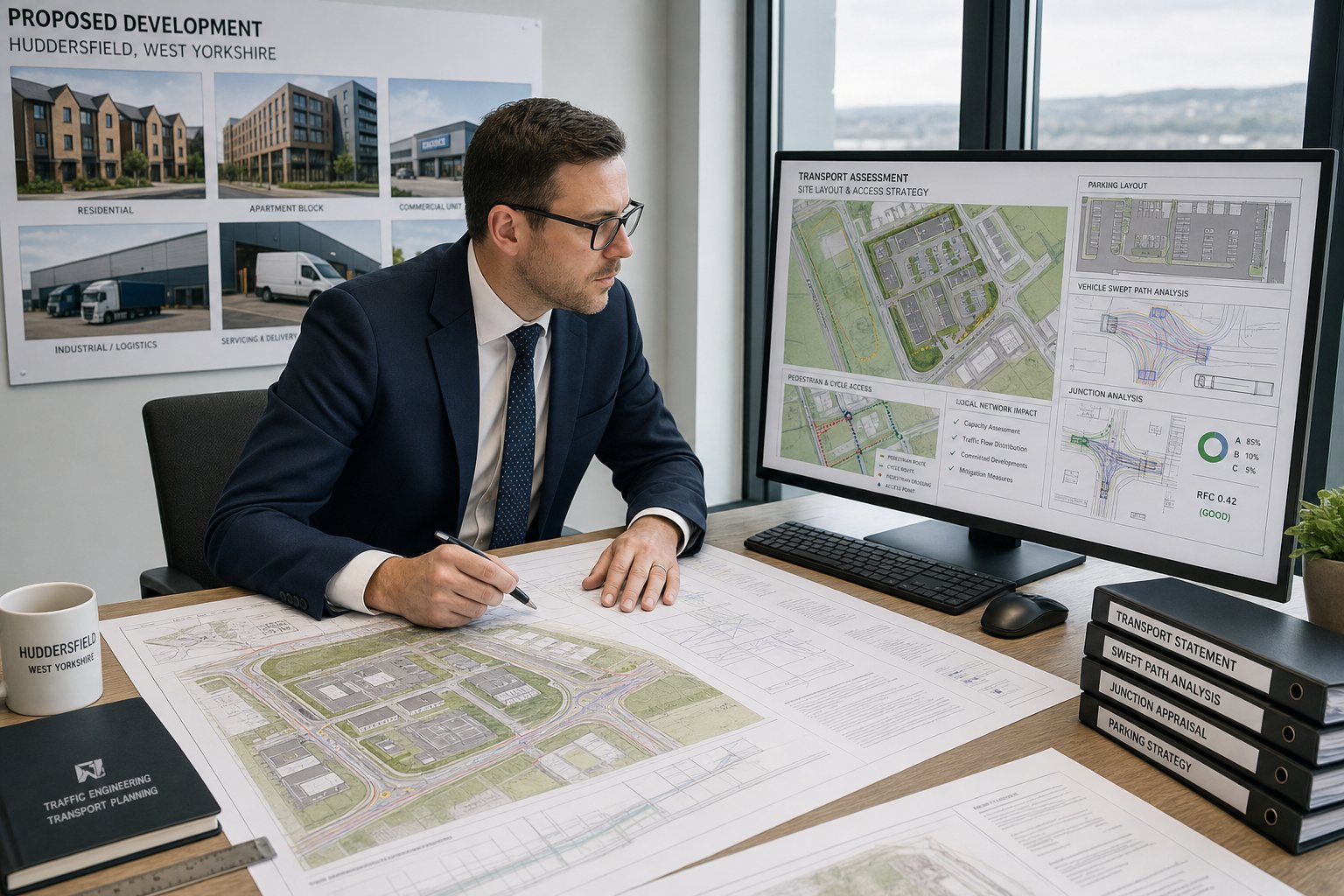
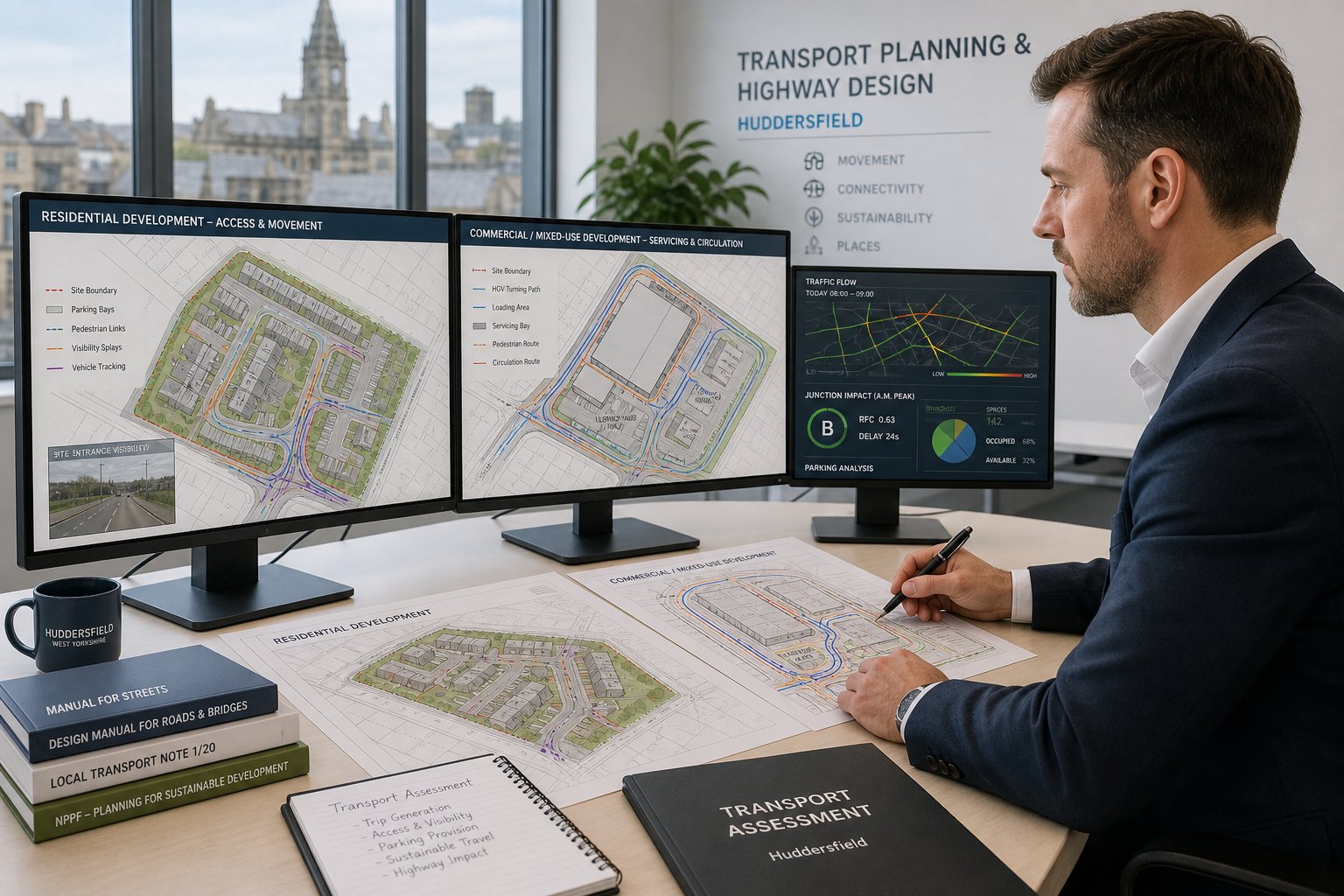
Some development categories routinely need transport input because the planning questions are predictable: how people arrive, where they park, how vehicles turn, and whether the local network can accommodate the change. Two broad groups come up again and again.
Residential Schemes
Residential developments often look straightforward until the detail is tested. Parking pressure, access width, emergency and refuse tracking, visibility at the site entrance, and pedestrian links all matter. On larger housing sites, trip generation and junction effects may also need to be assessed, particularly in peak periods.
In Huddersfield, residential schemes can vary from infill plots on existing streets to edge-of-settlement sites and apartment-led town locations. Each has a different transport profile. A small apartment scheme may generate modest traffic but raise sharp parking concerns. A suburban housing site may have adequate parking but require more robust evidence on access design, walking links, and network impact.
We also regularly advise on whether a residential proposal needs a transport statement, a fuller assessment, a travel plan, or simply focused access and parking input. Early clarity here avoids over-scoping.
Commercial, Industrial, And Mixed-Use Sites
Commercial and employment proposals often need more detailed operational review. Staff travel patterns, customer traffic, HGV movements, delivery times, yard circulation, servicing bays, and conflict between pedestrians and larger vehicles can all become central planning issues.
Industrial sites, in particular, may generate fewer peak-hour commuter trips than people expect but more servicing demand than early layouts allow for. Mixed-use developments add another layer because uses can interact in useful ways, or compete for the same parking and access space.
This is where comparative experience helps. Lessons from work by a Traffic Engineer In Manchester: on tighter urban sites or by a Traffic Engineer In Birmingham: on larger multi-user schemes can be useful, but the report still needs to fit the local Huddersfield planning context.
Key Traffic And Transport Issues Reviewed At The Planning Stage
Most planning-stage transport reviews circle around a core set of issues. The exact list changes from site to site, but the same themes appear repeatedly.
Trip generation is usually first. How many vehicle movements is the development likely to create, and at what times? That can influence whether a simple qualitative review is enough or whether detailed analysis is needed.
Access suitability comes next. Is the proposed entrance fit for the expected use, vehicle types, and traffic levels? Can vehicles enter and leave safely? Does the design create conflict with pedestrians or parked cars?
Parking and manoeuvring are another common focus. Under-provision can displace vehicles onto nearby roads: poor layout can create awkward reversing or blocked service areas. Over-provision can also be questioned if it undermines sustainable transport objectives or wastes land.
Servicing matters more than many teams expect. A development may work well for private cars but fail once refuse collection, deliveries, or maintenance vehicles are considered.
Highway safety is central throughout. Existing collision patterns, site lines, speed environment, and likely user behaviour all feed into the judgment.
Finally, sustainable travel is no longer a side note. Officers often want clear evidence that walking, cycling, and public transport opportunities have been thought through in practical terms, not simply listed. Good Traffic Engineering: Your practice means dealing with all of these issues in a balanced way, without overcomplicating the submission.
Access Design, Visibility, And Highway Safety Considerations
If one topic consistently shapes planning outcomes, it is access. A site can have strong design credentials and a viable use, but if the highway access is poorly configured or weakly evidenced, the application can quickly stall.
Access review normally considers geometry, width, gradient, relationship to nearby junctions, pedestrian crossing points, boundary treatment, and whether different users can move safely through the same space. For some sites, the issue is simple priority access design. For others, it is whether the access can accommodate service vehicles without over-running footways or causing conflict on the carriageway.
Visibility is equally important. We assess whether drivers can see and be seen within a distance appropriate to the road environment. That means understanding speed, frontage conditions, vegetation, walls, parked cars, and future maintenance responsibilities. Visibility splays that work only in ideal conditions rarely reassure a highway authority.
Highway safety is broader than splays alone. We also review recorded collision patterns where relevant, likely turning movements, vulnerable road users, and whether the proposal could intensify existing risk. Sometimes the answer is design change. Sometimes it is operational control. Sometimes it is demonstrating that the site already functions safely and the uplift is limited.
In short, a transport report should not treat access as a drawing note. It is usually one of the first things decision-makers test, because it goes directly to whether development can happen safely in real life.
Parking, Servicing, And Sustainable Travel Strategy
Parking is one of the most scrutinised planning issues because everyone has an opinion on it, and local residents often express those views forcefully. But good parking analysis is not guesswork. It should reflect land use, likely demand, location, local standards, availability of alternatives, and the practical usability of the spaces shown.
For residential schemes, the debate often centres on overspill parking, visitor provision, cycle storage, and whether spaces are realistically usable. For commercial and mixed-use sites, staff parking, customer turnover, disabled bays, EV provision, and shared parking arrangements may all be relevant.
Servicing is just as important, though it gets less public attention. Refuse collection, parcel deliveries, HGV access, loading activity, and turning provision need to work without creating regular conflict or unsafe reversing onto the highway. On constrained sites, servicing can become the make-or-break issue.
Then there is sustainable travel strategy. A convincing planning submission should explain how the site supports walking, cycling, and public transport in practical terms: footway links, cycle parking quality, bus stop proximity, travel information, and measures that fit the development type. This is especially important where car parking is restrained or the authority places strong weight on modal shift.
The strongest strategy balances realism with policy. We’re not trying to pretend every user will arrive by bike. We’re showing that the development has been planned sensibly, with genuine travel choices built into the scheme.
The Typical Process From Initial Review To Planning Submission
Most transport instructions follow a recognisable sequence, though the depth varies with the scheme.
First, we carry out an initial review. That usually includes site location, proposed use, access points, surrounding highway conditions, likely planning triggers, and whether any immediate transport risks stand out. This early stage is often where the biggest time savings happen, because design changes are still relatively easy.
Second comes data gathering and appraisal. Depending on the project, that may involve site visits, traffic counts, collision data, parking review, swept path testing, accessibility mapping, or policy review. Not every scheme needs all of this: proportionality matters.
Third, we move into assessment and strategy. We consider likely transport effects, whether mitigation is needed, and what type of reporting is appropriate. Sometimes that means a short technical note. Sometimes it means a full assessment package with plans and supporting appendices.
Fourth, we prepare the planning submission material itself. This is where technical findings need to be translated into a document that reads clearly and anticipates consultee concerns.
Finally, there is often post-submission support: responding to comments, clarifying assumptions, or refining details through condition discharge. That workflow is common across many regions, whether the instruction resembles a Traffic Engineer In London: city-centre commission or a more suburban Yorkshire site. The sequence stays similar: the local detail changes.
Choosing The Right Traffic Engineer In Huddersfield
Choosing a traffic engineer is not only about credentials. It is about fit: planning awareness, local sensitivity, responsiveness, and the ability to produce documents that are technically sound and commercially useful.
We’d suggest looking for five things.
First, planning focus. Some engineers are excellent modellers but less comfortable with the practical realities of planning submissions. You want advice that helps the application move forward, not just technically accurate text.
Second, proportional judgment. Over-reporting can waste time and money: under-reporting can expose the scheme to objection. A good consultant knows the difference.
Third, communication. Architects, planners, solicitors, and developers need clear answers quickly. Dense technical jargon rarely helps a project team make decisions.
Fourth, local authority awareness. That doesn’t mean claiming to know every officer personally. It means understanding how highway and planning concerns are typically framed, and preparing reports accordingly.
Fifth, reliability under programme pressure. Deadlines matter. Delays in transport input often hold up the wider submission pack.
At ML Traffic, our approach is built around concise, accurate reporting, shaped to local thresholds and planning context, with more than 30 years of experience behind it. For clients comparing broader regional support, our work as a Traffic Engineer In different cities reflects the same principle: practical transport advice should reduce friction, not add to it.
Conclusion
A well-prepared planning application does more than describe a development. It proves the scheme can function safely and credibly within its transport setting. That is exactly where a Traffic Engineer in Huddersfield adds value.
From early access reviews and parking strategy through to transport statements, assessments, travel plans, and responses to consultee comments, good transport input helps remove uncertainty from the process. It gives planners and highway officers something they can rely on, and it gives design teams a clearer basis for decision-making.
In our experience, the strongest outcomes usually come when transport advice is brought in early, kept proportionate, and aligned with the realities of local planning. Done properly, it doesn’t just support an application on paper. It helps the scheme stand up to scrutiny and move forward with fewer surprises.
Frequently Asked Questions about Traffic Engineers in Huddersfield
What is the role of a traffic engineer in Huddersfield planning projects?
A traffic engineer in Huddersfield assesses vehicle movements, access design, parking, servicing, and sustainable travel to ensure developments function safely and efficiently within the local transport network, providing accurate planning-ready evidence.
When does a development in Huddersfield require transport input from a traffic engineer?
Transport input is typically needed when a development affects traffic flows, access points, parking demand, servicing patterns, or road safety, especially for larger or sensitive sites, to meet local planning and highway requirements.
What are the differences between a transport assessment, transport statement, and travel plan in Huddersfield?
A transport assessment is detailed for larger schemes, analysing impacts on traffic and the network. A transport statement is a lighter report for smaller developments. A travel plan promotes sustainable travel options like walking and cycling to reduce vehicle trips.
How do local planning and highway requirements in Huddersfield shape transport reports?
Reports must address access safety, visibility splays, parking sufficiency, servicing logistics, highway safety, and support for sustainable travel, tailored to local policies and officer expectations to avoid generic or unnecessary analysis.
What common development types in Huddersfield require traffic engineering support?
Residential schemes, commercial, industrial, and mixed-use developments often need traffic engineering due to concerns like parking pressure, access safety, service vehicle manoeuvring, and trip generation assessments.
How can I choose the right traffic engineer in Huddersfield for my planning project?
Select a traffic engineer with local planning experience, clear communication skills, an understanding of highway authority concerns, proportional reporting, and a track record of delivering timely and relevant transport advice that facilitates smoother approvals.