
Planning applications in Birmingham rarely fail on architecture alone. More often, pressure builds around access, parking, servicing, highway safety, or a junction that already feels close to breaking point at school-run time. That’s where a traffic engineer in Birmingham becomes central to the process.
We work with architects, planners, developers, lawyers and project teams who need transport evidence that is practical, proportionate and credible. In a city like Birmingham, dense, fast-changing, and layered with local policy, bus priority, active travel infrastructure and strategic routes, transport input isn’t a box-ticking exercise. It can shape whether a scheme is validated smoothly, queried repeatedly, conditioned heavily, or supported.
A strong transport submission does two things at once. It satisfies the local authority’s technical expectations, and it helps the wider design team make better decisions before plans harden. Access geometry, parking ratios, swept paths, trip rates, servicing strategy, junction performance, sustainable travel measures, these are often the details that decide whether a proposal feels workable in the real world.
In this guide, we explain what a traffic engineer in Birmingham actually does, when Transport Assessments and Transport Statements are needed, how impacts are tested, and why early advice can save months rather than days. For Birmingham planning applications in 2026, that early clarity is often the difference between momentum and delay.
Key Takeaways
- A traffic engineer in Birmingham plays a crucial role in planning by assessing site access, parking, servicing, and highway safety to ensure proposals are workable and compliant with local policies.
- Early transport input is essential in Birmingham to address design constraints, allowing for better planning decisions and avoiding costly revisions or planning delays.
- Transport Assessments or Statements must be proportionate to the development’s scale and local context, considering Birmingham’s complex traffic environment and policy layers.
- Effective transport reports in Birmingham encompass more than traffic counts, including sustainable travel strategies, servicing plans, and construction logistics to meet local authority expectations.
- Choosing a traffic engineer with local Birmingham experience and sector-specific knowledge improves communication, relevancy, and planning success.
- Integrating transport advice early enhances project momentum, reduces objections, and aligns schemes with Birmingham City Council’s validation requirements and strategic objectives.
What A Traffic Engineer In Birmingham Does For Planning And Development

A traffic engineer in Birmingham supports development proposals by testing how a site will function on the ground and how it will interact with the surrounding network. That sounds simple. In practice, it spans access design, vehicle tracking, parking layout, trip generation, junction assessment, sustainable travel strategy, and discussions with the local highway authority.
For planning purposes, we typically start by asking a few blunt questions: Can vehicles get in and out safely? Will the site operate without conflict between cars, vans, refuse vehicles and pedestrians? Is parking realistic for the proposed use? And will the surrounding roads absorb the additional movement without creating severe impacts?
Those questions feed into formal reports and drawings. Depending on the scheme, that may mean a Transport Statement, a full Transport Assessment, a Travel Plan, a Delivery and Servicing Plan, or a targeted technical note responding to officer comments. On some projects, highway works are also needed, new bellmouth access, visibility improvements, junction alterations or internal layout changes. That is where transport planning and detailed design start to overlap, often alongside highway design consultants.
In Birmingham, the role also involves coordination. We may liaise with Birmingham City Council highways, public transport stakeholders, and, where trunk roads are affected, National Highways. Good transport advice isn’t just technical: it’s strategic. It helps the planning team present a scheme that works on paper and on the street.
Why Birmingham Developments Often Need Transport Input Early

Birmingham schemes benefit from transport input early because transport constraints tend to be design constraints. If a site has awkward frontage, restricted visibility, nearby signals, bus lanes, cycle routes, loading pressure or controlled parking, those issues can’t be tidied up gracefully at the end.
We regularly find that pre-application transport review changes the shape of a scheme in useful ways. A residential layout may need bin collection reworked. A city-centre scheme may need less emphasis on private parking and more on cycle storage, servicing windows and walking links. A commercial site may need a different access point entirely. These are not minor edits once an architect has fixed the massing and the planning statement is drafted.
Birmingham City Council generally expects highway and transport matters to be addressed as far as possible before submission, particularly on more sensitive or larger sites. Early scoping can establish whether surveys are required, what peak periods matter, which junctions need testing and whether the authority is likely to expect a TA rather than a lighter TS. Our experience mirrors the wider principles set out by Traffic Engineering Consultants: What: the earlier transport evidence starts, the more options a project team keeps.
And that flexibility matters. It is much cheaper to redraw a plan in week three than to defend an avoidable transport objection three months after submission.
Local Planning And Highway Context In Birmingham
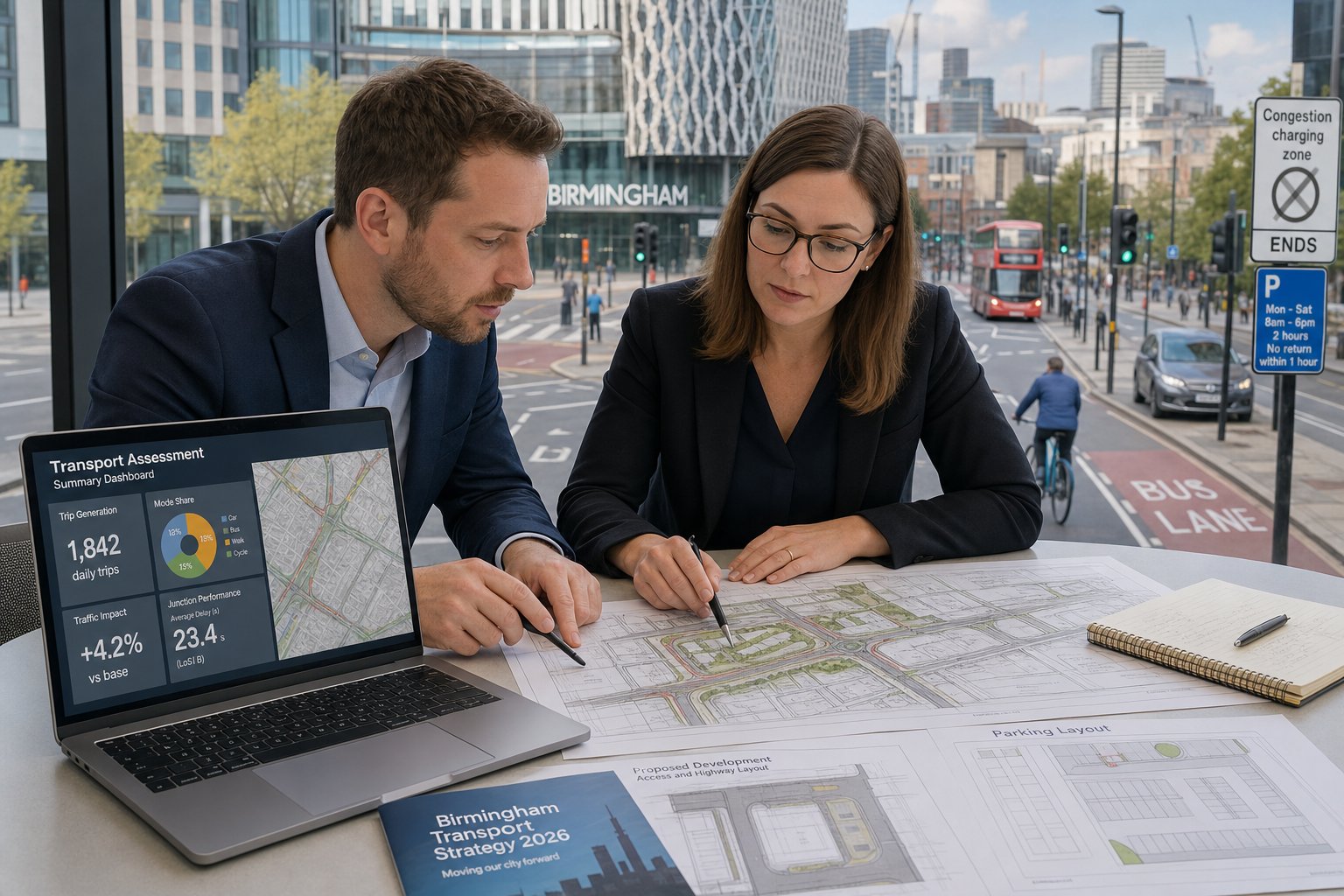
Birmingham has a planning and highway context that demands a local, not generic, approach. The city combines dense urban corridors, suburban neighbourhoods, major regeneration areas, strategic freight routes, clean air policy pressures, bus priority measures and an increasing emphasis on active travel. A site that looks straightforward on a red-line plan can sit in a surprisingly sensitive transport position.
Policy sits across several layers. At the national level, the National Planning Policy Framework and Planning Practice Guidance shape what counts as acceptable transport evidence and whether impacts would be severe. Locally, Birmingham Development Plan policies, transport strategy documents and highway design expectations influence the detail. West Midlands policy priorities, especially around mode shift, connectivity and public realm, also affect how schemes are judged.
That means we do more than count vehicle trips. We examine how a proposal sits within its street context: parking controls, public transport accessibility, pedestrian routes, cycle facilities, servicing restrictions, nearby schools, collision history and peak-period congestion. A good Birmingham Transport Consultant: Planning-Led approach reflects those local realities rather than relying on national assumptions alone.
For applicants, the key point is this: Birmingham is not a place where a templated report travels well from one authority to another. Local knowledge usually shows up in the quality of the analysis, and planning officers notice it.
Birmingham City Council Requirements And Validation Expectations
Birmingham City Council’s local validation expectations are a practical checkpoint, not an afterthought. If the right transport information is missing, applications can be delayed, queried or invalidated while further material is requested.
The exact requirement depends on the development type, scale and location, but BCC commonly expects proportionate transport evidence where a proposal could materially affect traffic, access, parking, servicing or sustainable travel patterns. That may include a Transport Assessment, a Transport Statement, a Travel Plan, access drawings, parking layouts, swept path analysis and visibility information. In more constrained cases, officers may also expect clarification on refuse collection, delivery activity or construction routing.
Thresholds are informed by national guidance, but local circumstances can push requirements higher. A moderate-sized scheme near a congested junction or on a corridor with active travel priorities may attract more scrutiny than a larger scheme in a less sensitive location. This is why we advise teams to confirm likely scope early and document assumptions clearly.
Concise evidence helps. Officers are rarely impressed by bulk for its own sake: they want a report that addresses the real issues directly. That is one reason many teams value Traffic Engineer In Birmingham support grounded in local validation practice.
When A Transport Assessment Or Transport Statement Is Needed
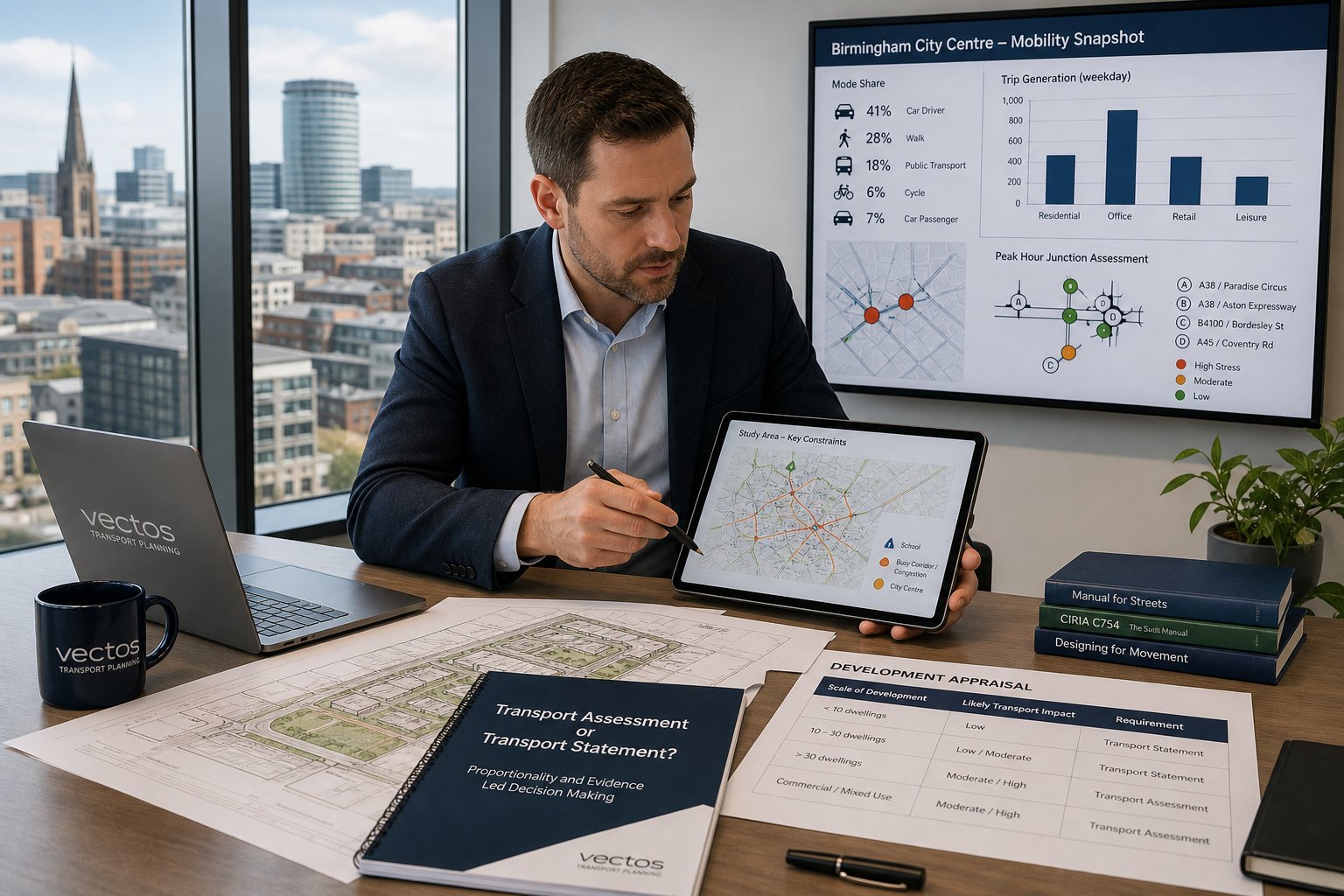
The decision between a Transport Assessment (TA) and a Transport Statement (TS) is mainly about scale, intensity and sensitivity. A TA is normally required for schemes that are likely to generate notable trip demand or affect multiple points on the network, larger residential development, supermarkets, schools, employment sites, mixed-use regeneration and other high-footfall uses. A TS is usually the proportionate route for smaller proposals where impacts are more limited but still need to be evidenced properly.
But size alone does not decide it. In Birmingham, location can tip the balance. A development below typical national thresholds may still need a TA if it sits near an already stressed junction, on a strategic corridor, close to a school, or in a city-centre environment with complex servicing and sustainable transport issues. Conversely, some straightforward schemes can be addressed through a well-scoped TS with targeted analysis.
We usually make the judgement by looking at land use, expected trip generation, local highway sensitivity, collision history, access complexity and whether mitigation may be required. If several of those factors are live, a TA is often the safer choice.
The important thing is proportionality. Over-scoping can waste time and money: under-scoping can create planning delay when the authority asks for more evidence later. A sound early review, often supported by broader Highway And Traffic planning advice, helps get that balance right from the outset.
How Trip Generation, Junction Capacity And Traffic Impact Are Assessed

Transport impact assessment is evidence-led, but not mechanical. We start with trip generation: how many vehicle, pedestrian, cycle and sometimes public transport trips a development is likely to create in relevant peak periods. That usually draws on TRICS data, local survey evidence, census or travel behaviour information, and professional judgement about the site’s actual context.
Those trips are then distributed and assigned across the network. In plain English, we work out where vehicles are likely to come from and go to, and which junctions will feel the effect. For Birmingham projects, that often means selecting junctions close to the site plus any known pressure points flagged by local knowledge or pre-application discussion.
Capacity testing follows. Priority junctions may be modelled in PICADY, roundabouts in ARCADY, and signalised layouts in LINSIG or similar software. We compare baseline conditions with future-year scenarios, then add development traffic to identify changes in queueing, delay and reserve capacity. The numbers matter, but they are not the whole story.
We also review road safety, servicing interactions, visibility, internal circulation and impacts on vulnerable users. A scheme that barely changes junction capacity could still raise concerns if pedestrian desire lines are poor or HGV manoeuvres conflict with cyclists. That wider perspective is central to Traffic Engineering and Transportation work. Good reporting explains not only what the models say, but what those results mean in the street environment people actually use.
Key Transport Reports Commonly Required For Birmingham Schemes
Different schemes call for different reports, and Birmingham planning applications often need a package rather than a single document. The right combination depends on use class, scale, site constraints, policy context and how much transport risk sits within the proposal.
Most commonly, we prepare Transport Assessments, Transport Statements, Travel Plans and technical notes. On operationally complex sites, Delivery and Servicing Plans matter just as much. And where the build phase could affect neighbours or key corridors, a Construction Logistics Plan or Construction Traffic Management Plan can become central to officer comfort.
The practical point is that each report answers a different planning question. A TA or TS explains the likely traffic and transport effects. A Travel Plan shows how sustainable travel will be encouraged. A servicing document proves that the day-to-day operation is realistic. Construction logistics address the temporary, but often politically sensitive, impacts during the works.
That layered approach is especially useful in Birmingham because many sites are constrained in more than one way. A city-centre development may not generate severe traffic impact, for example, but still need careful servicing strategy, cyclist protection, pedestrian management and construction routing. Broader thinking around Commercial Traffic Engineering is often what turns a merely compliant submission into a persuasive one.
Transport Assessments, Transport Statements And Technical Notes
A Transport Assessment is the most comprehensive of the core transport reports. It typically includes site context, policy review, baseline conditions, sustainable transport audit, trip generation, distribution, junction modelling, parking analysis, road safety review and mitigation proposals. For larger schemes, it may cover multiple future years and several tested scenarios.
A Transport Statement is a lighter-touch document, but it still needs discipline. A good TS does not simply say impacts are limited: it demonstrates that with proportionate evidence. That might include trip estimates, parking review, access appraisal, local highway observations and a short commentary on sustainable travel opportunities.
Technical notes sit somewhere else entirely. They are targeted responses used to deal with a specific issue: revised trip rates, updated surveys, a single junction reassessment, tracking for refuse vehicles, or clarification following authority comments. In practice, these notes can be hugely valuable because they allow the team to answer one question precisely rather than reopening an entire report.
For many applicants, concise technical work is as important as the main submission. It is one reason Traffic Engineering: Your Complete guidance remains useful across both strategic and detailed planning stages.
Travel Plans, Delivery And Servicing, And Construction Logistics
Travel Plans are often misunderstood as generic policy paperwork. In reality, a good Travel Plan is a behavioural strategy tied to the site. It sets out measures to encourage walking, cycling, public transport and car sharing, usually with targets, monitoring arrangements and management responsibility. In Birmingham, where mode shift is a live policy issue, that can carry real weight.
Delivery and Servicing Plans focus on daily operation. They show how vans, HGVs, refuse vehicles and occasional servicing activity will enter, manoeuvre, load, unload and leave without causing unreasonable disruption or safety problems. This is especially important for mixed-use, retail, hospitality, student and city-centre schemes where kerbside pressure is intense.
Construction Logistics Plans or CTMPs deal with the temporary but very visible impact of the build process. They can cover haul routes, vehicle timing, contractor parking, wheel washing, banksman procedures, temporary traffic control and communication with neighbours. A well-prepared plan reassures officers that the site can be built without chaos, which, frankly, is often half the battle.
Typical Projects That Benefit From A Traffic Engineer In Birmingham
Almost any development with transport implications can benefit from traffic engineering input, but some project types consistently need it more than others.
Residential schemes are the obvious example. That includes small infill sites, apartment blocks, build-to-rent projects, extra care, student accommodation and larger suburban allocations. The transport questions vary, parking demand, access width, emergency tracking, servicing, school-run interaction, walking links, but they arise on nearly every residential submission.
Mixed-use and city-centre projects also benefit strongly. Here, the challenge is often less about raw traffic growth and more about tight frontage conditions, servicing windows, taxi activity, cycle parking, public realm conflicts and integration with nearby bus and rail services. Hotels, offices and PBSA schemes can all be sensitive in this way.
Retail parks, supermarkets, drive-thrus and leisure uses usually generate sharper peak impacts and often need more detailed operational review. Schools, colleges, healthcare facilities and event-related uses can be even trickier because arrival patterns are concentrated and public concern is often high.
In short, if a proposal changes movement patterns, kerbside activity or demand on nearby junctions, transport input helps. The exact work may differ, but the principle stays the same: a traffic engineer in Birmingham gives the design team evidence before assumptions harden into planning risk.
How Early Traffic Engineering Input Helps Avoid Planning Delays
Planning delays often begin long before an application is submitted. They start when transport issues are assumed away, parked for later, or addressed with evidence that is too generic for the site. By the time comments come back from the authority, the design team is then forced into reactive work, new surveys, revised tracking, extra modelling, amended parking or a late servicing strategy.
Early input reduces that risk in several ways. First, it identifies show-stoppers before the project team is overcommitted. If visibility is poor, a right-turn movement is unsafe, or refuse collection cannot be achieved properly, it is better to know when the scheme is still flexible. Second, it helps agree the likely scope of work with the authority, including which junctions require modelling and whether a TS is enough or a TA will be expected.
Third, it improves the planning narrative. When parking levels, active travel measures, servicing arrangements and access design are evidenced from the start, objections tend to be narrower and easier to resolve. We have seen modest up-front transport advice save months of redesign and consultant churn later.
That is especially true on Birmingham sites close to strategic roads, heavily trafficked corridors or constrained urban streets. In those situations, early Traffic Engineer in Birmingham input is not really a luxury. It is project protection.
Choosing The Right Traffic Engineer For A Birmingham Planning Application
Choosing the right consultant is partly about technical skill and partly about fit. Plenty of engineers can produce a transport report. Fewer can produce one that is proportionate, locally aware, clearly argued and genuinely helpful to the wider planning team.
We would look for five things. First, direct Birmingham and West Midlands experience. Local authority preferences, common pain points and recurring network issues matter more than many clients expect. Second, relevant sector experience: a consultant who understands residential infill may not automatically be the best fit for a supermarket, school or city-centre mixed-use scheme.
Third, capability across the whole process. That includes surveys, trip-rate analysis, modelling, access review, swept paths, technical responses and, where needed, detailed highway design coordination. Fourth, communication. Planning programmes rarely survive consultants who write dense reports, disappear during determination, or cannot explain their own conclusions in meetings.
And fifth, judgement. The best advice is not always the longest report or the most defensive modelling package. Often it is the consultant who knows which issues matter, which can be scoped out, and how to give officers confidence without inflating the process.
For clients seeking concise reporting and local threshold awareness, that is the difference between documentation and support. With more than 30 years of experience behind our approach, we see the role as helping projects move, not just adding another PDF to the application set.
Conclusion
In Birmingham, transport is rarely a side issue in planning. It influences validation, design development, officer confidence and, eventually, whether a scheme feels deliverable in its real street context.
Using an experienced traffic engineer in Birmingham early in the process helps align proposals with local and national policy, identify risks before they become expensive, and provide evidence that is proportionate to the site and use. That may involve a full Transport Assessment, a concise Transport Statement, a servicing strategy, a Travel Plan, or simply the right technical note at the right moment.
What matters is timing and local judgement. When transport input is brought in early, design teams usually gain clearer options, fewer surprises and a stronger planning case. In a city as complex and fast-moving as Birmingham, that practical advantage still counts for a lot in 2026.
Frequently Asked Questions about Traffic Engineering in Birmingham
What does a traffic engineer in Birmingham do for planning applications?
A traffic engineer in Birmingham assesses how a development will function safely on local roads, including access, parking, servicing, and junctions. They prepare transport reports and liaise with Birmingham City Council and National Highways to ensure compliance and practical design solutions.
When is a Transport Assessment or Transport Statement required in Birmingham?
Larger developments or those affecting busy junctions typically need a Transport Assessment, while smaller schemes may only require a Transport Statement. The decision depends on the scale, trip generation, and network sensitivity, with Birmingham’s local policies influencing thresholds beyond national guidance.
How early should transport input be sought for Birmingham developments?
Transport advice should be obtained early at the pre-application stage to identify access or highway constraints, agree survey and modelling scope with authorities, and avoid costly redesign or planning delays later in the process.
What local planning policies affect traffic engineering in Birmingham?
Traffic engineering must consider the Birmingham Development Plan, Local Transport Plan, West Midlands transport priorities, and the National Planning Policy Framework. These policies emphasise active travel, bus priority, and mitigating severe traffic impacts.
How are traffic impacts like trip generation and junction capacity assessed?
Trip generation is estimated using local data and TRICS surveys, then assigned across the network. Junction capacity is tested with modelling software like PICADY and LINSIG, factoring in queues, delays, and safety impacts to recommend mitigation where needed.
What project types most benefit from a traffic engineer’s involvement in Birmingham?
Residential developments, city-centre mixed-use projects, retail parks, schools, healthcare, and leisure facilities all require transport input to address parking, access, servicing, and local highway impacts effectively.