
Milton Keynes is not a place where transport can be treated as an afterthought. Its grid-road network, roundabout-led movement pattern, strategic development pressures, and strong emphasis on accessibility mean planning proposals are often examined closely through a highways and transport lens. For architects, planners, developers, surveyors, lawyers, and local authorities, that usually raises one practical question early on: do we need a traffic engineer, and if so, what exactly will they do?
A Traffic Engineer in Milton Keynes does far more than count vehicles or comment on parking numbers. We assess how a proposal interacts with the surrounding network, whether access arrangements are workable, how people will arrive by different modes, and what evidence is likely to satisfy planning and highway officers. In many cases, the quality of that transport evidence can shape the speed, confidence, and outcome of a planning application.
In this text, we set out what that role looks like in practice in 2026, when transport input is commonly needed, which reports are usually required, and the local factors that matter most in Milton Keynes. We also explain how we support planning teams from early feasibility through to decision, and what information helps us give clear advice quickly. For project teams working to programme, budget, and committee pressure, getting the transport piece right early tends to save time later.
Key Takeaways
- A Traffic Engineer in Milton Keynes is essential for assessing transport impacts, ensuring proposals align with the city’s unique grid-road network and movement patterns.
- Early involvement of a traffic engineer in planning applications streamlines processes by addressing access, parking, and junction safety before designs are finalised.
- Transport evidence must be proportionate, locally aware, and clearly presented to satisfy planning officers and support confident decision-making.
- Transport reports like Transport Assessments, Statements, and Travel Plans are tailored to development scale and should reflect Milton Keynes’ specific highway structure and sustainable travel routes.
- Parking, servicing, and sustainable travel must be integrated thoughtfully to prevent operational conflicts and promote practical non-car travel.
- Choosing a traffic engineer with local experience and understanding of Milton Keynes’ planning context is crucial for producing relevant, defensible transport advice that aids planning approval.
What A Traffic Engineer Does In Milton Keynes
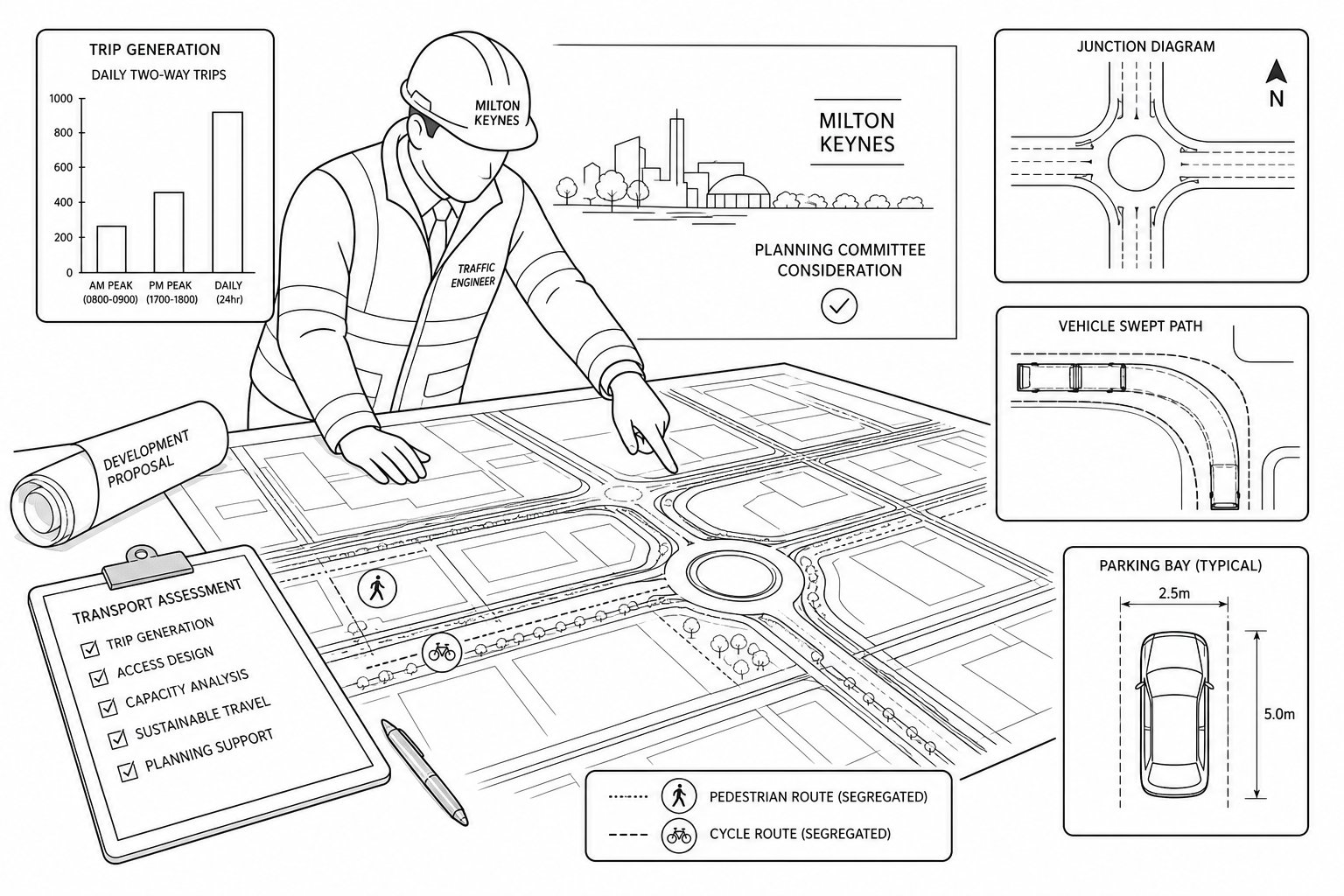
A traffic engineer in Milton Keynes provides technical evidence and practical design input so a development can be properly assessed against planning and highway requirements. In simple terms, we help answer the questions decision-makers usually ask: will the proposal create material traffic effects, can vehicles enter and leave safely, will nearby junctions cope, is parking adequate, and does the scheme support walking, cycling, public transport, and servicing in a sensible way?
That can involve traffic surveys, trip generation forecasts, junction capacity modelling, swept path analysis, access reviews, road safety input, and the preparation of transport reports to support an application. Depending on the site, we may also advise on visibility splays, internal layout, servicing strategy, active travel links, or mitigation measures to reduce impact.
In Milton Keynes, this role often carries extra weight because movement patterns are shaped by a distinctive local highway structure. Grid roads, large roundabouts, distributor routes, and separated pedestrian and cycle infrastructure mean transport analysis needs to reflect how trips actually move through the area, not just what a standard template might suggest.
Our role is also interpretive. We do not simply produce data: we explain it in a form planning officers, highway officers, committees, consultants, and clients can use. Good transport advice is technically sound, but it also needs to be proportionate, locally aware, and clear enough to support decisions with confidence. That is where experienced traffic engineering consultants add real value.
When You May Need A Traffic Engineer For A Planning Application
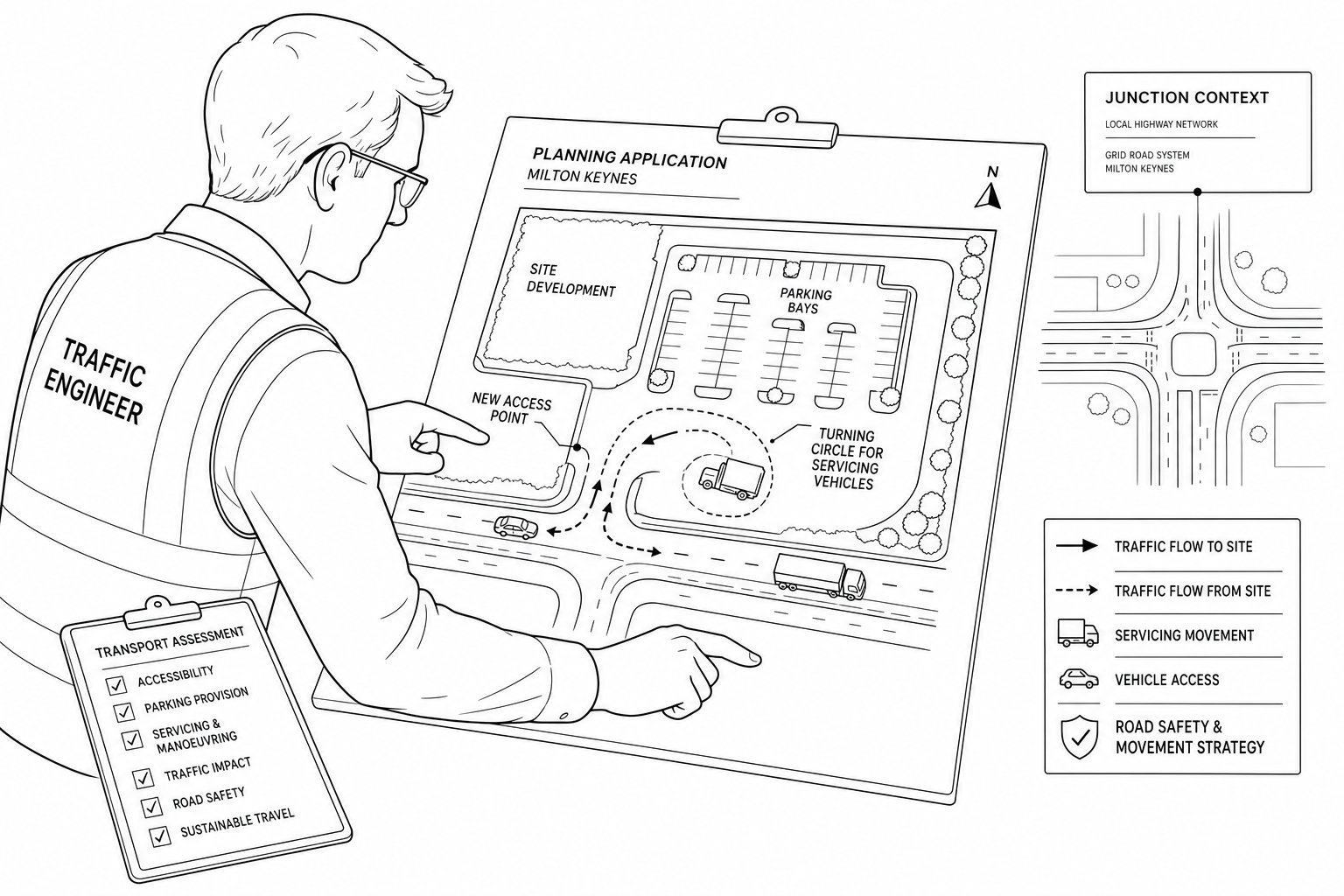
You may need a traffic engineer whenever a proposal has the potential to alter traffic flows, site access, parking demand, servicing patterns, or road safety conditions. That does not only apply to major development. Smaller schemes can also trigger transport concerns if they sit on constrained plots, connect to busy corridors, intensify commercial use, or generate awkward servicing activity.
We are often brought in at pre-application stage, when a team wants to understand likely transport risk before layouts are fixed. That is usually the most efficient point to involve us, because access geometry, parking arrangement, turning space, and movement strategy can still be adjusted without expensive redesign. But we are also regularly instructed after a planning authority asks for additional transport evidence, or when an objection from the local highway authority needs a structured response.
As a rule, the more a scheme changes how people and vehicles move to, from, and around a site, the more likely transport input becomes necessary. Milton Keynes planning applications can be particularly sensitive where a proposal affects a grid-road junction, introduces new access onto a strategic route, increases peak-hour trips, or relies on parking assumptions that are not well evidenced.
Common Project Types That Require Transport Input
Typical examples include residential development, commercial and industrial schemes, roadside and drive-through uses, schools, care uses, mixed-use regeneration, and changes of use that intensify occupation or deliveries. We also support highway works, junction alterations, active travel schemes, parking reviews, and developments needing detailed servicing analysis.
For developers and planning teams working on employment or mixed-use proposals, issues such as HGV routing, shift patterns, and peak spreading can be just as important as raw trip numbers. That is one reason commercial traffic engineering often needs tailored evidence rather than a generic report.
Milton Keynes Planning And Highway Context
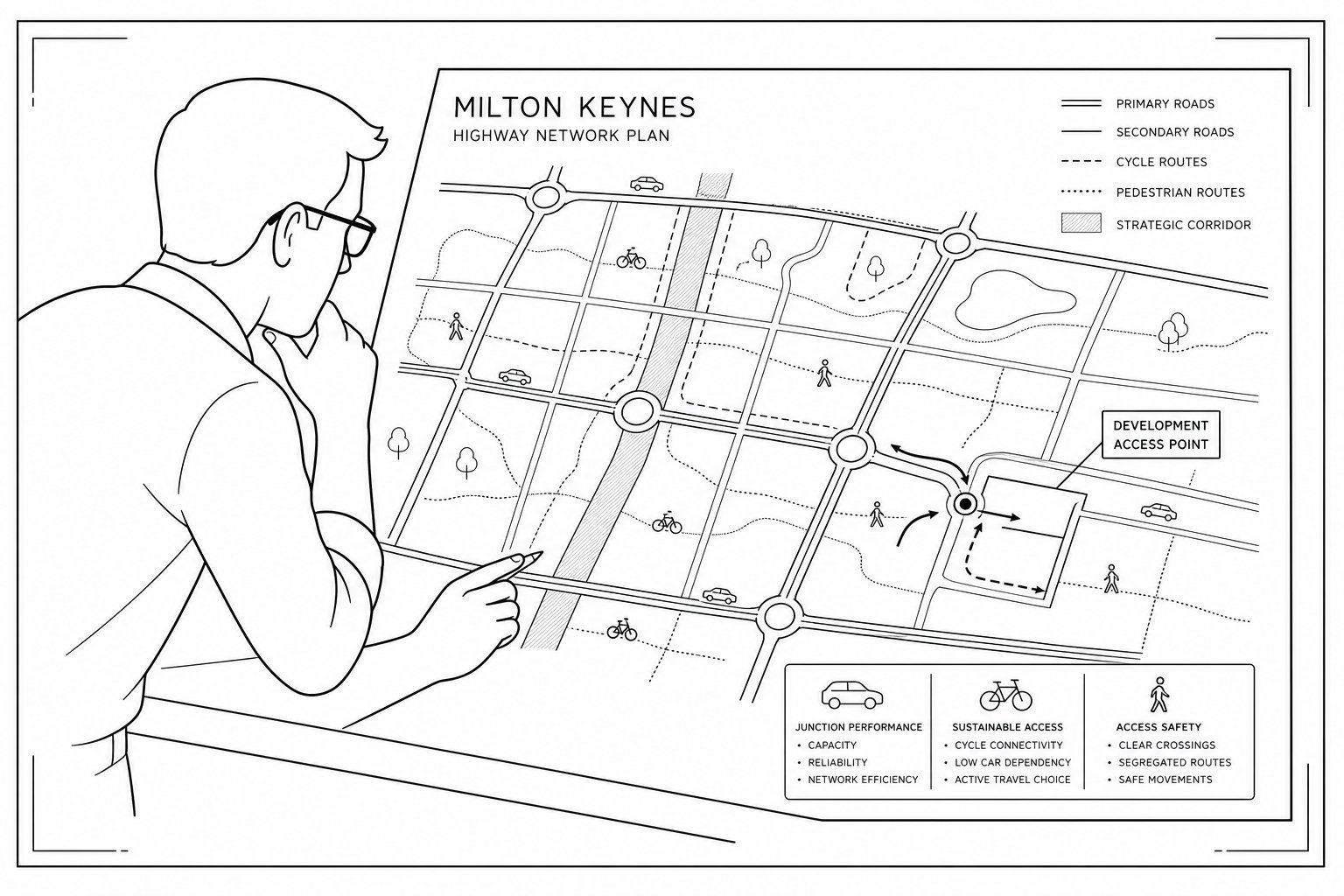
Milton Keynes has a planning and highway context that is unusually transport-aware. The city’s structure was designed around movement efficiency, with a recognisable grid-road system, frequent roundabouts, strategic corridors, and a long-established approach to separating certain travel modes. That creates opportunities for development, but it also means transport impacts can be highly visible when a proposal disrupts established patterns.
From a planning perspective, proposals are commonly examined for their effect on junction performance, access safety, network resilience, parking pressure, and sustainable travel integration. A site may appear straightforward on paper, yet become more sensitive once local movement conditions are understood. For instance, a new access near a busy roundabout, or a redevelopment that alters turning patterns onto a fast-moving distributor route, can raise issues well beyond the site boundary.
This is why local context matters so much. In Milton Keynes, officers and highway reviewers are often focused on how development interacts with the wider network rather than just the frontage. Peak-hour operation, route choice, conflict with cycle and pedestrian movements, and consistency with broader movement objectives all come into play.
We hence approach schemes with both national guidance and local realism in mind. Principles from Manual for Streets, DMRB, TSRGD, and current planning practice are essential, but they need to be applied to Milton Keynes conditions rather than copied in abstract. That blend of policy understanding and practical transport judgement is central to effective highway and traffic engineering support.
Typical Transport Reports Prepared For Development Proposals
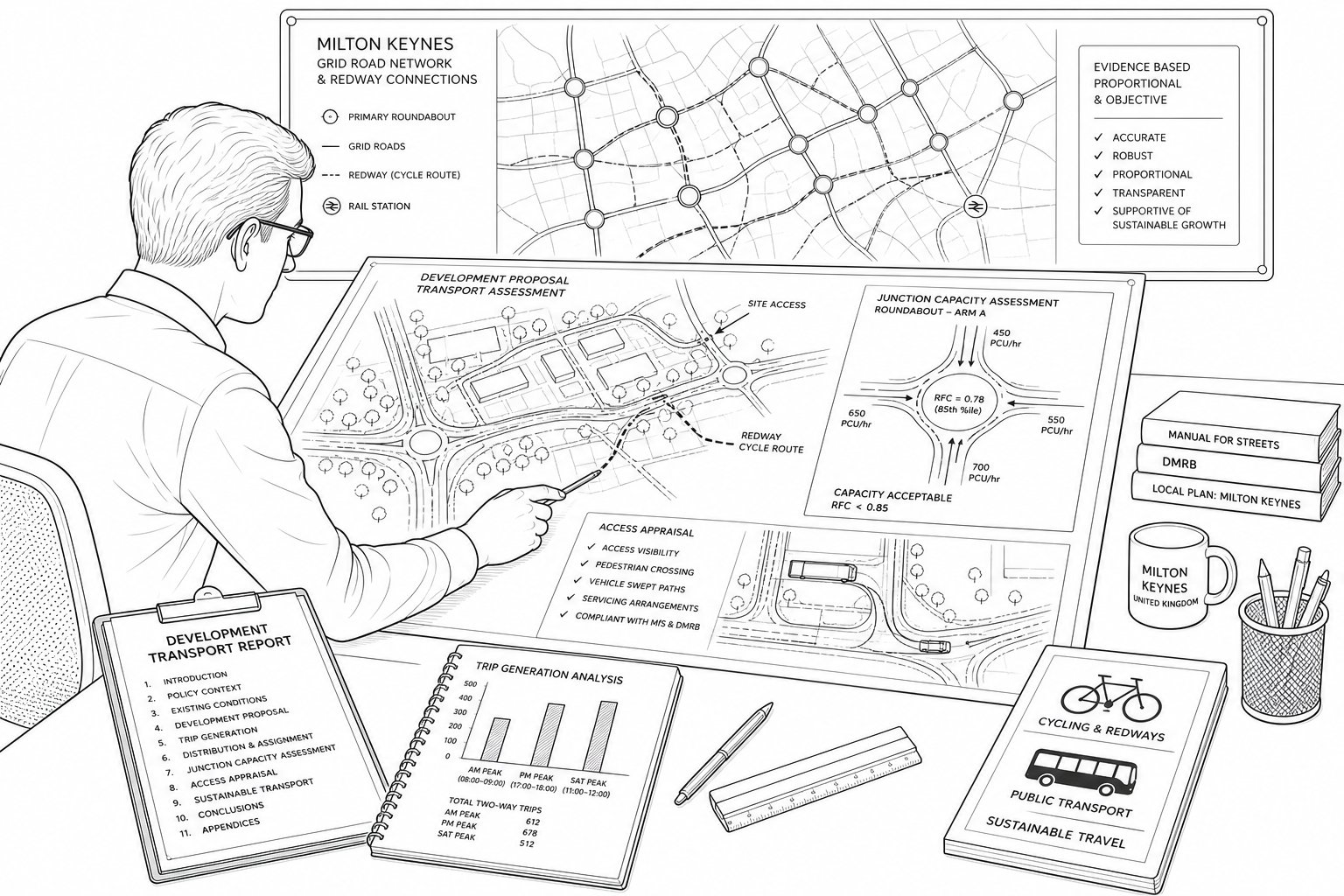
The right report depends on the nature, scale, and likely transport effects of the proposal. Not every site needs a full Transport Assessment, and not every small application can rely on a short note. The key is proportionality. A well-scoped report should address the real issues without overstating or understating them.
We typically prepare Transport Assessments, Transport Statements, Travel Plans, traffic impact notes, access appraisals, junction capacity assessments, delivery and servicing reviews, parking studies, and technical responses to planning or highway queries. The report suite is often shaped by pre-application dialogue, local validation expectations, and the transport characteristics of the development itself.
In practice, the best reports do three things. First, they describe the existing conditions accurately. Second, they estimate the transport effects of the proposal using appropriate evidence and assumptions. Third, they explain whether mitigation is required and, if so, what form that should take. When those elements are weak, applications can stall.
For teams trying to coordinate transport input with architecture, planning, drainage, and noise work, clarity matters. We often align our reporting with wider planning strategy so that access, layout, trip assumptions, and sustainability measures reinforce the planning narrative rather than sit awkwardly beside it.
Transport Assessments, Transport Statements, And Travel Plans
A Transport Assessment is usually the most detailed form of transport submission. It is commonly used where a development could create material transport effects and where decision-makers need structured evidence on trip generation, distribution, junction impacts, access design, parking, servicing, and mitigation. It may include survey analysis, capacity modelling, accident review, sustainable travel review, and detailed commentary on policy compliance.
A Transport Statement is lighter-touch. It is more suitable where impacts are expected to be limited, but where some transport evidence is still necessary to show that access, parking, and movement effects have been considered properly. It can be highly effective for smaller or less intensive schemes when scoped sensibly.
A Travel Plan sits alongside these documents and sets out how sustainable travel will be encouraged. That may include walking and cycling measures, public transport information, incentives, facilities, monitoring, or management actions. In Milton Keynes, where active travel connections can be a meaningful part of the movement picture, Travel Plans should be practical rather than tokenistic.
Junction Capacity, Trip Generation, And Access Appraisals
Trip generation work estimates how many vehicle and person trips a development is likely to produce. That usually involves informed use of survey databases, local comparisons, consented benchmarks, and professional judgement. The point is not to produce the biggest spreadsheet: it is to produce a defensible forecast.
Junction capacity assessments then test whether surrounding junctions can accommodate those trips, often during weekday peak periods. Depending on the local layout, this may involve roundabout modelling, priority junction analysis, signal assessment, or sensitivity testing. In Milton Keynes, roundabout interaction and corridor operation are frequently important.
Access appraisals consider whether a site can be entered, exited, and serviced safely and efficiently. That includes geometry, visibility, vehicle tracking, pedestrian and cycle interaction, and the relationship between site access and the surrounding highway environment. Strong analysis here often prevents later objections. Broader traffic engineering and transportation input can be especially useful when access strategy and planning strategy need to develop together.
How Traffic Engineers Support Planning Applications From Start To Decision
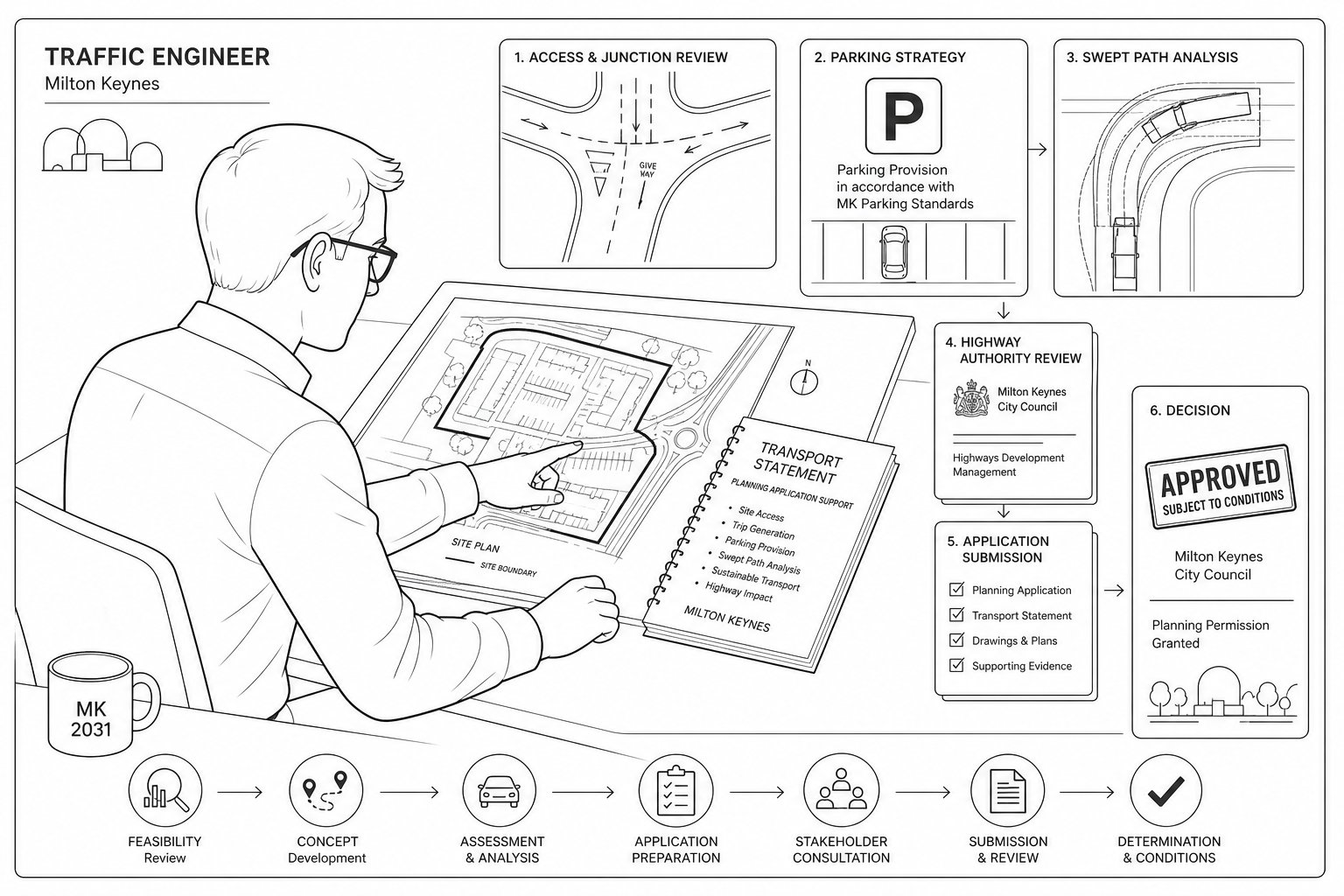
The most effective transport support usually starts before an application is submitted. Early in the process, we review the site, likely access options, land use mix, potential trip impacts, and the probable level of reporting needed. That helps project teams understand transport risk before they have invested too heavily in a layout that may be hard to defend.
At feasibility stage, we often identify whether a proposal is likely to need a Transport Statement, a full Transport Assessment, a Travel Plan, junction modelling, swept path analysis, or a targeted note on parking and servicing. We can also help shape red-line boundaries, internal circulation, access positioning, and mitigation concepts while those decisions are still flexible.
As the planning application develops, we prepare the required reports, coordinate with architects and planners, and make sure the technical narrative is consistent across the wider submission. That includes aligning floor areas, uses, access drawings, parking numbers, and operational assumptions. A surprising number of transport objections begin with simple inconsistencies between submitted documents.
After submission, our role often becomes just as important. We respond to highway authority comments, clarify methodology, update drawings, test alternatives, and negotiate proportionate mitigation where needed. Sometimes that means addressing a specific capacity concern. Other times it means reframing a point that has been misunderstood.
In our experience, planning support is not just about producing a report once. It is about staying engaged until determination, so the transport case remains clear, credible, and responsive. That practical, iterative approach is at the heart of Traffic Engineering: Your Complete Guide style advice, especially on live planning schemes.
Key Local Considerations For Sites In Milton Keynes
Several local factors regularly influence how we assess development sites in Milton Keynes. The first is the relationship to grid-road corridors and their junctions. Even when a site itself is modest, a nearby roundabout or strategic connection can become the focus of highway review if additional peak trips are expected.
The second is network character. Roads in Milton Keynes can operate very differently from tighter historic town centres. Speeds, route choice, lane discipline, and roundabout spacing all affect how access should be designed and how impacts should be tested. A layout that might work in another authority area may not be persuasive here without adaptation.
Third, pedestrian and cycle movement deserves proper attention. Milton Keynes has a long-established network of off-road and semi-segregated routes in many locations, and proposals should connect sensibly into that system. Sustainable travel arguments are strongest when they reflect real local routes rather than generic statements about mode shift.
Parking and servicing also need to be considered in the context of land use, local expectations, and likely operational patterns. Overspill concerns, delivery conflict, and turning space can become practical planning issues quickly if they are left unresolved.
And finally, highway safety remains central. Existing collision patterns, visibility, crossing demand, and access conflict points should be reviewed carefully. We often find that local success depends less on producing more paperwork and more on addressing the handful of site-specific movement issues that genuinely matter.
Parking, Servicing, And Sustainable Travel Considerations
Parking, servicing, and sustainable travel are often treated as separate topics, but in planning terms they are tightly connected. A scheme with adequate parking on paper can still perform badly if delivery vehicles block manoeuvring space, if disabled bays are poorly placed, or if cycle storage is technically provided but practically unusable.
We hence look at these elements as part of one operational picture. Parking provision should reflect the use, likely demand profile, local accessibility, and risk of overspill. Too little parking can displace problems onto surrounding streets or neighbouring land. Too much can undermine placemaking and weaken the sustainability case. The answer is rarely just “more”.
Servicing needs the same realism. Refuse collection, courier activity, staff deliveries, and larger vehicle movements should all be understood early. Swept path analysis is often essential, particularly where constrained plots, shared yards, or mixed residential-commercial environments are involved.
Sustainable travel measures work best when they are tailored. In Milton Keynes, that may mean convenient walking routes, direct cycle links, secure cycle parking, public transport information, staff travel measures, or small design changes that make non-car travel feel obvious rather than aspirational. A credible Travel Plan supports this, but the site design itself has to do some of the work.
Comparable urban lessons can be seen in areas such as Traffic Engineer In London: and Traffic Engineer In Manchester:, though Milton Keynes still needs its own locally grounded judgement.
How To Choose The Right Traffic Engineer In Milton Keynes
Choosing the right consultant is partly about technical competence and partly about planning judgement. You need someone who can produce robust transport evidence, but also someone who understands how that evidence will be read by planning officers, highway officers, committee members, and, in some cases, appeal inspectors.
We would suggest looking for four things. First, relevant UK experience in development planning, not just pure highway design. Second, familiarity with the standards and guidance that commonly shape advice, including DMRB, Manual for Streets, TSRGD, junction modelling tools, and road safety principles. Third, a clear understanding of how local authority review processes work in practice. And fourth, the ability to write concise, defensible reports rather than generic templates.
Speed matters too. Planning programmes move quickly, and transport advice often has to align with design revisions, planning deadlines, and comments from multiple consultants. A good engineer should be responsive without becoming careless.
For many clients, local awareness is especially valuable. Someone who understands how Milton Keynes sites are likely to be viewed in relation to grid roads, roundabouts, sustainable movement links, and strategic growth pressures will usually add more value than a consultant applying a one-size-fits-all method.
That is one reason firms with long experience and a focused planning approach, including teams such as those at ML Traffic, are often asked to support applications where concise evidence and authority-aware reporting are critical.
What Information To Prepare Before Seeking Transport Advice
Good transport advice starts with good input information. We can often give an early steer from limited material, but the clearer the starting brief, the faster and more reliable the advice will be.
At minimum, it helps to provide the site location, an address or plan, the red-line boundary, the proposed land use, estimated floor area or unit numbers, access ideas, likely parking provision, and any known servicing needs. If the scheme has evolved already, earlier layouts or pre-application comments can also be useful because they reveal what has been considered before.
We also recommend sharing any transport-related constraints you already know about: nearby junction concerns, visibility limitations, local parking sensitivities, existing traffic surveys, collision history, or planning officer comments. Even partial information can help us scope the work properly and avoid unnecessary reporting.
Where available, supporting documents such as topographical surveys, tracking plans, existing planning permissions, design and access material, and draft site layouts make a real difference. They help us spot whether the likely issue is traffic impact, access, servicing, parking, sustainable travel, or a combination of several.
For multi-site developers and planning teams, examples from other authorities can help frame expectations too, including work on Traffic Engineer In Bristol: or comparable regional schemes. But for Milton Keynes, the strongest starting point is still a clear brief, accurate plans, and honest assumptions about how the site will operate.
Conclusion
A well-chosen Traffic Engineer in Milton Keynes can make a substantial difference to the quality and resilience of a planning application. In a city where road hierarchy, roundabout performance, access design, parking, servicing, and sustainable movement all attract close attention, transport evidence needs to be both technically credible and locally informed.
The most successful schemes are usually the ones that address transport early, not after objections arrive. That means understanding whether the development needs a Transport Statement or Assessment, testing access and junction implications properly, and presenting clear, proportionate evidence that speaks to the realities of Milton Keynes.
For architects, planners, surveyors, developers, legal teams, and public sector clients, the aim is not to produce paperwork for its own sake. It is to reduce uncertainty, support decision-making, and give a project the best chance of moving through planning with fewer surprises. Done well, transport input becomes a practical planning tool, not a late-stage obstacle.
Frequently Asked Questions About Traffic Engineers in Milton Keynes
What does a traffic engineer in Milton Keynes do?
A traffic engineer in Milton Keynes assesses how developments affect traffic flow, access, parking, and road safety. They prepare transport reports, conduct junction modelling, and advise on walking, cycling, and public transport to support planning applications effectively.
When is it necessary to hire a traffic engineer for a planning application in Milton Keynes?
You typically need a traffic engineer whenever a proposed development may impact traffic movements, site access, parking demand or servicing. Early consultation helps address risks and avoids costly redesigns or objections during the planning process.
What types of projects commonly require transport input from a traffic engineer in Milton Keynes?
Projects such as residential developments, commercial sites, schools, mixed-use regeneration, highway improvements, and active travel schemes often require traffic engineering input to ensure safe and efficient transport arrangements.
How do traffic engineers support planning applications from start to decision in Milton Keynes?
Traffic engineers provide early feasibility advice, prepare technical evidence like Transport Assessments or Statements, respond to authority comments, and refine transport designs to align with planning and highway requirements until the application is determined.
What are the key local factors a traffic engineer must consider in Milton Keynes?
They must consider the grid-road network and roundabouts, local traffic and pedestrian/cycle movement patterns, parking and servicing needs, and highway safety conditions to produce transport evidence tailored to the unique Milton Keynes context.
How can I choose the right traffic engineer for my Milton Keynes development project?
Select a consultant with relevant UK transport planning experience, knowledge of local standards like DMRB and TSRGD, understanding of Milton Keynes highway conditions, and the ability to produce clear, concise, and locally aware transport reports.