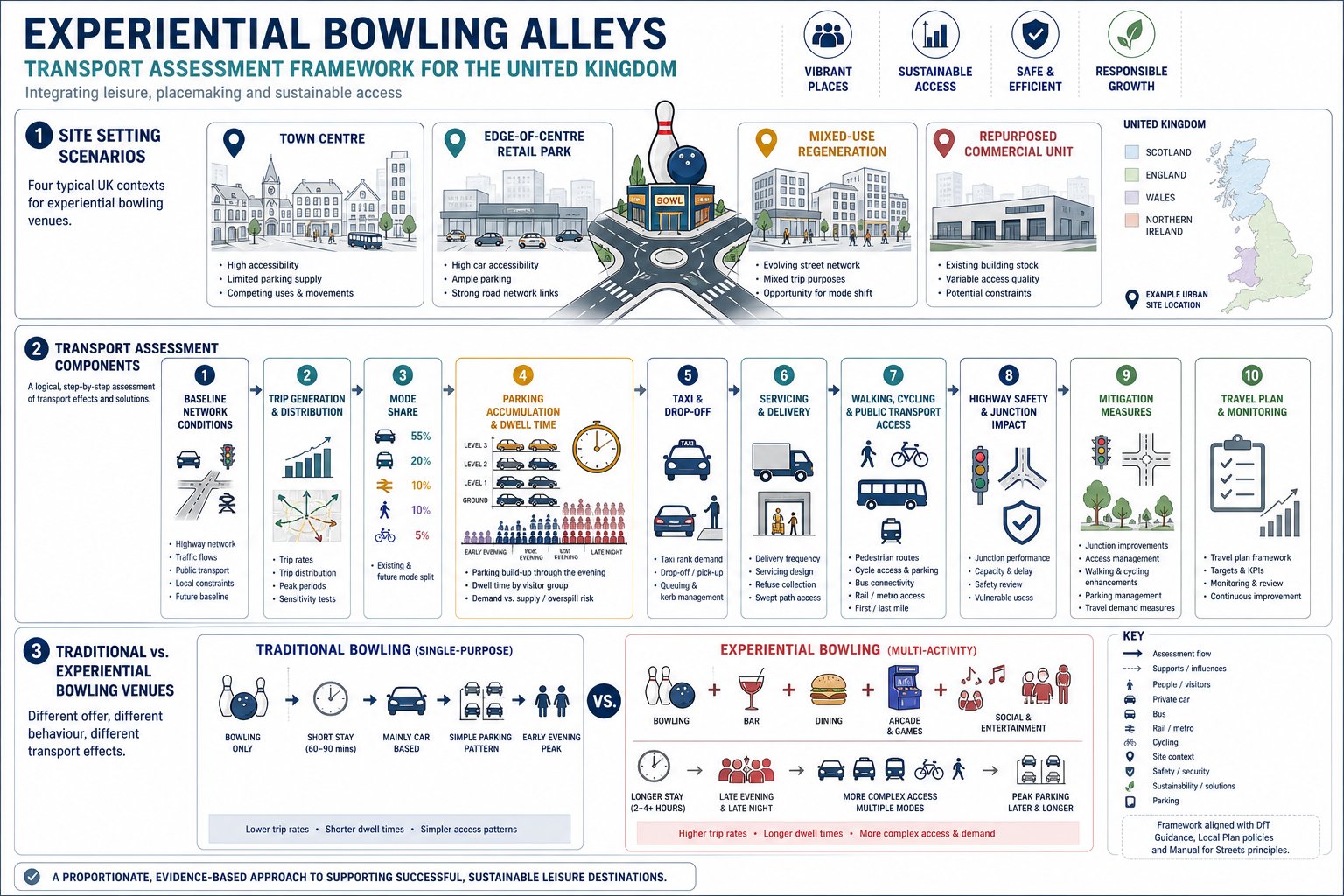
A modern bowling venue is rarely just a place to hire shoes, bowl two games, and head home. In 2026, many schemes combine lanes with bars, dining, arcade space, karaoke, or other leisure offers designed to keep people on site longer and widen the catchment. That sounds commercially attractive. It also makes transport planning more nuanced.
For architects, planners, developers, surveyors, lawyers, and local authorities, an Experiential Bowling Alleys Transport Assessment needs to do more than estimate car trips and count parking spaces. It has to show, in a credible and locally grounded way, that the venue can be accessed safely, served efficiently, and operated without causing unacceptable impacts on the surrounding highway network or town centre environment.
We find these projects often sit in exactly the locations where transport evidence matters most: edge-of-centre retail parks, repurposed town-centre units, mixed-use regeneration sites, and leisure-led extensions to existing destinations. In each case, longer dwell times, evening demand, family and group travel patterns, taxi activity, and linked trips can materially affect the assessment.
This article sets out what a robust Experiential Bowling Alleys Transport Assessment should cover, how experiential formats differ from traditional bowling centres, which planning scenarios typically trigger a full assessment, and the key methodological issues we need to get right if an application is to stand up to scrutiny.
Key Takeaways
- An Experiential Bowling Alleys Transport Assessment must evaluate safe access, efficient service, and minimal impact on local transport networks beyond just car trip estimates.
- Modern experiential bowling venues blend bowling with bars, dining, and entertainment, leading to longer dwell times and complex travel patterns requiring detailed transport analysis.
- Transport assessments should include trip generation, parking demand, mode share, taxi activity, servicing, and public transport accessibility tailored to the venue’s mixed-use nature.
- Linked and shared trips can reduce new vehicle demand in town-centre locations but must be supported by robust local survey evidence to be credible.
- Accurate forecasting demands local data reflecting peak leisure periods, particularly evenings and weekends, not just traditional commuter peaks.
- Mitigation plans like travel strategies, parking management, and servicing schedules are essential to address operational impacts and secure planning approval.
What An Experiential Bowling Alley Transport Assessment Needs To Cover
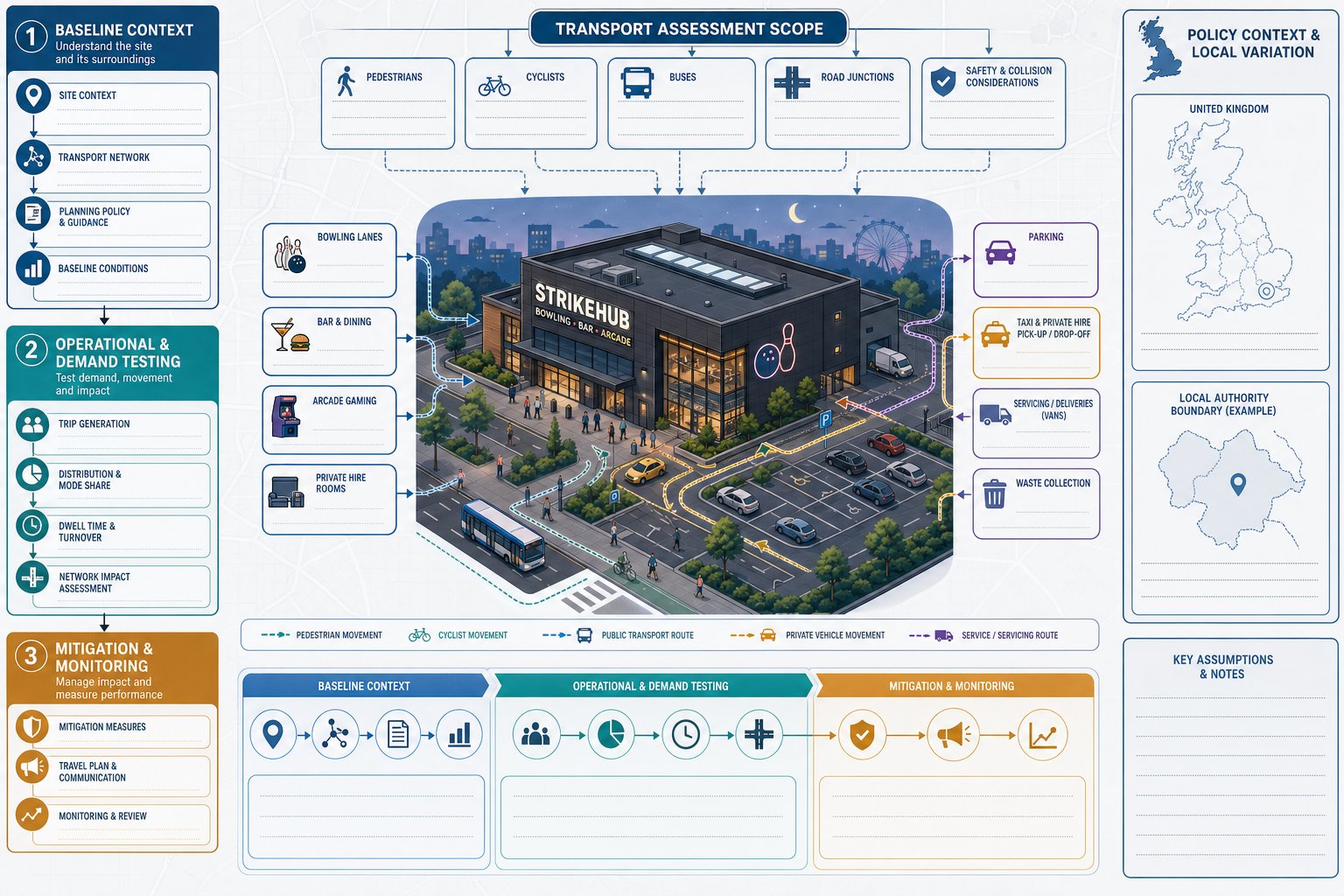
At its core, the assessment has to answer a simple planning question: can the proposed venue operate acceptably in transport terms? For an experiential bowling scheme, that means testing more than headline traffic generation.
A sound submission should cover the proposed land use mix in detail. Lane numbers matter, but so do bar floorspace, food and drink covers, arcade or gaming space, private hire rooms, and any ancillary attractions. Those elements shape arrival profiles, dwell times, and how visitors move through the site.
We would normally expect the assessment to address:
- baseline site and network conditions:
- policy and local validation requirements:
- trip generation and trip distribution:
- mode share assumptions:
- parking demand and parking management:
- pick-up, drop-off, taxi and private hire activity:
- servicing, deliveries, and waste collection:
- walking, cycling, and public transport accessibility:
- highway safety and operational impact: and
- mitigation, travel planning, and monitoring.
For planning teams working across different local authority areas, the detail often needs tailoring to local thresholds and committee sensitivities. That is why a broader transport assessment for developments: approach is useful context: the principle is consistency, but the evidence base must still be site-specific.
The strongest reports are transparent about assumptions. If a venue expects strong evening trading, substantial family bookings, or a major food and beverage component, that should be visible in the forecasting and not hidden behind generic leisure averages.
How Experiential Bowling Venues Differ From Traditional Bowling Centres
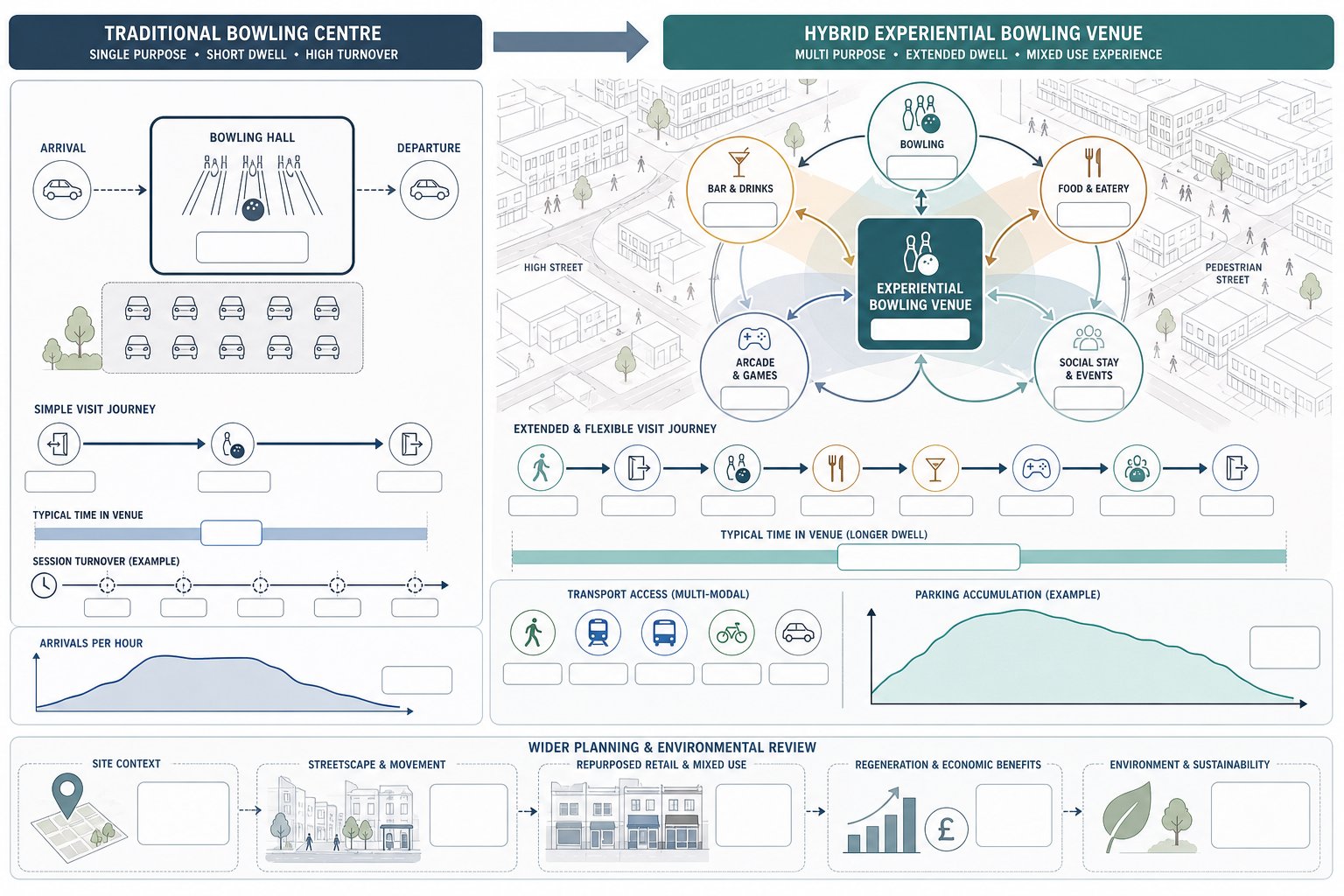
Traditional bowling centres were often relatively straightforward in transport terms. People travelled for bowling as the main purpose, stayed for a defined period, and left. The experiential model is messier, in a good commercial sense but a more demanding planning sense.
These newer venues are designed around mixed leisure behaviour. A group may arrive for bowling, stay for drinks afterwards, add food, spend time in an arcade, and leave significantly later than a classic two-game visit would suggest. Another group may not bowl at all, but still use the bar or entertainment offer. That changes trip purpose and length of stay.
It also changes peak characteristics. Traditional centres might show clearer session turnover. Experiential venues often have softer overlaps between bookings, walk-ins, and social dwell time. As a result, parking accumulation can be more important than simple arrivals per hour.
Location is different too. Many modern concepts are deliberately placed in town centres, mixed-use quarters, or repurposed retail/leisure assets where linked trips and non-car access are central to the planning case. That means the transport narrative cannot be built solely around private vehicle demand.
In practice, an Experiential Bowling Alleys Transport Assessment should treat the venue as a hybrid leisure use, not just a bowling box with extra branding. Where wider environmental effects are part of the planning context, an environmental impact assessment framework may also become relevant, especially on larger regeneration or mixed-use schemes.
Typical Planning Scenarios That Trigger A Transport Assessment
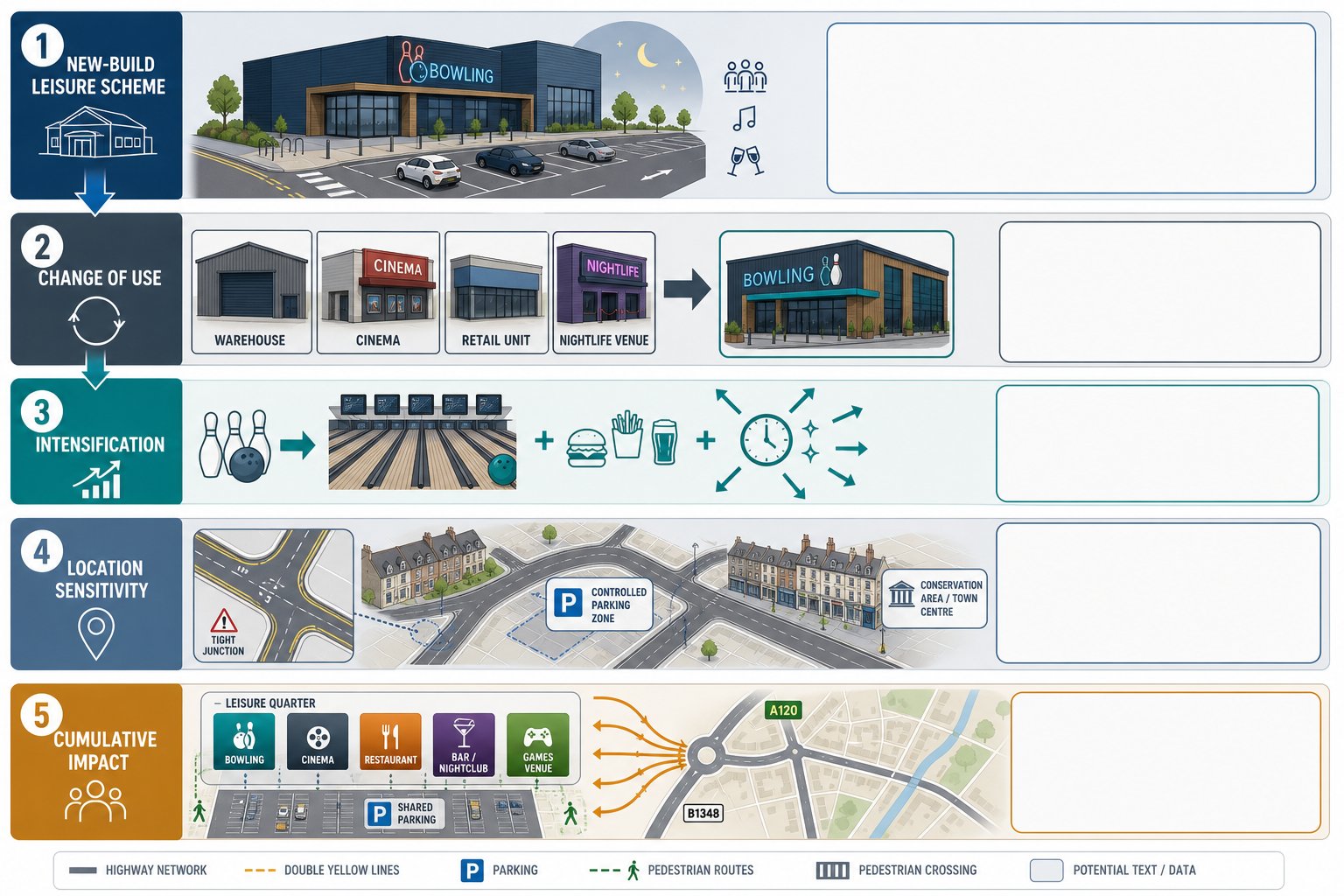
Not every bowling proposal requires the same level of reporting, but several common scenarios regularly trigger a formal transport assessment or transport statement.
The first is a new-build leisure scheme, whether standalone or part of a broader commercial development. A purpose-built venue with material floorspace, evening activity, and dedicated parking will usually require detailed testing.
The second is change of use. Converting a retail warehouse, cinema unit, department store, nightclub, or large town-centre commercial space into an experiential bowling venue can significantly alter trip timing and parking demand, even if the gross floorspace barely changes. Planning teams sometimes underestimate this point. Highway authorities usually do not.
The third is intensification or extension. Adding bowling lanes, expanding a food and drink offer, or introducing late-night trading and ancillary attractions can all increase trip generation and accumulation beyond the assumptions that underpinned an earlier consent.
The fourth is location sensitivity. Constrained junctions, controlled parking zones, conservation-led town centres, nearby residential streets, or sites with poor servicing arrangements can all make transport effects material even where floorspace is modest.
And then there is cumulative impact. Where the bowling venue forms part of a wider leisure quarter or mixed-use regeneration scheme, the assessment may need to consider not just the unit in isolation but how its demand interacts with neighbouring uses, shared parking, and local network peaks. That is often where robust scoping with the local planning authority saves time later.
Core Trip Generation Factors For Bowling-Led Leisure Uses
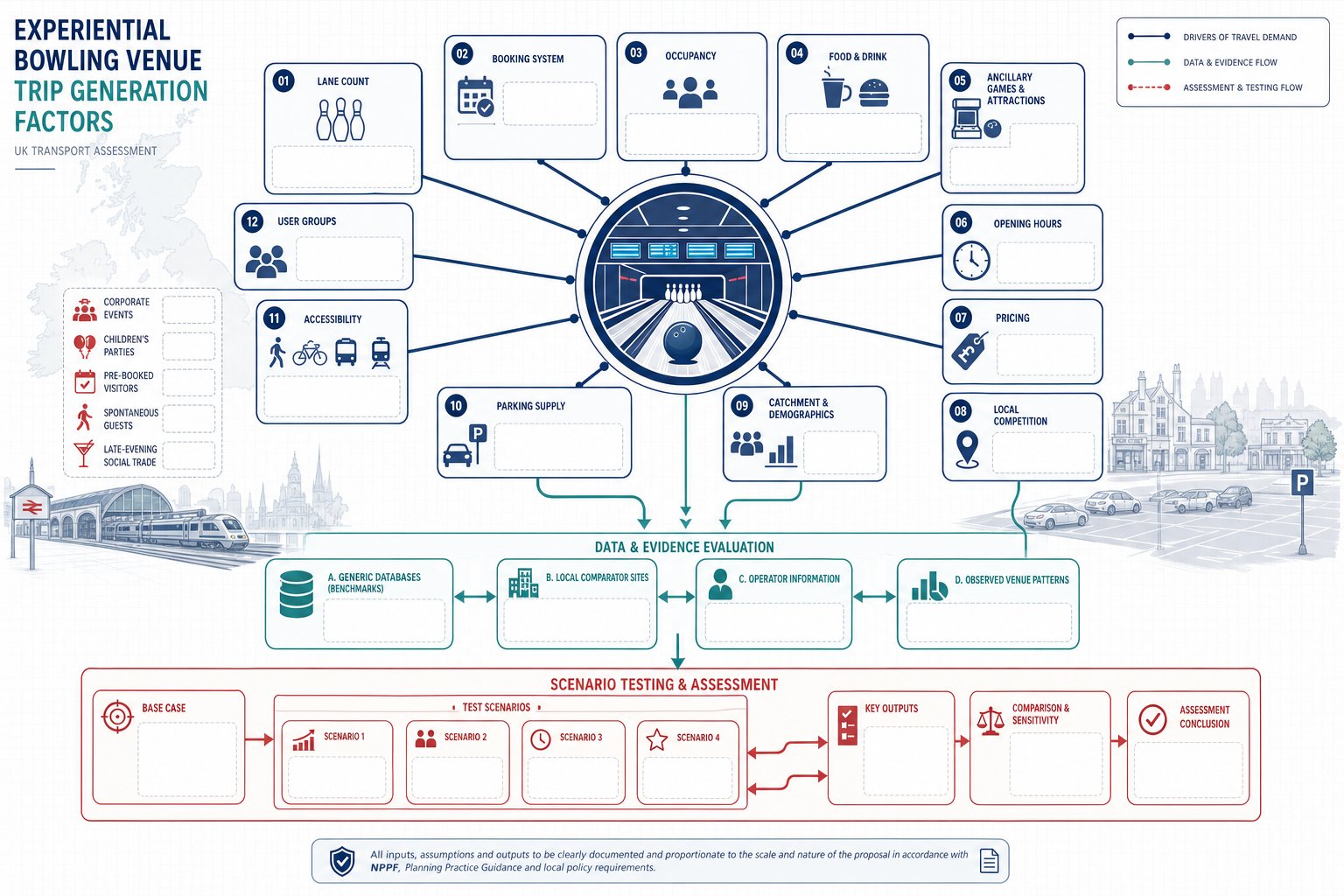
Trip generation for bowling-led leisure uses is rarely captured well by one generic rate. We need to build a picture from the operating model.
Key variables usually include lane numbers, booking format, expected occupancy, food and beverage offer, ancillary attractions, opening hours, pricing, local competition, catchment demographics, parking supply, and accessibility by non-car modes. A town-centre venue next to a railway station behaves differently from an edge-of-town site anchored by free parking.
It also matters whether the concept relies on pre-booked sessions, spontaneous visits, corporate events, children’s parties, or late-evening social trade. Those user groups generate different vehicle occupancy levels and different sensitivity to public transport availability.
Generic databases can help frame a starting point, but they should not be the whole answer. We usually need local comparator evidence, operator information, and observed patterns from similar venues to explain why the chosen rates are realistic. Otherwise, the report can look neat on paper and still fail under review.
For more complex sites, the wider logic used in a transport assessment for mixed-use developments is useful: identify the real drivers of travel demand first, then test scenarios transparently.
Arrival Patterns, Peak Periods, And Multi-Activity Dwell Time
The biggest mistake in leisure forecasting is treating all demand as if it behaves like a commuter peak. Bowling-led experiential uses often peak when the traditional highway model is only telling half the story.
Fridays, Saturdays, school holidays, and evenings are usually critical. Depending on the location, a venue may also overlap with the PM peak, especially where after-work social trips build from around 17:00 onward. Family trade can arrive earlier, while adult social trade may hold parking spaces deeper into the evening.
Dwell time is central. When a venue combines bowling with food, drinks, and ancillary activities, the visit duration can stretch well beyond the booked lane time. A nominal 60- or 90-minute bowling product can become a two-and-a-half-hour stay. That affects parking accumulation, taxi turnover, and the timing of departures.
Assessments should hence model accumulation as well as arrivals and departures. Session-based assumptions can be helpful, but they need reality checks from operator data and comparable sites. If the concept includes party rooms, event bookings, or high-value F&B trade, those longer stays need explicit allowance.
In short, the question is not just how many people arrive in a peak hour. It is how long they remain, what else they do on site, and how that stacks up across the evening.
Linked Trips, Shared Trips, And Town Centre Footfall Effects
Linked trips can be one of the strongest parts of the planning case for a town-centre bowling venue, but only if they are evidenced properly.
A linked trip is not just any person who happened to do two things in one evening. For transport purposes, we need to show that some visitors are genuinely combining the bowling venue with another destination as part of a wider journey pattern that does not create a wholly new vehicle trip. In town centres, that may include people already shopping, dining, or visiting nearby leisure uses.
Shared trips also matter on mixed-use sites with common parking and internal footfall. A bowling venue next to restaurants, a cinema, or a retail core may benefit from existing movement patterns, reducing the proportion of wholly new external trips.
But this is where submissions sometimes overreach. If linked trip allowances are too aggressive and unsupported by surveys, local authorities tend to push back quickly. The safer approach is to use local pedestrian counts, parking beat surveys, intercept evidence where available, and comparable town-centre case studies.
When handled carefully, linked trip analysis can show that the venue supports vitality and diversifies evening footfall rather than simply importing isolated car demand. That is especially persuasive in regeneration settings where activation and town-centre resilience are part of the wider planning objective.
Survey Data, Local Evidence, And Robust Assessment Methodology
Methodology is often where a good leisure proposal either gains credibility or loses it. For experiential bowling, generic assumptions alone are rarely enough.
Robust assessment usually starts with local evidence: classified turning counts, queue observations, parking beat surveys, pedestrian and cycle observations, public transport accessibility review, and site context analysis. Where a comparable venue exists, operator data on booking patterns, customer arrival modes, and average dwell time can be extremely helpful.
Survey timing matters. If the venue will trade heavily on Friday evenings and weekends, weekday daytime traffic counts on their own will not tell the whole story. We need surveys that reflect likely stress periods. In some cases, that means combining traditional weekday peak analysis with leisure-sensitive periods such as Saturday midday, Saturday evening, or Friday PM.
The methodology should also explain why comparator sites are appropriate. Similarity in floorspace is not enough: we need alignment on format, catchment, accessibility, and ancillary uses. Transparent assumptions are always easier to defend than apparently precise numbers with weak foundations.
On larger applications, methodology may need to dovetail with a broader environmental impact assessment transport: approach, particularly where cumulative traffic, air quality, or town-centre effects are being examined in parallel. The aim is simple: a report that reads like the site has been understood, not guessed.
Car Parking, Drop-Off Activity, And Servicing Considerations
Parking for an experiential bowling venue is rarely just about total bay numbers. We need to understand how demand builds, turns over, and interacts with other site functions.
Longer dwell times can mean that even moderate arrival rates create high parking accumulation. If food, drink, and additional attractions are successful, the car park may remain close to full for extended periods rather than clearing between sessions. Shared parking arrangements can work well, but only if complementary peaks are demonstrated rather than assumed.
Drop-off and pick-up activity deserves separate attention. Family groups, children’s parties, private hire vehicles, and taxis can create short-duration stopping demand even where overall car parking is adequate. Without dedicated space, those movements can spill into aisles, loading areas, or nearby streets.
Servicing is another frequent weak point. Deliveries, drinks stock, food supply, waste collection, and linen or consumables all need a practical routing and turning strategy. On constrained town-centre sites, timing restrictions may be necessary to avoid conflict with customer arrivals and pedestrian activity.
A defensible assessment should hence test:
- parking accumulation by time period:
- blue badge provision and proximity:
- drop-off and taxi demand:
- staff parking arrangements:
- delivery vehicle type and frequency:
- refuse storage and collection: and
- conflict points between customers and service vehicles.
If these details are left vague, objections often follow, sometimes late in the application process when changes are harder to make.
Walking, Cycling, And Public Transport Accessibility Requirements
Planning policy in 2026 expects far more than a note saying a bus stop exists nearby. For an experiential bowling venue, accessibility has to be demonstrated in practical terms.
For walking, we need to show that routes from surrounding streets, car parks, bus stops, and rail stations are direct, safe, well lit, and legible. That includes crossing points, gradients, personal security, wayfinding, and how pedestrians move through shared leisure or retail environments. A venue that trades strongly in the evening cannot ignore the quality of after-dark routes.
For cycling, local authorities increasingly expect secure, convenient cycle parking in visible locations, not an afterthought around the back of the building. We also need to consider cycle network connections, road safety, and whether the target audience is realistically likely to cycle for short local trips.
Public transport analysis should look at service frequency, span of service, weekend and evening operation, walking catchments, and interchange convenience. A station 12 minutes away on paper may feel much less accessible if the route is poor or the last train timing undermines evening use.
Where a proposal leans on sustainable access as part of the planning case, the evidence needs depth. Accessibility is not a slogan. It is a test of whether customers and staff can genuinely reach the venue without defaulting to the private car.
Highway Impact, Junction Capacity, And Network Performance Testing
Where traffic increases are material, the assessment must move from description into testing. That usually means junction capacity analysis, queue review, turning movement assessment, and sometimes wider network modelling.
The key is proportionality. Not every bowling proposal needs an elaborate model, but every material proposal needs evidence that the surrounding network can accommodate forecast demand without severe impact. For edge-of-centre or retail park sites, access junctions, roundabouts, signalised nodes, and internal circulation points are often the main pressure points. In town centres, the concern may instead be loading friction, short-stay stopping, and interaction with pedestrians and buses.
Forecasting should reflect realistic growth assumptions and committed development where required by the authority. Sensitivity testing is often sensible for leisure schemes because demand can be more variable than standard employment uses. If Friday evening and Saturday peaks are likely stress periods, they should be tested directly rather than inferred from weekday commuter conditions.
We also need to look beyond capacity ratios. Queue length, blocking back, right-turn storage, pedestrian delay, and access visibility can all become decisive in committee discussions.
Done well, this section shows that the proposal is operationally thought through. Done badly, it invites the criticism that the report measured what was easy rather than what actually matters on the ground.
Framework Travel Plans, Mitigation Measures, And Planning Conditions
A transport assessment should not stop at impact identification. It should also show how the scheme will be managed and improved over time.
For experiential bowling venues, a framework travel plan can be particularly useful where staff numbers are meaningful, public transport access is good, or the planning strategy relies on reducing car dependence. Measures may include staff travel information, cycle facilities, public transport promotion, car-share matching, end-of-trip amenities, and monitoring targets.
Mitigation can also be operational rather than infrastructure-heavy. Typical examples include parking management, overflow arrangements, signage to available parking, dedicated pick-up and drop-off space, delivery timing controls, booking management to smooth peaks, or improved pedestrian links between the venue and nearby transport hubs.
Planning conditions and obligations should be drafted with enough specificity to be workable. Vague promises are not much use once permission is granted. We normally want commitments that can be implemented, monitored, and, if necessary, adjusted.
For larger schemes, this sits neatly alongside the principles used in an Experiential Bowling Alleys Transport Assessment within mixed-use planning submissions: clear baseline, proportionate mitigation, and commitments that local authorities can actually rely on. That tends to produce smoother determination and fewer post-submission surprises.
Common Risks In Leisure Transport Submissions And How To Avoid Them
Most weak leisure transport submissions fail in familiar ways.
One common problem is underestimating the hybrid nature of the venue. If the report treats the proposal as simple bowling and ignores bars, dining, events, or ancillary attractions, trip generation and parking forecasts can quickly unravel.
Another is overclaiming linked trips. Town-centre and mixed-use contexts do support shared demand, but authorities will expect evidence. Unsupported discounts to external trips can undermine confidence in the whole document.
A third risk is poor survey design. Wrong days, wrong seasons, too short an observation period, or a lack of evening and weekend data can make the methodology look detached from how the venue will actually trade.
Parking and servicing are also regular pain points. Many reports focus heavily on junction modelling while giving only a paragraph to taxi activity, deliveries, or refuse collection. Yet those are often the issues local residents and highway officers notice first.
We also see problems where planning teams use recycled benchmark data without explaining relevance, or where assumptions are hidden instead of tested openly. The better approach is straightforward: use local evidence, be candid about uncertainty, test sensitivities, and align the report with local authority expectations from the outset.
That is usually what separates a submission that attracts technical queries from one that helps move an application forward.
Conclusion
An Experiential Bowling Alleys Transport Assessment has to reflect the reality of modern leisure behaviour, not a simplified version of it. These venues combine bowling with food, drink, socialising, and often other attractions, which means longer dwell times, more varied arrival patterns, and a more complex relationship with parking, servicing, and nearby streets.
For planning applications, the winning formula is rarely complicated: understand the format properly, gather the right local evidence, test the periods that genuinely matter, and present mitigation that is practical rather than cosmetic. That applies whether the scheme is a town-centre conversion, an edge-of-centre leisure anchor, or part of a wider regeneration proposal.
When we get those fundamentals right, the assessment becomes more than a planning requirement. It becomes a useful decision-making tool for developers, design teams, councils, and operators trying to create commercially strong venues that also work on the ground.
Frequently Asked Questions on Experiential Bowling Alleys Transport Assessment
What is an Experiential Bowling Alleys Transport Assessment?
It is a detailed evaluation to ensure that a modern bowling venue, combining leisure activities like dining and arcade gaming, can be accessed, parked, and operated without unacceptable impacts on local highways or town centres.
How do experiential bowling venues differ from traditional centres in transport terms?
Experiential venues encourage longer visits with multiple activities, leading to varied arrival patterns, extended dwell times, and complex parking needs compared to traditional bowling venues focused mainly on short games.
When is a transport assessment required for an experiential bowling alley?
Assessments are typically triggered by new builds, changes of use, extensions, or locations with sensitive highway or town-centre conditions where transport impacts may be significant.
What key factors influence trip generation for experiential bowling alleys?
Lane numbers, ancillary food and beverage offers, surrounding competition, parking supply, accessibility, and visitor behaviour patterns like booking format and visit duration all shape trip generation forecasts.
How important is considering linked and shared trips in the assessment?
Very important, especially in town centres where visitors combine bowling with other activities, reducing new vehicle trips and supporting local footfall, but these must be supported by local survey evidence to be credible.
What mitigation measures can be included in a transport assessment?
Measures include framework travel plans, parking management, dedicated drop-off zones, timing controls for deliveries, promotion of active travel, and well-defined planning conditions to manage transport impacts effectively.