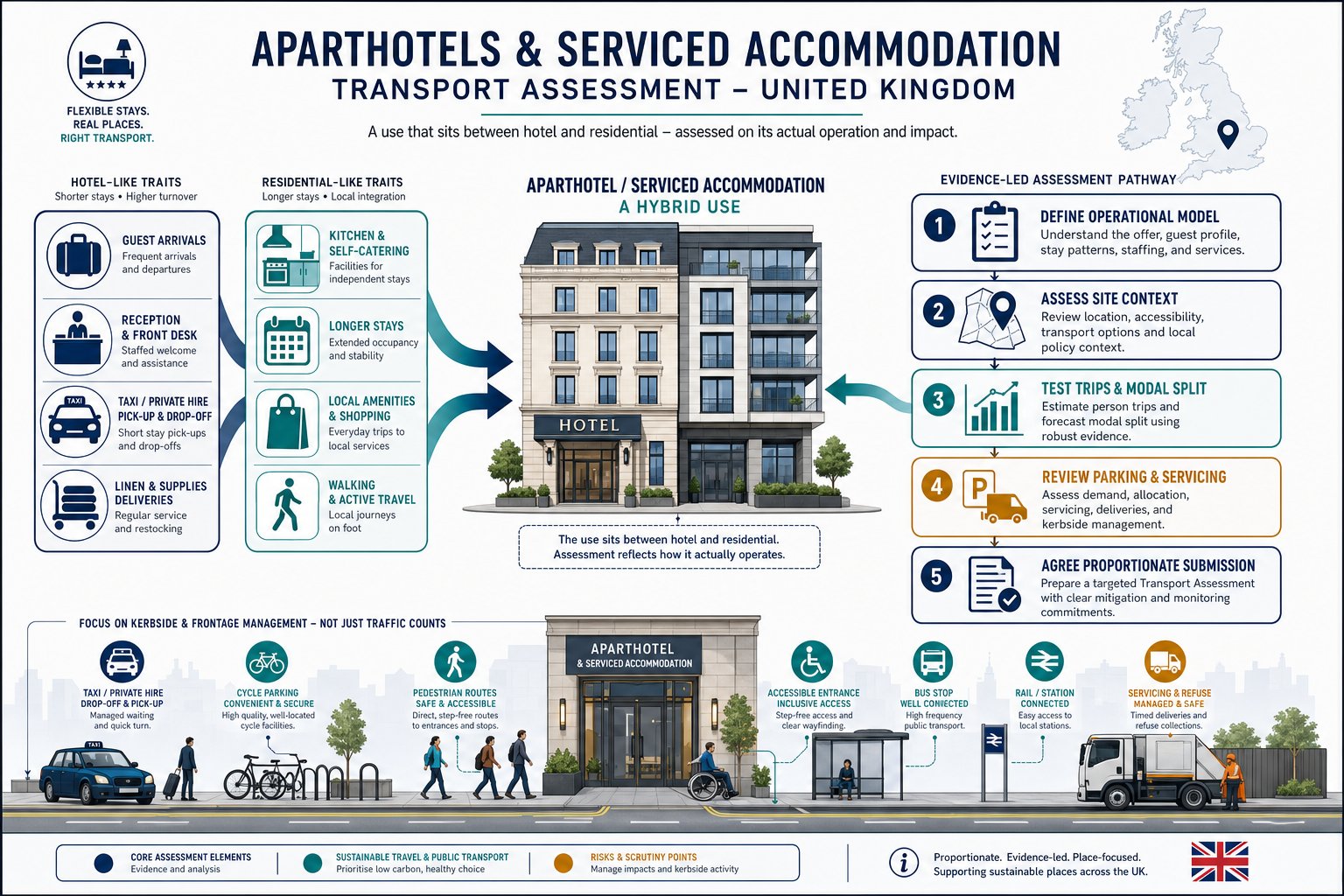
Aparthotels and serviced accommodation sit in an awkward planning space. They’re not quite hotels, not quite flats, and not something a local highway authority will usually accept on shorthand assumptions. That matters, because transport evidence built on the wrong land-use definition can unravel an otherwise well-prepared application.
In practice, we see the same issue again and again: teams reach for standard hotel trip rates or default residential parking logic, only to find that the actual operation of the scheme tells a different story. Length of stay is different. Guest behaviour is different. Servicing patterns, taxi activity, arrivals, departures and even cycle demand can all move away from what a pure C1 or C3 benchmark would suggest.
For architects, planners, lawyers, surveyors, developers and councils, the implication is straightforward. An Aparthotels and Serviced Accommodation Transport Assessment needs to be framed around how the development will really function day to day, not how it is labelled on a cover sheet.
In 2026, that means sharper definitions, earlier agreement with officers, and transport reporting that reflects site context as well as operational reality. Below, we set out what planning teams need to get right, where objections usually arise, and how to build a transport case that is proportionate, credible and much harder to challenge.
Key Takeaways
- Aparthotels and serviced accommodation require a distinct transport assessment approach reflecting their hybrid operational model, which differs from standard hotels or residential properties.
- Accurate transport assessments must consider real day-to-day functioning, including guest behaviour, length of stay, staffing, servicing, and kerbside management, rather than relying on generic land-use categories.
- Early engagement with local planning authorities and clear, evidence-based definitions of the development help prevent objections related to transport impacts and enable proportionate, credible reporting.
- Trip generation and modal split analyses should be supported by bespoke surveys or operator data to accurately capture transport patterns between hotel-like and residential behaviours.
- Transport evidence must address all users—pedestrians, cyclists, taxis—and include detailed parking, servicing, access, and safety considerations to meet evolving validation standards.
- A well-prepared Transport Assessment reduces delays by demonstrating operational realities, avoiding generic assumptions, and managing parking and servicing with practical, enforceable strategies.
Why Aparthotels And Serviced Accommodation Need A Distinct Transport Assessment Approach
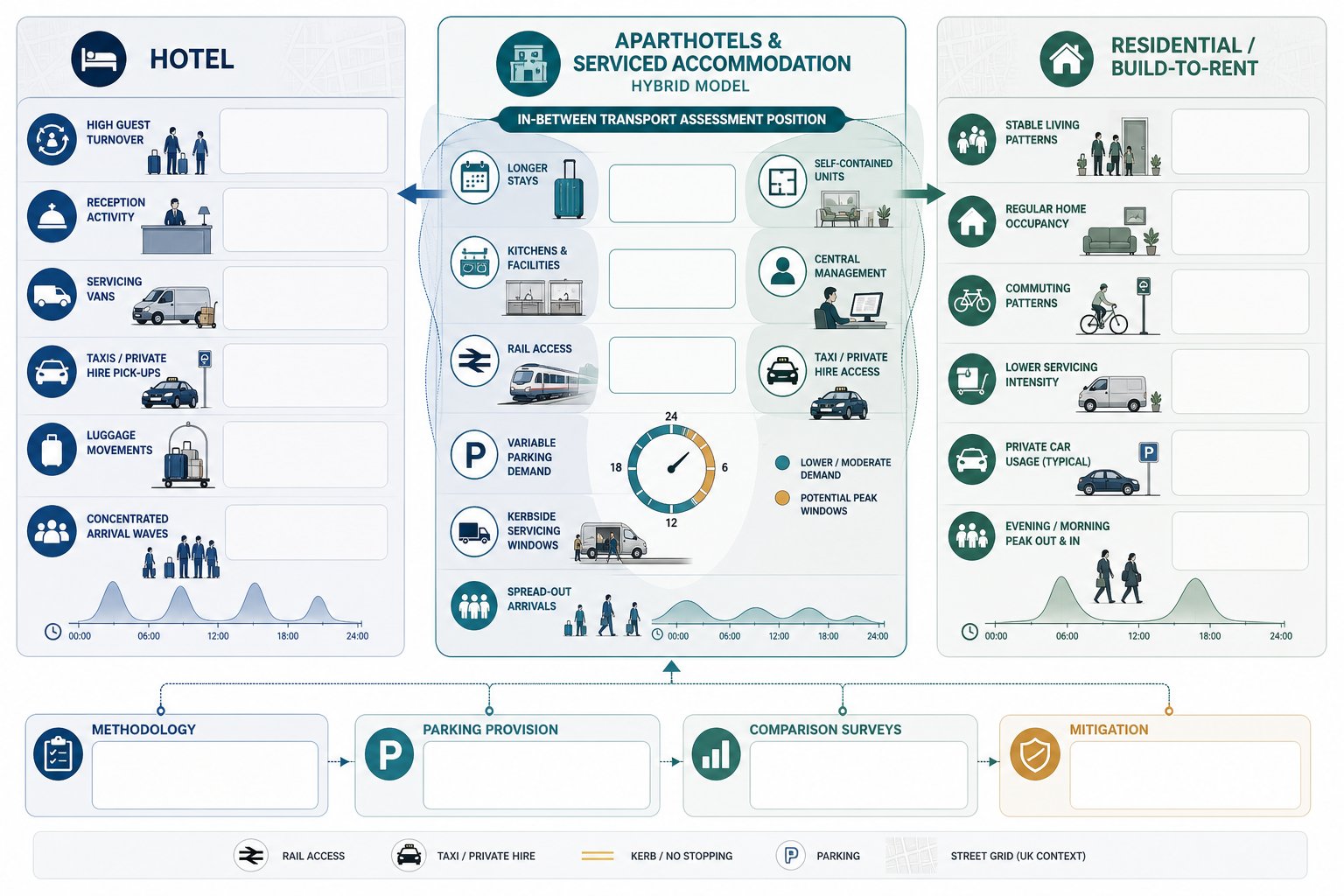
Aparthotels and serviced accommodation deserve their own transport lens because they blend two operational models. On one hand, they can behave like hotels: frequent guest turnover, concierge or reception activity, linen deliveries, taxi pick-up and drop-off, and short-stay travel patterns. On the other, they often include kitchens, more floor area, longer stays and a more self-contained style of occupation that can suppress some of the daily movement typically associated with hotels.
That hybrid nature changes the assessment. Parking demand may be lower than suburban residential but not necessarily as low as a central business hotel. Peak activity may not align neatly with commuter AM and PM peaks. Guest arrivals can be spread across the day, while servicing may still be concentrated into sensitive kerbside windows. If there is a gym, café, co-working lounge or meeting space, the transport profile becomes more layered again.
For planning teams, the risk of treating the use too simplistically is obvious: the wrong comparison sites, the wrong trip rates and the wrong conclusions. A well-structured report should explain why the use is distinct, how it will operate, and which transport assumptions logically follow from that operating model. The stronger that explanation is, the easier it becomes to justify methodology, parking provision and mitigation.
How These Uses Differ From Hotels, Build To Rent, And Conventional Residential Schemes
Hotels usually generate high turnover and pronounced check-in and check-out effects. They can also create stronger staff and servicing demand, especially where food, beverage and conference uses are present. Build to Rent and conventional residential schemes are different again, tending to show more stable occupation, more regular commuting patterns and less intensive reception or housekeeping activity.
Serviced apartments often sit in between. Guests may stay for several weeks or months, particularly on corporate placements, relocations or longer leisure visits. That usually means fewer turnover trips than a hotel and a less volatile daily profile. But they still don’t behave like standard flats, because occupation is temporary, management is centralised, and guest travel choices are shaped by booking conditions, luggage, unfamiliarity with the area and access to taxis or rail.
This is why a borrowed hotel model or a borrowed housing model can be misleading. In many cases, we need a blended position, supported by comparable surveys and a clear statement of what the scheme is actually intended to be.
When A Transport Assessment, Transport Statement, Or Technical Note Is Typically Required
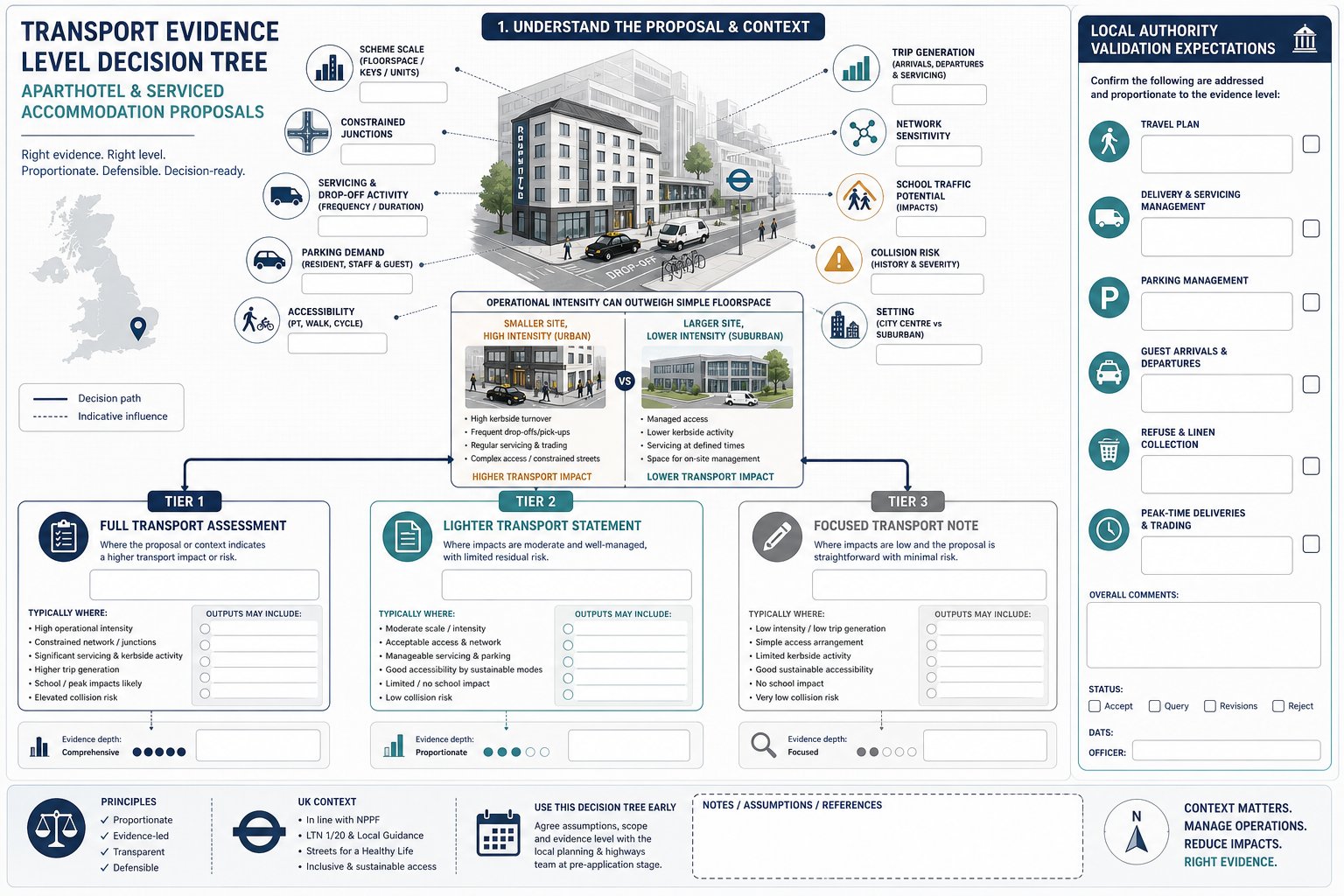
Whether a scheme needs a full Transport Assessment, a lighter-touch Transport Statement, or a focused Technical Note depends on scale, context and likely impact. There is no universal aparthotel rule that works everywhere. Local planning authorities usually apply their own validation standards, often informed by Department for Transport guidance and local policy expectations.
In broad terms, a full TA is more likely where a proposal is large, near a constrained junction, introduces meaningful servicing or drop-off demand, or sits in a location where even modest traffic changes could affect safety or network operation. A TS may be acceptable for smaller schemes with limited impact and good accessibility. A Technical Note can sometimes deal with a single issue, such as parking, trip generation or servicing, where the overall transport implications are clearly minor.
The problem is that planning teams often judge the likely requirement by floorspace alone. That is rarely enough for aparthotels and serviced accommodation. A modest city-centre scheme with no on-site parking and heavy kerbside reliance may invite more scrutiny than a larger but straightforward site with managed access. Operational intensity matters.
A proportionate scoping discussion early on can save weeks. It can also prevent the common scenario where an application is validated, only for the highway authority to request extra evidence later because the initial submission underplayed the transport effects. That’s one reason many teams frame the exercise within a wider transport assessment for developments: approach rather than treating the use class label as the whole story.
Local Authority Thresholds, Site Context, And Validation Expectations
LPAs generally look at a mix of indicators: gross internal area, number of units or rooms, expected trip generation, parking demand, accessibility and network sensitivity. Published local validation checklists often spell out when a TA, TS, Travel Plan, Delivery and Servicing Plan, or parking management details are required.
But thresholds are only half the picture. Site context can push a proposal upward in evidence terms. A central site near a railway station may support lower car mode share assumptions, yet it may still need detailed analysis of taxi activity, loading, walking routes and cycle parking. Equally, a suburban location may appear straightforward until officer review highlights school traffic, constrained visibility, or collision history nearby.
Validation expectations are becoming more operationally specific too. Authorities increasingly want to know how guest arrivals will be managed, whether there is a booking restriction for car use, how refuse and linen are collected, and what happens when delivery vehicles arrive at peak times. In short: the document type matters, but the credibility of the supporting narrative matters just as much.
Defining The Development Properly For Planning And Trip Generation Purposes
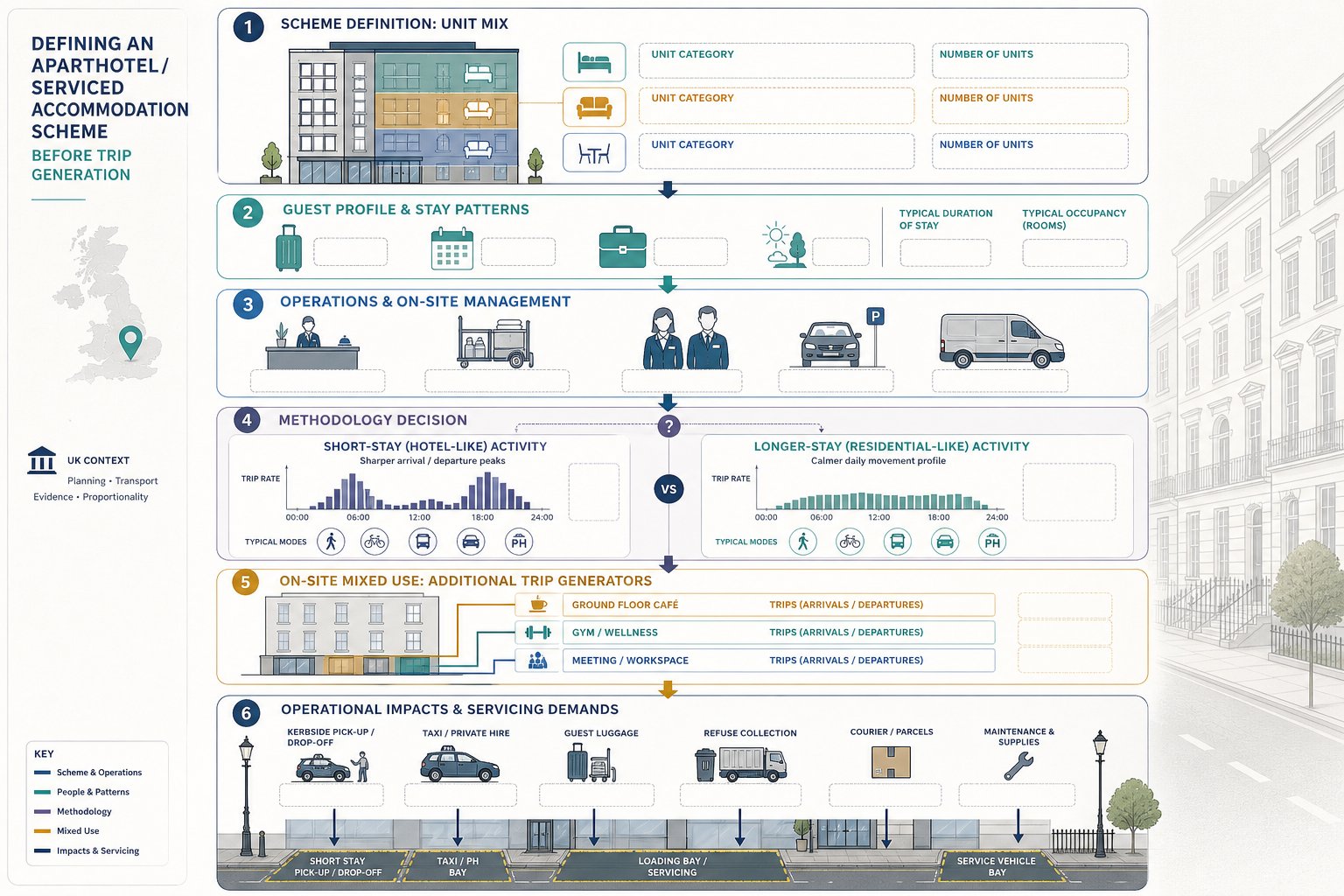
Before we estimate a single trip, we need to define the development properly. That sounds obvious, yet this is where many transport submissions become vulnerable. If the planning description, Design and Access narrative, management strategy and transport report are not aligned, objections tend to follow.
A robust definition should cover the number and type of units, likely guest profile, average and maximum stay patterns, staffing model, reception arrangements, housekeeping frequency, on-site amenities, parking offer and servicing arrangements. It should also explain whether the scheme is intended to operate closer to an aparthotel, a serviced apartment model, or a mixed offer that varies by season and booking channel.
That definition then drives methodology. If most guests are short-stay leisure visitors, hotel comparables may carry more weight. If the scheme targets medium-stay corporate occupiers with weekly housekeeping and in-unit cooking, the daily movement profile may be calmer and more residential in feel, though still not truly C3. The assessment has to reflect that nuance.
This is also the point at which we should test whether associated uses need to be separated out. A ground-floor café, meeting space or gym accessible to non-guests can materially affect person trips and servicing. Ignoring those components because they sit inside the same building envelope is a classic drafting mistake.
Occupation Patterns, Length Of Stay, Staffing, Servicing, And Guest Behaviour
Length of stay is one of the biggest variables. Hotels are often dominated by one- or two-night stays: serviced accommodation may average weeks, sometimes longer. That lowers turnover intensity and can reduce the daily churn of arrivals and departures. It can also flatten the sharp check-in/check-out peaks often associated with hotels.
Guest behaviour changes too. People staying longer often shop locally, cook in-unit, walk more for everyday needs and use public transport differently from overnight visitors. They may generate fewer discretionary evening trips than tourists in a city-centre hotel, though that depends on location and market positioning.
Staffing and servicing can cut the other way. Even where housekeeping is less frequent than in a hotel, we still need to account for linen, consumables, refuse, maintenance and courier activity. Reception staffing may be lighter, but concierge-style operations, security presence or outsourced cleaning can create distinct trip patterns.
And then there is luggage, which sounds minor until it starts driving kerbside design. Guests with suitcases often prefer taxis or private hire even in highly accessible areas. If the site has no loading pocket, that demand can spill into the public highway very quickly. Good transport evidence does not gloss over these operational details: it builds around them.
Core Transport Evidence Required To Support An Application
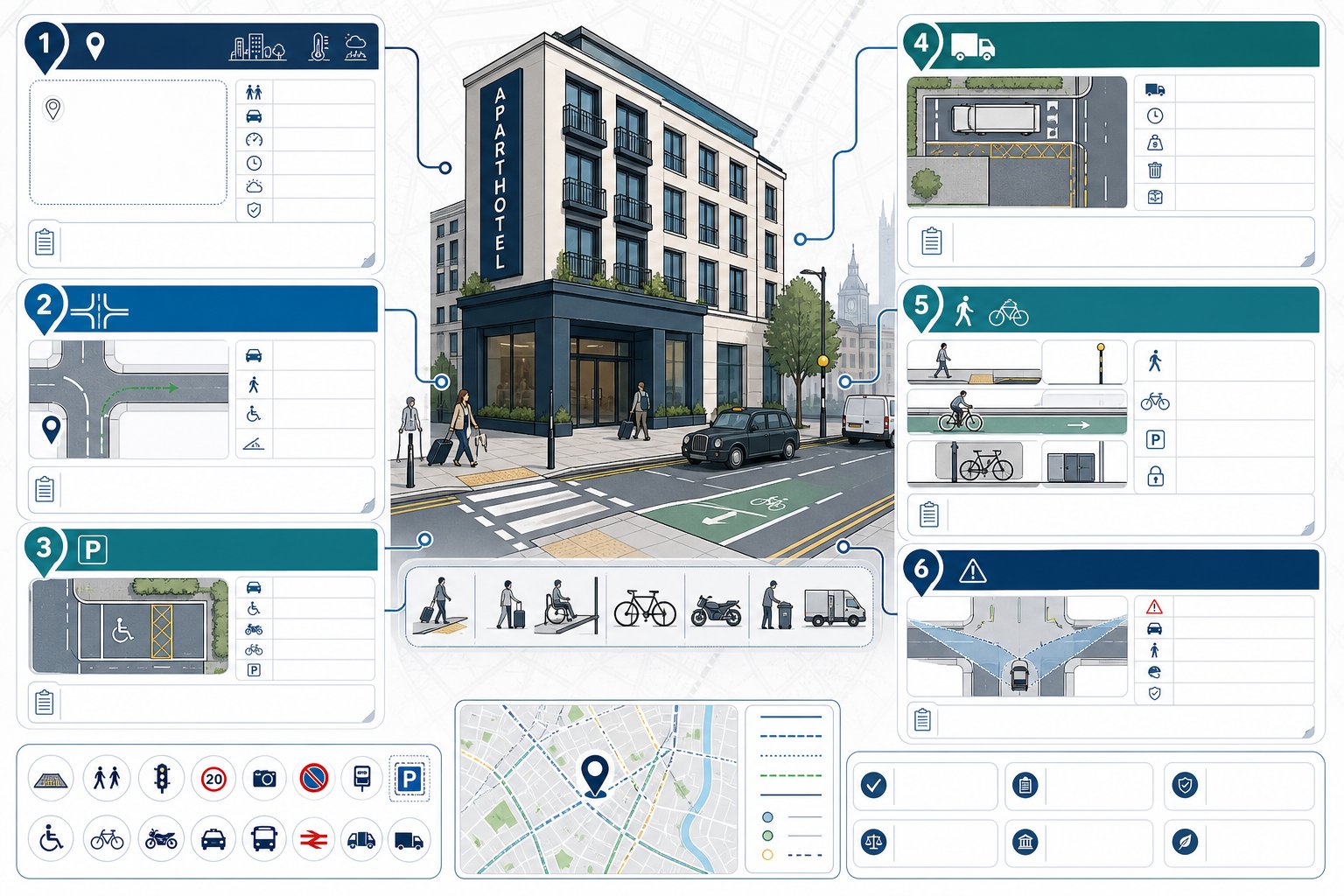
A credible application usually needs more than a short statement saying the site is in a sustainable location. Highway officers expect evidence that deals with baseline conditions, access, movement, parking, servicing and safety in a way that is specific to the proposal.
The baseline should describe the surrounding road network, junction operation where relevant, walking and cycling links, public transport accessibility, existing parking controls and recent collision history. For urban sites, kerbside conditions can be just as important as traffic flow data. A proposal may add little to junction demand but still create real pressure at the frontage because of taxis, deliveries and guest drop-offs.
The report should also set out access arrangements in practical terms. Can vehicles enter and exit safely? Is there adequate visibility? Are pedestrian routes legible, direct and step free? Can service vehicles turn within the site or is reverse manoeuvring proposed? Those questions sound technical because they are, but they also influence planning confidence. If the operational picture looks unresolved, policy support on sustainable location alone rarely carries the day.
Where broader development effects are possible, the work may need to interface with an environmental impact assessment transport: scope, particularly on larger mixed-use or cumulative urban schemes.
Access, Parking, Servicing, Active Travel, Public Transport, And Highway Safety
Access design should cover all user groups, not just cars. That means pedestrian desire lines, dropped kerbs, crossing opportunities, cycle access and whether people arriving with luggage can move from street to reception without conflict. Step-free access is especially important for inclusive design and for disabled guests.
Parking evidence should distinguish between guest, staff, accessible, motorcycle and cycle provision. If parking is limited or nil, the report should explain why overspill will not occur and how booking, permit controls or guest information will support compliance. Authorities are often more persuaded by management detail than by generic statements about sustainability.
Servicing deserves its own careful treatment. Deliveries, refuse collection, laundry, maintenance vans and taxi activity can all affect local highway operation. A swept path drawing may be necessary, but so is a realistic account of frequency, timing and management.
Active travel and public transport analysis should move beyond map screenshots. We should explain walking catchments, cycle infrastructure quality, station access, bus frequency and practical journey opportunities for likely users. Finally, a highway safety review should identify whether the proposal could worsen known risks. If there is a collision cluster nearby, ignoring it is not a strategy: addressing it is.
Trip Generation And Modal Split For Aparthotel And Serviced Accommodation Schemes
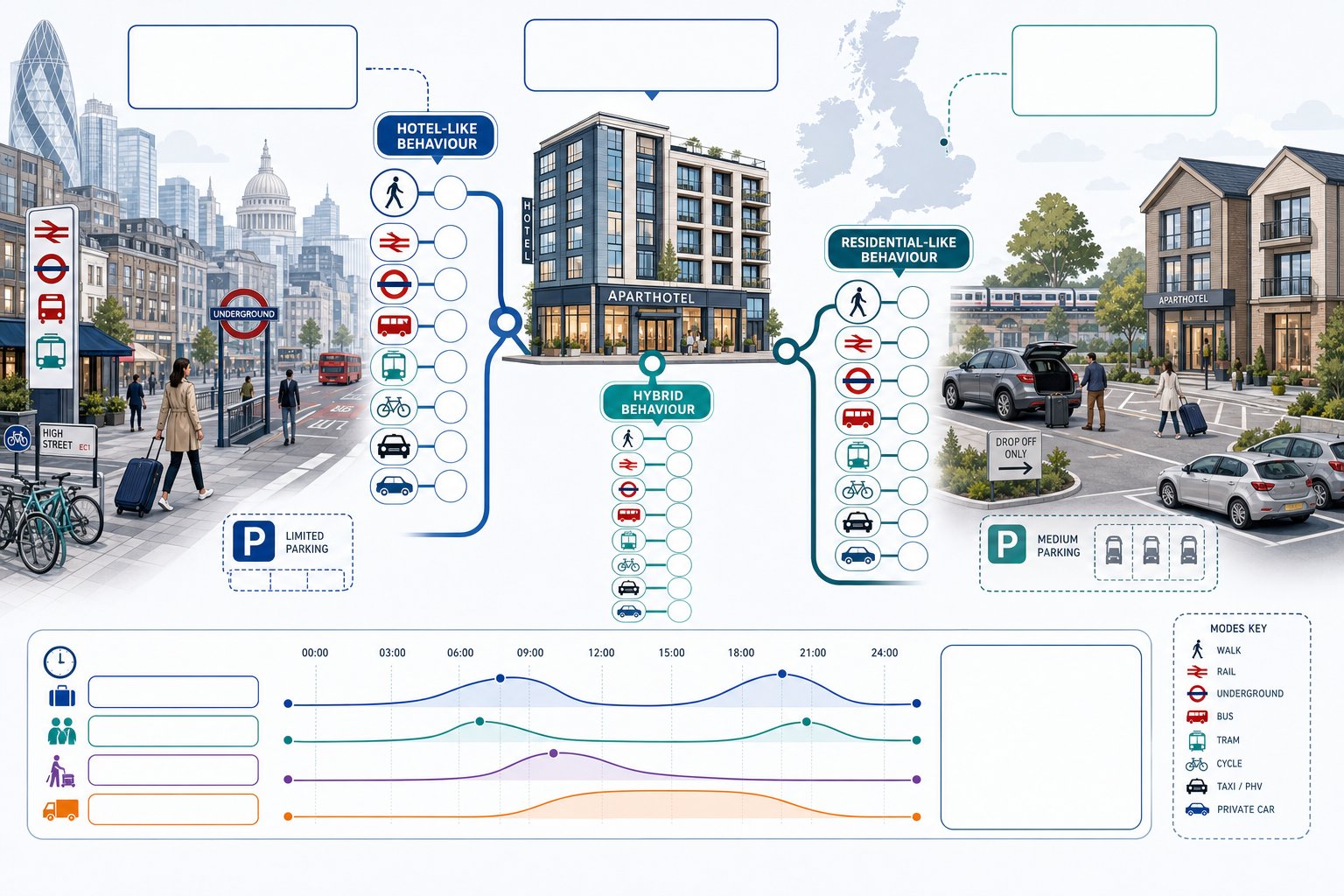
Trip generation is usually where scrutiny sharpens. For aparthotels and serviced accommodation, standard databases do not always provide a perfect match, so methodology matters as much as the numbers themselves.
The first question is whether the proposal behaves more like a hotel, more like a residential product, or somewhere between the two. In many cases, the honest answer is “between”. That is why bespoke evidence can be so valuable. Comparable site surveys, operator data and sensitivity testing often produce a stronger case than forcing the scheme into a category that everyone knows is imperfect.
Person trips should be considered alongside vehicle trips. A city-centre aparthotel may generate substantial movement, but much of it could be on foot, by rail, bus, Underground, tram, cycle or taxi rather than private car. In those cases, the main transport issue may be frontage management, not highway capacity. Conversely, a suburban serviced apartment scheme may attract more car use, especially for medium-stay guests who arrive with luggage and maintain access to a vehicle.
We should also resist one-size-fits-all peak assumptions. Hotel arrivals often cluster around afternoon and evening periods: medium-stay serviced accommodation may show flatter daily patterns. Staff shift changes, housekeeping rounds and servicing windows can be more relevant than classic commuter peaks.
Where the proposal sits beside housing-led development, cross-checking against Residential Development Transport evidence can be useful, not because the uses are the same, but because it helps show where the behavioural differences begin and end.
A good modal split case is grounded in context: PTAL or equivalent accessibility, parking restraint, nearby rail connections, cycle storage quality, local walkability and the likely guest market. Without that, low-car assumptions can read like wishful thinking.
Common Assessment Challenges In Urban Centres, Mixed Use Sites, And Car Free Locations
Urban sites rarely fail because the principle of sustainable travel is weak. They tend to run into trouble because the day-to-day choreography of movement has not been thought through. Aparthotels and serviced accommodation intensify that problem because they produce a messy mix of guests, taxis, couriers, refuse, staff and occasional visitors, all wanting the kerb at slightly different times.
On mixed-use sites, attribution becomes another challenge. If the building includes retail, leisure, co-working or food and drink elements, who generates what trip? Double counting and undercounting are both common. The cleaner approach is to define each use clearly, test linked trips where appropriate and explain how shared access and servicing will be managed.
Car-free and car-lite schemes create a different evidential burden. They can be entirely appropriate in accessible centres, but they need more than policy citations. Officers usually want comfort that guests will know parking is unavailable, that blue badge provision has been addressed, that private hire activity will not block the frontage and that nearby controlled parking zones will not absorb displaced demand.
Land-use ambiguity adds one more layer. Some authorities treat aparthotels as close to C1: others lean toward a residential interpretation or sui generis analysis. That affects parking standards, trip-rate selection and policy framing. The practical answer is not to argue labels in the abstract. It is to demonstrate operational reality with enough clarity that the chosen transport approach feels logical, evidence-led and difficult to dismiss.
Frequent Planning Risks And How To Avoid Delays Or Objections
The most common planning risk is underestimating the operation behind the accommodation. A neat TA can still attract objections if the scheme appears to have no credible answer on drop-off, deliveries, refuse or guest arrivals with luggage. Highway officers are used to spotting these gaps quickly.
Another frequent problem is weak trip-rate selection. Using pure hotel or pure residential comparables without explaining why they fit invites challenge, particularly where the accommodation offer is hybrid. If the concept is unusual, bespoke surveys or operator evidence are often the safer route. Even a simple sensitivity test can show that the conclusions remain robust if actual performance sits at the top end of the assessed range.
Parking is an equally common fault line. Reduced provision can be justified, especially in urban locations, but only if management is real rather than aspirational. Booking-stage information, permit restrictions, staff travel expectations, disabled parking strategy and taxi arrangements all need to be coherent. A zero-parking proposal with vague wording is practically an objection letter waiting to happen.
The best way to avoid delay is early agreement. Pre-application discussion with highway officers, clear scoping, realistic survey evidence and a transparent management plan make a huge difference. In our experience, concise reporting grounded in local validation requirements tends to outperform long documents padded with generic theory. That is especially true on aparthotel and serviced accommodation schemes, where the planning question is rarely “is transport relevant?” and more often “have you actually understood how this place will work?”
Conclusion
Aparthotels and serviced accommodation sit between established planning categories, so their transport evidence has to do more than follow a template. It needs to explain the use honestly, define the operational model clearly and connect that model to credible assumptions on trips, parking, servicing, active travel and public transport.
For planning teams in 2026, the strongest submissions are usually the ones that avoid false certainty. They acknowledge where the scheme behaves like a hotel, where it behaves more like residential accommodation, and where a bespoke position is justified by evidence. That is what gives officers confidence.
In practical terms, a successful Aparthotels and Serviced Accommodation Transport Assessment is proportionate, locally informed and operationally detailed. If we get those basics right early, we reduce objections, shorten validation debates and give the wider application a much better chance of moving forward without unnecessary friction.
Frequently Asked Questions about Aparthotels and Serviced Accommodation Transport Assessments
Why do aparthotels and serviced accommodation require a distinct transport assessment approach?
Aparthotels and serviced accommodation combine characteristics of hotels and residential units, resulting in unique trip generation, parking demand, and servicing patterns. This hybrid nature means standard hotel or residential trip rates often misrepresent their true transport impact.
How should planning teams define an aparthotel or serviced accommodation development for transport assessment purposes?
They should clarify unit types, length of stay patterns, staffing models, on-site amenities, parking provision, and servicing arrangements. This detailed definition guides the choice of appropriate trip rates and supports a credible, operationally grounded transport assessment.
When is a full Transport Assessment needed versus a Transport Statement or Technical Note for these schemes?
A full Transport Assessment is usually necessary for larger aparthotels near constrained junctions or with significant servicing demands. Smaller or low-impact developments with good accessibility might only require a Transport Statement or focused Technical Note, depending on local planning authority thresholds.
How do trip generation and modal split typically differ between aparthotels and conventional hotels or residential developments?
Aparthotels often show lower guest turnover than hotels, leading to flatter trip patterns and lower car mode share, especially in urban centres. Their modal split includes substantial public transport, walking, cycling and taxi use, unlike higher car dependency in suburban residential schemes.
What common planning risks should be avoided to ensure smooth approval of transport assessments for these uses?
Risks include underestimating servicing and drop-off demand, using inappropriate hotel or residential trip rates without justification, weak parking management plans, and unclear definitions of stay length or guest behaviour. Early engagement with highway officers and bespoke survey evidence mitigate these risks.
How does the presence of non-residential facilities (like gyms or cafes) within aparthotel developments affect transport assessments?
Such facilities generate additional person trips and servicing requirements, complicating trip attribution. Assessments must separate these uses clearly, account for linked trips, and explain shared access to avoid undercounting or double counting travel impacts on the local transport network.