
Planning in Hillingdon rarely turns on architecture alone. A scheme can look well considered on paper and still run into trouble if access is awkward, parking is undercooked, servicing conflicts with the street, or the transport evidence is too thin for officers and consultees to rely on. In a borough shaped by major roads, public transport constraints in some locations, sensitive town centre conditions, and the added complexity of Transport for London interfaces, traffic input often becomes one of the practical factors that decides whether an application moves smoothly or stalls.
That is where a traffic engineer in Hillingdon adds real value. We do more than produce a report at the end of the design process. We test assumptions early, pressure-check layouts, assess likely highway impacts, and help project teams align proposals with borough and London-wide policy expectations. For architects, planners, lawyers, surveyors, developers, and local authorities, that means fewer surprises later on.
In this guide, we set out what a traffic engineer in Hillingdon typically does, which transport documents are commonly needed, when technical input is likely to be necessary, and how early advice can strengthen both design quality and planning prospects in 2026.
Key Takeaways
- A traffic engineer in Hillingdon plays a critical role by assessing access, parking, traffic impact, and aligning proposals with local and London-wide transport policies early in the planning process.
- Local transport knowledge is essential in Hillingdon to create credible evidence that reflects the borough’s unique road conditions, public transport accessibility, and peak activity pressures.
- Transport documents such as Transport Assessments, Statements, Travel Plans, Delivery and Servicing Plans, and Construction Logistics Plans must be proportionate and site-specific to avoid delays and objections in planning applications.
- Early traffic engineering advice benefits a wide range of developments including residential, commercial, schools, and healthcare by identifying design changes that improve safety, functionality, and policy compliance.
- Collaboration between traffic engineers, architects, planners, surveyors, and legal teams ensures transport considerations are integrated effectively, reducing planning risks and enabling smoother approval processes.
- Choosing an experienced traffic engineer familiar with Hillingdon and London policies can streamline planning by providing targeted, relevant transport advice and adapting quickly to project timelines.
What A Traffic Engineer In Hillingdon Does For Planning And Development
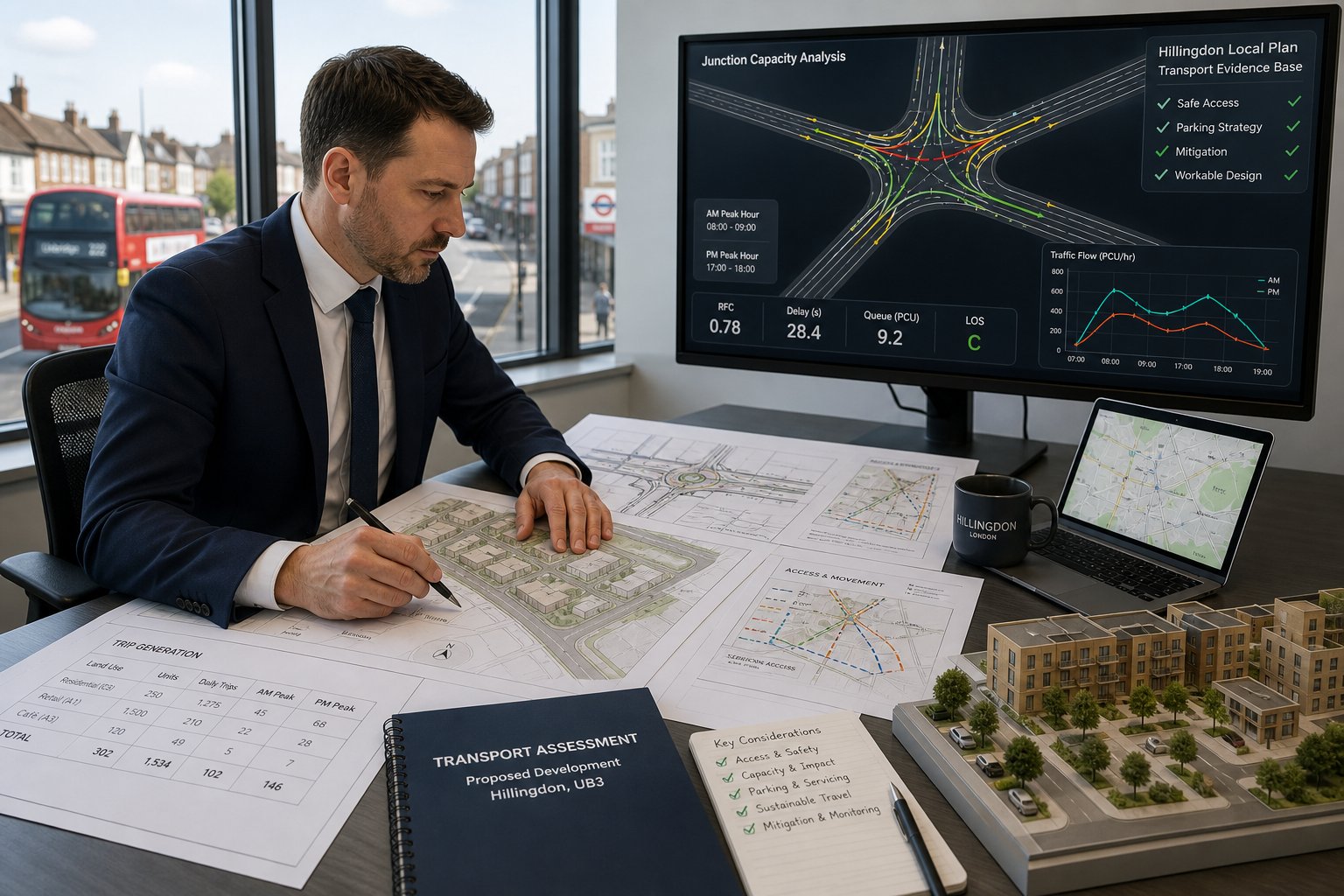
A traffic engineer in Hillingdon supports development from the point where a site is still being tested through to application, determination, and sometimes discharge of conditions. In practical terms, we assess how a proposal interacts with the surrounding highway network, whether the access works safely, how much traffic it is likely to generate, what parking demand may arise, and whether any mitigation is needed to make the scheme acceptable.
That can involve traffic counts, parking beat surveys, trip generation analysis, junction capacity modelling, swept path assessments, collision review, servicing strategy, and travel planning. But the technical work only matters if it answers planning questions clearly. Officers, highway teams, and TfL do not want pages of numbers for their own sake: they want evidence showing that the development can function safely and reasonably in its context.
We also help shape schemes before positions harden. A relocated access, a better refuse strategy, fewer but better-laid-out spaces, or a more realistic cycle offer can remove objections that would otherwise become expensive to fix later. For broader context across the capital, our overview of a Traffic Engineer In London: shows how local authority expectations vary even within Greater London.
The core value is not just analysis. It is translating transport risk into workable design and planning decisions.
Why Hillingdon Projects Require A Local Transport And Highways Perspective
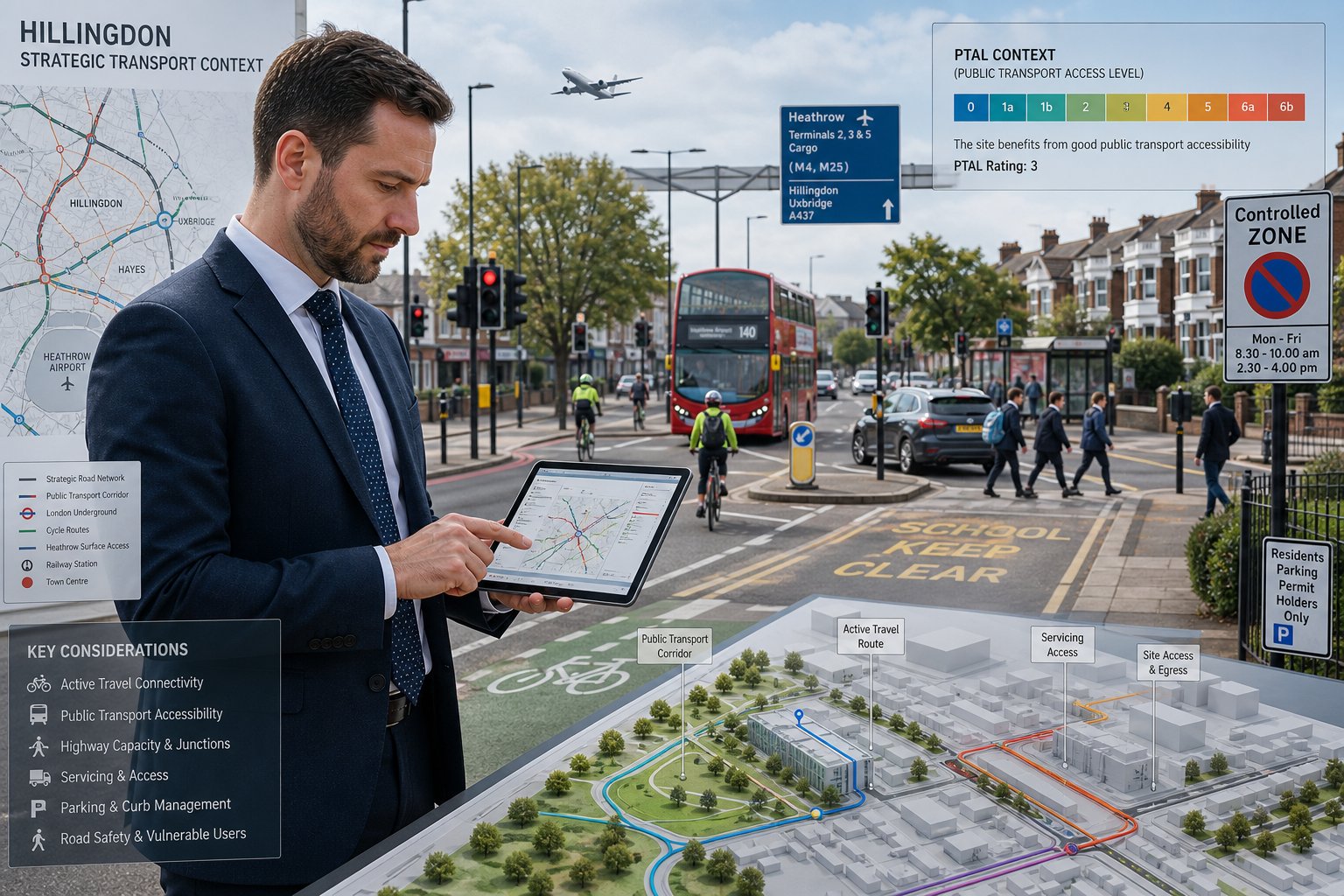
Hillingdon has its own planning character, and transport evidence needs to reflect that. The borough includes strategic road corridors, suburban residential streets, Heathrow-related movement pressures, industrial areas, town centres, schools with concentrated peak activity, and locations where public transport accessibility is strong in one pocket and far weaker a short distance away. A generic report prepared without local understanding usually shows its weaknesses very quickly.
A local transport and highways perspective matters because the acceptability of a scheme is rarely judged in the abstract. It is judged against the London Plan, the Hillingdon Local Plan, parking standards, PTAL context, active travel expectations, servicing realities, road safety concerns, and the operational position of the local highway authority or TfL where relevant. In some cases, the same quantum of development may be acceptable on one site and problematic on another simply because the street conditions are different.
We hence look beyond policy wording and examine the lived network: bus movements, school-run pressure, controlled parking zones, nearby junction stress, footway conditions, and delivery patterns. Teams comparing options often benefit from the wider planning lens used by Highway Engineering Consultants, particularly where the transport case needs to align tightly with design and consent strategy.
In Hillingdon, local knowledge does not replace technical evidence. It makes that evidence credible.
Key Planning Documents Commonly Needed For Hillingdon Applications

The transport documents needed for a Hillingdon application depend on scale, use, access conditions, and likely impact. Some smaller developments may only need a concise supporting note. Others will require a fuller suite of reports because the planning issues are broader than vehicle trip generation alone.
Most commonly, the discussion centres on a Transport Assessment or Transport Statement, sometimes supported by a Travel Plan, Delivery and Servicing Plan, and Construction Logistics Plan. These are familiar documents nationally, but they still need to be proportionate and site-specific. A weak submission often fails because it uses a standard template that does not properly address the application’s real transport risks.
We normally advise teams to decide the reporting strategy as early as possible. That avoids duplicated survey work and helps coordinate the planning statement, design package, and transport narrative. Where a scheme has several moving parts, a wider understanding of how Traffic Engineering Consultants: support planning success can be useful in framing the right level of evidence from the outset.
The aim is simple: produce only what is needed, but make sure what is submitted is robust enough to withstand scrutiny.
Transport Assessments And Transport Statements
A Transport Assessment, or TA, is generally used for larger or more transport-sensitive proposals. It provides a detailed examination of trip generation, distribution, modal split, parking effects, highway safety, servicing, and junction performance. If mitigation is needed, the TA should identify it and explain why the package is proportionate.
A Transport Statement, or TS, is lighter-touch and usually suited to smaller developments where impacts are more limited. That does not mean it can be vague. A good TS still needs a clear site appraisal, realistic trip assumptions, parking review, access analysis, and policy response.
The choice between TA and TS matters. Too little information can trigger delays or validation issues: too much irrelevant material can obscure the key points. We usually advise project teams to discuss thresholds and scope early so the evidence is proportionate, defensible, and aligned with the application strategy.
Travel Plans, Delivery And Servicing, And Construction Logistics
Many Hillingdon schemes need more than a TA or TS. A Travel Plan may be required to show how residents, staff, visitors, or pupils will be encouraged to use sustainable modes through practical measures rather than wishful statements. If the site has constrained parking or relies on mode shift, this document becomes especially important.
A Delivery and Servicing Plan, or DSP, explains how goods, refuse, maintenance, and operational vehicles will reach and use the site. This is often critical for mixed-use, commercial, educational, and healthcare schemes where poor servicing arrangements can affect highway safety and neighbour amenity.
A Construction Logistics Plan, or CLP, deals with temporary but very real risks during build-out: routing, timing, contractor parking, vulnerable road user safety, and construction vehicle management. On tighter urban sites, a weak CLP can cause as much concern as the permanent access design. The broader relationship between transport reports and Highway And Traffic Engineering often becomes most visible in these supporting documents.
When A Development In Hillingdon Is Likely To Need Traffic Input
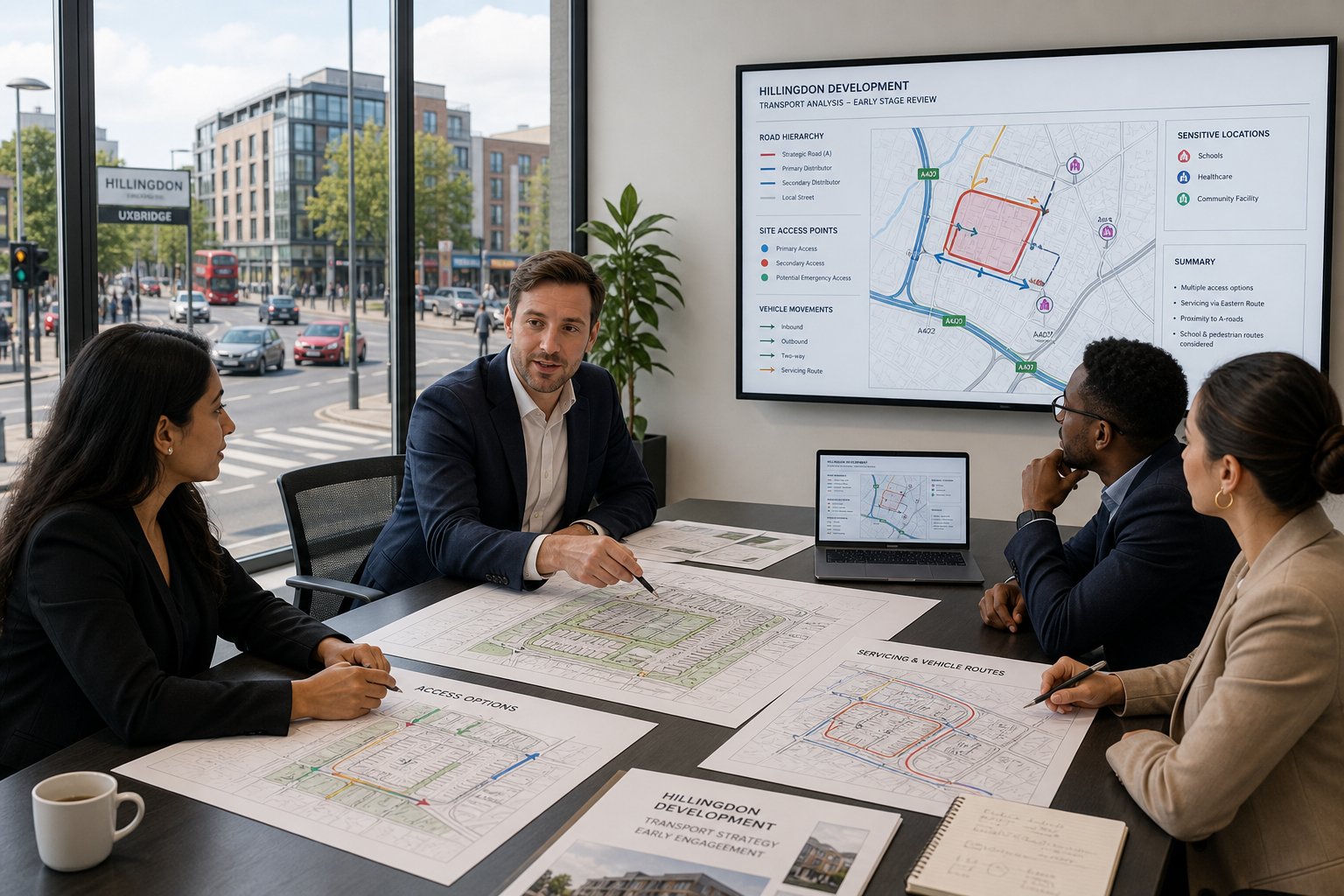
Not every application in Hillingdon needs a full transport package, but many need at least some level of traffic input earlier than clients first expect. As a rule, the need grows with scale, intensity, sensitivity of location, and complexity of access or servicing.
Traffic input is often required for major residential schemes, mixed-use proposals, offices, retail, industrial and logistics sites, hotels, schools, healthcare uses, and community developments with concentrated peaks. But smaller schemes can also trigger transport questions if they sit on an A-road, rely on substandard visibility, propose reduced parking, remove on-street capacity, intensify servicing, or are close to schools or other sensitive receptors.
Change-of-use applications are a common example. On paper they may seem straightforward, yet the transport profile can change quite sharply between uses. Likewise, basement parking alterations, new access points, and car-free or low-car proposals usually need technical justification.
We often tell clients that traffic advice is most useful when there is still something to influence. Once the layout is fixed and the planning statement drafted, transport evidence becomes reactive. Earlier involvement allows the team to test whether the scheme is likely to be acceptable before time and cost are sunk into the wrong design direction.
Typical Schemes That Benefit From Early Traffic Engineering Advice

Early traffic engineering advice is most valuable on projects where transport issues are not obvious from the red line boundary alone. A site may appear generous until vehicle tracking shows conflict. Parking may look adequate until local demand, disabled provision, cycle storage access, and servicing are all considered together. And sometimes the issue is not volume but timing: a development that adds modest weekday traffic can still create concern if arrivals cluster around school peaks or nearby junction congestion.
In those situations, early advice helps the wider consultant team design with transport in mind rather than bolt it on later. It is usually faster, cheaper, and less painful to adjust a site plan in concept design than after officer comments arrive.
Residential, Mixed-Use, And Commercial Development
Residential schemes are among the most common instructions for a traffic engineer in Hillingdon, especially where density is increasing on constrained suburban plots. Questions typically include whether access width is adequate, whether refuse and emergency vehicles can operate safely, whether parking is policy-compliant and realistic, and whether local streets can absorb overspill risk.
Mixed-use schemes add another layer because trip patterns, servicing needs, and parking demand vary by use and by time of day. A ground-floor retail unit under flats may seem simple: in practice, deliveries, short-stay parking, and pedestrian interaction can become the determining issues.
Commercial development brings its own pressures. Offices may focus on mode share and parking restraint, while industrial and warehousing schemes often turn on HGV routing, yard operation, and servicing intensity. On these projects, experience in Commercial Traffic Engineering can be especially relevant where planning success depends on getting operational detail right as well as strategic transport policy.
Schools, Healthcare, Leisure, And Community Sites
Schools and nurseries are classic examples of uses where a moderate amount of floor space can create significant local concern. The school-run effect is less about average daily traffic and more about concentrated pick-up and drop-off activity, informal stopping, crossing behaviour, and interaction with nearby residents. A credible assessment needs to understand that lived reality, not just present spreadsheet outputs.
Healthcare uses can be similarly nuanced. A GP hub, clinic, or diagnostic centre may generate short-stay visits, blue badge demand, taxis, patient transport, staff shift changes, and servicing patterns that differ from standard office assumptions.
Leisure and community sites also benefit from early advice because activity can be highly peaky and sometimes seasonal. Gyms, places of worship, sports facilities, and community halls may have calm weekday periods and then sudden surges at evenings or weekends. In these cases, the transport strategy often needs to combine parking review, access design, event management, and travel planning in one coherent approach.
How Traffic Engineers Assess Access, Parking, And Highway Impact
Our assessment usually starts with evidence gathering. That means understanding the site, the surrounding street network, policy context, and existing travel conditions before we jump to conclusions. Depending on the proposal, we may undertake traffic counts, queue observations, parking beat surveys, servicing observations, collision analysis, and a review of walking, cycling, and public transport connections.
Access assessment then looks at geometry, visibility, junction form, gradient, pedestrian interaction, and whether the layout can safely accommodate expected vehicles. For many schemes, vehicle tracking is central. Refuse wagons, fire appliances, delivery vans, and in some cases articulated vehicles all need to enter, manoeuvre, and leave without awkward reversals or unrealistic assumptions. Questions of access design highway detail often become decisive surprisingly early.
Parking analysis is broader than simply counting spaces. We consider borough standards, land use, likely car ownership, disabled parking, electric vehicle provision, cycle parking quality, operational parking, and the practical risk of overspill. On constrained sites, layout efficiency can be the difference between a supportable scheme and an objection.
For highway impact, we estimate trip generation, assign traffic to the network, and where necessary test junction operation. We also review road safety and identify mitigation such as lining changes, access amendments, crossing improvements, or servicing controls. Wider principles from Traffic Engineering and Transportation are useful here, because impact is never just about vehicles: it is about how the place functions overall.
Working With Architects, Planners, Surveyors, And Legal Teams
Transport work is rarely effective in isolation. The strongest planning submissions usually come from iterative collaboration between architects, planning consultants, surveyors, legal teams, and transport advisers who are willing to challenge each other early. We may identify that an access needs widening by half a metre, but that change affects landscape, frontage treatment, swept paths, visibility splays, and sometimes viability. Good outcomes depend on those conversations happening before positions become entrenched.
With architects, we typically refine access points, internal circulation, cycle storage access, parking layout, and servicing arrangements. With planners, we align the transport narrative to local and strategic policy, anticipated objections, and validation requirements. With surveyors and development managers, we help test whether changes needed for compliance still support the commercial intent of the scheme.
Legal input also matters more than many teams assume. Highway works, obligations, servicing controls, and Travel Plan commitments can all have drafting or negotiation implications. If a proposal is heading toward committee or appeal, transport evidence needs to be clear enough for witness statements, reasons for refusal analysis, and condition wording.
On more parking-sensitive projects, an informed parking strategy traffic approach often helps bridge the gap between design ambition and policy acceptability. In short, we are not just report writers: we are part of the planning team.
Choosing The Right Traffic Engineer In Hillingdon For A Smooth Planning Process
Choosing the right traffic engineer in Hillingdon is partly about technical competence and partly about judgement. Plenty of consultants can produce a transport report. Fewer can quickly identify what the authority is likely to focus on, scope proportionate work, and help the wider team solve transport issues before they become planning problems.
We would usually look for three things. First, relevant UK planning and highway experience, ideally backed by professional standards and a working knowledge of London policy. Second, a track record in Hillingdon or nearby West London boroughs, where practical familiarity with local road contexts, parking pressure, and TfL interfaces can make a real difference. Third, the ability to cover the full range of likely outputs, from TAs and TSs to Travel Plans, DSPs, CLPs, access reviews, parking strategy, and junction analysis.
Responsiveness matters too. Planning programmes are rarely generous, and transport advice has to keep pace with design revisions, pre-application feedback, committee deadlines, and legal drafting. Firms with long experience can often move faster because they know where the real issues usually sit. With more than 30 years of experience, our own approach is built around concise, accurate reporting tailored to local authority thresholds rather than bloated documents that bury the answer.
The smoothest planning process usually starts with a simple discipline: appoint transport support early enough that it can influence the scheme, not merely defend it.
Conclusion
In Hillingdon, transport evidence is rarely a box-ticking exercise. It sits right at the intersection of planning policy, site design, operational practicality, and local acceptability. A well-judged transport strategy can reduce objections, improve layout efficiency, support negotiations with officers and consultees, and give decision-makers confidence that a proposal will work in the real world.
For architects, planners, surveyors, lawyers, developers, and public sector teams, the key is timing. Bring a traffic engineer in Hillingdon into the process early, scope the right level of evidence, and use the findings to shape the scheme rather than simply justify it after the fact. In 2026, that is still one of the clearest ways to achieve a smoother planning route, a stronger technical case, and fewer avoidable surprises along the way.
Frequently Asked Questions About Traffic Engineering in Hillingdon
What role does a traffic engineer in Hillingdon play in planning applications?
A traffic engineer in Hillingdon assesses how developments interact with the local highway network, evaluates access safety, predicts traffic and parking demand, and prepares necessary transport reports to support planning approvals.
When is traffic input typically necessary for developments in Hillingdon?
Traffic advice is generally needed for major residential, commercial, mixed-use projects, sites near A-roads or schools, and proposals altering parking or servicing, ensuring compliance with local transport and planning policies.
What transport documents are commonly required for Hillingdon planning applications?
Applications often require a Transport Assessment or Transport Statement to analyse traffic impact, plus supporting documents like Travel Plans, Delivery and Servicing Plans, and Construction Logistics Plans tailored to site specifics.
How does local knowledge affect traffic engineering reports in Hillingdon?
Local insight ensures transport reports reflect Hillingdon’s unique road network, borough policies, PTAL ratings, and road safety concerns, making evidence credible and aligned with the expectations of local and TfL authorities.
How do traffic engineers work with other professionals during development planning?
They collaborate closely with architects, planners, surveyors, and legal teams to iteratively refine access, parking, servicing arrangements, and legal obligations, helping to align the transport strategy with the overall design and planning submission.
What should developers consider when choosing a traffic engineer in Hillingdon?
Choose an engineer with UK highway experience, a track record of successful permissions in Hillingdon or West London, and expertise producing TAs, Travel Plans, and other relevant reports to ensure a smoother planning process.