Every planning application lives or dies on its ability to prove safe, efficient access. Yet too many developments stumble at the highway authority stage, not because the scheme itself is flawed, but because the traffic control strategy hasn’t been clearly articulated or properly evidenced. Whether you’re designing a twenty‑home infill or a mixed‑use quarter, your ability to plan, manage and regulate vehicle, pedestrian and cyclist movements will determine whether the case officer recommends approval or refusal. This guide walks through what traffic control actually means in a planning context, who does what on site, and how to structure your traffic management plans to meet local authority expectations.
Key Takeaways
- Traffic control is essential for planning applications as highway authorities assess site access safety, internal circulation hazards, and whether construction and operational traffic will create unacceptable congestion on surrounding networks.
- A well-evidenced traffic control strategy backed by swept-path plots, signal timing and construction phasing gives local authority officers and members confidence to approve development without harm.
- Traffic controllers on site must set out signs, cones and barriers as specified, adapt layouts when conditions change, and monitor compliance with agreed routing, signage visibility and pedestrian access.
- Construction traffic management plans must include site-specific scaled layouts, traffic and pedestrian flow analysis, emergency procedures, and a named 24/7 contact, with monthly reports and incident logs required by most authorities.
- Temporary measures during construction follow a hierarchy of advance warning signs, transition zones, buffer zones, work zones and termination zones, with quality maintenance and professional equipment being critical to reduce driver confusion and risk.
- Permanent traffic control solutions for new developments include new or modified junctions, pedestrian crossings, cycle facilities and internal site layouts that accommodate service vehicles, with swept path analysis confirming safe turning movements for refuse trucks and fire appliances.
What Is Traffic Control and Why Does It Matter for Planning Applications?
Traffic control is the planning, management and regulation of all road users, drivers, pedestrians, cyclists, to keep movements safe, maintain capacity and ensure roads and access routes operate efficiently. In practical terms, it’s the system that assigns right‑of‑way, organises flows at junctions, and prevents conflicts that could lead to collisions or gridlock.
For planning applications, traffic control underpins three core tests every highway authority applies: whether the site can be accessed safely, whether internal circulation avoids hazards, and whether construction and operational traffic will produce unacceptable congestion or safety risks on the surrounding network. Your transport assessment and travel plan must demonstrate that each phase of development, from first excavator to final occupation, can be controlled without tipping adjacent junctions into severe queuing or creating new accident clusters.
Local authorities scrutinise how you’ll manage HGV routes during demolition, coordinate deliveries during fit‑out, and handle peak‑hour turning movements once the scheme is occupied. If your submission lacks a credible traffic control narrative, expect a holding objection from highways. Conversely, a well‑evidenced control strategy, backed by swept‑path plots, signal timing and construction phasing, gives both officers and members confidence that the development can proceed without harm.
Key Responsibilities of a Traffic Controller on Development Sites
On site, the traffic controller is the person who translates your approved management plan into day‑to‑day reality. Their role starts before the first lorry arrives and continues until the last cone is lifted.
Typical duties include setting out signs, cones, barriers and temporary lane closures exactly as specified in the plan, then directing traffic using stop/slow bats or hand signals to protect both workers and the public. When conditions shift, a burst water main closes a diversion route, or afternoon rainfall turns a haul road to mud, the controller adapts the layout, repositions barriers, and communicates changes to the site team and, if necessary, the highway authority.
Controllers also monitor compliance: are delivery drivers following the agreed routing? Is signage visible and undamaged? Are pedestrian routes still passable? Any incident, near miss, complaint, or actual collision, triggers an immediate review and often a revised risk assessment. In practice, a competent traffic controller saves schemes from enforcement action and protects the developer’s reputation, because small lapses (a missing advance warning sign, a lane closure that extends beyond permitted hours) can quickly escalate into formal complaints and stop notices. Competence, vigilance and clear communication are non‑negotiable.
Traffic Management Plans: Requirements for Local Authority Approval
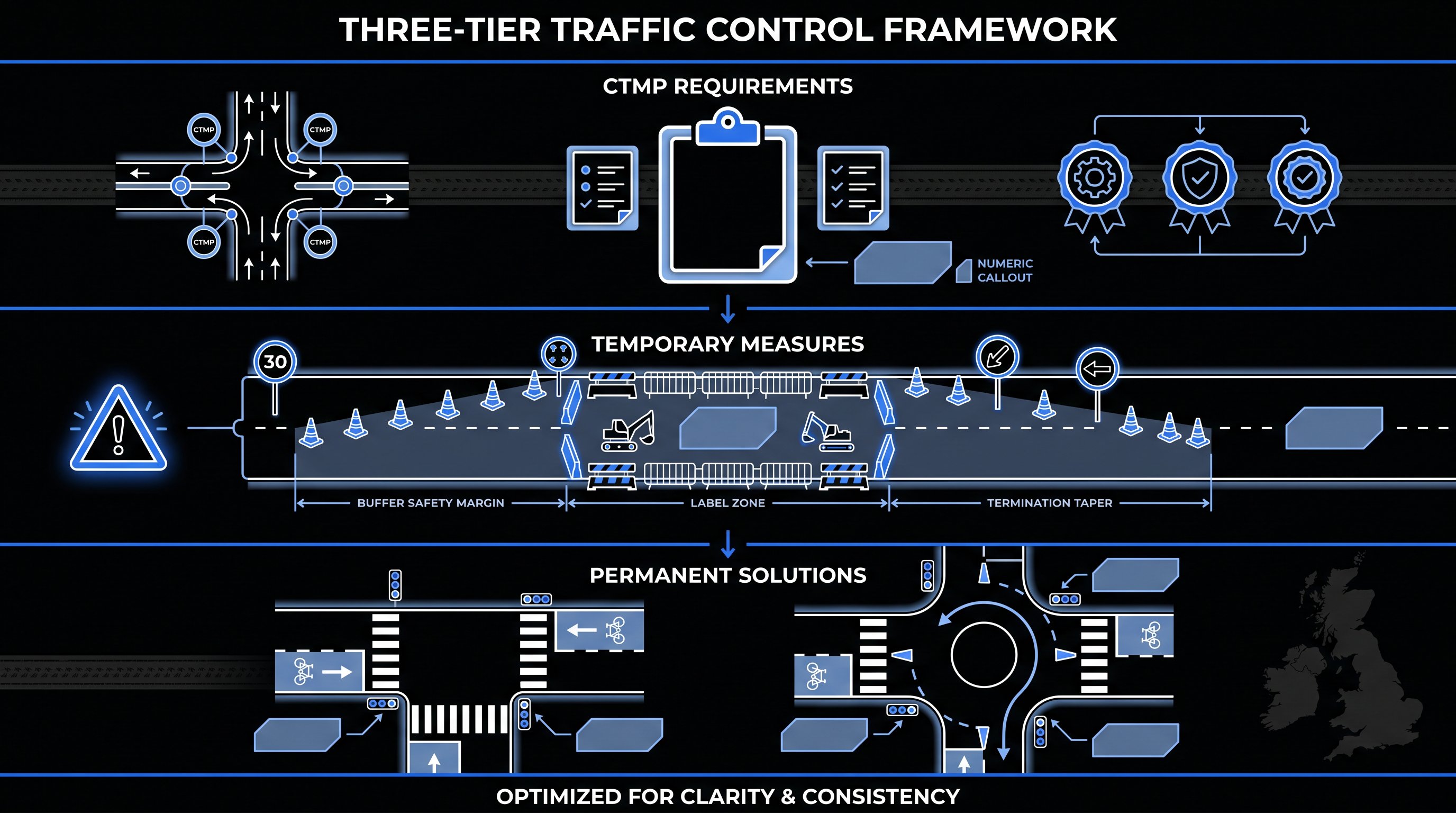
Most authorities will condition consent on submission and approval of a construction traffic management plan (CTMP) before any works begin. What do they expect to see?
First, site‑specific layouts: scaled drawings showing every diversion, lane closure, signing location and access point, tied to Ordnance Survey grid references. Second, a traffic and pedestrian flow analysis that quantifies baseline volumes, predicts construction‑phase increases, and identifies pinch‑points or vulnerable user groups, school routes, bus stops, cycle lanes. Third, compliance with recognised standards: in the UK that typically means the Traffic Signs Manual, Chapter 8 guidance, and any local authority streetworks codes.
Your plan must also cover emergency procedures (how will an ambulance pass if you’ve closed a lane?), arrangements for public transport (will bus stops need relocation?), servicing and deliveries (time windows, booking systems), and a named contact available 24/7. Authorities increasingly ask for a monitoring and review schedule, monthly reports, incident logs, and a commitment to update the plan if conditions change. It’s also worth addressing Traffic Flow Management early in the design process, so that any consultant input is embedded before submission rather than bolted on at condition‑discharge stage.
Temporary Traffic Control Measures During Construction
Temporary measures are the visible, physical interventions that protect the work zone and guide road users safely past or around it. The hierarchy is straightforward: advance warning signs alert drivers early: a transition zone tapers lanes and reduces speed: the buffer zone provides a safety margin: the work zone itself is coned or barriered: and a termination zone returns traffic to normal running.
Common elements include temporary speed limits (often 30 or 20 mph), single‑lane shuttle working controlled by temporary signals or flaggers, and protected pedestrian diversions with temporary footway and barrier fencing. Staging work outside peak periods, overnight closures for utility diversions, weekend possessions for junction remodelling, minimises disruption and is often a condition of approval. Where space is tight, consider traffic calming principles to slow approaches naturally and reduce reliance on signage alone.
Quality matters: faded signs, displaced cones and unswept mud all erode driver confidence and increase risk. Budget for regular inspections, prompt repairs and professional supply of compliant equipment.
Permanent Traffic Control Solutions for New Developments
Once construction wraps, permanent measures take over to manage the operational traffic your development generates. These might include new or modified junctions, simple priority T‑junctions for smaller schemes, signalised crossroads or compact roundabouts for larger flows, designed using junction capacity software and validated by Traffic Engineering principles.
Pedestrian crossings (zebra, signal‑controlled or refuge islands), dedicated cycle facilities, road markings and permanent signage schemes all form part of the control suite. Internal site layouts deserve equal attention: carriageway widths and geometry must accommodate service vehicles, and swept path analysis confirms that refuse trucks, fire appliances and delivery vans can turn, pass and reverse safely without mounting kerbs or blocking through routes.
Authorities often require a commuted sum or bond to cover future maintenance of new signals or street lighting. Factor these costs into your viability appraisal early, and confirm adoption agreements with the highway authority before you pour the first base course. A well‑designed parking strategy also plays a role: overspill parking on adjacent streets undermines even the best junction design, so provision, management and enforcement need to be coherent from day one.
Common Traffic Control Challenges in Transport Assessments
Even experienced teams encounter recurring headaches. Limited space in dense urban areas makes it hard to carve out safe temporary layouts without closing entire streets or requiring night working, both of which inflate cost and programme risk. Peak‑hour congestion and event‑related surges, match days, festivals, term‑time school runs, compress your margin for error: a junction that just copes at 08:45 can fail catastrophically when your construction traffic coincides with a local event.
Ensuring adequate, visible signage sounds simple but requires co‑ordination across utilities, neighbours and the highway authority, especially when multiple schemes overlap. Trained, certified personnel are in finite supply: if your programme assumes six flaggers for a four‑week road closure, book them well in advance.
Finally, demonstrating that residual impacts remain acceptable is as much about narrative as numbers. Raw queue‑length or RFC figures can alarm non‑technical readers: contextualise them with before‑and‑after comparisons, explain why a forecast increase of fifteen vehicles in the peak hour is well within junction capacity, and show how your proposed mitigation measures address any hotspots. A transport assessment that anticipates officer questions and provides clear, proportionate answers will always outperform one that buries the reader in raw PICADY outputs.
Conclusion
Effective traffic control, expressed through robust management plans, appropriate temporary measures and well‑designed permanent infrastructure, is central to securing planning permission, protecting safety and maintaining efficient movement on and around development sites. Get it right, and highways officers become allies rather than obstacles: get it wrong, and even the best architectural vision can stall at committee.
Frequently Asked Questions
What is traffic control in the context of planning applications?
Traffic control is the planning, management and regulation of vehicle, pedestrian and cyclist movements to ensure safety, maintain capacity and keep roads operating efficiently. For planning applications, it underpins whether a site can be accessed safely, internal circulation avoids hazards, and construction or operational traffic won’t cause unacceptable congestion or safety risks on the surrounding network.
What are the main responsibilities of a traffic controller on a development site?
A traffic controller implements approved management plans by setting out signs, cones and barriers, then directing traffic using stop/slow bats or hand signals. They monitor compliance with agreed routings, adapt layouts when conditions change (e.g., road flooding), and report incidents or near misses to the site team and highway authority immediately.
What must a construction traffic management plan include for local authority approval?
A CTMP must contain site-specific scaled layouts with signing and access points, analysis of baseline and construction-phase traffic volumes, compliance with Traffic Signs Manual Chapter 8 guidance, emergency procedures, public transport arrangements, servicing schedules, and a named 24/7 contact. Monthly monitoring reports and incident logs are increasingly required too.
How should temporary traffic control measures be structured during construction?
Temporary measures follow a hierarchy: advance warning signs alert drivers early, a transition zone tapers lanes and reduces speed, a buffer zone provides safety margins, the work zone is coned or barriered, and a termination zone returns traffic to normal. Common elements include temporary speed limits (20–30 mph), single-lane shuttle working, and protected pedestrian diversions with temporary fencing.
What permanent traffic control solutions are needed after construction completes?
Permanent measures manage operational traffic through new or modified junctions, signalised crossings, roundabouts, pedestrian crossings, cycle facilities and road markings. Internal site layouts must be designed so refuse trucks, fire appliances and delivery vans can turn and reverse safely. A coherent parking strategy prevents overspill parking that undermines junction design.
Why is demonstrating residual network impacts so challenging in transport assessments?
Raw queue-length or RFC figures often alarm non-technical readers. Success requires contextualising forecast increases with before-and-after comparisons, explaining why additional peak-hour traffic remains within junction capacity, and showing how mitigation measures address hotspots. A narrative-led assessment that anticipates officer questions outperforms data-heavy submissions lacking clarity.