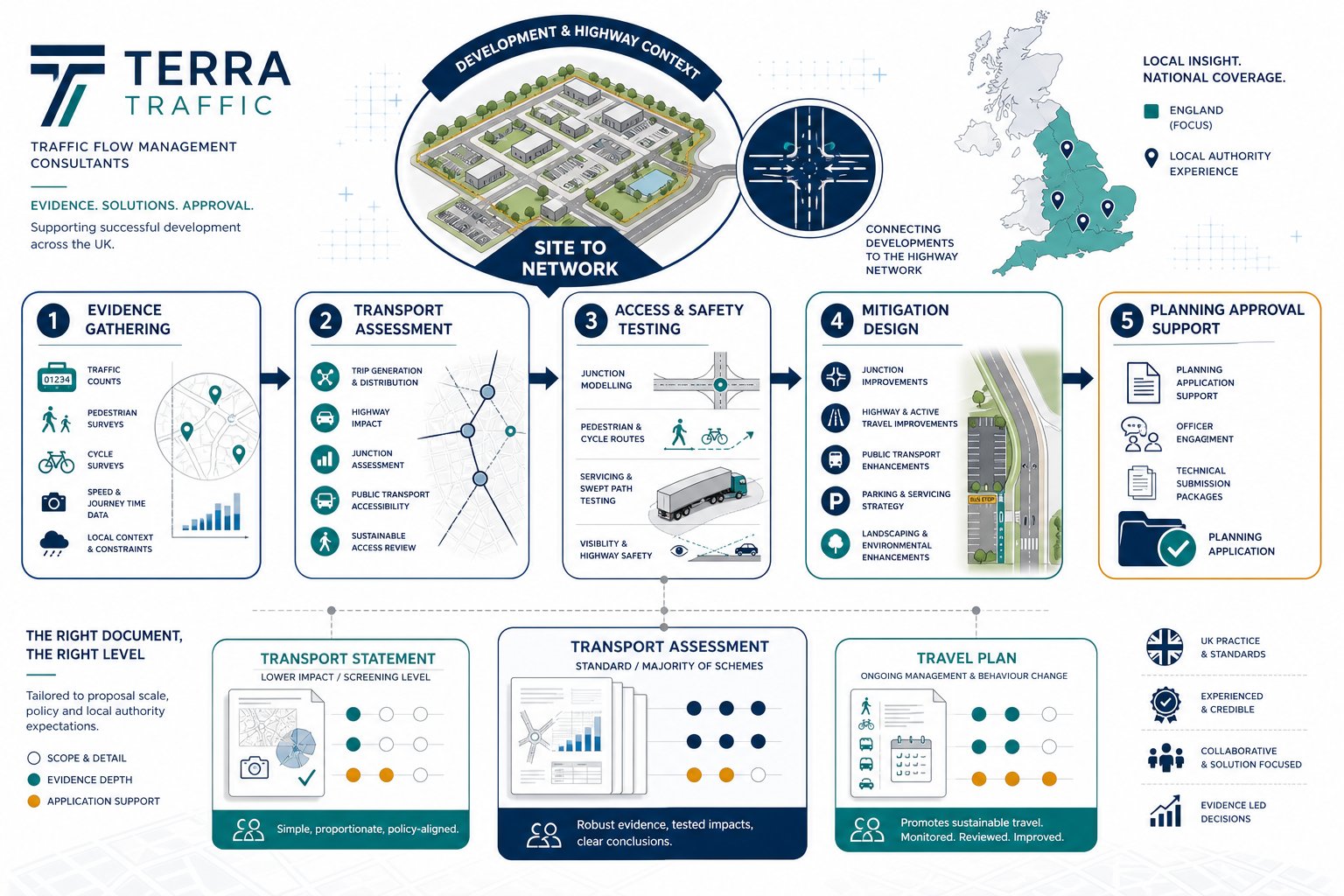
A planning application can look perfectly sensible on paper and still stall the moment transport questions start landing. Will the junction cope? Is the access safe? Can service vehicles turn without conflict? Will pedestrians, cyclists and buses be properly considered? Those are the points that often decide whether a scheme moves forward smoothly or gets dragged into rounds of objection, redesign and delay.
That’s where traffic flow management consultants come in. We use transport evidence to test how a development will function in the real world, not just on a site plan. For architects, developers, planning consultants, solicitors, surveyors and local authorities, that input is rarely a box-ticking exercise. Done well, it shapes layout, supports planning strategy, answers highway authority concerns and reduces risk early.
In 2026, expectations are sharper than ever. Planning and highway authorities want clear methodology, locally relevant analysis and mitigation that is practical, proportionate and policy-led. They also expect transport reports to speak plainly. A weak note full of assumptions won’t carry much weight.
In this guide, we explain what traffic flow management consultants actually do, when projects need transport input, which reports are usually required, and how the right consultant helps turn transport from a planning problem into a planning solution.
What Traffic Flow Management Consultants Do
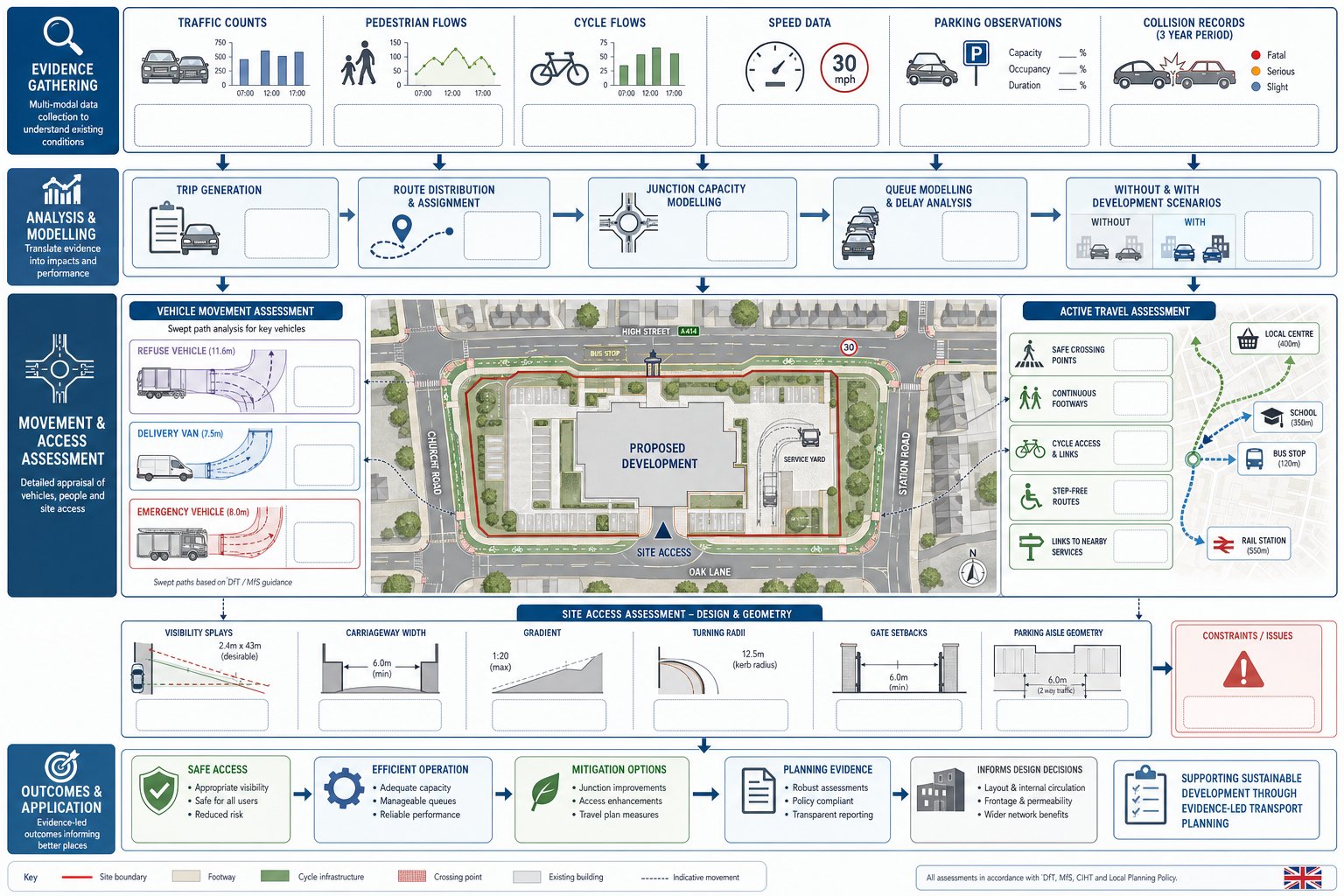
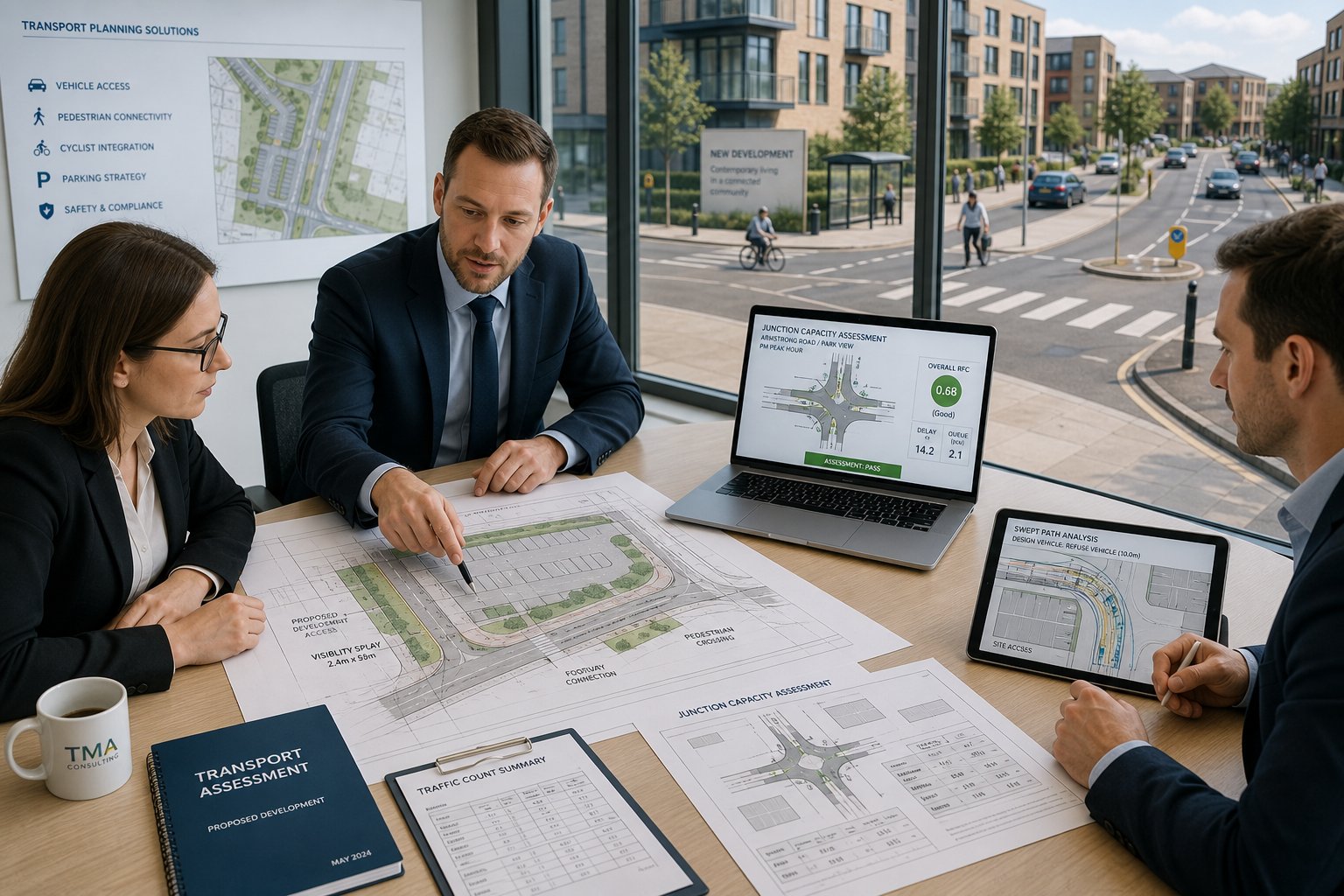
Traffic flow management consultants are specialist transport planners who assess how people and vehicles move around a site and through the surrounding network. Our job is to show whether a proposal can be accessed safely and operate efficiently, and if not, what needs to change.
That usually means far more than counting cars. We review existing highway conditions, trip generation, junction performance, parking demand, walking and cycling links, public transport accessibility, servicing arrangements and the practical design of access points. For planning applications, we turn that technical analysis into evidence that planning officers and highway authorities can use.
Early input matters. On many schemes, transport problems are not really report problems: they are design problems discovered too late. A development might have enough floorspace and the right land use, but the access geometry is too tight, visibility is compromised, or the internal layout forces awkward servicing movements. Bringing in transport advice at concept stage often prevents expensive redesign after submission.
In practice, we also work across disciplines. Transport advice feeds into site layout, viability, drainage interfaces, frontage design, townscape decisions and planning strategy. That’s why the role often overlaps with wider Traffic Engineering and Transportation input, especially where movement, access and highway design are tightly linked.
How They Assess Vehicle, Pedestrian, And Site Access Impacts
The assessment process typically starts with evidence. We gather traffic counts, pedestrian and cycle movement data, speed information, parking observations and collision records where relevant. We then examine how the site currently works and how the proposed development is likely to change conditions.
For vehicles, that may include trip generation forecasts, distribution and assignment, queue analysis and junction capacity modelling. We test scenarios such as with-development versus without-development, peak-hour operation and the effect of mitigation. If the scheme includes larger vehicles, we often use swept-path analysis to confirm that refuse lorries, delivery vehicles and emergency appliances can enter, turn and leave safely.
Pedestrian and cycle assessment is just as important. Authorities increasingly expect clear evidence on crossing opportunities, footway continuity, cycle access, step-free routes and connections to local services. A scheme can be acceptable in traffic terms but still draw criticism if active travel access is poor.
Site access work focuses on the details that often decide an application: visibility splays, carriageway width, gradients, radii, gate set-backs, parking aisle dimensions and interaction with nearby junctions. On more sensitive sites, we may also review safety, accessibility and placemaking against local policy and guidance. The aim is simple: prove that movement around the site will be workable, safe and proportionate to the development proposed.
When A Project Needs Traffic Flow Management Input
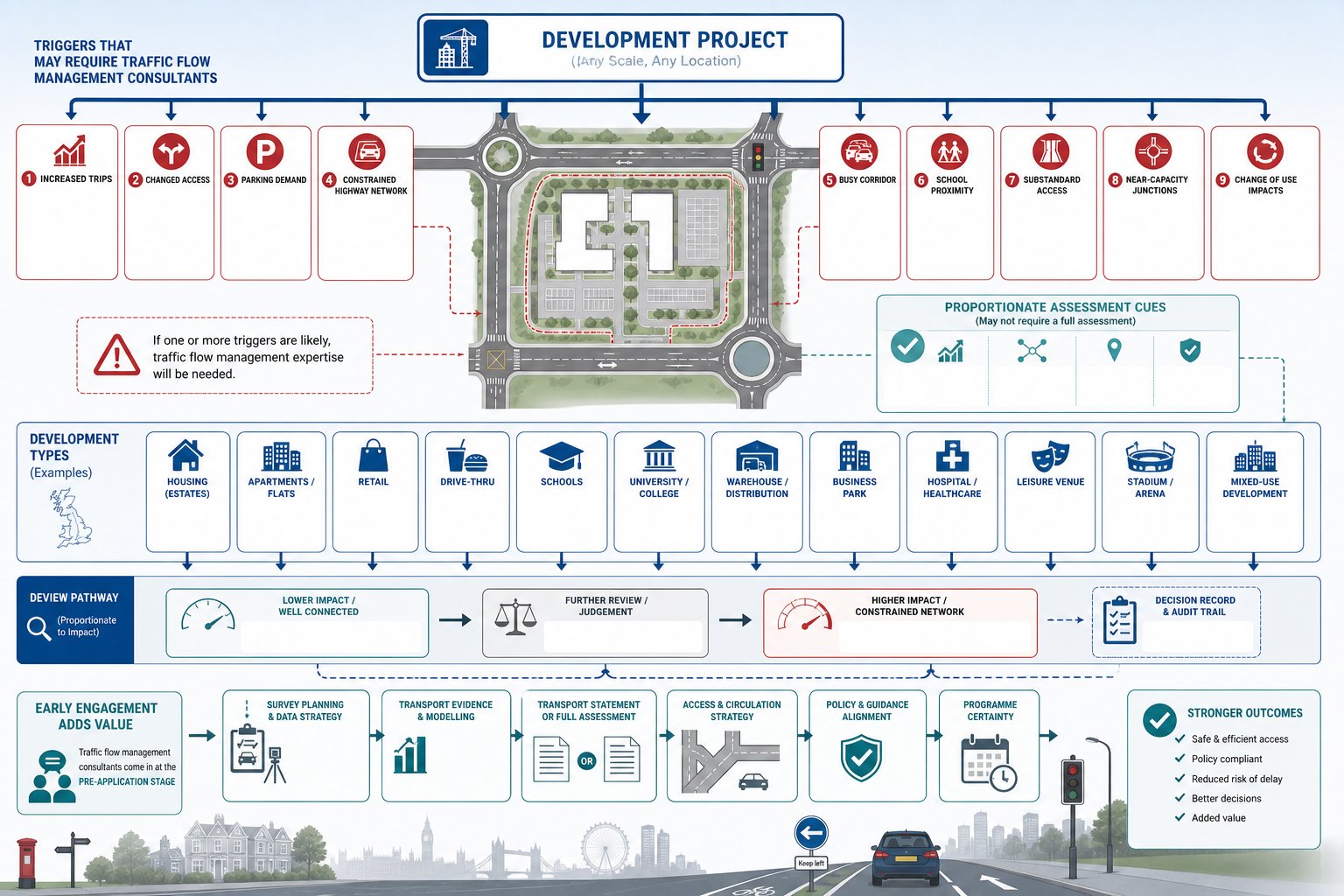
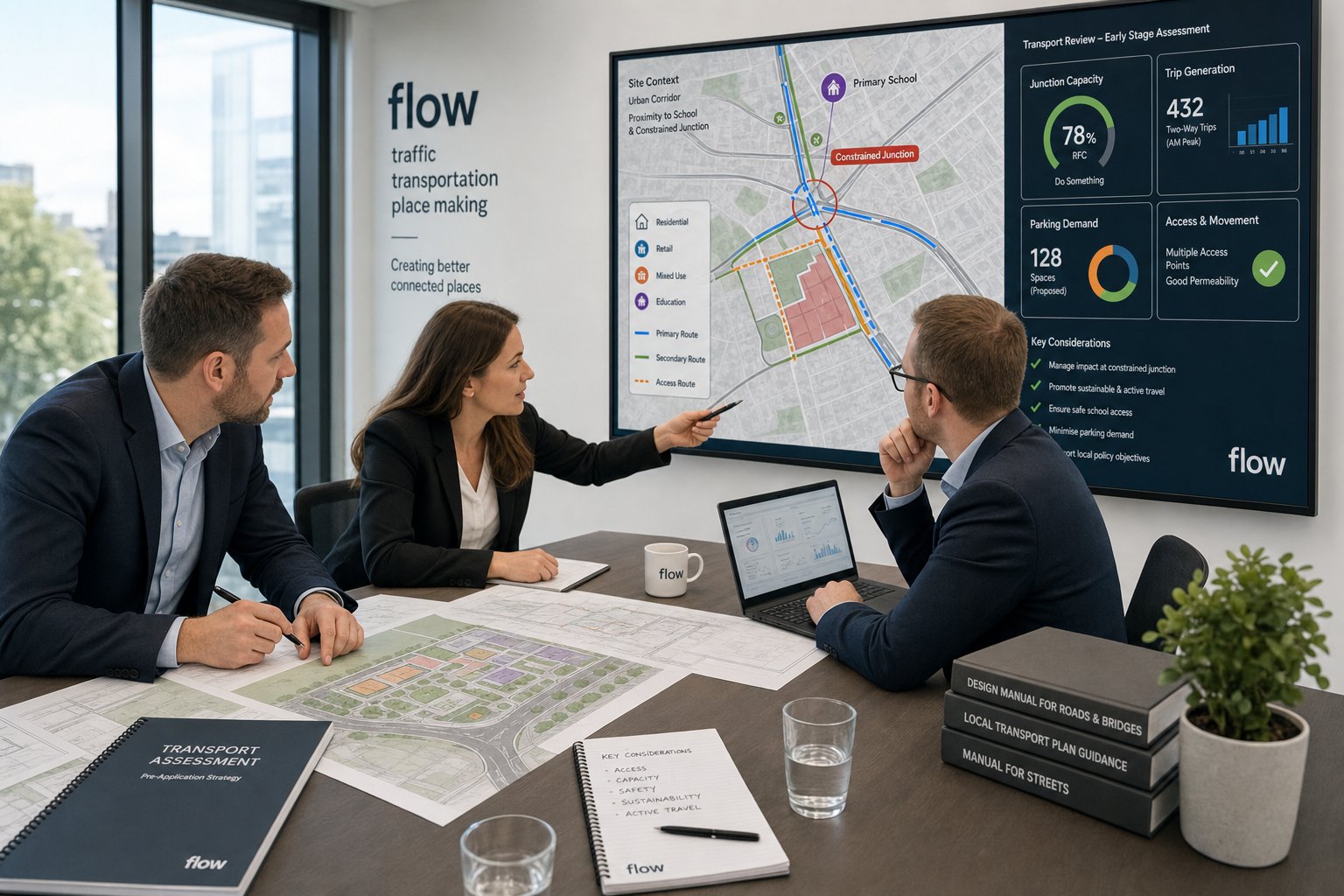
Not every proposal needs a lengthy transport report. But any development that materially changes trips, alters access, affects parking demand or interacts with a constrained part of the highway network should usually have traffic flow management input. The key question is not just size. It is transport effect.
A relatively modest scheme can trigger scrutiny if it sits on a busy corridor, uses a substandard access, sits near a school, or relies on a junction already operating close to capacity. Equally, a larger development in a well-connected location may only need proportionate evidence if its impacts are limited and well managed.
Pre-application is often the right point to bring consultants in. We can scope likely requirements, advise whether a Transport Statement or full assessment is more appropriate, identify survey needs and help the project team avoid committing to an awkward access strategy too early. That can be especially valuable where local thresholds are nuanced rather than absolute.
For development teams trying to keep planning on programme, early transport advice reduces uncertainty. It also helps align the planning narrative with policy, access design and likely consultee concerns. That broader role is one reason many clients pair traffic input with Transport Planning Consultants: advice when schemes move from feasibility into formal application work.
Typical Developments That Trigger Transport Review
The most common triggers are residential, retail, employment, education, healthcare, leisure and mixed-use schemes. Housing estates, apartment blocks and student accommodation often need review because of trip generation, parking demand, access geometry and pedestrian connectivity. Retail parks, supermarkets and drive-thrus are closely examined because peaks can be sharp and junction effects can spread beyond the site frontage.
Schools, colleges and universities frequently require detailed thought because arrivals and departures are concentrated, kerbside management matters, and walking, cycling and coach arrangements are often contentious. Warehouses, business parks and industrial developments raise servicing, HGV routing and junction capacity issues. Hospitals, event venues and stadium-related development can be even more sensitive due to surges in demand and operational complexity.
Change-of-use schemes also get overlooked. A building may remain physically similar while generating a very different movement pattern. A former office becoming a gym, medical use or food-led destination can alter peaks, parking and servicing dramatically.
As a rule, if a proposal changes how people arrive, where they stop, how vehicles enter and leave, or how the surrounding network performs, a transport review is sensible. Whether the final output is short or detailed depends on scale and context, but the need for informed judgement is often there from the start.
How Traffic Evidence Supports Planning Applications
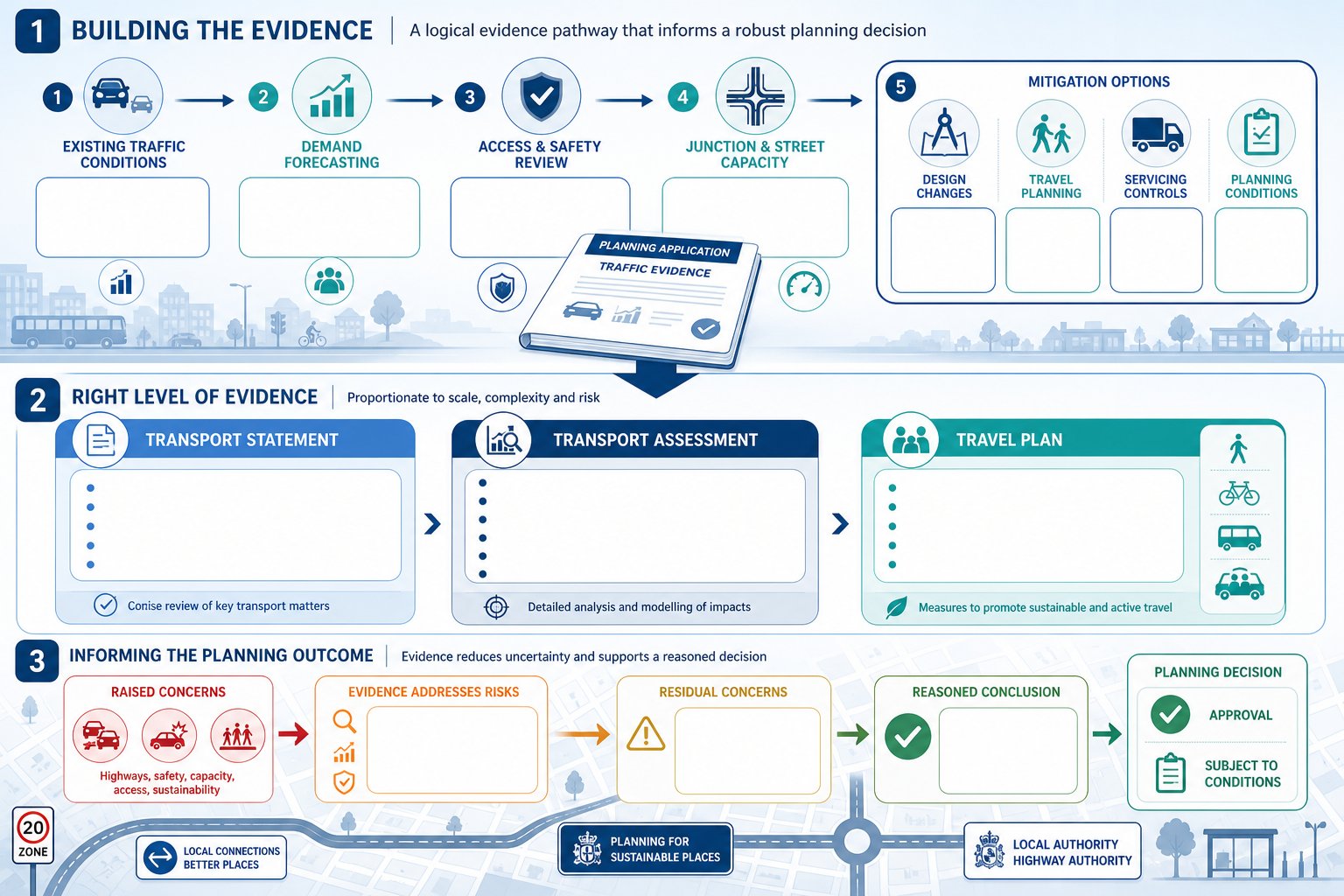
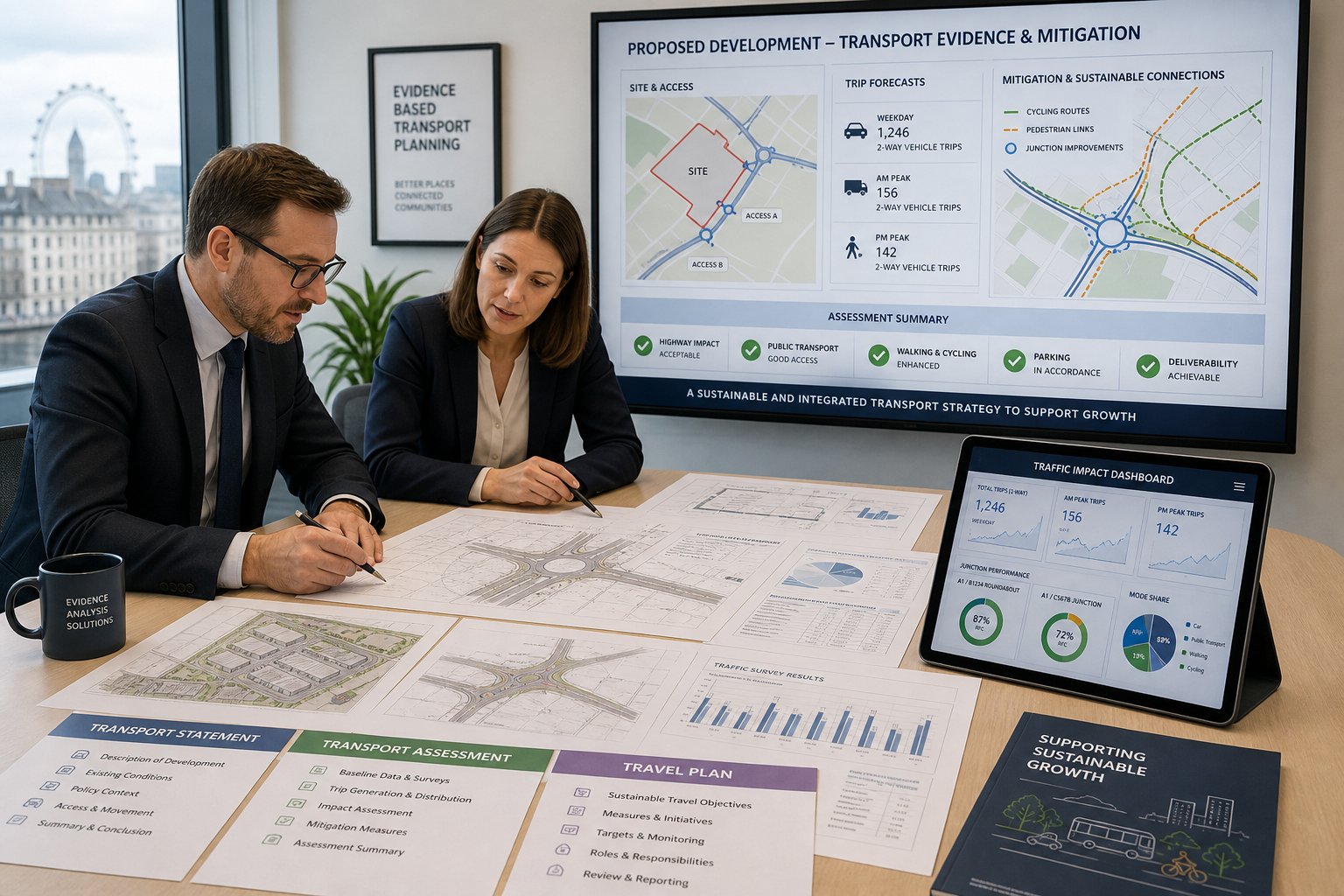
Strong traffic evidence does two jobs at once. First, it demonstrates whether the development is acceptable in transport terms. Second, it shows that the applicant has understood the site, tested impacts properly and proposed realistic mitigation where needed. That matters because planning decisions are rarely made on assertion alone.
A good transport submission gives decision-makers confidence. It explains existing conditions, forecasts likely demand, assesses access and safety, and sets out whether nearby junctions and streets can accommodate the proposal. If constraints exist, it shows how they can be addressed through design changes, physical mitigation, travel planning measures, servicing controls or planning conditions.
This is particularly important where transport concerns might otherwise become a reason for refusal. Clear evidence can narrow disputes, frame consultee comments more usefully and prevent broad, untested objections from dominating the process. It also helps legal and planning teams by creating a robust, traceable basis for the application’s transport case.
Policy context sits behind all of this. National and local policy generally support development that enables safe and suitable access for all users and avoids severe residual cumulative impacts. But the phrase everyone remembers is “severe”, and that threshold still needs evidence. On some schemes, a focused traffic impact assessment is what turns a vague concern into a reasoned conclusion.
The Difference Between Transport Statements, Transport Assessments, And Travel Plans
These documents are related, but they are not interchangeable.
A Transport Statement (TS) is normally used for smaller or lower-impact developments. It provides a concise review of existing transport conditions, site access, likely trips and any relevant constraints. A TS may include basic junction review or parking analysis, but it is generally proportionate rather than exhaustive.
A Transport Assessment (TA) is more detailed. It is usually required where development scale, sensitivity or likely impact is greater. A TA can include surveys, trip forecasting, distribution, junction modelling, active travel review, servicing analysis, parking strategy and mitigation proposals. It is the main evidence document for larger or more complex schemes.
A Travel Plan (TP) is different again. It does not primarily test highway impact. Instead, it sets out measures to encourage walking, cycling, public transport use, car sharing and smarter travel behaviour. Authorities often seek Travel Plans alongside TSs or TAs, especially for workplaces, schools, residential schemes and mixed-use development.
The right choice depends on local thresholds, site context and officer expectations. We usually advise clients not to guess. A short scoping discussion with the authority can save weeks of wasted work, or avoid under-scoping a submission that later needs to be redone.
Key Traffic Flow Studies And Reports Consultants Prepare
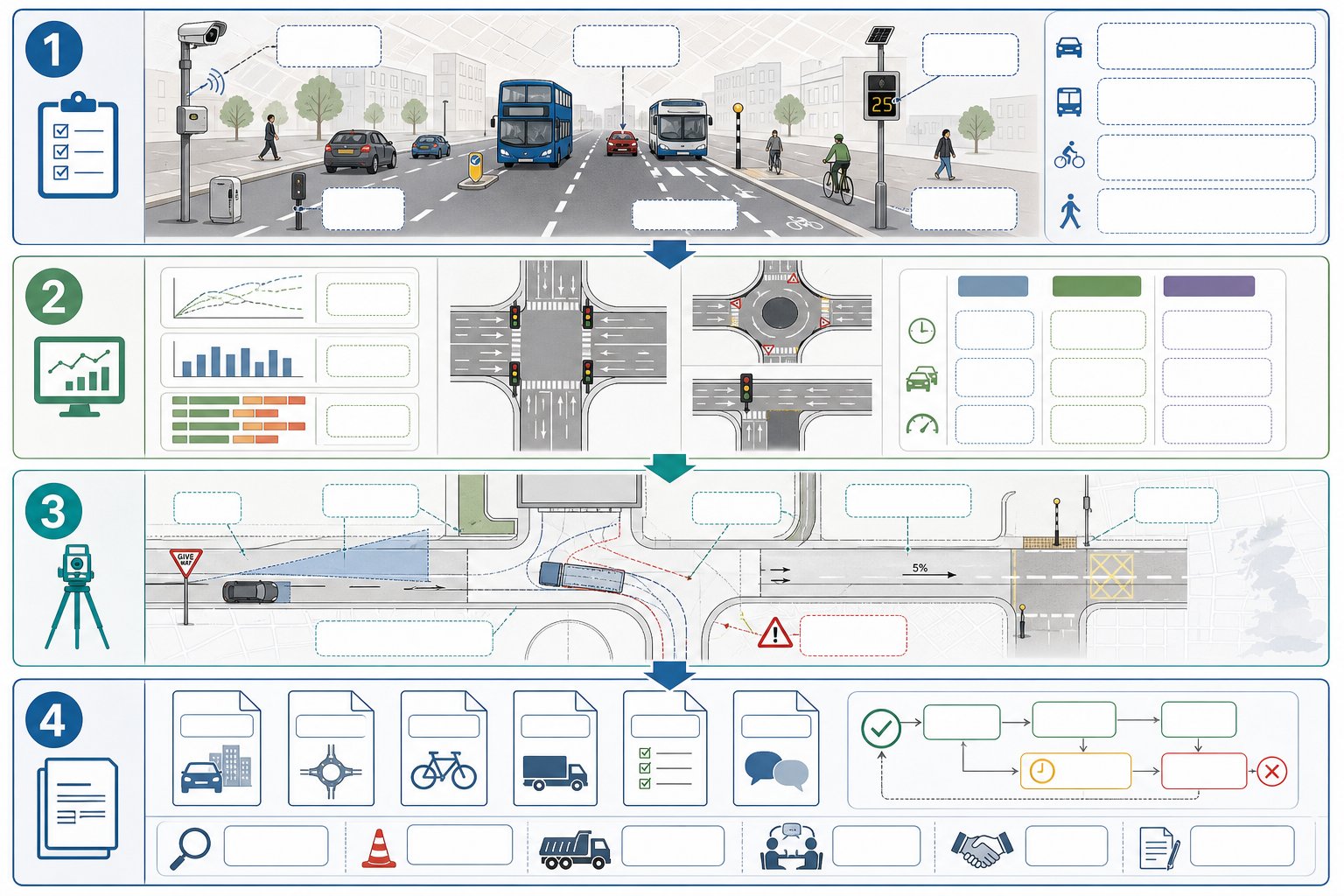

The report list varies by project, but most traffic flow management consultants prepare a core group of planning and technical documents. These often include transport scoping notes, Transport Statements, Transport Assessments, Travel Plans, access appraisals, parking and servicing strategies, delivery and servicing plans, and technical responses to consultee comments.
On some schemes, we also coordinate specialist inputs such as Road Safety Audits, stage-by-stage highway design review, construction traffic management advice or support for Section 278 and Section 38 discussions. Audits themselves are often undertaken by independent accredited teams, but the transport consultant usually helps make sure the design package is ready for that process.
The value of these documents is not just that they exist. It is that they are proportionate, evidence-led and tailored to the local authority’s validation and policy expectations. A generic report lifted from another site tends to unravel quickly once officers compare assumptions with actual site conditions.
That is one area where experienced firms stand out. Teams with long planning-led transport experience, including those producing concise reports for varying authority thresholds such as Birmingham Transport Consultant: Planning-Led, usually focus on the question behind the report: what exactly needs proving here?
Traffic Surveys, Junction Capacity Modelling, And Access Appraisals
Traffic surveys provide the raw evidence. Depending on the scheme, that may include automatic traffic counts, turning counts, queue length surveys, journey time surveys, speed data, vehicle classification counts, parking beat surveys and pedestrian or cycle counts. Timing matters. Surveys need to reflect representative conditions, and school holidays, abnormal roadworks or seasonal distortion can weaken the dataset.
Junction capacity modelling is then used to test performance. In the UK, consultants commonly use recognised software and standard methodologies to assess priority junctions, roundabouts and signalised junctions. The core exercise is usually to compare existing and future baseline scenarios with a development case, then test whether queues, delays or reserve capacity remain acceptable. Mitigation options can then be modelled before any design commitment is made.
Access appraisals are more geometric and practical. We review visibility splays, widths, gradients, corner radii, stopping behaviour, swept paths, pedestrian crossing points and how the access relates to nearby junctions or frontage activity. In some cases, the issue is not whether the network can absorb additional traffic but whether vehicles can use the site entrance safely and comfortably at all.
These studies often overlap with highway design consultants work, especially where mitigation involves new bellmouths, frontage changes, TRO implications or adoptable highway details.
How Consultants Work With Architects, Planners, And Developers
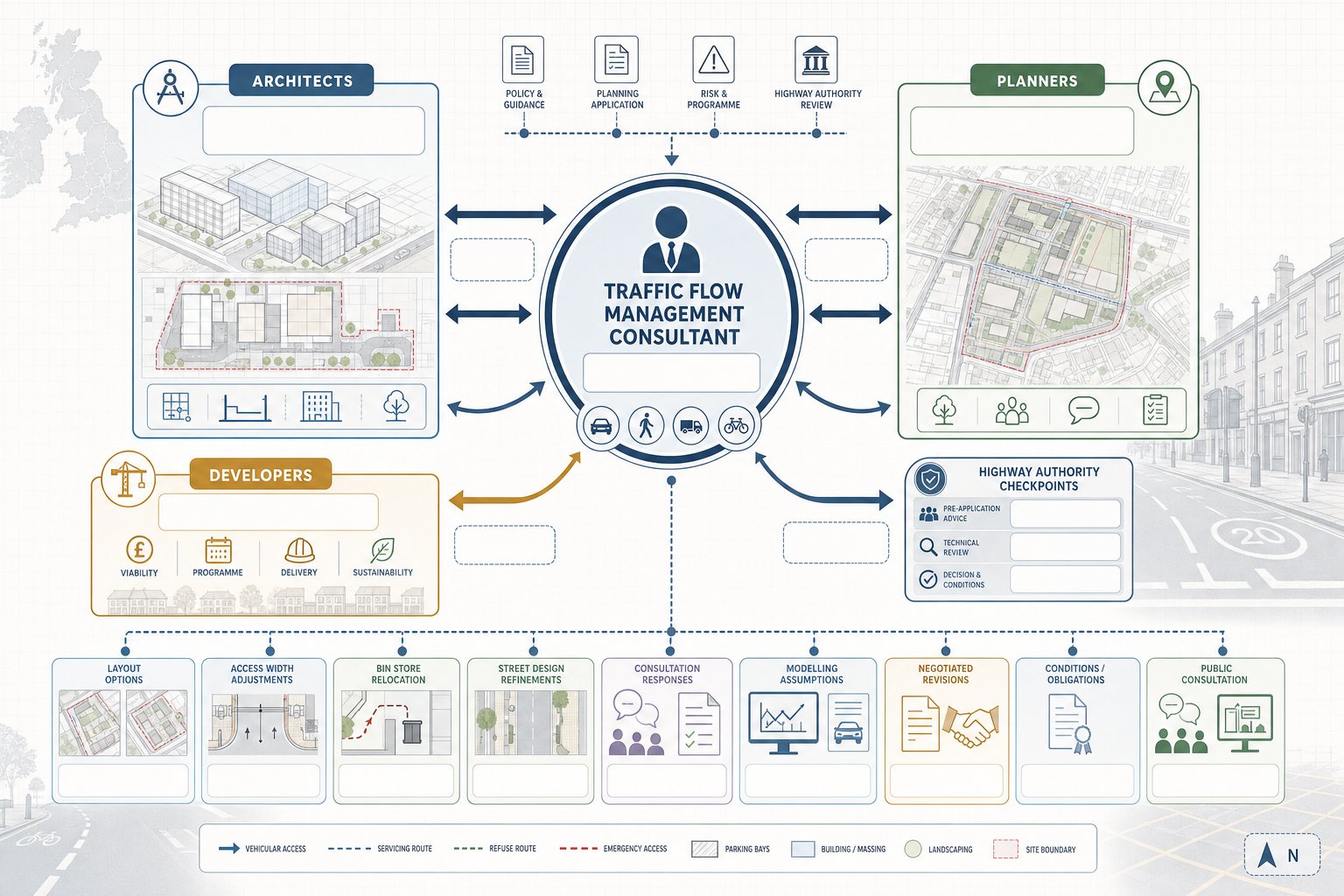
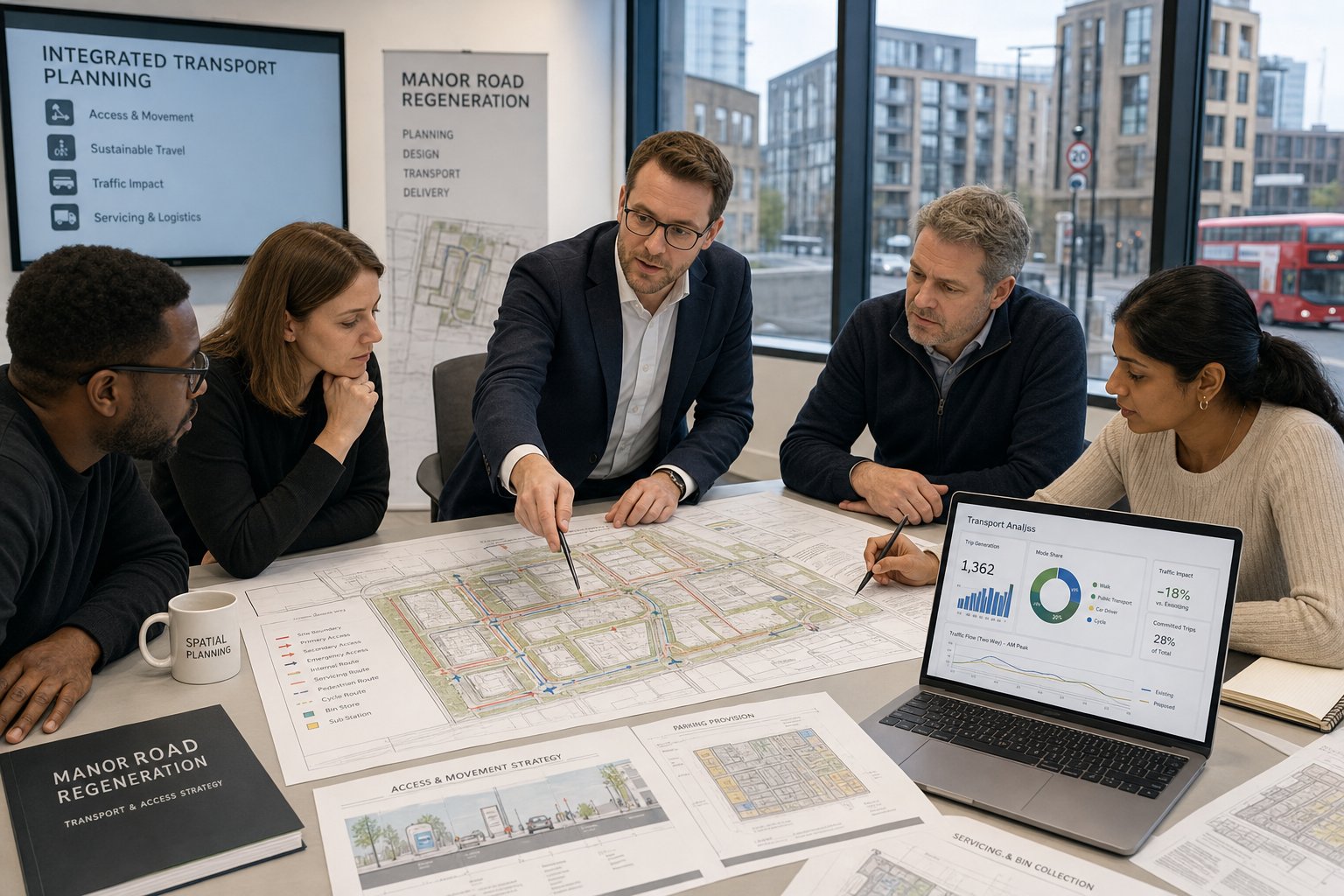
The best transport work is collaborative, not bolted on at the end. We usually start by understanding the scheme’s planning aims, site constraints, commercial drivers and likely authority sensitivities. From there, transport advice feeds into layout options, access location, parking strategy, servicing routes, street design and the overall planning narrative.
With architects, we often comment on internal circulation, refuse strategy, emergency access, tracking, frontage treatment and the small design moves that stop a scheme becoming awkward operationally. With planning consultants, we align transport evidence with policy wording, application strategy and pre-app discussions. With developers and land teams, we help test site capacity and programme risk before too much money is committed.
This matters because transport can quietly reshape a scheme. A few metres of access width, a different bin store position, or a revised servicing route can resolve issues that would otherwise trigger objections. On constrained urban sites, those changes can be the difference between a workable application and a redesign after submission.
Consultants also play a practical role during consultation and determination. We respond to highway authority comments, explain modelling assumptions, agree revisions and support negotiations over conditions or obligations. Where community concern is likely, transport evidence can also feed into broader public consultation transport exercises so that movement issues are addressed with facts rather than speculation.
In short, our role is not just to write the report. It is to help the whole project team make decisions that stand up technically and politically.
Common Planning And Highway Issues They Help Resolve
Most planning transport disputes come back to a familiar set of issues. Junction capacity is high on the list: will extra trips cause unacceptable delay or queuing, especially at nearby priority junctions, roundabouts or signalised nodes? Then there is safety, not only recorded collisions, but also visibility, speed environment, turning conflict, crossing demand and whether vulnerable users are properly catered for.
Parking is another recurring pressure point. Authorities may question whether parking is overprovided, underprovided or poorly laid out. Residential schemes often face tension between policy aspirations for sustainable travel and market expectations for car ownership. Commercial sites bring their own problems: delivery activity, staff parking, disabled spaces, EV charging, cycle parking and kerbside management all need coherent treatment.
Servicing is frequently underestimated. Refuse collection, delivery vehicles and emergency access have a way of exposing weak layouts. If a vehicle cannot enter and exit in forward gear, or has to reverse excessively in a shared environment, objections follow quickly. Construction traffic creates a separate layer of concern, especially on tight urban sites where temporary traffic management, routing and loading arrangements must be controlled.
Consultants help resolve these matters by testing options, refining layouts and translating technical constraints into realistic mitigation. Sometimes the answer is physical improvement. Sometimes it is operational control, such as delivery timing, car park management or a Construction Traffic Management Plan. And sometimes the real value lies in framing a proportionate response that addresses the authority’s concern without over-engineering the scheme.
That blend of technical evidence and policy judgement is why transport advice often overlaps with Transport Policy Review work on more complex or contentious applications.
What Local Planning Authorities And Highway Authorities Expect
Authorities expect transport submissions to be proportionate, evidence-based and clearly tied to policy. They do not want a heavily technical document that dodges the real issue, and they do not want a short report that makes sweeping claims without data. The standard is simpler than that: explain the site, use robust methods, assess the right scenarios and set out defensible conclusions.
In UK practice, that usually means alignment with national guidance, local plan policy, parking standards, highway design principles and recognised transport assessment methods. Guidance such as Manual for Streets remains influential, but local policy often shapes the details: survey scope, peak periods, trip rate assumptions, modelling years, mitigation triggers and whether a Travel Plan is expected.
Highway authorities also care about transparency. They want to understand where survey data came from, why certain junctions were included, how development traffic was distributed and what assumptions sit behind the model. If sensitivity tests are needed, they should be there. If a mitigation package is proposed, it should be practical, cost-aware and capable of being secured by condition or obligation.
We find that early scoping can make a major difference. Agreeing methodology up front reduces argument later and helps everyone focus on genuine planning issues rather than process disputes. It also improves the chances that reports are concise without being thin, a balance many applicants want, especially when trying to maintain programme certainty.
Above all, authorities expect transport documents to help decision-making. If a report answers the key questions plainly and backs them with sound analysis, it stands a much better chance of moving the application forward.
How To Choose The Right Traffic Flow Management Consultant
Choosing the right consultant is partly about technical competence and partly about judgement. Plenty of people can produce a model or compile a report. Fewer can identify the real planning risk early, scope the work proportionately and communicate with officers in a way that keeps the application moving.
We’d start with experience in UK development planning, not just general traffic engineering. The consultant should understand how local planning authorities and highway authorities review submissions, how thresholds vary, and what level of evidence is usually needed for the type of scheme you are promoting. A strong track record with residential, retail, education, employment or mixed-use applications similar to yours is a practical sign.
Then look at method and communication. Do they use recognised survey and modelling tools? Can they explain, in plain language, why a TS may be enough instead of a TA, or why a Travel Plan should be framed in a certain way? Are their reports concise, readable and tailored to place? That matters. Dense technical writing can be just as unhelpful as thin reporting.
Local knowledge is useful too, especially on schemes involving sensitive junctions, constrained urban access or authority-specific expectations. But local knowledge on its own is not enough. You want a consultant who can challenge assumptions, coordinate with the wider design team and respond quickly when comments arrive.
Finally, look for evidence of planning success rather than promises. A consultant with a history of producing clear, authority-aware submissions, including practical guidance around traffic flow management consultants and related planning-led transport work, is usually better placed to add value than one who simply offers generic analysis.
Conclusion
Traffic flow management consultants do much more than measure traffic. We provide the evidence, design input and negotiation support that help show a development can be accessed safely, function efficiently and comply with planning and transport policy.
For architects, planners, developers, surveyors, lawyers and local authorities, the practical benefit is straightforward: fewer surprises, stronger submissions and a clearer route through transport risk. The right advice at the right stage can shape site layout, support pre-application strategy, answer highway objections and keep a planning application from drifting into avoidable delay.
In 2026, that role is only becoming more important. Authorities expect robust data, proportionate reporting and mitigation that genuinely works on the ground. When transport evidence is well prepared and properly integrated with the wider scheme, it does not just defend an application. It helps unlock it.
Frequently Asked Questions about Traffic Flow Management Consultants
What roles do traffic flow management consultants play in planning applications?
Traffic flow management consultants assess vehicle, pedestrian and cyclist movement to ensure safe, efficient access for developments. They provide evidence-based transport reports, design input and mitigation proposals that support planning approvals and address highway authority concerns.
When is it necessary to involve traffic flow management consultants in a development project?
Any development likely to increase trips, alter access or impact sensitive junctions typically needs traffic input. This includes larger residential, retail, educational, employment and mixed-use schemes, particularly at the pre-application stage to avoid delays.
How do traffic flow management consultants assess vehicle and pedestrian impacts?
They conduct traffic counts, pedestrian and cycle surveys, junction capacity modelling, and swept-path analysis for larger vehicles. They also appraise site access issues like visibility splays, carriageway widths and safety audits to ensure functionality and compliance.
What is the difference between a Transport Statement, Transport Assessment and Travel Plan?
A Transport Statement is a concise review for low-impact schemes. A Transport Assessment is a comprehensive report with detailed modelling for larger developments. A Travel Plan focuses on managing travel behaviour, promoting walking, cycling and public transport to reduce car dependency.
How do traffic flow management consultants collaborate with architects and planners?
Consultants work closely with architects and planners to inform site layout, access design, parking and servicing strategies. Their input during early design stages helps avoid costly redesigns and ensures the transport aspects support a smoother planning process.
What are common transport issues these consultants help resolve during planning?
They address junction capacity, safety concerns such as visibility and pedestrian provision, parking adequacy and design, servicing access, and construction traffic management. Their solutions balance technical analysis with local policy to mitigate objection risks effectively.