
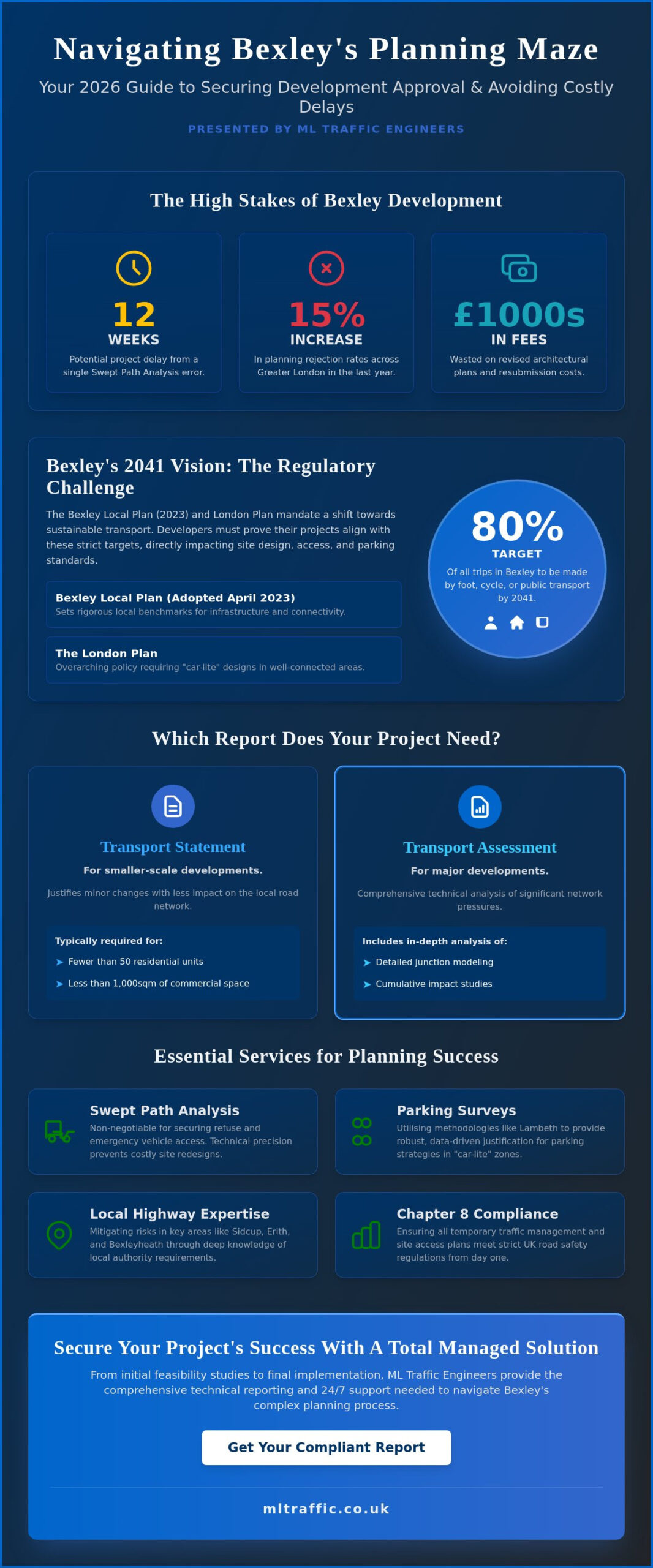
A single error in your Swept Path Analysis can delay a Bexley development project by up to 12 weeks, costing thousands in revised architectural fees. You already know that securing planning permission in the London Borough of Bexley requires more than just a basic site plan; it demands technical precision that satisfies strict Council highways standards. Working with experienced Transport Planning Consultants Bexley ensures your project doesn’t stall due to overlooked Chapter 8 compliance or inadequate access data. It’s about getting the technical reporting right the first time to avoid the 15% increase in planning rejection rates seen across Greater London in the last 12 months.
We’ve designed this 2026 buying guide to help you manage these regulatory hurdles without overpaying for technical reporting. You’ll learn how to identify affordable, compliant consultancy services that deliver accurate CAD designs and robust transport assessments from day one. We’ll break down the essential criteria for choosing a partner who provides total managed solutions, from initial feasibility to final implementation. This guide covers everything from securing fast planning approval to ensuring your site’s multi-way systems meet the latest safety standards, keeping your project on track and within budget.
Key Takeaways
- Navigate the updated 2026 Bexley Local Plan and London Plan requirements to ensure your development meets all regulatory standards and avoids costly planning delays.
- Learn how to secure affordable, right-sized Transport Assessments by hiring expert Transport Planning Consultants Bexley who focus on site-specific data rather than over-engineered reports.
- Discover why technical precision in Swept Path Analysis and Lambeth Methodology parking surveys is non-negotiable for securing refuse and emergency vehicle access approval.
- Identify the essential technical capabilities and local highway department experience required to mitigate development risks across Sidcup, Erith, and Bexleyheath.
- See how 24/7 availability and comprehensive technical reporting from ML Traffic Engineers provide a total managed solution for complex planning applications.
Why Transport Planning Consultants in Bexley are Essential for 2026 Projects
Developers targeting 2026 completion dates must navigate a tightened regulatory framework. The Bexley Local Plan, adopted in April 2023, and the overarching London Plan set rigorous benchmarks for infrastructure and connectivity. Hiring expert Transport Planning Consultants Bexley is no longer an optional luxury but a technical necessity. These specialists bridge the gap between architectural vision and the strict safety standards required by local highway authorities. Professional transportation planning reduces the risk of costly delays by ensuring every design choice aligns with current UK road regulations.
Professional reporting mitigates financial risk in areas like Sidcup, Erith, and Bexleyheath. In these hubs, traffic congestion and air quality are primary concerns for planning committees. A bespoke report ensures that your site access designs and trip generation models stand up to scrutiny. Generic, “off-the-shelf” reports fail because they don’t account for Bexley’s specific modal split targets or the borough’s unique topography. Our team understands that precision is a legal necessity, providing the technical authority required to secure approvals without 11th-hour revisions.
The Impact of the Bexley Local Plan on Development
The Bexley Local Plan requires a robust evidence base for all site allocations. By 2026, developers must prove their projects support the borough’s target of 80% of trips being made by foot, cycle, or public transport by 2041. This policy directly influences parking standards, often requiring developers to implement “car-lite” designs in well-connected areas. Early engagement with Bexley’s highway officers allows Transport Planning Consultants Bexley to negotiate these requirements, ensuring the project remains viable while meeting statutory safety and environmental benchmarks. This proactive approach identifies potential access issues before they become expensive obstacles during the construction phase.
Transport Statements vs. Assessments: What Does Your Project Need?
Determining the correct level of documentation is vital for a seamless planning application. Smaller developments in Bexley, typically those yielding fewer than 50 residential units or 1,000sqm of commercial space, usually require a Transport Statement. Larger projects that significantly impact the local road network must submit a full Transport Assessment, including detailed junction modeling and cumulative impact studies. The primary difference lies in the scale of the development’s impact, where a Transport Statement justifies minor changes while a Transport Assessment provides a comprehensive technical analysis of significant network pressures.
ML Traffic provides the technical authority needed to manage these requirements from initial consultation and planning through to final implementation. We deliver comprehensive support that satisfies both the London Plan 2026 and Bexley Council’s specific highway requirements. Our focus on precision and compliance ensures your project moves forward with unwavering reliability.
Evaluating Costs: Finding Affordable Transport Assessments in London
Securing planning permission in Bexley requires more than just a basic report. London’s complex road networks and the specific demands of the London Borough of Bexley mean that costs vary based on site complexity and projected traffic volume. Professional Transport Planning Consultants Bexley must account for local traffic patterns and public transport accessibility levels (PTAL) to satisfy council requirements. You shouldn’t pay for data your site doesn’t require. A residential conversion with five units needs far less intensive modelling than a large-scale industrial warehouse. Expert consultants tailor their data collection to the specific requirements set by the local highway authority to avoid over-engineering.
See our project types to match your development scale and ensure you’re only paying for necessary technical analysis. Cheap reports often result in “Requests for Further Information” (RFIs) or outright rejection. A rejected application can delay a project by 6 to 12 months, costing thousands in holding fees and lost revenue. In 2024, industry data indicated that poorly prepared reports are 40% more likely to face formal objections from National Highways or local councils. Investing in precision from the start is a safety-conscious decision that protects your project’s timeline.
Fixed-Fee vs. Variable Consultancy Rates
Fixed-fee structures provide budget certainty for standard planning applications. These usually cover the initial site visit, data collection, and the drafting of the report. Variable rates are better suited for complex projects where extensive council liaison is expected. Always request a transparent quote that explicitly includes technical requirements like junction capacity modelling or swept path analysis. This prevents “scope creep” where additional fees appear mid-project. Our team maintains a sense of readiness to provide these quotes quickly, ensuring your project doesn’t stall at the procurement stage.
The ROI of Expert Traffic Engineering
Precision in the early stages saves significant capital during the construction phase. Accurate CAD designs and swept path analysis prevent expensive road layout revisions once the ground is broken. Following the official guidance on Transport Assessments and Statements ensures your project meets legal benchmarks from day one. High-quality design also reduces long-term S278 and S38 infrastructure costs. By optimising the site entrance or parking layout, you can often reduce the amount of off-site highway works required by the council. Securing permission on the first attempt isn’t just about speed; it’s about protecting your bottom line through smart design and Chapter 8 compliance. If you’re ready to move forward, we provide comprehensive support to manage your transport requirements from initial planning through to final implementation.
Key Criteria for Selecting a Transport Consultancy in Bexley
Selecting the right Transport Planning Consultants Bexley isn’t just a box-ticking exercise for your planning application. It’s about securing a partner who understands the specific logistical hurdles of the London Borough of Bexley. Every development project faces unique regulatory pressures where precision is both a legal and physical necessity. You need a team that operates with a sense of readiness and urgency. We provide 24/7 responsiveness because we know that fast-moving projects don’t wait for standard office hours. A reliable consultant acts as a safe pair of hands, managing the technical complexities so you can focus on the build.
Verifying Technical Credentials and Software Use
Your consultant must utilize industry-standard software to ensure your application survives the scrutiny of council highways officers. TRICS-compliant trip generation data is the non-negotiable baseline for any credible Transport Assessment or Statement. We use AutoCAD for high-precision design and perform Swept Path Analysis using Junctions 9/10 to prove that refuse and emergency vehicles can navigate your site safely. This level of detail prevents expensive revisions during the construction phase.
Adhering to the latest Transport analysis guidance ensures that your data is robust and defensible during the planning committee review. When vetting a firm, verify the following credentials:
- Proficiency in ARCADY and PICADY for junction capacity modelling.
- Current professional indemnity insurance to protect your investment.
- Experience in Chapter 8 compliance for temporary traffic management.
- Accreditation from recognized industry bodies like the CIHT.
Assessing Local Borough Experience
Bexley Council has specific expectations regarding highway safety and sustainable travel. A consultant who already speaks the language of local planning officers can preempt objections before they turn into costly delays. This local knowledge is vital when dealing with specific pain points like the A2 corridor or narrow residential streets in Erith and Sidcup. They’ll know exactly how the council views parking stress and highway capacity in these sensitive areas.
Ask potential consultants how they handle developments in PTAL 1b or 2 zones. These low-accessibility areas often trigger strict parking requirements and demand creative mitigation strategies to satisfy the London Plan. We focus on providing bespoke solutions that align with local policy while maintaining the viability of your project. Learn more about what we do to see how our experience in local planning helps streamline the approval process. A consultant with a proven track record in Bexley will understand the nuances of the borough’s Streetscape Design Guide, ensuring your project integrates seamlessly into the existing infrastructure.
Technical Requirements: Swept Path Analysis and Parking Surveys in Bexley
Securing planning permission in the London Borough of Bexley requires more than just a conceptual layout. It demands technical precision. Transport Planning Consultants Bexley utilize Swept Path Analysis (SPA) to provide digital proof that large vehicles can safely enter, turn, and exit a site. Without this data, applications often fail at the consultation stage due to objections from London Fire Brigade or Bexley’s waste management teams.
Our team provides Swept Path Analysis Services in London to ensure every development meets these strict safety standards. We simulate the movements of 11.4m fire tenders and 10.2m refuse vehicles using industry-standard CAD software. This proactive approach identifies pinch points before they become costly construction errors.
Manoeuvrability and Access Feasibility
Bexley’s residential pockets, particularly in areas like Bexleyheath and Welling, are characterized by narrow Victorian or Edwardian street patterns. We use SPA to prove site viability for HGVs and delivery vehicles, ensuring they don’t mount kerbs or strike street furniture. These technical drawings are vital for negotiating Section 278 agreements. By resolving access issues during the design phase, developers avoid legal disputes and delays during the implementation of highway works. We focus on comprehensive support to get these details right the first time.
Justifying Parking Provisions in Low PTAL Areas
Public Transport Accessibility Level (PTAL) ratings in suburban Bexley are often low, frequently falling into the 1a to 2 range. This creates a challenge for developers aiming for car-free or reduced-parking schemes. To overcome this, Transport Planning Consultants Bexley conduct parking stress surveys following the Lambeth Methodology. This involves:
- Conducting overnight surveys on two separate weekday nights.
- Recording all parked vehicles within a 200-metre walking distance of the site.
- Analyzing data collected between 00:30 and 05:30 to capture peak residential demand.
By presenting accurate data, we can justify lower parking ratios even in areas with limited bus or rail links. We pair these surveys with robust Travel Plans that encourage cycling and car-sharing, mitigating the overall transport impact on the local network. This evidence-based strategy is the most effective way to satisfy Bexley’s highways officers in 2026.
Securing Planning Success with ML Traffic Engineers
Choosing the right Transport Planning Consultants Bexley determines whether a project breaks ground on time or stalls in committee. ML Traffic Engineers provides the technical precision required for the 2026 planning environment. We’ve built our reputation on a foundation of 24/7 availability. Planning emergencies don’t stick to office hours. If a planning officer raises a last-minute objection, our team responds immediately to keep your application moving. We produce data-driven technical reports that withstand intense scrutiny. Our work aligns with the latest National Planning Policy Framework (NPPF) updates and the specific highway requirements of the London Borough of Bexley.
Our engineers prioritize accuracy and safety in every design. We understand that in 2024, construction delays in Greater London averaged £12,000 per week for mid-sized developments. We prevent these financial losses by delivering right-first-time documentation. By acting as your technical authority, we alleviate the regulatory burdens that often overwhelm developers. We don’t just provide reports; we provide a safe pair of hands for your entire project lifecycle.
Our Approach to Affordable, High-Quality Consultancy
We focus on efficiency to keep your project within budget. By streamlining our reporting process, we pass direct cost savings to our clients without sacrificing depth. We don’t produce filler. Every page of our Transport Statements and Assessments serves a specific regulatory purpose. Our track record in London includes hundreds of successful applications where we navigated the complex interactions between local boroughs and Transport for London (TfL).
We offer a total managed solution. This moves your project from the first site survey through to final planning approval. You won’t need to coordinate multiple vendors for CAD designs or traffic counts. It’s a seamless integration of technical expertise and project management. We use industry-standard software to ensure every multi-way system or access point is Chapter 8 compliant and optimized for safety.
Next Steps for Your Bexley Planning Application
Preparation is the key to a fast approval. Before your consultation, organize your site’s historical usage data and proposed parking ratios. This allows our engineers to provide an accurate preliminary access review. We identify visibility splay issues or junction capacity constraints at the earliest stage. This proactive stance saves weeks of back-and-forth with highway departments. Proactive planning can reduce the risk of application refusal by up to 40% based on recent regional development data.
You can Contact ML Traffic Engineers for a Bexley project quote tailored to your specific site. Our expert support ensures your technical submission is robust, compliant, and ready for approval. Don’t risk your investment with subpar documentation. Secure your planning permission with the professional reliability your project deserves. Our team is ready to start your preliminary review today.
Secure Your 2026 Planning Approval in Bexley
Navigating Bexley’s planning landscape in 2026 requires technical precision and total compliance with London’s evolving transport policies. Developers need accurate Swept Path Analysis and TRICS-compliant data to avoid costly delays at the committee stage. Partnering with professional Transport Planning Consultants Bexley ensures your project meets every regulatory hurdle from the initial consultation through to final implementation.
ML Traffic Engineers has supported London developers since 2014, bringing over a decade of hands-on expertise to every site. We provide 24/7 availability for urgent technical surveys, ensuring your project doesn’t stall when deadlines are tight. Our team uses AutoCAD and advanced Swept Path Analysis to create robust reports that satisfy strict council requirements. We’re a safe pair of hands for your technical needs, managing complex road regulations so you don’t have to.
Get a Fast, Affordable Quote for Your Bexley Transport Report
Your development goals are within reach, and we’re ready to help you secure that vital planning success.
Frequently Asked Questions
How much does a Transport Statement cost for a Bexley development?
A Transport Statement for a Bexley development is priced based on the project’s scale, typically requiring 20 to 40 hours of professional consultancy time. Costs are influenced by the need for bespoke traffic counts and the complexity of the local highway network. We provide detailed, fixed-fee quotations after reviewing your site plan to ensure full transparency and compliance with Bexley Council’s 2026 planning requirements.
Do I need a transport consultant for a small residential conversion in Sidcup?
You often need a transport consultant for residential conversions in Sidcup to address parking stress and access safety. Even if you’re only creating two or three new units, Bexley’s local plan requires evidence that the development won’t negatively impact highway safety or local parking capacity. Our Transport Planning Consultants Bexley team ensures your application includes the necessary technical evidence to satisfy council highways officers from the outset.
What is the Lambeth Methodology for parking surveys, and is it used in Bexley?
The Lambeth Methodology is the industry standard for conducting overnight parking surveys, and Bexley Council strictly requires its application for most residential developments. It involves surveying all parking spaces within a 200-metre walking distance of the site over two separate weekday nights between 01:00 and 05:00. This data proves whether the local street network can absorb any parking overspill generated by your new development.
How long does it take to prepare a Transport Assessment for a London project?
Preparing a comprehensive Transport Assessment generally takes four to six weeks from instruction to final report delivery. This timeline includes 10 days for data collection, such as traffic counts or parking surveys, followed by technical analysis and drafting. If your project requires pre-application discussions with Transport for London, you should allow an additional 21 days for their formal response and feedback.
Can a Transport Planning Consultant help with a refused planning application?
Expert Transport Planning Consultants Bexley can help overturn refusals by addressing specific highway objections through technical mitigation or revised design. If your application was rejected due to unacceptable impact on the road network or insufficient parking, we provide the CAD drawings and traffic modelling needed for a robust planning appeal. We’ve successfully supported appeals by demonstrating that proposed mitigation measures meet the National Planning Policy Framework standards.
What is Swept Path Analysis, and why is it required for my driveway access?
Swept Path Analysis is a computer-aided design simulation that tracks the movement of a vehicle to ensure it can enter and exit a site safely. Bexley’s highways department requires this for new driveways to prove that a standard 4.8-metre car or an 11.4-metre refuse vehicle can manoeuvre without hitting kerbs or blocking traffic. It eliminates guesswork and provides visual proof that your layout functions correctly in the real world.
How does a PTAL rating affect my parking requirements in Bexley?
Your Public Transport Accessibility Level rating directly dictates the maximum number of parking spaces allowed under the London Plan 2021. Sites with a high PTAL of 5 or 6, such as those near Bexleyheath station, are often required to be car-free or have significantly restricted parking. Conversely, lower PTAL areas in suburban Bexley may allow for higher parking ratios to reflect the reduced availability of trains and buses.
What is the difference between a Transport Statement and a Transport Assessment?
The primary difference lies in the scale of the development and the depth of the required impact analysis. A Transport Statement is a concise report for smaller projects with limited transport implications, focusing on local access and parking. A Transport Assessment is a much more detailed document for larger developments that could significantly affect the wider road network, requiring complex junction modelling and multi-modal trip generation data.

Article by
Michael Lee
Transport planner with over 35 years’ experience.
Disclaimer
The content on mltraffic.co.uk, including all technical articles, guides, and resources, is provided for general informational and educational purposes only. It is not intended to constitute professional advice in traffic engineering, transportation planning, development approvals, or any other technical or legal field.
While ML Traffic Engineers makes every reasonable effort to ensure the accuracy, completeness, and timeliness of the information published, we do not provide any warranties or representations (express or implied) regarding its reliability, suitability, or availability for any particular purpose. Any reliance you place on the content is strictly at your own risk.
In no event shall ML Traffic Engineers, its directors, employees, authors, or affiliates be liable for any direct, indirect, incidental, special, consequential, or punitive damages (including, without limitation, loss of profits, data, or business opportunities) arising out of or in connection with the use of, or inability to use, any information provided on this website.
The articles and guides on this site are not a substitute for engaging a qualified, professional traffic engineer to assess your specific project requirements. For tailored advice, compliance assessments, or traffic engineering services, please contact a competent professional.
This disclaimer may be updated from time to time without notice. By accessing or using this website, you agree to be bound by the most current version of this disclaimer.