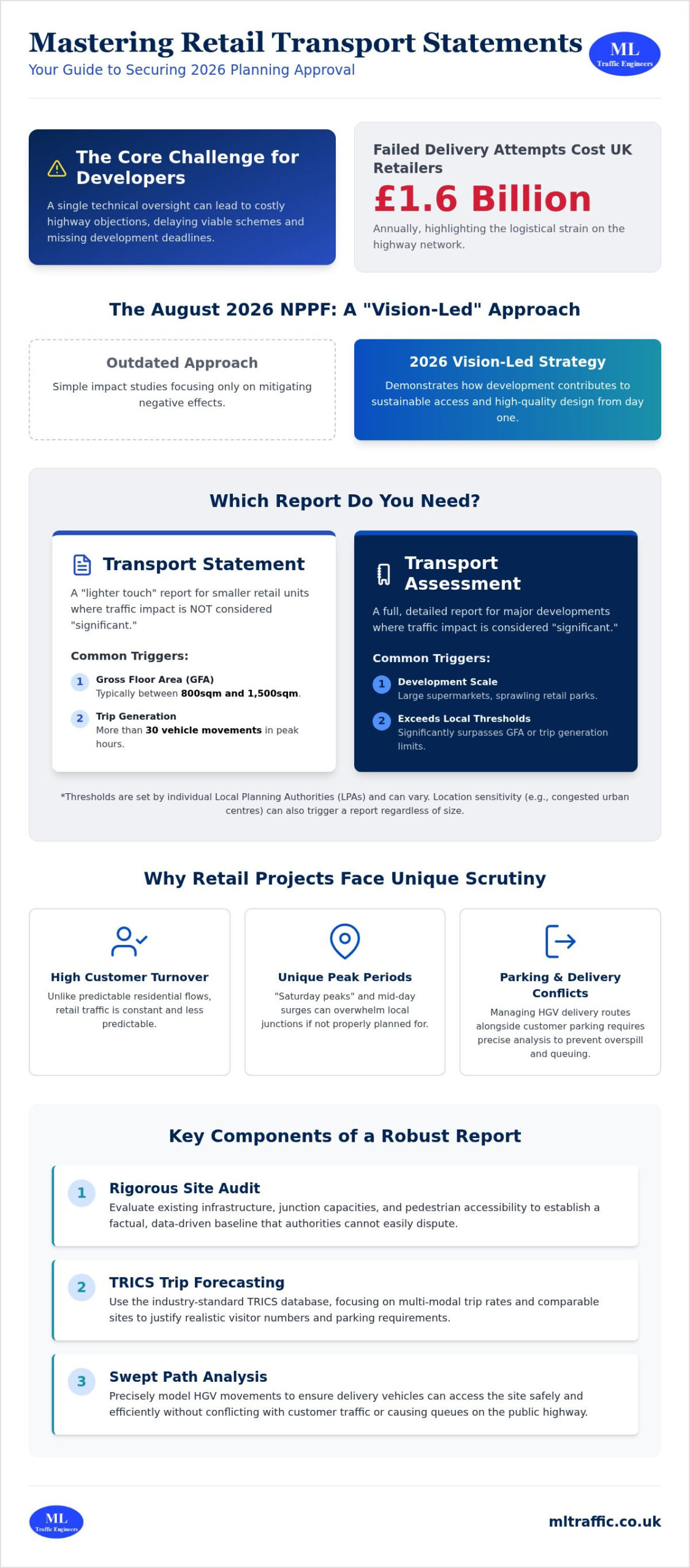
Did you know that failed delivery attempts now cost UK retailers an estimated £1.6 billion annually? For developers, this logistical strain is often compounded by unexpected highway objections when submitting a transport statement for retail development. You likely understand the frustration of seeing a viable scheme delayed because of confusion over parking requirements or whether a full Assessment is truly necessary. It’s a high-stakes environment where a single technical oversight leads to costly revisions and missed development deadlines.
This guide helps you secure planning approval by mastering the technical requirements of the 2026 planning landscape. You’ll learn how to align your project with the August 2026 NPPF “vision-led” approach, shifting away from outdated models. We provide a clear roadmap for planning validation that mitigates highway authority concerns through precise data and Swept Path Analysis. By the end of this article, you’ll have the tools to produce cost-effective technical reports that protect your project timelines and your budget.
Key Takeaways
- Understand the transition to “vision-led” planning under the 2026 NPPF and how it influences the technical scope of your retail project.
- Learn how to leverage TRICS data and site audits to produce a robust transport statement for retail development that meets local authority requirements.
- Identify strategies to resolve conflicts between customer parking and HGV delivery routes through precise Swept Path Analysis and parking accumulation data.
- Discover how to navigate the Local Validation List and use pre-application advice to reduce planning risks and prevent costly project delays.
- Master the technical requirements for securing planning approval, from initial accessibility audits to final highway authority mitigation.
What is a Transport Statement for Retail Development?
A transport statement for retail development is a technical report required by Local Planning Authorities (LPAs) to evaluate the impact of a proposed shop or commercial unit on the highway network. Under the August 2026 National Planning Policy Framework (NPPF) update, this document has transitioned from a simple impact study to a “vision-led” strategy. It must now demonstrate how a development contributes to sustainable access and high-quality design from the earliest planning stages. This document is a fundamental part of Transportation planning, ensuring that new retail space integrates safely with existing infrastructure without compromising public safety.
For developers, the statement serves as a tool to justify the feasibility of a site. It provides the technical evidence needed to overcome potential highways objections that often delay project timelines. By addressing accessibility and traffic generation early, you can avoid the high costs associated with unmanaged parking requirements or late-stage design revisions.
Transport Statement vs. Transport Assessment
The primary difference between these two reports lies in the scale of the development and the volume of traffic it generates. A full Transport Assessment is typically reserved for major developments, such as large supermarkets or sprawling retail parks, where traffic impact is considered “significant.” In contrast, a Transport Statement is a “lighter touch” report designed for smaller retail units that don’t reach the major impact thresholds set by the LPA.
The “significant movement” benchmark is the critical trigger for these reports. While national guidelines provide a framework, individual boroughs in England use their own Local Validation Lists to set mandatory thresholds. These are often based on:
- Gross Floor Area (GFA): Many authorities trigger a statement for retail units between 800sqm and 1,500sqm.
- Trip Generation: Projects projected to create more than 30 vehicle movements during peak hours often require formal reporting.
- Location Sensitivity: Small shops in congested urban centres may require a statement regardless of size due to local air quality or safety concerns.
Why Retail Projects Face Unique Scrutiny
Retail applications attract higher scrutiny than residential or office projects because of their high customer turnover and specific peak periods. Unlike residential sites with predictable morning and evening flows, retail developments often experience “Saturday peaks” or mid-day surges that can overwhelm local junctions. Highway authorities demand precise data to ensure these surges don’t lead to dangerous queuing on the public highway.
Specific retail challenges include managing the conflict between customer parking and HGV delivery routes. Authorities expect to see how you’ll manage parking accumulation to prevent overspill into neighbouring streets. We focus on these technical nuances to ensure your application meets local borough parking standards while maintaining a cost-effective design for the developer.
Key Technical Components of a Retail Transport Report
Precision is the non-negotiable foundation of a transport statement for retail development. We begin every project with a rigorous audit of the existing site infrastructure to identify physical constraints and accessibility gaps. This process involves evaluating local junction capacities and the quality of existing pedestrian crossings. Following UK government guidance, we ensure that every technical claim is backed by current evidence. By establishing an accurate baseline through 2026 parking and traffic surveys, we provide a factual foundation that highway authorities can’t easily dispute. This data-driven approach is essential for demonstrating that your project won’t compromise the safety or efficiency of the local road network.
Utilizing TRICS for Retail Trip Forecasting
The TRICS (Trip Rate Information Computer System) database remains the industry standard for forecasting visitor numbers. Our experts carefully select comparable sites from the database, filtering for location type and gross floor area to ensure the projections are defensible. In 2026, we focus heavily on multi-modal trip rates to reflect modern shopping habits and the rise of click-and-collect services. TRICS data justifies lower parking requirements by demonstrating actual peak demand rather than relying on generic maximum standards. This technical justification is often the difference between a project that’s financially viable and one that’s burdened by excessive infrastructure costs.
Swept Path Analysis for Delivery and Service Bays
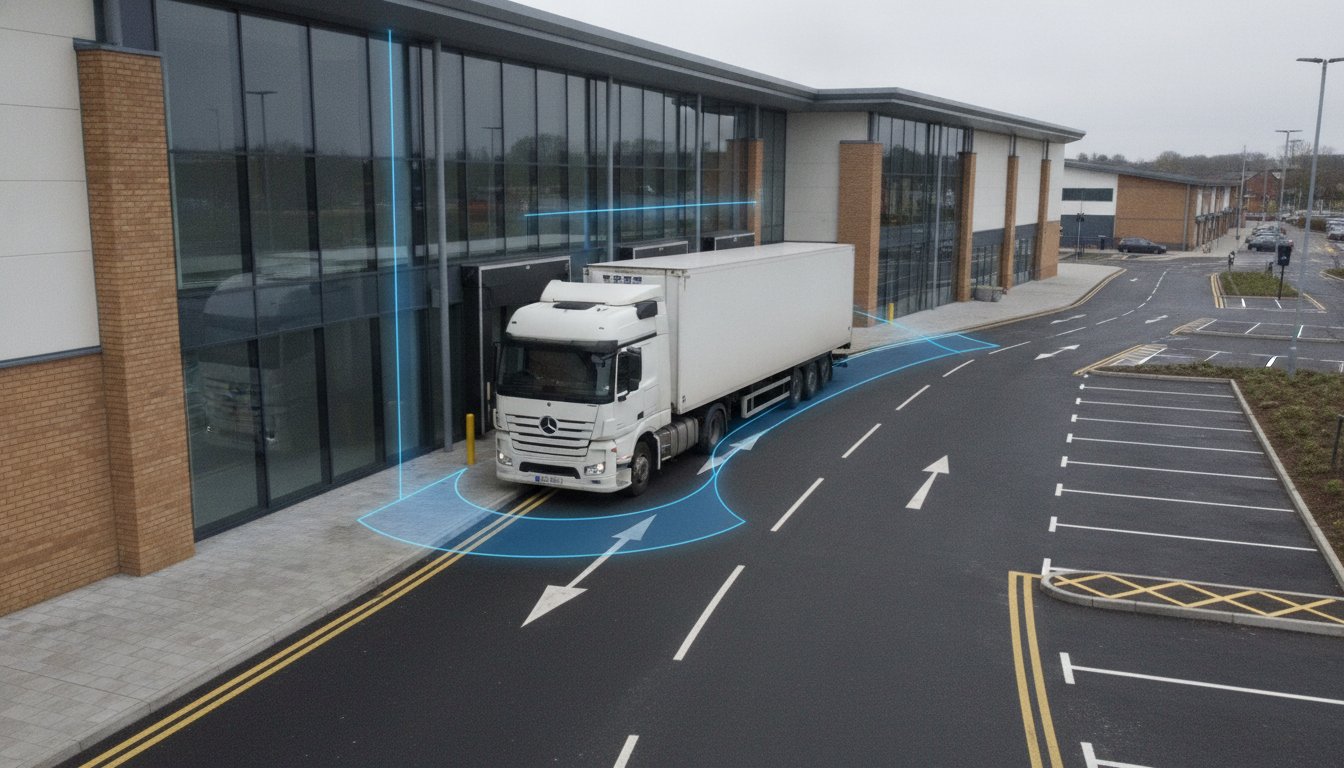
Retail logistics require meticulous planning to avoid operational failure. We utilize advanced software to perform Swept Path Analysis, proving that a 16.5m articulated vehicle can safely navigate your delivery bays. This analysis isn’t just about HGVs; we also simulate fire tender and refuse vehicle movements to meet statutory safety requirements. Preventing design errors at this stage is critical, as a single tight corner can lead to an immediate planning refusal. Our detailed CAD overlays provide the visual proof highway officers need to see that your site layout is functionally sound and safe for all users.
We manage the full technical lifecycle of your report, ensuring all data meets current legislative standards. If you want to ensure your site layout is fully optimized for HGV access, you can view our range of technical survey services to see how we support successful applications.
Managing Retail-Specific Impacts: Deliveries and Parking
Retail environments are high-intensity zones where customer convenience often competes with operational logistics. Managing this friction is a core objective of any transport statement for retail development. Unlike residential sites, retail hubs experience high vehicle turnover, which places constant pressure on site access points and local junction capacity. A comprehensive transport statement for retail development must address both the visitor experience and the logistical backbone of the business to ensure long-term viability. We provide the technical evidence needed to demonstrate that your site can handle these dual demands without compromising public safety.
Calculating Parking Accumulation and Demand
Accurate parking accumulation data is essential to prevent vehicle overspill into surrounding residential streets. We calculate “peak stay” durations for visitors to determine the exact number of spaces required during the busiest hours of operation. This analysis is critical for 2026 retail developments, which must also integrate mandatory EV charging infrastructure without reducing overall site efficiency. In areas with high Public Transport Accessibility Level (PTAL) scores, we use official government guidance on transport statements to justify reduced parking or “car-free” schemes. This data-driven approach aligns with sustainability goals while maximizing the developable area of your site.
Designing for Safe Servicing and Deliveries
The conflict between heavy delivery vehicles (HGVs) and pedestrians is a primary concern for highway officers. We prioritize the physical segregation of these movements through clear site zoning and designated loading areas. A robust servicing strategy often involves scheduling deliveries outside of peak shopping hours to reduce congestion at the site entrance. This proactive management reduces the risk of HGVs idling on the public highway while waiting for site access, which is a common cause for planning objections.
We ensure that refuse vehicles and fire tenders can navigate the site by conducting rigorous vehicle tracking. This is not just a planning requirement; it’s a functional necessity for site safety and operational efficiency. If your project involves complex logistics, a separate Servicing and Delivery Plan (SDP) may be required alongside your main statement. This additional document provides the highway authority with the reassurance that all HGV movements are managed professionally and safely. Developers can review our transport statement guidance for more information on meeting these strict urban delivery standards.
Navigating the Local Highway Authority Validation Process
Validation lists are not merely suggestions; they are the gatekeepers of the planning system. If a transport statement for retail development lacks even one borough-specific requirement, the application is stalled before it reaches an officer’s desk. We meticulously review the “Local Validation List” for each specific authority to ensure every technical component is present. This stage often involves addressing Section 278 (S278) requirements for off-site highway works. Whether your project requires a new site entrance or the relocation of a bus stop, these works must be technically feasible and costed early to avoid budget overruns later in the development cycle.
The Importance of Pre-Application Consultation
Engaging with highway officers through pre-application advice is the most effective way to reduce planning risk. This process allows us to agree on the “scope” of the report before submission, ensuring we don’t waste time on unnecessary data collection. It also identifies potential “deal-breakers” in the site access design, such as inadequate visibility splays or restricted HGV turning circles, allowing for design adjustments before the final submission. For schemes that exceed the threshold for a statement, see our guide on Transport Assessments for larger projects. We find that early negotiation helps build rapport with the highway authority, making the formal submission process much smoother.
Common Mistakes in Retail Transport Submissions
Rejections often stem from technical oversights that suggest a lack of site-specific understanding. Using outdated traffic data or irrelevant TRICS comparators from 2023 or earlier will immediately undermine the credibility of your submission. Highway officers also look for safe pedestrian visibility splays, especially at site entrances where high footfall is expected. An inaccurate Swept Path Analysis that fails to account for real-world kerb heights or street furniture will lead to an immediate planning refusal from the highway officer. We ensure every technical drawing is verified against current 2026 standards to prevent these avoidable setbacks and keep your project on its critical path.
To avoid these pitfalls and ensure your submission is right the first time, book a technical review of your retail site layout with our specialist engineering team today.
Securing Approval with ML Traffic Engineers
Securing planning permission for retail assets requires technical precision and strategic negotiation with local authorities. Since 2014, ML Traffic Engineers UK has provided specialized support for developers across England. A transport statement for retail development must be robust enough to withstand the scrutiny of local highway officers while remaining commercially viable. We handle the technical heavy lifting, including TRICS data analysis and Swept Path Analysis for HGV access, so you can focus on the commercial aspects of your project. Our team acts as a vital guardian of public safety, ensuring every site layout we verify meets the highest industry benchmarks and legislative requirements.
Our Full-Managed Reporting Service
Our full-managed service covers the entire project lifecycle from initial inception to final planning approval. We don’t just provide a static document; we act as your comprehensive partner throughout the validation process. Our engineers manage every detail, including on-site parking surveys and accessibility audits. We understand that retail environments are high-stakes, where precision is a functional necessity rather than a luxury. Our team takes immense pride in adherence to standards, ensuring that every survey we conduct is accurate and defensible. Our reporting is safety-conscious and reflects the immediate action required to meet tight planning deadlines. We reduce the logistical and regulatory pressures on our clients by providing clear, direct, and functional reporting. You can explore our retail project experience to see how we’ve helped developers manage complex urban environments and secure vital approvals.
Get a Professional Quote for Your Retail Project
We provide bespoke pricing based on the unique scale and complexity of your development. Whether you’re planning a small local store or a larger commercial unit, we offer fast turnaround times to ensure you hit your validation targets. Our role is to simplify the planning process by understanding intricate regional regulations so you don’t have to. We maintain constant accessibility and a rapid response capability to ensure your project moves forward without delay. This commitment to reliability stems from our understanding of the fast-moving nature of the infrastructure and retail sectors. Our team is ready to manage the transport statement for retail development for your next project, ensuring full adherence to 2026 standards. Contact ML Traffic Engineers UK today to discuss your requirements and receive a professional quote tailored to your specific site needs.
Accelerating Your Retail Development Approval
Mastering the technical requirements of a transport statement for retail development is the most effective way to protect your project timelines. Success in the 2026 planning landscape is about more than just meeting basic thresholds; it’s about a vision-led strategy that prioritizes sustainable access and safe delivery logistics. By integrating precise TRICS forecasting and Swept Path Analysis early in your design phase, you eliminate the highway objections that frequently stall commercial applications. These technical benchmarks ensure your site is functionally sound and compliant with the latest NPPF standards.
ML Traffic Engineers has provided comprehensive UK planning support since 2014. We specialize in the technical heavy lifting, from parking surveys to complex HGV tracking, allowing you to navigate regional regulations with confidence. Our team is ready to deliver the precision and reliability your project requires to move from inception to completion without regulatory delays. Request a Transport Statement Quote for Your Retail Project today to secure expert support for your next submission. We’re ready to help you achieve a successful planning outcome for your retail development.
Frequently Asked Questions
Do I need a Transport Statement for a small retail change of use?
You need one if the change of use generates more traffic than the previous occupant. Local authorities often require a transport statement for retail development to ensure that new customer patterns don’t overwhelm local parking or delivery access. We check the specific Local Validation List for your borough to confirm if the new use class triggers mandatory reporting, helping you avoid unexpected delays during the planning validation process.
How long does it take to prepare a Transport Statement for a retail site?
Preparation typically takes two to four weeks depending on the complexity of the data collection. If your project requires new traffic or parking surveys, we must account for the time needed to conduct these on-site during neutral periods. We prioritize rapid delivery to help you meet planning deadlines while ensuring every technical detail meets the highway authority’s rigorous standards for precision and safety.
What is the difference between a Transport Statement and a Travel Plan?
A Transport Statement evaluates the physical impact of the development on the road network, while a Travel Plan is a strategy to encourage sustainable transport use. Statements focus on infrastructure capacity and safety; Travel Plans focus on behavioral change. Local authorities frequently require both documents for retail applications to meet modern sustainability targets and reduce long-term car dependency in line with the latest 2026 planning policies.
Can I use a Transport Statement from a previous application?
You shouldn’t rely on old reports because traffic data and planning policies change rapidly. National guidance generally considers traffic surveys older than three years to be out of date. Using a transport statement for retail development from a previous application risks immediate rejection under the August 2026 NPPF update. We refresh baseline data and policy sections to ensure your application reflects current highway conditions and the latest legislative requirements.
How much does a retail Transport Statement typically cost?
Costs vary based on the scale of the retail unit and the depth of analysis required by the local authority. Factors like the need for manual traffic counts or complex junction modeling influence the final fee. We provide bespoke pricing for every project to ensure you only pay for the specific technical reporting your planning application needs to achieve validation and approval without unnecessary overheads.
What happens if the Highway Authority objects to my retail development?
An objection requires immediate technical negotiation to address the specific concerns raised, such as junction capacity or pedestrian safety. We review the officer’s comments and propose mitigation measures, which might include design revisions or revised delivery schedules. Our proactive liaison service aims to resolve these conflicts through data-driven evidence, helping to remove the objection and clear the path for your project’s planning consent.
Is Swept Path Analysis always required for retail planning?
Swept Path Analysis is essential for any retail site that requires regular HGV deliveries or refuse collection. It provides the visual proof that large vehicles can enter, turn, and exit the site safely without striking kerbs or blocking the public highway. Highway officers almost always demand this analysis to verify that your service yard design is functionally safe for all road users and delivery staff.
How does the TRICS database help my retail application?
TRICS provides defensible data on how many trips your specific type of retail development will generate. By selecting comparable sites from this national database, we can accurately predict customer and staff arrival patterns. This technical forecasting is vital for justifying your parking provision and demonstrating that the local road network can accommodate the additional traffic without creating dangerous congestion or compromising local highway safety.

Disclaimer
The content on mltraffic.co.uk, including all technical articles, guides, and resources, is provided for general informational and educational purposes only. It is not intended to constitute professional advice in traffic engineering, transportation planning, development approvals, or any other technical or legal field.
While ML Traffic Engineers makes every reasonable effort to ensure the accuracy, completeness, and timeliness of the information published, we do not provide any warranties or representations (express or implied) regarding its reliability, suitability, or availability for any particular purpose. Any reliance you place on the content is strictly at your own risk.
In no event shall ML Traffic Engineers, its directors, employees, authors, or affiliates be liable for any direct, indirect, incidental, special, consequential, or punitive damages (including, without limitation, loss of profits, data, or business opportunities) arising out of or in connection with the use of, or inability to use, any information provided on this website.
The articles and guides on this site are not a substitute for engaging a qualified, professional traffic engineer to assess your specific project requirements. For tailored advice, compliance assessments, or traffic engineering services, please contact a competent professional.
This disclaimer may be updated from time to time without notice. By accessing or using this website, you agree to be bound by the most current version of this disclaimer.