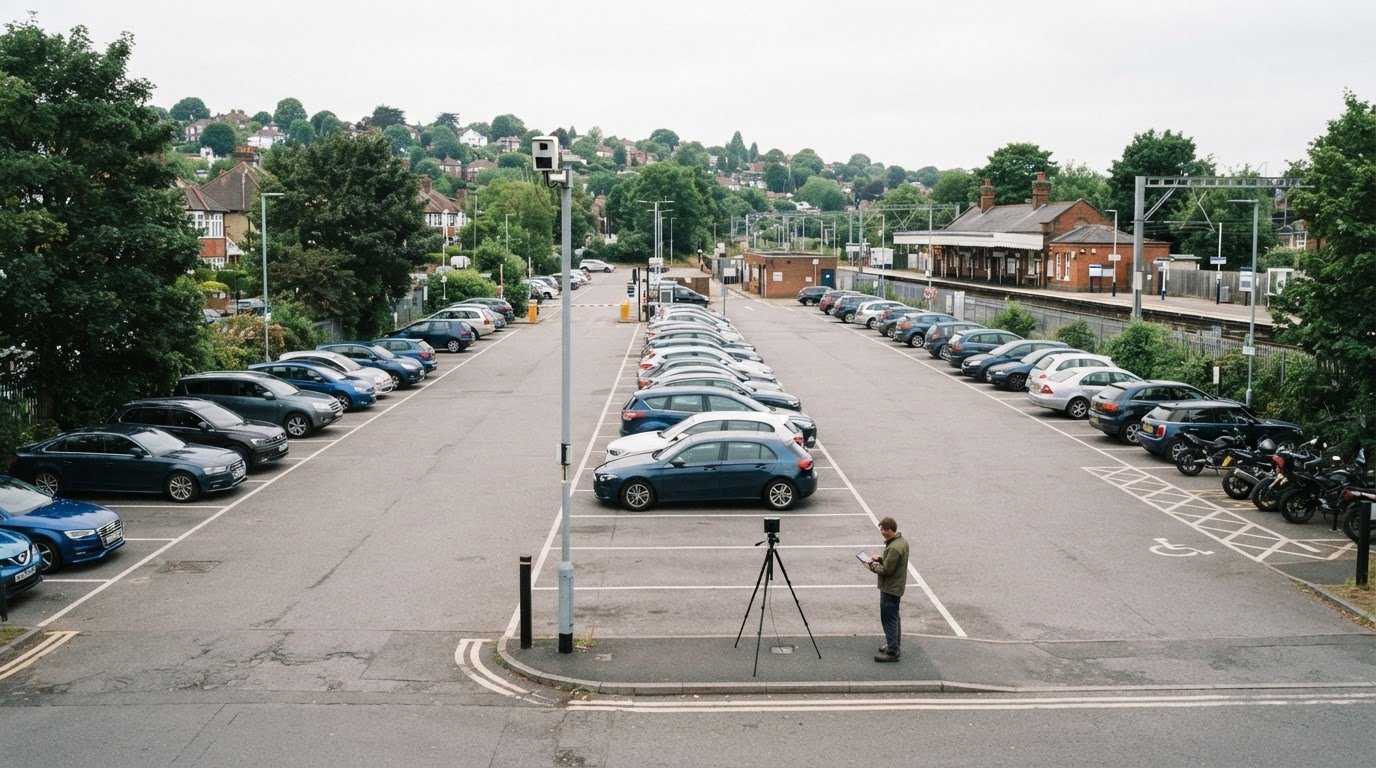
Parking at High Barnet Station is shaped by your booking time: arriving between 15 minutes and 2 hours early means paying the standard tariff for the extra time, and staying beyond your booked end time is charged at the same rate. The car park has 173 spaces and a maximum stay of seven days, so a parking survey in Barnet should account for both its layout and how people use it.
Planning a visit means balancing parking availability with the time you need on site. This guide explains the arrival and departure allowances, the location and facilities at High Barnet Station Car Park, including accessible and motorcycle spaces, and pick-up and drop-off arrangements. You’ll also find the maximum stay and the restriction on electric vehicle charging spaces, so you can understand the practical parking conditions before travelling.
Key Takeaways
- Plan your payment around the car park’s overnight deadline and daily ticket expiry to avoid confusion about when your stay is covered.
- Compare the available parking types and facilities at High Barnet Station Car Park with your travel needs before setting off.
- Understand how the seven-day maximum stay applies, including the separate restrictions for electric vehicle hackney taxis using charging spaces.
- A parking survey can help establish local parking conditions when planning a project or reviewing a residents’ parking scheme.
- Learn what information to prepare when commissioning a survey and when a Transport Statement may help support a planning proposal.
Arrival and departure time allowances
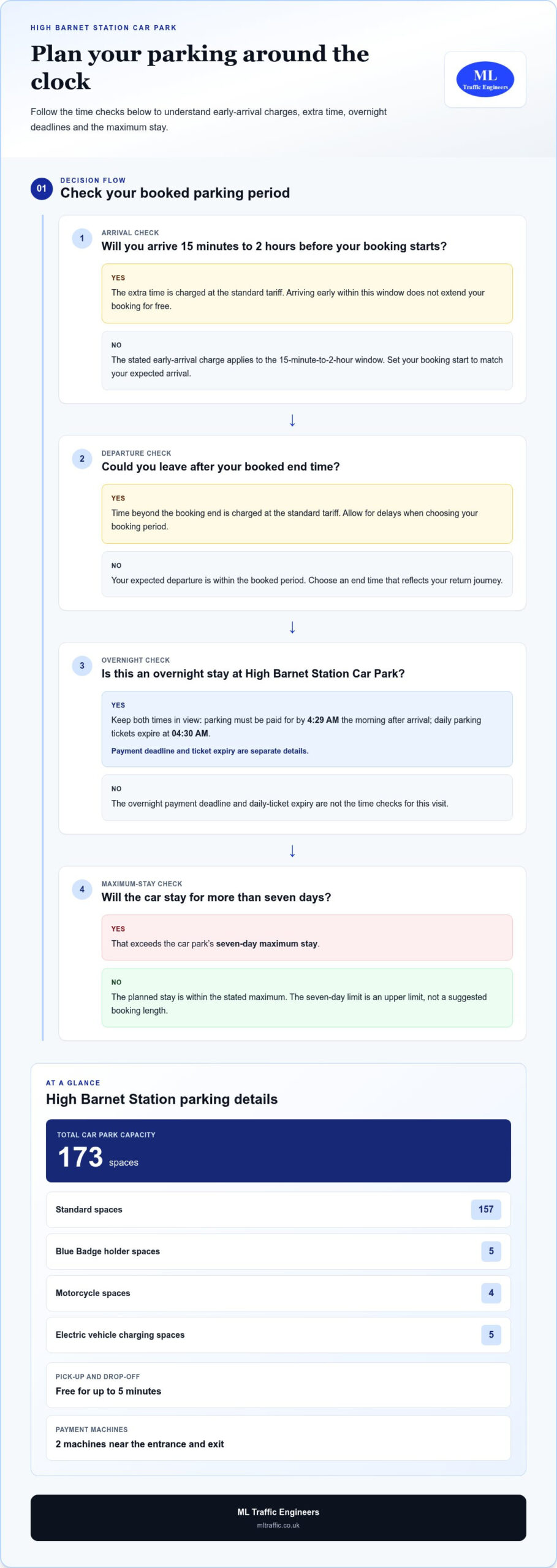
At Barnet car parks using number plate recognition, arriving between 15 minutes and 2 hours before a booking starts incurs a charge for the additional time at the standard tariff. An early arrival within that window does not extend the booking for free. Set the booking start to match your expected arrival, rather than treating it as a suggested time. For a parking survey in Barnet, this rule is also relevant when distinguishing booked parking activity from other site use.
Parking beyond the booked end time is charged at the standard tariff for the additional time. If your return journey to High Barnet Station runs late, you’ll be charged for time beyond the booking end. Allow for possible delays when choosing your booking period, particularly if a train journey or appointment affects your return. This helps you plan your stay without relying on an unplanned extension.
High Barnet Station Car Park has two separate overnight time details. Parking must be paid for by 4:29 AM the morning after arrival, while daily parking tickets expire at 04:30am. These times relate to payment and ticket expiry respectively. Keep both in view when planning an overnight stay, and review the ticket details so the payment deadline is not confused with the expiry time.
Use this sequence to organise a stay:
- Estimate when you will reach the car park, then set the booking start accordingly.
- Choose an end time that reflects your expected return, including the journey back.
- Allow for the additional standard-tariff charge if you arrive early within the stated window or leave after the booking ends.
- For an overnight visit to High Barnet Station Car Park, note both the 4:29 AM payment deadline and 04:30am daily ticket expiry.
How long does a parking survey in Barnet take, and when is it conducted? The duration depends on the study area, the question being assessed and the required coverage. Survey periods are chosen to capture the parking activity relevant to the site and the decision the findings will inform.
Booking allowances describe an individual driver’s permitted parking period. A parking survey in Barnet instead examines patterns across a defined location. To study arrival and departure activity, specify the site boundary, relevant observation periods and required data. For example, a station-area study may examine parking in relation to journeys, while a different site may require another focus. Booking rules alone don’t show how spaces are used across the wider area.
For drivers, plan arrival and departure within the booked period and account for any additional-time charges. When planning a survey, define the activity to measure and the relevant observation periods. Keeping these purposes distinct ensures a parking survey in Barnet assesses site-wide evidence rather than treating one driver’s booking allowance as a complete picture of parking demand.
Barnet parking location and facilities
High Barnet Station Car Park is the specific parking location covered here. Its space types, tariffs and access arrangements distinguish station parking from nearby on-street parking.
Recent survey areas and streets
Survey locations are defined by each study’s geographic scope. A study may examine kerbside parking around a development, a station car park or both, depending on the question it needs to answer. High Barnet Station Car Park is the specific facility described here. Street-level survey coverage should be considered separately from the spaces within the car park.
Location and facility details
High Barnet Station Car Park has 173 spaces: 157 standard spaces, five Blue Badge holder spaces, four motorcycle spaces and five electric vehicle charging spaces. Pick-up and drop-off are free for up to five minutes. Two payment machines are located near the entrance and exit, giving drivers an on-site payment option.
Tariffs differ by day and parking type.
These details help drivers choose an appropriate space and plan their visit. For example, motorcyclists can distinguish the motorcycle tariff from standard daily parking, while Blue Badge holders can identify designated spaces. The five electric vehicle charging spaces have a specific user restriction, so they shouldn’t be treated as general-purpose charging bays. Where car parks and private developments require physical measures to protect reserved bays or control vehicle access, equipment from Bollard Secure provides security bollards and parking posts to manage those boundaries.
How reliable are parking survey results, and what can affect them? Results are most useful when the study boundary, observation periods and parking categories match the decision being assessed. Gaps in coverage, unusual conditions during observations and inconsistent recording can affect how well findings represent parking activity.
For a parking survey in Barnet, define what the study needs to establish before interpreting the results. A site assessment may focus on car park occupancy and space types, while a street assessment may examine kerbside demand. Combining them makes sense when both areas relate to the same planning question. Clear boundaries help readers understand exactly which parking activity the results describe.
When visiting, check the space type, relevant tariff and any restrictions. For a survey, record the location and parking categories being assessed, then consider whether observations cover the places and periods relevant to the question. This ties the findings to the defined area rather than treating all Barnet parking as one system.
For visitors needing accessible provision, the 5 Blue Badge holder spaces are a distinct part of the facility’s capacity. Pick-up and drop-off are free for up to 5 minutes, which can suit brief transfers without requiring a longer stay.
Maximum stay
High Barnet Station Car Park has a maximum stay of seven days. Treat this as the upper limit for one stay, not as a guide to how long to book. Match the planned time away with your booking and the car park’s payment arrangements. If your trip may extend beyond seven days, the stated maximum stay does not cover your full absence.
The limit matters most for travellers leaving a vehicle while away from Barnet. Before parking, estimate your departure and return times, then compare the full interval with the seven-day maximum. Include the time needed to reach the car park and leave after returning. A journey that seems to fit closely may exceed the intended period if your plans change.
High Barnet Station Car Park has a separate restriction for its electric vehicle charging spaces. Those five spaces are for electric vehicle hackney taxis only, and the maximum stay is 50 minutes. A taxi using one of these charging spaces cannot return for two hours. These conditions are distinct from the general seven-day car park limit.
That distinction affects how drivers should plan. The seven-day maximum applies to parking at the car park, while the 50-minute limit governs use of the designated charging spaces. A private electric car driver should not treat those taxi-only spaces as ordinary charging bays. A hackney taxi driver using one should plan around both the charging-space stay and the two-hour return restriction.
- Set your expected parking period against the seven-day maximum at High Barnet Station Car Park.
- Keep the general car park limit separate from the 50-minute charging-space restriction.
- Use the charging spaces only in line with their hackney taxi restriction.
- Include the two-hour return restriction in a taxi’s charging plan.
For a parking survey, maximum-stay conditions also shape what observations need to capture. A survey assessing long-stay demand should distinguish vehicles parked for extended periods from shorter visits. At High Barnet Station Car Park, the seven-day maximum defines the longest permitted stay, while the charging spaces have a separate, much shorter limit. Keeping these categories distinct avoids treating all parked vehicles as having the same turnover pattern.
Define the survey question before selecting observations. If the issue concerns use of the general car park, record the relevant parking activity against its seven-day limit. If the question concerns the charging spaces, focus on their taxi-only use, 50-minute maximum stay and two-hour return restriction. Those separate conditions provide a clear framework for interpreting parking activity without confusing a facility-specific restriction with the car park’s overall maximum.
For drivers, the practical decision is to plan within the relevant limit: seven days for a general stay, or 50 minutes for an eligible hackney taxi using a charging space. For survey work, identify which limit applies to the parking activity being assessed. The distinction helps make the findings specific to High Barnet Station Car Park rather than a general assumption about every space.
How do I request or commission a parking survey in Barnet?
Start by defining the decision the survey needs to support. A development proposal, for example, may need evidence about parking demand near its site, while a residents’ parking review may focus on kerbside use. A clear purpose helps set the survey area, observations and reporting requirements.
Prepare location details before requesting a proposal. Mark the site boundary and nearby streets on a plan, then identify the parking areas relevant to the question. If the study concerns a station, specify whether it covers the station car park, surrounding streets or both. This makes clear which spaces belong in the assessment.
Describe what the survey needs to measure. Depending on the decision, this could include occupied spaces, parking duration, vehicle turnover or the distinction between on-street and off-street parking. A question about short-stay visitor activity, for example, needs a different observation focus from one about longer-stay demand.
Use this preparation sequence:
- Set out the planning or parking decision the evidence will inform.
- Provide a site plan showing the boundary and relevant parking locations.
- List the parking activity or vehicle types that need assessment.
- Explain which observation periods matter to the decision.
- State the format and level of detail needed in the findings.
Choose observation periods to match the question, not just convenience. A survey examining activity linked to a particular use should cover the periods when that use matters. If a site has different patterns on weekdays and weekends, state that when describing the scope. The survey plan can then capture the evidence required without assuming every location behaves alike.
Share relevant background alongside the map. Include the proposed development or scheme, known parking restrictions, access points and nearby uses that may affect demand. A site close to High Barnet Station, for instance, may raise different parking questions from a residential street. This context helps define a useful boundary and interpret the observations.
Before commissioning a parking survey in Barnet, agree what the completed report needs to answer. A practical brief names the location, explains the purpose, defines the study area and identifies the required observations. It should also state who will use the findings and what decision they support. This gives the survey a clear scope and makes its conclusions easier to apply to the relevant planning or parking question.
How are parking surveys used to assess residents’ parking schemes in Barnet?
A residents’ parking scheme assessment starts with a defined question: where is parking pressure occurring, and when? A survey records conditions across the streets under consideration, helping distinguish persistent demand from isolated observations. The evidence can inform discussion about whether a scheme is appropriate and which roads need closer consideration.
Survey boundaries matter. Include the residential streets being assessed and consider nearby roads where displaced parking could affect the picture. Recording only one street, for example, may miss vehicles parked on an adjacent road instead. A clear area plan shows which kerbside spaces were observed and how the findings relate to the proposed scheme.
Observations can examine how many spaces are occupied, where vehicles are parked and how use changes during the selected periods. The survey brief should explain whether the assessment needs to distinguish residents’ vehicles from other parking activity. The approach depends on the decision being considered, so set out the observation method and reporting categories clearly.
Survey findings are most useful when interpreted in the local context. Nearby shops, workplaces, schools or transport links may influence demand on particular streets. Parking near a station, for instance, can reflect travel activity as well as residential needs. Recording relevant land uses and access points gives decision-makers a clearer basis for understanding the observed patterns.
A practical assessment can follow these steps:
- Define the streets and kerbside areas relevant to the scheme.
- Set the survey question and the parking activity to record.
- Select observation periods that relate to the issue being assessed.
- Record the method, coverage and limitations alongside the results.
- Compare findings across streets, then consider nearby parking impacts.
Coverage and timing affect how well results represent the area. A survey conducted during an unusual event may capture conditions that differ from typical use. Incomplete street coverage can also obscure where demand is concentrated. A transparent report identifies the area observed, the periods covered and how parking activity was classified.
For Barnet residents, the value of a survey is evidence that connects street conditions to a specific scheme question. Occupancy patterns can show where parking pressure appears concentrated, while comparisons between streets can indicate whether the issue is localised or wider. Findings don’t determine a scheme’s outcome by themselves; they provide structured information for considering options and impacts.
If you’re preparing an assessment, define the scheme area and the decision the evidence must support before setting the survey scope. A clearly scoped parking study can help organise observations around relevant streets, periods and parking patterns, giving the resulting findings a practical purpose.
ML Traffic Engineers UK: Transport Statements
ML Traffic Engineers UK prepares Transport Statements to support planning proposals where transport and parking evidence is relevant. A Parking Survey can describe existing parking conditions, while a Transport Statement sets out transport considerations for a development. Swept Path Analysis and Transport Assessments may also suit a proposal, depending on its requirements.
Consider this support when you need a clear account of a site’s parking context or the transport implications of a planning proposal. The appropriate work depends on the project’s question and the evidence needed to answer it.
Visit ML Traffic Engineers UK to discuss your project.
Turn your parking question into a clear next step
Before moving forward, decide what the evidence needs to help you determine. A parking survey in Barnet is most useful when its purpose is clear from the outset, whether you’re reviewing parking conditions or preparing information for a planning proposal. Define the area you need to understand, the issue you want to examine and how the findings will inform your next decision.
A focused brief gives the assessment practical direction. Identify the location, describe the decision ahead and outline the parking activity that matters. This keeps the work relevant to your site and the questions stakeholders need answered.
ML Traffic Engineers UK can help you consider the right transport evidence for your project. Contact ML Traffic Engineers UK to discuss your requirements and take the next step with confidence.
Frequently Asked Questions
What is a parking survey in Barnet and what does it measure?
A parking survey in Barnet records parking activity across a defined area to answer a specific question. It may examine vehicle locations, space occupancy, turnover, parking duration or differences between kerbside and off-street use. For example, a survey for Barnet could help assess how vehicles use streets near a proposed development. The brief determines which observations are relevant and how the study area is defined.
Who conducts parking surveys in the London Borough of Barnet?
Transport planning and traffic engineering consultancies conduct surveys for clients who need evidence about a site or scheme. A developer may commission a parking survey in Barnet to inform a planning proposal, while a local authority may assess parking conditions. ML Traffic Engineers UK provides Parking Surveys for project and planning needs. The scope should reflect the decision the findings need to support.
Does Barnet Council publish parking survey results or maps?
Publication depends on the specific scheme and related council material. A scheme map may show proposed or existing parking arrangements, while survey results may appear in consultation or decision documents. For a particular Barnet location, search relevant council scheme or consultation documents by street or area. Distinguish mapped parking restrictions from survey observations, as they describe different aspects of local parking.

Disclaimer
The content on mltraffic.co.uk, including all technical articles, guides, and resources, is provided for general informational and educational purposes only. It is not intended to constitute professional advice in traffic engineering, transportation planning, development approvals, or any other technical or legal field.
While ML Traffic Engineers makes every reasonable effort to ensure the accuracy, completeness, and timeliness of the information published, we do not provide any warranties or representations (express or implied) regarding its reliability, suitability, or availability for any particular purpose. Any reliance you place on the content is strictly at your own risk.
In no event shall ML Traffic Engineers, its directors, employees, authors, or affiliates be liable for any direct, indirect, incidental, special, consequential, or punitive damages (including, without limitation, loss of profits, data, or business opportunities) arising out of or in connection with the use of, or inability to use, any information provided on this website.
The articles and guides on this site are not a substitute for engaging a qualified, professional traffic engineer to assess your specific project requirements. For tailored advice, compliance assessments, or traffic engineering services, please contact a competent professional.
This disclaimer may be updated from time to time without notice. By accessing or using this website, you agree to be bound by the most current version of this disclaimer.