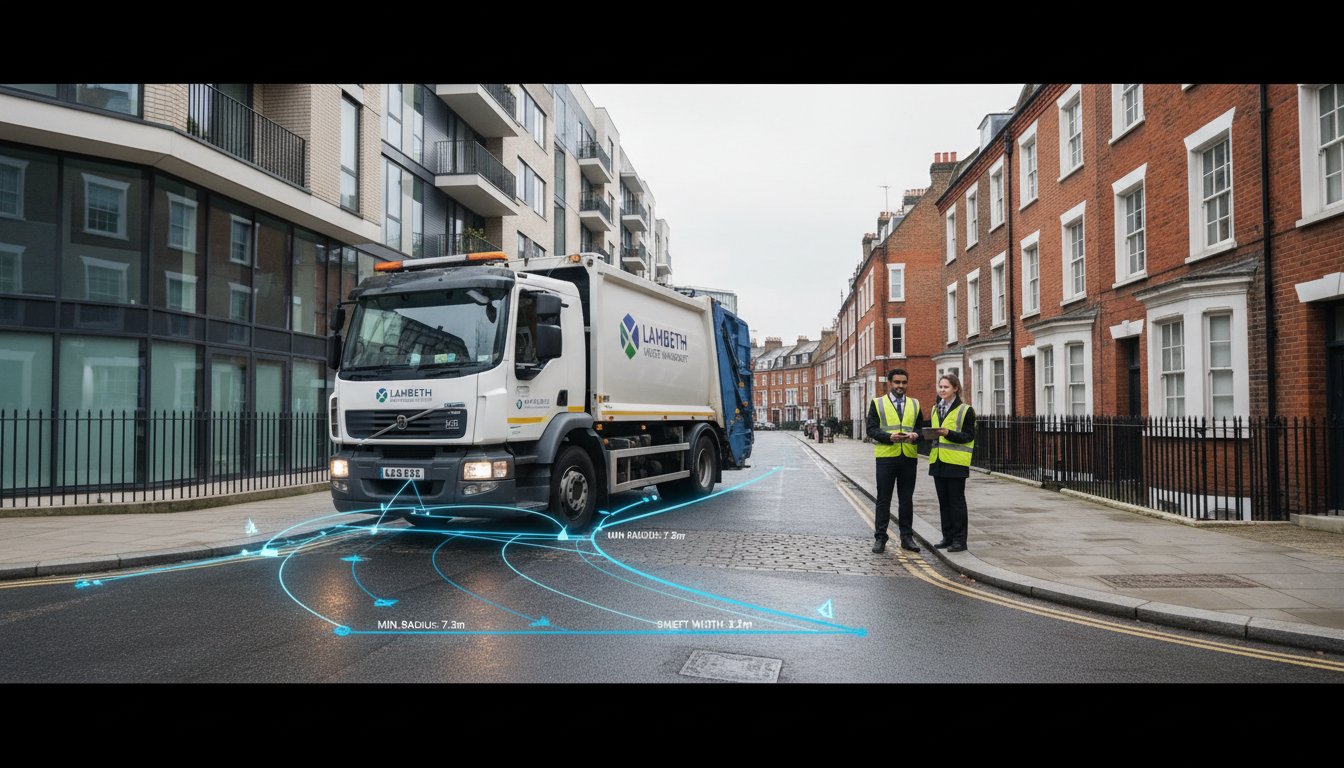
Could a single oversight in your parking survey methodology be the reason your next development faces a costly planning refusal? With Lambeth’s recent £3 million funding injection from Transport for London in March 2026, the borough’s shift toward active travel and bus priority is no longer a suggestion; it’s a strict regulatory mandate. As specialized Transport Planning Consultants Lambeth, we recognize that securing approval requires a hyper-local technical strategy that aligns perfectly with the Lambeth Local Plan 2021-2026.
We understand the logistical strain of managing high PTAL areas that limit parking provision while still ensuring complex urban access for refuse and emergency vehicles. It’s a high-stakes balancing act where precision is a functional necessity. This guide provides the technical clarity you need to master local requirements, from conducting compliant Parking Surveys to executing detailed Swept Path Analysis. We’ll preview the essential reporting steps and the April 2026 national guidance updates to ensure your planning submission is robust, compliant, and ready for immediate approval.
Key Takeaways
- Understand how the Lambeth Local Plan 2021-2026 mandates car-free developments in high PTAL zones and the impact this has on your site’s parking provision.
- Identify whether your project triggers the need for a Transport Statement or a full Assessment by reviewing specific residential and commercial development thresholds.
- Expert Transport Planning Consultants Lambeth ensure your application follows the strict “Lambeth Methodology” for overnight parking stress surveys to avoid technical objections.
- Utilize Swept Path Analysis to prove site feasibility for refuse and emergency vehicles, especially within the constrained urban layouts of Clapham and Stockwell.
- Learn how data-driven reporting and professional Travel Plans reduce regulatory pressure and streamline the path toward a successful planning submission.
The Lambeth Planning Landscape: Transport Policy and Requirements
The Lambeth Local Plan 2021-2026 serves as the primary regulatory framework for all development within the borough. Its transport objectives are uncompromising, prioritizing sustainable growth and the reduction of private vehicle use. For developers, this means traditional parking-led designs are rarely acceptable. Instead, the council enforces a “car-free” or “car-capped” approach for most new projects, particularly those located in high-density areas. Professional Transport Planning Consultants Lambeth are essential for translating these high-level policies into actionable site layouts that meet technical scrutiny.
Effective transportation planning in Lambeth requires more than just meeting minimum standards; it demands an active contribution to the borough’s environmental targets. With Lambeth securing over £3 million in TfL funding in March 2026 to support walking and cycling initiatives, the pressure on developers to provide robust sustainable infrastructure has never been higher. Early engagement with the Lambeth Highway Authority is critical for major developments. It allows us to identify potential site access constraints and traffic impact issues before they become grounds for refusal.
To better understand the borough’s vision for expansion and infrastructure, watch this overview of the Lambeth Growth Plan:
Understanding PTAL Ratings in Lambeth
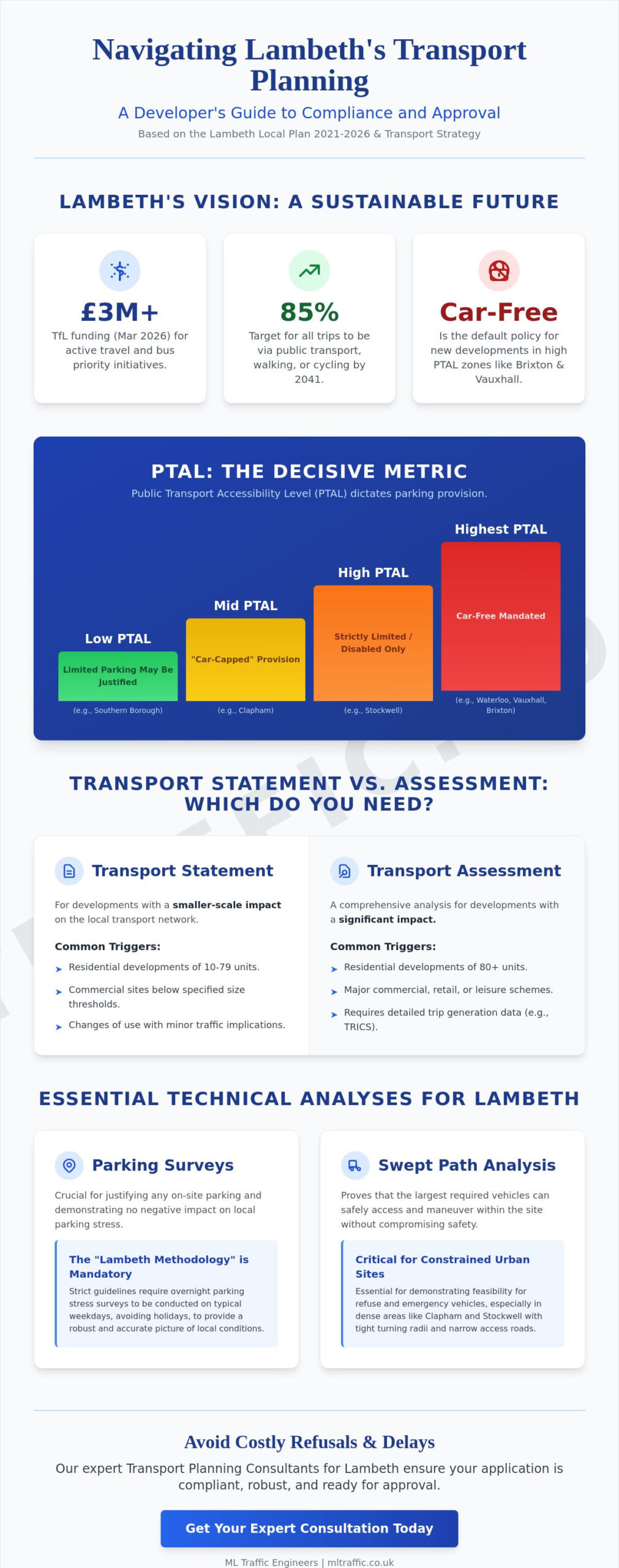
Public Transport Accessibility Level (PTAL) is the decisive metric for development in areas like Brixton, Vauxhall, and Waterloo. These districts often achieve the highest possible scores, which triggers a mandatory restriction on residential parking provision. We help developers navigate these constraints by providing data-driven justifications for site-specific requirements. In the southern, lower PTAL areas of the borough, we use detailed Parking Surveys to demonstrate where limited parking is necessary without compromising local network capacity.
The Impact of the Lambeth Transport Strategy 2019-2040
The Lambeth Transport Strategy sets an ambitious target for 85% of all trips to be made via public transport, walking, or cycling by 2041. Your planning submission must reflect the “Healthy Streets” approach, focusing on air quality and pedestrian safety. We integrate active travel infrastructure into site designs, ensuring that cycle storage and pedestrian pathways are core components of the project. Our role as Transport Planning Consultants Lambeth is to mitigate local traffic impact through precise reporting, ensuring your development supports the borough’s long-term vision while remaining commercially viable.
Transport Statements vs. Assessments: Which Do You Need?
Determining the correct level of reporting is the first step in any successful planning application. The distinction between a Transport Statement and a Transport Assessment depends on the scale of your development and its potential impact on the local highway network. As experienced Transport Planning Consultants Lambeth, we use the TRICS database to provide accurate trip generation forecasts. This data is vital for negotiating S106 and S278 legal agreements, ensuring that developer contributions are proportional to the project’s impact.
The requirements are grounded in Lambeth’s Transport Strategy, which prioritizes sustainable modes over private car use. Since the UK government updated national guidance for Local Transport Plans in April 2026, the emphasis on integrated ticketing and road safety has become even more central to these reports. We provide the technical evidence needed to satisfy the Lambeth Local Plan’s specific development management policies, reducing the risk of costly delays during the consultation period.
When is a Transport Statement Sufficient?
A Transport Statement is typically required for smaller residential developments, often those under 20 units, where the traffic impact is expected to be minimal. These reports focus on accessibility and local transport links rather than complex junction modelling. We ensure every statement covers essential components like parking provision and high-quality cycle storage. If you’re unsure about your project’s scale, learn more about our Transport Statements and how they streamline the approval process for minor works.
Full Transport Assessments for Major Lambeth Projects
Large-scale developments, particularly in high-growth areas like Vauxhall or Nine Elms, trigger the need for a full Transport Assessment. These major projects require sophisticated traffic modelling to analyze the impact on surrounding junctions. Our expertise as Transport Planning Consultants Lambeth ensures that your major project addresses the 23,000 new jobs expected in Waterloo and Vauxhall through comprehensive multi-modal analysis. We manage the full project lifecycle, from initial assessment to ongoing support. For a deeper dive into these requirements, read The Developer’s Guide to Transport Assessments.
Precision in these reports prevents delays and secures your site’s future. If you’re preparing a submission, it’s often beneficial to review our project types to see how we’ve handled similar technical challenges across the borough.
The Lambeth Parking Survey Methodology: Precision for Approval
Generic parking surveys often lead to immediate planning delays or technical refusals in Lambeth. The council requires a specific, evidence-based approach to assess overnight parking stress, known as the Lambeth Methodology. This process is far more rigorous than standard industry practices. As specialized Transport Planning Consultants Lambeth, we manage the full data collection lifecycle to ensure your application meets these precise standards. We recognize that in a high-stakes planning environment, technical accuracy is a functional necessity.
The core of this process is the 200-meter walking distance requirement. Unlike a simple radial line on a map, this measurement follows the actual pedestrian route from the site entrance. Within this defined area, every available on-street parking space must be mapped, categorized, and analyzed. This includes identifying spaces within various Controlled Parking Zones (CPZs) and understanding how their specific operating hours impact potential development overspill. This level of detail is a non-negotiable foundation of Lambeth’s official Transport Strategy, which seeks to manage street capacity without compromising safety.
Conducting an Accurate Lambeth Parking Survey
Lambeth Council mandates two separate overnight surveys to ensure data reliability. These must occur on a Tuesday/Wednesday and a Wednesday/Thursday between 00:30 and 05:30. We meticulously exclude “unusable” spaces, such as those within 10 meters of a junction, across driveways, or at bus stops. Our final report calculates parking stress percentages to the council’s exact standards, providing a transparent view of local capacity. We deliver these results with the readiness and precision required to withstand intense scrutiny from highway officers.
Justifying Parking Provision in High-Density Zones
In high-density urban zones, planning officers often worry that new developments will saturate existing street parking. We use our detailed survey data to prove that local streets can absorb any projected overflow. This technical evidence is vital for projects that do not meet the car-free criteria discussed in the previous sections. By presenting a clear delta between current stress levels and future projections, we mitigate officer concerns and reduce regulatory pressure. Explore our parking survey expertise to see how we translate complex street data into successful planning outcomes.
Our team understands that a single misplaced data point can derail a project. We prioritize clarity and rapid delivery of information, ensuring that your submission remains on schedule. By adhering to these strict benchmarks, we act as a reliable partner that understands intricate regional regulations so that you don’t have to. Our goal is to provide an all-encompassing, fully-managed service that secures your planning approval through technical excellence.
Swept Path Analysis: Ensuring Access in Lambeth’s Urban Fabric
Proving that a site is physically accessible is a prerequisite for any Lambeth planning submission. In high-density areas like Vauxhall, Waterloo, or Brixton, every centimeter of road space is contested. We use Swept Path Analysis (SPA) to simulate vehicle movements through the borough’s narrowest streets, such as those found in Clapham or Stockwell. This technical modelling ensures that proposed developments don’t create gridlock or safety hazards. As Transport Planning Consultants Lambeth, we prioritize precision to reduce regulatory friction and demonstrate site feasibility from the outset.
We use advanced software to track the path of specific vehicle templates against your proposed site layout. This process identifies potential “pinch points” where a vehicle might strike a curb, building, or street furniture. Catching these issues during the design phase helps developers avoid costly redesigns after a planning refusal. Our team provides the technical authority required to reassure highway officers that your project is safe and functional. We manage this process with the readiness and urgency that the industry demands.
Refuse and Emergency Vehicle Access
Lambeth Council enforces strict standards for refuse collection vehicle (RCV) maneuvering. We use specific London-standard templates to prove that a large RCV can safely service your site without multiple-point turns that block traffic. Emergency access is equally critical. We demonstrate compliance with Building Regulations Part B by showing clear, unobstructed paths for fire tenders. This documentation is essential for securing approval in constrained urban settings. For more technical details, see our guide on Securing Approval with Swept Path Analysis.
Designing for Modern Delivery Needs
The rise in online retail has changed how we design residential and commercial access. Modern developments must accommodate frequent van deliveries without obstructing the public highway. We calculate precise turning circles and visibility splays to ensure safe ingress and egress for all users. This data-driven approach allows us to optimize car park layouts and delivery bays, maximizing site value while meeting all highway safety requirements. If you need to prove site feasibility in a constrained location, book a professional Swept Path Analysis to secure your project’s future.
Expert Transport Planning Consultancy in Lambeth: Why Local Knowledge Wins
ML Traffic Engineers provides a level of technical depth that generalist planning firms often cannot match. While generalists offer broad advice, we function as specialized Transport Planning Consultants Lambeth, focusing specifically on the engineering and data requirements that drive planning decisions. Our local presence in London ensures we’re available for urgent site visits and direct liaison with Lambeth Highway Authority officers. This proximity allows our team to respond rapidly to evolving project demands, which is vital in a fast-moving infrastructure environment where timing is everything.
We manage the full project lifecycle, moving from initial feasibility assessments to post-approval support for S278 agreements. Our reports use objective data to anticipate and neutralize the unique objections often raised by Lambeth Council regarding parking stress or vehicle access. If a project moves to an appeal, our data-driven reporting provides the robust technical evidence needed to defend your site layout. We take immense pride in our precision and adherence to standards, acting as a dependable partner so you don’t have to navigate complex regional regulations alone. Our support ensures that any required highway works are designed to adoptable standards from the outset.
A Tailored Approach for Lambeth Developers
Every development requires a strategy that speaks the specific language of local planning officers. We reduce project risk by offering pre-application transport advice, identifying potential hurdles before they lead to formal objections during the consultation phase. This proactive approach ensures that your initial submission is technically sound and aligned with the Lambeth Local Plan. To see how we’ve applied this methodology to diverse sites across the borough, you can view our project types and experience.
Securing Your Planning Approval
Technical precision is the foundation of a successful application in 2026. Minor errors in a parking survey or a flawed swept path analysis often result in costly design revisions and months of avoidable delays. Our Travel Plans complement your submission by demonstrating a clear commitment to the borough’s sustainability goals, helping to mitigate the impact of car-free development mandates. We provide an all-encompassing, fully-managed service that prioritizes your project’s timeline and regulatory compliance. If you’re ready to move forward with a partner who understands the high-stakes nature of London infrastructure, contact ML Traffic Engineers for a Lambeth project quote and ensure your development is backed by expert technical authority.
Securing Technical Approval for Your Lambeth Development
Mastering the intricate requirements of the Lambeth Local Plan 2021-2026 is essential for any developer looking to avoid project delays. As specialized Transport Planning Consultants Lambeth, we provide the technical authority needed to navigate high PTAL constraints and strict parking survey methodologies. Our team delivers data-driven reports that withstand the scrutiny of London Highway Authorities, ensuring your site layout is both compliant and optimized for modern urban needs. We understand that precision is a functional necessity in this high-stakes environment.
We offer a proven track record in executing expert Swept Path Analysis for tight urban sites, proving feasibility where others see obstacles. Our commitment to the specific Lambeth Methodology ensures your submission is robust and ready for immediate review. Don’t leave your planning submission to chance when you can partner with a reliable expert who manages the full project lifecycle. We are ready to provide the technical evidence your project requires. Get a Professional Transport Report Quote for Your Lambeth Project and take the final step toward a successful planning outcome.
Frequently Asked Questions
Do I need a Transport Statement for a small residential conversion in Lambeth?
Yes, you’ll likely need a Transport Statement if your conversion triggers the thresholds set in the Lambeth Local Plan. For smaller projects under 20 units, this report proves that the change in use won’t negatively impact local traffic or pedestrian safety. It focuses on accessibility, cycle storage, and parking provision to ensure your site remains compliant with the borough’s sustainable travel objectives.
What is the Lambeth Methodology for parking surveys?
The Lambeth Methodology is a strict technical standard for assessing overnight parking stress. It requires two separate surveys on consecutive weekday nights, typically Tuesday/Wednesday or Wednesday/Thursday, between 00:30 and 05:30. The survey must cover a 200-meter walking distance from the site entrance. We meticulously exclude unusable spaces near junctions or bus stops to provide the precision planning officers demand.
How does a car-free development policy affect my planning application?
A car-free policy prohibits on-site parking for residents, except for disabled badge holders, in high PTAL areas like Brixton or Vauxhall. Your application must include robust data showing how the project supports the borough’s goal of 85% sustainable mode share by 2041. Professional Transport Planning Consultants Lambeth are essential for justifying these designs and ensuring they meet the council’s strict car-capped development criteria.
Can I use a generic vehicle template for Swept Path Analysis in London?
No, generic vehicle templates are frequently rejected by Lambeth highway officers. You must use specific London-standard templates for refuse collection vehicles and fire tenders to prove site feasibility. Our Swept Path Analysis uses these precise dimensions to identify potential pinch points in narrow streets like those in Clapham. This ensures your site access is safe and functional for the exact vehicles operating in the borough.
What happens if my parking survey shows 100% parking stress?
If your survey shows 100% parking stress, it indicates that local streets are at capacity. Planning officers will likely object to any development that adds further demand to the network. We help you mitigate this risk by proposing car-free legal agreements or optimizing your site layout. These strategies prevent overspill into the surrounding neighborhood and maintain the safety and integrity of the local highway.
How long does it take to prepare a Transport Assessment for Lambeth Council?
Preparing a full Transport Assessment typically takes between four and six weeks. This timeframe allows for detailed site visits, data collection, and any necessary junction modelling for major projects in growth areas like Nine Elms. We prioritize rhythmic efficiency to ensure your reporting is delivered rapidly without compromising technical accuracy. This proactive approach helps you avoid costly delays during the planning consultation period.
Does Lambeth require a Travel Plan for all new developments?
No, Lambeth only requires a full Travel Plan for major developments or projects with significant transport implications. These plans outline specific measures to encourage walking, cycling, and public transport use among site users. For smaller developments, a shorter Travel Plan Statement might be sufficient. We provide the technical evidence needed to satisfy these requirements and reduce the regulatory pressure on your planning submission.
What is the role of a Section 278 agreement in my transport planning?
A Section 278 agreement is a legal contract that allows you to make permanent alterations to the public highway as part of your development. This includes creating new site entrances or improving pedestrian crossings to meet safety standards. We provide the expert reporting and technical data required to secure these agreements. Our support ensures all highway works are designed to adoptable standards from the very beginning.

Disclaimer
The content on mltraffic.co.uk, including all technical articles, guides, and resources, is provided for general informational and educational purposes only. It is not intended to constitute professional advice in traffic engineering, transportation planning, development approvals, or any other technical or legal field.
While ML Traffic Engineers makes every reasonable effort to ensure the accuracy, completeness, and timeliness of the information published, we do not provide any warranties or representations (express or implied) regarding its reliability, suitability, or availability for any particular purpose. Any reliance you place on the content is strictly at your own risk.
In no event shall ML Traffic Engineers, its directors, employees, authors, or affiliates be liable for any direct, indirect, incidental, special, consequential, or punitive damages (including, without limitation, loss of profits, data, or business opportunities) arising out of or in connection with the use of, or inability to use, any information provided on this website.
The articles and guides on this site are not a substitute for engaging a qualified, professional traffic engineer to assess your specific project requirements. For tailored advice, compliance assessments, or traffic engineering services, please contact a competent professional.
This disclaimer may be updated from time to time without notice. By accessing or using this website, you agree to be bound by the most current version of this disclaimer.