
What if the difference between your project breaking ground and getting stuck in a multi-month regulatory deadlock was a single technical report? You already know that securing planning permission is becoming more expensive and complex, particularly following the 3.8% increase in planning application fees across England on April 1, 2026. It’s common to feel the pressure when local councils suddenly demand intricate data or when you’re forced to navigate the confusion between consumer journey apps and a professional transport planner who understands the law.
You deserve a clear path to approval without the friction of unexpected technical hurdles. This guide shows you how a transport planner acts as a strategic risk-mitigator to secure your approvals and protect your bottom line. We will examine how specialized services like Swept Path Analysis and Transport Statements ensure your site access is safe and compliant with the latest 2026 standards. By the end of this guide, you’ll understand how to leverage technical expertise to avoid costly design revisions and keep your project moving forward at pace.
Key Takeaways
- Identify the specific role of a professional transport planner in translating complex regulatory requirements into technical reports that secure planning approval.
- Differentiate between Transport Statements and comprehensive Transport Assessments to ensure your application meets the exact evidentiary standards of the local authority.
- Utilize digital tools like Swept Path Analysis to provide definitive proof of safe site access and avoid expensive design revisions late in the project lifecycle.
- Navigate the technical complexities of Section 278 and Section 106 agreements with precision to mitigate development risks and manage infrastructure impacts.
- Leverage data-driven Parking Surveys and Traffic Surveys to address council objections regarding local network capacity and site viability.
Table of Contents
What is a Transport Planner? (And Why Developers Need One)
A transport planner acts as a technical bridge between your architectural vision and the regulatory requirements of the local highway authority. This role isn’t about deciding where a new train line should go. Instead, it focuses on providing the robust technical evidence needed to prove that your specific development won’t negatively impact road safety or local congestion. They assess how a project integrates with the existing network, ensuring that site access is safe and the infrastructure can handle the increased demand.
To better understand this concept, watch this helpful video:
Professional transportation planning involves a rigorous cycle of data collection, traffic modelling, and the preparation of statutory reports. This work is entirely distinct from consumer-facing tools like TfL’s journey planners. While a journey app helps a commuter find the quickest route, a professional consultant uses specialized CAD software and TRICS data to prove that a refuse vehicle can safely maneuver within your site boundaries. They translate raw data into the technical language that council planning officers require for approval.
The Role in the Planning Application Process
In the context of a planning application, your transport planner serves as an expert witness. They handle technical scrutiny from council officers and provide the data required by the National Planning Policy Framework (NPPF). This involves liaising directly with Highway Authorities to agree on mitigation measures, ensuring that transport-related queries don’t stall your project. By providing this technical evidence early, you reduce the risk of late-stage objections that could derail your construction timeline or lead to expensive design changes.
Consultancy vs. Public Sector Planning
It’s vital to distinguish between public sector planners and private consultants. Public sector planners work for the local authority to set regional transport policy and manage the wider network. Private consultants, however, focus exclusively on the developer’s needs. They help you navigate specific council standards and use independent data to challenge unreasonable or outdated demands from local authorities. A transport planning consultant is a strategic partner who ensures your development remains viable, safe, and fully compliant with current legislation.
Key Deliverables: Transport Statements and Assessments
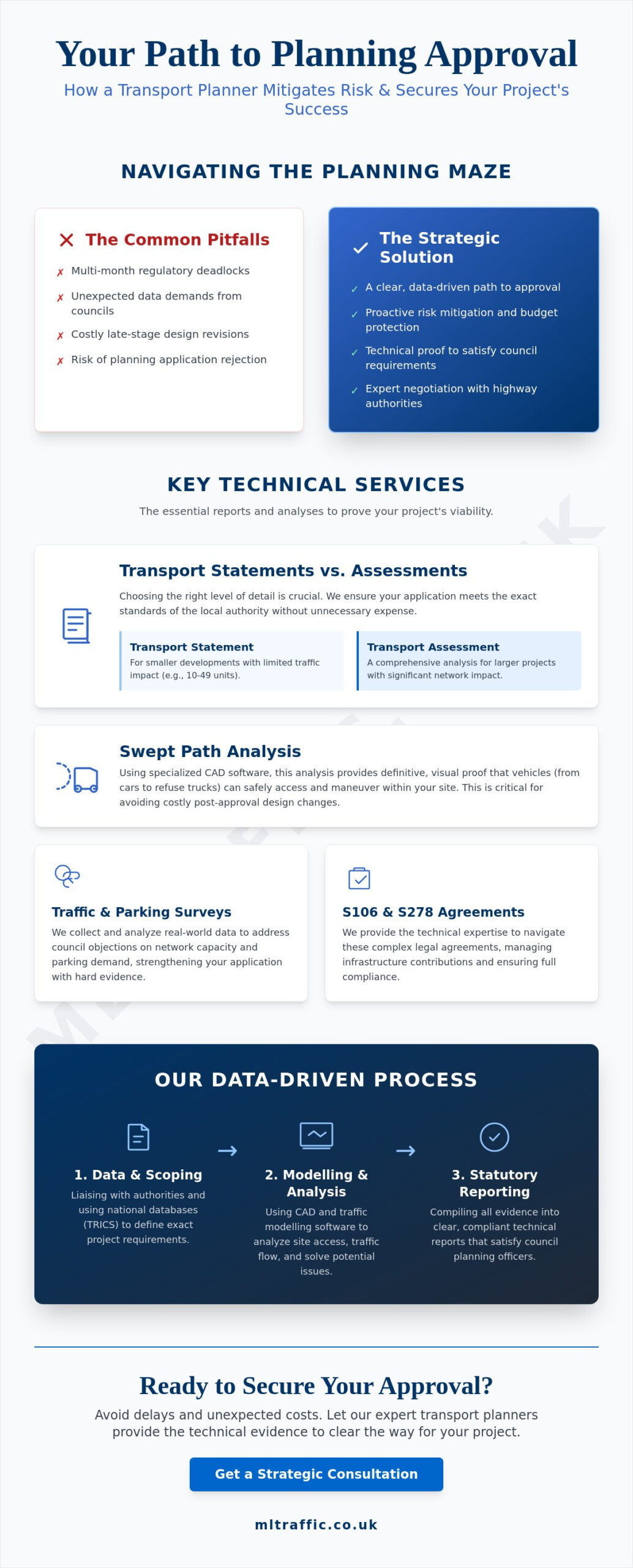
A transport planner produces the specific technical documentation required for every stage of a planning application. The scale of your development determines the depth of reporting needed. Smaller projects with limited traffic implications typically require a Transport Statement. Larger developments that could significantly impact the local network necessitate a full Transport Assessment. Both types of documents rely on the TRICS database. This national system allows consultants to predict trip generation by comparing your project to similar land uses across the UK. By using this data, your consultant provides a realistic forecast of the volume of vehicles, cyclists, and pedestrians your site will attract.
Choosing the Right Report for Your Project
Selecting the correct report depends on specific thresholds set by individual local authorities. While official government guidance provides a general framework, councils often apply stricter requirements in dense urban environments. For residential developments, a Transport Statement is often the standard for 10 to 49 units, but these figures can change based on local policy. Engaging a professional early for a scoping study can prevent you from over-investing in a full assessment when a simpler statement would suffice. You can review our resources to understand how these technical requirements apply to your specific project type.
Sustainable Travel and Travel Plans
Modern planning success in 2026 relies heavily on sustainable transport strategies. A Travel Plan is no longer an optional extra; it is a vital tool to encourage active travel and reduce reliance on private cars. Since the electric vehicle exemption for the London Congestion Charge ended in late 2025, the focus has shifted toward infrastructure readiness. Your reports must now detail active EV charging points and high-quality cycle parking to meet the 100% provision mandate for new residential spaces. A robust plan can effectively offset concerns about traffic volume by demonstrating a clear commitment to reduced vehicle usage.
Securing your planning approval requires precision in these technical reports. If you’re unsure which document your project needs, reviewing our technical services can help clarify the requirements for your next submission. A transport planner ensures your data is accurate and compliant from the first draft.
Technical Analysis: Proving Site Viability
Technical analysis transforms a conceptual design into a viable, functional site. While previous sections focused on the strategic reports required for submission, this stage involves the raw data that proves those reports are accurate. A transport planner utilizes advanced modelling software and on-site observations to ensure every vehicle, from a standard car to a 12-meter refuse truck, can navigate the proposed layout. This precision reduces the risk of the council rejecting a scheme based on perceived safety or access issues. It moves the conversation from abstract policy to physical reality.
The Power of Swept Path Analysis
Swept Path Analysis (SPA) is the cornerstone of modern site design. By simulating the movement of specific vehicles on your digital site plans, we identify potential pinch points before they become physical obstacles. This is particularly critical for emergency services access. If a fire tender cannot reach the furthest point of your development, the scheme will fail its safety assessment. Utilizing professional Swept Path Analysis services provides the definitive evidence needed to satisfy these safety requirements. This proactive approach prevents the need for expensive structural changes or road widening once construction has already begun.
Parking Surveys and the Lambeth Methodology
High-density urban developments often face intense scrutiny regarding parking capacity. To justify a specific parking ratio, we conduct comprehensive Parking Surveys. Following the Lambeth Methodology, these overnight surveys establish the exact level of parking stress on surrounding streets. This data is essential when proposing car-free developments in areas with high Public Transport Accessibility Levels (PTAL). It demonstrates that the development won’t cause overspill parking that inconveniences existing residents or compromises road safety. Accurate surveys are the only way to challenge council assumptions about local parking availability.
Establishing the baseline environment also requires real-world Traffic Surveys. We measure vehicle speeds and volumes to determine the precise dimensions of visibility splays at new junctions. A visibility splay is the unobstructed view a driver needs to see oncoming traffic before pulling out. These sightlines must adhere to strict safety standards to prevent collisions. This level of technical rigor is a core responsibility within the Transport planner job profile, ensuring that every project contributes to a safer and more efficient highway network.
Navigating Regulatory Hurdles: S278 and Local Authorities
Securing planning approval is only half the battle. Once technical viability is proven through analysis and surveys, a transport planner must navigate the legal frameworks that govern physical changes to the road network. Most developers encounter Section 278 (S278) agreements when their project requires modifications to the existing public highway. These agreements ensure that any changes, such as a new junction or pavement widening, meet the strict safety and construction standards of the local authority. Without this technical oversight, projects risk significant delays or refusal during the later stages of the planning process.
Section 106 contributions also play a major role in the financial feasibility of a development. These are legally binding obligations used to mitigate the impact of a project on the wider transport infrastructure. A planner acts as your advocate, ensuring that requested contributions are proportionate and directly related to the development’s actual impact. They facilitate direct liaison with National Highways and local authorities to reach a technical consensus that protects your project’s timeline and budget.
Understanding Highway Design Agreements
It’s essential to distinguish between S278 and Section 38 (S38) agreements. While S278 covers works on the existing public highway, S38 relates to the adoption of entirely new roads built within the development site. A planner ensures that the technical design of these roads meets the council’s specific adoption standards from the outset. For a detailed breakdown of these requirements, read our Highway Design S278 & S38 Guide. This early alignment prevents the council from refusing to adopt the roads later, which would leave the developer with long-term maintenance liabilities.
Pre-application Advice and Negotiation
Risk mitigation starts long before the formal submission. Engaging a transport planner for pre-application discussions allows for early negotiation with council officers to find a technical middle ground on complex issues like site access or parking ratios. These early meetings provide an opportunity to address potential concerns in a collaborative environment rather than a confrontational one. Early engagement prevents "objection" letters from statutory consultees that can otherwise stall an application for months. This proactive liaison ensures that the final submission is already aligned with the highway authority’s expectations.
If you’re preparing a new submission and need to navigate these regulatory requirements, view our project types to see how ML Traffic Engineers UK manages these legal agreements for developers.
Why Choose ML Traffic Engineers UK for Your Transport Planning?
Choosing the right transport planner is a critical decision for any developer. At ML Traffic Engineers UK, we provide specialized expertise in the English planning system, with a deep understanding of the evolving London-specific requirements. As of May 2026, motor vehicle traffic volumes have reached 105% of pre-COVID levels. This increase makes accurate data more essential than ever for securing approvals. We utilize a data-driven approach, leveraging the latest TRICS data and CAD-based Swept Path Analysis to deliver reports that withstand the highest levels of scrutiny. Our proven track record spans residential, commercial, and mixed-use developments, ensuring that your project benefits from our extensive industry knowledge.
You gain direct access to senior consultants who prioritize rapid response and professional reassurance. In a high-stakes regulatory environment, precision is a functional necessity. We don’t just provide reports; we act as a reliable partner throughout the entire project lifecycle. Our team understands intricate regional regulations, such as the 2026 mandates for 100% EV charging access in residential developments. We handle these complexities so you don’t have to navigate them alone.
Comprehensive Project Lifecycle Support
Our support begins at the initial site feasibility stage and continues through to final planning sign-off. We produce tailored reporting that speaks the technical language of local authority planning officers, reducing the risk of friction during the application process. Whether we are conducting complex Parking Surveys or detailed Traffic Surveys, our focus remains on precision. This commitment ensures public safety and full regulatory compliance, protecting your project from costly delays. We manage the technical lexicon and industry benchmarks so you can focus on the broader architectural vision.
Get Started with Your Transport Statement
Initiating your technical assessment is a straightforward process. To provide an accurate quote for your specific development type, we typically require a site location plan and a clear description of the project scale. This information allows us to determine whether a Transport Statement or a more comprehensive Transport Assessment is the most appropriate deliverable. We value your time and understand the fast-moving nature of the infrastructure industry. By providing an all-encompassing, fully-managed service, we ensure your submission is robust from day one.
Contact ML Traffic Engineers UK for your Transport Planning needs to discuss your next project and secure professional technical support today.
Secure Your Development’s Future with Technical Precision
Securing planning approval requires more than just a vision; it demands technical accuracy and a deep understanding of highway regulations. By integrating robust data from the outset, you protect your project from the high-stakes risks of regulatory delays and late-stage design changes. A professional transport planner acts as your primary advocate, translating complex traffic modelling and site constraints into the technical reporting that local authorities demand.
Since our foundation in 2014, ML Traffic Engineers UK has delivered over a decade of planning success for developers navigating London Borough and National Highway requirements. Our comprehensive toolkit, including advanced Swept Path Analysis and TRICS trip generation data, ensures your submission is compliant and safe. We provide the technical authority needed to satisfy strict 2026 standards, from EV charging mandates to active travel targets.
Don’t let technical transport data requests stall your project’s progress. Secure your planning approval with expert Transport Planning from ML Traffic Engineers UK. Our team is ready to provide the precision and reliability your development needs to move forward with confidence.
Frequently Asked Questions
What is the difference between a transport planner and a traffic engineer?
A transport planner focuses on the strategic assessment, modeling, and reporting required to secure planning permission. They analyze how a development impacts the wider network and ensure compliance with transport policy. A traffic engineer typically handles the detailed design and technical engineering of physical infrastructure, such as junction geometry or traffic signal timings. While their roles overlap, the planner’s work is centered on the impact analysis phase of the project lifecycle.
When is a Transport Statement required for a planning application in England?
A Transport Statement is typically required for residential developments consisting of 10 to 49 units. However, local highway authorities in dense urban areas often set lower thresholds based on local network capacity. You should check the specific validation requirements of your local council, as they may demand a statement for smaller projects if the site is in a sensitive location or has complex access requirements.
How much does a professional transport planner cost?
Fees for a professional transport planner are determined by the complexity of the project and the specific deliverables required, such as Traffic Surveys or Swept Path Analysis. A comprehensive Transport Assessment involves more extensive modeling and data analysis than a Transport Statement, which impacts the overall project budget. We recommend requesting a tailored quote based on your site’s specific constraints and the local authority’s requirements.
Can a transport planner help with a refused planning application?
Yes, a planner is vital when a project is refused on highway or transport grounds. They analyze the council’s reasons for refusal and provide the technical evidence, such as revised Parking Surveys or improved access designs, to address those specific concerns. This evidence is essential for a successful resubmission or to support a formal planning appeal by proving the development is safe and viable.
What is the TRICS database and why do planners use it?
TRICS stands for the Trip Rate Information Computer System. It is the national standard database used to predict the number of trips a new development will generate. Planners use this data to provide a realistic forecast of vehicle, pedestrian, and cyclist movements by comparing your project to similar land uses across the UK. This ensures the local network can accommodate the additional demand without compromising safety.
Do I need a transport planner for a small residential conversion?
Small residential conversions don’t always require a full assessment, but they often trigger requests for a Parking Survey or a short Transport Statement. If your conversion is located in a high-density area with existing parking stress, the council will likely need technical proof that the new residents won’t negatively impact local street capacity. Providing this data early prevents the council from stalling your application with last-minute requests.
What is Swept Path Analysis and is it mandatory?
Swept Path Analysis is a digital simulation that proves specific vehicles can safely enter, maneuver within, and exit a site. While not mandatory for every single application, it’s almost always required when a development involves new access points or internal roads. Councils use it to verify that refuse trucks and fire tenders can operate without hitting curbs or buildings, ensuring the site meets essential safety standards.
How long does it take to produce a Transport Assessment?
Producing a full Transport Assessment typically takes several weeks, though this timeline depends on the scale of the project and the availability of data. If new Traffic Surveys or complex modeling are required, the process may take longer to ensure all information is accurate and compliant. Early engagement ensures that these technical reports are ready well before your submission deadline, reducing the risk of project delays.
Which areas in London do you cover?
We service Acton, Balham, Barking, Barnes, Barnet, Battersea, Beckenham, Bexleyheath, Brentford, Brixton, Bromley, Camberwell, Carshalton, Charlton, Chelsea, Chiswick, Clapham, Coulsdon, Croydon, Crystal Palace, Dagenham, Dulwich, Ealing, Edgware, Eltham, Enfield, Finchley, Forest Gate, Fulham, Golders Green, Greenwich, Hackney, Hammersmith, Hampstead, Harrow, Hayes, Highgate, Hounslow, Ilford, Islington, Kensington, Kentish Town, Kingston upon Thames, Lewisham, Mitcham, Muswell Hill, New Malden, Notting Hill, Orpington, Peckham, Pinner, Purley, Putney, Richmond, Romford, Ruislip, Sidcup, Southall, Southgate, Streatham, Surbiton, Sutton, Tooting, Tottenham, Twickenham, Uxbridge, Walthamstow, Wembley, West Norwood, Wimbledon, Wood Green, Woolwich, Bethnal Green, Shoreditch, Canary Wharf, Deptford, Leyton, Palmers Green, Stanmore, Upminster, Chislehurst, Erith, Feltham.
Which cities in England do you cover?
We service London, Birmingham, Manchester, Liverpool, Sheffield, Leeds.

Disclaimer
The content on mltraffic.co.uk, including all technical articles, guides, and resources, is provided for general informational and educational purposes only. It is not intended to constitute professional advice in traffic engineering, transportation planning, development approvals, or any other technical or legal field.
While ML Traffic Engineers makes every reasonable effort to ensure the accuracy, completeness, and timeliness of the information published, we do not provide any warranties or representations (express or implied) regarding its reliability, suitability, or availability for any particular purpose. Any reliance you place on the content is strictly at your own risk.
In no event shall ML Traffic Engineers, its directors, employees, authors, or affiliates be liable for any direct, indirect, incidental, special, consequential, or punitive damages (including, without limitation, loss of profits, data, or business opportunities) arising out of or in connection with the use of, or inability to use, any information provided on this website.
The articles and guides on this site are not a substitute for engaging a qualified, professional traffic engineer to assess your specific project requirements. For tailored advice, compliance assessments, or traffic engineering services, please contact a competent professional.
This disclaimer may be updated from time to time without notice. By accessing or using this website, you agree to be bound by the most current version of this disclaimer.