Author: adminmltuk

  • Traffic Engineer In Chingford Mount: Planning-Led Transport Support For Faster, Stronger Applications In 2026

    Traffic Engineer In Chingford Mount: Planning-Led Transport Support For Faster, Stronger Applications In 2026

    A planning application can look perfectly sensible on paper and still run into trouble once transport is examined properly. In Chingford Mount, that happens more often than many teams expect. A modest infill scheme, a shopfront change with servicing implications, or a small residential intensification can all trigger questions about access, parking stress, safety, bus movements, or network impact. And because the area sits within a busy urban setting shaped by local shops, schools, controlled parking pressures, and strategic movement corridors, those questions tend to arrive early.

    That’s why a traffic engineer in Chingford Mount is rarely just a box-ticking consultant. We help turn transport risk into planning evidence: clear reports, realistic trip analysis, practical mitigation, and technical responses that fit the expectations of the London Borough of Waltham Forest, Transport for London, and wider London policy. For architects, planners, developers, solicitors, and surveyors, that usually means fewer surprises, better coordinated submissions, and a stronger chance of moving through consultation without avoidable objections.

    The key is not producing a long report for the sake of it. It’s knowing what matters locally, what can be scoped proportionately, and how to present transport issues in a way decision-makers can trust. That is where experienced, planning-led traffic engineering makes a real difference.

    Key Takeaways

    • A traffic engineer in Chingford Mount plays a crucial role in addressing local transport concerns early, helping to prevent planning delays due to access, parking, or safety issues.
    • Transport assessments should be proportionate and tailored to the London Borough of Waltham Forest’s specific policies, focusing on practical impacts rather than generic data.
    • Residential and commercial developments alike require detailed analysis of trip generation, parking demand, servicing arrangements, and pedestrian and cycle access to ensure smooth integration into the busy urban environment.
    • Providing clear, concise, and locally relevant transport reports increases trust with planning officers and consultees, improving the chances of approval and reducing objections.
    • Choosing a traffic engineer with proven London experience, knowledge of local nuances, and strong communication skills is essential for successful planning support in Chingford Mount.

    Why A Traffic Engineer Matters For Projects In Chingford Mount

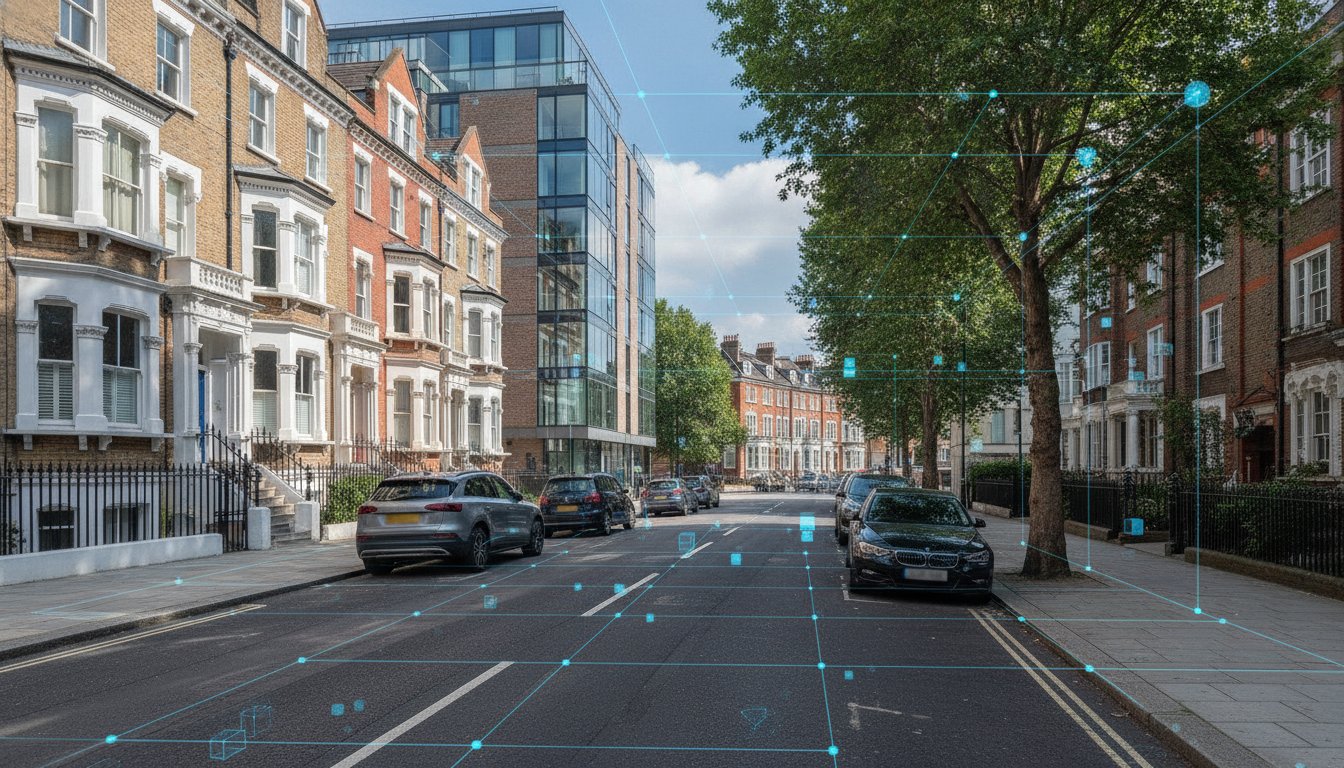
    Traffic engineer reviewing street access and transport plans in Chingford Mount.

    Chingford Mount isn’t a place where transport issues stay theoretical for long. The street environment is active, constrained, and sensitive to change. Bus routes, local retail activity, school travel patterns, side-road parking demand, and established residential streets all mean even relatively small schemes can have noticeable effects on daily movement.

    For planning teams, that creates a familiar problem: a development may appear modest in scale, but the local highway authority can still ask detailed questions about how people arrive, where deliveries stop, whether refuse collection works safely, and what happens to already-pressured parking stock. We often find that the difference between a smooth application and a delayed one is not the size of the scheme, but whether those questions were anticipated early.

    A traffic engineer in Chingford Mount helps by testing assumptions before they become objections. We review likely trip generation, access geometry, visibility, servicing practicality, pedestrian routes, cycle provision, and public transport context. That evidence then feeds directly into a Transport Statement, technical note, or design amendment.

    In practice, this planning-led role is broader than many expect. It sits somewhere between highway design, land-use planning, and strategy. Our work often mirrors the discipline explained in broader Traffic Engineering Consultants: guidance, but applied to the sharper realities of a London borough review process.

    And importantly, we’re not only writing reports after a design is fixed. The strongest results usually come when transport advice informs the scheme while layouts are still flexible.

    Local Planning And Highway Considerations That Shape Transport Advice

    Traffic engineer reviewing local road planning data in a modern office.

    Transport advice in Chingford Mount is shaped by several overlapping layers: the London Plan, local planning policy in Waltham Forest, TfL expectations where relevant, and technical standards such as Manual for Streets, cycling guidance, and inclusive access principles. That sounds dry. But in reality, these frameworks determine what the authority is likely to focus on and how robust your evidence needs to be.

    One recurring issue is proportionality. Not every site needs a full Transport Assessment. But not every “small” scheme can rely on a short letter either. A change in use near a busy frontage, a residential proposal with limited on-site parking, or a scheme affecting a main road can quickly justify more detailed analysis. Knowing where that threshold sits locally is one of the most valuable parts of the job.

    Another key consideration is context. PTAL levels, nearby bus services, school streets, controlled parking arrangements, collision history, pedestrian crossing opportunities, and junction sensitivity all influence what a professional assessment should cover. Queueing at a nearby junction may matter. So might overspill parking on side roads, step-free access to the entrance, or whether delivery activity would conflict with peak-time kerbside demand.

    For teams working across multiple regions, local nuances can be easy to miss. London authorities often expect a different level of transport narrative and policy alignment than less constrained areas. That’s why cross-city experience helps, whether we are preparing a site-specific note in Chingford Mount or drawing on lessons from wider Traffic Engineer In London: planning support.

    Good advice is never copied in from another borough. It is shaped around the actual street, the actual proposal, and the actual planning risks.

    Common Schemes That Need Traffic Engineering Input

    Traffic engineer reviewing urban site access and parking plans in Chingford Mount.

    Not every planning application needs detailed transport work, but a surprisingly wide range of projects benefit from it. In Chingford Mount, the trigger is often less about headline floor area and more about practical impact: extra vehicle trips, servicing constraints, tighter access arrangements, parking pressure, or concern from neighbours and consultees.

    We’re regularly involved where a proposal changes how a site functions rather than simply how it looks. A new access point, a revised refuse strategy, the loss of informal parking, or an increase in delivery activity can all justify transport input. The earlier those matters are tested, the easier it is to refine the scheme before submission.

    That is particularly true on urban sites with limited margins. If a design only “just works” for turning, visibility, loading, or cycle parking, it needs evidence. If it doesn’t yet work, it needs revision before the planning authority says so.

    Below are the types of schemes where traffic engineering input most often proves valuable in Chingford Mount.

    Residential Developments

    Residential schemes are a major part of transport work in Chingford Mount. That includes infill houses, small apartment blocks, backland plots, conversions, HMOs, and prior approval proposals where transport still needs to be addressed clearly.

    The issues tend to be familiar, but never identical. Will the site generate a meaningful increase in trips? Is on-site parking sufficient, excessive, or contrary to policy expectations? Could overspill affect neighbouring streets already under pressure? Are cycle stores convenient enough to be used in real life, not just compliant on a drawing? Can refuse vehicles operate without awkward reversing or obstruction?

    For flatter, central-looking schemes, teams sometimes assume the transport case will be easy. Yet local objections often focus on parking stress and road safety rather than strategic traffic growth. That means survey work, parking beat analysis, and a realistic understanding of resident travel behaviour can matter as much as formal junction modelling.

    We also consider family housing differently from studio-led schemes, and car-free or low-parking proposals differently from suburban formats. Household composition, accessibility to buses and local services, and the availability of controlled parking all influence the right transport response.

    Where a development team wants a proportionate but credible evidence base, our role is to frame the residential transport story properly: not over-engineered, not undercooked, and aligned with the authority’s likely concerns.

    Commercial, Mixed-Use, And Community Schemes

    Commercial and community uses often create more transport complexity than their floor area suggests. A small takeaway can have a very different impact from a small office. A nursery may generate sharp peak-time drop-off pressures. A place of worship can create short-duration surges that standard weekday assumptions miss. And mixed-use schemes add overlap between resident, staff, visitor, and servicing movements.

    In Chingford Mount, where local frontages and residential streets sit close together, those details matter. We typically examine arrival profiles, delivery needs, refuse arrangements, short-stay parking demand, disabled access, and whether activity spills onto the public highway at the wrong times.

    For retail and service uses, kerbside management is often the hidden issue. If there is no safe, practical place for loading, the planning debate can shift quickly from land use to highway harm. The same goes for schools, health uses, and small industrial premises where operational patterns need to be understood properly.

    This is where focused technical input adds value. Our approach to Commercial Traffic Engineering is usually about operational realism: who comes, when they come, how they move through the site, and what mitigation is actually deliverable. Broad assumptions aren’t enough when councillors, residents, and officers are all asking practical questions.

    What A Traffic Engineer In Chingford Mount Can Prepare

    The output depends on the scale of the proposal, the site context, and what the planning authority is likely to request. Sometimes the right answer is a concise technical note addressing access and parking. Sometimes it is a fuller evidence package with surveys, trip analysis, collision review, drawings, and a Travel Plan.

    A traffic engineer in Chingford Mount should be able to scope that package efficiently. Over-reporting wastes time and budget. Under-reporting can delay validation or trigger highways objections that are harder to answer later. The aim is a submission that is proportionate, credible, and tailored to Waltham Forest’s review process.

    At ML Traffic, that usually means producing concise technical material quickly, but not generically. With more than 30 years of experience behind our work, we focus on reports that planning officers, highway consultees, and design teams can actually use. In some cases that is a standalone statement. In others, it is a response to consultee comments or a package supporting amended drawings.

    The most common deliverables are set out below.

    Transport Statements, Transport Assessments, And Travel Plans

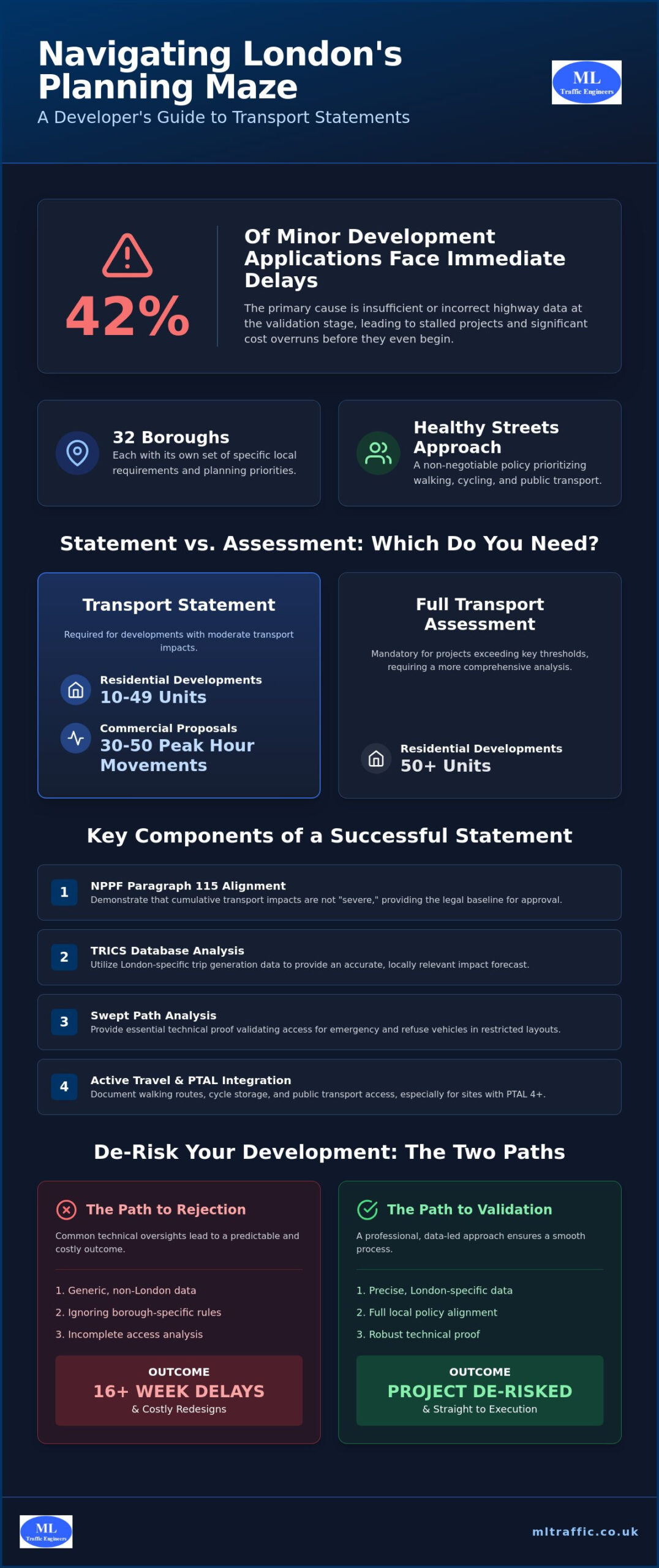
    Transport Statements and Transport Assessments are the backbone of most planning-related traffic engineering work. The distinction is usually one of scale and complexity. A Transport Statement tends to provide a concise, evidence-based review of likely impacts and mitigation for smaller or less intensive schemes. A Transport Assessment goes further, often including more detailed forecasting, junction analysis, multi-modal review, and technical appendices.

    In Chingford Mount, either document may need to cover site accessibility, PTAL context, trip generation, trip distribution, local highway conditions, collision history, parking, servicing, and sustainable travel opportunities. The best reports are selective. They deal with the issues that matter rather than padding out pages with national text that adds little.

    Travel Plans are also common, particularly for schemes with staffing, visitors, school travel, or larger residential occupation. Depending on the project, the authority may accept an interim, framework, or full Travel Plan. Effective versions include realistic measures, monitoring arrangements, and targets that reflect the actual site. Promising dramatic mode shift with no mechanism behind it rarely convinces anyone.

    Where policy alignment is important, we often position these reports within a wider Traffic Engineering: Your Complete understanding of safer access and smarter planning, while keeping the final document tightly focused on the site itself.

    Highway Technical Notes, Swept Path Analysis, And Parking Reviews

    Not every scheme requires a full transport report. Many need targeted technical work instead, especially where the design challenge is specific. That might be a difficult access, a constrained yard, a turning issue for refuse vehicles, or concern about local parking capacity.

    Highway technical notes are often used to respond to consultee queries, justify design amendments, or provide additional evidence after submission. When done well, they are short, direct, and persuasive. They address the exact point raised by the authority rather than reopening the whole transport case.

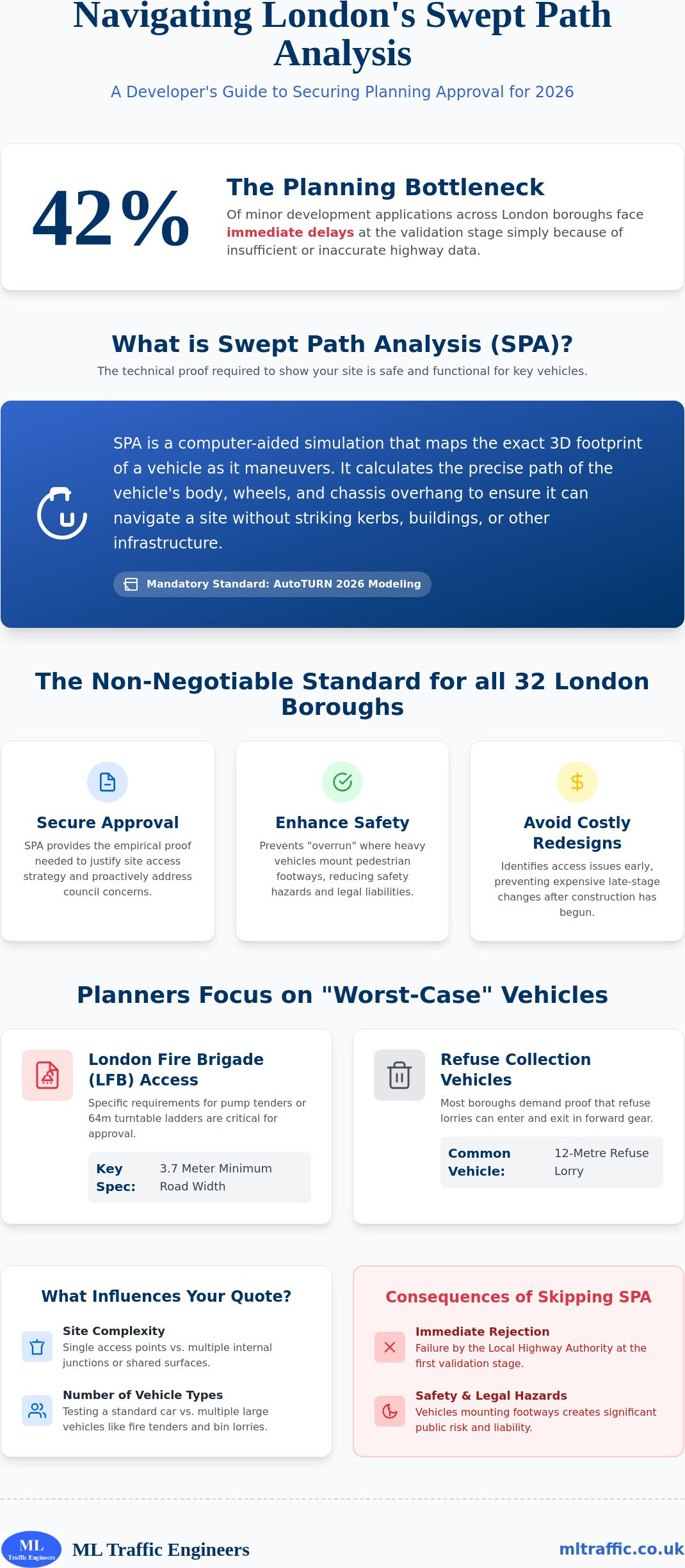
    Swept path analysis is essential where vehicle movements are tight or unusual. We commonly test cars, vans, refuse wagons, fire appliances, and delivery vehicles to show that access and turning can occur safely without overrunning footways, striking street furniture, or relying on unrealistic manoeuvres. On constrained urban sites, a simple drawing can settle an argument that pages of text won’t.

    Parking reviews are another frequent requirement. These can include on-street beat surveys, parking stress calculations, layout reviews, disabled bay provision, and cycle parking design checks. In dense London locations, parking is often the issue residents care about most, so weak evidence here can undermine an otherwise sound planning case.

    We sometimes support these tasks as part of a broader Traffic Engineer In style planning workflow: diagnose the exact transport risk, answer it directly, and avoid unnecessary technical bulk.

    How Traffic Assessments Support Planning Applications

    A good traffic assessment does more than describe a site. It reduces uncertainty for decision-makers. Planning officers, highway engineers, committee members, and sometimes inspectors want evidence that a proposal has been tested properly and that any transport effects are understood, manageable, and policy-compliant.

    That support works in several ways. First, the assessment quantifies likely demand: how many person trips and vehicle trips the development could generate, at what times, and by which modes. Second, it tests consequences: whether nearby junctions, accesses, crossings, or parking conditions are likely to be affected materially. Third, it explains mitigation: design features, management measures, servicing arrangements, or sustainable travel steps that reduce risk.

    Just as importantly, a transport assessment gives the wider consultant team a common reference point. Architects can adjust layouts. Planning consultants can shape the statement and anticipate objections. Solicitors and developers can understand what obligations or conditions may be realistic. That coordination often saves far more time than the report itself takes to prepare.

    In London boroughs, concise clarity is valuable. Officers are not looking for theatrics: they are looking for competent, defensible judgement. That is why we favour direct evidence, transparent assumptions, and plain-English conclusions.

    Teams with portfolios beyond the capital often recognise the same principle from comparable urban work such as Traffic Engineer In Birmingham: robust local analysis is what strengthens applications, not generic transport language.

    Key Transport Issues Often Reviewed By Local Authorities

    When local authorities review a planning application, transport comments usually cluster around a fairly consistent set of themes. The exact emphasis changes from scheme to scheme, but the core questions remain: how many trips will be created, where will they go, can the local network cope, is the layout safe, and does the proposal support sustainable movement rather than simply adding pressure to an already constrained street?

    For Chingford Mount projects, those issues are sharpened by the local urban grain. Junctions can be sensitive even where the strategic impact appears limited. Parking pressure can become politically significant. A servicing arrangement that looks acceptable on a plan may not work once street activity, school peaks, and bus operations are considered.

    The authority is hence likely to look beyond headline traffic growth and examine whether the proposal functions well day to day. Evidence needs to answer that practical question, not just satisfy a policy checklist.

    The two sub-areas below are where review comments most often concentrate.

    Trip Generation, Junction Impact, And Road Safety

    Trip generation is usually the starting point. We estimate the number of person and vehicle movements likely to be created by the development, often using comparable survey data, professional judgement, and local context. In urban London settings, this analysis needs care. Standard database rates can be useful, but they should not be applied blindly where PTAL, parking restraint, existing use, or mixed-mode accessibility materially affect likely travel behaviour.

    Once trips are identified, the next question is impact. Will they materially affect nearby junctions, accesses, or crossing points? For some schemes, a reasoned qualitative case is enough. For others, especially where flows are higher or a junction is already sensitive, more detailed capacity analysis may be needed. The aim is not to create false precision, but to show whether the impact is likely to be severe, negligible, or manageable with mitigation.

    Road safety is equally important. Local authorities commonly expect a review of collision records, visibility splays, vehicle manoeuvring, pedestrian desire lines, and conflict points around access arrangements. If there is an existing accident pattern, a report should address it honestly and explain why the proposal would not worsen conditions, or what changes are proposed if it might.

    This blend of evidence and judgement is central to the role described across wider Traffic Engineer In Bristol: and other urban planning work, but local street conditions always shape the final answer.

    Access, Servicing, Walking, Cycling, And Parking Provision

    Access design can make or break a scheme. A technically substandard junction, awkward vehicle tracking, poor visibility, or an entrance that conflicts with pedestrian movement is exactly the kind of issue that draws highways objections. In Chingford Mount, many sites are tight, existing streets are busy, and kerbside conditions are already doing several jobs at once. So access needs to be practical, not just compliant on a drawing.

    Servicing is often the overlooked part. Deliveries, refuse collection, maintenance vehicles, and emergency access all need to be thought through. If a van stops in the wrong place every day, the authority will treat that as a design failure, not an operational footnote.

    Walking and cycling are also central to policy review. Authorities increasingly expect direct, legible pedestrian routes, secure and convenient cycle parking, inclusive access, and a layout that supports lower-car travel choices where the location allows. These elements should be integrated from the start, because retrofitting them later usually compromises something else.

    Then there is parking. Quantity matters, but so do layout, usability, disabled provision, EV charging expectations, visitor demand, and the likelihood of overspill. We’re often asked to demonstrate that parking demand has been assessed realistically and that any restraint-based strategy is supported by local accessibility rather than wishful thinking.

    Done properly, these topics come together as one operational story: how the site will work on a normal Tuesday morning, not just in a planning statement.

    Choosing The Right Traffic Engineer For Chingford Mount Projects

    The right consultant is not simply the one who can produce a report. It is the one who understands how to make that report useful within the planning process. For Chingford Mount projects, we would look for four things.

    First, genuine London experience. Waltham Forest and TfL-facing work often demands a sharper grasp of parking policy, sustainable transport expectations, urban servicing constraints, and committee sensitivities than more conventional suburban assessments.

    Second, relevant project history. High-street frontages, infill housing, mixed-use schemes, and constrained access sites each come with recurring transport problems. A consultant who has seen those patterns before is more likely to scope work proportionately and spot issues before they escalate.

    Third, communication. Technical skill matters, but so does the ability to explain findings clearly to planners, architects, councillors, residents, and clients. Short, direct reporting usually performs better than bloated documentation.

    Fourth, responsiveness. Planning programmes are rarely tidy. Designs change, officers request clarification, and comments arrive late. Transport support needs to keep pace.

    That is the standard we aim to meet at ML Traffic: concise, accurate, planning-led advice delivered quickly and grounded in long practical experience. In the end, a strong traffic engineer in Chingford Mount helps applications move forward because the transport case is not merely present: it is coherent, local, and trusted.

    When that happens, stronger submissions tend to follow, and so do faster decisions.

    Frequently Asked Questions About Traffic Engineering in Chingford Mount

    What role does a traffic engineer play in planning applications in Chingford Mount?

    A traffic engineer in Chingford Mount provides evidence-based assessments on how developments affect local roads, junctions, pedestrian routes and parking. They prepare reports ensuring compliance with London Borough of Waltham Forest and TfL, helping reduce objections and support smoother planning approvals.

    Which types of developments in Chingford Mount commonly require traffic engineering input?

    Common schemes needing traffic engineering include residential developments like infill houses and HMOs, commercial or mixed-use projects such as shops, nurseries, and places of worship. These schemes often impact access, parking, servicing, or local traffic patterns requiring professional evaluation.

    How does a traffic engineer assess trip generation and its impact in Chingford Mount?

    They estimate likely person and vehicle trips using local context and comparable data, considering PTAL and accessibility. The assessment evaluates if additional trips affect junctions or crossings significantly, guiding necessary mitigation to avoid severe congestion or safety issues.

    What are the key local planning policies and standards shaping transport advice in Chingford Mount?

    Transport advice is guided by the London Plan, Waltham Forest Local Plan, TfL guidance, and standards like Manual for Streets. These set expectations for junction capacity, road safety, public transport access, walking, cycling provision, and parking controls tailored to local urban conditions.

    Why is early involvement of a traffic engineer beneficial for Chingford Mount projects?

    Early traffic engineering input helps identify potential transport risks, allowing design adjustments before submission. This proactive approach reduces surprises, avoids delays from local authority objections, and leads to coordinated, credible transport evidence aligned with planning requirements.

    What kinds of reports and technical documents can a Chingford Mount traffic engineer prepare?

    They produce Transport Statements, Transport Assessments, Travel Plans, highway technical notes, swept path analyses, and parking reviews. The chosen documents depend on project scale and local authority requirements, ensuring proportionate and effective transport evidence.

  • Traffic Engineer In Walthamstow: Expert Support For Planning, Transport Assessments, And Local Approval In 2026

    Traffic Engineer In Walthamstow: Expert Support For Planning, Transport Assessments, And Local Approval In 2026

    Walthamstow is rarely a place where transport issues sit quietly in the background of a planning application. Tight residential streets, busy bus corridors, low traffic neighbourhoods, School Streets, controlled parking zones and strong sustainable transport policies mean access, servicing, parking and road safety are examined closely. For architects, developers, planners and legal teams, that creates a familiar pressure: even a well-designed scheme can stall if the transport case is weak, late or poorly scoped.

    That is where a traffic engineer in Walthamstow becomes central to the project team rather than an afterthought. We help translate development proposals into evidence the local planning authority and highway officers can actually use. In practice, that means assessing likely trip generation, junction effects, walking and cycling links, public transport accessibility, servicing demands, refuse movements and construction impacts, then setting out mitigation that is realistic, policy-led and proportionate.

    In Waltham Forest, transport work is not just about vehicle counts. It sits within London Plan policy, Healthy Streets principles, Vision Zero expectations and local sensitivities around overspill parking and neighbourhood traffic. So the value of good advice is not simply technical accuracy: it is knowing what will matter to officers, to TfL where relevant, and to neighbours likely to object.

    In this guide, we set out what reports may be needed, what a traffic engineer will examine before submission, and how robust transport evidence can improve the prospects of timely approval in 2026.

    Key Takeaways

    • A traffic engineer in Walthamstow plays a crucial role in translating development proposals into transport evidence that meets local planning authority and highway officer requirements.
    • Robust transport reports like Transport Assessments, Statements, and Travel Plans tailored to the scheme size can significantly improve planning application success and reduce delays.
    • Early engagement with a traffic engineer ensures transport considerations are integrated into design, addressing local challenges such as narrow streets, parking stress, and sustainable travel policies.
    • Walthamstow’s transport strategy must comply with London Plan, Healthy Streets, and Vision Zero policies while balancing practical issues like servicing, delivery logistics, and community impact.
    • Good transport evidence anticipates officer and neighbour concerns, helping to mitigate objections related to parking, road safety, and construction disruptions.
    • Choosing a traffic engineer familiar with Walthamstow’s local context and planning policies ensures credible, clear reports that facilitate smoother planning approval processes.

    Why A Traffic Engineer Matters For Development In Walthamstow

    Infographic showing a traffic engineer coordinating Walthamstow development, transport issues, and stakeholders.
    Infographic showing how a traffic engineer guides development planning in Walthamstow.

    A traffic engineer in Walthamstow does far more than produce a report to satisfy a validation checklist. We act as the link between the design team, planning consultants, architects, the London Borough of Waltham Forest as highway authority, and in some cases Transport for London. That link matters because transport concerns often cut across several disciplines at once: site layout, access geometry, cycle provision, disabled parking, refuse strategy, servicing, construction routing and public realm design.

    In Walthamstow, those issues are amplified by context. Streets are often constrained. Bus movement is important. Walking and cycling policy has real weight. Car-free and car-lite expectations can be strong, especially near Walthamstow Central and other well-connected corridors. And local residents tend to pay close attention to parking stress, rat-running, school traffic and delivery activity. A transport submission that ignores those realities may be technically complete yet still unpersuasive.

    That is why early scoping is often the difference between a smooth process and weeks of avoidable rework. We typically review the planning context, likely report requirements, site access options and local sensitivities before the application package is fixed. That allows the project team to design with transport in mind instead of trying to defend a poor arrangement later.

    For teams working across multiple boroughs, wider Traffic Engineer In London: experience also helps because London authorities share policy themes but apply them in distinct ways. A concise grasp of Traffic Engineering Consultants: support is especially useful when applications need both technical rigour and practical planning judgement.

    The Main Transport Reports Needed For Planning Applications

    Infographic comparing transport reports needed for planning applications in Walthamstow.
    Planning transport reports infographic with assessment, statement, travel plan, and logistics steps.

    Most planning applications in Walthamstow do not need every possible transport document, but many need at least one. The key is proportionality. Officers want evidence that matches the scale, location and nature of the proposal.

    For larger or potentially material developments, a Transport Assessment usually forms the core document. It examines existing conditions, trip generation, likely routing, junction and access effects, parking demand, servicing, road safety and mitigation. For smaller schemes where impacts are expected to be limited, a Transport Statement may be more appropriate. The principle is similar, but the analysis is shorter and more focused on demonstrating that impacts are minor and manageable.

    A Travel Plan is different again. It is not primarily about proving impact acceptability: it is about influencing future travel behaviour. On sites with good public transport access, cycle links and walkable catchments, a Travel Plan can be an important part of the planning strategy because it shows how car use will be reduced in practice.

    Depending on the scheme, the authority may also require a Delivery and Servicing Plan, a Construction Logistics Plan, swept path analysis, parking surveys, road safety review or junction modelling. Good transport input starts by identifying what is genuinely needed and agreeing scope early, rather than producing a document set that is either thin or excessive.

    That broader relationship between planning evidence and movement strategy is covered well in Traffic Engineering and Transportation, while sector-specific expectations are often clearer when teams understand Commercial Traffic Engineering In more generally.

    Transport Assessment Vs Transport Statement Vs Travel Plan

    A Transport Assessment, or TA, is the most detailed of the three. We would normally prepare one where the proposal could create material effects on the local network or where the site context is sensitive enough that officers need robust evidence. A TA commonly includes traffic counts, trip generation from comparable databases, modal split assumptions, junction capacity analysis where justified, parking accumulation, accessibility review and mitigation recommendations.

    A Transport Statement, or TS, is the proportionate alternative. It is used where impacts are expected to be modest and can be explained without full modelling. But concise does not mean casual. A credible TS still needs to address site access, local parking, servicing, sustainable travel opportunities and any obvious safety concern. In many Walthamstow cases, a strong TS can be more effective than an inflated TA because it stays focused on the actual planning questions.

    A Travel Plan sits alongside either document where needed. It sets out measures, targets and monitoring arrangements to support sustainable travel. That might include cycle parking management, welcome packs, car-club membership offers, public transport information, staff travel coordinators, delivery consolidation or season-ticket loan measures. In short: the TA or TS explains likely impact, while the Travel Plan explains how behaviour will be nudged in the right direction.

    When A Delivery And Servicing Plan Or Construction Logistics Plan May Be Required

    A Delivery and Servicing Plan, usually called a DSP, becomes important when regular freight, refuse or servicing trips could create conflict with neighbours, kerbside restrictions or bus movement. Retail units, food-led premises, larger residential blocks, student schemes, mixed-use projects and employment uses often fall into this category. In Walthamstow town centre and other constrained streets, the question is rarely whether deliveries happen: it is whether they can happen without blocking traffic, creating noise problems or forcing unsafe manoeuvres.

    A Construction Logistics Plan, or CLP, deals with the build phase rather than the operational phase. It is often required for major works, tight urban plots, sites near schools, bus routes or cycle corridors, and schemes where HGV activity could significantly affect the surrounding area. A good CLP covers routing, timing, holding areas, banksman arrangements, vulnerable road user safety, contractor parking and communication protocols.

    This is one area where early drafting saves pain later. If the planning authority fears unmanaged deliveries or construction traffic, objections and conditions multiply very quickly. A practical, site-specific logistics strategy usually does far more than a generic appendix.

    Walthamstow Planning And Highway Considerations That Can Affect Transport Strategy

    Infographic of Walthamstow street planning factors shaping local transport strategy.
    Infographic of Walthamstow transport planning factors, street constraints, and local network context.

    Transport strategy in Walthamstow has to respond to local policy and local street reality at the same time. The policy side is relatively clear: the London Plan, Waltham Forest planning policies, Healthy Streets principles and Vision Zero all favour safer, lower-impact, more sustainable movement. The practical side is messier. Terraced streets may already experience heavy parking pressure. Existing kerbside space may be restricted by loading controls, bus stops, cycle infrastructure or crossing points. And low traffic neighbourhood measures can alter route choice in ways that standard assumptions miss.

    So we start by asking a simple question: what will officers actually worry about on this site? Near Walthamstow Central, they may focus on car-free compliance, disabled parking, cycle quality and pedestrian connectivity. On an edge-of-centre residential street, overspill parking and servicing may dominate. Near a school, pickup and drop-off behaviour can become the key issue. Around commercial frontage, loading and kerbside turnover may matter more than peak-hour traffic growth.

    Public transport accessibility also shapes strategy. Strong PTAL can support reduced parking and stronger Travel Plan measures, but that argument only works if the walking route quality, cycle provision and operational management are credible. Likewise, proposals on constrained streets often need closer review of refuse collection points, fire access, van turning and delivery timing.

    We also pay attention to surrounding networks that are not obvious on a red-line plan: School Streets, controlled parking zones, local cycle routes, bus corridors and nearby junction pinch points. General principles from Traffic Engineering: Your Complete are useful, but Walthamstow schemes succeed when those principles are translated into local, street-by-street judgement.

    Typical Development Types That Need Traffic Engineering Input

    Infographic of Walthamstow development types needing traffic engineering assessment.
    Infographic showing Walthamstow development types needing traffic engineering input.

    Not every scheme requires the same level of transport work, but many development types in Walthamstow benefit from early traffic engineering input because even modest changes can trigger local concern or policy scrutiny.

    Residential intensification, mixed-use redevelopment, retail reconfiguration, commercial floorspace changes, school expansion, healthcare provision and late-running community uses all create different movement patterns. Some increase commuter trips. Some increase servicing. Some hardly add vehicle trips at all but still create sharp peaks at exactly the wrong time of day. Planning success often depends on understanding that nuance rather than relying on a generic threshold-based view.

    We are often asked to step in when a scheme looks straightforward on paper but sits in a very sensitive location. A small nursery on a narrow street can create more transport concern than a larger office near a station. A change of use from shop to gym may seem minor yet generate evening activity, short-stay parking and cycle demand that neighbours notice immediately. The technical task is to quantify effects, but the planning task is to explain them in a way that feels grounded and believable.

    Across sectors, the common thread is this: the earlier transport advice is integrated into layout, access and operational planning, the easier it becomes to defend the application.

    Residential, Mixed-Use, And Commercial Schemes

    Residential schemes are among the most common instructions, and they vary widely. A few flats over a shop may only require a concise statement and parking review. A larger flatted development, PBSA or build-to-rent scheme may need a full TA, Travel Plan, servicing strategy and detailed cycle and refuse analysis. In Walthamstow, officers will often look closely at car-free commitments, blue badge provision, cycle storage quality, delivery management and the interaction between resident demand and nearby CPZ conditions.

    Mixed-use schemes add complexity because trip patterns overlap. Residential peaks, retail servicing, office staff travel and evening leisure activity can all sit on the same site. That means we assess not just total demand but timing, access hierarchy and whether different uses can share space without conflict.

    Commercial development can be equally varied. Light industrial, urban logistics, supermarkets, leisure uses and workspace all raise different questions around HGVs, loading bays, customer turnover and employee travel. For teams preparing these applications, a grounded understanding of Commercial Traffic Engineering can help align operational assumptions with planning evidence from the outset.

    Schools, Healthcare, Community, And Change-Of-Use Applications

    Schools and nurseries are intensely scrutinised because transport effects are concentrated into short periods and often involve vulnerable road users. A school expansion can be acceptable in overall trip terms yet still trigger serious concern if crossing points, drop-off behaviour or coach movement are poorly planned. We typically examine arrival profiles, staff travel, cycle demand, parent behaviour, nearby restrictions and whether staggered start times or supervised access management are realistic.

    Healthcare and community uses bring another layer. GP hubs, clinics, worship spaces and community halls may attract a broad mix of users, including people with reduced mobility, taxi demand, informal pick-up activity and off-peak surges. The transport case hence needs to address accessibility in human terms, not just abstract ratios.

    Change-of-use applications can be deceptively sensitive. A former office becoming a gym, a shop turning into a food-led unit, or a hall shifting to a late-night use may alter trip timing, noise, servicing and parking demand more than the floor area suggests. In those cases, comparative assessment is often key: what is changing, when, and why does that matter on this specific street?

    What A Traffic Engineer Will Assess Before Submission

    Infographic of pre-submission traffic engineering checks for a Walthamstow planning scheme.
    traffic engineering assessment steps for a Walthamstow planning submission

    Before submission, we try to answer the questions officers and objectors are likely to ask before they ask them. That usually starts with policy compliance: what does the London Plan require, what does Waltham Forest expect, what parking standards apply, and does the proposal align with local sustainable transport objectives? If there is tension, we identify it early and work out whether it can be justified or whether the scheme needs amendment.

    Next comes movement analysis. We assess multimodal trip generation and likely distribution, but not in a vacuum. Existing public transport accessibility, walk and cycle catchments, nearby land uses and route constraints all influence the view we take. For some sites, a parking stress survey will matter more than detailed traffic modelling. For others, junction operation or servicing manoeuvres become the central issue.

    We also review access design in detail: visibility, turning, swept paths, refuse collection, loading activity, emergency vehicle access, cycle entry, pedestrian priority and conflict points with vulnerable users. Road safety matters throughout, especially where schools, bus stops or active travel routes are nearby.

    Just as important is agreeing the right scope of evidence. A well-pitched TS with a Travel Plan may be enough. Elsewhere, a TA, DSP and CLP may all be necessary. The judgement lies in matching evidence to risk.

    That same practical scoping discipline underpins Traffic Engineer In Birmingham: and Traffic Engineer In Leeds: work too, but Walthamstow often demands closer attention to constrained residential streets and active travel policy than many applicants first expect.

    How Transport Evidence Can Help Reduce Planning Delays And Objections

    Weak transport evidence rarely fails dramatically on day one. More often, it slows the application down in stages. First comes an officer query. Then a request for more survey detail. Then concern from highways about servicing, parking or access geometry. Then neighbour objections citing traffic, safety or construction disturbance. Each point may be manageable, but together they can push determination well off programme.

    Robust transport evidence reduces that risk because it frames the discussion early. If we can show clearly how many trips are likely, where they will go, how deliveries will work, why parking provision is appropriate and what mitigation is proposed, the authority has less reason to seek repeated clarification. That does not guarantee a frictionless process, of course, but it materially lowers the chance of avoidable RFIs, excessive conditions or refusal on highway grounds.

    Transparent analysis also helps in the public realm of planning. Residents may still object, but a clear explanation of parking controls, cycle provision, servicing hours, construction routing and road safety measures makes those objections easier to answer. And where a concern is valid, transport work gives the team a basis for amending the scheme rather than arguing in the abstract.

    Over 30 years of practical reporting experience matters here because speed only helps if the document is concise and credible. Our approach is to keep the evidence proportionate, readable and aligned to what decision-makers actually need.

    Choosing The Right Traffic Engineer For A Walthamstow Project

    Not all traffic support is equal, especially in inner-London planning contexts. For a Walthamstow project, we would look for a consultant who understands both transport engineering and the planning dynamics that sit around it. That means familiarity with London borough expectations, TfL interfaces where relevant, local policy language, active travel priorities and the realities of constrained urban streets.

    Technical competence is the baseline. The consultant should be comfortable preparing TAs, TSs, Travel Plans, DSPs and CLPs: advising on trip generation and parking: coordinating junction modelling where required: and working through access, loading and road safety issues in a way that can stand up to scrutiny. But soft skills matter too. Officers respond better to concise, well-structured reports than to bloated technical dumps. Project teams need someone who can explain trade-offs clearly, flag risk early and join pre-app meetings or hearings if the scheme becomes contentious.

    Local judgement is often what separates a routine report from a persuasive one. Does the engineer understand how LTNs may affect routing? Can they explain why a car-lite strategy is credible on this street but not that one? Will they challenge a layout before it becomes expensive to redesign? Those are the questions worth asking.

    For clients operating in several cities, comparisons with Traffic Engineer In Manchester: or wider metropolitan work can be helpful, but Walthamstow still needs its own local reading. The best outcomes usually come from consultants who combine broad technical depth with very specific place awareness.

    Conclusion

    In Walthamstow, transport evidence is rarely a box-ticking exercise. It is often one of the main tests of whether a scheme feels deliverable, neighbour-conscious and policy compliant. A specialist traffic engineer helps the team demonstrate safe access, acceptable highway impact, workable servicing and credible sustainable travel measures in a form officers can assess with confidence.

    For architects, planners, lawyers, surveyors, builders, developers and councils, that support is most valuable when it starts early. The right advice can shape layout, reduce planning risk, answer likely objections before they harden, and keep the application moving. In a borough where congestion, active travel and street management are all under close scrutiny, that is not a minor advantage. It is often the difference between a delayed submission and a stronger, faster route to permission in 2026.

    Frequently Asked Questions about Traffic Engineering in Walthamstow

    What role does a traffic engineer play in Walthamstow development projects?

    A traffic engineer in Walthamstow assesses transport impacts like trip generation, junction effects, parking demand, and sustainable travel links to ensure planning proposals comply with local policies and operate safely within constrained streets.

    When is a Transport Assessment required in Walthamstow planning applications?

    A Transport Assessment is needed for larger or sensitive developments that may materially impact the local network, involving detailed analysis of traffic, junction capacity, parking, road safety, and mitigation measures to meet Waltham Forest and TfL standards.

    How do Delivery and Servicing Plans (DSP) and Construction Logistics Plans (CLP) affect Walthamstow schemes?

    DSPs manage the impact of regular freight, refuse, and servicing movements in busy or constrained areas, while CLPs coordinate construction phase vehicle routing, timing, and safety to reduce disruption near schools, bus routes, or residential streets.

    What local policies influence traffic engineering strategies in Walthamstow?

    Traffic strategies must align with the London Plan, Waltham Forest Local Plan, Healthy Streets principles, Vision Zero targets, and consider low traffic neighbourhoods, controlled parking zones, and active travel priorities unique to Walthamstow.

    What types of development in Walthamstow typically require traffic engineering input?

    Residential intensification, mixed-use, commercial developments, schools, healthcare, community facilities, and change-of-use projects often require transport assessments or statements due to their varying impacts on parking, servicing, and local traffic patterns.

    How can early engagement with a traffic engineer benefit a planning application in Walthamstow?

    Early scoping by a traffic engineer helps design transport-compliant schemes, reduces risk of delays or objections, and ensures appropriate reports like Transport Assessments or Travel Plans are prepared to satisfy officers and neighbours efficiently.

  • Traffic Engineer In South Woodford: Expert Transport Support For Planning Applications In 2026

    Traffic Engineer In South Woodford: Expert Transport Support For Planning Applications In 2026

    South Woodford is not the kind of place where transport issues stay abstract for long. Put a new access on the wrong corner, underestimate parking stress near a parade, or ignore how school-run traffic interacts with the A406 corridor, and a planning application can run into trouble quickly. For architects, planners, developers and legal teams, that usually means one thing: transport evidence needs to be credible, proportionate and locally aware from the start.

    That is where a traffic engineer in South Woodford becomes central to the planning process rather than a late-stage add-on. We use technical highway analysis to show how a proposal will function in the real world: how people arrive, where vehicles turn, whether servicing works, whether parking demand is manageable, and whether any mitigation is needed to satisfy the highway authority. In a London context, that also means aligning with borough policy, TfL expectations, Healthy Streets principles and road safety priorities.

    In our experience, the strongest submissions are rarely the ones with the longest reports. They are the ones that answer the right questions clearly, with evidence that fits the site, the scale of development and the concerns likely to be raised by Redbridge officers. Below, we set out why transport input matters in South Woodford, what schemes typically need it, and what good traffic engineering support should look like in 2026.

    Key Takeaways

    • A traffic engineer in South Woodford plays a crucial role in providing credible, locally tailored transport evidence that supports planning applications effectively.
    • Early traffic engineering input helps prevent planning objections by addressing access, parking, servicing, and road safety concerns specific to South Woodford’s urban context.
    • Transport assessments and parking surveys must be proportionate and focused, targeting key local issues like the A406 corridor impact and local parking pressures.
    • Residential, mixed-use, and change-of-use developments often require bespoke traffic engineering analysis to evaluate trip generation, parking demand, and servicing arrangements accurately.
    • Choosing a traffic engineer with local planning knowledge and clear communication skills ensures that transport evidence aligns with Redbridge borough policies and speeds up the planning process.
    • Strong transport evidence not only supports planning validation but also improves scheme design and mitigates objections, facilitating a smoother path to approval in South Woodford.

    Why A Traffic Engineer Matters For Development In South Woodford

    Traffic engineer reviewing a South Woodford development transport plan.

    South Woodford presents a very London-style mix of planning pressures: constrained sites, busy distributor roads, established residential streets, public transport accessibility that varies by micro-location, and sensitive local concerns around parking and safety. In that setting, highway and transport issues often become decisive even when the development itself is relatively modest.

    A traffic engineer in South Woodford helps translate a design proposal into measurable transport effects. We assess access geometry, likely trip generation, servicing arrangements, visibility, swept paths, parking demand, cycle provision and pedestrian movement. That evidence gives planning officers and highway consultees a structured basis for deciding whether a scheme is acceptable.

    This matters because transport objections are often framed in practical terms rather than theory. Residents may raise overspill parking concerns. Officers may question whether a refuse vehicle can enter and leave in forward gear. A case officer may need reassurance that a change of use will not intensify peak-hour traffic beyond what the local network can reasonably accommodate. Those are not issues best answered with assumptions.

    In many cases, our role is also preventative. Early transport input can reshape a layout before an application is submitted, avoiding weak access arrangements or underprovided cycle parking that later trigger objections. For teams working across multiple authorities, broader context from Traffic Engineer In London: assignments is useful, but local judgement in South Woodford is what usually makes the difference between a report that merely exists and one that actually helps secure consent.

    Local Planning And Highway Context In South Woodford

    Traffic engineer reviewing South Woodford street and transport planning details.

    South Woodford sits within the London Borough of Redbridge, where highway matters are considered against a mix of local and London-wide policy. In practice, that means development teams need to think beyond simple traffic flow. Officers may also focus on sustainable travel, road danger reduction, cycle parking quality, accessibility, bus operations and the cumulative impact of parking demand on nearby streets.

    The borough’s Highways and Transport function, including its Traffic Engineering Team, plays an important role in reviewing how proposals affect the network. That review is not carried out in a vacuum. It is shaped by the London Plan, Redbridge Local Plan policies, national planning guidance and transport design expectations commonly associated with TfL standards. Vision Zero and Healthy Streets are not just policy phrases: they influence how access, crossings, servicing and street design are judged.

    South Woodford’s location near the A406 corridor adds another layer. Some schemes may appear small on paper but sit in a sensitive operational context because of turning movements, congestion patterns or interactions with strategic roads. Nearby bus routes, school travel patterns and established parking stress can all change the level of evidence required.

    That is why proportionate reporting matters. A concise note may be enough for one site, while another will need a fuller package of surveys, trip analysis and junction review. The discipline outlined in Traffic Engineering Consultants: work is especially relevant here: understand the authority’s likely concerns, then answer them directly with local evidence rather than generic transport wording.

    Common Schemes That Need Transport Input

    Traffic engineer assessing a mixed-use development on a South Woodford street.

    Not every planning proposal in South Woodford needs a lengthy Transport Assessment, but many need some form of transport input. The trigger is usually not just floorspace or unit numbers. It is whether the scheme changes access, increases movements, affects kerbside activity, alters parking demand or raises road safety questions.

    Typical instructions include small and medium residential developments, infill plots, apartment schemes over ground-floor commercial space, office-to-residential conversions, HMOs, food and drink uses, schools, places of worship, healthcare uses, community facilities and alterations to existing servicing arrangements. Even when a proposal seems straightforward architecturally, transport can be where the planning risk sits.

    We also see frequent demand for support on dropped kerbs, vehicle crossovers, bin collection strategy, cycle parking justification and minor highway works linked to frontage changes. Those tasks may sound technical and narrow, but they often feed directly into whether an application is validated, supported by officers or challenged during determination.

    For developer teams, the practical question is simple: will the local authority need evidence to understand how people, goods and vehicles interact with the site? If the answer is yes, transport input is usually sensible.

    Residential Developments And Change Of Use Projects

    Residential schemes in South Woodford often attract detailed scrutiny because their transport effects are felt immediately by surrounding streets. A new-build block may generate modest vehicle trips in network terms, but if it adds pressure to an already stressed parking area, creates a weak refuse collection arrangement or relies on awkward reversing movements, objections can arrive fast.

    Change-of-use projects are especially sensitive. Converting a house to an HMO, an office to flats, or a shop unit to a more intensive use may alter arrival patterns, delivery frequency and on-street parking demand in ways that are not obvious from floor area alone. We typically assess likely trip generation, parking accumulation, cycle storage provision, refuse access, emergency access and whether a car-free or low-car approach is realistic in that exact location.

    On constrained urban plots, a short parking survey can be more valuable than pages of generic commentary. It shows whether spare kerbside capacity exists at the times residents and visitors will actually park. For residential-led planning teams, principles from Traffic Engineering: Your practice are helpful, but the real task is applying them to South Woodford’s street pattern, controls and local behaviour.

    Commercial, Mixed-Use, And Community-Led Proposals

    Commercial and mixed-use schemes bring a different set of transport questions. The authority will often focus less on resident parking and more on servicing, short-stay turnover, staff travel, customer arrival patterns and conflict between deliveries, buses, cyclists and pedestrians.

    A café or retail unit, for example, may seem low-impact until delivery timings, collection activity and nearby waiting restrictions are examined properly. A mixed-use scheme can also create overlapping peaks, where residential departures, servicing windows and visitor arrivals all occur within similar periods. Community-led proposals such as schools, healthcare facilities or religious uses need particular care because arrivals can be peaky, highly directional and closely tied to neighbouring amenity concerns.

    In these cases, we usually test not just how many trips are generated, but how they are managed. Is there a lawful loading point? Can vehicles turn safely? Will taxis or informal pick-up activity block traffic? Do cycle routes or bus stops alter access design options? Practical guidance developed in Commercial Traffic Engineering work often maps well onto South Woodford schemes, especially where mixed urban frontages and limited kerb space make operations tighter than first impressions suggest.

    Core Traffic Engineering Services For Planning Applications

    Traffic engineer reviewing planning transport reports and site access plans.

    The exact scope of transport work should always match the scale and risk profile of the application. Over-reporting wastes time and budget. Under-reporting, though, is what usually causes delay. For South Woodford projects, the core objective is to produce evidence that is technically sound, proportionate and aligned with what officers and highway reviewers are likely to test.

    Our role commonly starts with a review of planning history, site access, local constraints and probable policy triggers. From there, we advise whether the scheme needs a brief technical note, a Transport Statement, a full Transport Assessment, a Travel Plan, parking survey work, traffic counts, junction modelling or access design support. The right package depends on the proposal and the sensitivity of the surrounding network.

    Some projects also need coordination with architects and planning consultants on layout revisions before reports are finalised. That can include vehicle tracking, bin lorry access, cycle parking arrangement, visibility splays or frontage changes. It is rarely efficient to treat transport as a separate bolt-on once the site plan has hardened.

    Transport Statements, Transport Assessments, And Travel Plans

    Transport Statements and Transport Assessments are the backbone of most planning-related traffic engineering work. The difference is usually one of scale, complexity and likely impact. A Transport Statement is normally used where effects are limited and can be explained clearly without extensive modelling. A Transport Assessment is broader and more detailed, often required where trip generation, access arrangements or network effects need deeper scrutiny.

    In South Woodford, both documents typically cover existing site conditions, local highway context, sustainable transport accessibility, parking supply, trip generation, distribution, servicing, road safety considerations and any mitigation or design changes proposed. Good reports are not padded. They target the concerns that matter to Redbridge and, where relevant, TfL.

    Travel Plans are also increasingly important, especially for schemes expected to support non-car travel. These set out measures to encourage walking, cycling, public transport use, car club membership, delivery management or staff travel management. A Travel Plan is stronger when it reflects the actual site context rather than repeating generic pledges.

    Teams comparing regional practice sometimes benefit from examples similar to Traffic Engineer In Leeds: frameworks, but South Woodford applications still need a specifically London-led treatment grounded in local policy and public transport conditions.

    Parking Surveys, Trip Generation, And Junction Capacity Reviews

    This is often where planning applications are won or lost. If neighbours say parking is impossible, or officers think an access junction will operate poorly, opinion alone is not enough. We need evidence.

    Parking surveys establish how much on-street capacity exists around a site at relevant times. The methodology matters: survey extents, beat lengths, restrictions, permit controls and timing must be chosen carefully so the findings are defensible. In urban boroughs, a well-executed parking stress survey can directly answer one of the most common refusal risks.

    Trip generation work estimates how many person-trips and vehicle trips a development is likely to create. Depending on the proposal, that may rely on TRICS-based analysis, census-style context, comparable sites, or a combination of professional judgement and empirical data. The point is not to inflate precision: it is to provide a realistic basis for assessment.

    Where access or nearby junction performance is in issue, capacity reviews may follow using tools such as ARCADY, PICADY or LINSIG, depending on junction type. We only recommend modelling when it is justified. Still, when a proposal sits near a sensitive junction or strategic corridor, robust technical review is far better than leaving a consultee to assume the worst. Comparable workflows in Traffic Engineer In Bristol: assignments show how local thresholds vary, which is exactly why site-specific advice matters.

    How Traffic Evidence Supports A Stronger Planning Submission

    Traffic engineer reviewing planning and transport evidence with a professional team.

    Strong traffic evidence does more than satisfy a validation checklist. It changes the quality of the planning submission itself. When transport issues are properly understood, drawings improve, management measures become more credible, and the planning statement can address likely objections before they harden.

    For example, a parking survey may support a restrained parking provision strategy by showing there is genuine local resilience, or it may reveal the need to redesign the scheme before submission. A swept path review may confirm that refuse and emergency access works safely, avoiding a standard but damaging highways objection. A concise assessment of trip generation may demonstrate that a feared traffic impact is, in reality, negligible.

    This evidence is also valuable in negotiation. Highway officers are more likely to engage constructively when the applicant’s team has used recognised methodologies, acknowledged constraints honestly and offered proportionate mitigation where needed. That might include amended access geometry, improved cycle parking, delivery controls, car club membership, updated line marking or a financial contribution where policy supports it.

    From a legal and planning risk perspective, objective transport work creates a clearer audit trail. It shows that decisions were informed by technical analysis rather than assumption. For multidisciplinary teams, that clarity is often what turns a vulnerable application into a defensible one.

    We have found that concise reporting, quick turnaround and borough-specific judgement matter as much as technical competence alone. Broader examples from Traffic Engineer In Liverpool: work underline the same lesson: the best reports do not try to say everything, only what the authority actually needs to support the scheme.

    Key Local Factors That Can Affect Highways Advice

    South Woodford is not transport-neutral territory. Advice that would be adequate elsewhere can fall short here if it ignores the local network and street environment.

    The A406 corridor is one obvious factor. Even where a development does not connect directly to the strategic road network, nearby junction operation, rat-running sensitivity and peak-period congestion can influence how access and trip impacts are viewed. Sites close to strategic junctions tend to require more careful review of routing and operational effects.

    Public transport accessibility also matters, but it must be read properly. A decent PTAL does not automatically remove concern about parking demand, especially where occupant profiles, site constraints or local parking controls complicate the picture. Equally, lower car ownership assumptions may still be supportable if the evidence is coherent and the travel plan measures are realistic.

    Schools are another recurring factor. A site that functions smoothly at 11am may feel very different during school drop-off and pick-up windows. Nearby parades, bus stops, zebra crossings, cycle movements and existing waiting restrictions can all shape what highway advice is appropriate.

    And then there are local safety initiatives, including the South Woodford Road Safety Zone. These can affect how proposals are judged in relation to visibility, pedestrian movement, crossing desire lines and general risk reduction. In practice, that means transport advice needs to be rooted in site observation, not just desktop review. A capable Traffic Engineer In one city may still miss the mark if they do not adapt to South Woodford’s borough-led and corridor-specific realities.

    What To Look For When Appointing A Traffic Engineer

    First, look for local planning fluency, not just technical software capability. A consultant may know how to run a junction model, but that alone does not mean they understand how Redbridge officers are likely to review a scheme in South Woodford. You want someone who can judge what level of evidence is proportionate and what the probable pressure points will be.

    Second, check whether they routinely prepare the documents your project may need: Transport Statements, Transport Assessments, Travel Plans, parking surveys, trip generation work, access reviews and, where necessary, capacity testing. The useful question is not “do they offer transport services?” but “do they regularly produce planning evidence for urban sites like ours?”

    Third, communication matters more than many teams expect. Highway issues usually sit between disciplines. The traffic engineer needs to speak clearly with architects, planners, solicitors, project managers and sometimes directly with local authority officers. A technically correct report that no one can easily use is not much help.

    Fourth, ask about turnaround and project handling. Planning timetables are rarely generous. At ML Traffic, we know clients often need concise, accurate reporting quickly, especially when a submission window is already moving.

    Finally, look for practical judgement. The best consultant is often the one who says a full assessment is unnecessary when a focused note will do, and equally says a layout must change before any report can credibly support it. That balance is what separates basic reporting from planning support that actually earns its keep.

    Conclusion

    In South Woodford, transport evidence is rarely a box-ticking exercise. It is often the mechanism that shows whether a scheme is workable, policy-aligned and safe in a real urban context shaped by the A406 corridor, local parking pressures, sustainable travel policy and borough highway scrutiny.

    A good traffic engineer in South Woodford helps quantify impacts, refine access and servicing, test parking assumptions and present clear evidence that officers can rely on. For architects, planners, developers, lawyers and councils, that means fewer avoidable objections and a stronger basis for decision-making.

    The aim is not to produce the biggest report. It is to produce the right one: proportionate, locally informed and technically robust. When that happens, planning applications tend to move forward with fewer surprises and far better prospects of approval.

    Common Questions About Traffic Engineering in South Woodford

    Why is a traffic engineer important for developments in South Woodford?

    A traffic engineer ensures that new developments meet local and London-wide transport policies by assessing access, parking, servicing, and road safety. Their evidence helps planning authorities in Redbridge make informed decisions based on credible, site-specific data.

    What types of projects in South Woodford typically require transport input?

    Projects such as small to medium residential developments, change-of-use conversions (e.g., office to residential), mixed-use schemes, schools, healthcare facilities, and minor highway works usually need transport analysis to address parking, access, and safety concerns.

    How does local context affect traffic engineering advice in South Woodford?

    South Woodford’s location near the A406 corridor, existing parking stress, nearby schools, and safety initiatives like the South Woodford Road Safety Zone mean transport advice must consider congestion, peak-period impacts, and local policies including Vision Zero and Healthy Streets principles.

    What are Transport Statements and Transport Assessments in the planning process?

    Transport Statements provide concise transport impact summaries for smaller developments, while Transport Assessments offer detailed analysis for larger or more complex projects. Both assess trip generation, access, parking, and mitigation measures aligned with Redbridge and TfL standards.

    How can a traffic engineer improve the chances of planning consent in South Woodford?

    By producing proportionate, locally informed transport evidence that addresses officer concerns early, a traffic engineer can refine access layouts, justify parking provision, ensure safe servicing, and introduce mitigation measures, resulting in stronger applications with fewer objections.

    What should I consider when appointing a traffic engineer for a South Woodford project?

    Choose an engineer with local Redbridge experience, expertise in Transport Statements and Assessments, clear communication skills, and the ability to liaise with council teams and TfL. Practical judgement to match report scope to project needs is also essential.

  • Traffic Engineer In Wanstead: Planning Support, Local Insight, And Faster Transport Reports In 2026

    Traffic Engineer In Wanstead: Planning Support, Local Insight, And Faster Transport Reports In 2026

    Wanstead schemes rarely fail on ambition alone. More often, they stall because a planning team underestimates what highways officers, transport planners, or TfL will want to see before they’re comfortable with a proposal. A modest change of use can trigger parking concerns. A small infill scheme can raise questions about refuse tracking, visibility, or congestion at a nearby junction. And if a site sits close to the A12, A406, a school route, or a station catchment, the transport conversation gets serious quite quickly.

    That’s where a traffic engineer in Wanstead becomes genuinely useful. We don’t just produce reports to fill a planning checklist. We help turn early design ideas into evidence-led submissions that address access, safety, capacity, servicing, and policy fit before those issues become reasons for delay. For architects, planners, surveyors, developers, legal teams, and local authorities, that usually means clearer advice, fewer avoidable objections, and a better chance of keeping a programme on track.

    In Wanstead, local knowledge matters. Redbridge policy, London Plan expectations, PTAL context, controlled parking pressure, and the practical behaviour of nearby streets all shape what “acceptable” looks like. In this guide, we explain what transport support typically involves, when it’s needed, which reports are commonly used, and how we assess the details that planning decisions often turn on.

    Key Takeaways

    • A traffic engineer in Wanstead provides essential, evidence-led transport input that addresses access, safety, capacity, and policy compliance, helping development proposals succeed.
    • Early involvement of a traffic engineer can prevent costly delays by ensuring designs meet Redbridge and London Plan expectations and local highway authority requirements.
    • Transport reports in Wanstead should be proportionate, ranging from concise technical notes to full Transport Assessments depending on scheme size and impact.
    • Local factors such as parking pressure, proximity to strategic roads, school routes, and sustainable travel opportunities significantly influence transport assessments in Wanstead.
    • Collaboration between traffic engineers, architects, planners, and councils leads to better schemes and smoother planning approvals by integrating transport expertise early in the design process.
    • Choosing an experienced, communicative traffic engineer familiar with Wanstead’s specific policies and practical realities is crucial for timely, tailored, and effective transport advice.

    What A Traffic Engineer In Wanstead Does For Planning Applications

    Traffic engineer reviewing a development site plan in a modern office.

    A traffic engineer in Wanstead helps demonstrate that a development can function safely and efficiently within the surrounding highway network. In practice, that starts with reviewing the proposal as drawn, not as imagined. We look at access geometry, internal circulation, parking layout, servicing, refuse collection, pedestrian movement, cycle provision, and how the site connects to the local road hierarchy.

    For planning applications, our job is partly technical and partly strategic. The technical side involves measurements, standards, surveys, trip forecasting, visibility checks, and sometimes junction modelling. The strategic side is knowing what level of evidence is proportionate for Redbridge, when TfL may need to be involved, and how to present transport issues in a way that addresses officer concerns directly.

    A good transport input can also improve the design itself. We often advise on widening or repositioning an access, refining parking arrangements, safeguarding servicing space, or strengthening walking and cycling links so the scheme performs better before submission. That is usually far easier than defending a weak layout after objections arrive.

    For teams needing broader context beyond a single borough, our work often aligns with the same principles covered in Traffic Engineering and Transportation across urban planning projects. The difference in Wanstead is that local street character, parking pressure, and strategic route sensitivity can make small details carry unusual weight.

    When Transport Input Is Needed For A Wanstead Development

    Traffic engineer reviewing Wanstead development plans with local roads and transport context.

    Not every scheme needs a full Transport Assessment, but many developments in Wanstead benefit from transport input much earlier than teams expect. If a proposal could materially affect local roads, parking demand, servicing activity, or pedestrian and cycle conditions, it is sensible to involve a traffic engineer before planning documents are finalised.

    We are commonly asked to support residential blocks, HMOs, mixed-use schemes, schools, nurseries, healthcare uses, retail units, leisure proposals, and employment sites. Change-of-use applications are especially easy to underestimate. A building may look unchanged externally while generating very different arrivals, departures, delivery patterns, or on-street parking demand.

    Transport support also becomes more important where access is constrained, where vehicles must manoeuvre in tight courtyards, or where the surrounding network is already sensitive. In Wanstead, sites near busy local junctions, bus corridors, or strategic roads often need careful justification even when the proposal itself is not especially large.

    That’s why early appraisal matters. On a straightforward scheme, concise Traffic Engineering Consultants: support may be enough to confirm the likely scope. On a more complex site, early transport advice can prevent an architect from investing weeks in a layout that will later be challenged on access or servicing grounds.

    Typical Schemes That Often Require Assessment

    Certain development types repeatedly trigger transport questions in Wanstead. Medium to large housing schemes are the obvious example, particularly where parking is restrained or the local highway network already experiences pressure. Mixed-use proposals can be even trickier because residential, commercial, and service traffic often peak at different times.

    We also regularly see transport evidence requested for change-of-use applications that intensify demand. A former office becoming a healthcare use, or a retail unit becoming a food-led use, can alter trip rates and kerbside activity quite sharply. Sites on or near the A12, A406, or heavily trafficked local routes are another common trigger, especially where turning movements may affect network reliability.

    Then there are context-led issues: school-frontage sites, locations near stations, schemes affecting cycle corridors, and developments with awkward servicing needs. Even a modest proposal may need assessment if it interferes with a bus route, compromises pedestrian desire lines, or adds pressure to a controlled parking zone. The size of a site is only part of the story: its surroundings often decide the level of scrutiny.

    The Main Transport Reports Used In Wanstead Planning

    Traffic engineer reviewing transport planning reports and site plans in a modern office.

    Transport reporting in Wanstead should be proportionate. Planning officers and highway authorities usually want enough evidence to understand the likely impact of a scheme, but they do not always need a heavyweight document. Choosing the right report matters because an oversized submission can waste time, while an underspecified one can trigger objections or validation delays.

    At the simpler end, a short technical note may be enough to address a single point, such as parking stress, visibility, or refuse access. For many minor developments, but, a Transport Statement provides the right level of structure. Larger or more complex schemes usually require a fuller assessment of trips, network effects, mitigation, and policy compliance.

    The best approach is usually to define the need based on use class, scale, access conditions, and local sensitivity rather than relying on guesswork. Our reporting style is concise because planning teams rarely benefit from padded analysis. What they need is clear evidence, local policy awareness, and direct answers to the questions officers are likely to ask.

    That is also the principle behind our Highway And Traffic Engineering work more broadly: keep reports focused, defensible, and aligned with the decision-making context.

    Transport Statements, Transport Assessments, And Travel Plans

    A Transport Statement (TS) is normally used for smaller schemes where impacts are expected to be limited. It explains the site context, access arrangements, parking, sustainable travel opportunities, and likely trip effects in a concise format. In Wanstead, a TS often works well for modest residential, community, or commercial proposals where there is a need for evidence but not full-scale modelling.

    A Transport Assessment (TA) is more detailed and usually reserved for larger developments or sites likely to have a more significant effect on the network. A TA may include baseline surveys, trip generation, trip distribution, junction capacity work, parking analysis, servicing review, and mitigation proposals. It also tends to engage more directly with borough and London-wide policy requirements.

    A Travel Plan (TP) is different. It is less about measuring impact and more about managing travel behaviour. A good Travel Plan sets out realistic measures to encourage walking, cycling, public transport, car sharing, and reduced single-occupancy car trips. In London contexts, this can be particularly important where parking is limited and mode shift is a policy expectation rather than a nice extra.

    Technical Notes, Swept Path Analysis, And Highway Advice

    Not every planning issue needs a full report. Sometimes the most effective response is a concise technical note dealing with one disputed point. That could be a rebuttal to a highways comment, a short parking stress review, a note on cycle parking standards, or a clarification of servicing frequency. Small, well-targeted notes can unblock applications surprisingly quickly.

    Swept path analysis is another common requirement. Using vehicle tracking, we test whether cars, refuse vehicles, delivery vans, and emergency vehicles can enter, turn, load, and leave safely. For constrained Wanstead sites, especially backland or infill developments, this can be one of the most important pieces of evidence in the whole application.

    We also provide practical highway advice on visibility splays, kerb radii, access widths, adoption issues, and potential section 278 or section 38 implications. For teams handling commercial or mixed-use proposals, the transport issues often overlap with the concerns discussed in Commercial Traffic Engineering, particularly around servicing, loading, and peak-hour activity.

    Key Local Transport And Highway Considerations In Wanstead

    Traffic engineer assessing Wanstead street layout, parking, and public transport access.

    Wanstead is not a place where generic transport advice works especially well. A report can be technically competent and still miss the local planning mood if it ignores how Redbridge and London policy apply on the ground. That includes the Redbridge Local Plan, the London Plan, and, where relevant, TfL expectations around strategic roads, sustainable mode share, Healthy Streets, and Vision Zero principles.

    One of the first things we consider is whether the site’s location changes the planning balance. Proximity to Underground or rail stations can support lower parking provision, but only if the walking route is realistic and the wider design supports non-car travel. PTAL matters, but it should never be treated as the whole story. A site may have a decent theoretical accessibility level and still present practical concerns if crossings are poor, footways are narrow, or local roads feel hostile.

    Parking pressure is another recurring issue. Controlled Parking Zones, school pick-up behaviour, and on-street stress can all influence officer responses. In some parts of Wanstead, neighbours are less worried about extra traffic in the abstract than about where delivery vans, carers, visitors, or second cars will actually go.

    Then there are the strategic and semi-strategic corridors nearby. Sites influenced by the A12 or A406, or by busy local junctions feeding them, can attract more scrutiny because small turning or queueing effects may be judged cumulatively rather than in isolation. We also pay close attention to local walking and cycling routes, crossings near schools, and any interaction with bus services. Those details often decide whether a scheme is seen as merely acceptable or genuinely policy-aligned.

    For teams working across multiple boroughs, the broader framework set out in Traffic Engineer In London: is useful, but Wanstead-specific judgement remains essential.

    How A Traffic Engineer Assesses Access, Safety, And Capacity

    Traffic engineer reviewing site access and junction plans on a Wanstead street.

    Most planning transport work comes back to three questions: can vehicles and people get in and out safely, will the proposal create unacceptable risk, and can the surrounding network cope? A traffic engineer structures the assessment around those fundamentals, then scales the evidence to match the site.

    For access, we examine width, gradient, junction spacing, turning provision, gate positions, and whether refuse or emergency vehicles can operate without awkward reversing or conflict. For safety, we review visibility, likely pedestrian and cycle interactions, historic collision patterns where relevant, and whether the design introduces unnecessary points of tension. For capacity, we test the effect of development traffic on the local network, sometimes with simple reasoned assessment and sometimes with formal modelling.

    The important point is that these are not separate silos. A tight access can create safety issues. A parking shortfall can become a highway concern if overspill blocks sightlines. A servicing bay that works on plan may fail in operation if it forces vehicles to wait in the carriageway. That is why transport input works best when it is integrated with layout design rather than added after the fact.

    Our approach reflects the same practical mindset found in Traffic Engineering: Your Complete discussions, but planning applications demand a more site-specific and policy-aware application of those principles.

    Traffic Surveys, Trip Generation, And Junction Analysis

    Evidence starts with understanding existing conditions. Depending on the scheme, we may commission traffic counts, queue surveys, speed surveys, parking beat surveys, or pedestrian and cycle observations. Sometimes suitable recent data already exists: sometimes fresh counts are clearly necessary, especially where local conditions fluctuate around schools or peak commuter periods.

    Trip generation is then estimated using TRICS, comparable sites, census-informed assumptions, or a combination of sources. In London locations, person-trip analysis can be as important as vehicle-trip analysis because public transport, walking, and cycling mode share may materially affect outcomes. The purpose is not to inflate precision but to arrive at a realistic and defensible estimate.

    Where a junction is likely to be sensitive, we assign trips to the network and assess operational effects. That may involve priority junction modelling using PICADY, roundabout review with ARCADY, or signal analysis in other software where appropriate. The headline question is simple: does the development traffic cause a material worsening, and if so, is mitigation available?

    Design Review, Visibility, Parking, And Servicing

    Design review is where transport theory meets what people will actually do on site. We check whether access visibility splays are appropriate for likely speeds, whether drivers can emerge without creeping into conflict, and whether pedestrians are protected along the desire lines they are most likely to use. A compliant number on a drawing is not enough if the arrangement is awkward in practice.

    Parking is assessed against borough and London standards, but standards alone do not settle the issue. We look at local ownership patterns, PTAL, the nature of the use, visitor demand, blue-badge provision, cycle parking quality, and likely on-street consequences. In Wanstead, parking objections are often emotionally charged, so the evidence needs to be calm, specific, and credible.

    Servicing is equally important. Refuse, deliveries, and occasional larger vehicles can make or break a site layout. We test tracking, loading positions, waiting space, and whether vehicles can leave in forward gear where expected. On tighter plots, a few metres of poor planning can create years of operational frustration, and a very avoidable planning refusal.

    Working With Architects, Planners, Developers, And Councils

    The best transport outcomes usually come from collaboration, not heroic report writing at the end. By the time a planning application is assembled, access, level changes, bin strategy, parking layout, and servicing assumptions have already been shaped by other disciplines. If transport input arrives too late, the whole team may be trying to defend avoidable weaknesses.

    We hence work closely with architects on site layout, access geometry, tracking, and pedestrian movement. With planners, we align the transport case to policy and anticipated officer concerns. With developers and land teams, we balance technical recommendations against viability, phasing, and programme pressure. And with councils or TfL, we aim to keep the conversation specific, proportionate, and solution-focused.

    This matters because transport planning is rarely just about one report. A simple note may prompt a revised drawing. A swept path issue may affect landscaping. A parking strategy may need support from a Travel Plan or permit-free condition. A servicing concern may influence tenancy assumptions on a commercial scheme.

    Across wider regional work, we often draw comparisons with lessons seen in Traffic Engineer In Manchester: and other city contexts, but local authority engagement in London tends to be more policy-dense and more sensitive to sustainable transport detail. In Wanstead, concise communication helps. Officers usually respond better to clear evidence and sensible amendments than to long, defensive explanations.

    Where needed, we also support design team meetings, pre-application discussions, and responses to highways comments. Occasionally, that extends to planning committee or appeal input. The aim is not to make transport look more complicated than it is. It is to make sure a planning team has a defensible case at the points where scrutiny is highest.

    Choosing The Right Traffic Engineer In Wanstead

    Choosing the right consultant is not just about finding someone who can produce a Transport Statement. It is about finding a team that understands what evidence is proportionate, how Redbridge and TfL are likely to view the scheme, and how to keep advice practical under programme pressure.

    We would start with experience. A strong traffic engineer in Wanstead should be comfortable with London policy, borough parking standards, junction assessment, swept path work, Travel Plans, and written highways responses. Credentials matter too, whether that means chartered or incorporated status, specialist transport planning background, or a long record of development support. But experience on paper is only part of it.

    Communication matters just as much. Planning teams need concise advice, quick turnarounds, and reports that answer the actual issue rather than wandering through generic theory. That is particularly important when a highways officer has asked a narrow question and the application cannot afford a month of delay while everyone waits for an over-engineered response.

    We would also look for a proven approval record and a willingness to engage early. The right consultant should be able to say, with some confidence, when a full TA is unnecessary, when a technical note will do, and when the layout itself needs fixing first. That practical judgement is often what saves time.

    At ML Traffic, our focus is exactly that: concise, accurate transport reports delivered quickly, shaped by more than 30 years of experience and tailored to local authority thresholds. For many planning teams, the value is not simply in producing analysis. It is in producing the right analysis, at the right moment, in a form decision-makers can actually use.

    Conclusion

    In Wanstead, transport input is rarely a box-ticking exercise. It is the evidence base that shows whether a scheme is safe, workable, and policy-compliant in a location where parking pressure, strategic roads, school movements, and London-wide transport expectations can all influence planning outcomes.

    A capable traffic engineer in Wanstead helps teams make proportionate decisions early: whether a site needs a Transport Statement or a fuller assessment, whether access or servicing needs redesign, and whether local conditions require stronger justification on parking, active travel, or junction impact. Done properly, that support reduces uncertainty and strengthens the application before objections harden.

    For architects, planners, developers, surveyors, legal teams, and councils, the real benefit is clarity. Better transport advice usually means a better scheme, and, very often, a faster route through planning in 2026.

    Frequently Asked Questions About Traffic Engineering in Wanstead

    What role does a traffic engineer play in planning applications in Wanstead?

    A traffic engineer in Wanstead reviews development proposals for access, layout, parking, and servicing against safety and highway standards. They provide evidence to ensure schemes are safe, efficient, and meet Redbridge and London Plan policies, helping to avoid delays and objections during planning.

    When is transport input necessary for a development project in Wanstead?

    Transport input is needed when a scheme materially affects local roads, parking, servicing, or active travel routes. This often includes residential blocks, HMOs, schools, healthcare, retail, and sites near busy junctions or strategic roads like the A12 or A406, where access and traffic impact require early expert advice.

    What kinds of transport reports are typically required for Wanstead planning applications?

    Wanstead developments commonly use a Transport Statement for smaller schemes, a more detailed Transport Assessment for larger or complex projects, and Travel Plans to encourage sustainable travel. Technical notes and swept path analyses address specific points like parking or access safety as needed.

    How do traffic engineers assess access and safety for Wanstead developments?

    They evaluate factors such as access width, gradient, visibility splays, junction spacing, and vehicle manoeuvrability including refuse and emergency access. Safety reviews include collision history, pedestrian and cycle interactions, ensuring the scheme functions safely within the local highway network.

    How does local context in Wanstead influence traffic engineering assessments?

    Local conditions including Redbridge policy, controlled parking zones, PTAL ratings, school routes, and strategic roads like the A12 and A406 shape assessment. A traffic engineer considers local walking, cycling, and bus corridors, plus neighbour parking concerns, to provide tailored advice specific to Wanstead’s transport environment.

    What should I look for when choosing a traffic engineer in Wanstead?

    Choose a consultant with chartered status and expertise in London and Redbridge policies, proven planning approval experience, and the ability to produce proportionate assessments like Transport Statements, modelling, and Travel Plans. Clear communication and responsiveness to local authority processes are equally important.

  • Traffic Engineer In Sundridge: Local Transport Support For Smoother Planning Applications In 2026

    Traffic Engineer In Sundridge: Local Transport Support For Smoother Planning Applications In 2026

    Planning in a village setting is rarely just about the red-line boundary. In places like Sundridge, a proposal can look straightforward on a layout plan and still raise immediate transport questions once it meets the public highway: is the access safe, will visibility work, where will people park, can service vehicles turn, and will the local road network cope without creating unacceptable impact?

    That is where a traffic engineer in Sundridge becomes valuable. We help turn transport concerns into evidence-led answers that fit the planning process, local road conditions, and the expectations of the highway authority. For architects, planners, surveyors, developers, legal teams, and councils, that often means getting the right advice early enough to shape the scheme rather than trying to rescue it after objections arrive.

    In 2026, that early input matters even more. Planning authorities expect transport submissions to be proportionate, technically sound, and clearly linked to policy, safety, access, servicing, and sustainable travel. A weak report can slow an application. A well-targeted one can remove uncertainty, support negotiations, and improve the odds of consent.

    Below, we set out what a traffic engineer in Sundridge actually does, when transport input is usually needed, what reports may be required, and how to choose the right support for a local planning project.

    Key Takeaways

    • A traffic engineer in Sundridge provides essential early advice on access, visibility, parking, and servicing to ensure development proposals meet local planning and highway authority requirements.
    • Transport submissions must be proportionate and technically sound, with appropriate reports such as Transport Statements for smaller schemes or Transport Assessments for larger, more complex developments.
    • Village-specific challenges like narrow carriageways, constrained visibility, and parking pressures demand tailored transport assessments to mitigate safety risks and planning objections.
    • Collaboration between traffic engineers, architects, planners, and other specialists from the design stage optimises access and circulation solutions and aligns transport evidence with planning policies.
    • Selecting a local traffic engineer with experience in village or semi-rural settings and a strong track record ensures relevant, concise, and effective transport advice that improves planning application success.
    • Providing detailed site information, pre-application feedback, and programme timelines before instruction enables faster, sharper, and cost-effective transport planning support in Sundridge.

    What A Traffic Engineer In Sundridge Does For Planning And Development

    Traffic engineer reviewing village development plans and road access details in a modern office.

    A traffic engineer in Sundridge assesses how a proposed development interacts with the surrounding transport network and whether that relationship is acceptable in planning and highway terms. In practice, we review the site context, the likely scale of vehicle movements, walking and cycling conditions, public transport access, parking demand, servicing needs, and the design of any new or altered access.

    We then translate that into planning evidence. That may involve advising whether a scheme needs a brief note, a Transport Statement, a fuller Transport Assessment, or a Travel Plan. It also means testing the proposal against national policy, local planning policy, parking standards, and established design guidance such as Manual for Streets, visibility standards, and where relevant, strategic road criteria.

    Just as importantly, we identify risk early. A village site can be constrained by narrow carriageways, frontage parking, bend radii, speed environment, or nearby junction pressure. Spotting those issues before submission often saves time and redesign costs later. Our role is not simply to describe transport effects, but to help shape a workable scheme: access geometry, refuse tracking, delivery arrangements, pedestrian connections, and proportionate mitigation.

    For development teams wanting a broader view of how transport input supports planning outcomes, the principles behind Traffic Engineering Consultants: What and Highway And Traffic Engineering apply directly here: good transport advice is part technical discipline, part strategy.

    When Transport Input Is Needed For A Sundridge Planning Application

    Traffic engineer reviewing a Sundridge planning access and road safety proposal.

    Not every proposal needs a lengthy transport submission, but many schemes in Sundridge need at least some highways input. The most obvious trigger is a new access onto the public highway, or a material change to an existing one. As soon as access location, width, radii, visibility, gates, gradients, or pedestrian interaction become live issues, transport advice is usually warranted.

    We are also commonly instructed where an application is likely to intensify use of a site. A small redevelopment may still generate concerns if it adds regular staff trips, customer arrivals, school-related movements, deliveries, or parking demand beyond what the local street can comfortably absorb. That is especially true on constrained village roads or where on-street parking already narrows running lanes.

    Sensitive locations raise the need further. Sites close to schools, bus stops, rural bends, high-speed approaches, priority junctions on the A25, or roads with an established collision history often attract more detailed scrutiny from highway officers. Even modest proposals can prompt questions around visibility splays, pedestrian safety, vehicle overrun, and refuse access.

    Pre-application discussions, previous refusals, or planning officer concerns are another sign to bring us in early. In many cases, early transport input is less about producing a long report and more about steering the design away from predictable objections. That is often the difference between a smooth submission and a prolonged exchange of technical comments.

    Common Types Of Transport Reports Required By Local Planning Authorities

    Traffic engineer reviewing transport planning reports in a modern UK office.

    Local planning authorities usually expect transport evidence to be proportionate to the scale and context of the development. In other words, the right report is the one that answers the authority’s likely questions without burying the application under unnecessary paperwork. In Sundridge, where local road constraints can matter more than scheme size alone, choosing the right report type is a strategic step.

    At ML Traffic, our approach is to match the report to the planning risk. Some sites only need a concise statement confirming that effects are limited and access can operate safely. Others need fuller traffic forecasting, junction modelling, parking analysis, and sustainable travel measures. And occasionally, a short technical response to a highways consultation comment is enough to unlock progress.

    The three report types below are the ones most teams encounter most often.

    Transport Statements

    A Transport Statement is typically used for small to medium schemes where transport effects are expected to be limited, but where the authority still needs clear evidence on access, safety, parking, servicing, and local movement patterns.

    A good TS is not just a lighter version of a Transport Assessment. It is focused. We would normally include a description of the site and proposal, the local highway setting, traffic conditions where relevant, collision history, walking and cycling links, public transport availability, parking provision, and an appraisal of access suitability. If a development is expected to create only modest trip increases, a TS may be sufficient to show that impacts would not be severe in policy terms.

    For village locations, the TS often becomes the document that deals with practical concerns planners hear first: can two cars pass, is there enough visibility around a bend, will deliveries block the road, and will parking overspill spill into neighbouring streets? Concise, yes. Superficial, no.

    That same proportional approach is discussed in Commercial Traffic Engineering, particularly where smaller commercial or mixed-use schemes need planning-ready transport evidence without drifting into over-assessment.

    Transport Assessments

    A Transport Assessment is normally required for larger or more sensitive developments where traffic effects may be significant, where junction performance is likely to be questioned, or where the site context is constrained enough to justify a more detailed evidence base.

    Compared with a TS, a TA goes further into quantified analysis. We may assess baseline traffic flows, undertake turning counts, estimate trip generation using TRICS or comparable data, distribute those trips across the network, and test impacts at nearby junctions. Depending on the layout and local highway form, that can include PICADY for priority junctions, ARCADY for roundabouts, or LINSIG for signal-controlled nodes. Queueing, delay, reserve capacity, and sensitivity testing may all become relevant.

    In Sundridge, a TA is often less about headline traffic growth and more about how modest growth interacts with constrained geometry. A development can be acceptable in broad traffic volume terms but still need careful analysis of access operation, parking stress, or turning movements on a narrow frontage. The TA gives the authority a structured basis for that judgement.

    Where clients want a wider technical grounding before commissioning one, Traffic Engineering: Your gives useful context around the role of transport evidence in safer, more defensible planning decisions.

    Travel Plans And Technical Notes

    Travel Plans and Technical Notes are different tools, but both can be crucial.

    A Travel Plan is commonly requested for developments that generate regular staff, visitor, pupil, or member trips, such as offices, schools, leisure uses, healthcare, or larger residential schemes. Its purpose is to encourage sustainable travel through practical measures: cycle parking, walking information, public transport details, car-share initiatives, EV charging, welcome packs, management commitments, and sometimes monitoring targets. A decent Travel Plan is realistic. It reflects what people can actually do from that site, not what looks good in a template.

    Technical Notes are shorter, more targeted responses. We often prepare them when a highways officer asks for clarification on trip rates, visibility, parking accumulation, swept-path analysis, or a particular design point. They can also support pre-app discussions or condition discharge submissions. Sometimes a two-page note with the right evidence does more for an application than a 50-page report written too early.

    That proportionate mindset matters in every region, whether the issue is a village site in Kent or a denser urban context such as Traffic Engineer In London: or Traffic Engineer In Leeds:.

    Key Traffic And Access Issues That Often Affect Sites In Sundridge

    Sundridge presents the kind of transport conditions that can make apparently simple schemes more technical than expected. Village-scale roads often have limited carriageway width, irregular frontage conditions, and a mix of local traffic, school activity, servicing, and pedestrian movement that does not always show up neatly in desktop mapping.

    One recurring issue is constrained visibility. Accesses near bends, vegetation, boundary walls, or changes in level can reduce sightlines below the standard that highway officers would usually want to see. Whether that becomes fatal to a scheme depends on actual vehicle speeds, traffic character, achievable set-backs, and whether the access can be redesigned. But it needs careful assessment, not assumption.

    Parking pressure is another common concern. Existing on-street demand can narrow running lanes and alter how vehicles pass each other, particularly at busier times of day. A proposal that relies on informal kerbside capacity may hence attract criticism even if its internal parking numbers look acceptable on paper.

    Walking conditions also matter. In village locations, footways may be narrow, intermittent, or absent on one side of the road. Crossings may be informal, and routes to bus stops or schools may involve pinch points. If a development is expected to generate pedestrian movement, the safety and convenience of those links can become a decisive issue.

    Then there is servicing. Refuse vehicles, vans, and occasional larger deliveries need to get in, turn where necessary, and leave safely. If they cannot, the highway authority will usually notice.

    How A Traffic Engineer Assesses Vehicle Access, Visibility, And Highway Safety

    Our assessment usually begins with the access itself: where it sits, how it connects to the carriageway, whether vehicles can enter and leave in a controlled way, and how that movement interacts with pedestrians, parked cars, and opposing traffic.

    Visibility is central. We review measured or surveyed sightlines against the relevant guidance, typically drawing from Manual for Streets for lower-speed environments and, where appropriate, more strategic standards. The detail matters: actual observed speeds may differ from posted limits, and that difference can alter the required visibility splay. We also consider whether obstructions are permanent, seasonal, or removable. A hedge line that can be cut back is a different problem from a listed wall.

    We then assess manoeuvrability. Swept-path analysis shows whether cars, refuse vehicles, and delivery vehicles can access the site without excessive overrun or reversing conflict. This is often where layouts need refinement, especially on tight infill sites.

    Safety is broader than geometry. We look at collision records, route legibility, pedestrian provision, crossing points, lighting, gradients, and the likelihood of conflict at the site entrance. A technically compliant access can still perform poorly if it channels vehicles into a blind pinch point or forces pedestrians into shared conflict space.

    Detailed access strategy often overlaps with access design highway principles, especially where the planning success of a site depends on small but critical design changes.

    Trip Generation, Junction Capacity, And Parking Considerations

    Once access is established, the next question is usually impact. How many trips will the development generate, where will they go, can nearby junctions absorb them, and is parking provision realistic?

    Trip generation is typically estimated using TRICS or a comparable evidence base, adjusted to reflect local context, scale, and likely mode share. That sounds straightforward, but professional judgement is essential. A village-edge scheme in Sundridge should not be treated as if it sits in central London with abundant rail access, nor should every rural scheme be assumed to be entirely car-dependent without evidence.

    From there, we assign trips onto the surrounding network and test relevant junctions where required. For some schemes, a simple proportional review is enough. For others, especially where concerns focus on a priority junction, mini-roundabout, or known bottleneck, modelling may be needed to assess queueing and delay in future year scenarios. The key is proportionality: enough analysis to answer the planning question, no more than that.

    Parking is often where local objections gather force. We compare proposed provision with adopted standards, but we do not stop there. We also consider likely accumulation, visitor demand, servicing overlap, disabled provision, cycle parking, EV charging, and whether vehicles can use spaces conveniently. A layout with the right number of spaces can still fail operationally if bays are blocked, tandem parking is over-relied upon, or turning is awkward.

    The same practical issues appear across wider project types, including Traffic Engineer In Manchester: work where capacity and parking evidence often become central to planning negotiations.

    Working With Architects, Planners, And Consultants During The Design Process

    Transport input works best when it is embedded in the design process, not bolted on at the end. We often start by reviewing early sketches with architects to test whether the emerging layout can accommodate safe access, vehicle tracking, parking, cycle storage, servicing, and internal circulation without compromising the wider concept.

    That collaboration is usually iterative. An architect may be trying to preserve frontage, trees, or unit numbers: we may be flagging the need for a wider bellmouth, better pedestrian visibility, or a bin collection strategy that avoids reversing onto the highway. The right solution is rarely produced by one discipline alone.

    With planners and planning consultants, the conversation is more strategic. We help align the transport evidence with local policy, likely consultee concerns, and the application narrative. If pre-app feedback suggests anxiety about parking overspill, school-time conflict, or A25 access safety, the transport submission should address those points directly rather than hiding them in appendices.

    We also coordinate with drainage engineers, ecologists, noise consultants, and arboricultural teams because transport design is rarely isolated. A visibility splay can affect planting, a swale can constrain access geometry, and an acoustic fence can become a sightline obstruction. Catching those conflicts early avoids late redesign.

    After 30 years in the field, we know that the best planning outcomes usually come from joined-up design, quick reporting, and clear technical judgement rather than the longest report in the room.

    What To Prepare Before Instructing A Traffic Engineer

    A little preparation makes transport advice faster, sharper, and better value. Before instructing a traffic engineer, it helps to assemble the core information that defines both the site and the planning risk.

    Start with the red-line boundary and the latest site layout, even if it is still evolving. We need to understand the proposed use, floorspace, unit numbers, likely occupancy, servicing requirements, and parking intentions. If there are alternative layout options, it is often worth sharing those too: sometimes the transport answer changes materially with a small shift in access position or parking arrangement.

    Pre-application feedback is especially useful. Any comments from the local planning authority, highway authority, parish input, or previous appeal or refusal history can save days of duplicated work. We also need to know whether there have been prior objections about speed, visibility, overspill parking, school traffic, or turning provision.

    Topographical constraints matter just as much. Trees, levels, ditches, walls, neighbouring accesses, rights of way, protected frontages, and land ownership limitations can all influence what is achievable. If surveys already exist, sharing them early keeps the assessment grounded in reality.

    And one practical point: tell us the programme. If the planning team is aiming for a submission in three weeks, the transport scope and survey needs must reflect that. Good technical work can be quick, but only when the brief is clear from day one.

    Choosing The Right Traffic Engineer For A Sundridge Project

    Not all transport advice is equal, and for a Sundridge project, local judgement matters almost as much as technical competence. We would look for a consultant with clear experience in village, semi-rural, and edge-of-settlement contexts, especially in Kent, Sevenoaks, or comparable authority areas where narrow roads, constrained accesses, and policy-sensitive design are common.

    Track record is important, but it should be the right kind of track record. A consultant who routinely handles major urban schemes may be highly capable and still miss the subtleties of a smaller village application where the decisive issue is passing width outside the site or visibility around a soft bend. Ask what comparable schemes they have supported and how they approached similar highway concerns.

    Professional standards matter too. Membership of bodies such as CIHT or ICE, use of recognised software, and confidence with TRICS, PICADY, ARCADY, LINSIG, vehicle tracking, and parking analysis all point to a robust service. But responsiveness matters just as much. Planning programmes do not always wait politely.

    We also think it is fair to ask how the consultant writes. Highway officers and planners prefer reports that are concise, relevant, and clearly argued. Dense boilerplate tends to slow decisions.

    For teams comparing options, the benchmark should be simple: can this consultant give us proportionate, locally aware, planning-focused transport advice that improves the application rather than merely documenting it?

    Conclusion

    A well-chosen traffic engineer in Sundridge can do far more than produce a report. Early transport input helps shape access, parking, servicing, layout, and mitigation before those issues harden into objections. That matters in a village context, where narrow roads, visibility constraints, school movements, and parking pressure can quickly turn a modest proposal into a contentious one.

    For architects, planners, developers, legal teams, and councils, the real value is clarity. We need to know what the highway authority is likely to ask, what evidence is proportionate, and what design changes will genuinely improve the scheme. When those answers are provided early and backed by solid technical work, planning applications tend to move with fewer surprises.

    In short: if transport could influence the outcome, involve the right expertise at the start. It is usually the fastest route to a more defensible, workable, and approval-ready proposal.

    Frequently Asked Questions about Traffic Engineering in Sundridge

    What services does a traffic engineer in Sundridge provide for planning applications?

    A traffic engineer in Sundridge assesses how a proposed development affects local transport, including access safety, visibility, parking, servicing, and sustainable travel. They produce proportionate transport reports like Transport Statements or Assessments and advise on design improvements to meet national and local policies.

    When is transport input typically required for a Sundridge planning application?

    Transport input is usually needed when a development involves new or altered access to public roads, increases traffic or parking demand, or is situated near sensitive locations such as schools, busy junctions like the A25, or constrained village streets prone to safety concerns.

    What are the main types of transport reports used in Sundridge planning submissions?

    Common reports include Transport Statements for smaller projects with limited impact, Transport Assessments for larger developments requiring detailed traffic analysis, Travel Plans promoting sustainable travel for sites with regular trips, and Technical Notes responding to specific highway queries during the planning process.

    How does a traffic engineer assess access and visibility issues in Sundridge?

    They evaluate visibility splays against standards like the Manual for Streets, conduct swept-path analyses for vehicles including refuse trucks, consider local vehicle speeds and collision history, and assess pedestrian safety to ensure safe and practical site access within Sundridge’s village road constraints.

    Why is early collaboration with a traffic engineer important in Sundridge development projects?

    Early input helps identify and resolve transport-related issues before submission, guiding access design, parking, and servicing strategies to avoid objections. Working closely with architects, planners, and other consultants ensures integrated solutions aligned with local policies and site conditions.

    How should developers choose the right traffic engineer for a Sundridge project?

    They should select consultants experienced in rural and village contexts like Kent and Sevenoaks, who understand local road constraints and policy. Professional memberships, proven local approvals, use of recognised software, and clear, concise reporting are key factors for effective support.

  • Traffic Engineer In Oxted: Planning Support, Local Insight, And Faster Transport Reports In 2026

    Traffic Engineer In Oxted: Planning Support, Local Insight, And Faster Transport Reports In 2026

    Planning in Oxted rarely turns on architecture alone. A well-designed scheme can still stall if the transport case is weak, the access strategy is unclear, or the local highway issues have not been dealt with properly. That is why a traffic engineer in Oxted often becomes a key part of the planning team early on, not just a technical add-on near submission.

    For architects, planners, surveyors, developers, solicitors, and local authorities, the transport question is usually straightforward in principle but messy in practice: will the proposal work safely and acceptably on the surrounding network? The answer depends on trip generation, parking demand, visibility, servicing, pedestrian links, junction performance, and how the site fits local planning expectations.

    We approach that problem by producing concise, planning-led transport evidence that is proportionate to the scheme and clear enough for decision-makers to rely on. In Oxted, that means looking closely at the development type, the surrounding road layout, likely concerns from highways officers, and whether the application needs a Transport Statement, a fuller Transport Assessment, a Travel Plan, or supporting technical work.

    In this guide, we set out what a traffic engineer in Oxted does, when transport reports are typically required, which local considerations matter most, and how early advice helps reduce objections, redesign, and delay. For teams working to tight programmes, that can make a very real difference.

    Key Takeaways

    • A traffic engineer in Oxted plays a crucial role early in planning by ensuring transport aspects like access, parking, and junction safety are properly addressed to support planning applications.
    • Transport Statements suit smaller developments with limited impacts, while larger or sensitive schemes require detailed Transport Assessments reflecting local road conditions and planning requirements.
    • Local highway context—including junction performance, parking pressures, and pedestrian links—significantly influences whether a development proposal is acceptable in Oxted.
    • Early involvement of a traffic engineer helps identify and mitigate common transport risks, reducing delays, costly redesigns, and objections during the planning process.
    • Choosing a traffic engineer with experience in planning-led transport work and local knowledge ensures concise, effective transport evidence tailored to Oxted’s specific conditions.
    • Proportionate, clear, and site-specific transport reports improve chances of smooth planning approvals by addressing the right issues without overcomplication.

    What A Traffic Engineer In Oxted Does For Planning Applications

    Traffic engineer planning review steps for site access, parking, and transport impact.

    A traffic engineer in Oxted supports planning applications by testing whether a development can be accommodated safely and reasonably on the local transport network. In practical terms, we review access, traffic impact, servicing, parking, walking and cycling links, and any highway constraints that could affect planning outcome.

    That work usually starts with the basics: how vehicles enter and leave the site, whether visibility is acceptable, whether swept paths work for refuse or delivery vehicles, and whether the level of traffic generated is likely to create a material issue. From there, we prepare the evidence needed to explain those findings in a form that planners, highway officers, and appeal inspectors can assess.

    The role is partly analytical and partly strategic. We are not just producing numbers. We are identifying risks before they become objections. A modest housing scheme, for example, may not need a lengthy modelling exercise, but it may still need a careful access review, parking assessment, and a short technical note that addresses local concerns clearly. Larger or more complex proposals often need broader reporting and closer coordination with architects and planning consultants.

    We also help project teams decide what level of transport submission is proportionate. That matters. Over-reporting can waste time and budget: under-reporting can trigger delays. Broader guidance on the role of Traffic Engineering Consultants: What and the planning role of Highway And Traffic aligns with the same principle: evidence should be technically sound, locally aware, and matched to the application.

    When A Transport Assessment Or Transport Statement Is Needed In Oxted

    Decision infographic showing when transport statements or assessments are needed in Oxted.

    Not every planning application in Oxted needs a full Transport Assessment, but many schemes need at least some transport evidence. The trigger is not simply the size of the development. It is whether the proposal could materially affect travel demand, road safety, access arrangements, parking stress, servicing, or the operation of nearby junctions.

    A Transport Statement is generally used for smaller or less intensive schemes where impacts are expected to be limited but still need to be explained. It sets out the site context, expected trip generation, access arrangements, parking provision, and any mitigation or sustainable travel measures. A Transport Assessment is usually required where impacts may be more significant or where the site context is more sensitive. That can include larger residential schemes, commercial floorspace, mixed-use development, or proposals in constrained locations.

    In Oxted, the need for one document rather than the other often depends on local road conditions and planning sensitivity as much as headline development numbers. A site on a quiet road with straightforward access may justify a proportionate statement. A site near a busier junction, school route, or established parking pressure point may need more detailed assessment.

    We advise clients to make that call early, ideally before the design is fixed. The wider principles discussed in Traffic Engineering and Transportation and examples from a Traffic Engineer In London: context show the same pattern: proportionality works best when it is grounded in site-specific evidence rather than assumptions.

    How Local Planning And Highway Considerations Shape Development In Oxted

    Infographic showing how local highway factors influence development design in Oxted.

    Oxted schemes are shaped by more than generic transport policy. Local highway character, the way streets function day to day, nearby junction conditions, parking demand, and the relationship between the site and walking, cycling, and public transport links can all influence what is likely to be acceptable.

    That means the traffic engineering task is often about fit as much as impact. Can vehicles enter and leave in a safe manner? Is there enough room for servicing without awkward manoeuvres? Will the parking layout operate sensibly in practice, not just on a drawing? Does the proposal add pressure to a location where on-street parking is already contested? Those questions can push design revisions long before a planning officer reaches the wider planning balance.

    Local authority expectations also matter. Highway officers usually want to see that transport evidence has engaged with the actual conditions around the site rather than relying on standard wording. In our experience, concise reporting that addresses the key local issues directly tends to be more effective than long documents that never quite get to the point.

    For development teams, this often affects layout, unit numbers, servicing strategy, and site access geometry. It can also affect whether a change-of-use scheme is genuinely straightforward. Work in Commercial Traffic Engineering and broader thinking in Traffic Engineering: Your Complete both reinforce the same reality: local transport context can quietly determine whether a scheme moves smoothly or gets tied up in avoidable highway concerns.

    Typical Development Types That Need Traffic Engineering Input

    Infographic of development types needing traffic engineering review in Oxted.

    Some schemes obviously require traffic input: others only become transport-sensitive once the design is tested properly. In Oxted, we are commonly asked to support residential development, commercial projects, mixed-use schemes, and change-of-use applications where traffic generation, access design, servicing, or parking could be material to planning determination.

    The point is not that every site needs a large report. It is that many sites benefit from early technical review, even when the eventual output is a concise statement rather than a full assessment.

    Residential Schemes

    Residential proposals are one of the most frequent triggers for transport evidence. Even relatively small schemes can raise questions about access width, visibility splays, parking provision, turning for service vehicles, and the effect of additional vehicle movements on nearby junctions.

    Infill sites are a good example. On paper, ten or twelve dwellings may look modest. But if the access sits on a bend, close to a priority junction, or in a street already under parking pressure, the transport issues can become central. We often assess likely trip rates, review whether internal turning is workable, and consider how pedestrians connect to shops, schools, and public transport.

    Larger residential schemes usually need more detailed evidence, especially if they generate a noticeable increase in peak-hour traffic or require off-site mitigation. At that point, the transport strategy can influence layout from the outset rather than simply supporting it at the end.

    Commercial, Mixed-Use, And Change-Of-Use Proposals

    Commercial and mixed-use developments tend to generate a broader spread of transport questions. Servicing becomes more important, parking demand can be less predictable, and the timing of trips may differ sharply from residential patterns. A medical use, nursery, gym, restaurant, or office conversion can each create very different effects, even where floor area is similar.

    Change-of-use applications are particularly easy to underestimate. A building may already exist, but the proposed use can alter arrival patterns, delivery activity, and demand for short-stay parking. In those cases, the transport case often turns on comparative trip generation and whether the new use creates materially different highway effects.

    For larger employment or mixed-use proposals, access design, delivery routing, and junction performance often become the core issues. That is where lessons from a Traffic Engineer In Manchester: setting or a Traffic Engineer In Leeds: context are useful in principle, but the Oxted application still has to be justified on its own local merits.

    Core Traffic Engineering Reports Used To Support Applications

    Infographic of planning traffic reports and supporting technical studies in Oxted.

    The reports used to support a planning application depend on the development type, scale, and local constraints. In Oxted, the core documents are usually Transport Statements, Transport Assessments, and Travel Plans, sometimes supported by more focused technical exercises such as vehicle tracking, access reviews, and junction capacity assessments.

    What matters most is not the title of the report but whether it answers the right planning questions with enough clarity and evidence.

    Transport Statements, Transport Assessments, And Travel Plans

    A Transport Statement is typically the proportionate option for lower-impact development. It explains the existing transport context, likely trip generation, parking strategy, access arrangements, and any measures needed to make the proposal acceptable. It is often enough where impacts are limited but still need a structured technical justification.

    A Transport Assessment goes further. It is used where development is larger, more sensitive, or more likely to affect surrounding network operation. That can include comparative trip analysis, committed development review, junction assessment, sustainable travel options, and mitigation proposals. The stronger the risk of objection, the more important it is that the assessment is both robust and easy to follow.

    Travel Plans are sometimes required alongside these documents, especially where encouraging sustainable travel forms part of the planning strategy. A good Travel Plan is practical. It should reflect the actual users of the site rather than recycling generic measures that no one will carry out.

    Vehicle Tracking, Access Reviews, And Junction Capacity Assessments

    Supporting technical work often carries a disproportionate amount of weight in planning discussions. Vehicle tracking can prove that refuse vehicles, delivery vans, or larger service vehicles can manoeuvre safely within the site and at the access. That is often decisive on constrained layouts.

    Access reviews examine geometry, visibility, gradient, and the relationship with pedestrians and nearby highway features. They are especially important where a proposed access is new or materially altered. Junction capacity assessments test whether surrounding junctions can accommodate forecast traffic without severe operational harm.

    We regularly find that these focused studies are what unlock a scheme. A concise statement backed by credible tracking and a clear access review can be more persuasive than a long report with weak supporting analysis.

    How The Traffic Engineering Process Works From Enquiry To Submission

    The process usually starts earlier than many teams expect. Ideally, we are brought in when the scheme is still flexible, because that is when transport advice can improve the design rather than simply defend it.

    First, we review the site, proposed development, and likely planning route. That includes a high-level check of access arrangements, local highway conditions, parking pressures, and whether transport concerns are likely to be material. We then scope the work: perhaps a brief technical note, perhaps a Transport Statement, perhaps a fuller package with modelling or tracking.

    Next comes data collection and analysis. Depending on the scheme, that may involve site observations, traffic surveys, trip generation research, parking accumulation review, collision data consideration, or a walkover of pedestrian and cycle links. We then test the design assumptions against what the site can realistically support.

    After that, we prepare draft outputs and coordinate with the wider consultant team. This stage matters more than people think. If the architect changes the layout, the access geometry may change. If the planner shifts the application strategy, the report emphasis may need to change as well. Good traffic engineering is collaborative, not isolated.

    Finally, we issue the submission documents in a planning-ready form. That means clear technical reasoning, proportionate scope, and wording that addresses likely local authority concerns directly. Speed matters, of course, but speed without accuracy is usually what creates the delay later.

    Common Planning Risks And How Early Traffic Advice Helps Avoid Delays

    Many transport objections are predictable. The trouble is that they are often spotted only after the application has been submitted, when design changes are slower, consultant time is more expensive, and determination deadlines are already under pressure.

    Common risks include poor access geometry, inadequate visibility, parking layouts that do not function properly, insufficient turning space for service vehicles, and underestimating the traffic effect of a new use. Another regular problem is simple absence of evidence: the scheme may be acceptable in principle, but the application does not prove it clearly enough for the planning authority or highway officer to sign off.

    Early advice reduces that risk by stress-testing the scheme before positions harden. If the access is weak, we can often identify an alternative layout. If parking is marginal, we can review demand assumptions before they are challenged. If a proposed use is likely to prompt servicing concerns, we can address them in the transport submission rather than in a reactive addendum two months later.

    This is particularly valuable on tight programmes. A short upfront review can save weeks of redesign, re-consultation, or negotiation. And in appeal-prone cases, it can improve the quality of the evidence from day one. The aim is not to overcomplicate the scheme. It is to remove the avoidable reasons for delay before they become formal objections.

    What To Look For When Choosing A Traffic Engineer In Oxted

    Choosing the right traffic engineer in Oxted is partly about technical competence and partly about judgement. Plenty of consultants can produce a report. Far fewer know how to pitch the scope correctly, identify the real planning risks, and write in a way that is useful to both clients and decision-makers.

    We would look first for experience with planning-led transport work rather than purely operational highway design. Development support is its own discipline. It requires understanding thresholds, trip generation, access standards, parking considerations, highway safety, and the way local authorities assess transport evidence in practice.

    Local awareness matters too. That does not always mean being based around the corner. It means understanding how to review an Oxted site in context, what kinds of transport concerns are likely to matter, and how to produce concise evidence that responds directly to them.

    Then there is communication. The best consultant for a planning application is not necessarily the one with the densest report. It is usually the one who can explain the issue clearly, coordinate well with architects and planners, and avoid unnecessary overreach. At ML Traffic, our focus is exactly that: concise, accurate reporting delivered quickly and shaped by more than 30 years of transport planning and engineering experience. For clients, that often translates into faster decisions and fewer avoidable rounds of revision.

    Conclusion

    In Oxted, transport issues can be decisive even on schemes that seem fairly straightforward at first glance. Access design, parking, servicing, trip generation, and local highway context all feed into whether an application feels credible and complete.

    That is why the value of a traffic engineer is not limited to writing a report at the end. The real benefit is helping shape a planning strategy early, choosing the right level of evidence, and resolving transport concerns before they slow everything down. For architects, planners, developers, surveyors, lawyers, and public sector teams, that means fewer surprises and a clearer route to submission.

    A strong transport case is rarely about producing the longest document. It is about producing the right one: proportionate, technically sound, and tailored to the site. In our experience, that is what gives planning applications the best chance of moving forward efficiently in 2026.

    Frequently Asked Questions About Traffic Engineers in Oxted

    What does a traffic engineer in Oxted do for planning applications?

    A traffic engineer in Oxted assesses site access, trip generation, parking, servicing, and local highway conditions to prepare transport evidence that supports planning applications, helping to identify and resolve potential issues early.

    When is a Transport Assessment or Transport Statement required in Oxted?

    Transport Statements are used for smaller developments with limited transport impact, while Transport Assessments are needed for larger or sensitive sites where proposals may significantly affect travel demand, road safety, or local junctions.

    How do local planning and highway considerations influence development in Oxted?

    Developments in Oxted must address local access constraints, parking demand, junction performance, and connections to walking, cycling, and public transport to ensure proposals fit the local transport context and planning expectations.

    What types of developments in Oxted typically require traffic engineering input?

    Residential schemes, commercial projects, mixed-use developments, and change-of-use applications often need traffic engineering support to address trip generation, access design, servicing, and parking implications for planning.

    How can engaging a traffic engineer early help prevent delays in Oxted planning applications?

    Early involvement allows for design review and identification of risks like poor access or inadequate parking, enabling adjustments before submission to avoid objections, redesign, and costly delays.

    What should I look for when choosing a traffic engineer in Oxted?

    Choose an engineer with experience in planning-led transport work, local authority processes, strong communication skills, and the ability to produce concise, proportionate reports tailored to the specific site and scheme.

  • Traffic Engineer In North Watford: Local Planning, Transport Assessments, And Highway Advice For 2026 Projects

    Traffic Engineer In North Watford: Local Planning, Transport Assessments, And Highway Advice For 2026 Projects

    North Watford schemes rarely fail on design ambition alone. More often, they get slowed down by practical questions: will the access work, can the local junction cope, is parking realistic, and has the transport case been evidenced properly? Those issues matter whether we’re advising on a small change of use near a local centre or a more complex residential or mixed-use proposal feeding onto a busier corridor.

    That is where a Traffic Engineer In North Watford becomes central to the planning process. In this part of Watford, transport isn’t just a technical appendix. It can shape site layout, influence unit numbers, determine whether a servicing strategy is acceptable, and affect how Hertfordshire County Council, as highway authority, responds to an application. Roads such as the A41, North Western Avenue and St Albans Road, together with links toward the M1 and A405, create a context where even modest traffic changes can attract scrutiny.

    Our role is to turn that scrutiny into a clear, proportionate evidence base. That usually means transport assessments or statements, access reviews, trip generation work, parking analysis, swept path checks, and, where needed, junction modelling. Done well, this work reduces uncertainty early, helps planning teams respond to policy and local thresholds, and gives decision-makers confidence that a proposal can operate safely and acceptably in 2026 and beyond.

    Key Takeaways

    • A Traffic Engineer in North Watford plays a crucial role in ensuring transport evidence is accurate and influences planning strategy effectively from the start.
    • Transport assessments must be proportionate and locally specific, addressing access feasibility, parking, trip generation, and junction impacts to satisfy Hertfordshire County Council requirements.
    • Early engagement with local planning and highway authorities streamlines applications and helps tailor transport reports to reduce objections and delays.
    • Access design and visibility checks are vital to safe site operations; early integration of these factors prevents costly redesigns and strengthens planning cases.
    • Transport evidence should clearly demonstrate safe access, manageable network impact, and compliance with local policies to secure smooth planning consent in North Watford.
    • Travel Plans and parking reviews support sustainable transport goals and can justify reduced parking provision when backed by solid evidence reflecting actual site conditions.

    Why A Traffic Engineer Matters For North Watford Developments

    Infographic showing traffic engineering factors for North Watford planning developments.

    North Watford presents a very specific transport planning environment. Development sites are often influenced by strategic traffic movements, constrained frontage conditions, nearby residential streets, bus routes, school travel patterns and existing parking stress. In practice, that means transport evidence cannot be generic. It needs to reflect how people actually move around the site and how the network performs at the times that matter.

    A competent traffic engineer helps frame that evidence from the start. We identify likely planning triggers, review access feasibility, test whether the proposal is likely to raise concerns from Hertfordshire County Council, and advise the wider consultant team before an application is fixed in the wrong shape. That early input can save months. A scheme that looks fine on a block plan can become problematic if refuse tracking fails, visibility is restricted, or parking overspill appears inevitable.

    For architects, planners and developers, the value is not just technical accuracy. It is strategy. We align reports with local policy, likely officer concerns and proportionality. That is especially important where applications need to show that residual cumulative impacts would not be severe, that sustainable modes are genuinely available, and that highway safety has been properly considered. Broader best practice used by Traffic Engineering Consultants: What and wider Highway And Traffic Engineering teams applies here, but North Watford still demands local judgement.

    The Role Of Transport Evidence In Planning Applications

    Transport evidence gives planning officers and highway officers a structured basis for decision-making. Without it, assumptions take over, and assumptions usually work against the applicant.

    At application stage, that evidence may include a Transport Assessment, Transport Statement, access appraisal, parking survey, swept path analysis, trip generation calculations, delivery and servicing input, travel planning measures and junction capacity modelling. Each document answers a different question. Together, they show whether the proposal is safe, suitable and policy-compliant.

    Good evidence also narrows debate. Instead of broad objections about “more traffic”, we can focus on measurable impacts: peak-hour trips, likely routing, visibility splays, parking demand, cycle provision, pedestrian connectivity and operational effects on nearby junctions. That is the difference between a vague application and one with a defendable transport case.

    Local Transport And Highway Considerations In North Watford

    North Watford transport infographic showing access, parking, trip impact and sustainable travel.

    North Watford is not assessed in isolation. Its schemes sit within a network influenced by strategic corridors, local distributor roads, rail access, schools, neighbourhood centres and established residential parking patterns. A site may appear modest in scale but still connect to a sensitive movement corridor or a stressed local junction.

    In many cases, the A41 corridor and links toward North Western Avenue, St Albans Road, the A405 and the M1 shape the discussion. Highway officers will often want reassurance that a proposal does not create unacceptable local effects that spill into those wider routes, particularly where turning movements, queueing or access friction could affect network operation. Equally, proximity to Watford North station or established bus services can support a sustainable transport argument, but only if pedestrian routes are direct, safe and realistic.

    For planning teams, this means transport strategy has to be site-specific. We typically review nearby collision history, frontage conditions, crossing opportunities, bus stop accessibility, cycling links, school-related peaks and existing parking controls. On larger or more exposed sites, a methodology similar to Commercial Traffic Engineering work can be useful because operational impacts, servicing and peak spreading often become central to the acceptability case.

    Common Constraints Affecting Access, Parking, And Trip Impact

    The most common North Watford constraints are not mysterious: they are just easy to underestimate.

    First, access. Many sites have limited frontage, nearby junctions, boundary walls, vegetation, parked vehicles or carriageway alignment issues that restrict visibility. A technically possible access is not always a policy-compliant one.

    Second, parking. Existing on-street demand can be high, especially near local centres, schools and public transport corridors. Where a development proposes reduced parking, it needs a credible justification rooted in accessibility, likely car ownership and active management measures.

    Third, trip impact. Even smaller schemes can attract scrutiny where they load onto already busy junctions, interfere with bus movement, or create turning conflicts. Net new demand matters, but so does timing. School peaks, commuter peaks and servicing windows can all sharpen impacts.

    Finally, sustainable mode claims need evidence. Saying a site is “walkable” is not enough: decision-makers usually want to understand route quality, crossing provision, gradients, surveillance and journey realism.

    Transport Assessments And Statements For Planning Submission

    Flowchart comparing transport assessment and transport statement for planning applications.

    For most planning applications, the transport question is not whether evidence is needed but what level of evidence is proportionate. That is where many submissions go wrong. Some applicants over-produce material that obscures the real issues. Others submit too little and invite requests for more information, delays or objections.

    A well-prepared transport report should match the scale, land use and sensitivity of the proposal. It should explain the site context, review policy, describe existing conditions, estimate trip generation, assess sustainable accessibility, consider parking and servicing, and deal with access arrangements. If relevant, it should also address collision records, delivery activity, swept paths and junction operation.

    We usually advise that the report is prepared alongside layout development, not after it. That way, design and evidence inform each other. A parking layout can be tested before it becomes fixed. A servicing route can be corrected before planning drawings are issued. If access geometry is marginal, the team can respond early rather than after validation.

    This is the same disciplined approach we apply across regions, whether a scheme needs Traffic Engineer In London: style urban sensitivity or the more suburban context reflected by Traffic Engineer In Bristol: work. Local thresholds differ, but the principle is constant: proportional, robust evidence wins time.

    When A Full Assessment Is Needed Versus A Proportionate Statement

    A full Transport Assessment is generally needed where a scheme is larger, more traffic-intensive, access-led, or likely to affect sensitive junctions or strategic routes. Examples include substantial residential developments, mixed-use schemes with notable peak-hour trip generation, proposals creating a new access onto a busier road, or applications near constrained junctions where capacity is already an issue.

    A Transport Statement is usually appropriate for smaller developments with modest and broadly manageable impacts. It still needs evidence, but the scope is lighter. We would normally expect concise trip generation, parking review, sustainable accessibility commentary, access checks and a clear statement on why impacts are not significant.

    The difference is not simply scheme size. Site sensitivity matters just as much. A small proposal on a constrained frontage near a stressed junction may need more analysis than a larger one in a forgiving location. That is why early scoping with the local authority can be so valuable.

    Travel Plans, Parking Reviews, And Sustainable Transport Measures

    Infographic of travel planning, parking review, and sustainable transport measures.

    Travel Plans are often treated as paperwork. They shouldn’t be. In the right form, they help demonstrate that the transport strategy behind a scheme is practical, policy-aware and capable of reducing reliance on private car travel over time.

    In North Watford, this can be particularly important where parking provision is tight, where the site sits near bus or rail services, or where the planning authority expects stronger support for walking, cycling and public transport. Depending on the scheme, a Framework Travel Plan may be sufficient at outline or early stage, while a full Travel Plan may be expected for larger residential, education, employment or mixed-use proposals.

    A good Travel Plan is specific. It sets targets, identifies measures, names responsibilities and establishes monitoring. Typical measures include welcome packs, cycle parking, EV charging, car club provision, public transport information, pedestrian wayfinding, cycle repair facilities, travel coordinators and incentives tied to occupation stages.

    Parking reviews sit alongside that work. We compare the proposal against local standards, then assess whether any deviation is reasonable considering accessibility, likely user profile, nearby controls and site constraints. When reductions are justified, the explanation needs to be evidence-led rather than aspirational. Wider principles from Traffic Engineering: Your Complete and practical access design highway guidance often overlap here, especially where parking layout and movement strategy need to work together.

    Highway Access Design And Visibility Requirements

    Infographic of site access design, visibility splays, and vehicle turning requirements.

    Access design is one of the fastest ways for a planning application to run into trouble. If vehicles cannot enter and leave safely, if refuse or delivery movements are awkward, or if visibility is substandard without mitigation, the rest of the transport case becomes much harder to defend.

    For North Watford sites, we assess access against the character of the road, observed vehicle speeds, surrounding land use, pedestrian activity and the likely level of turning movement the development will generate. Design principles commonly draw on Manual for Streets and, where appropriate, DMRB-related standards, but context matters. A lower-speed urban street does not require the same response as a more strategic corridor.

    Visibility splays are a recurring issue. Boundary treatments, street furniture, trees, parked cars and road alignment can all compromise them. In some cases, a scheme can be redesigned to improve the outcome. In others, the geometry or land control makes compliance difficult, and the application strategy has to confront that honestly.

    We also review tracking for refuse vehicles, emergency access, servicing and internal turning. For residential and mixed-use developments, that often affects building siting and courtyard design. Seemingly minor tweaks to kerb radii, gate positions or aisle widths can determine whether an application feels resolved or risky.

    This is why access work should not be left until the end. When it is integrated early, the layout has a far better chance of surviving consultation without significant redesign.

    Junction Capacity, Trip Generation, And Traffic Modelling

    Once a scheme’s access is workable, the next question is usually operational impact. How many trips will the development generate? Where will they go? And will nearby junctions continue to function acceptably?

    Trip generation normally begins with TRICS, combined with local judgement about land use, location, public transport accessibility, parking restraint and comparable development patterns. That matters because raw database outputs can mislead if they are not filtered carefully. A North Watford site near bus services and rail may perform differently from a more isolated location, even for the same use class.

    From there, we distribute and assign trips using the surrounding network, likely desire lines and observed route choice. If the resulting impacts are modest, a qualitative review may be enough. If not, we move into capacity testing using standard tools such as PICADY, ARCADY or LINSIG, depending on junction type.

    The point of modelling is not to create complexity for its own sake. It is to answer practical planning questions: will queues materially worsen, are there reserve capacity concerns, does a right-turn manoeuvre create friction, and is mitigation needed? In North Watford, that can be especially relevant on routes feeding strategic corridors or where local junctions are already sensitive during commuter and school peaks.

    Well-presented modelling also helps negotiations. Officers may still challenge assumptions, but they are responding to a transparent method rather than broad claims. And that usually produces a faster route to an agreed position.

    Supporting Change Of Use, Residential, And Mixed-Use Schemes

    Different scheme types need different transport narratives. Treating them all the same is a common mistake.

    For change of use proposals, the key issue is often the net effect. What was the lawful or established use generating before, and what is proposed now? If the replacement use creates fewer peak trips or similar parking demand, that can materially strengthen the planning case. But it must be evidenced properly, particularly where the existing use is not active or where its traffic profile is disputed.

    Residential schemes usually require a broader review. We look at car and cycle parking, internal movement, refuse collection, visitor management, servicing, pedestrian permeability, accessibility to local facilities and cumulative impact on nearby streets. Family housing, flats and specialist accommodation can all generate different travel patterns, so assumptions should reflect the actual product.

    Mixed-use developments are more nuanced again. Uses can complement one another through linked trips and internal capture, but they can also create competing peaks, servicing pressure and more complex access arrangements. In those cases, a single transport report needs to explain how the parts work together, not just independently.

    Across all three categories, early transport advice can influence site yield and layout in a positive way. That is often the difference between a scheme that merely submits and one that stands up to scrutiny from planners, highway officers and, where necessary, appeal inspectors.

    Working With Local Planning Authorities And Highway Officers

    A technically sound report can still struggle if the process around it is poor. In North Watford, pre-application engagement often makes a real difference, especially for sites with new access points, sensitive parking issues, or potential effects on busy corridors.

    We generally recommend early dialogue with Watford Borough Council and Hertfordshire County Council’s highway team to agree scope, baseline assumptions, survey needs and the likely level of reporting. That does not guarantee agreement later, but it reduces the chance of fundamental objections based on missing evidence or the wrong methodology.

    The most productive discussions are usually specific. Which junctions should be assessed? Is a parking stress survey likely to be expected? What committed development should be included? Is a Travel Plan required? Could a Transport Statement be accepted in place of a full Assessment? These are manageable questions when raised early: they become delays when raised after submission.

    This stage is also where mitigation is often shaped. Officers may seek access amendments, localised waiting restrictions, walking and cycling improvements, monitoring clauses, or contributions through Section 106 or works under Section 278. Practical experience from a Traffic Engineer In Manchester: context or another urban authority can be useful, but successful negotiation in Watford still depends on local policy reading, concise technical responses and credible compromise.

    With more than 30 years of combined experience reflected in our work, we have found that concise, accurate reporting usually carries more weight than oversized documents. Officers want clarity, not theatre.

    Conclusion

    For 2026 projects, appointing the right Traffic Engineer In North Watford is not just about producing a report to tick a box. It is about shaping a planning strategy that can withstand technical scrutiny from the outset.

    Where transport evidence is proportionate, locally aware and integrated into the design process early, applications tend to move more smoothly. Access issues are addressed before they harden into objections. Parking and trip impacts are explained with confidence. And discussions with planning and highway officers become more focused and constructive.

    For architects, planners, lawyers, developers and councils, that matters. North Watford can present strategic road sensitivities, constrained frontages and real parking pressure, but those challenges are manageable when the evidence is prepared properly. The goal is simple: demonstrate safe access, acceptable network impact, policy compliance and a credible route to consent.

    Frequently Asked Questions About Traffic Engineering in North Watford

    What role does a traffic engineer play in North Watford developments?

    A traffic engineer in North Watford provides essential transport evidence and advice to ensure proposals operate safely on local and strategic roads like the A41, helping align schemes with Hertfordshire Local Transport Plan and Watford planning policies.

    When is a full Transport Assessment required instead of a Transport Statement in North Watford?

    A full Transport Assessment is generally needed for larger or more traffic-intensive schemes affecting sensitive junctions or strategic routes, while a proportionate Transport Statement suits smaller developments with modest, manageable impacts.

    How does transport evidence influence planning applications in North Watford?

    Transport evidence, including assessments, travel plans, and modelling, supports planning decisions by quantifying trip generation, parking needs, access design, and ensuring compliance with local highway policies for safe, acceptable developments.

    What common constraints affect access and parking for developments in North Watford?

    Typical constraints include limited road frontage reducing visibility, high on-street parking demand near centres or schools, and sensitive junction capacities that may impact bus reliability and local safety.

    How can early engagement with local authorities improve traffic engineering outcomes in North Watford?

    Pre-application discussions with Watford Borough Council and Hertfordshire County Council’s highway team help define evidence scope, agree survey needs, and mitigate potential objections, speeding up planning approval processes.

    What sustainable transport measures might a traffic engineer recommend for a North Watford development?

    Recommended measures include EV charging points, car club schemes, improved walking and cycling links, cycle parking, travel plans with monitoring, and public transport incentives to reduce private car reliance.

  • Traffic Engineer In Hillingdon: Planning, Transport Assessments, And Local Approval Support In 2026

    Traffic Engineer In Hillingdon: Planning, Transport Assessments, And Local Approval Support In 2026

    Planning in Hillingdon rarely turns on architecture alone. A scheme can look well considered on paper and still run into trouble if access is awkward, parking is undercooked, servicing conflicts with the street, or the transport evidence is too thin for officers and consultees to rely on. In a borough shaped by major roads, public transport constraints in some locations, sensitive town centre conditions, and the added complexity of Transport for London interfaces, traffic input often becomes one of the practical factors that decides whether an application moves smoothly or stalls.

    That is where a traffic engineer in Hillingdon adds real value. We do more than produce a report at the end of the design process. We test assumptions early, pressure-check layouts, assess likely highway impacts, and help project teams align proposals with borough and London-wide policy expectations. For architects, planners, lawyers, surveyors, developers, and local authorities, that means fewer surprises later on.

    In this guide, we set out what a traffic engineer in Hillingdon typically does, which transport documents are commonly needed, when technical input is likely to be necessary, and how early advice can strengthen both design quality and planning prospects in 2026.

    Key Takeaways

    • A traffic engineer in Hillingdon plays a critical role by assessing access, parking, traffic impact, and aligning proposals with local and London-wide transport policies early in the planning process.
    • Local transport knowledge is essential in Hillingdon to create credible evidence that reflects the borough’s unique road conditions, public transport accessibility, and peak activity pressures.
    • Transport documents such as Transport Assessments, Statements, Travel Plans, Delivery and Servicing Plans, and Construction Logistics Plans must be proportionate and site-specific to avoid delays and objections in planning applications.
    • Early traffic engineering advice benefits a wide range of developments including residential, commercial, schools, and healthcare by identifying design changes that improve safety, functionality, and policy compliance.
    • Collaboration between traffic engineers, architects, planners, surveyors, and legal teams ensures transport considerations are integrated effectively, reducing planning risks and enabling smoother approval processes.
    • Choosing an experienced traffic engineer familiar with Hillingdon and London policies can streamline planning by providing targeted, relevant transport advice and adapting quickly to project timelines.

    What A Traffic Engineer In Hillingdon Does For Planning And Development

    Traffic engineer reviewing development plans and road access analysis in a modern office.

    A traffic engineer in Hillingdon supports development from the point where a site is still being tested through to application, determination, and sometimes discharge of conditions. In practical terms, we assess how a proposal interacts with the surrounding highway network, whether the access works safely, how much traffic it is likely to generate, what parking demand may arise, and whether any mitigation is needed to make the scheme acceptable.

    That can involve traffic counts, parking beat surveys, trip generation analysis, junction capacity modelling, swept path assessments, collision review, servicing strategy, and travel planning. But the technical work only matters if it answers planning questions clearly. Officers, highway teams, and TfL do not want pages of numbers for their own sake: they want evidence showing that the development can function safely and reasonably in its context.

    We also help shape schemes before positions harden. A relocated access, a better refuse strategy, fewer but better-laid-out spaces, or a more realistic cycle offer can remove objections that would otherwise become expensive to fix later. For broader context across the capital, our overview of a Traffic Engineer In London: shows how local authority expectations vary even within Greater London.

    The core value is not just analysis. It is translating transport risk into workable design and planning decisions.

    Why Hillingdon Projects Require A Local Transport And Highways Perspective

    Traffic engineer assessing a complex Hillingdon street and transport planning context.

    Hillingdon has its own planning character, and transport evidence needs to reflect that. The borough includes strategic road corridors, suburban residential streets, Heathrow-related movement pressures, industrial areas, town centres, schools with concentrated peak activity, and locations where public transport accessibility is strong in one pocket and far weaker a short distance away. A generic report prepared without local understanding usually shows its weaknesses very quickly.

    A local transport and highways perspective matters because the acceptability of a scheme is rarely judged in the abstract. It is judged against the London Plan, the Hillingdon Local Plan, parking standards, PTAL context, active travel expectations, servicing realities, road safety concerns, and the operational position of the local highway authority or TfL where relevant. In some cases, the same quantum of development may be acceptable on one site and problematic on another simply because the street conditions are different.

    We hence look beyond policy wording and examine the lived network: bus movements, school-run pressure, controlled parking zones, nearby junction stress, footway conditions, and delivery patterns. Teams comparing options often benefit from the wider planning lens used by Highway Engineering Consultants, particularly where the transport case needs to align tightly with design and consent strategy.

    In Hillingdon, local knowledge does not replace technical evidence. It makes that evidence credible.

    Key Planning Documents Commonly Needed For Hillingdon Applications

    Traffic engineer reviewing transport planning documents in a modern UK office.

    The transport documents needed for a Hillingdon application depend on scale, use, access conditions, and likely impact. Some smaller developments may only need a concise supporting note. Others will require a fuller suite of reports because the planning issues are broader than vehicle trip generation alone.

    Most commonly, the discussion centres on a Transport Assessment or Transport Statement, sometimes supported by a Travel Plan, Delivery and Servicing Plan, and Construction Logistics Plan. These are familiar documents nationally, but they still need to be proportionate and site-specific. A weak submission often fails because it uses a standard template that does not properly address the application’s real transport risks.

    We normally advise teams to decide the reporting strategy as early as possible. That avoids duplicated survey work and helps coordinate the planning statement, design package, and transport narrative. Where a scheme has several moving parts, a wider understanding of how Traffic Engineering Consultants: support planning success can be useful in framing the right level of evidence from the outset.

    The aim is simple: produce only what is needed, but make sure what is submitted is robust enough to withstand scrutiny.

    Transport Assessments And Transport Statements

    A Transport Assessment, or TA, is generally used for larger or more transport-sensitive proposals. It provides a detailed examination of trip generation, distribution, modal split, parking effects, highway safety, servicing, and junction performance. If mitigation is needed, the TA should identify it and explain why the package is proportionate.

    A Transport Statement, or TS, is lighter-touch and usually suited to smaller developments where impacts are more limited. That does not mean it can be vague. A good TS still needs a clear site appraisal, realistic trip assumptions, parking review, access analysis, and policy response.

    The choice between TA and TS matters. Too little information can trigger delays or validation issues: too much irrelevant material can obscure the key points. We usually advise project teams to discuss thresholds and scope early so the evidence is proportionate, defensible, and aligned with the application strategy.

    Travel Plans, Delivery And Servicing, And Construction Logistics

    Many Hillingdon schemes need more than a TA or TS. A Travel Plan may be required to show how residents, staff, visitors, or pupils will be encouraged to use sustainable modes through practical measures rather than wishful statements. If the site has constrained parking or relies on mode shift, this document becomes especially important.

    A Delivery and Servicing Plan, or DSP, explains how goods, refuse, maintenance, and operational vehicles will reach and use the site. This is often critical for mixed-use, commercial, educational, and healthcare schemes where poor servicing arrangements can affect highway safety and neighbour amenity.

    A Construction Logistics Plan, or CLP, deals with temporary but very real risks during build-out: routing, timing, contractor parking, vulnerable road user safety, and construction vehicle management. On tighter urban sites, a weak CLP can cause as much concern as the permanent access design. The broader relationship between transport reports and Highway And Traffic Engineering often becomes most visible in these supporting documents.

    When A Development In Hillingdon Is Likely To Need Traffic Input

    Traffic engineer and planning team reviewing a Hillingdon development site proposal.

    Not every application in Hillingdon needs a full transport package, but many need at least some level of traffic input earlier than clients first expect. As a rule, the need grows with scale, intensity, sensitivity of location, and complexity of access or servicing.

    Traffic input is often required for major residential schemes, mixed-use proposals, offices, retail, industrial and logistics sites, hotels, schools, healthcare uses, and community developments with concentrated peaks. But smaller schemes can also trigger transport questions if they sit on an A-road, rely on substandard visibility, propose reduced parking, remove on-street capacity, intensify servicing, or are close to schools or other sensitive receptors.

    Change-of-use applications are a common example. On paper they may seem straightforward, yet the transport profile can change quite sharply between uses. Likewise, basement parking alterations, new access points, and car-free or low-car proposals usually need technical justification.

    We often tell clients that traffic advice is most useful when there is still something to influence. Once the layout is fixed and the planning statement drafted, transport evidence becomes reactive. Earlier involvement allows the team to test whether the scheme is likely to be acceptable before time and cost are sunk into the wrong design direction.

    Typical Schemes That Benefit From Early Traffic Engineering Advice

    Traffic engineer reviewing site access and parking plans in a modern office.

    Early traffic engineering advice is most valuable on projects where transport issues are not obvious from the red line boundary alone. A site may appear generous until vehicle tracking shows conflict. Parking may look adequate until local demand, disabled provision, cycle storage access, and servicing are all considered together. And sometimes the issue is not volume but timing: a development that adds modest weekday traffic can still create concern if arrivals cluster around school peaks or nearby junction congestion.

    In those situations, early advice helps the wider consultant team design with transport in mind rather than bolt it on later. It is usually faster, cheaper, and less painful to adjust a site plan in concept design than after officer comments arrive.

    Residential, Mixed-Use, And Commercial Development

    Residential schemes are among the most common instructions for a traffic engineer in Hillingdon, especially where density is increasing on constrained suburban plots. Questions typically include whether access width is adequate, whether refuse and emergency vehicles can operate safely, whether parking is policy-compliant and realistic, and whether local streets can absorb overspill risk.

    Mixed-use schemes add another layer because trip patterns, servicing needs, and parking demand vary by use and by time of day. A ground-floor retail unit under flats may seem simple: in practice, deliveries, short-stay parking, and pedestrian interaction can become the determining issues.

    Commercial development brings its own pressures. Offices may focus on mode share and parking restraint, while industrial and warehousing schemes often turn on HGV routing, yard operation, and servicing intensity. On these projects, experience in Commercial Traffic Engineering can be especially relevant where planning success depends on getting operational detail right as well as strategic transport policy.

    Schools, Healthcare, Leisure, And Community Sites

    Schools and nurseries are classic examples of uses where a moderate amount of floor space can create significant local concern. The school-run effect is less about average daily traffic and more about concentrated pick-up and drop-off activity, informal stopping, crossing behaviour, and interaction with nearby residents. A credible assessment needs to understand that lived reality, not just present spreadsheet outputs.

    Healthcare uses can be similarly nuanced. A GP hub, clinic, or diagnostic centre may generate short-stay visits, blue badge demand, taxis, patient transport, staff shift changes, and servicing patterns that differ from standard office assumptions.

    Leisure and community sites also benefit from early advice because activity can be highly peaky and sometimes seasonal. Gyms, places of worship, sports facilities, and community halls may have calm weekday periods and then sudden surges at evenings or weekends. In these cases, the transport strategy often needs to combine parking review, access design, event management, and travel planning in one coherent approach.

    How Traffic Engineers Assess Access, Parking, And Highway Impact

    Our assessment usually starts with evidence gathering. That means understanding the site, the surrounding street network, policy context, and existing travel conditions before we jump to conclusions. Depending on the proposal, we may undertake traffic counts, queue observations, parking beat surveys, servicing observations, collision analysis, and a review of walking, cycling, and public transport connections.

    Access assessment then looks at geometry, visibility, junction form, gradient, pedestrian interaction, and whether the layout can safely accommodate expected vehicles. For many schemes, vehicle tracking is central. Refuse wagons, fire appliances, delivery vans, and in some cases articulated vehicles all need to enter, manoeuvre, and leave without awkward reversals or unrealistic assumptions. Questions of access design highway detail often become decisive surprisingly early.

    Parking analysis is broader than simply counting spaces. We consider borough standards, land use, likely car ownership, disabled parking, electric vehicle provision, cycle parking quality, operational parking, and the practical risk of overspill. On constrained sites, layout efficiency can be the difference between a supportable scheme and an objection.

    For highway impact, we estimate trip generation, assign traffic to the network, and where necessary test junction operation. We also review road safety and identify mitigation such as lining changes, access amendments, crossing improvements, or servicing controls. Wider principles from Traffic Engineering and Transportation are useful here, because impact is never just about vehicles: it is about how the place functions overall.

    Working With Architects, Planners, Surveyors, And Legal Teams

    Transport work is rarely effective in isolation. The strongest planning submissions usually come from iterative collaboration between architects, planning consultants, surveyors, legal teams, and transport advisers who are willing to challenge each other early. We may identify that an access needs widening by half a metre, but that change affects landscape, frontage treatment, swept paths, visibility splays, and sometimes viability. Good outcomes depend on those conversations happening before positions become entrenched.

    With architects, we typically refine access points, internal circulation, cycle storage access, parking layout, and servicing arrangements. With planners, we align the transport narrative to local and strategic policy, anticipated objections, and validation requirements. With surveyors and development managers, we help test whether changes needed for compliance still support the commercial intent of the scheme.

    Legal input also matters more than many teams assume. Highway works, obligations, servicing controls, and Travel Plan commitments can all have drafting or negotiation implications. If a proposal is heading toward committee or appeal, transport evidence needs to be clear enough for witness statements, reasons for refusal analysis, and condition wording.

    On more parking-sensitive projects, an informed parking strategy traffic approach often helps bridge the gap between design ambition and policy acceptability. In short, we are not just report writers: we are part of the planning team.

    Choosing The Right Traffic Engineer In Hillingdon For A Smooth Planning Process

    Choosing the right traffic engineer in Hillingdon is partly about technical competence and partly about judgement. Plenty of consultants can produce a transport report. Fewer can quickly identify what the authority is likely to focus on, scope proportionate work, and help the wider team solve transport issues before they become planning problems.

    We would usually look for three things. First, relevant UK planning and highway experience, ideally backed by professional standards and a working knowledge of London policy. Second, a track record in Hillingdon or nearby West London boroughs, where practical familiarity with local road contexts, parking pressure, and TfL interfaces can make a real difference. Third, the ability to cover the full range of likely outputs, from TAs and TSs to Travel Plans, DSPs, CLPs, access reviews, parking strategy, and junction analysis.

    Responsiveness matters too. Planning programmes are rarely generous, and transport advice has to keep pace with design revisions, pre-application feedback, committee deadlines, and legal drafting. Firms with long experience can often move faster because they know where the real issues usually sit. With more than 30 years of experience, our own approach is built around concise, accurate reporting tailored to local authority thresholds rather than bloated documents that bury the answer.

    The smoothest planning process usually starts with a simple discipline: appoint transport support early enough that it can influence the scheme, not merely defend it.

    Conclusion

    In Hillingdon, transport evidence is rarely a box-ticking exercise. It sits right at the intersection of planning policy, site design, operational practicality, and local acceptability. A well-judged transport strategy can reduce objections, improve layout efficiency, support negotiations with officers and consultees, and give decision-makers confidence that a proposal will work in the real world.

    For architects, planners, surveyors, lawyers, developers, and public sector teams, the key is timing. Bring a traffic engineer in Hillingdon into the process early, scope the right level of evidence, and use the findings to shape the scheme rather than simply justify it after the fact. In 2026, that is still one of the clearest ways to achieve a smoother planning route, a stronger technical case, and fewer avoidable surprises along the way.

    Frequently Asked Questions About Traffic Engineering in Hillingdon

    What role does a traffic engineer in Hillingdon play in planning applications?

    A traffic engineer in Hillingdon assesses how developments interact with the local highway network, evaluates access safety, predicts traffic and parking demand, and prepares necessary transport reports to support planning approvals.

    When is traffic input typically necessary for developments in Hillingdon?

    Traffic advice is generally needed for major residential, commercial, mixed-use projects, sites near A-roads or schools, and proposals altering parking or servicing, ensuring compliance with local transport and planning policies.

    What transport documents are commonly required for Hillingdon planning applications?

    Applications often require a Transport Assessment or Transport Statement to analyse traffic impact, plus supporting documents like Travel Plans, Delivery and Servicing Plans, and Construction Logistics Plans tailored to site specifics.

    How does local knowledge affect traffic engineering reports in Hillingdon?

    Local insight ensures transport reports reflect Hillingdon’s unique road network, borough policies, PTAL ratings, and road safety concerns, making evidence credible and aligned with the expectations of local and TfL authorities.

    How do traffic engineers work with other professionals during development planning?

    They collaborate closely with architects, planners, surveyors, and legal teams to iteratively refine access, parking, servicing arrangements, and legal obligations, helping to align the transport strategy with the overall design and planning submission.

    What should developers consider when choosing a traffic engineer in Hillingdon?

    Choose an engineer with UK highway experience, a track record of successful permissions in Hillingdon or West London, and expertise producing TAs, Travel Plans, and other relevant reports to ensure a smoother planning process.

  • Traffic Engineer In Northwood: Local Transport Planning Support For Smoother Approvals In 2026

    Traffic Engineer In Northwood: Local Transport Planning Support For Smoother Approvals In 2026

    Planning in Northwood rarely falls apart because of one dramatic transport issue. More often, schemes get delayed by a cluster of smaller concerns: a tight access, nervous comments about overspill parking, unclear servicing, school-peak congestion, or a local highway officer asking for evidence that simply was not prepared early enough. That is where a traffic engineer in Northwood becomes genuinely useful.

    We work at the point where design, policy and real-world street conditions meet. For architects, planners, developers, surveyors and councils, that means turning transport risk into something measurable and manageable before an application is determined. In practice, we assess how a proposal will function, whether it aligns with local and London-wide standards, and what level of reporting is needed to keep the planning process moving.

    Northwood has its own mix of suburban sensitivity and strategic transport context. Residential streets can be highly sensitive to parking pressure. Accessibility to the Metropolitan line and bus services can support lower-car approaches in some locations, but not automatically. And if a site sits near a school, parade, junction or classified road, the burden of proof usually rises.

    In this guide, we explain what a traffic engineer in Northwood does, when transport input is needed, which reports are commonly requested, and how early coordination can materially improve the odds of a smoother planning outcome in 2026.

    Key Takeaways

    • A traffic engineer in Northwood ensures planning applications address local transport risks early, making schemes safer and compliant with policies.
    • Early traffic engineering input can prevent delays by resolving access, parking, servicing, and visibility issues before submission.
    • Transport reports like Transport Statements or Assessments must be tailored to the development’s scale and local sensitivity for effective planning support.
    • Robust, timely traffic surveys and local data underpin convincing transport evidence to counter objections and satisfy highway authorities.
    • Collaboration between traffic engineers, architects, planners, and councils leads to practical, workable designs and smoother planning approvals.
    • Choosing a traffic engineer familiar with Northwood’s policies and conditions ensures clear, focused advice that balances technical detail with planning priorities.

    What A Traffic Engineer In Northwood Does For Planning Applications

    Infographic showing how a traffic engineer supports Northwood planning applications.

    A traffic engineer in Northwood provides technical transport and highways advice that helps planning applications stand up to scrutiny. At a basic level, we review how people, vehicles, deliveries, refuse trucks and emergency services will reach and use a site. But the real value is rarely just producing a report. It is identifying planning risk early enough to fix it.

    That usually starts with access geometry, parking layout, servicing practicality, turning movements, visibility splays, cycle provision and likely trip generation. We then compare those findings against local policy, London Plan expectations, highway design standards and the likely concerns of the planning and highway authority. A modest residential infill scheme may need only a concise statement. A more sensitive site may need surveys, mitigation and detailed justification.

    We also act as translators between disciplines. Architects may produce an elegant layout that needs small changes to achieve compliant vehicle tracking. Planners may need a transport narrative that aligns with policy wording. Developers want to know whether a transport objection is a fatal issue or simply something that needs evidence. That coordination role is often as important as the technical analysis.

    For project teams operating across regions, the same principles that apply in Northwood often sit within a wider planning framework discussed in Traffic Engineering Consultants: and broader urban authority experience such as Traffic Engineer In London:. In short, our job is to produce robust evidence, reduce avoidable objections and help a scheme look safe, workable and policy-compliant.

    When Traffic Engineering Input Is Needed For Northwood Developments

    Flowchart showing when Northwood developments need traffic engineering advice.

    Transport input is not reserved for major schemes. In Northwood, relatively small developments can trigger meaningful highway questions if they increase trips, intensify use or rely on constrained access arrangements. Change-of-use proposals are a common example. A building that functioned quietly as an office may create very different arrival patterns as a nursery, clinic, café or place of worship.

    We are usually brought in when a proposal does one or more of the following: increases vehicle movements, changes peak-hour behaviour, alters access, reduces on-site parking, introduces servicing demand, or sits on a road where safety and capacity are already live issues. Sites near schools deserve particular care because objections often focus on drop-off chaos rather than technical trip totals.

    Early advice matters because transport issues can affect layout, unit numbers, refuse strategy, basement ramps, frontage treatment and viability. If those questions are left until submission week, the result is often a reactive report trying to defend a design that should have evolved sooner.

    That is especially true for mixed or business-led schemes, where trip profiles and servicing expectations can be nuanced, as explored in Commercial Traffic Engineering. A good rule of thumb: if transport could become a reason for refusal, a condition that alters viability, or a source of local objection, bring a traffic engineer in before the planning package is fixed.

    Common Project Types That Require Transport Advice

    In Northwood, the most common instructions come from residential infill developments, small blocks of flats, extensions that intensify occupation, healthcare uses, education-related sites, food-and-drink premises and local retail proposals. Places of worship can also require careful assessment because activity patterns may be concentrated at specific times rather than evenly spread.

    We also regularly advise on schemes with awkward constraints rather than obvious scale: narrow frontages, substandard visibility, shared surfaces, limited turning space, or sites fronting busy roads. Even a relatively small proposal can attract a request for a Transport Statement if neighbours raise concerns about parking stress or if the council expects a clearer explanation of traffic effects.

    Another common trigger is a proposal that looks simple on plan but is operationally messy. Think of a corner site where deliveries must occur without blocking a footway, or a residential scheme where refuse collection depends on a vehicle reversing too far. These are not abstract design points. They are exactly the details highway officers test.

    Key Transport Reports Often Requested By Local Planning Authorities

    Infographic of key planning transport reports and supporting traffic documents in Northwood.

    Local planning authorities typically want transport evidence that is proportionate to the scale and sensitivity of the proposal. The mistake we still see is assuming that “small” means “no report needed”. In reality, report type depends on impact, context and policy concern.

    A concise, well-scoped report can be enough where effects are limited and access is straightforward. But where there are capacity questions, vulnerable road user concerns, servicing constraints or notable parking impacts, authorities generally expect more than a few transport paragraphs in a planning statement. They want technical evidence that can be reviewed by highway officers.

    Our role is to recommend the right package early. That may include a Transport Statement, a fuller Transport Assessment, a Travel Plan, an access note, swept-path analysis, parking surveys, or construction and servicing documentation. The package should answer likely questions before they are asked. That sounds obvious, but it is often the difference between a clean consultation response and several rounds of avoidable queries.

    For teams comparing expectations in different authorities, approaches described in Traffic Engineer In Birmingham: and Traffic Engineer In Leeds: show how thresholds may vary while the core discipline stays the same.

    Transport Statements, Transport Assessments, And Travel Plans

    A Transport Statement (TS) is usually prepared for developments with limited to moderate transport effects. It explains existing site conditions, access arrangements, parking, likely trip generation, servicing and any local impacts. In many Northwood applications, a TS is the right tool when the issue is not severe congestion but the need to demonstrate that a scheme is sensible and safe.

    A Transport Assessment (TA) is broader and more analytical. It is commonly required for larger, more sensitive or potentially contentious schemes. A TA may include junction assessments, a more detailed review of sustainable access, survey-led baseline conditions and a clearer mitigation strategy.

    A Travel Plan (TP) focuses on behavioural measures that reduce reliance on the private car. For residential schemes, that might mean cycle parking, travel information packs and car club measures. For schools or workplaces, it may involve mode-share targets, monitoring and appointed coordinators. In London contexts, Travel Plans can carry real weight because they connect site design to policy objectives around sustainable movement.

    Supporting Documents Such As Construction And Servicing Reviews

    Supporting transport documents are often where practical credibility is won or lost. A planning officer may accept the principle of development, yet highway concerns can remain around how the site will actually operate during construction and occupation.

    A Construction Traffic Management Plan or Construction Logistics Plan can set out routing, delivery timing, contractor parking controls, wheel washing, banksman arrangements and measures to protect pedestrians and neighbours. On tighter urban or suburban sites, this is not box-ticking. It reassures the authority that the build process itself will be manageable.

    A Servicing and Delivery Management Plan is useful where deliveries are frequent, spaces are limited or kerbside activity could conflict with residents and through traffic. We also prepare swept-path analysis to demonstrate that refuse vehicles, vans and emergency vehicles can enter, turn and exit safely.

    In many cases, these supporting documents resolve the “yes, but how?” questions that otherwise linger into determination or condition discharge.

    Northwood Planning And Highway Considerations That Can Affect A Scheme

    Infographic of Northwood development traffic, parking, safety and transport planning factors.

    Northwood is not assessed in a vacuum. A proposal may be modest in pure trip terms but still sensitive because of street character, parking pressure, frontage conditions or nearby schools and local centres. That is why context matters as much as scale.

    One recurring issue is the effect on local residential roads. Residents often know exactly when parking is stressed and when turning movements become awkward, particularly near station-adjacent areas or roads used as informal overflow parking. If a proposal removes existing spaces, introduces car-dependent units or relies on weak assumptions about displaced demand, objections can build quickly.

    Public transport accessibility is also relevant, but it must be handled carefully. Access to the Metropolitan line and local bus services can support lower parking provision or stronger sustainable travel arguments. Still, PTAL-style reasoning should be grounded in the actual catchment, walk routes, gradients and user profile of the development. A retirement-focused scheme and a commuter-led apartment scheme may not justify the same assumptions.

    We also review collision records, school peak conditions, classified road impacts and London-wide policy expectations. In practice, the authority may test whether the proposal aligns with the London Plan, TfL guidance, borough parking standards and local road safety objectives all at once.

    That mix of local detail and policy structure is why seemingly straightforward sites can become transport-sensitive. The strongest submissions do not minimise those issues. They acknowledge them, quantify them and address them with workable mitigation.

    Access, Parking, Servicing, And Visibility Requirements

    Infographic showing site access, visibility, parking, and servicing checks for development.

    Highway officers tend to focus on the operational basics first: can vehicles enter and leave safely, can they see and be seen, is parking appropriately provided, and can servicing occur without creating new hazards? If those fundamentals are weak, the planning case becomes harder regardless of wider design quality.

    Access design is about more than a gate width. We test whether the proposed arrangement works for the vehicles that will actually use it, whether gradients are acceptable, whether the crossover relationship is safe, and whether turning can occur on site where policy or practicality requires it. On constrained sites, small design changes can make a disproportionate difference.

    Visibility splays remain a frequent point of challenge. Boundary walls, planting, parked vehicles and curvature can all compromise what initially looks acceptable on a drawing. We hence review visibility in line with relevant standards and with local conditions in mind, including observed vehicle speeds where necessary.

    Parking provision must also be policy-compliant and operationally credible. That includes disabled spaces, cycle parking, electric vehicle infrastructure expectations and the likely real-world demand generated by the use. Under-provision can attract resident objections: over-provision may conflict with sustainable transport policy.

    Servicing is often the hidden issue. Refuse vehicles, delivery vans and emergency access all need a realistic strategy. If a design only works by assuming perfect driver behaviour on a narrow frontage, the council will usually spot it. Our job is to make sure the site functions on an ordinary Tuesday, not just on a tidy CAD drawing.

    How Traffic Surveys And Local Data Inform A Robust Submission

    Strong transport reporting is evidence-led. Opinions about traffic, parking or safety carry more weight when supported by surveys and local datasets collected at the right time and interpreted properly. In Northwood, where objections often focus on lived street conditions, data can be the difference between a vague defence and a convincing one.

    Depending on the scheme, we may commission classified turning counts, queue surveys, automatic traffic counts, speed surveys, parking beat surveys and pedestrian observations. For residential proposals, parking stress data is frequently crucial. For access visibility assessments, speed data may be needed to justify splay requirements. For larger or sensitive developments, peak-hour turning counts can establish whether a junction effect is material.

    We also draw on collision data, census travel patterns, public transport accessibility information and site-specific operational evidence. The point is not to collect every dataset available. It is to assemble the evidence most likely to answer the authority’s actual questions.

    Survey timing matters too. School-term conditions, weather, roadworks, rail disruption and holiday periods can all distort the picture. A rushed survey programme that misses representative conditions often creates more problems than it solves.

    Across practice, we find that early survey planning is one of the biggest predictors of a smooth programme. Wider examples in Traffic Engineer In Liverpool: and Traffic Engineer In Bristol: reflect the same lesson: robust local data gives planning arguments something solid to stand on.

    Working With Architects, Planners, Developers, And Councils

    Traffic engineering works best when it is integrated, not bolted on. We usually add most value when we are involved while layouts are still flexible, because transport changes are cheaper and easier before the scheme has hardened.

    With architects, we focus on the details that affect site function: access width, tracking, bin collection points, cycle stores, parking geometry, pedestrian routes and frontage visibility. A half-metre shift in a boundary or a slight rearrangement of bays can sometimes resolve a problem that would otherwise require pages of justification.

    With planners and planning lawyers, the focus is often policy strategy. We help frame transport effects in language that aligns with decision-making tests: severity, safety, sustainability, neighbour impact and proportional mitigation. For developers, there is also the commercial angle. We need solutions that protect viability, not idealised designs that collapse under delivery pressure.

    Engagement with councils matters as well. Pre-application dialogue, scope agreement and responsive clarification can all shorten the path to a decision. Highway officers are far more likely to accept a transport position if they can see the methodology is proportionate and the team has addressed practical concerns rather than dodged them.

    That collaborative approach reflects how we work at ML Traffic: concise reporting, locally tuned advice and early problem-solving shaped by more than 30 years of transport planning experience. In most Northwood projects, the smoother applications are not the ones with no constraints. They are the ones where the team coordinated early enough to manage them.

    How To Choose The Right Traffic Engineer For A Northwood Project

    Not every transport consultant is the right fit for a Northwood planning application. Technical competence is essential, of course, but so is judgement. You want someone who understands when a short, focused statement will do and when a scheme needs a deeper package of surveys, drawings and mitigation.

    We would look for four things. First, proven experience with planning-led transport work rather than only highway design in isolation. Second, familiarity with London borough expectations, including parking restraint, sustainable travel policy and the way local highway concerns are typically framed. Third, clear writing. A report can be technically sound and still unpersuasive if it is vague, overlong or disconnected from the actual planning issues. Fourth, responsiveness: the ability to discuss scope early, answer consultation points and support meetings or appeals if needed.

    Chartered status or equivalent senior experience helps, but track record matters more than badges alone. Ask practical questions. Have they dealt with constrained suburban access points? Can they prepare swept-path analysis? Do they know when a Travel Plan adds value and when it is unnecessary padding? Can they liaise confidently with architects and case officers?

    A good consultant should make a complicated issue feel manageable without pretending every site is easy. That balance of realism and problem-solving is usually what separates a helpful traffic engineer from a report factory.

    Typical Challenges, Timescales, And Next Steps

    Northwood projects often run into a familiar group of transport challenges: tight frontage widths, poor visibility because of boundary treatment or alignment, neighbour concern about overspill parking, servicing on narrow roads, and congestion linked to school peaks or local centre activity. None of these issues is unusual. What matters is how early they are identified and whether the design team leaves enough room to respond.

    Timescales are usually manageable if the process starts early. Surveys can often be organised within 1 to 3 weeks, depending on scope and representative conditions. Once data is available, a Transport Statement or modest assessment may take around 2 to 4 weeks. Larger or more iterative projects can take longer, especially if layout revisions, further survey work or pre-application feedback need to be folded in. The biggest delays typically come from rework, not analysis.

    Our preferred next steps are straightforward. Engage a traffic engineer at RIBA Stage 2 or 3 if possible. Agree the likely report scope before the planning pack is finalised. Commission the right surveys, not every survey imaginable. Then align the transport narrative with the site layout, planning statement and access drawings.

    If the council is likely to focus on parking, prove the parking case. If the risk is servicing, test it properly. And if visibility is marginal, do not leave it to assumption. In planning, transport problems rarely improve by being ignored: they improve when they are measured, explained and designed around.

    Conclusion

    A well-chosen traffic engineer in Northwood does more than produce a report for the planning portal. We help shape a scheme so it works on the ground, aligns with policy and answers the highway authority’s likely concerns before they become delays or refusal reasons.

    For architects, planners, developers, surveyors and councils, the practical lesson is simple: bring transport advice in early, especially where access, parking, servicing or local sensitivity could influence the outcome. The strongest submissions are usually not the most complicated. They are the ones where the evidence is proportionate, the design has been tested properly, and the transport case reads as part of a coherent planning strategy.

    In 2026, that kind of clarity matters. Northwood schemes still need local awareness, sound data and reports that are concise but technically credible. Done properly, transport planning support is not an obstacle to design ambition. It is often the reason a good scheme gets over the line.

    Common Questions About Traffic Engineering in Northwood

    What does a traffic engineer in Northwood do for planning applications?

    A traffic engineer in Northwood assesses site access, parking, servicing, and circulation using highway standards. They prepare transport reports, advise on mitigation, and liaise with local highway officers to ensure the scheme is safe and policy-compliant.

    When is traffic engineering input required for developments in Northwood?

    Input is needed when a development increases vehicle movements, changes peak-hour traffic, alters access, reduces on-site parking, or is near busy roads or schools. Even small changes like change-of-use can require professional transport advice.

    What types of transport reports are typically requested by Northwood planning authorities?

    Common reports include Transport Statements for schemes with moderate traffic impact, Transport Assessments for larger or sensitive projects, and Travel Plans focused on reducing car use and encouraging sustainable travel options.

    How do traffic surveys and local data support a robust planning application in Northwood?

    Traffic surveys like classified turning counts, parking beat surveys, and speed measurements provide evidence of real conditions. This data helps address local concerns on congestion, safety, and parking stress, strengthening the transport case.

    What are typical traffic and parking challenges for developments in Northwood?

    Developments often face issues with narrow frontages, poor visibility, neighbour concerns about overspill parking, servicing on restricted roads, and school peak-time congestion. Early identification and design adaptation help manage these challenges.

    How should I choose the right traffic engineer for a Northwood project?

    Choose an experienced, chartered traffic engineer familiar with London borough policies, who provides clear, concise reports and coordinates well with architects, planners, and local authorities. Responsiveness and a strong local track record are key.

  • Traffic Engineer In Wood Green: Planning Support, Local Insight, And Faster Transport Reports In 2026

    Traffic Engineer In Wood Green: Planning Support, Local Insight, And Faster Transport Reports In 2026

    Wood Green looks straightforward on a plan until transport becomes the reason a scheme slows down. A site may sit close to the Underground, on a busy bus corridor and within a highly walkable town centre, yet still raise difficult questions about servicing, parking stress, highway safety, junction performance and policy compliance. That tension is exactly why appointing a Traffic Engineer In Wood Green early matters.

    For architects, planners, lawyers, developers and local authorities, transport reporting in this part of Haringey is rarely just a box-ticking exercise. The local context is dense, mixed-use and sensitive. A modest access change can affect pedestrian flows, delivery patterns or cycle movement: a larger residential or commercial proposal can trigger detailed scrutiny from highways officers and, in some cases, Transport for London.

    We approach these projects with a simple aim: make the transport case clear, proportionate and defensible. That means understanding not only technical guidance, but also how Wood Green actually operates day to day – from constrained kerb space and controlled parking pressures to peak-time congestion on the A105 and A109 corridors. In the sections below, we break down where traffic engineering input adds value, what reports are commonly needed, and how to keep a planning submission moving rather than getting stuck in avoidable transport queries.

    Key Takeaways

    • Appointing a Traffic Engineer in Wood Green early in the design process helps address complex local transport challenges and avoids delays in planning applications.
    • Wood Green’s dense urban environment requires transport assessments to focus on parking, servicing, pedestrian safety, and sustainable travel provisions aligned with local policies.
    • Transport documentation—such as Transport Statements, Assessments, and Travel Plans—must be proportionate, evidence-based, and clearly justified for each development.
    • Swept path analysis is essential where vehicle movements are constrained, ensuring access and servicing plans are practical and safe.
    • Coordinated consultant teamwork and up-to-date, high-quality survey data are critical to producing credible, consistent transport reports that gain planning approval.
    • Understanding and responding realistically to Wood Green’s local transport policies, including car-lite measures and servicing constraints, smooths the transport assessment process.

    Why A Traffic Engineer In Wood Green Matters For Planning Applications

    Traffic engineer reviewing transport plans in a modern Wood Green street setting.

    Planning decisions in Wood Green are shaped by more than land use and design. Transport sits near the centre of the conversation because officers need confidence that a development can function safely, efficiently and in line with policy. That applies whether the proposal is a mixed-use redevelopment, a residential infill scheme, a change of use, or a commercial site with new servicing demands.

    A traffic engineer helps translate a scheme into transport terms that a planning authority can assess. We examine trip generation, access, parking demand, servicing patterns, road safety, pedestrian movement and the interaction with nearby junctions or public transport. In practice, that often means resolving concerns before they harden into formal objections.

    In Wood Green, local knowledge makes a measurable difference. High PTAL levels do not remove transport scrutiny: if anything, they shift the focus. Officers may expect a stronger car-free or car-lite rationale, better cycle provision, and a robust Travel Plan. They may also want reassurance that deliveries, refuse collection and emergency access work on a constrained urban plot.

    This is where experienced Traffic Engineering Consultants: add value beyond drafting a report. We can advise on layout choices, testing assumptions and the likely threshold between a short Transport Statement and a fuller assessment. On London schemes generally, the wider planning context covered by Traffic Engineer In London: often applies, but Wood Green has its own local pressure points that need a more tailored response.

    Wood Green Planning And Transport Issues That Commonly Affect Development

    Traffic engineer assessing busy Wood Green street and kerbside transport constraints.

    Wood Green combines intense urban activity with limited physical space. That sounds obvious, but it drives most of the transport issues that affect planning applications.

    The first is corridor pressure. Roads such as the A105 and A109 carry significant traffic, support bus movements and often sit beside active frontages, side roads and crossing demand. Even where a development generates modest vehicular trips, the authority may ask how those trips interact with existing congestion, bus reliability and pedestrian safety.

    The second is kerbside competition. On many sites, the real problem is not the internal layout but what happens at the edge of the highway. Loading, drop-off activity, refuse collection, blue badge parking, cycle stands and general pedestrian movement can all compete for a limited stretch of frontage. If a servicing strategy is vague, the scheme can quickly lose credibility.

    Third, Wood Green has strong sustainable transport expectations. Proximity to stations and bus routes supports reduced car parking, but it also means cycle parking, walk routes and step-free access need to be handled properly. A car-free statement on its own won’t satisfy officers if the practical operation of the site remains unresolved.

    Air quality, school streets, controlled parking zones and impacts on nearby residential roads also come up regularly. In short, the challenge is rarely one single transport issue. It is the cumulative effect of several ordinary urban constraints sitting on top of each other.

    Typical Schemes That Need Traffic Engineering Input

    Traffic engineer assessing access and parking on a busy Wood Green street.

    Not every application needs a lengthy transport report, but many more schemes need traffic engineering input than applicants first assume.

    In Wood Green, residential developments are the obvious example: flats, HMOs, estate renewal, student accommodation and mixed-use blocks with active ground floors. These schemes often need advice on trip generation, cycle parking, refuse strategy, disabled parking and access geometry. Even a relatively small proposal can raise questions if it changes how vehicles enter the site or where servicing takes place.

    Commercial and town centre projects are equally common. Retail units, food and drink uses, gyms, healthcare facilities and workspace can all create peak activity at very different times of day. That matters when neighbouring streets are already busy and kerbside capacity is tight. For developers handling trade-focused proposals, the wider principles discussed in Commercial Traffic Engineering are often relevant, especially where deliveries and customer turnover shape the transport case.

    We also see frequent demand from schools, community uses, places of worship and care-related schemes, where safeguarding, pick-up and drop-off behaviour, or accessibility for less mobile users becomes central. And then there are alteration-led projects: new crossover points, basement ramps, reconfigured yards, or changes from on-street to off-street servicing. Those can trigger transport review even when the floor area change is small.

    Put simply, if a proposal affects access, parking, loading, traffic generation or movement patterns, it probably benefits from early traffic engineering advice.

    Transport Statements, Transport Assessments, And Travel Plans Explained

    Traffic engineer reviewing transport reports and vehicle tracking plans in a modern office.

    These three documents are often mentioned together, but they serve different purposes.

    A Transport Statement is normally used for smaller or lower-impact developments. It describes existing transport conditions, summarises likely trip generation, reviews access and parking, and explains why the scheme’s impact is acceptable. The emphasis is on proportionate evidence. A good statement is concise but not lightweight.

    A Transport Assessment goes further. It is usually required where the scale, location or operational complexity of a development justifies deeper analysis. That may include survey data, committed development review, junction capacity testing, servicing assessment, accident data, public transport accessibility and mitigation proposals. In Wood Green, a TA is often the right route where strategic or cumulative impacts could become a concern.

    A Travel Plan is different again. It is a management tool rather than a pure impact report. It sets out how residents, staff or visitors will be encouraged to use sustainable modes through measures such as cycle facilities, welcome packs, monitoring, incentives and targets. For many schemes in London, a Travel Plan is expected either as part of the submission or by planning condition.

    The real skill lies in judging what level of work is proportionate. Over-reporting can waste time and cost. Under-reporting creates challenge risk. That balance is a core part of practical Traffic Engineering: Your approach, especially on urban sites where transport issues are nuanced rather than dramatic.

    When A Swept Path Analysis Or Vehicle Tracking Assessment Is Needed

    Swept path analysis becomes necessary where vehicle movement is constrained, unusual or safety-critical. Common examples in Wood Green include basement ramps, tight mews accesses, refuse collection points, loading bays, fire appliance access routes and servicing yards behind mixed-use frontages.

    The point is not to produce a drawing for the sake of it. It is to demonstrate that the design actually works with the vehicles that must use it. Can a refuse vehicle enter and exit in forward gear? Can a fire tender reach the building without overrunning footways or striking street furniture? Can a delivery vehicle turn without blocking a pedestrian route or crossing into opposing traffic?

    Authorities will usually expect the vehicle type to be justified, the geometry to match the architectural plan, and any assumptions about gate operation or marshalling to be realistic. Poor tracking is one of the quickest ways for a transport submission to lose confidence, because it exposes whether the access strategy has been properly thought through.

    Parking, Servicing, And Access Reviews For Urban Sites

    Traffic engineers reviewing parking, servicing, and access plans for an urban site.

    Urban transport review is often won or lost on the practical details of parking, servicing and access. In Wood Green, those details are rarely generous.

    Parking assessment needs to align with the London Plan, Haringey expectations and the site’s public transport context. That usually means a careful justification for car-free or low-car provision, proper disabled parking review, EV charging where relevant, and cycle parking that is convenient rather than tokenistic. A drawing can technically meet numbers and still fail operationally if cycle stores are awkward, oversubscribed or inaccessible.

    Servicing is even more sensitive. Town centre and mixed-use sites depend on deliveries, refuse collection and occasional maintenance access, but there may be no spare road space to absorb poor planning. We often review vehicle size assumptions, delivery frequency, loading duration, on-street restrictions and whether off-street turning is genuinely feasible. Sometimes the best answer is a timed servicing plan: sometimes it is redesign.

    Access design ties it all together. Footway crossings, visibility, pedestrian priority, ramp gradients, entry widths and gate positions can all affect whether an application feels credible to highways officers. There is also a legal dimension where rights of access, servicing obligations or design evidence may support a planning appeal or negotiation. In those cases, transport input needs to be coordinated with the wider consultant team rather than treated as a late-stage appendix.

    Junction Capacity And Traffic Impact Assessments

    Junction assessment is not required on every scheme, but where it is needed, it must be done properly. In Wood Green, that usually means testing whether development traffic would materially worsen queues, delay, safety risk or bus operation at nearby priority, roundabout or signal-controlled junctions.

    The method depends on context. We may use PICADY or ARCADY for priority and roundabout analysis, LINSIG for signal junctions, or more detailed modelling where the network is complex and interactions are closely spaced. The aim is not to bury the reader in software outputs. It is to answer a practical planning question: will this development cause an unacceptable transport impact?

    A robust traffic impact assessment starts with sensible scoping. Which junctions matter? What assessment years should be used? What background growth and committed development assumptions are reasonable? If those basics are weak, the modelling rarely survives scrutiny.

    Mitigation can range from subtle to substantial: signal timing changes, local widening, access control, revised servicing arrangements, pedestrian crossing improvements or mode shift measures through a Travel Plan. But mitigation only carries weight if it responds to a clearly evidenced issue.

    We often remind project teams that capacity work is persuasive only when it fits the whole scheme narrative. A junction model cannot rescue a poor access arrangement, and equally a well-designed site should not be pushed into unnecessary modelling without a genuine evidence basis.

    Surveys, Data Collection, And Evidence Needed To Support A Report

    Most challenged transport reports have the same weakness: thin evidence. Good professional judgement matters, but in planning, judgement needs data behind it.

    For Wood Green applications, the survey package commonly includes traffic counts, turning counts at key junctions, queue observations, parking beat surveys, loading observations, pedestrian and cycle counts, and where relevant, speed data. The right mix depends on the proposal. A change of use with delivery implications may need detailed servicing evidence: a residential scheme near a constrained junction may need peak-hour turning counts.

    Collision data, usually from the STATS19 record, is also important for identifying any existing road safety pattern. Public transport accessibility, local bus provision, nearby stations, walking catchments and cycling links help frame the sustainability case. Then there is baseline planning evidence: committed developments, consented schemes and realistic future year assumptions.

    Survey quality matters as much as survey quantity. Dates should be recent, weather conditions noted, school holiday periods considered, and methodologies transparent. If a survey was commissioned before the design changed, it may no longer fit the application.

    This is one area where speed and quality can coexist if the process is managed well. A structured approach like the one we apply in Traffic Engineer In Manchester: projects elsewhere is just as valuable in Wood Green: scope the evidence early, collect what is defensible, and make sure every data point supports a planning question rather than sitting in the appendix unused.

    How Traffic Engineers Support Architects, Planners, Lawyers, And Developers

    The best transport input does not arrive at the end of the job. It shapes the scheme while options are still open.

    For architects, we test whether layouts work in real movement terms: entrance widths, turning heads, cycle stores, refuse routes, basement ramps and pedestrian desire lines. Small adjustments at concept stage can avoid large planning problems later.

    For planning consultants and town planners, we help build a policy-led case that is technically credible. That means matching the transport response to local and strategic policy, pre-empting likely highways comments and keeping the narrative proportionate. One of the most useful things we do is say when a scheme does not need overcomplicated transport work.

    Lawyers and appeal teams often need something different: clear evidence, consistency across drawings, and technical positions that will stand up under challenge. Whether the issue is a condition, a Section 106 travel plan obligation, a Section 278 scope or a disputed access point, transport evidence has to be precise.

    Developers, meanwhile, need certainty on programme risk. Delays often come from avoidable transport queries that should have been resolved during design. Our role is partly technical and partly strategic: identify risks early, scope the right submission, and avoid spending weeks answering questions that a coordinated team could have closed out at the start.

    That joined-up support is why specialist input tends to outperform generic reporting, particularly on dense London sites with little room for transport assumptions to drift.

    What Local Authorities Usually Expect From A Transport Submission

    Local authorities rarely expect a perfect scheme, but they do expect a coherent one. In Wood Green, that means a transport submission should be policy-aware, evidence-based and consistent with the architectural package.

    First, officers usually want a clear explanation of why the chosen report type is proportionate. If the submission is a Transport Statement, it should still address the likely concerns directly. If it is a full assessment, its scope should be justified rather than inflated.

    Second, assumptions must be transparent. Trip rates, modal splits, survey dates, servicing demand and parking stress methodology should all be explained in a way that another reviewer can follow. Hidden assumptions create distrust quickly.

    Third, drawings matter. Access plans, visibility information, cycle parking layouts, servicing arrangements and swept path drawings should align with each other. A transport report that describes one access strategy while the architect’s plan shows another is asking for trouble.

    Authorities also expect policy alignment. That usually means demonstrating consistency with the NPPF, the London Plan, local development plan policies and any relevant transport guidance. For applicants operating across multiple cities, comparisons can be useful internally, but each authority still expects a local response rather than a recycled template. Lessons from Traffic Engineer In Birmingham: or Traffic Engineer In Liverpool: work can inform process, not replace site-specific judgement.

    Common Reasons Transport Reports Are Delayed Or Challenged

    Most transport delays are not caused by exotic technical disputes. They come from ordinary project coordination failures.

    Out-of-date survey data is a frequent culprit. If counts are stale, taken in unusual conditions or disconnected from the final design, officers may ask for re-surveying. That can knock weeks off a programme. Unagreed trip generation is another common issue, especially where a development type is unusual or a consultant relies on benchmark data without explaining local fit.

    Inconsistency between documents is just as damaging. We have seen transport reports refer to one parking layout, servicing strategy or access width while the submitted drawing package shows another. Once that inconsistency appears, every conclusion in the report comes under suspicion.

    A weaker but still common problem is unsupported optimism. Statements such as “the impact will be negligible” or “servicing can be managed” need evidence. In Wood Green, where kerbside and network conditions are already pressured, bare assertions rarely carry much weight.

    Failure to address pre-application comments also slows submissions down. If Haringey officers or TfL have already raised concerns about bus operation, access safety, or parking restraint, those points need to be answered directly. Hoping they disappear in the formal round almost never works.

    And sometimes the delay is simply timing: the transport team is appointed after the design has hardened, leaving too little room to fix what the evidence uncovers.

    How To Prepare A Wood Green Site For A Smooth Transport Assessment Process

    The smoothest transport submissions usually begin before the transport report itself. Preparation is half the job.

    Start with early appointment. Bringing in a Traffic Engineer In Wood Green at concept stage allows the team to test access, servicing and parking assumptions before they are embedded in the layout. That is faster than redesigning after pre-app feedback.

    Next, scope the work properly. Identify whether the site is likely to need a Transport Statement, full assessment, Travel Plan, swept path review, parking survey or junction modelling. Not every scheme needs everything, but every scheme needs clarity on what is proportionate.

    Survey planning comes immediately after that. We recommend agreeing survey needs and timing as early as possible, especially on sites affected by schools, seasonal footfall, operational restrictions or nearby highway changes. Good data collected too late still creates delay.

    Coordination across the consultant team is crucial. Architects should share live layouts, planners should flag policy and pre-app issues, and legal teams should identify access or highway agreement constraints early. This is where practical lessons from broader Traffic Engineer In project work are useful: clear scope, early evidence, no surprises.

    Finally, be realistic about Wood Green’s policy context. Car-lite expectations, cycle provision, public realm sensitivity and servicing constraints are not side notes. If the scheme acknowledges them honestly and responds with workable measures, the transport assessment process becomes much more straightforward.

    Conclusion

    In Wood Green, transport is rarely a background issue. It is often one of the main tests of whether a proposal feels workable, policy-compliant and genuinely ready for planning review.

    A strong traffic engineer brings more than calculations. We bring local interpretation, proportionate reporting, realistic servicing and access thinking, and evidence that stands up when highways officers start asking detailed questions. For architects, planners, lawyers, developers and councils, that usually means fewer avoidable revisions and a clearer route through the application process.

    The earlier transport issues are identified, the easier they are to solve. And in a dense urban centre like Wood Green, that timing can make the difference between a report that merely exists and one that actively helps secure a smoother planning outcome.

    Frequently Asked Questions About Traffic Engineering in Wood Green

    Why is appointing a traffic engineer in Wood Green important for planning applications?

    A traffic engineer in Wood Green ensures developments operate safely and efficiently within the local road network, addressing congestion, parking, highway safety, and policy compliance to reduce objections and support planning approval.

    What are common transport challenges faced by developments in Wood Green?

    Developments in Wood Green often face issues like congestion on A105 and A109 corridors, limited kerbside parking, servicing restrictions, air quality concerns, and strong sustainable transport expectations due to its dense urban setting.

    When is a Transport Statement required versus a Transport Assessment in Wood Green?

    Transport Statements suit smaller, lower-impact schemes with a concise review of trip generation and access, while Transport Assessments are needed for larger or complex developments, involving detailed junction modelling and network analysis.

    How does swept path analysis assist Wood Green developments?

    Swept path analysis demonstrates that vehicles such as refuse trucks and fire tenders can safely manoeuvre in constrained accesses, basements, or loading bays, ensuring compliance and preventing safety risks in tight urban sites.

    What should developers consider for parking and servicing in urban Wood Green sites?

    Developers need to justify car-free or low-car parking aligned with London Plan standards, provide adequate cycle parking, plan efficient servicing strategies with possible time controls, and ensure safe pedestrian-vehicle interfaces.

    How early should a traffic engineer be involved in a Wood Green development project?

    Engaging a traffic engineer at the concept stage allows testing of access, parking, and servicing options early, preventing costly redesigns and smoothing the planning process for car-lite and sustainable transport measures.