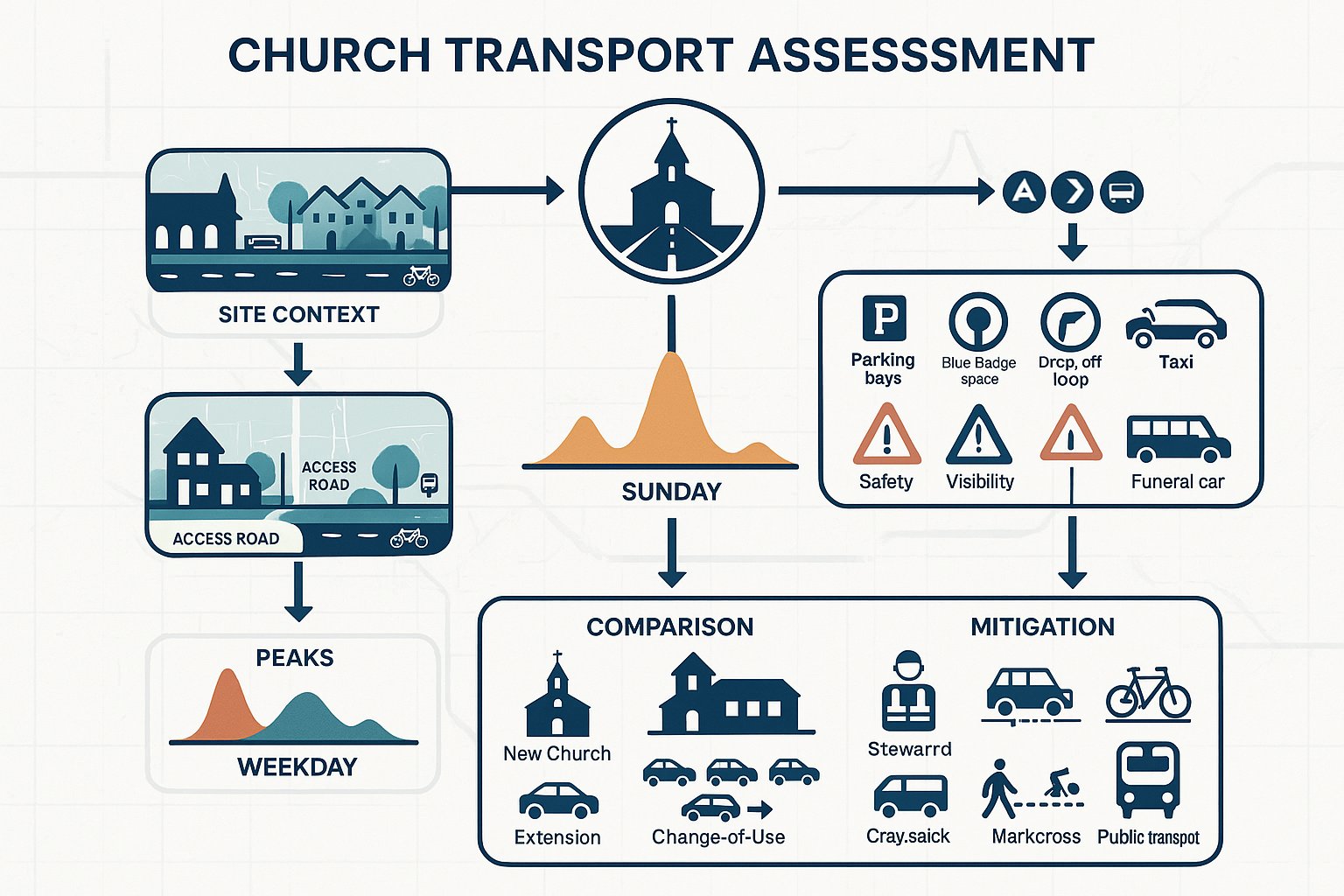
A church transport assessment can look straightforward on paper: count some trips, review access, check parking, submit the report. In practice, church schemes rarely behave like standard commercial or residential development. Their traffic patterns are more peaky, their busiest periods often fall outside typical commuter models, and a single site may need to accommodate worshippers, school-age children, elderly attendees, taxis, minibuses, delivery vehicles, funeral corteges and the occasional coach, all without creating safety or amenity problems on nearby streets.
That is exactly why church proposals can attract closer scrutiny from local planning authorities and highway officers than applicants first expect. Whether we are dealing with a new worship building, an extension to an established parish, or a change-of-use scheme, the transport evidence has to reflect how the site will actually operate in real life, not how a generic land-use spreadsheet says it might.
In this guide, we set out what planners, parishes, architects and consultants need to get right in 2026. We cover when a church transport assessment is likely to be required, what makes church travel demand distinctive, the core components of a robust report, and how to present evidence that stands up in planning. Drawing on the practical approach we use at ML Traffic, the focus here is simple: clear analysis, locally relevant evidence, and fewer avoidable planning delays.
What A Church Transport Assessment Is And When It Is Required
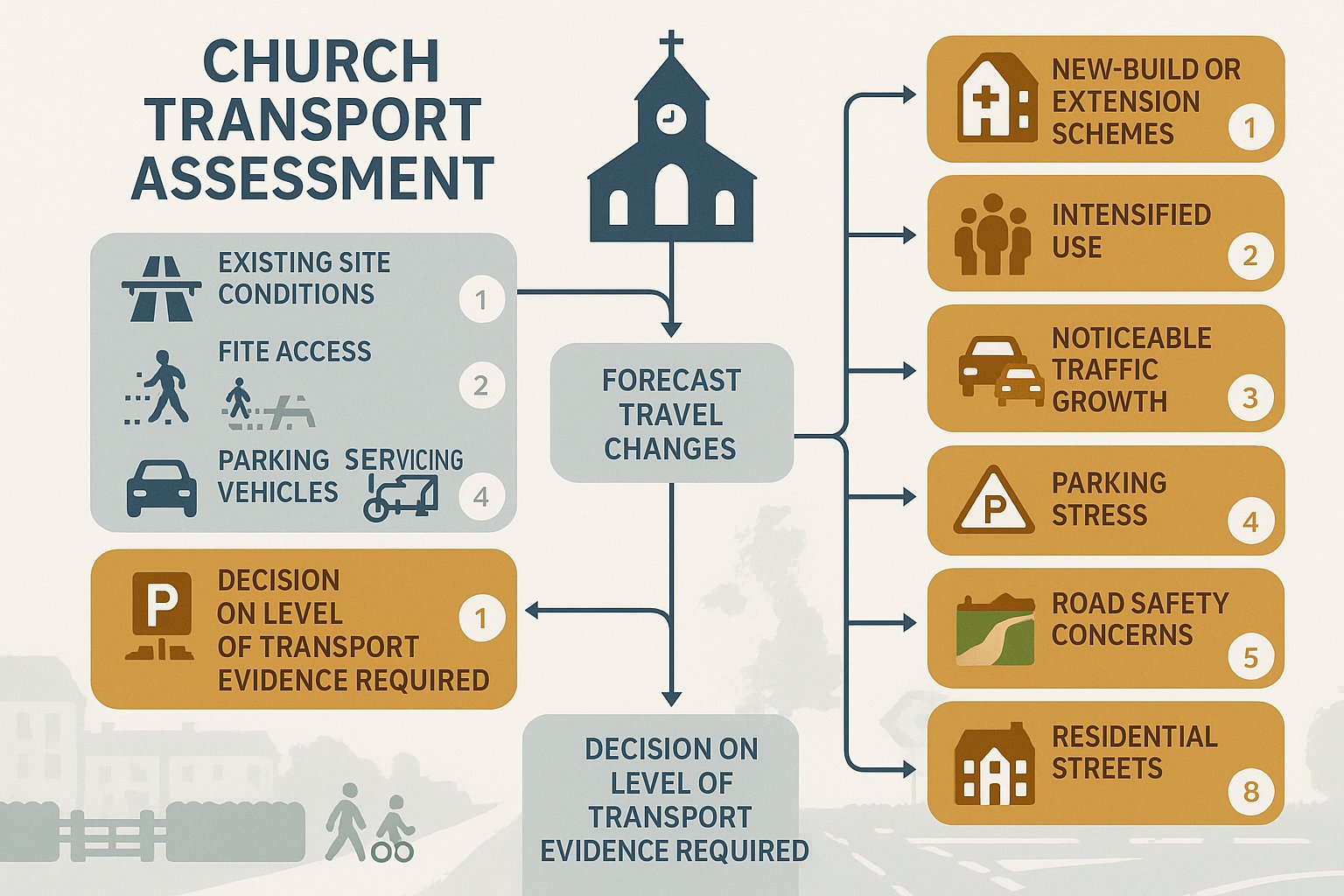
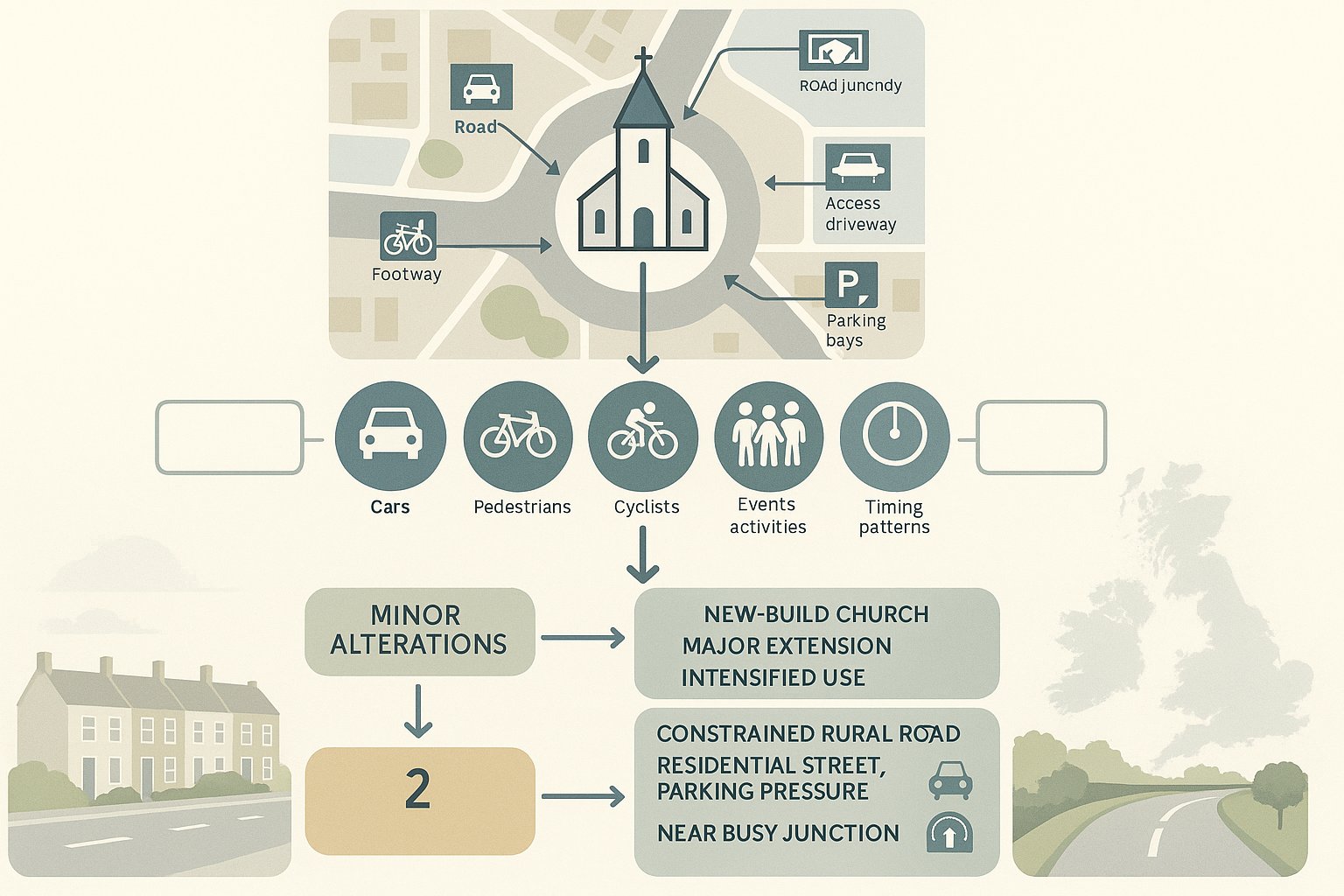
A church transport assessment is a planning document that examines how a proposed church development will affect movement to and from a site. In plain terms, it asks whether the surrounding highway network, access points, footways, crossings, parking areas and servicing arrangements can cope safely and efficiently with the development being proposed.
For church schemes, that usually means assessing existing conditions first, then forecasting likely changes in vehicle trips, pedestrian activity, cycle movements and parking demand. The report may range from a concise transport statement for a modest proposal through to a fuller assessment for larger or more sensitive schemes.
When is it required? There is no single national threshold that applies to every church project. Local planning authorities typically decide the level of transport evidence based on scale, location and likely impact. A small internal alteration with no material change in attendance may need very little transport input. A new-build church, a substantial extension, or a proposal that intensifies use can be very different.
In our experience, transport appraisal is most often triggered where a scheme is likely to generate noticeable traffic, worsen parking stress, alter access arrangements, or raise road safety concerns. Sites on constrained rural roads, in residential streets with existing parking pressure, or near busy junctions often receive closer attention. Councils also tend to look carefully at proposals where there are regular children’s activities, community uses, or larger event days.
The key point is this: if the church proposal changes how many people travel to the site, when they travel, or how they arrive, transport evidence is usually needed in some form.
How Church Use Creates Unique Transport Planning Issues
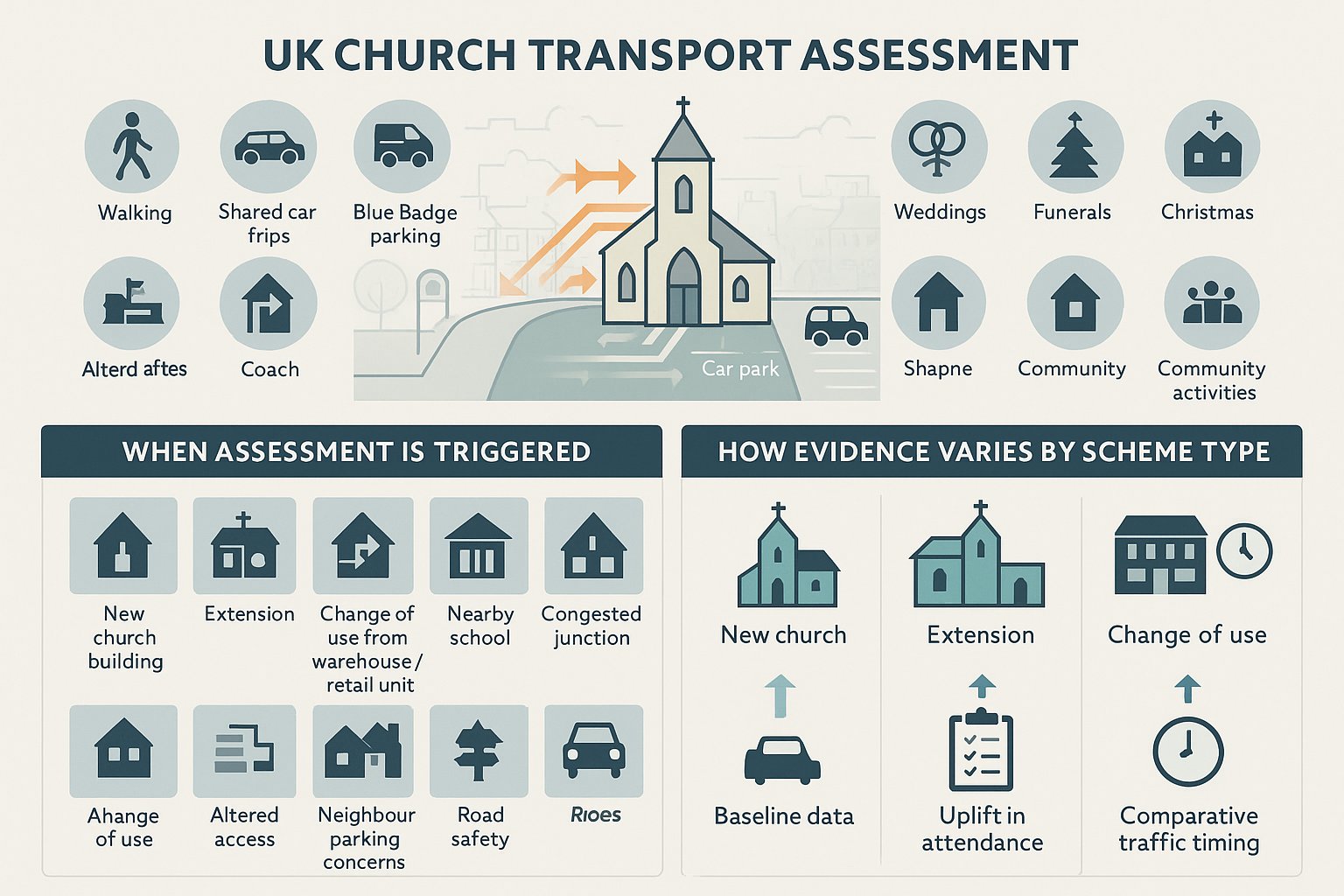
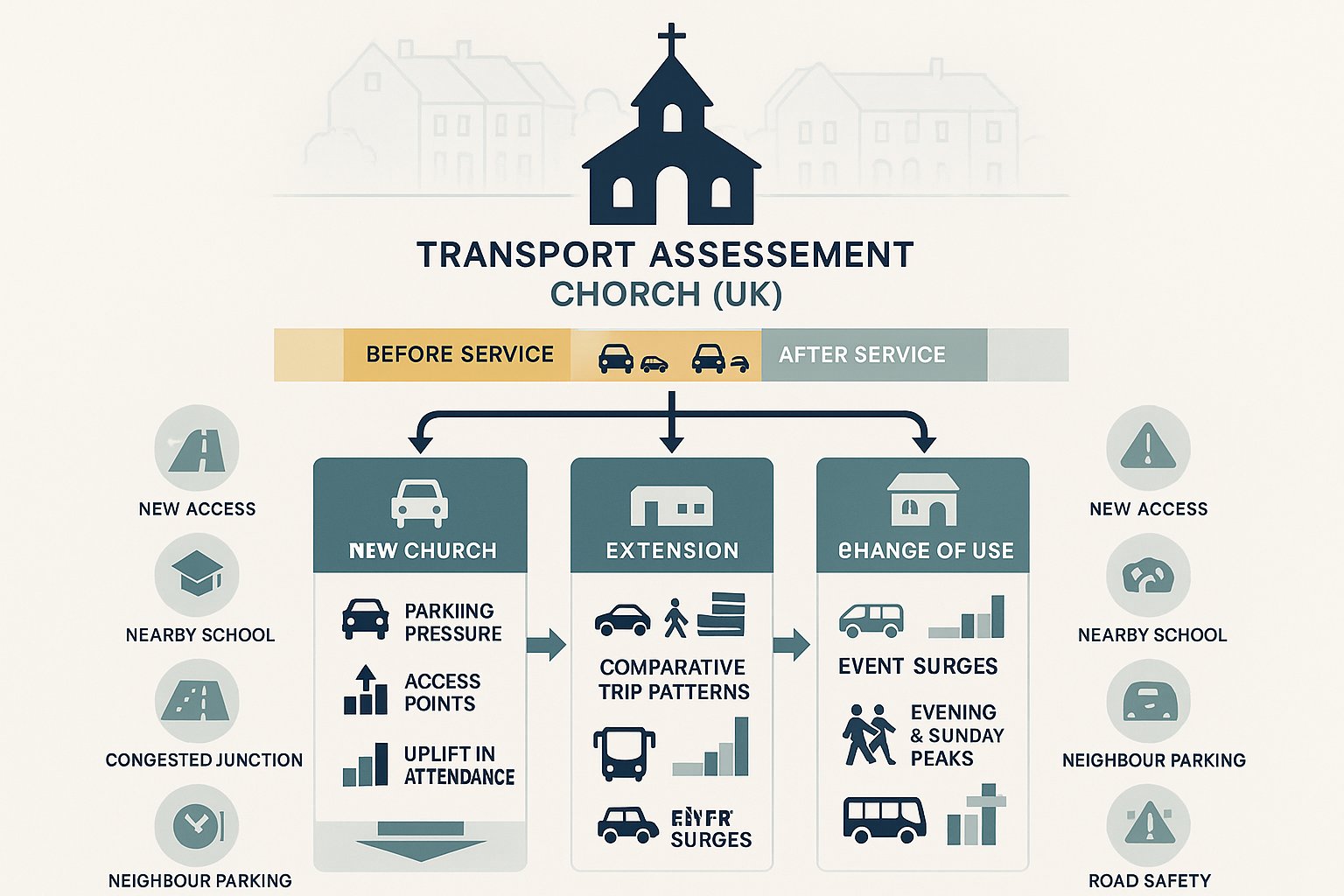
Church development does not fit neatly into the standard transport-planning mould. Unlike offices, schools or supermarkets, churches often produce highly concentrated arrivals and departures over relatively short periods. A Sunday morning service may lead to a pronounced spike in vehicle movements, then the site can be comparatively quiet for hours. Midweek prayer meetings, youth groups, foodbank operations or counselling sessions may create a very different profile again.
That variability matters. If we rely only on average daily traffic assumptions, we can miss the real operational issue, the 20 to 40 minutes before and after a main service, wedding or funeral, when access and parking are under the greatest strain. Church sites also tend to attract a broad demographic. Some attendees walk from nearby homes, some share lifts, some need blue-badge parking close to the entrance, and some arrive by minibus or coach.
There is also a behavioural element that planning reports sometimes underplay. Congregations are often loyal to a venue rather than choosing the nearest one. So catchments can be wider than expected, especially for larger evangelical, Pentecostal, Catholic or multi-service churches serving a regional community. That can increase car dependency even in urban areas with decent public transport.
And then there are occasional peaks. Christmas services, Easter events, weddings, funerals, conferences and charity drives can all create transport conditions far removed from an ordinary weekday. A credible church transport assessment needs to acknowledge that lived reality and build the analysis around it.
Typical Triggers For A Church Transport Assessment In Planning Applications
Certain planning scenarios nearly always justify transport input. A new church building is the clearest example, especially where it introduces a substantial congregation to a site that has not previously operated as a place of worship. The same applies where a proposal includes a large hall, classrooms, café space, community rooms or multiple auditoriums that widen the scale and frequency of use.
Extensions can also trigger assessment, even where the worship use is already established. If new floorspace is intended to increase attendance, host parallel activities or formalise previously informal gatherings, councils will usually want evidence on traffic and parking implications. We often see this where applicants describe a scheme as “ancillary” but the practical effect is to intensify use materially.
Change-of-use applications are another common trigger. Converting a warehouse, office, light industrial unit or former retail premises into a church can alter trip patterns sharply, particularly on Sundays and evenings. Authorities may ask whether the previous lawful use would really have generated more traffic than the proposed church use, and if so, at what times.
Other triggers include new or amended access arrangements, proposals near schools or congested junctions, known neighbour objections about overspill parking, and sites with a poor road safety record. Even where a full assessment is not required, a transport statement or technical note may still be essential.
Key Differences Between New Churches, Extensions, And Change-Of-Use Schemes
The transport strategy should reflect the type of church proposal rather than treating all schemes the same.
For new churches, we usually need the broadest evidence base. There may be no established attendance pattern at the site, no proven parking arrangement and no accepted baseline traffic profile linked to worship use. That means the assessment often has to rely on observed data from comparable sites, congregation surveys, agreed assumptions about likely attendance, and careful testing of access and parking operation.
For extensions, the central issue is uplift. How many extra attendees will the enlarged building accommodate? Will service times change? Will the extension support children’s ministry, events or weekday programmes that increase trip generation beyond the current pattern? Here, comparing existing observed use against forecast future use is often more persuasive than abstract trip-rate modelling alone.
For change-of-use schemes, the key planning question is comparative impact. The previous lawful use may have generated weekday traffic but little Sunday demand: the church use may reverse that pattern. Councils and neighbours often focus on parking shortfall, evening activity and compatibility with local streets. A robust comparison must hence consider not just gross trip totals but timing, mode split, turnover and operational management.
In short, each scheme type needs a tailored line of evidence. One-size-fits-all reporting is where planning trouble usually starts.
Core Elements Of A Church Transport Assessment
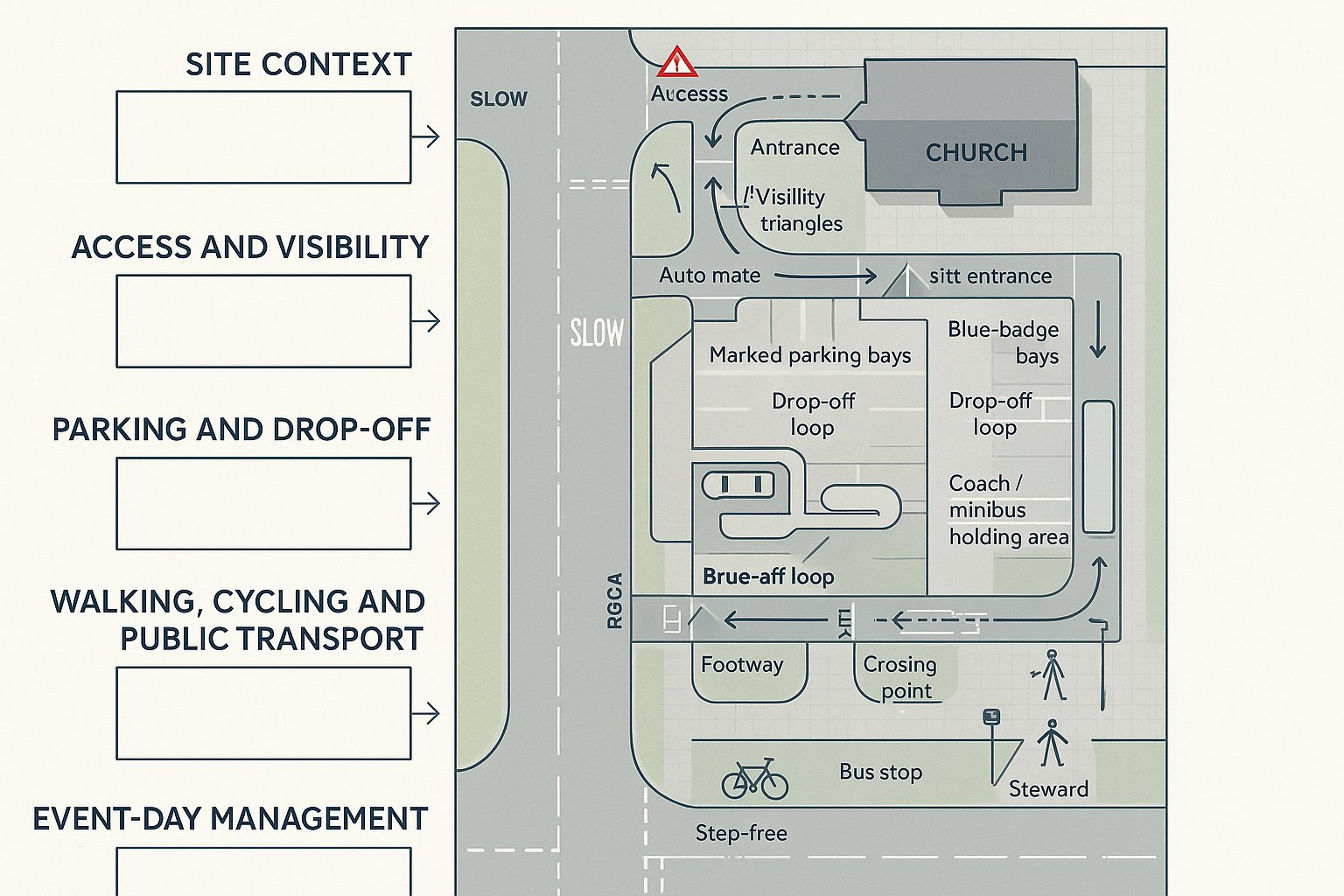
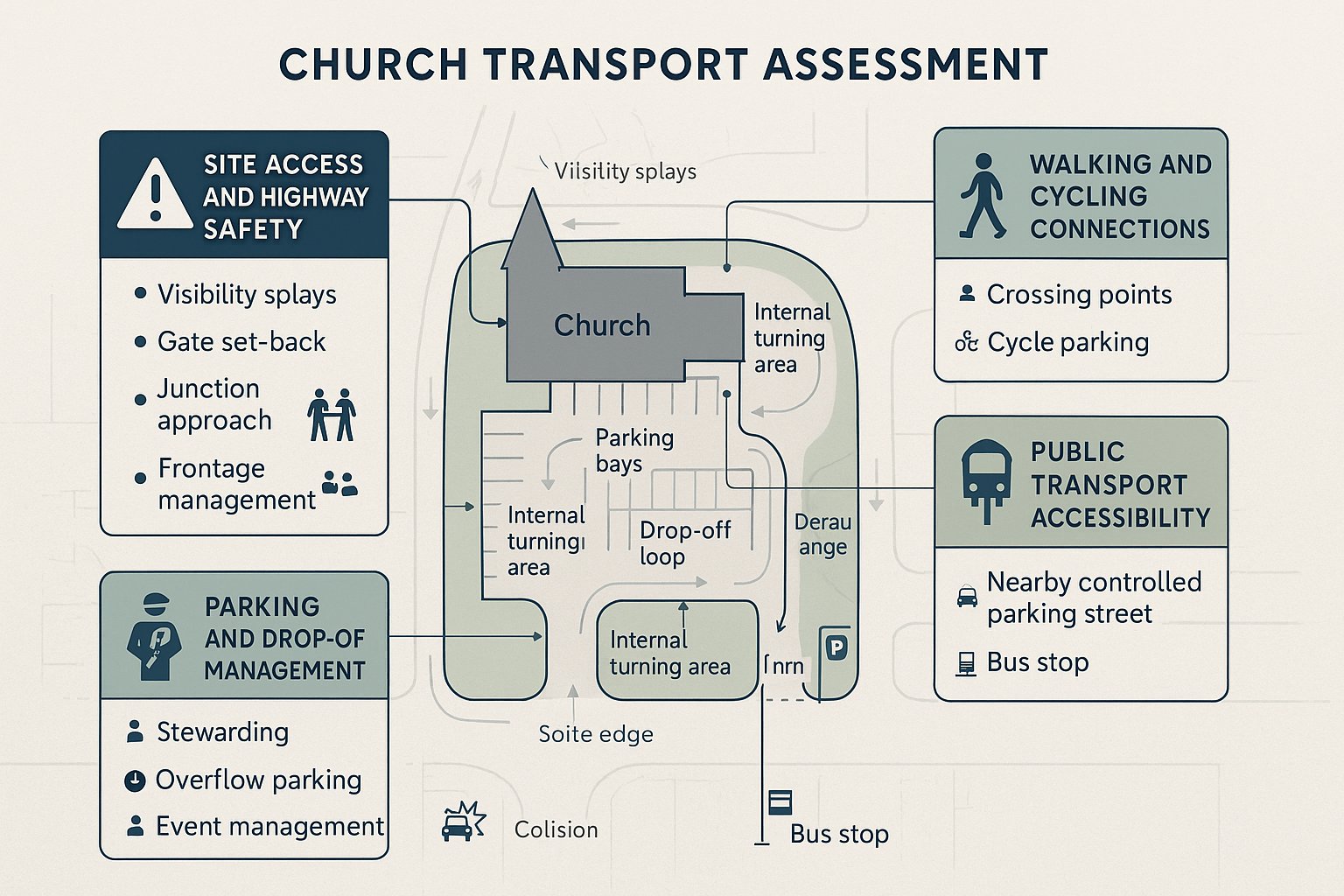
A robust church transport assessment is not just a traffic count with a few plans attached. It should explain how the site works now, how the proposed development will work in practice, and whether any mitigation is needed to make that operation safe and acceptable.
Most reports begin with the site context: surrounding roads, speed environment, nearby junctions, footways, crossings, bus stops, cycle routes and local parking controls. From there, the assessment typically moves into existing traffic and parking surveys, an overview of current church activity if relevant, and a forecast of future trip demand.
The core technical themes are usually consistent. We need to understand whether vehicles can enter and leave safely, whether visibility splays meet the appropriate standard, whether on-site layout allows convenient turning and drop-off, and whether parking supply is realistic for both ordinary worship and more intensive events. Pedestrian accessibility is equally important. A church site serving families, older worshippers and disabled users cannot be assessed credibly without looking closely at footway quality, crossing opportunities, gradients and public transport availability.
Good reports also deal with operation, not just infrastructure. If the site occasionally hosts large events, how will stewards manage arrivals? If minibuses are used, where do they load and wait? If parking demand exceeds on-site capacity during peak events, what is the actual strategy, not the hopeful one, for avoiding overspill impact?
That practical level of detail is often what turns a transport document from merely adequate into genuinely persuasive.
Site Access, Visibility, And Highway Safety Considerations
Access design is usually one of the first issues a highway officer will test. For church schemes, that scrutiny can be sharper because arrivals are often concentrated into short windows, increasing the chance of conflict at the site entrance. If vehicles are turning across traffic, reversing into the highway, or queuing back from a substandard access, even a modest congregation can create planning concern.
We hence assess the geometry of the access in detail: width, radii, gradients, gate set-back, intervisibility and the ability for cars, minibuses or service vehicles to manoeuvre within the site. Visibility splays need to match the local speed environment and actual on-street conditions. Parked cars, boundary walls, vegetation and street furniture regularly compromise visibility in ways that old site plans never quite capture.
Highway safety review should also cover pedestrian movement at the frontage. Can people step out of cars or minibuses without entering the carriageway? Are there safe walking routes from the entrance to the building? If children attend classes or Sunday school, are the crossing conditions acceptable at busy times?
Where there is an existing accident pattern nearby, that should be examined properly rather than brushed aside. Not every recorded collision is relevant, but a cluster of turning or pedestrian incidents can shape the authority’s view quickly. Sometimes modest mitigation, revised access alignment, localised widening, mirror-free visibility improvements, stewarding arrangements, can make the difference between a difficult recommendation and a workable one.
Parking, Drop-Off, And Coach Management
Parking is where many church applications become contentious. Local residents worry about overspill. Councils worry about obstruction, unsafe manoeuvring and pressure on controlled streets. Applicants, understandably, sometimes point to staggered services or shared travel. All can be relevant, but none replaces evidence.
A sound assessment should quantify on-site parking capacity, describe how spaces are laid out, and test whether the supply is suitable for the actual user profile. Churches often need more than standard parking calculations suggest because demand may peak sharply and include older worshippers, families with children and mobility-impaired users who need convenient access.
Drop-off is another recurring issue. Taxis, community transport, informal lift-sharing and school-age passenger drop-off can create a surprising amount of short-stay activity. If there is no dedicated area, vehicles may stop on the highway, block visibility or interfere with through traffic right when arrivals are busiest.
Coach and minibus management matters too, particularly for larger congregations or occasional conferences. Can larger vehicles enter, turn and exit in forward gear? Is there somewhere to wait without obstructing the car park? If not, where exactly will they go? “Managed off-site” is not enough unless the arrangement is specific and credible.
For some sites, a parking management plan is as important as the parking layout itself. Stewarding, overflow protocols, marked blue-badge bays and event-specific controls can significantly reduce planning risk when backed by a realistic operating strategy.
Walking, Cycling, Public Transport, And Accessibility
A church transport assessment should never assume everyone drives. Equally, it should not exaggerate sustainable travel prospects where the site context does not support them. The right approach is evidence-led and honest.
Walking catchments need to reflect the actual quality of local routes, not just distance circles on a plan. Are the footways continuous? Are there dropped kerbs? Is the route lit? Would an older worshipper or parent with a buggy genuinely find the route practical in winter? These details matter, particularly where a proposal is presented as sustainably located.
Cycling should be reviewed in the same practical way. If a church expects some cycle arrivals, secure and convenient cycle parking should be shown, not treated as an afterthought near the bins. Public transport access also needs careful treatment. A site may be close to a bus stop on paper, but if Sunday frequencies are sparse or evening services finish after buses have thinned out, the effect on mode choice may be limited.
Accessibility for disabled users deserves particular emphasis. Places of worship often serve people with reduced mobility who attend regularly and need predictable, dignified access. That includes blue-badge parking close to entrances, step-free routes, manageable gradients, suitable crossing points and enough space for assisted drop-off.
When these factors are assessed properly, they strengthen the whole planning case. They show the authority that the proposal has been designed around real users rather than generic transport-policy language.
How Trip Generation Is Assessed For Church Developments
Trip generation is often the technical heart of a church transport assessment. It is also where generic methodology can let schemes down.
For many land uses, standard database trip rates give a reasonable starting point. Church developments are trickier. Attendance can vary by denomination, service format, catchment, parking availability, and whether the building doubles as a broader community hub. One congregation might have a single main Sunday service: another may run multiple services, youth activities, food distribution, rehearsals and counselling sessions across the week.
That is why we usually combine several strands of evidence. Existing traffic counts at the site, where a church use is already operating, are often the most persuasive starting point. For new churches, surveys from comparable worship sites can help, but they must be chosen carefully. A suburban parish church with mainly local walk-in attendance is not an obvious proxy for a regional destination church drawing families from several boroughs.
Congregation data can also be valuable if treated critically. Expected attendance, number of staff or volunteers, car-sharing patterns and service schedules all inform the forecast. Parking beat surveys and on-street observations help test whether claimed travel patterns align with actual demand.
The assessment should then identify the relevant peak periods and quantify arrivals and departures by mode. That may include ordinary worship periods, weekday activity and occasional higher-intensity events if they are part of the proposal. The aim is not to produce a false sense of precision: it is to provide a reasonable, transparent and defensible forecast that the local authority can follow.
Peak Worship, Weekday, And Special Event Traffic Patterns
The biggest mistake in church trip generation is averaging away the problem. A site may have modest daily traffic overall but still create a sharp and locally significant peak before and after services. That is the pattern that usually matters most to neighbours and highway officers.
Sunday worship is the obvious focus. We need to understand not just total attendance, but service times, overlap between congregations, volunteer arrival patterns, and whether departures from one gathering coincide with arrivals for the next. A church running back-to-back services can create two compressed peaks rather than one.
Weekday use can be equally relevant, especially where the proposal includes nursery activity, community outreach, counselling, classes, rehearsals or evening meetings. These uses may spread demand more evenly, but they can also overlap with school-run traffic or commuter parking pressure, which changes the planning picture.
Special events deserve explicit treatment. Weddings and funerals are not everyday occurrences, but they are foreseeable and can produce concentrated arrivals, unusual parking behaviour and sensitivity around kerbside stopping. Seasonal events such as Christmas services, conferences or festivals can be larger still. Authorities do not always expect every occasional peak to be modelled in full, but they usually do expect an operational strategy showing how those events will be managed.
A realistic assessment hence distinguishes between regular peak worship periods, recurring weekday activity and occasional high-demand events. That layered approach is far more credible than relying on one blended average trip figure.
Common Planning Risks And How To Address Them Early
Most church transport objections are predictable. That is good news, because predictable issues can usually be addressed before they harden into refusal reasons.
The first recurring risk is parking shortfall. If likely peak demand materially exceeds on-site supply, local residents will assume overspill onto surrounding streets. Sometimes they are right. Early surveys should test both normal and busier operating periods, with honest allowance for disabled spaces, staff parking and drop-off activity. If there is a shortfall, the answer may involve revised layout, shared parking agreements, staggered service times or a formal management plan, but it needs substance.
The second is unsafe or constrained access. Narrow entrances, weak visibility, awkward turning and vehicles waiting on the highway can all trigger concern. These issues are best reviewed before an application is fixed architecturally, because small layout changes early on are much cheaper than redesign after objections arrive.
Third, there is overspill and event management. Even where ordinary worship is manageable, unplanned peaks for funerals, weddings or conferences can undermine confidence. A simple operational note on stewarding, booking controls, overflow arrangements and minibus handling can go a long way.
Fourth is mismatch between planning description and real use. If a proposal is presented as modest worship accommodation but plans show extensive halls, classrooms or café space, authorities may assume the impacts are being understated. We always advise aligning the transport case with the actual intended operation.
And finally, there is late evidence. Once neighbour concern and officer doubt have set in, even good technical work can feel reactive. Front-loading surveys and strategy usually produces a smoother planning path.
Preparing Evidence That Supports A Stronger Planning Submission
The strongest church planning submissions do not just say the impacts are acceptable: they show why, with evidence that is proportionate, transparent and local.
First, we need reliable baseline data. That often includes traffic counts, parking accumulation surveys, access observations, swept-path review where larger vehicles are relevant, and a clear audit of walking, cycling and public transport conditions. Timing matters. Surveying only a quiet weekday and ignoring Sunday worship patterns is an easy way to weaken the file from the outset.
Second, assumptions must be visible. If trip forecasts are based on expected congregation size, service schedules, car occupancy or modal split, those assumptions should be stated plainly and, where possible, supported by comparable evidence. Hidden assumptions are where objections usually land.
Third, the report should explain operations in human terms. How will arrivals be managed? Where will blue-badge users park? What happens when a funeral coincides with another activity? Can a minibus turn on site? This kind of operational clarity often reassures authorities more than pages of abstract policy citation.
Fourth, mitigation should be practical and deliverable. That may mean access improvements, revised internal layout, marked drop-off areas, cycle parking, a travel plan, stewarding protocols or an event management note. The best mitigation is usually simple, specific and easy to secure by condition if needed.
Finally, the transport evidence should align with the wider planning package. Plans, design statement, planning statement and transport report all need to describe the same development in the same way. When they do, the submission feels competent and credible. When they do not, even a technically sound church transport assessment can be dragged into avoidable doubt.
For applicants working to tight planning programmes, that is often where experienced transport input adds the most value: not by producing a longer report, but by producing the right report, at the right level, early enough to influence the design.
Conclusion
A well-prepared church transport assessment is really about fit between a proposal and the way a site will function in everyday life. In 2026, local authorities are not just looking for standard trip-rate tables or generic policy wording. They want evidence that reflects the distinctive rhythm of church use: concentrated worship peaks, varied weekday activity, occasional high-demand events, and the practical needs of families, older worshippers and disabled users.
For planners, parishes and consultants, the lesson is straightforward. Start early, survey the right periods, test the real operational risks, and make sure the transport story matches the development being applied for. That usually means focusing on access, parking, drop-off, walkability, public transport realism and event management in one coherent narrative.
When that is done properly, transport need not be the part of the application that causes delay. It can become one of the clearest parts of the planning case, concise, defensible and tailored to local authority expectations.
Church Transport Assessment FAQs
What is a church transport assessment and when is it required?
A church transport assessment evaluates how a proposed church development affects local traffic, parking, access, and safety. It’s typically needed for new churches, significant extensions, or changes in use that increase vehicle trips or parking demand, especially on constrained or residential streets.
Why do church transport assessments differ from those for other developments?
Churches create highly peaked traffic patterns during services and special events, unlike standard daily flows. They also serve diverse users including elderly or disabled attendees, minibuses, and coaches, requiring assessments to reflect real operational scenarios rather than generic land-use data.
What are the key components of a robust church transport assessment?
It should include analysis of site access and visibility, parking capacity and management, drop-off arrangements, pedestrian routes, cycle and public transport links, and accessibility for disabled users, plus operational strategies for peak worship times and special events.
How is trip generation assessed for church developments?
Trip generation uses observed traffic counts, congregation attendance data, and surveys from comparable churches to forecast vehicle arrivals by mode and time. It distinguishes between Sunday peaks, weekday activities, and occasional events for a realistic travel demand profile.
What common planning risks should be addressed early in a church transport assessment?
Key risks include insufficient parking causing overspill, unsafe or narrow site access, limited visibility, unmanaged event peaks, and discrepancies between planning descriptions and actual use. Early surveys and clear strategies help mitigate these issues.
How can a church ensure its transport assessment supports a smoother planning process?
By providing transparent baseline data, clear travel assumptions, detailed access and parking strategies, event management plans, and aligning transport reports with other planning documents, churches can create credible, tailored cases that local authorities accept more readily.