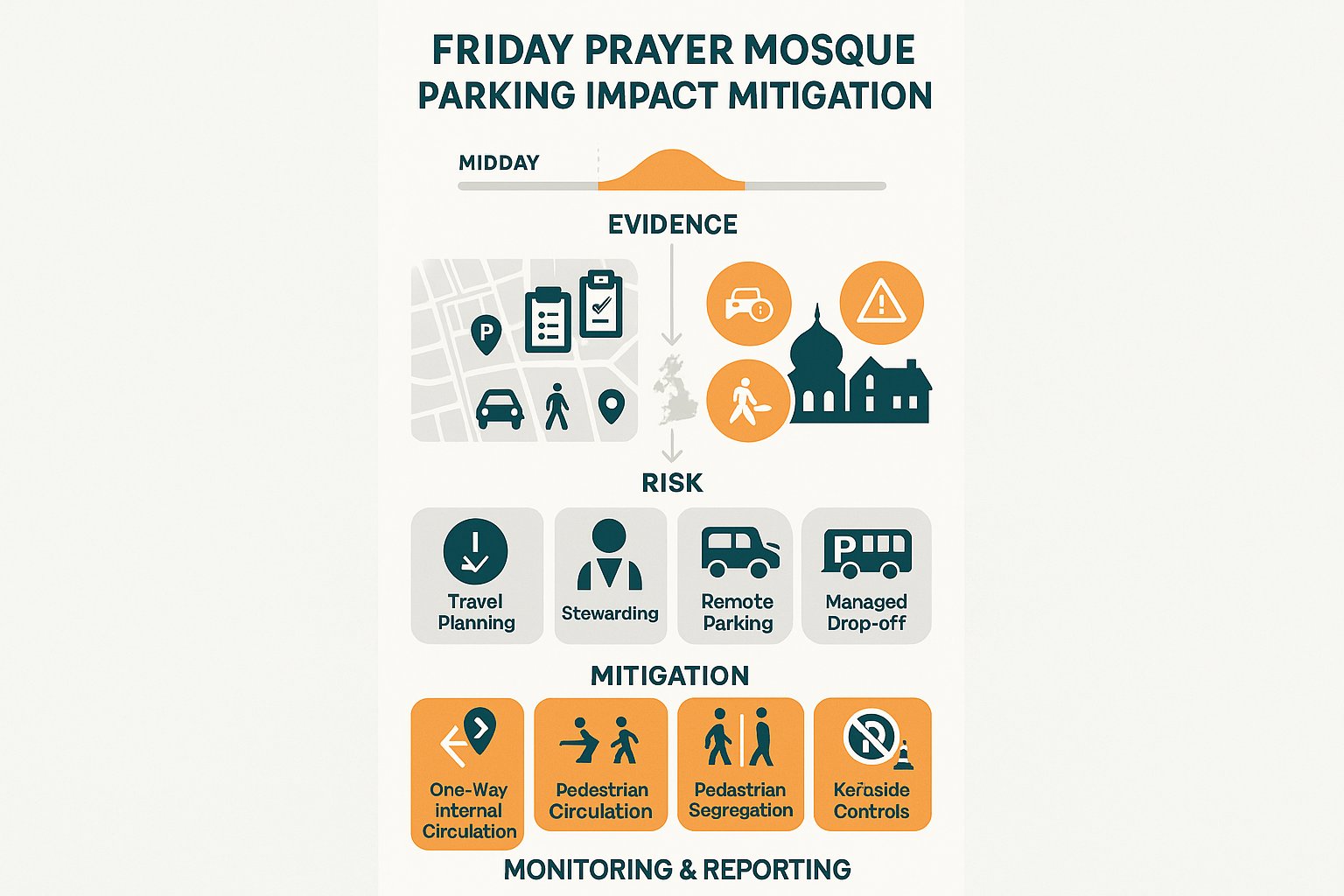
A mosque scheme can look perfectly manageable on paper and still run into planning resistance if the Friday picture hasn’t been properly tested. That’s because Friday prayer mosque parking impact mitigation is rarely about average daily demand. It’s about one compressed period, usually around midday, when arrivals and departures bunch tightly, kerbside pressure rises fast, and local concerns become very visible.
For architects, planners, developers and local authorities, that distinction matters. A generic parking standard or broad-brush transport note often won’t be enough where Jumu’ah demand is a material issue. Planning officers and highways authorities usually want a focused, evidence-led explanation of what happens on a typical Friday, what risks arise on surrounding streets, and how those risks will be controlled in practice.
In our work at ML Traffic, we see the same pattern repeatedly: proposals become easier to defend when Friday conditions are assessed as their own operational scenario rather than folded into a standard place-of-worship narrative. The strongest applications don’t deny peak impacts. They quantify them, compare them properly with local parking supply and network conditions, and then set out a mitigation package that is realistic, proportionate and monitorable.
This article looks at how to approach that process in 2026 applications, from evidence gathering and survey design through to transport statements, layout decisions and practical management measures that can make a real difference on the ground.
Why Friday Prayer Parking Impacts Require A Distinct Assessment Approach
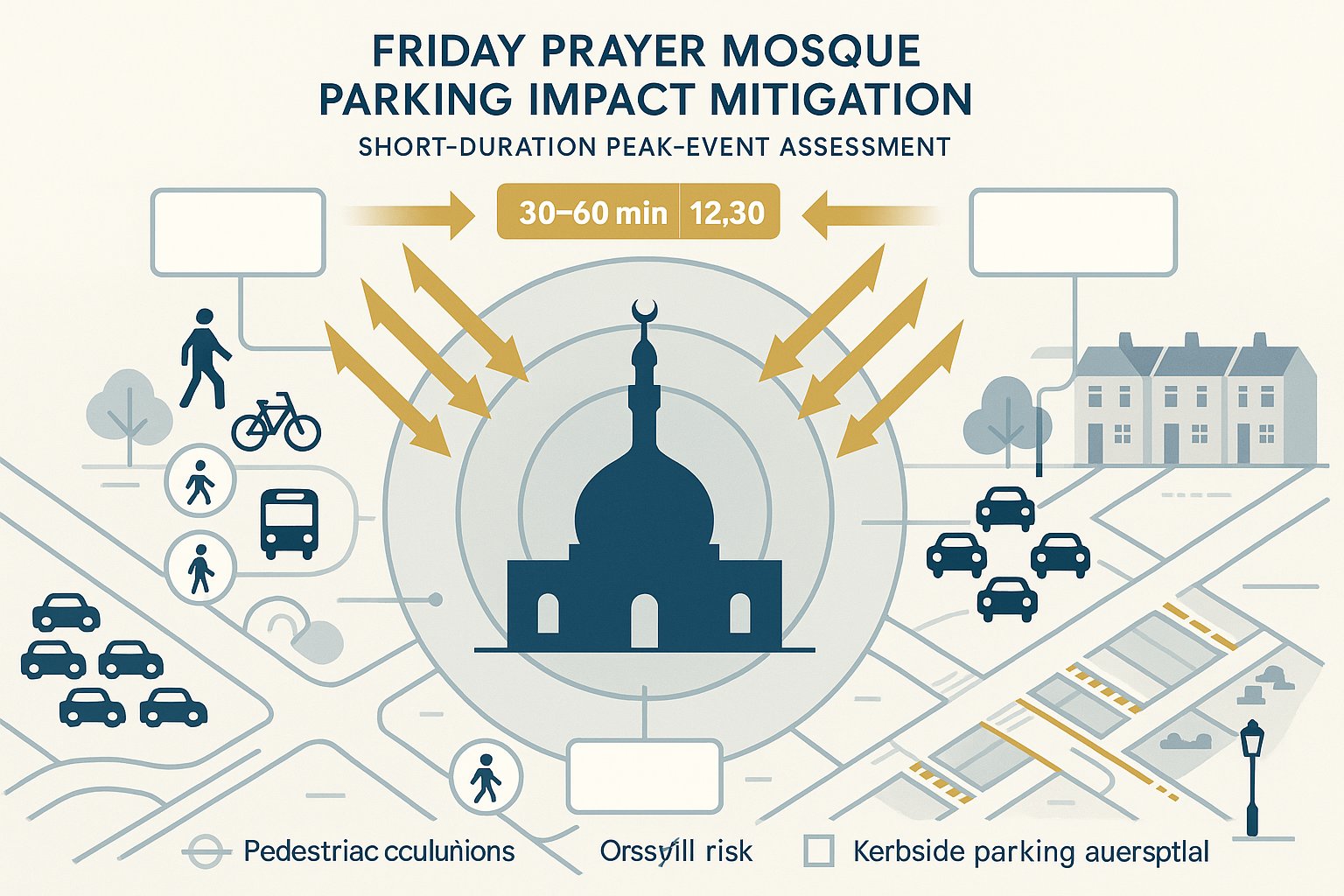
Friday midday demand should not be treated as a simple extension of normal daily mosque activity. In planning terms, it behaves more like a short-duration peak event layered onto an otherwise modest background use pattern. That is exactly why a tailored assessment is usually needed.
For many worshippers, Jumu’ah is the key weekly attendance period. The result is a concentrated arrival wave before the sermon and a similarly concentrated departure wave afterwards, often within 30 to 60 minutes. If we rely only on generic class-based assumptions, we risk missing the issue that actually drives objections: temporary but intense parking and traffic pressure on streets around the site.
A distinct assessment also helps keep the process fair and proportionate. Local authorities are entitled to test impacts rigorously, but parking expectations should be applied consistently with how comparable places of worship and other peak-time community uses are considered. The aim is not to single out mosques. It is to understand the real transport effects of the proposed use and respond with evidence-based mitigation.
In practice, that means focusing on Friday peak trip generation, modal split, catchment patterns, parking accumulation, overspill risk, pedestrian movement and local junction performance, rather than leaning too heavily on average weekday activity.
The Main Parking And Traffic Risks Around Friday Prayers
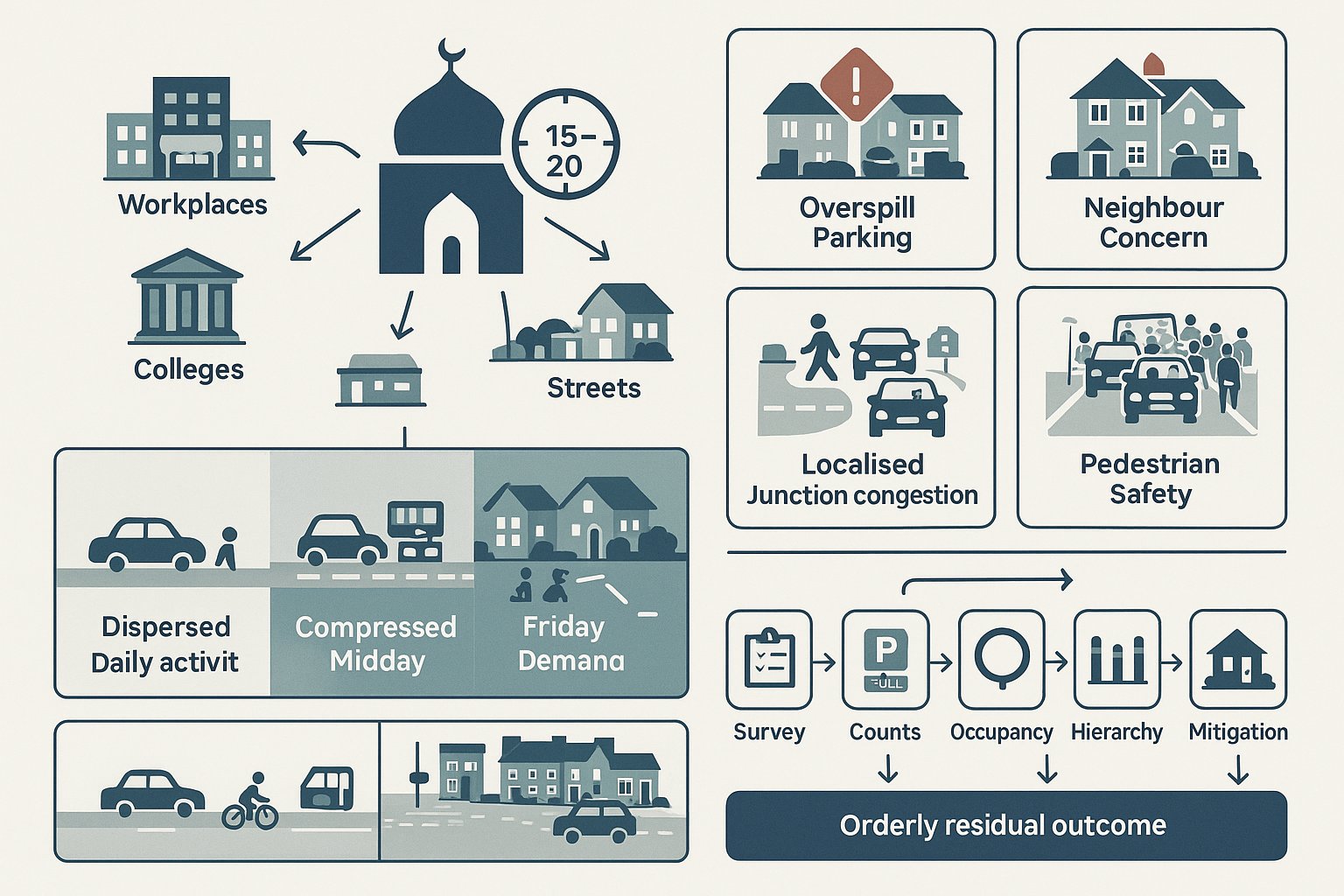
The principal transport challenge around Friday prayers is not usually all-day traffic growth. It is a short, intense pulse of vehicle activity that can overwhelm nearby kerbside space if unmanaged. That pulse creates a cluster of familiar planning concerns.
First, there is overspill parking. Even where on-site provision exists, demand may temporarily exceed capacity, pushing vehicles onto surrounding residential or mixed-use streets. Second, there is localised congestion. Vehicles slowing to search for spaces, stopping informally, turning around, or waiting for passengers can affect side roads, priority junctions and crossing points.
Third, there are safety issues. Compressed arrivals and departures increase vehicle manoeuvring at exactly the moment pedestrian activity is highest. If the route between informal parking locations and the mosque entrance crosses side roads, private accesses or busier distributor roads, conflict risk can rise quickly.
And finally, there is perception. Even where the measurable highway effect is modest, repeated weekly episodes of poor parking behaviour can generate strong neighbour concern and planning resistance. So our job in a transport assessment is not only to demonstrate technical adequacy. It is also to show that the operation will be orderly, enforceable and considerate of the surrounding area.
How Friday Midday Demand Differs From Daily Mosque Activity
Typical daily mosque activity is dispersed. Attendance levels vary by prayer time, many journeys are made on foot from the immediate neighbourhood, and family or household-linked trips are more common. Friday midday is different.
The catchment often broadens because people travel from workplaces, colleges, shops and other daytime locations rather than from home alone. That tends to increase the proportion of car-borne trips from a wider area. At the same time, family travel is often less dominant, with more solo drivers or very small groups arriving under time pressure. Those two factors can push parking demand up faster than headline attendance numbers might suggest.
Then there is timing. Daily activity usually ebbs and flows. Jumu’ah compresses movement into a narrow operational window tied to sermon and prayer start times. That compression affects not just parking occupancy but kerb turnover, access junction performance, pedestrian crossing demand and the practical usefulness of on-site spaces. A car park that functions acceptably over an hour and a half may feel overloaded if most vehicles try to enter within 15 to 20 minutes.
For that reason, Friday prayer mosque parking impact mitigation has to be grounded in the actual peak profile, not diluted by averages that smooth away the operational problem.
What Planning Officers And Highways Authorities Usually Expect
Most planning officers and highway authorities expect a focused Transport Statement or Transport Assessment that deals specifically with the Friday peak. In straightforward cases, a concise but well-evidenced statement can be enough. In more constrained urban locations, or where demand is expected to be substantial, a fuller assessment is usually safer.
What do they normally look for? First, credible local evidence: parking beat surveys, traffic counts, site observations, on-site occupancy data and a reasoned estimate of trip generation and modal split. Second, context: existing parking stress, road hierarchy, collision history, nearby schools or other attractors, and any residents’ parking controls. Third, mitigation: not a vague promise to “manage parking”, but a defined package with responsibilities and implementation triggers.
Authorities also tend to expect proportionality. Requirements should be reasonable, site-specific and applied consistently with comparable uses. A mosque cannot be assessed on a lower evidential standard just because the use is familiar: equally, it should not be subjected to arbitrary parking demands that are not applied elsewhere. The strongest reports recognise that balance and make it easy for decision-makers to follow the chain from evidence, to impact, to mitigation, to residual effect.
Building A Robust Evidence Base For A Planning Application
A defensible planning application starts with evidence that reflects how the site and surrounding streets actually function. If Friday effects are likely to be the main concern, the baseline must be built around that reality from day one.
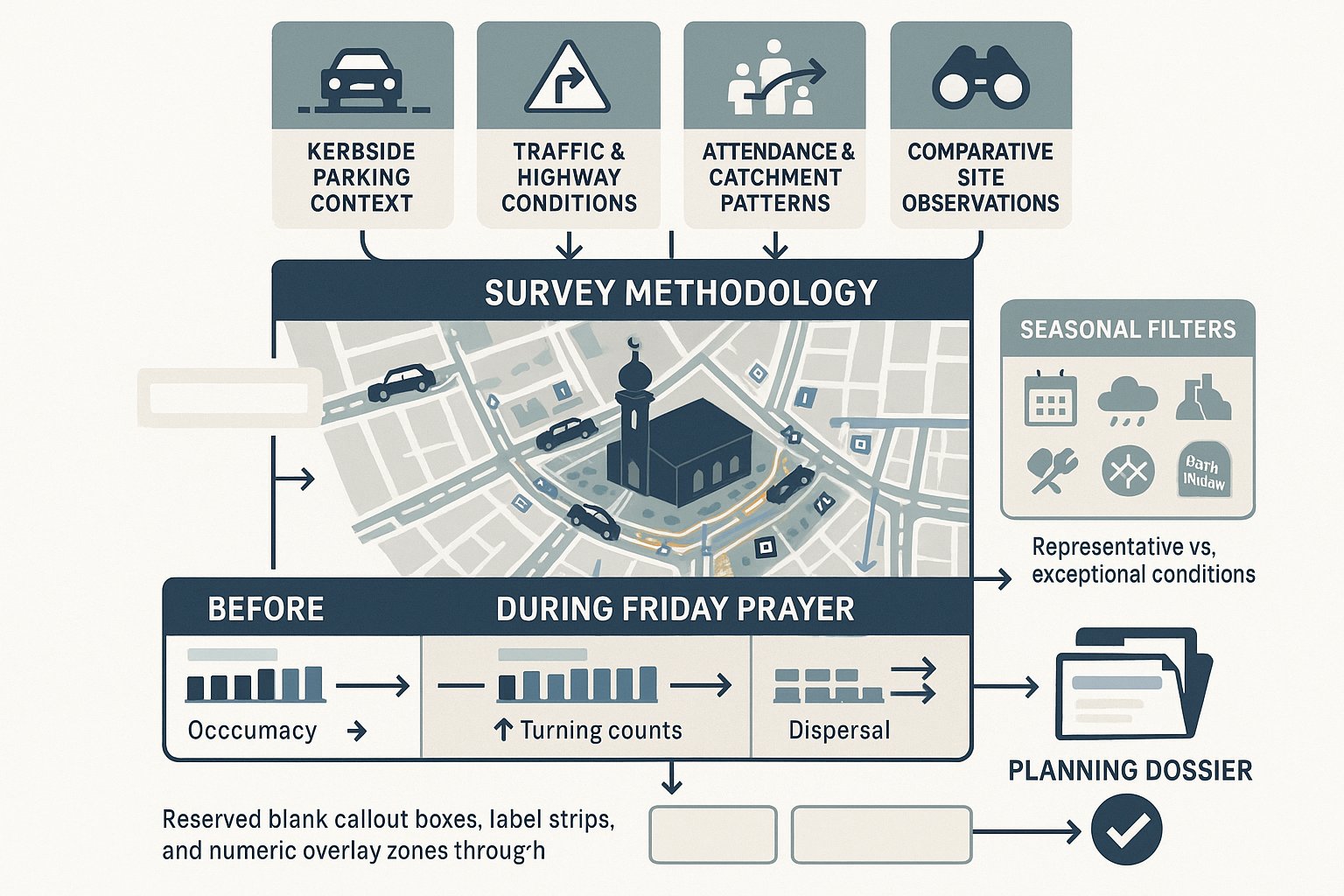
We usually begin with four strands. The first is the local parking context: existing on-street demand, parking restrictions, private accesses, public car parks, school keep-clear markings, loading activity and any obvious pressure points. The second is traffic and highway context: access geometry, junction operation, pedestrian crossing desire lines, bus routes, cycle facilities and collision records. The third is use-based evidence: likely attendance profile, role of the mosque within its catchment, and whether the proposal replaces, expands or regularises an existing pattern. The fourth is comparative and qualitative material, including observations from similar mosques where that comparison is genuinely relevant.
Early engagement matters too. A brief pre-application discussion with the highway authority can save a lot of wasted effort by clarifying survey extents, expected peak periods and the level of reporting needed. Community engagement can also be useful, not as a substitute for technical work, but as a way of identifying blocked-drive concerns, school-time interactions or informal parking hotspots that surveys should test.
A strong evidence base does two things at once: it shows we understand the local problem, and it gives the authority confidence that the proposed mitigation is rooted in real operating conditions rather than generic assumptions.
Survey Methods, Peak Period Counts, And Seasonal Considerations
Survey design is where many applications either gain credibility or lose it. For Friday prayer issues, one isolated count is rarely enough. We need a method that captures accumulation, turnover and network effects before, during and after the key period.
Area-wide parking beat surveys are often the backbone of the work. These involve repeated sweeps of surrounding streets on typical Fridays, recording occupancy levels, parking stress, and where relevant, inappropriate parking behaviour. The survey area has to be wide enough to capture realistic overspill rather than just the streets immediately outside the site. We normally pair this with on-site parking occupancy counts, entry and exit surveys, and observation of nearby public car parks that may be part of the demand picture.
Classified traffic counts or turning counts can also help where the access is sensitive or where local concern focuses on a particular junction. Pedestrian counts may be appropriate near crossing points, bus stops or schools. And timing matters: surveys should capture pre-prayer build-up and post-prayer dispersal, not just a single snapshot at the nominal start time.
Seasonality needs judgment. Ramadan, school holidays, bank holidays, abnormal weather and special religious dates can all distort the picture. The goal is a representative typical Friday unless the application specifically relates to an exceptional scenario. If a survey date is not ideal, the report should say so plainly and explain why the data remains robust or how it has been supplemented.
Effective Mitigation Measures For Friday Prayer Parking Demand
Mitigation works best as a package. There is rarely a single measure that resolves every Friday issue on its own. What authorities want to see is a joined-up strategy that tackles demand, distributes arrivals more safely, protects neighbours, and gives the operator practical tools to manage the peak every week.
The right package depends on context. In a dense urban area with limited kerbside capacity, travel planning, remote parking agreements and active stewarding may carry most of the weight. On a larger suburban site, internal circulation, queue storage and pedestrian segregation may be more important. Some locations need both.
A good mitigation package is also operational, not just physical. It should explain who does what on a Friday, how worshippers are informed, what happens if the on-site car park fills, how drop-offs are controlled, and when any monitoring review will be triggered. If the package depends on shared parking, stewards or timed controls, those elements should be secured and deliverable rather than aspirational.
Importantly, mitigation should be proportionate. Over-design can be as unhelpful as under-design if it creates unnecessary cost or awkward site constraints without addressing the actual transport problem. The aim is to reduce overspill, conflict and neighbour impact to an acceptable level, using measures that reflect the scale of the proposal and the characteristics of the surrounding network.
Travel Planning, Stewarding, Remote Parking, And Managed Drop-Offs
Travel planning is often underestimated in these cases. Yet a focused mosque Travel Plan can make a real difference when it is practical, specific and actively managed. We usually recommend identifying a Travel Plan Coordinator and, where appropriate, volunteer travel champions who can communicate expectations to regular attendees. Clear messaging about walking routes, bus services, cycle parking, car-sharing and where not to park matters more than many applicants assume.
Stewarding is frequently one of the most effective Friday peak measures because it addresses behaviour in real time. Trained stewards can direct vehicles into available on-site spaces, prevent stopping across dropped kerbs, keep informal queues off the highway, guide pedestrians at conflict points and redirect late arrivals to agreed remote parking. But the key word is trained. A planning authority will have more confidence if the report explains numbers, positions, timings and responsibilities.
Remote parking can be highly effective where there is a willing partner and a realistic walking route. Shared use of public, office or church car parks by agreement often works well, especially if spaces are close, signed and publicised in advance. If managed drop-offs are needed, they should be formalised with a defined location, short dwell times, supervision and no-waiting discipline. Otherwise, a “drop-off zone” can quickly turn into ad hoc kerbside obstruction.
Designing Site Access, Internal Layout, And Kerbside Controls
Physical design still matters, even where much of the management response is operational. Poor access geometry or a muddled internal layout can create avoidable conflict during the short Friday peak.
Where space allows, a simple one-way circulation system can improve turnover and reduce reversing conflict. Sufficient internal queue space is critical so that arriving vehicles do not stack back onto the highway. Pedestrian routes from parking spaces to the entrance should be direct, legible and separated from manoeuvring areas where possible. Good lighting, surface treatment and signs are basic, but they often determine whether a layout works smoothly under pressure.
Access design should also account for the real user pattern. If many attendees arrive shortly before the start time, gate widths, barrier arrangements and visibility splays need to support quick and safe entry. If post-prayer departures are more concentrated, exit operation may be the limiting factor. Sometimes small design changes, such as repositioning a pedestrian gate, widening an aisle or removing a conflict point near the frontage, have outsized benefits.
Kerbside controls may be needed beyond the site boundary. In some cases, waiting restrictions, protected dropped kerbs, loading controls or residents’ parking arrangements can support the mitigation strategy. Those measures require careful discussion with the authority because they involve separate powers and processes, but acknowledging that relationship in the application can strengthen the overall case.
Presenting Mitigation Clearly In Transport Statements And Assessments
Even strong mitigation can fall flat if it is poorly presented. Planning officers, committee members and local residents need to understand not just what is proposed, but how it changes the transport picture on a typical Friday.
The clearest reports usually start with a short explanation of the Friday operational scenario, then present baseline evidence in a disciplined way: survey dates, area coverage, parking occupancy, traffic conditions, local constraints and any known complaint themes. After that, the report should quantify demand and supply as directly as possible. How many attendees are expected at the Friday peak? What modal split has been assumed, and why? How many vehicles are likely to arrive? What on-site and off-site managed spaces are available? What is the likely residual overspill, if any?
Plans and diagrams help enormously. A simple parking stress plan, stewarding plan, remote parking plan and access layout can do more than pages of prose. Peak hour tables should show before-and-after conditions where mitigation changes capacity or distribution. If a package relies on travel planning or remote parking, the mechanism should be explicit: agreements, management arrangements, communication channels and implementation timing.
Monitoring is the part many reports rush, but authorities notice when it is done properly. We recommend setting out who will monitor Friday operations, what metrics will be checked, how often reviews will take place, and what triggers would lead to changes in stewarding, communications or parking management. That level of transparency makes a proposal feel governable, which is often half the battle in planning.
Conclusion
Friday prayer parking issues are rarely solved by generic standards or broad statements of intent. They are solved when we treat Jumu’ah as the distinct operational peak it is, measure conditions honestly, and put forward a mitigation package that reflects the actual site and street context.
For 2026 applications, the most persuasive approach is straightforward: quantify Friday demand clearly, test it against local parking and highway conditions, and explain exactly how travel planning, stewarding, layout design, remote parking and kerbside management will work together. Just as importantly, present that package in a transparent Transport Statement or Transport Assessment with plans, tables and monitoring commitments that decision-makers can rely on.
When that is done well, mosque proposals can be shown to be acceptable in transport terms without imposing arbitrary or inconsistent standards. In our experience, that combination of robust evidence, proportionate mitigation and clear reporting gives applicants the best chance of moving discussions away from assumption and towards practical, defensible planning outcomes.
Friday Prayer Mosque Parking Impact FAQs
Why does Friday prayer parking require a distinct assessment from regular mosque activities?
Friday midday Jumu’ah prayers generate a sharp 30–60 minute peak in arrivals and departures, creating intense parking and traffic pressure unlike typical daily mosque use, necessitating a focused, evidence-based assessment to capture this unique demand accurately.
How is parking demand during Friday midday prayers different from daily mosque activity?
During Friday midday prayers, a larger proportion of worshippers arrive by car from wider catchment areas due to work or study locations, with fewer family groups and more solo drivers, concentrating arrivals and departures in a short time window around the sermon.
What do planning and highways authorities expect in assessments for mosque Friday prayer parking impact?
Authorities typically require a robust Transport Statement or Assessment focused on the Friday peak, including local survey data on trip generation, parking demand, modal split, plus a clear, proportionate mitigation and monitoring plan consistent with standards applied to similar places of worship.
What are common parking and traffic risks associated with Friday prayers at mosques?
Risks include short-term overspill parking onto surrounding streets, localised congestion at junctions, informal double-parking, driveway blocking, and heightened vehicle-pedestrian conflict due to compressed arrival and departure times around the mosque entrance.
How can effective mitigation reduce Friday prayer mosque parking impacts?
A coordinated mitigation package using travel planning, stewarding, remote parking agreements, managed drop-off zones, optimised site layout, and kerbside controls tailored to local context helps disperse demand, improve safety, and minimise neighbour disturbance during peak periods.
What role does stewarding play in managing Friday prayer parking demand?
Trained stewards direct vehicles to available on-site or remote spaces, prevent obstructive parking, manage queues off the highway, guide pedestrians safely, and redirect late arrivals, significantly reducing congestion and neighbour impact during the intense Friday midday peak.