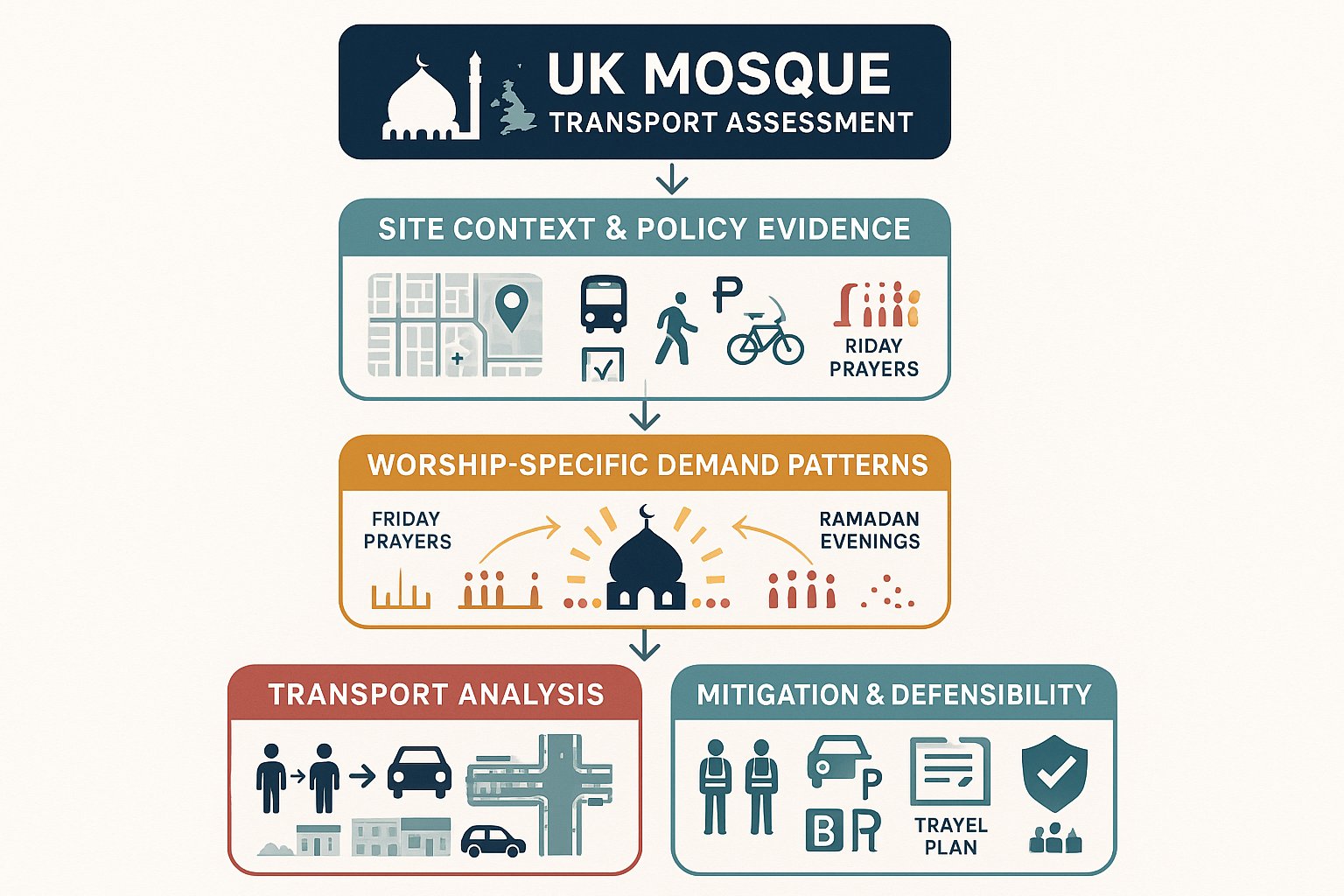
A mosque transport assessment is rarely a routine box-ticking exercise. In practice, it sits at the point where planning policy, local community sensitivity, highway impact, and real worship patterns all meet. And that matters, because mosque proposals often generate a transport profile that looks very different from a standard D1/F1 community use, particularly around Friday prayers, Ramadan activity, and Eid events.
For architects, planning consultants, developers, local authorities, and legal teams, the challenge is usually not whether transport can be addressed at all. It is whether the evidence is specific enough, realistic enough, and well-presented enough to stand up during validation, consultation, and determination. Generic assumptions tend to get exposed quickly, especially where surrounding streets already experience parking pressure or where neighbours are likely to raise concerns about congestion and highway safety.
We see this regularly in planning work. The strongest assessments are the ones that start early, use mosque-specific data where possible, reflect local authority thresholds and policy wording, and deal honestly with worst-case demand rather than smoothing it out. That is exactly what planning teams need to get right in 2026.
In this guide, we set out what a robust mosque transport assessment should cover, when a full Transport Assessment or lighter Transport Statement is likely to be needed, the evidence base that makes it credible, and the practical steps that make an application more defensible.
What A Mosque Transport Assessment Covers
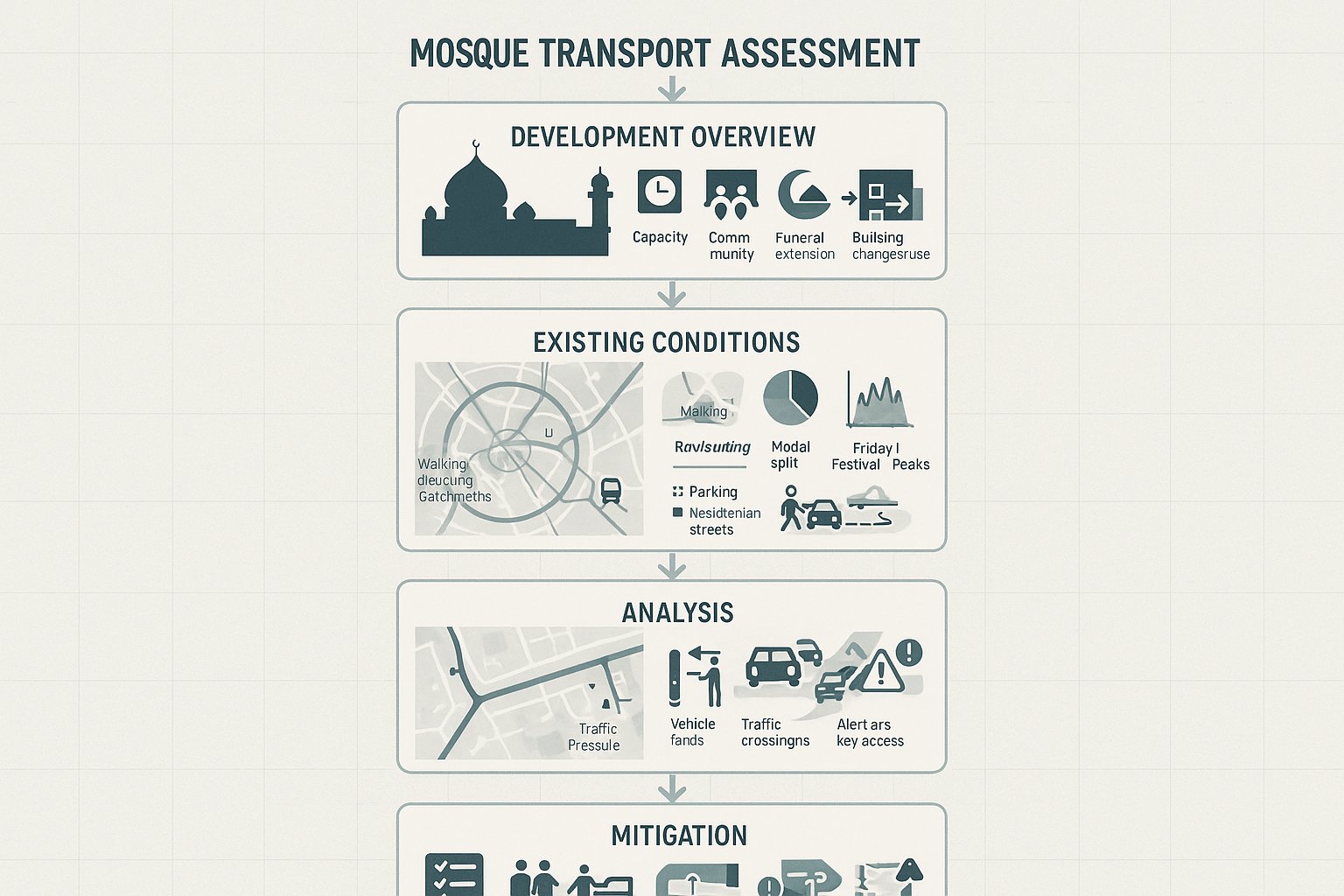
A mosque transport assessment should explain, in a structured and evidence-led way, how a proposal will affect travel demand, parking demand, highway operation, and safe access. That starts with a clear description of the development itself: prayer hall capacity, number of worshippers likely to attend key sessions, opening hours, ancillary functions such as madrasa classes, community rooms, funeral use, or event space, and whether the scheme is a new-build, expansion, or change of use.
From there, the assessment normally sets out existing transport conditions around the site. We would expect this to include the local highway network, access arrangements, nearby junctions, public transport availability, walking and cycling catchments, parking restrictions, and the current level of on-street parking stress. If the site sits in a dense residential area, that context needs to be documented properly rather than described in broad terms.
The core analytical chapters then look at trip generation, modal split, and peak accumulation, with particular attention to Jumu’ah and Eid. A sound report also tests whether local junctions can accommodate additional traffic, whether pedestrians can arrive and leave safely, and whether any overspill parking effects are likely.
Finally, it should identify mitigation: Travel Plan measures, stewarding, managed drop-off arrangements, formal overflow parking where appropriate, and any highway works needed to make the development acceptable in planning terms.
When A Transport Assessment Or Transport Statement Is Likely To Be Required
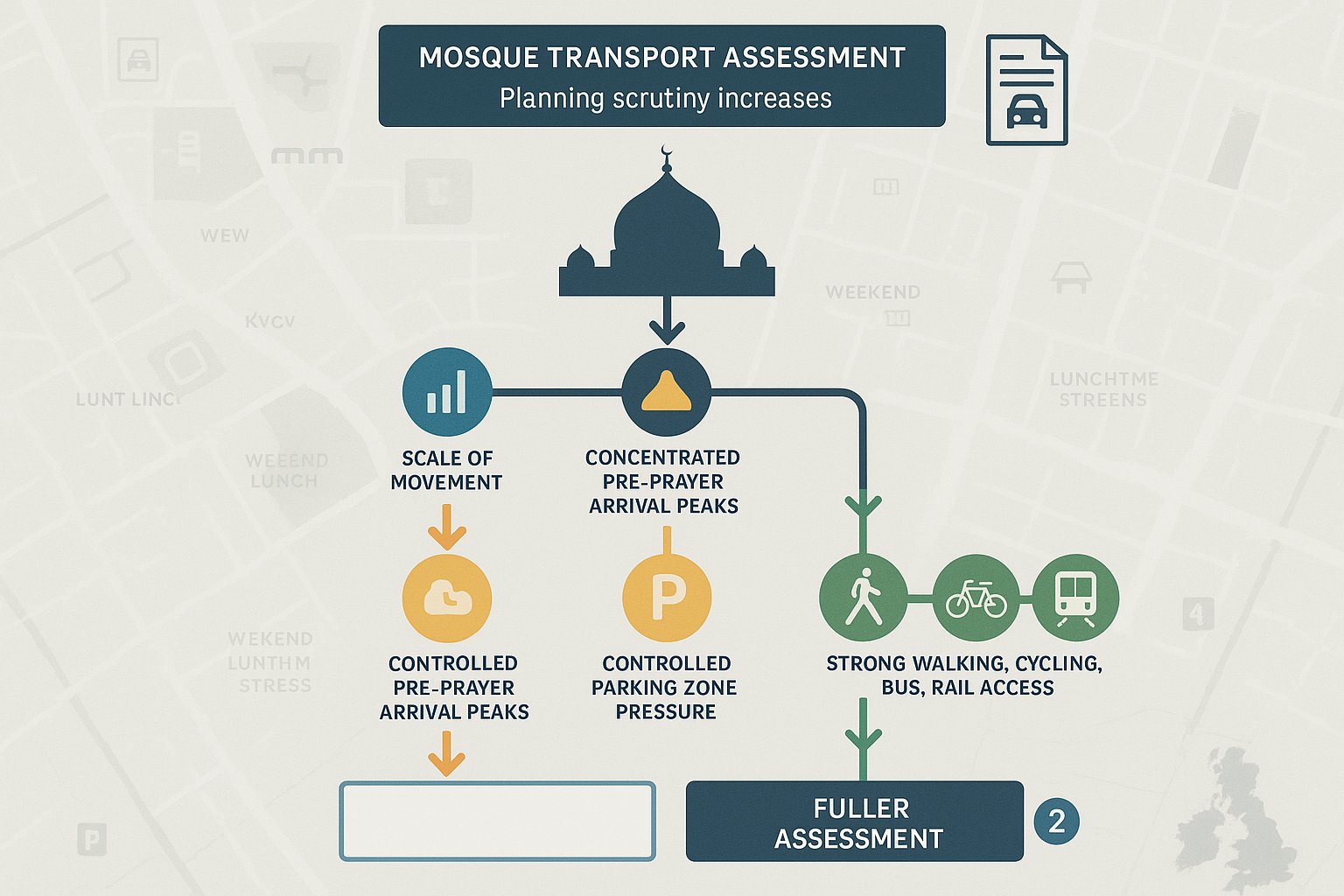
The starting point is national policy. Under the National Planning Policy Framework, developments that generate significant amounts of movement should be supported by a Transport Statement or Transport Assessment. In reality, the question is not just floor area. It is the scale, concentration, timing, and sensitivity of movement.
That distinction is important for mosques. A relatively modest scheme can still trigger concern if arrivals are heavily compressed into a short pre-prayer window, if the surrounding roads are narrow, or if the site sits in a controlled parking zone with known stress at weekends or lunchtime. Conversely, a larger proposal in a highly accessible town-centre location with strong non-car mode share may be capable of being addressed proportionately.
Local planning authorities usually publish validation guidance or transport thresholds, and these vary. Some councils will expect a full TA for larger places of worship or where there is likely to be material parking impact. Others may accept a Transport Statement for smaller changes of use, provided the evidence is still site-specific and robust.
Our advice is simple: do not assume that a lighter report will be enough just because the gross internal area appears modest. If the proposal could attract objections on parking, congestion, or road safety grounds, it is often better to scope the work early with the council and prepare evidence at a level that can survive scrutiny.
Why Mosques Create Distinct Transport Planning Challenges
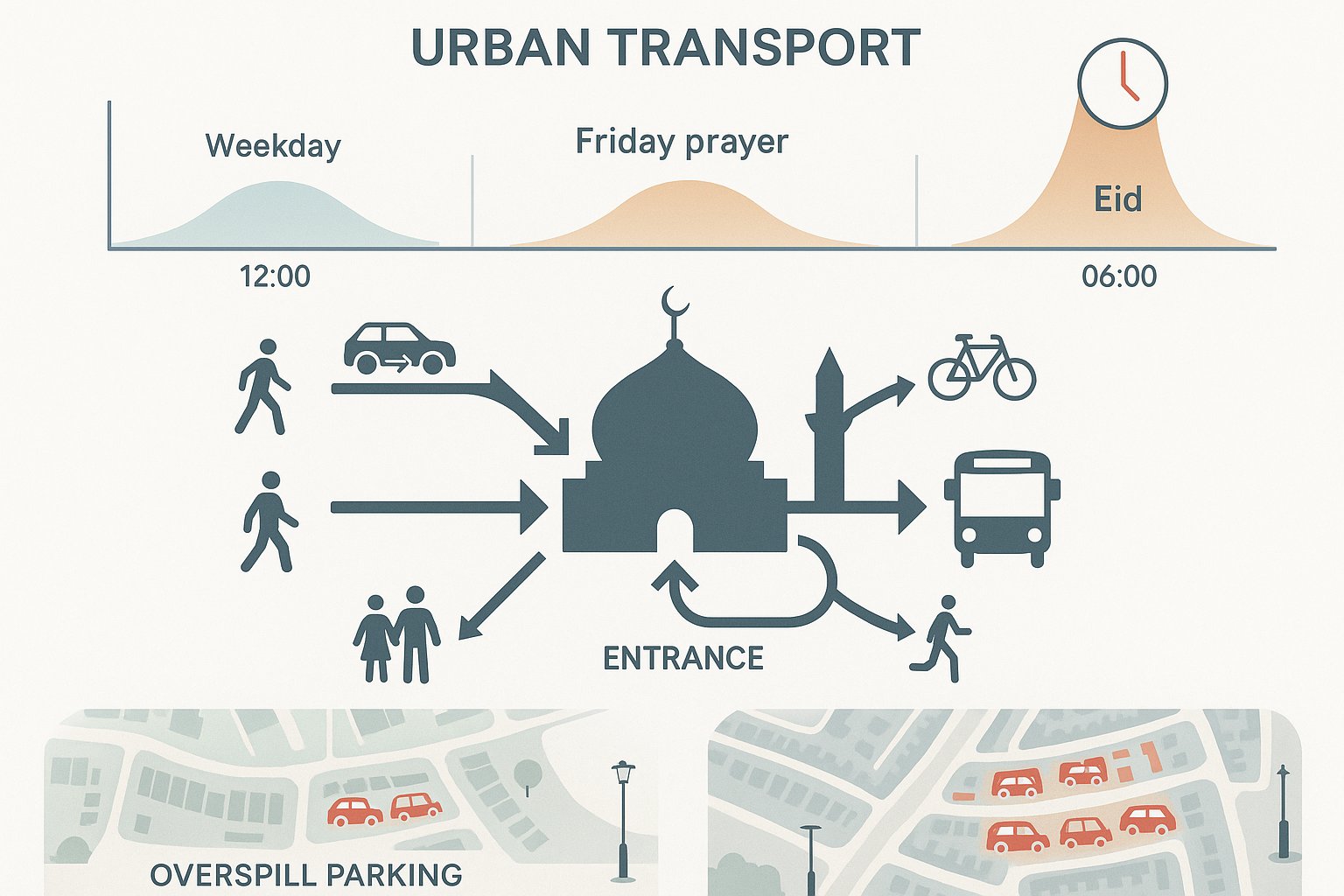
Mosques often produce a transport pattern that differs from many other community, education, or assembly uses. The issue is not simply trip volume: it is the concentration of demand at specific times, the interaction between person trips and vehicle trips, and the strong local sensitivity to parking and kerbside activity.
Many mosque sites are in established urban neighbourhoods where land is tight, streets are already parked up, and off-street provision is limited. Worshippers may live locally and a substantial proportion may walk, which is positive. But a relatively short peak period can still create sharp pressure from car arrivals, drop-offs, informal stopping, and short-stay parking on nearby residential roads. That pattern can feel more intense than the total daily trip numbers might suggest.
Planning teams also need to recognise that attendance is not always evenly spread across the week. Friday prayers matter most from an assessment perspective, and Eid can generate a very different demand profile again. Add in madrasa sessions, evening activity during Ramadan, or occasional larger community events, and the transport picture quickly becomes more complex than a generic land-use category implies.
That is why a defensible mosque transport assessment needs to be tailored. Standard assumptions may help as a starting point, but they are rarely enough on their own.
Friday Prayers, Eid, And Peak-Demand Patterns
Friday Jumu’ah is usually the defining test. Arrivals often cluster within 30 to 45 minutes before prayers, and departures can also be sharply concentrated, especially where there is a single main session. Some mosques manage demand through multiple prayer sittings, which can reduce peak accumulation at any one moment, but only if the timing, management, and expected distribution are evidenced properly.
Eid is different again. Attendance can exceed normal Friday levels, trips may start much earlier in the morning, family travel is more common, and car mode share may be higher than on a routine weekday. If the proposal is likely to rely on temporary arrangements for Eid, the assessment should say so clearly and explain how those arrangements will be managed.
A common mistake is to assess only weekday network peaks and overlook the actual worship peak. Councils and objectors tend to notice that straight away. We need to test the development at the times that genuinely matter, not only at the times that are easiest to model.
Travel Modes, Drop-Off Activity, And Short-Stay Parking Pressure
Travel mode can be mixed and highly local. Many worshippers may walk from surrounding neighbourhoods: others arrive by car as drivers or passengers: some use buses: cycling is usually modest but can still form part of the Travel Plan case. The detail matters because person attendance does not translate neatly into vehicle demand.
Drop-off and pick-up activity is especially important. A site may technically have a manageable number of parked vehicles, yet still create operational issues because cars stop briefly near the entrance, double-park, wait on corners, or turn in awkward locations. Those movements can affect visibility, bus operation, pedestrian comfort, and general traffic flow.
Short-stay parking pressure also tends to be spatially concentrated. Drivers often seek the nearest available spaces, which can lead to overspill on a small cluster of streets rather than a broad, dispersed pattern. That is why parking beat surveys and street-by-street occupancy data are so valuable. Without them, it is difficult to show whether spare capacity genuinely exists or whether a proposal would simply shift stress onto neighbouring roads.
Key Planning Policy And Local Authority Considerations
Policy compliance is one of the foundations of a successful mosque transport assessment. At national level, the NPPF remains central: developments should provide safe and suitable access for all users, help address the impacts of transport, and support sustainable modes where practical. Parking policy also matters, particularly where local plans balance accessibility with constraints on excessive car provision.
At local level, councils will usually have more specific expectations. These can include transport thresholds, parking standards or maximums, cycle parking requirements, road safety criteria, Travel Plan triggers, and guidance on when junction modelling or parking surveys are required. In London and other dense urban authorities, accessibility and restraint-based parking policy can carry particular weight. In suburban and edge-of-centre areas, the emphasis may fall more heavily on parking stress and residential amenity.
For mosques, planning officers often focus on a few recurring points: whether peak attendance has been assessed realistically: whether local parking conditions have been measured, not guessed: whether the site is genuinely accessible by non-car modes: and whether operational mitigation can be secured by condition or obligation.
We find that the strongest reports do not just cite policy in a standard appendix-style way. They show how the evidence answers the actual policy tests. In other words: safe access, acceptable highway impact, appropriate parking management, and credible support for walking, cycling, public transport, and shared travel.
Core Evidence Needed To Prepare A Robust Assessment
A robust assessment stands or falls on evidence quality. For mosque proposals, that evidence usually needs to go beyond a standard desktop review because worship patterns, modal split, and parking behaviour can vary markedly by location, denomination, local catchment, and management approach.
At minimum, we would normally expect a clear development schedule, plans showing access and parking layout, local highway context, baseline traffic data, parking controls, public transport information, and an explanation of likely attendance profiles. But the more sensitive the scheme, the more valuable site-specific and mosque-specific survey evidence becomes.
Comparable-site surveys can be particularly useful where a new mosque has no operating history yet. They can help anchor assumptions about arrivals by mode, vehicle occupancy, dwell time, and the effect of multiple prayer sessions. TRICS can still play a role, but for many mosque schemes it should be treated carefully and supplemented with bespoke evidence rather than used as a blunt shortcut.
The report should also bring together safety inputs, accessibility analysis, Travel Plan measures, and, where relevant, operational management arrangements for Friday and Eid. A planning team that assembles this evidence early is in a much better position to respond to highways comments before they become reasons for refusal.
Site Surveys, Junction Capacity, And Parking Stress Data
Survey design matters. If counts are taken only on a standard weekday peak and not around Jumu’ah, the resulting evidence may miss the very impact that the application needs to address. For many mosque proposals, we need classified turning counts at nearby junctions, observed traffic conditions on key streets, and parking beat surveys covering the right days and times.
Parking stress data is particularly persuasive when done properly. That means recording occupancy by street, by hour or half-hour, identifying permit controls or limited waiting restrictions, and distinguishing between legal capacity and practical capacity. Streets that are technically unrestricted can still operate as effectively full when gaps are too small or access is obstructed.
Junction capacity analysis should then focus on the locations that actually matter to the proposal. Depending on context, that may involve priority junction modelling, signalised junction assessment, or a more observational operational review where formal modelling would add little. What councils want to see is a transparent explanation of existing conditions and whether forecast demand would cause material queues, delay, or safety concerns.
Travel Plan Information, Accessibility, And Highway Safety Inputs
A Travel Plan should not sit in the report as a generic afterthought. For a mosque, it needs to respond to real worship patterns and include practical measures: promoting walking catchments, secure cycle parking, better public transport information, lift-sharing, staggered sessions where appropriate, volunteer stewarding, and communication with worshippers about considerate parking.
Accessibility analysis helps demonstrate whether these measures are realistic. We usually look at walking isochrones, cycle routes, bus stops, rail access if relevant, pedestrian crossings, gradients, lighting, and route quality. If the site is well connected, that should be evidenced clearly. If it is not, the report needs to be honest about that and show how vehicle impacts will still be managed.
Highway safety is another essential input. Collision data, visibility splays, crossing points, footway widths, vehicle manoeuvring, servicing arrangements, and school-run interactions can all become material. In some cases, the issue is not traffic volume at all, but conflict at the kerb edge just before and after prayer times. A good assessment recognises that early and addresses it directly.
How Trip Generation And Peak Impacts Are Assessed For Mosques
Trip generation for a mosque should be assessed in people first, then converted into modes and vehicle movements. That sounds obvious, but it is where many weak reports go wrong. They jump too quickly to car trip rates without first establishing likely attendance, session timing, and catchment behaviour.
A sound approach usually combines several strands: capacity-based estimates, observed survey data from the site or comparable mosques, local demographic and accessibility context, and any relevant TRICS evidence used with caution. We then derive person trips by time period, split them by mode, and apply realistic vehicle occupancy assumptions to estimate driver and passenger trips.
The peak period needs just as much care as the trip rate. For a mosque, the critical assessment window may be a Friday lunchtime period, an evening prayer period during Ramadan, or an Eid scenario rather than the standard AM peak. Scenario testing is often essential: routine weekday use, worst-case Friday attendance, multiple-session operation, and exceptional event management where relevant.
Once vehicle trips are derived, we assess impact on the surrounding network and kerbside conditions. That may include junction modelling, qualitative operational review, parking accumulation analysis, and sensitivity testing. The most defensible reports show assumptions openly and test reasonable worst cases rather than presenting a single neat figure as if travel behaviour were fixed.
Common Planning Risks And How To Address Them Early
The most common planning risk is underestimating car-related impact. That can happen because attendance is overstated as walk-in and local, because drop-off activity is ignored, or because parking surveys are carried out at the wrong times. Once neighbours submit photos of overspill parking and blocked driveways, the application can become much harder to recover.
Another recurring risk is relying on management measures that are vague or unsecured. Statements such as “worshippers will be encouraged not to park nearby” rarely carry much weight. Councils want specifics: who manages arrivals, how stewards operate, whether formal overflow parking exists, whether multiple sessions are committed to, and how these measures will be monitored.
A third issue is mismatch between the planning description and actual use. If the building also accommodates teaching, community events, or evening programmes, the transport evidence needs to reflect that. Trying to assess only the core prayer use may create credibility problems later.
The best way to address these risks is early scoping, realistic assumptions, and a willingness to test uncomfortable scenarios. That includes Friday and Eid, not just average days: local parking stress, not just on-site provision: and operational detail, not just broad intent. In our experience, concise, accurate evidence prepared early is far cheaper than trying to retrofit justification once objections arrive.
What Makes A Mosque Transport Assessment More Defensible
A defensible report is one that a planning officer, highway officer, committee member, or inspector can follow without having to fill in the gaps themselves. That usually comes down to four things: mosque-specific evidence, transparent assumptions, proportionate technical analysis, and clear mitigation linked to policy.
First, the evidence should reflect actual worship patterns. If survey data comes from the application site, excellent. If not, comparable mosque surveys with a clear rationale are often far stronger than generic class averages. Second, every important assumption should be stated plainly: attendance, mode share, vehicle occupancy, session timings, parking accumulation, and sensitivity scenarios.
Third, the analysis needs to be proportionate but not thin. A small scheme does not always need complex modelling, but it does need enough technical depth to address the likely concerns. And fourth, mitigation has to be concrete. Travel Plan measures, stewarding, signage, controlled access, cycle parking, formalised overflow arrangements, and any highway works should connect directly back to the impacts identified.
This is also where experience helps. At ML Traffic, we know that local authority expectations can differ sharply from one borough or district to another. Reports that are concise but tailored to those expectations tend to perform far better than generic templates. In 2026, that local calibration is not a nice extra: it is part of what makes a mosque transport assessment credible.
Conclusion
A strong mosque transport assessment does not try to dilute the difficult bits. It deals with them directly: Friday peaks, Eid demand, parking stress, drop-off behaviour, and the realities of urban site constraints. That is what makes the difference between a report that merely accompanies an application and one that actively helps secure permission.
For planning teams, the practical takeaway is straightforward. Start early. Scope with the local authority. Use mosque-specific evidence wherever possible. Test the real peak conditions, not just conventional traffic periods. And make sure mitigation is detailed enough to be secured and implemented.
When those pieces come together, the assessment becomes far more defensible. It shows that the proposal can operate safely, manage local impact responsibly, and align with national and local transport policy. In a sensitive planning context, that level of rigour is often exactly what gets a scheme over the line.
Frequently Asked Questions about Mosque Transport Assessment
What is a mosque transport assessment and why is it important?
A mosque transport assessment evaluates how a mosque proposal affects travel demand, parking, highway safety, and access, focusing on peak periods like Friday prayers and Eid. It helps ensure the development complies with planning policies and manages local transport impacts responsibly.
When is a full Transport Assessment or Transport Statement required for a mosque project?
Under the National Planning Policy Framework, any development generating significant movement needs a Transport Assessment or Statement. For mosques, this depends on factors like size, peak traffic concentration, local parking stress, and council thresholds, so early scoping with local authorities is advised.
Why do mosques create distinct transport planning challenges compared to other community uses?
Mosques generate highly concentrated arrivals in short time windows, especially for Friday prayers and Eid, often in dense residential areas with limited off-street parking. This leads to intense short-stay parking, drop-offs, and kerbside activity, requiring tailored transport assessments to address these specific issues.
How are trip generation and peak demand assessed for mosques?
Trip generation is first estimated by person attendance, then converted into vehicle trips using mode share and occupancy data. Peak demand is carefully assessed for key times like Friday Jumu’ah and Eid, including scenario testing with mosque-specific survey data, rather than relying solely on generic traffic periods.
What key evidence supports a robust mosque transport assessment?
Essential evidence includes mosque-specific attendance and travel surveys, detailed parking beat data, classified turning counts at local junctions during peak worship times, accessibility analysis, highway safety data, and a Travel Plan with practical measures tailored to mosque activities and local transport policy.
How can transport impacts from mosques be mitigated effectively?
Mitigation can include managed drop-off and pick-up arrangements, stewarding at peak times, formal overflow parking, Travel Plan initiatives promoting walking and public transport, traffic management measures, and secured obligations or conditions aligning with identified transport risks and local policies.