
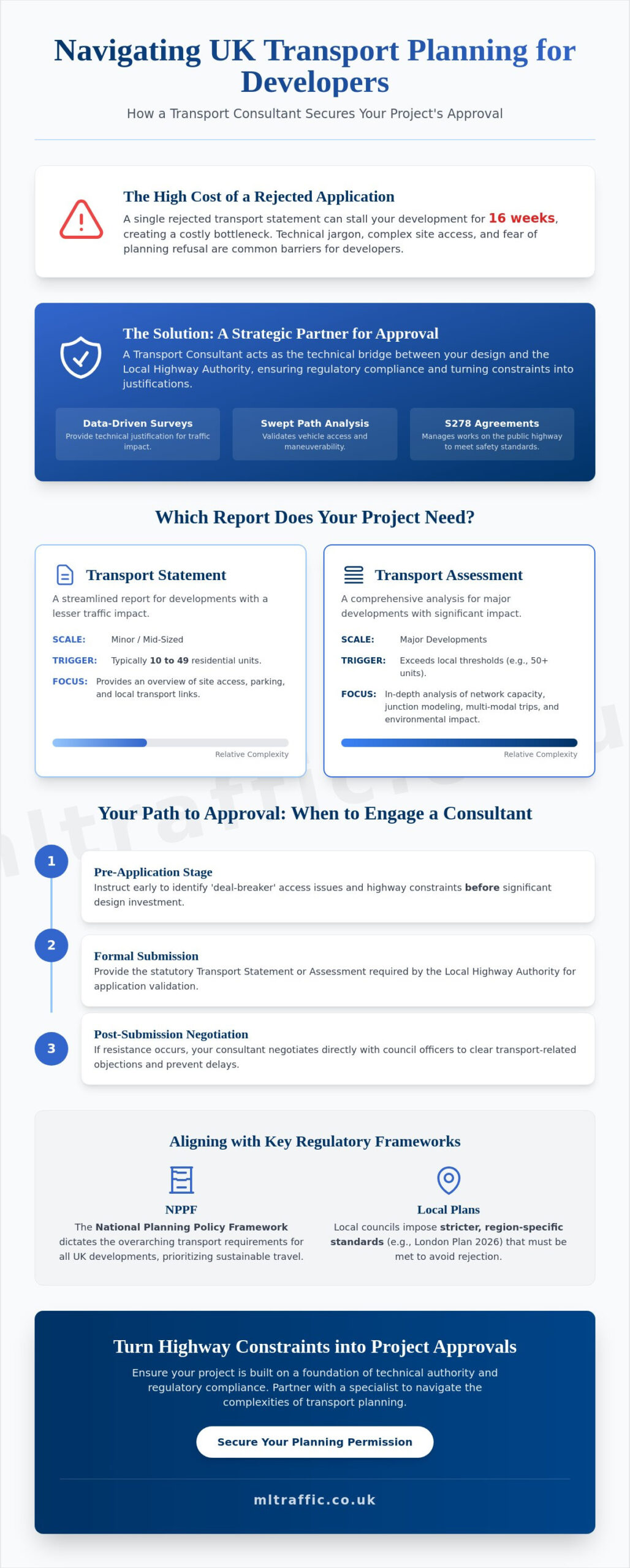
A single rejected transport statement can stall your development for 16 weeks, creating a costly bottleneck in your project timeline. For many developers, the Highway Authority’s requirements for Section 278 agreements or complex site access layouts feel like a high-stakes barrier to progress. It’s common to feel frustrated by technical jargon and the fear that a minor design error in your car park could trigger a full planning refusal. You need a partner who understands that precision is a functional necessity when dealing with modern infrastructure. Engaging a transport consultant ensures your application is built on a foundation of technical authority and regulatory compliance.
This guide explains how a transport consultant acts as your strategic architect of approval. You’ll learn how they secure your planning permission through data-driven traffic surveys, swept path analysis, and expert negotiation with local authorities. We will outline the process of validating site access and optimizing layouts to ensure your project meets the latest 2026 regulatory standards without unnecessary delays. From Transport Assessments to detailed Travel Plans, we cover everything required to move your project from inception to completion with confidence. By the end of this article, you will understand how to turn highway constraints into technical justifications for your development.
Key Takeaways
- Understand the critical role of a transport consultant as the technical bridge between your development design and the Local Highway Authority.
- Identify the specific reporting requirements for your site, including the differences between Transport Statements for minor works and comprehensive Transport Assessments for major developments.
- Learn how to streamline the instruction process by defining project scope and requesting detailed fee proposals aligned with planning demands.
- Gain insights into managing Section 278 agreements to ensure all works on the public highway comply with current safety benchmarks.
- Discover how data-driven tools like Swept Path Analysis and professional Parking Surveys provide the technical justification needed to secure planning approval.
What is a Transport Consultant in the Context of UK Planning?
A transport consultant is a specialized technical expert who evaluates the impact of new developments on the existing transport network. They don’t just provide data; they act as the vital bridge between your architectural site design and the Local Highway Authority (LHA). Their primary role involves translating complex development goals into technical justifications that satisfy regulatory requirements. By integrating transportation planning principles with site-specific engineering, they ensure your project is both accessible and safe for the public. They manage the full lifecycle of transport requirements, from initial feasibility studies to final highway adoptions.
To better understand this concept, watch this helpful video:
The 2026 planning standards demand more robust data than ever before. With planning fees in England having increased by 3.8% as of April 1, 2026, the cost of a rejected application is higher than ever. Authorities now require granular evidence regarding vehicle movements and environmental impact. Within a consultancy, you’ll encounter two distinct roles. Transport planners focus on policy, sustainable travel strategies, and long-term network impact. Traffic engineers handle the technical design aspects, such as junction capacity and physical site access. Both roles are essential for a successful Transport Statement or Assessment.
When Does a Developer Need to Instruct a Consultant?
Precision starts at the pre-application stage. Instructing a consultant early allows you to identify ‘deal-breaker’ access issues before you’ve invested heavily in design. During formal submission, they provide the statutory Transport Statement or Assessment required by law. For residential developments of 10 to 49 units, a Statement is typically the baseline. If your project faces resistance, the consultant works post-submission to negotiate directly with council officers. This targeted advocacy helps clear transport objections that might otherwise stall your progress for 16 weeks or more.
Key Regulatory Frameworks: NPPF and Local Plans
The National Planning Policy Framework (NPPF) dictates the overarching transport requirements for all UK developments. However, local councils often impose stricter regional standards, such as the London Plan 2026 mandates for car-free developments in high PTAL areas. Your reports must align perfectly with these specific borough expectations to avoid immediate rejection. Under the 2026 NPPF update, sustainable transport is defined as an integrated network that prioritizes low-carbon mobility, active travel, and public transport accessibility to reduce reliance on private vehicles. Adhering to these benchmarks is a non-negotiable foundation for modern planning success.
Technical Reports: Transport Statements, Assessments, and Travel Plans
Technical reports serve as the objective evidence required to move a project through the planning system. A transport consultant uses these documents to demonstrate that a proposed development will not negatively impact highway safety or network capacity. Following official UK government guidance, these reports must be proportional to the scale of the development. They provide the technical justification that planning officers need to recommend an application for approval.
Transport Statements are the baseline requirement for mid-sized schemes. In 2026, national guidelines indicate that residential projects between 10 and 49 units typically require a Statement. This report provides a streamlined overview of site access and local transport links. For larger developments, a full Transport Assessment is necessary. In London, the 2026 threshold for an Assessment is usually 80 residential units or commercial space exceeding 2,500 square meters. These assessments involve rigorous data modeling to predict how your site will interact with the wider road network over time.
Travel Plans are strategic documents designed to encourage sustainable travel patterns. They are critical for meeting the 2026 National Planning Policy Framework (NPPF) requirements regarding decarbonisation. By promoting walking, cycling, and public transport use, these plans help developers meet TfL’s ambitious target of 80% sustainable trips by 2041. Without a robust Travel Plan, larger applications often face immediate objections from the Local Highway Authority. You can review our full range of technical reporting services to see how we support UK developers.
Swept Path Analysis: Visualising Vehicle Maneuverability
Designing a site layout without verifying vehicle movements is a high-risk strategy that often leads to planning refusal. We use CAD software to perform Swept Path Analysis Services in London, simulating the exact turning circles of refuse trucks, fire tenders, and delivery vans. This technical verification prevents costly site redesigns by proving access feasibility before a single brick is laid. If a fire engine cannot safely navigate your proposed access road, the Highway Authority will reject the layout. It’s a functional necessity that ensures your site is safe and operational from day one.
Data Collection: Traffic and Parking Surveys
Planning committees require objective data, not anecdotal evidence about parking availability. We utilize the Lambeth Methodology for parking surveys to establish precise demand and capacity in high-density areas. This data is essential for justifying parking provision in 2026, especially under the London Plan’s car-free mandates for areas with high PTAL scores. We also deploy Automatic Traffic Counters (ATC) to establish baseline traffic flows. This data-driven approach ensures your transport consultant can build a case grounded in reality, making your application ready for the highest levels of technical scrutiny.
How to Instruct a Transport Consultant: A Step-by-Step Guide
Instructing a transport consultant is a logical process that begins with project definition. To avoid technical delays, you must provide a clear brief that allows your partner to align their work with Local Highway Authority (LHA) expectations. Following a structured approach ensures that the resulting reports are robust enough to withstand the scrutiny of planning committees and statutory consultees.
- Step 1: Define project scope. Identify which LHA oversees your site. Requirements in Worcestershire differ from those in West Sussex or London, so local context is vital.
- Step 2: Request a fee proposal. Base this on specific planning needs. Ensure the proposal covers all necessary deliverables, such as Parking Surveys or Swept Path Analysis.
- Step 3: Provide site plans. Submit accurate layouts and confirmed use classes. This data allows for precise trip generation analysis, which is the cornerstone of any Transport Assessment.
- Step 4: Review the draft. Check the report for alignment with your commercial goals. Ensure the technical justifications maintain safety standards while supporting your site access strategy.
- Step 5: Finalise for submission. Once approved, the consultant finalises the document for the planning portal, ready for formal consultation.
Avoiding Common ‘Poor Service’ Pitfalls
Technical accuracy depends on the quality of the tools used. Council officers will flag outdated data immediately, which leads to costly revisions. Ensure your consultant uses the latest TRICS database versions for trip rate analysis to maintain credibility. It’s also vital to verify that your partner holds adequate professional indemnity insurance and maintains membership with the Chartered Institution of Highways & Transportation. Selecting a low-cost report often creates a false economy. Low-quality submissions frequently trigger 16-week delays during the consultation period as authorities demand more detailed evidence.
The Importance of Pre-Application Advice
Early engagement with the LHA is a strategic necessity. By involving your transport consultant during the pre-application stage, you can secure early buy-in for your access strategy. This proactive approach identifies potential ‘deal-breakers’ before you commit to final designs. A well-negotiated pre-application response can significantly reduce the number of restrictive planning conditions attached to your final approval. You can learn more about how we manage these early-stage negotiations by reviewing what we do at ML Traffic. Reducing regulatory pressure through expert advocacy is the most efficient way to maintain your project timeline.
Navigating S278 Agreements and Highway Design
A Section 278 (S278) agreement is a legal requirement for any developer needing to carry out permanent alterations or improvements to the public highway. Whether you’re creating a new site access or improving a junction, the transport consultant acts as the technical lead during these negotiations. They ensure that your proposed highway works meet the exacting safety standards of the Local Highway Authority (LHA). Without a precise design, you risk facing the ‘Highway Objection’, which is the most common reason for planning delays in the UK. This objection can stall a project for months, directly impacting the commercial viability of your development.
The financial stakes for these agreements are high. Medium-scale S278 schemes typically cost between £50,000 and £500,000, with utility diversions often accounting for 30% to 50% of the total budget. Regional fee structures also add to the complexity. For example, as of June 1, 2026, Worcestershire County Council requires an initial technical submission fee of £2,000. In West Sussex, the fee is 10% for schemes up to £1 million as of April 1, 2026. A skilled transport consultant manages these regulatory pressures, ensuring your design is approved without triggering excessive inspection fees or repeated submission costs.
Car Park Layout and Access Review
Precision in car park design is a functional necessity to avoid costly site redesigns after construction has begun. We focus on optimising parking spaces while maintaining safe visibility splays for both vehicles and pedestrians. Modern design also requires strict adherence to environmental mandates. The London Plan 2026 now mandates that 100% of all permitted parking spaces in new developments must have active electric vehicle charging points. Integrating these requirements early prevents logistical bottlenecks during the planning phase. For a deeper look at these requirements, read our Highway Design S278 & S38 Guide.
Mitigating Traffic Impact Through Design
Your transport consultant can often reduce the need for expensive ‘hard’ infrastructure changes by implementing ‘soft’ mitigation measures. These strategies are essential for negotiating Section 106 contributions and ensuring that pedestrian safety remains at the heart of your technical submission. By demonstrating a clear commitment to active travel and public transport accessibility, you can often secure approval for higher density sites even in constrained areas. If you need expert support with your highway design, contact ML Traffic Engineers UK to ensure your submission meets all current benchmarks.
Why Partner with ML Traffic Engineers UK for Your Next Project?
Choosing the right transport consultant is a strategic decision that directly impacts your project’s risk profile and delivery timeline. ML Traffic Engineers UK provides the technical authority required to manage the logistical and regulatory pressures of the UK planning system. We specialize in delivering high-precision Transport Statements and Assessments that meet the rigorous standards of 2026 legislation. Our team balances technical expertise with a client-focused approach, ensuring that your site design is both safe and commercially viable. By providing an all-encompassing, fully-managed service, we act as a vital guardian of your project’s progress from inception to final approval.
Precision is a functional necessity in modern development. We utilize a data-driven approach to eliminate guesswork and prevent costly design errors. Our team performs detailed Swept Path Analysis to verify vehicle maneuverability and conducts professional Parking Surveys to establish robust baseline data. These technical deliverables are essential for overcoming the ‘Highway Objection’ and securing approval from the Local Highway Authority. We take immense pride in our adherence to industry benchmarks, ensuring every report we produce is ready for the highest levels of technical scrutiny.
Our track record includes navigating complex planning applications across London and the wider English regions. We understand the specific nuances of the London Plan 2026, including car-free mandates and 100% EV charging requirements. We also manage the financial and technical complexities of Section 278 agreements, helping you avoid the pitfalls of repeated submissions and excessive inspection fees. Our readiness and urgency stem from a deep understanding of the fast-moving nature of the infrastructure sector. We ensure your application is built on a foundation of professional integrity and regulatory compliance.
Our Comprehensive Approach to Transport Planning
We manage the full project lifecycle, reducing the burden on your internal teams. Our consultants possess direct experience working with local highway authorities across the country, allowing us to anticipate potential obstacles before they cause delays. From initial feasibility assessments to final planning negotiations, we provide the unwavering reliability your development requires. You can explore our project types to see how we have successfully supported developers in residential, commercial, and mixed-use sectors.
Get Started with Your Transport Planning Strategy
Don’t let transport constraints stall your development progress. Our team is available to provide expert guidance tailored to the specific requirements of your site and the relevant local authority. We deliver the technical justifications needed to turn highway challenges into approved access solutions. Contact us today to ensure your planning application is supported by expert technical reporting and data-driven insights. You can request a transport planning quote from ML Traffic Engineers UK to begin your journey toward a successful planning outcome.
Secure Your Planning Approval with Technical Precision
Securing planning permission in the current regulatory environment requires more than just a basic site plan. It demands a rigorous technical foundation that addresses the specific concerns of Local Highway Authorities. By engaging an expert transport consultant, you ensure that every aspect of your site’s traffic impact is documented and justified. This process includes the production of data-led reports that align with the latest 2026 planning standards and the 2024 NPPF framework. Expert advocacy at the pre-application stage can prevent the 16-week delays that frequently stall projects during the consultation period.
ML Traffic Engineers UK, founded in 2014, brings over a decade of technical expertise to your project. We specialize in precision tools like Swept Path Analysis and Lambeth Parking Surveys to validate your site’s functionality. Our team delivers comprehensive technical reports tailored to strict English planning standards, helping you navigate Section 278 agreements without unnecessary delays. Secure your planning approval with a professional Transport Statement from ML Traffic Engineers UK. Your project’s success depends on the technical authority we provide. We’re ready to help you move forward with confidence.
Frequently Asked Questions
What is the difference between a transport consultant and a traffic surveyor?
A traffic surveyor focuses on the physical collection of raw data, such as manual vehicle counts or installing Automatic Traffic Counters (ATC). In contrast, a transport consultant takes this raw data and applies it to planning policy and engineering design. The consultant produces the technical reports and planning justifications required to secure approval from the Local Highway Authority. They act as the strategic lead for your application’s transport strategy.
Do I need a transport consultant for a small residential development?
Most developments with 10 or more units require professional technical input. National guidelines in 2026 state that residential projects between 10 and 49 units typically need a Transport Statement. Even for smaller sites, a consultant is often necessary to resolve complex visibility splays or site access issues. Engaging a professional early prevents design errors that could lead to a full planning refusal based on highway safety concerns.
How much does it cost to hire a transport consultant for a planning application?
Fees for consultancy services are determined by the specific technical requirements of your planning application. Factors that influence the final quote include the need for specialized Parking Surveys, junction modeling, or complex Swept Path Analysis. Developers should provide clear site plans and use classes to receive an accurate fee proposal. This ensures the technical support is proportional to the scale and potential traffic impact of the development.
What is a Swept Path Analysis and why is it required by the council?
Swept Path Analysis is a computer-aided simulation that tracks the physical path of a vehicle’s body and wheels during a maneuver. Councils require this to verify that large vehicles, such as refuse collectors or emergency fire tenders, can navigate the site safely. Proving that these vehicles won’t overrun footways or collide with structures is a functional necessity for securing approval of your proposed site layout.
Can a transport consultant help if the council has already objected to my site access?
A consultant is often the most effective partner for resolving existing highway objections. They review the council’s feedback and use data-driven evidence to challenge or mitigate the concerns raised. This might involve redesigning site access, providing more detailed traffic surveys, or negotiating soft mitigation measures through a Travel Plan. Their role is to find a technical solution that satisfies the authority while protecting your project’s viability.
How long does it take to produce a Transport Statement for a planning submission?
Producing a robust Transport Statement typically takes between two and four weeks. This timeline depends on whether baseline data is already available or if new Traffic Surveys are required. If field data collection is necessary, the process includes the time needed to deploy equipment and analyze the results. We prioritize efficiency to ensure your technical submission is ready for the planning portal without unnecessary delays.
What data is required to start a Transport Assessment?
You need to provide accurate site layouts, confirmed use classes, and total floor areas to begin the process. The consultant uses this information to calculate trip generation using the TRICS database. Additional requirements include details on existing parking provision and any proposed changes to the highway. This data allows for a comprehensive analysis of how the development will interact with the local transport network and public transport links.
Do transport consultants handle Section 278 negotiations with the highway authority?
Transport consultants manage the full technical negotiation of Section 278 agreements. They design the physical changes to the public highway and ensure these plans meet the strict safety benchmarks of the local authority. By managing the technical submission and liaison with highway officers, they help developers avoid the high costs associated with repeated design revisions or excessive inspection fees for defective works.

Disclaimer
The content on mltraffic.co.uk, including all technical articles, guides, and resources, is provided for general informational and educational purposes only. It is not intended to constitute professional advice in traffic engineering, transportation planning, development approvals, or any other technical or legal field.
While ML Traffic Engineers makes every reasonable effort to ensure the accuracy, completeness, and timeliness of the information published, we do not provide any warranties or representations (express or implied) regarding its reliability, suitability, or availability for any particular purpose. Any reliance you place on the content is strictly at your own risk.
In no event shall ML Traffic Engineers, its directors, employees, authors, or affiliates be liable for any direct, indirect, incidental, special, consequential, or punitive damages (including, without limitation, loss of profits, data, or business opportunities) arising out of or in connection with the use of, or inability to use, any information provided on this website.
The articles and guides on this site are not a substitute for engaging a qualified, professional traffic engineer to assess your specific project requirements. For tailored advice, compliance assessments, or traffic engineering services, please contact a competent professional.
This disclaimer may be updated from time to time without notice. By accessing or using this website, you agree to be bound by the most current version of this disclaimer.