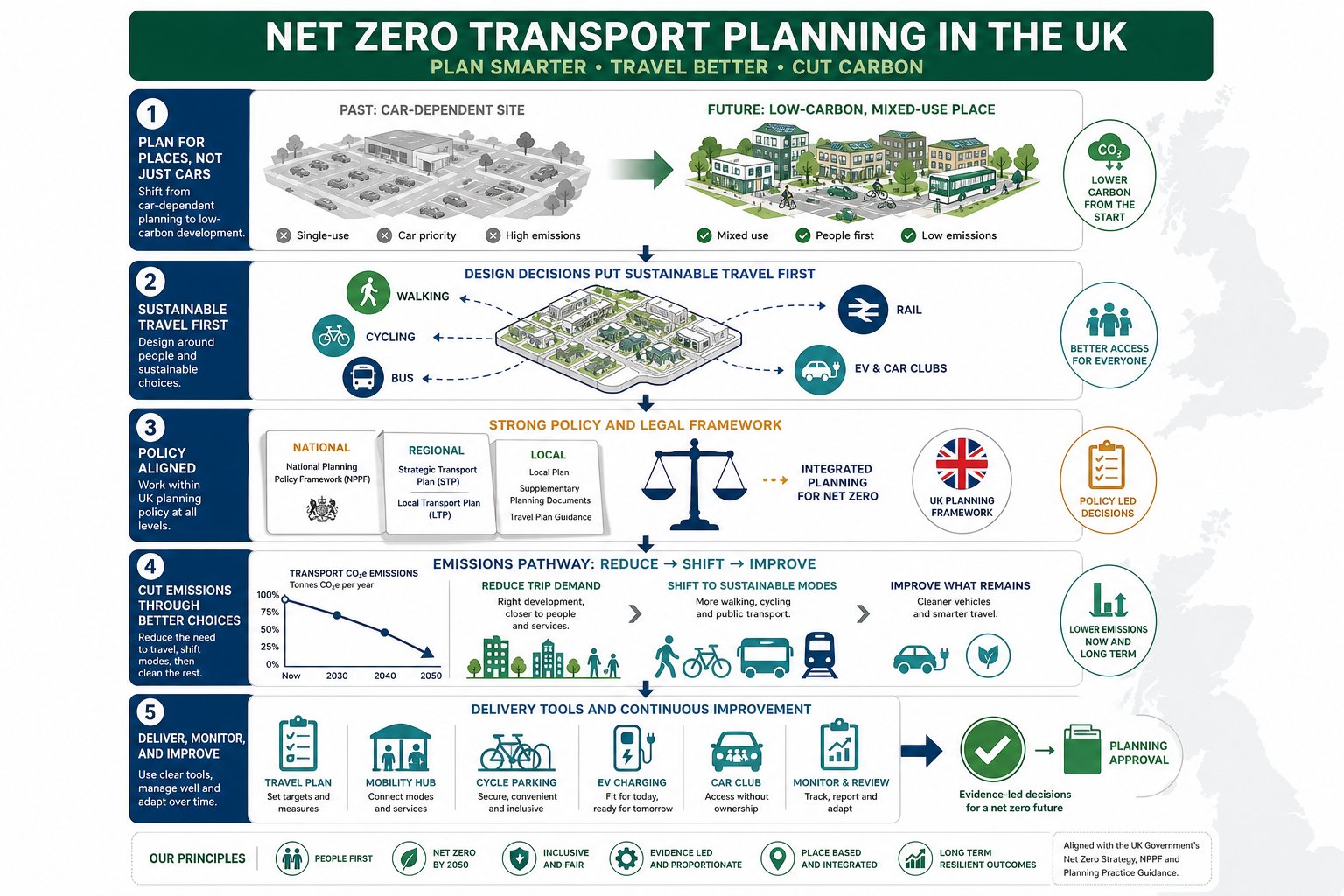
Transport is now one of the clearest tests of whether a planning application looks like yesterday’s development logic or tomorrow’s. In the UK, that matters because transport emissions remain stubbornly high, while planning decisions made today will shape travel behaviour for decades. A scheme that locks in car dependency, long trip lengths and weak public transport access can quickly run into policy tension, local objection and awkward questions from highways officers, planning committees and consultees.
That is why net zero transport planning has moved from a nice-to-have narrative to a practical development requirement. For architects, planners, lawyers, surveyors, developers and councils, the issue is no longer just whether a site can accommodate vehicle trips. It is whether the proposal reduces the need to travel, supports mode shift, enables low-emission movement and stands up to increasingly climate-aware scrutiny.
In our experience, stronger planning outcomes tend to come from joining up land use, access, movement and carbon evidence early, not bolting it on at the Transport Assessment stage. The best schemes are not simply “less bad” for traffic. They are intentionally planned around sustainable travel first, with parking, servicing and electric vehicle provision handled as part of a wider decarbonisation strategy.
This guide sets out what that means in practice in 2026, how policy is shaping decisions, and where planning applications most often succeed or stumble.
What Net Zero Transport Planning Means In A UK Planning Context
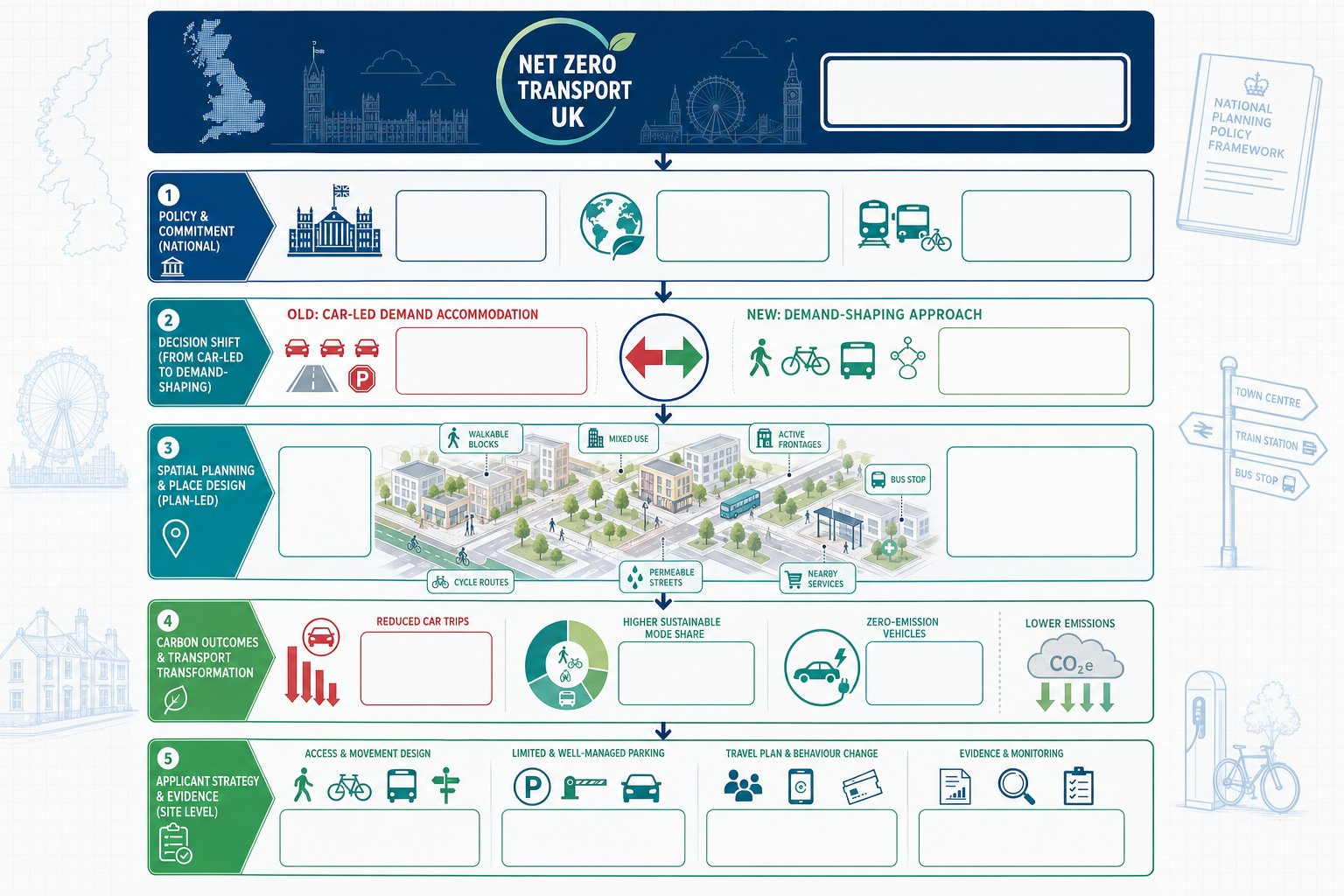
In UK terms, net zero transport planning means aligning transport-related planning decisions with the statutory target to reach net zero greenhouse gas emissions by 2050. In practice, that pushes us beyond the old question of whether residual traffic impacts are “severe”. We also need to ask whether a development pattern increases car dependence, whether trips can reasonably shift to walking, cycling and public transport, and whether remaining vehicle trips are being decarbonised.
That changes the starting point. Instead of treating transport as a technical exercise in accommodating forecast demand, the planning process increasingly expects us to shape demand. The Transport Decarbonisation Plan, the Climate Change Act framework and local climate policies all point in the same direction: fewer unnecessary vehicle kilometres, more sustainable mode share, and support for zero-emission travel where trips still occur.
Spatial planning is central to this. Site layout, land-use mix, density, frontage activity, permeability and proximity to services all influence carbon outcomes long before a junction model is built. A well-located scheme with direct pedestrian links and realistic bus access can materially reduce emissions. A remote, single-use, car-led layout usually does the opposite.
For applicants, this means transport evidence should explain not only movement impacts, but the carbon logic of the proposal. That is often where early strategy work pays off, especially when access design, parking restraint and sustainable travel measures are coordinated from the start rather than revisited under pressure late in the application programme.
Why Transport Planning Matters To Net Zero Targets
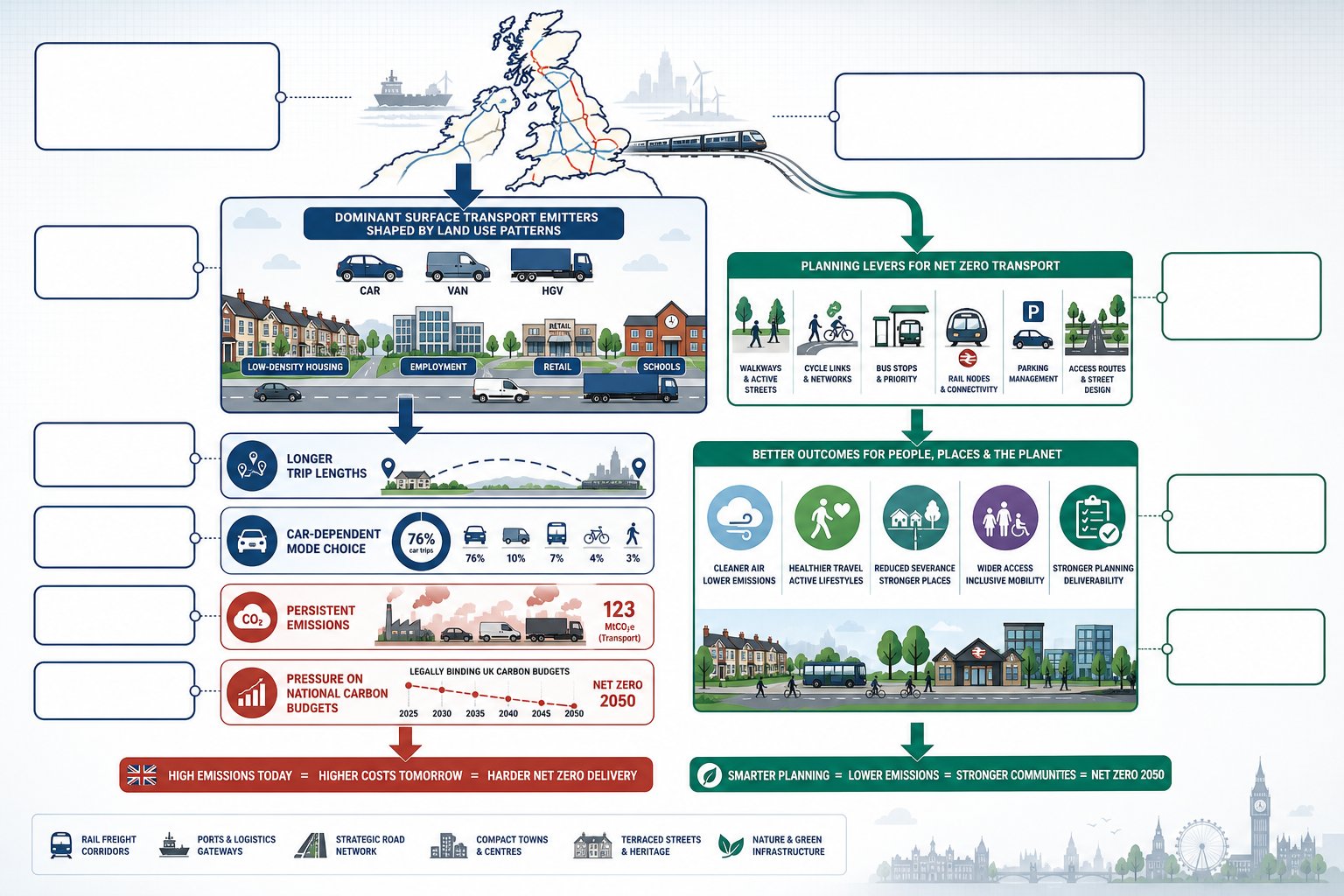
Transport planning matters because surface transport remains one of the UK’s biggest emitting sectors and, compared with electricity generation, progress has been frustratingly slow. Cars, vans, HGVs and the land-use patterns that generate their trips still dominate day-to-day emissions. If that trajectory does not change, other sectors have to decarbonise even faster to keep the country within its carbon budgets.
This is why transport is no longer a side issue in planning policy. The way we locate housing, employment, logistics, education and retail directly affects trip lengths and mode choice. A development approved today may still be shaping commuting, servicing and school-run patterns in 2050. So a weak transport strategy is not just a highways problem: it is a carbon problem with a very long tail.
There is also a practical development angle. Schemes that show a credible route to lower car use are often easier to defend in planning terms, especially in authorities with climate emergency declarations or strong local transport policies. That may involve active travel links, parking standards aligned with sustainable access, or a more coherent access strategy approach tied to the site’s context.
And there is a broader public interest. Lower-carbon transport planning can improve air quality, support healthier travel, reduce severance and widen access for people who do not own a car. Net zero, in other words, is not a separate planning theme. It is tied to place quality, equity and deliverability.
The Policy And Regulatory Framework Shaping Decisions
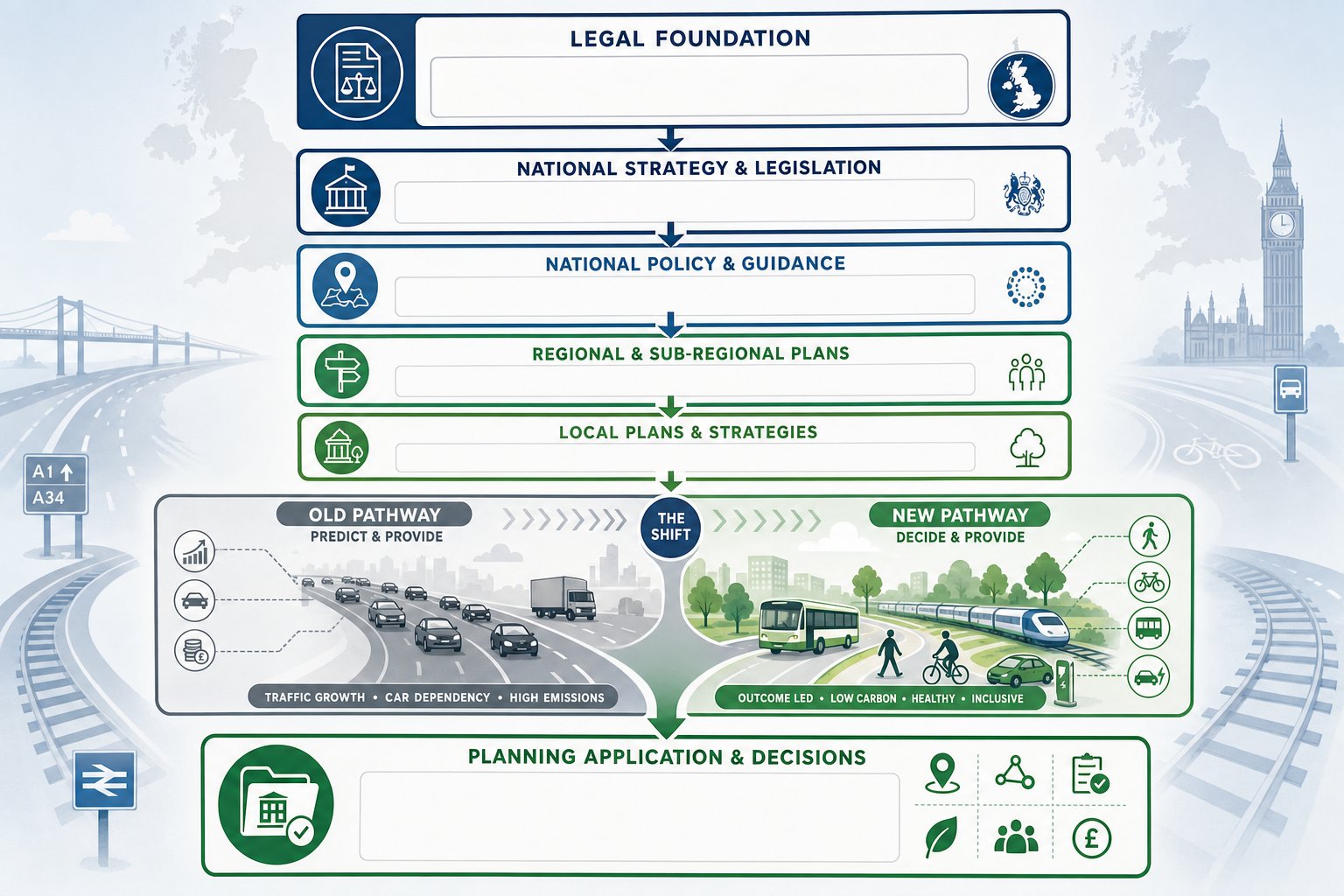
The policy framework is now broad enough that net zero transport planning cannot be treated as optional gloss. At national level, the Climate Change Act 2008, as amended for the 2050 net zero target, sets the legal backdrop. The Transport Decarbonisation Plan then gives sector-specific direction, including the need to avoid unnecessary travel, shift more trips to public and active transport, and decarbonise the vehicles that remain.
For planning decisions, this intersects with the National Planning Policy Framework in England and equivalent policy approaches across the UK nations. The common thread is familiar: developments should be focused on locations which can be made sustainable, opportunities to promote walking, cycling and public transport should be identified and pursued, and planning should support the transition to a low-carbon future.
A more subtle but important shift sits underneath this. Transport planning is moving away from “predict and provide”, where growing traffic is accepted and accommodated, toward “decide and provide”, where networks and places are planned around desired outcomes. Those outcomes now include carbon reduction. So forecasting still matters, but it is no longer the whole story.
For applicants, that means reports should read like planning documents, not just engineering appendices. Policy alignment needs to be explicit, especially where local authorities expect climate impacts to be addressed alongside traffic operation. This is often where experienced transport consultants add value: turning technical transport evidence into a planning-ready case.
National, Regional And Local Planning Requirements
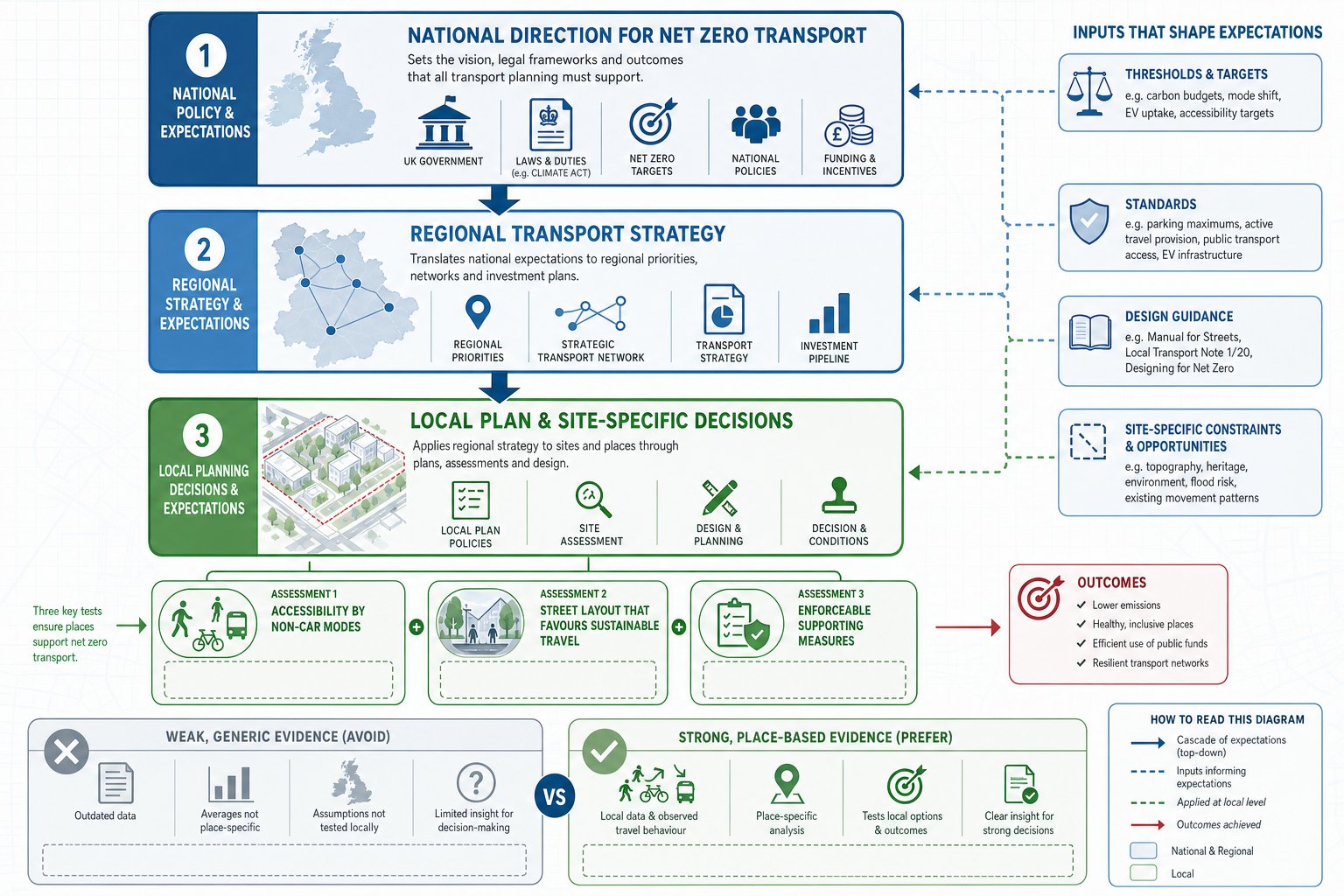
National policy sets the direction, but most decisions are won or lost through regional and local interpretation. Combined authorities, county councils, unitary authorities and London boroughs increasingly embed decarbonisation in Local Transport Plans, movement strategies, parking standards, climate action plans and design guidance. Those documents may not all carry equal statutory weight, but together they shape what officers expect to see.
At local level, we often find three practical tests. First, is the site genuinely accessible by non-car modes, not just theoretically served by them? Second, does the layout make sustainable travel the easiest option? Third, do the supporting documents commit the applicant to measures that can be monitored and enforced?
This is where detail matters. A Local Plan allocation does not automatically mean the transport strategy is net zero aligned. Nor does proximity to a bus stop, if the walking route is indirect or the service infrequent. Councils are increasingly alive to those gaps.
Good applications hence map national policy to regional strategy and then to local thresholds, standards and site-specific constraints. We have found that concise, authority-aware evidence often performs better than generic climate wording. It shows that the proposal has been designed for the place it sits in, which is exactly what decision-makers want to see.
How Development Proposals Are Assessed For Transport Carbon Impacts
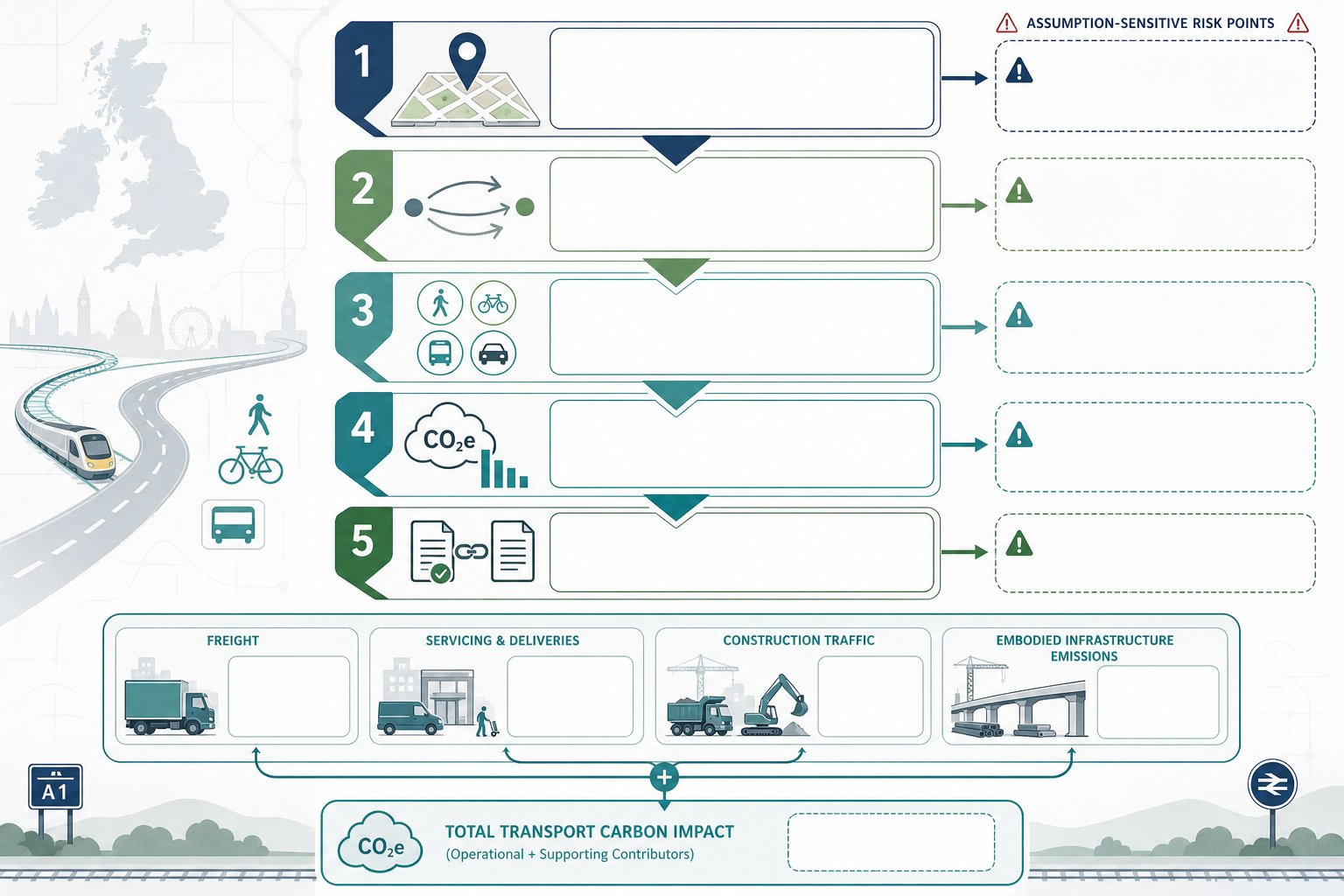
Transport carbon assessment is becoming more structured, even where formal methodologies still vary between authorities. In broad terms, decision-makers want to understand three things: how many trips a scheme will generate, how those trips are likely to be made, and what emissions follow from that travel profile.
That sounds straightforward, but the quality of the answer depends heavily on assumptions. If trip rates are borrowed from highly car-dependent comparator sites, if mode share is left close to baseline even though strong intervention opportunities, or if the assessment ignores demand reduction measures, the carbon picture will skew badly.
A robust approach usually starts with land-use context and accessibility. From there, we assess realistic trip generation, test mode share against local evidence, and explain how design and operational measures influence outcomes. For larger schemes, there may also be value in considering freight, servicing and construction movement strategies, because those can materially affect total transport emissions.
Some authorities now expect carbon impacts to be addressed directly in the Transport Assessment, while others deal with them across planning, sustainability and energy statements. Either way, disconnects between the documents can cause trouble. If the sustainability narrative promises mode shift but the TA assumes car-dominant behaviour, objections become much more likely.
And yes, embedded emissions from transport infrastructure are entering the conversation too, especially where highway works are extensive.
Forecasting Trip Demand, Mode Share And Operational Emissions
Traditional forecasting tools still have a role, but they need handling carefully in a net zero context. If we simply project historic traffic patterns forward, we risk baking past behaviour into future development. That is rarely enough in 2026, particularly on sites where policy clearly seeks lower car reliance.
A better approach is scenario-led. We can test baseline demand, then examine how layout, mixed use, active travel links, bus improvements, parking levels, EV uptake and Travel Plan measures alter mode share over time. This does not mean inventing optimistic numbers. It means grounding forecasts in the interventions actually proposed and in decarbonisation trajectories already embedded in policy.
Operational emissions can then be estimated from trip volumes, travel distances, likely vehicle mix and expected fleet transition. EV uptake matters, but so does total mileage. A scheme with slightly cleaner cars but substantially more car trips may still perform poorly from a net zero perspective.
There is also a presentational point. Carbon forecasting should be intelligible to planners and committees, not just modellers. Clear assumptions, tested sensitivities and transparent caveats usually carry more weight than black-box outputs. We have seen applications improve considerably when the forecasting narrative is written to explain decision-relevant choices, not merely to document software runs.
Designing Developments Around Sustainable Travel First
If we are serious about net zero transport planning, design sequence matters. The most common mistake is to set the site up around vehicle circulation and parking, then try to insert walking, cycling and bus access afterwards. By that stage, the carbon outcome is largely locked in.
A sustainable-travel-first approach begins with the shortest, most direct routes on foot and by cycle: to local centres, schools, employment, bus stops, stations and open space. It then looks at block structure, permeability, frontage quality, crossing points, gradients, overlooked paths and the simple question of whether people will actually want to use those routes in winter, with shopping, with children, at 7am.
Mixed use and density also matter. Bringing homes, services and jobs closer together reduces trip lengths and supports viable public transport. Parking and vehicle access are still important, of course, but they should be resolved in ways that do not undermine those first principles.
This is often where early coordination between architects, planners and transport specialists pays off. It is much easier to evidence low-carbon movement when the masterplan visibly supports it. In that sense, net zero transport planning is not just a reporting exercise. It is a site design discipline.
Walking, Cycling, Public Transport And Mobility Hubs
Walking and cycling provision carries an outsized share of the net zero burden because so many everyday trips are short enough to switch mode if the route feels safe, direct and obvious. That means continuous footways, low-stress crossings, secure cycle parking, coherent internal streets, reduced conflict with servicing, and links that connect to real destinations rather than ending neatly at the red line boundary.
Public transport has to be treated with the same realism. A stop within nominal walking distance is not enough if service frequency is poor, journey times are uncompetitive or interchange feels awkward. Stronger schemes often show how the development supports public transport viability, whether through density, stop upgrades, routing changes, travel information or phased contributions.
Mobility hubs are increasingly useful on larger or more urban sites. Done properly, they bring together bus or rail access, cycle hire, car-club spaces, lockers, parcel facilities, seating, wayfinding and EV charging in one recognisable place. The point is not trendiness. It is reducing friction in multimodal travel.
These measures also support inclusion. Not everyone drives, can afford to drive, or wants to. A net zero transport strategy that improves independent mobility for more people is usually stronger planning, full stop.
The Role Of Travel Plans In Delivering Long-Term Behaviour Change
Travel Plans are sometimes treated as a postscript to the Transport Assessment. That is a mistake. In a net zero framework, they are one of the few mechanisms that can convert design intent into measurable long-term travel behaviour.
A good Travel Plan does more than list aspirations. It identifies target groups, baseline conditions, specific interventions, monitoring periods, responsibilities, funding and triggers for action if outcomes slip. For residential schemes that may include welcome packs, public transport ticket offers, cycle vouchers, car-club membership, school travel support and parking management. For employment sites, it may extend to flexible working, season ticket loans, shower facilities, demand-responsive shuttle links or freight consolidation measures.
The key word is credibility. If a planning application relies on mode shift to justify its transport and carbon case, the Travel Plan must show how that shift will actually be delivered and tracked. Without that, local authorities may reasonably conclude that the lower-car scenario is more hope than evidence.
We often advise clients to develop the Travel Plan alongside the TA rather than after it. That way, assumptions on mode share, parking demand and mitigation line up properly, and the commitments can be framed in a way that supports both planning negotiation and long-term site management.
Planning For Electric Vehicles Without Relying On Car-Led Schemes
Electric vehicles are essential to decarbonisation, but they are not a licence to keep designing car-dominant places. That distinction matters. EVs reduce tailpipe emissions, yet they do not solve congestion, road danger, inactive travel patterns or the land-use inefficiency that comes with over-parking and vehicle-heavy layouts.
So EV planning needs balance. We should provide charging infrastructure at homes, workplaces and shared locations where it is justified, but within a broader strategy that also reduces total car kilometres. On many schemes, that means pairing EV charging with parking restraint, car-club bays, robust active travel provision and realistic public transport access.
There are technical questions too: grid capacity, passive versus active provision, management arrangements, accessibility of charge points, and how future demand will be phased. Poorly handled charging layouts can create operational headaches or consume valuable frontage and public realm.
For planning purposes, the strongest position is usually to show that EVs are part of the answer, not the whole answer. A proposal that simply replaces petrol parking with electric parking may still struggle if the wider movement strategy remains fundamentally car-led. Authorities are increasingly alert to that nuance, and rightly so.
Embedding Net Zero Principles In Transport Assessments And Statements
A Transport Assessment or Statement written for 2026 should make net zero principles visible throughout, not confine them to a paragraph near the end. That starts with scoping: agreeing early what the authority expects on carbon, mode shift, EV provision, active travel, public transport and monitoring.
From there, the document should explicitly align the proposal with national and local carbon objectives. It should explain how the site context, land use, layout and access strategy reduce the need to travel and support lower-emission modes. It should test parking and trip assumptions against those objectives. And it should show that mitigation is not limited to junction tweaks.
In practical terms, that often means including a clear narrative on trip reduction, mode share targets, Travel Plan commitments, servicing strategy, EV infrastructure and any phased interventions. Where appropriate, it may also reference how developer transport advice can coordinate local thresholds, authority expectations and application timing.
Most importantly, the TA should be internally consistent. If the drawings, sustainability statement and transport evidence all point in the same direction, the application feels deliberate. If they do not, officers notice. Usually quite quickly.
Common Risks, Evidence Gaps And Reasons Schemes Face Objection
Most objections in this area are not caused by the phrase “net zero” itself. They arise because the evidence does not support the claim. We regularly see the same pressure points.
One is over-optimistic forecasting dressed up as sustainability. If the mode share assumptions are ambitious but the site has weak walking links, poor buses and generous parking, the authority may conclude the strategy is not deliverable. Another is the reverse problem: a highly car-based forecast on a site where policy clearly expects stronger mode shift. That can make the scheme appear out of step with both local policy and national decarbonisation direction.
Evidence gaps around freight, servicing, construction traffic and infrastructure emissions also cause issues, especially on larger or more complex schemes. So does underplaying cumulative impact where several developments rely on the same constrained active travel or bus network.
Travel Plans are another common weak spot. If monitoring is vague, funding unclear or remedial triggers absent, committees may see commitments as unenforceable. Parking can be similarly contentious: too much suggests car lock-in: too little without proper alternatives can look performative.
In truth, most of these risks are manageable. But they need early, place-specific evidence and a willingness to test the uncomfortable question: does this scheme genuinely reduce transport carbon, or are we only describing it that way?
Conclusion
Net zero transport planning is now a core planning discipline, not a specialist add-on. In the UK context, it means bringing land use, movement and carbon strategy together from the earliest design stages, then evidencing that logic clearly through Transport Assessments, Statements and Travel Plans.
For applicants and advisers, the direction of travel is clear. Stronger schemes reduce the need to travel, prioritise walking, cycling and public transport, support cleaner remaining vehicle trips, and avoid locking places into long-term car dependence. Just as importantly, they show how those outcomes will actually be delivered and monitored.
That is what strengthens planning applications in 2026: not broad sustainability language, but a transport strategy that is policy-aligned, locally grounded and technically credible. When the movement strategy and the place strategy point the same way, objections become easier to answer and good development becomes easier to support.
Net Zero Transport Planning FAQs
What does net zero transport planning mean in the UK context?
Net zero transport planning in the UK means making planning decisions that align with the statutory target of net zero greenhouse gas emissions by 2050, reducing trip lengths, car dependence, and vehicle emissions, while supporting zero-emission vehicles as outlined in the Transport Decarbonisation Plan.
Why is transport planning crucial for achieving net zero targets?
Transport is one of the UK’s largest emitting sectors with slow progress in decarbonisation. Effective transport planning reduces car dependency and travel demand, which is critical to meet carbon budgets and avoid increasing decarbonisation burdens on other sectors.
How should developments be designed to support net zero transport goals?
Developments should prioritise sustainable travel by placing homes, jobs, and services close together, creating permeable street networks, and providing high-quality walking, cycling, and public transport links before addressing car access and parking to avoid car-led patterns.
What role do Travel Plans play in net zero transport planning?
Travel Plans are essential for delivering long-term behaviour change by detailing specific interventions, monitoring, funding, and responsibilities, ensuring mode shift commitments are credible and enforceable throughout the development’s lifetime.
Can electric vehicle provision alone achieve net zero transport planning objectives?
No, while electric vehicles reduce tailpipe emissions, net zero transport planning requires combining EV infrastructure with strategies that reduce total car kilometres, such as parking restraint, car-club provision, and enhancing alternatives to car ownership.
How are transport carbon impacts assessed in planning applications?
Transport carbon assessment involves estimating trip generation, mode share, and emissions linked to travel profiles, referencing policy trajectories and local carbon plans, and ensuring consistent low-carbon design and operational measures are supported by credible evidence and monitoring.