If you’re submitting a planning application for a development that touches or affects public highways, understanding road traffic control isn’t optional, it’s fundamental. Whether you’re an architect designing a residential scheme, a town planner navigating local authority requirements, or a developer managing a commercial build, road traffic control can make or break the viability of your project. It determines how safely vehicles and pedestrians move around works, how disruption is managed during construction, and how permanent highway infrastructure keeps everyone safe long after the project is complete. In 2026, with heightened scrutiny on safety, sustainability, and traffic flow, knowing when and how to integrate traffic control into your planning strategy is more crucial than ever.
Key Takeaways
- Road traffic control is a fundamental requirement for planning applications affecting public highways, determining safe movement of vehicles and pedestrians whilst managing construction disruption and long-term safety.
- Local planning authorities typically require a Construction Traffic Management Plan (CTMP) when developments involve footway closures, new road access, significant HGV movements, or works within the highway boundary.
- Trained road traffic controllers act as a critical dynamic element in traffic management, adapting to real-time conditions on narrow roads and congested sites, and are often a mandatory planning condition and CDM safety requirement.
- An effective traffic control strategy uses a coordinated framework with advance warning, transition, activity, and termination zones, supported by appropriate devices such as cones, barriers, variable message signs, and temporary traffic lights.
- Permanent highway measures including traffic signals, markings, tactile paving, and guardrails must comply with Design Manual for Roads and Bridges standards and be agreed through Section 278 or Section 38 agreements with the highway authority.
- Submitting a detailed, proportionate traffic control strategy upfront demonstrates responsible project management, reduces planning delays, and protects developers from liability whilst ensuring the scheme integrates safely into the public realm.
What Is Road Traffic Control and Why Does It Matter?
Road traffic control is the systematic management of vehicles and pedestrians around roadworks, incidents, or other disruptions to ensure safe and orderly movement. It’s the framework that keeps workers alive, traffic flowing, and emergency responders able to do their jobs when a road is compromised.
At its core, road traffic control involves directing traffic through or around a disrupted space using a combination of signs, signals, road markings, barriers, cones, and, when needed, trained personnel standing in high-visibility gear with a stop/go paddle. The dual purpose is safety and continuity of movement. Without it, a simple kerb replacement can turn into a hazard zone: a major development can gridlock an entire neighbourhood.
For anyone involved in planning applications, road traffic control matters because local planning authorities assess how your project will affect the highway network. If your scheme generates construction traffic, narrows carriageways, or changes junction geometry, you’ll need to demonstrate that you’ve planned for safe traffic control. Failure to do so can result in planning refusal, enforcement action, or, worst case, liability if someone is injured on site. It’s not just a box-ticking exercise: it’s a legal and moral obligation that underpins every successful development.
The Role of a Road Traffic Controller in Development Projects
A road traffic controller (sometimes called a traffic marshal or banksman) is the person on the ground who stops, slows, and safely directs traffic through construction sites. They’re the human interface between moving vehicles and active works, giving clear hand signals, protecting workers in the carriageway, and keeping traffic moving with minimal delay.
Their role becomes critical when other passive control methods, signs, cones, barriers, aren’t adequate on their own. This typically happens on narrow roads, at junctions, or where sightlines are poor. The controller acts as a dynamic, responsive element in the traffic control plan, adapting in real time to changing conditions: a delivery lorry arriving early, a school run creating a sudden surge, or an emergency vehicle needing priority access.
In development projects, traffic impact assessment documents often specify when controllers are required and for how long. Planners and local highways officers expect to see evidence that controllers will be properly trained (usually to Chapter 8 or equivalent standards), have the right equipment, and work within a documented traffic management plan. Without this level of detail, your planning application may be deemed incomplete or risky.
Controllers aren’t just a nice-to-have. They’re often a planning condition, a safety requirement under CDM regulations, and a practical necessity to avoid complaints from residents and businesses. For developers, budgeting for trained personnel is as essential as budgeting for skips or scaffolding.
When Road Traffic Control Is Required for Planning Permission
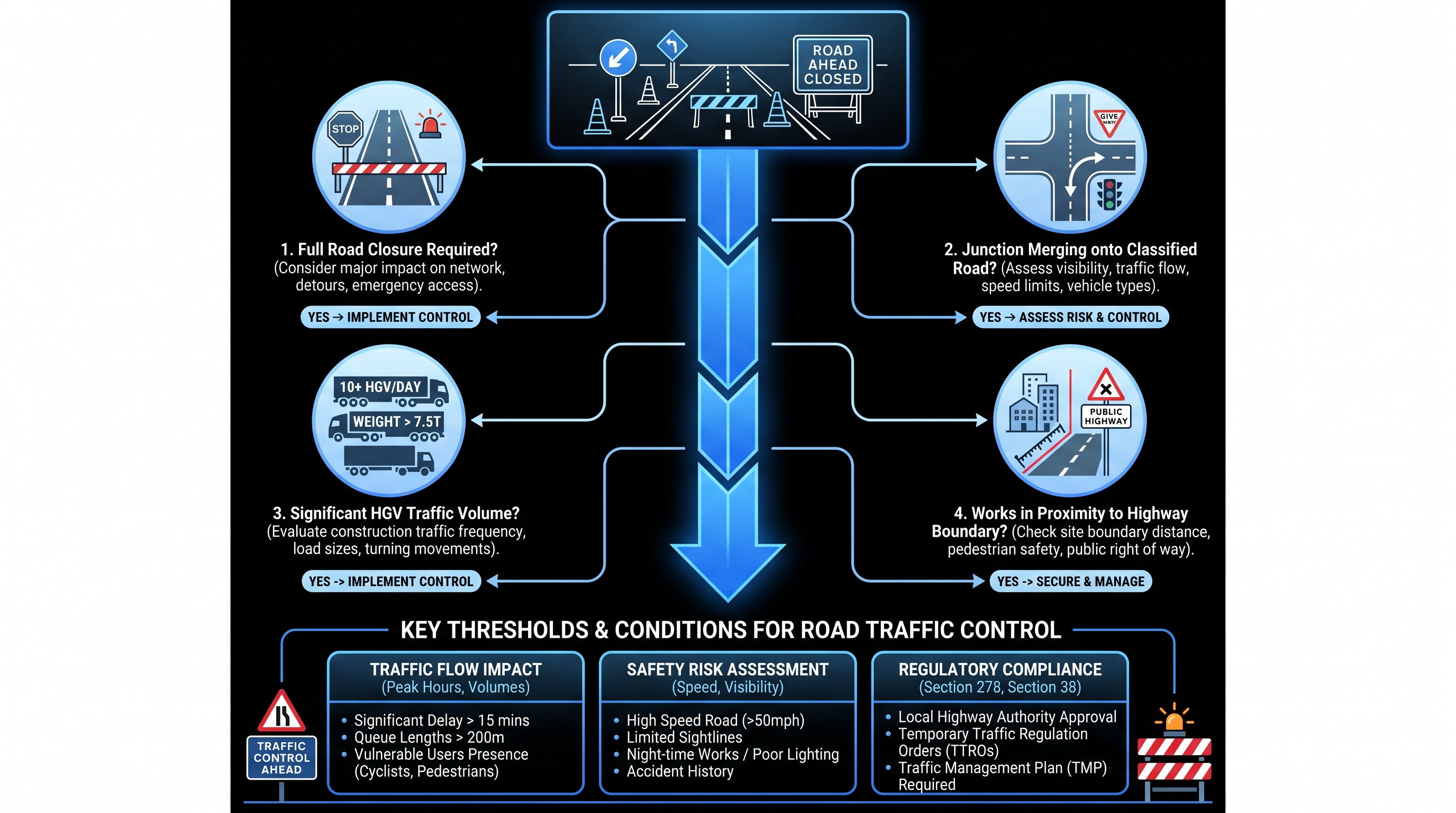
Road traffic control planning is required before occupying a temporary traffic control zone for highway construction, utility work, maintenance operations, or incident management. In the context of planning applications, this means any time your development affects the public highway, even temporarily.
Local planning authorities and highway authorities will typically ask for a Construction Traffic Management Plan (CTMP) or similar document as part of your submission. This plan must show how you’ll handle traffic through the work zone, what devices you’ll use, and how long disruptions will last. The threshold for requiring formal traffic control varies by council, but as a rule of thumb, if your works involve:
- Closing a footway or carriageway
- Creating a new access onto a classified road
- Generating more than a certain number of HGV movements per day (often 20–50 depending on the authority)
- Working within or adjacent to the highway boundary
…then you’ll need a traffic control plan. In many cases, developments involving swept path analysis for large vehicles will also trigger the need for temporary control measures during construction, particularly if access is tight or shared with existing properties.
Even minor works can require formal traffic control if they pose a safety risk or cause significant disruption. Councils have broad discretion here, and it’s wise to consult with the highways department early. Submitting a detailed, realistic traffic control strategy upfront can save months of back-and-forth and demonstrate that you’re a responsible applicant who takes safety seriously.
Key Components of an Effective Traffic Control Strategy
An effective traffic control strategy isn’t a single document or device, it’s a coordinated system that anticipates risk and manages flow across multiple zones. The standard framework divides the work area into advance warning, transition, activity, and termination areas, each serving a distinct purpose.
The advance warning area alerts road users to what’s ahead, giving them time to slow down, change lanes, or prepare to stop. Transition zones guide them safely into the controlled area using cones, barriers, or temporary signals. The activity area is where the work happens, protected by physical barriers and clear signage. Finally, the termination area eases traffic back to normal conditions.
Beyond layout, an effective strategy relies on trained staff who understand how to set up, maintain, and dismantle controls safely. It also depends on choosing appropriate devices, not every situation needs full lane closures: sometimes a simple cone taper or advance warning sign will do. Coordination with adjacent works is essential too, especially in urban areas where multiple utilities or developments may be active simultaneously.
Engineering judgement plays a big role in device placement. Cookie-cutter plans rarely work because every site has unique geometry, traffic volumes, and constraints. That’s why experienced traffic engineering input is invaluable, it ensures your strategy is proportionate, compliant, and realistic.
Temporary Traffic Management During Construction
Temporary traffic control plans maintain safe and efficient road user flow during work zones, incidents, or special events. They’re the tactical measures that keep a project moving without causing chaos on the network.
Typical measures include variable message signs (VMS) to warn drivers in advance, channelising devices like cones and barriers to delineate safe routes, temporary traffic lights at single-lane working sections, pavement markings to guide lane use, and sometimes police or dedicated traffic management operatives in high-risk or high-traffic locations. Work vehicles with flashing beacons also form part of the visible control environment.
For construction projects, temporary traffic management is often phased. Early works might involve minor footway closures: later phases could require full carriageway occupation or night-time working to minimise disruption. The plan must specify timing, duration, and contingency measures, what happens if works overrun, or if there’s an emergency?
Local authorities increasingly expect developers to consider mitigation measures that reduce the impact of temporary controls, such as scheduling HGV deliveries outside peak hours, providing alternative pedestrian routes, or using smaller plant to avoid full road closures. These aren’t just nice gestures, they can be the difference between planning approval and refusal, especially in sensitive areas near schools, hospitals, or major transport corridors.
Permanent Highway Measures and Safety Features
Permanent traffic control uses signs, signals, markings, and other devices installed by the road authority to regulate, guide, or warn road users for the long term. Once your development is complete, the temporary cones and barriers come down, but permanent measures often remain to manage the ongoing impact of your scheme.
Examples include traffic signals at new junctions, stop signs or give-way markings at site access points, tactile paving and dropped kerbs for pedestrian safety, speed limit signs and road markings to manage vehicle speeds, and crash attenuators or guardrails at high-risk locations.
These permanent features are typically designed as part of a Section 278 or Section 38 agreement (depending on whether you’re altering an existing highway or building a new one). The highway authority will have strict technical standards, usually based on the Design Manual for Roads and Bridges (DMRB) or local design guides, and will expect detailed drawings, safety audits, and sometimes independent review before approving your proposals.
Permanent measures also tie into broader parking strategy and access design. For instance, if your development introduces a new junction, you’ll need to demonstrate that sightlines are adequate, that turning movements are safe, and that signage is clear and conspicuous. This is where road traffic control overlaps with transport planning: it’s not just about construction, it’s about the lifetime safety and operation of the highway network.
Failure to provide adequate permanent control measures can result in planning conditions requiring post-occupation improvements, or worse, accidents that expose the developer and design team to legal liability. Getting it right from the start, through competent design and early engagement with the highway authority, is essential.
Conclusion
Road traffic control is a core safety and operations measure in construction and highway management, supporting safe access, worker protection, and traffic efficiency. For anyone involved in planning applications, it’s not an afterthought, it’s a strategic component that shapes approval, phasing, cost, and community relations. Whether you’re managing temporary controls during a build or designing permanent highway features, the quality and thoroughness of your traffic control strategy will influence how smoothly your project progresses and how safely it integrates into the public realm.
Frequently Asked Questions About Road Traffic Control
What is road traffic control and why is it essential for planning applications?
Road traffic control is the systematic management of vehicles and pedestrians around roadworks using signs, signals, barriers, and trained personnel to ensure safe and orderly movement. It’s essential for planning applications because it demonstrates to local authorities that your scheme manages safety, minimises disruption, and protects workers and the public. Local planning authorities assess how your project affects the highway network and require evidence of proper traffic control planning before approval.
When do I need to include road traffic control in my planning application?
You’ll need a traffic control plan if your development closes a footway or carriageway, creates a new access onto a classified road, generates significant HGV movements (typically 20–50+ per day), or works within the highway boundary. Even minor works require formal control if they pose safety risks or cause disruption. Consulting with the highways department early helps determine your specific requirements and avoids delays.
What does a road traffic controller do on a construction site?
A road traffic controller stops, slows, and safely directs traffic through construction zones using hand signals and equipment. They protect workers in the carriageway, keep traffic flowing with minimal delay, and adapt in real time to changing conditions like delivery vehicles or emergency access needs. Controllers are often a planning condition and a requirement under CDM regulations for high-risk or high-traffic locations.
What are the key components of an effective traffic control strategy?
An effective strategy includes advance warning areas (alerting road users), transition zones (guiding safe entry), activity areas (protecting active works), and termination areas (easing return to normal). Success also depends on trained staff, appropriate devices proportionate to the site, coordination with adjacent works, and sound engineering judgement. Cookie-cutter plans rarely work; each site’s unique geometry and constraints require tailored design.
How can I reduce the impact of temporary traffic control on my development?
Consider mitigation measures such as scheduling HGV deliveries outside peak hours, providing alternative pedestrian routes, and using smaller plant to avoid full road closures. These aren’t just gestures—they can be the difference between planning approval and refusal, especially near schools, hospitals, or major transport corridors. Working with mitigation measures traffic strategies early strengthens your application.
What permanent traffic control measures remain after construction is complete?
Permanent measures include traffic signals at new junctions, stop signs, give-way markings, tactile paving, dropped kerbs, speed limit signs, and crash attenuators. These are designed via Section 278 or Section 38 agreements based on standards like the Design Manual for Roads and Bridges. Swept path analysis ensures permanent features are safe and legally compliant for the scheme’s lifetime.