Getting planning permission isn’t just about what you build, it’s about proving you can manage what happens around it. Traffic control management has become a make-or-break component of development applications, particularly as local authorities scrutinise the movement of vehicles, construction logistics, and pedestrian safety more closely than ever. Whether you’re submitting a Transport Assessment, a Construction Traffic Management Plan, or simply trying to demonstrate your scheme won’t gridlock the local high street, understanding how traffic control management works, and what planners expect, can be the difference between approval and a costly refusal.
Key Takeaways
- Traffic control management is essential to planning approval, as it demonstrates to local authorities that a development won’t cause unacceptable congestion, safety risks, or parking stress.
- Effective traffic control management combines clear signage, appropriate traffic signals, safe pedestrian provision, certified traffic controllers, and ongoing monitoring to keep people and vehicles moving safely.
- A comprehensive Transport Assessment or Construction Traffic Management Plan must prove that residual impacts are acceptable, access arrangements comply with standards, and sustainable transport is maximised.
- Understanding local authority thresholds and transport policies is critical, as requirements for formal assessments vary significantly—some authorities require assessments for 30+ vehicle movements, whilst others set thresholds at 50 or 100.
- Mitigation measures should address both temporary construction impacts (phased deliveries, speed limits, protected pedestrian routes) and permanent operational safety features (traffic calming, visibility improvements).
- Regular audits, complaint monitoring, and real-time adjustments to traffic control measures maintain public confidence and ensure schemes comply with highways authority requirements throughout construction and operation.
What Is Traffic Control Management?
Traffic control management is the planning, design, implementation, and monitoring of measures that regulate the safe and efficient movement of vehicles and pedestrians. It’s most visible around developments, construction sites, and roadworks, anywhere the normal flow of traffic is disrupted or altered by new activity.
At its core, it covers three overlapping responsibilities:
- Designing traffic control plans that specify signage, lane closures, diversions, and pedestrian routes tailored to site conditions.
- Organising and controlling transport flows and services, ensuring vehicles can move predictably and safely through temporary or permanent changes.
- Coordinating with local authorities and emergency services to manage disruptions, maintain access, and respond to incidents.
In the context of planning applications, traffic control management isn’t an afterthought, it’s part of the evidence base planners use to judge whether a development is viable. It underpins formal documents like Transport Assessments, Travel Plans, and Construction Traffic Management Plans, all of which demonstrate that you’ve thought through how your project will interact with the existing transport network.
Why Traffic Control Management Matters in Planning Applications
Planning authorities need to be convinced that a development won’t cause unacceptable congestion, safety risks, or parking stress. That means showing that your scheme has suitable access for residents, delivery vehicles, and emergency services, and that construction activity won’t paralyse local roads for months on end.
Traffic control management provides that assurance. Without it, even well-designed schemes can be refused on highways grounds. A development might tick every box architecturally, but if the council’s highways officer believes it’ll create rat-runs, obstruct bus routes, or leave pedestrians dodging lorries, the application is in trouble.
This is where formal assessments come in. Transport Assessments and Construction Traffic Management Plans rely on traffic control management principles to model impacts, propose mitigations, and satisfy policy tests. Experienced traffic flow management consultants help applicants navigate these requirements, particularly when local thresholds are unclear or cumulative impacts with neighbouring sites need careful handling.
In short, traffic control management turns abstract concerns, will this development work?, into demonstrable, enforceable commitments that give planners confidence to approve.
Key Components of Effective Traffic Control Management
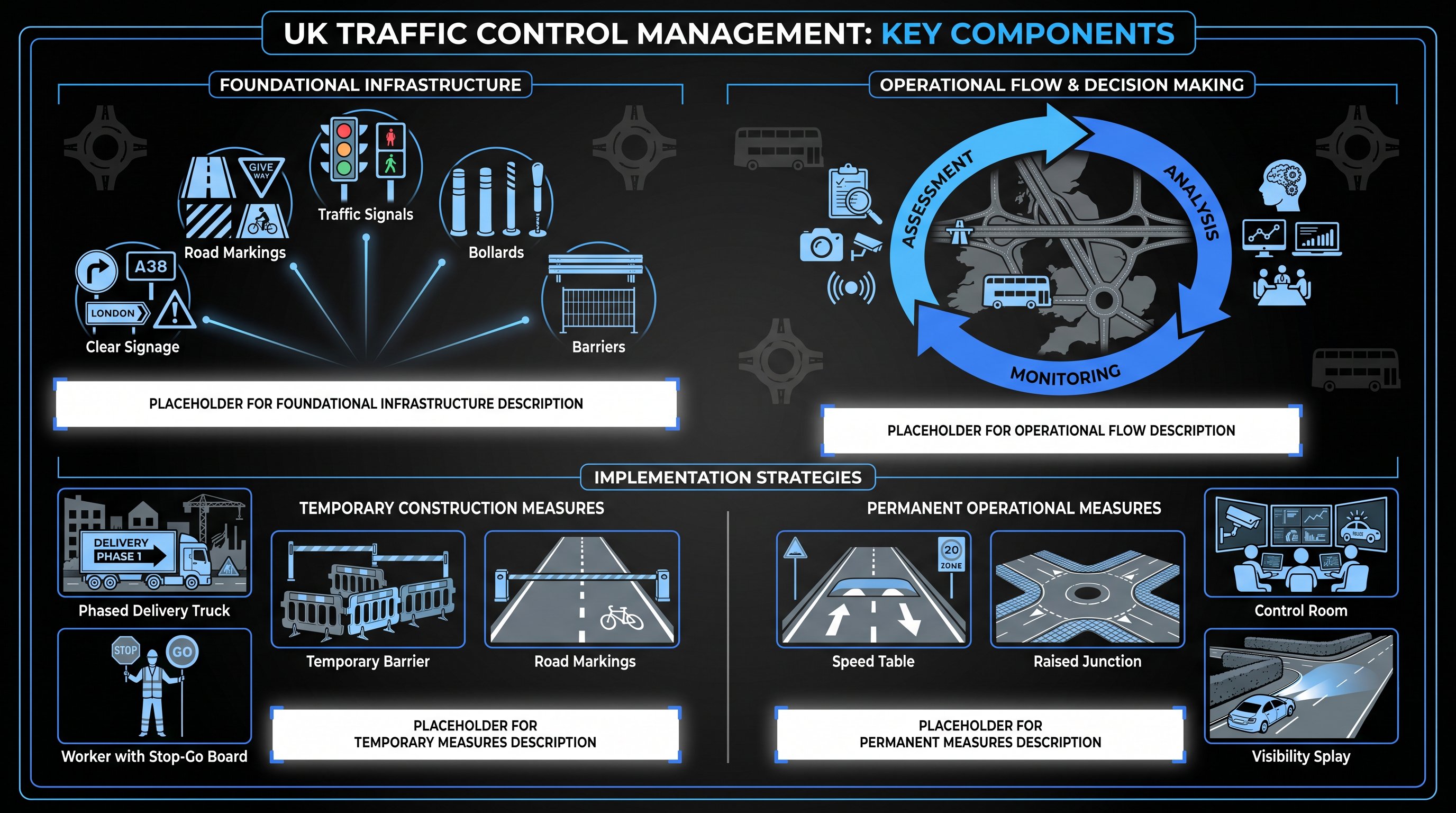
A robust traffic control management system is built from several interlocking elements, each designed to keep people and vehicles moving safely:
- Clear signage and road markings that communicate lane changes, hazards, speed limits, and diversions unambiguously.
- Appropriate traffic signals and control devices, including temporary lights, bollards, barriers, and delineation tailored to site-specific risks.
- Safe pedestrian and cyclist provision, such as protected walkways, advanced warning signage, and crossing points that don’t force vulnerable users into conflict with construction traffic.
- Competent, certified traffic controllers where manual control is required, particularly at site entrances, single-lane working, or complex junctions during peak hours.
- Monitoring and adjustment of measures during operation, ensuring that what works on paper also works on the ground, with flexibility to respond to complaints, incidents, or unforeseen conditions.
These components aren’t static. Effective traffic control management anticipates change: phasing of construction, seasonal traffic patterns, school holidays, and local events all influence how measures perform. Schemes that bake in adaptability, and regular review, tend to avoid the enforcement notices and neighbour complaints that derail projects mid-construction.
Traffic Assessment and Impact Analysis
Before you can manage traffic, you need to understand it. That starts with a baseline assessment: surveys of existing traffic volumes, vehicle speeds, junction performance, and collision history. This data establishes what “normal” looks like, so you can credibly model what happens when your development adds trips to the network.
Impact analysis then models how those new trips, both operational (residents, customers, deliveries) and construction-related (HGVs, worker vehicles), affect junctions, links, and parking. It identifies pinch points, capacity constraints, and safety risks. For larger schemes, this might involve junction modelling software: for smaller sites, a simpler trip generation calculation and qualitative assessment may suffice.
Crucially, impact analysis must also consider cumulative effects: nearby developments, planned highway works, and background traffic growth. A scheme that looks benign in isolation can tip a junction into gridlock when considered alongside other committed developments. Understanding this bigger picture often requires input from specialists who know local transport models and traffic impact assessment protocols inside out.
Mitigation Measures and Safety Protocols
Once impacts are identified, mitigation measures address them. These fall broadly into two categories: temporary measures for construction and permanent measures for operational phases.
Common temporary measures include:
- Phased construction and delivery times to avoid peak hours, reducing pressure on already-congested roads and limiting disruption to school runs or commuter traffic.
- Temporary speed limits, barriers, and delineation that protect workers, pedestrians, and drivers from each other.
- Safe pedestrian crossings and protected walkways, particularly where footways are narrowed or diverted.
- Training and deployment of certified traffic controllers, ensuring that manual interventions, banksmen, stop-go boards, are carried out safely and consistently.
- Emergency access plans and incident procedures that maintain ambulance, fire, and police access even when sites are active.
Permanent measures often overlap with traffic calming design principles: speed tables, raised junctions, visibility splays, and junction improvements that reduce collision risk and manage speeds around new developments.
Safety protocols also extend to monitoring. Regular audits, complaint logs, and liaison with local residents and businesses allow schemes to adjust measures in real time, maintaining public confidence and highways authority sign-off. This is where experienced consultants add value: they know what works, what fails, and how to carry out mitigation measures that satisfy both planners and neighbours.
Meeting Local Authority Requirements and Thresholds
Every local authority has its own transport policies, design standards, and thresholds that trigger formal assessments. Some require a full Transport Assessment for developments generating 30+ two-way vehicle movements in peak hours: others set the bar at 50 or 100. Some expect Construction Traffic Management Plans for any scheme involving more than a handful of HGV movements: others take a lighter-touch approach.
Navigating this patchwork requires familiarity with local plan policies, supplementary planning documents, and highways authority guidance. National standards, Manual for Streets, Design Manual for Roads and Bridges, Traffic Signs Manual, provide the technical baseline, but local interpretation varies.
Your Transport Assessment or Statement must demonstrate that:
- Residual impacts are acceptable after mitigation, not zero-impact, but within policy tests and capacity thresholds.
- Access arrangements comply with visibility splay standards, swept path analysis for service vehicles, and emergency access requirements.
- Sustainable transport is maximised, with demand management strategies such as Travel Plans, cycle parking, and public transport contributions where appropriate.
- Parking provision aligns with local standards, balancing the need to avoid overspill with policies that discourage car dependency. A well-considered parking strategy is often scrutinised closely by highways officers and ward councillors alike.
Meeting these requirements isn’t just about ticking boxes, it’s about building a credible, proportionate case that your scheme fits the local context. That’s where over 30 years of experience and knowledge of local authority thresholds can make applications smoother, faster, and far less likely to hit a highways objection.
Conclusion
Effective traffic control management is central to safe, efficient development. It enables planning permission by showing that traffic and safety impacts are understood, assessed, and robustly mitigated in line with local authority requirements. Get it right, and your scheme moves forward: get it wrong, and even the best designs can stall at committee.
Frequently Asked Questions About Traffic Control Management
What is traffic control management and why does it matter for planning applications?
Traffic control management is the planning, design, implementation, and monitoring of measures that regulate safe, efficient vehicle and pedestrian movement. It matters for planning because it provides evidence that developments won’t cause unacceptable congestion, safety risks, or parking stress, underpinning Transport Assessments and Construction Traffic Management Plans that planners require for approval.
What are the key components of an effective traffic control management system?
Effective systems comprise clear signage and road markings, appropriate traffic signals and barriers, safe pedestrian and cyclist provision, competent certified traffic controllers for manual control, and ongoing monitoring with flexibility to adjust measures. These elements work together to anticipate changes like construction phasing, seasonal patterns, and local events.
How do traffic impact assessments help with development proposals?
Traffic impact assessments establish baseline data on existing volumes, speeds, and collisions, then model how new operational and construction trips affect junctions, links, and parking. This identifies pinch points and cumulative effects from neighbouring developments, allowing applicants to propose credible, evidence-based mitigation measures that satisfy planning authorities.
What temporary and permanent mitigation measures reduce traffic and safety impacts?
Temporary measures include phased construction to avoid peak hours, temporary speed limits, barriers, safe pedestrian crossings, and certified traffic controller deployment. Permanent measures involve traffic calming design such as speed tables, raised junctions, and visibility splays that reduce collision risk and manage speeds around new developments long-term.
How can experienced traffic consultants help navigate local authority requirements?
Traffic consultants understand local thresholds triggering formal assessments, local plan policies, and highways authority guidance that varies by authority. They build proportionate cases demonstrating residual impacts are acceptable after mitigation, access complies with standards, sustainable transport is maximised, and parking aligns with local policy—reducing refusal risk.
What should a Transport Assessment demonstrate to planning authorities?
A Transport Assessment must show that residual impacts are acceptable after mitigation, access arrangements comply with visibility and emergency access standards, sustainable transport is maximised through demand management strategies, and parking provision aligns with local standards, balancing overspill prevention with policies discouraging car dependency.