Traffic control plans sit at the heart of most planning and development projects, yet they’re often misunderstood or left too late. Whether you’re designing a new residential estate, upgrading commercial access, or managing temporary works on a busy highway, a well-prepared traffic control plan (TCP) is your ticket to smoother approvals and fewer headaches with local authorities. In this guide, you’ll discover what a TCP actually is, when it’s required, what goes into an effective plan, how to align it with local standards, and the common traps that cause delays, so you can secure approval faster and keep your project on track.
Key Takeaways
- A traffic control plan is a mandatory, detailed document required whenever your project impacts a public highway, and it sits at the heart of planning approvals and development consent.
- Effective traffic control plans must include risk assessments, temporary traffic management details, access/egress arrangements, and dedicated provisions for vulnerable users like pedestrians and cyclists.
- Non-compliance with standard sign layouts, inadequate risk assessments, and vague descriptions of internal site circulation are the most common reasons traffic control plans are rejected by authorities.
- Early engagement with local highways teams at pre-application stage, combined with thorough risk identification and clear drawings, significantly reduces re-submissions and accelerates approval timelines.
- Permanent highway arrangements in your traffic control plan must address junction geometry, visibility splays, crossing points, and parking layouts whilst aligning with national guidance such as the Manual for Streets and Design Manual for Roads and Bridges.
- Building in staged layouts, monitoring regimes, and phasing diagrams demonstrates professional delivery and increases the likelihood that your traffic control plan gains rapid local authority approval.
What Is a Traffic Control Plan and When Is It Required?
A Traffic Control Plan, often called a Traffic Management Plan (TMP), is a detailed, scaled document that shows exactly how traffic will be managed safely around or through a work zone or development. It sets out signs, barriers, routing, speed management, and safety measures for vehicles, pedestrians, and cyclists whenever works affect a public road or significantly alter traffic movements.
TCPs are normally required whenever your activity impacts a public highway or requires changes to existing traffic patterns. That includes:
- Construction and utility works on or adjacent to roads
- New site access or junction improvements
- Temporary road closures, diversions, or lane restrictions
- Events and activities that affect road safety or capacity
In most jurisdictions, a TCP is a condition of permits, road-opening licences, or development consent. Local authorities use it to assess whether your proposal protects road users, workers, and the public, and to decide whether to grant approval.
The scope and detail depend on the scale and location of your project. A major housing development will need both a temporary TCP for the construction phase and permanent highway drawings showing final access arrangements. A smaller utility repair might only need a single-sheet temporary layout. Either way, no TCP usually means no permission to proceed.
Key Components of an Effective Traffic Control Plan
Every effective TCP shares a set of core elements. These components demonstrate to the authority that you’ve identified risks, planned controls, and designed a safe layout for all road users.
Typical components include:
- Project details – location, duration, working hours, scope of works, and expected traffic impacts
- Risk assessment – traffic volumes, road type, geometry, vulnerable users, specific hazards, and control measures to reduce risks to as low as reasonably practicable (ALARP)
- Temporary traffic control – signage, signals, cones, barriers, lane closures, speed management, and routing for vehicles, pedestrians, and cyclists
- Internal site traffic management – segregation of plant, vehicles, and pedestrians: one-way systems: reversing controls
- Access and egress – safe entrances and exits, visibility at junctions, emergency access
- Communication and training – briefings, inductions, and instructions for drivers, operatives, and visitors
- Monitoring and review – inspections, CCTV where needed, incident logging, and plan updates
The level of detail should match the complexity and risk profile of your site. High-traffic urban locations or schemes involving vulnerable users (school routes, care homes, cycle lanes) demand more thorough plans and staged layouts.
Temporary Traffic Management During Construction
Temporary TCPs are required before you occupy a temporary traffic control zone for highway construction, utility works, or maintenance activities. They define temporary layouts, diversions, work zones, and protection measures for both workers and road users.
Your temporary TCP should include:
- Clear work zone boundaries and advance warning signs
- Phased layouts if works progress in stages
- Pedestrian and cyclist diversions or protected routes
- Speed limits, lane tapers, and buffer zones
- Emergency access and evacuation routes
- Provision for out-of-hours or weekend traffic (if works continue)
Many authorities expect temporary TCPs to follow national guidance such as Chapter 8 of the Traffic Signs Manual (UK) or local equivalents. Using standard sign layouts, spacings, and colour codes reduces the risk of rejection and makes your plan easier for inspectors to review. Developers preparing applications for residential traffic impact often need both construction-phase and operational TCPs.
Permanent Highway Arrangements and Access Provisions
For developments, permanent arrangements cover junction design, site access locations, internal circulation, parking layouts, and pedestrian routes. The goal is to separate vehicles and pedestrians, provide safe crossings, and ensure adequate visibility at all conflict points.
Permanent highway elements typically include:
- Geometry and radii of new access junctions
- Visibility splays in both directions
- Footway and cycleway connections
- Crossing points, dropped kerbs, and tactile paving
- Internal roads, one-way systems, and turning areas
- Parking bays, loading zones, and servicing arrangements
- Street lighting, signage, and road markings
These details are often shown on separate General Arrangement (GA) drawings but must align with the TCP narrative. Authorities will check that your permanent layout doesn’t introduce new hazards or compromise the existing highway network. Larger schemes may also require traffic impact assessments to model future traffic flows and demonstrate capacity.
Aligning Your Traffic Control Plan with Local Authority Requirements
Most local authorities require TCPs and TMPs to comply with national guidance, such as the Manual for Streets, Design Manual for Roads and Bridges (DMRB), or Construction (Design and Management) Regulations, and to be approved by the highway or transport authority before works begin.
Each authority has its own process, templates, and standards:
- Some publish standard drawings, typical details, and design checklists on their planning portals
- Others require submission via specific permit systems (e.g., street works permits, Section 278 agreements)
- Many specify minimum visibility splays, junction radii, or sign spacings that differ from neighbouring councils
Before you draft your TCP:
- Check the local design guide – most councils publish highway design standards or adopt national manuals with local variations
- Review recent decisions – look at approved TCPs for similar developments in the same area
- Contact the highways team early – pre-application advice can clarify expectations and flag issues before formal submission
- Use qualified designers – many authorities require TCPs to be prepared or checked by a chartered engineer or accredited designer
Compliance isn’t just about ticking boxes. A TCP that matches local standards shows the authority you understand their priorities, traffic safety, pedestrian accessibility, network resilience, and makes approval faster and more predictable. For schemes requiring broader analysis, consider engaging traffic flow management consultants who specialise in aligning plans with local thresholds and conditions.
Common Pitfalls and How to Avoid Delays in Approval
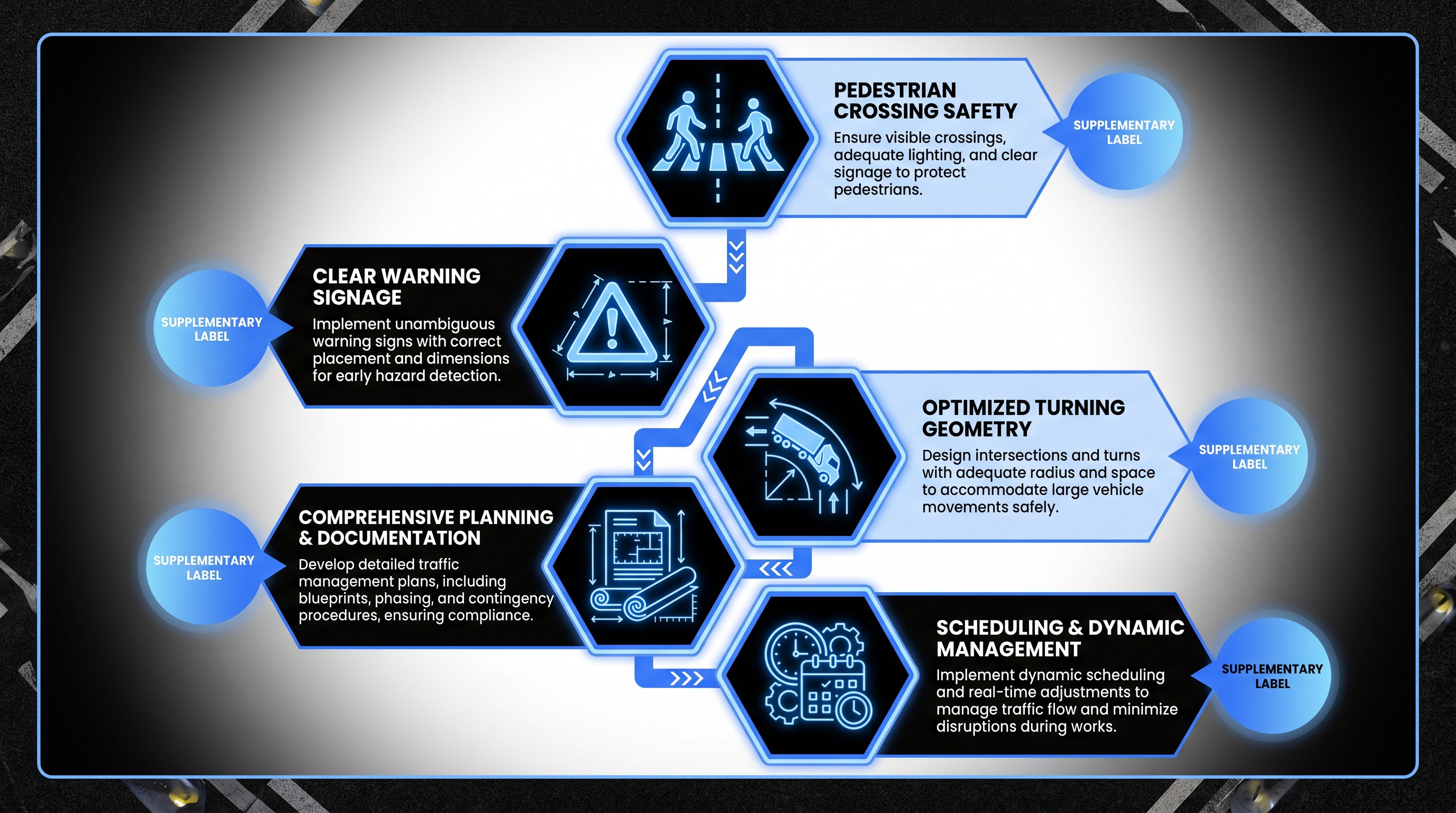
Even experienced teams can stumble over the same few issues. Here are the most common pitfalls, and how to sidestep them:
Inadequate risk assessment or missing pedestrian/cyclist provision
Authorities often reject TCPs that focus solely on vehicle movements and ignore vulnerable users. Always include dedicated pedestrian routes, crossing points, and cycle provision, especially near schools, shops, or public transport hubs. If construction works block a footway, your TCP must provide a safe alternative, not just a vague note about “temporary diversions.”
Non-compliance with standard sign layouts, spacings, or speed management guidance
Using the wrong sign sizes, colours, or spacings is a quick route to rejection. Stick to the published standards for your region (e.g., Chapter 8 in the UK, MUTCD in the US, or local authority templates). If in doubt, use recognised traffic management software or consult the authority’s standard details library.
Poorly defined access/egress and internal site circulation
Vague descriptions like “vehicles will enter via the existing access” don’t cut it. Show exactly where vehicles enter and exit, turning radii for the largest expected vehicle (delivery trucks, refuse lorries, emergency appliances), and how you’ll prevent reversing onto the public highway. Internal one-way systems, banksmen, and segregated pedestrian zones should all be clearly marked on your drawings. Many commercial traffic engineering projects fail on this point.
Insufficient detail (no drawings, staging plans, or monitoring regime)
A text-only TCP rarely satisfies an authority. You need scaled layout drawings, phasing diagrams if works progress in stages, and a monitoring/review process (inspections, incident logs, contact details for emergencies). Missing any of these invites requests for more information, and delays your start date.
Late engagement and rushed submissions
Leaving the TCP until after planning permission is granted (or worse, until the day before works start) is a recipe for trouble. Engage the highways team early, ideally at pre-application stage. Use their feedback to refine your design, and allow time for revisions. Early dialogue also helps you understand whether you’ll need supporting documents, such as mitigation measures or a full transport assessment, alongside your TCP.
By anticipating these traps and building in review time, you’ll reduce re-submissions, avoid costly on-site delays, and keep your project moving.
Next Steps: Securing Approval for Your Development
Ready to move forward? Here’s a practical roadmap to get your TCP approved and your project underway:
- Undertake a site and traffic risk assessment – Walk the site, measure sightlines, record traffic volumes and speeds, and identify vulnerable users and pinch points.
- Prepare preliminary permanent access design and a construction-phase TCP – Sketch your proposed junctions, internal layout, and temporary works arrangements. Use this to test feasibility and flag any showstoppers early.
- Check local authority design standards and TCP requirements – Download templates, standard details, and application guidance from the council’s planning or highways portal. Note any specific approval routes (permit applications, Section 278, planning conditions).
- Submit TCP and access drawings with your planning or highway applications – Include all required sheets: site location plan, general arrangement, phasing diagrams, sign schedules, and risk assessments. For larger schemes, bundle your TCP with a traffic impact assessment to demonstrate capacity and safety in one package.
- Respond promptly to authority comments and update the plan – Treat feedback as an opportunity to refine your design, not a setback. Quick, clear responses keep your application at the top of the inbox and signal professionalism.
If you’re working on a strategic site or masterplan traffic strategy, consider running a workshop with highways officers, emergency services, and public transport operators. Collaborative design often uncovers issues, and solutions, that a desk-based TCP might miss.
With a robust TCP in hand, you’re not just ticking a planning box, you’re demonstrating to the authority, your team, and the public that your project will be delivered safely, efficiently, and with minimal disruption. That confidence translates into faster approvals, fewer conditions, and a smoother path from consent to completion.
Frequently Asked Questions About Traffic Control Plans
What is a traffic control plan and when is it required?
A traffic control plan (TCP), also called a Traffic Management Plan (TMP), is a detailed, scaled document showing how traffic will be managed safely around a work zone or development. It’s normally required whenever your activity impacts a public highway or significantly alters traffic patterns, and is usually a condition of permits or development consent.
What are the key components of an effective traffic control plan?
An effective TCP includes project details, risk assessment, temporary traffic control measures (signage, barriers, speed management), internal site traffic management, access and egress provisions, communication and training plans, and monitoring/review processes. The level of detail should match the complexity and risk profile of your site.
How do I align my traffic control plan with local authority requirements?
Most authorities require TCPs to comply with national guidance (such as Chapter 8 of the Traffic Signs Manual in the UK) and be approved before works begin. Check your local design guide, review approved plans for similar projects in your area, and engage the highways team early via pre-application advice to clarify expectations.
What are the most common reasons traffic control plans get rejected?
Common pitfalls include inadequate risk assessments, missing pedestrian or cyclist provision, non-compliance with standard sign layouts and spacings, poorly defined access/egress arrangements, and insufficient detail such as missing drawings or monitoring regimes. Authorities often reject plans that focus solely on vehicles whilst ignoring vulnerable users.
What’s the difference between temporary and permanent traffic control arrangements?
Temporary TCPs define layouts, diversions, and protection during construction or utility works. Permanent arrangements cover final junction design, site access locations, internal circulation, parking, and pedestrian routes designed to separate vehicles and pedestrians and provide safe crossings with adequate visibility.
How early should I start the traffic control plan approval process?
Engage the highways team at pre-application stage, ideally before formal submission. Early dialogue helps clarify local expectations, identify whether supporting documents (such as traffic impact assessment developers) are needed, and avoids costly delays. Leaving the TCP until after planning approval or close to works commencement almost always causes problems.