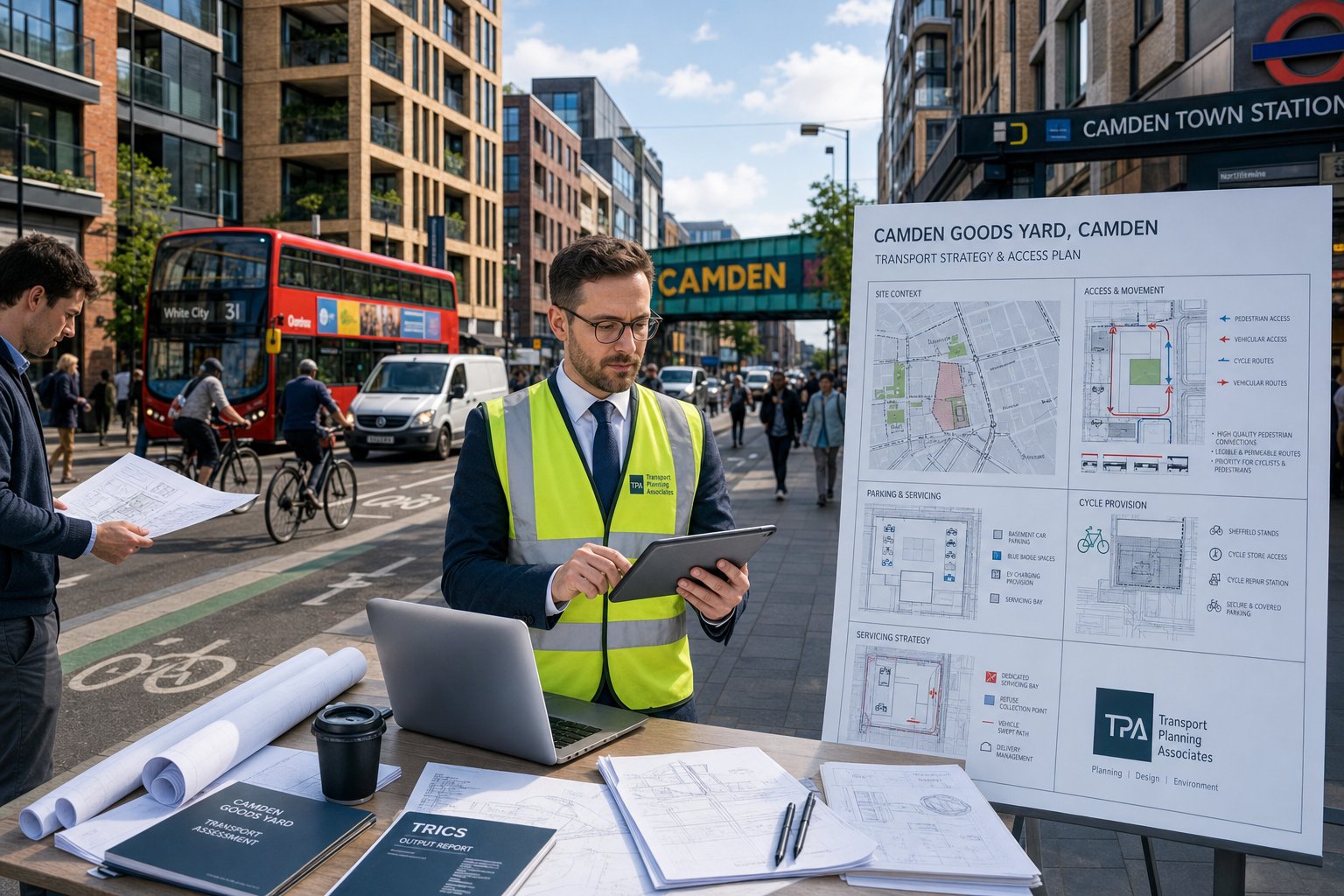
Camden Town is rarely a simple planning environment. Streets are busy, kerb space is fought over, walking and cycling flows are heavy, and even modest schemes can trigger questions about access, servicing, parking, and cumulative highway impact. For architects, planners, developers, and legal teams, that means transport input often becomes critical earlier than expected.
A skilled Traffic Engineer in Camden Town helps turn that complexity into a clear planning case. We’re not just talking about traffic counts or junction models. In practice, the role covers site access strategy, delivery and servicing, parking review, trip generation, transport statements, travel plans, and technical responses to local authority comments. In dense urban locations, those pieces need to work together.
At ML Traffic, we focus on concise, accurate reporting shaped around real planning thresholds, local authority expectations, and the commercial realities of development. With more than 30 years of experience behind our work, we know that a transport report is only useful if it answers the right questions, supports the design team, and stands up under scrutiny.
In this guide, we explain when you need a traffic engineer, what services matter most for Camden Town schemes, how to prepare evidence for planning, and what information should be ready before technical work begins. If your project may change how people, vehicles, or deliveries interact with the street, this is where transport planning starts to matter.
Key Takeaways
- A Traffic Engineer in Camden Town plays a vital role in managing the complex and dense urban transport environment by developing clear, practical planning cases.
- Early involvement of a traffic engineer ensures that site access, parking, servicing, and trip generation are effectively addressed before planning submission, reducing objections.
- Transport reports must be concise, accurate, and aligned with local authority expectations to support design teams and withstand scrutiny in Camden Town.
- Critical services include transport statements, parking reviews, delivery and servicing strategies, and trip generation analyses tailored for Camden Town’s busy streets and limited space.
- Preparing a strong transport case requires understanding daily site operations, including who arrives when and how deliveries and parking are managed, supported by clear visual evidence.
- Gathering comprehensive project details and planning history before appointing a traffic engineer helps define scope and avoid costly revisions later, ensuring transport strategies are realistic and proportionate.
Why Traffic Engineering Matters In Camden Town
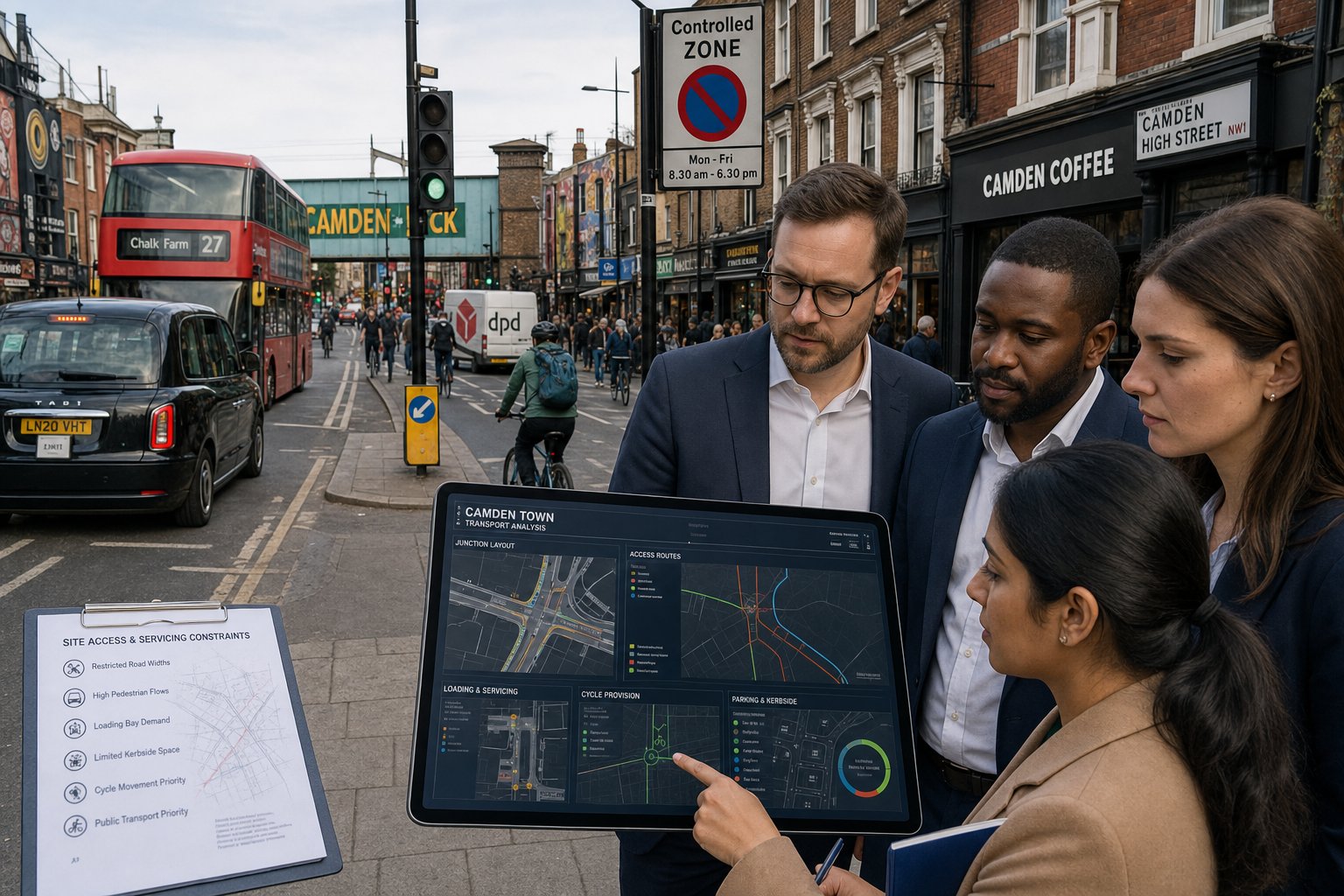
Camden Town compresses a lot of movement into a relatively tight urban area. Residents, buses, taxis, deliveries, pedestrians, cyclists, visitors, and servicing vehicles all compete for limited street space. That creates planning pressure very quickly. A proposal that looks straightforward on a site plan can have knock-on effects on access arrangements, loading activity, visibility, junction operation, or parking demand once it meets the real street network.
That is why transport engineering matters here. It gives project teams a structured way to test how a development will function, not just how it looks. We use traffic engineering to assess whether a site can be safely accessed, whether trips are material, whether servicing is realistic, and whether impacts on the surrounding highway network are acceptable. For planning teams, that evidence often becomes the difference between a smooth validation process and a long round of avoidable transport objections.
For broader context on how urban planning support is typically structured, our piece on Traffic Engineer In London: sets out the wider capital-city approach that often shapes borough-level review.
Transport And Planning Challenges Unique To Camden Town
Camden Town brings together the familiar problems of a dense centre with some very local operational headaches. High pedestrian footfall means access points must be designed carefully. Narrow streets and constrained frontages can limit vehicle manoeuvring. Loading pressure is usually intense, especially for mixed-use and commercial sites. And parking is rarely just about numbers: it is about turnover, restrictions, disabled access, cycle provision, and whether the kerbside can actually support the proposed operation.
There is also the practical issue of timing. Deliveries in the wrong window can conflict with peak footfall. Pick-up and drop-off behaviour can create informal stopping patterns. A basement car park might technically work on drawing, yet still be difficult in live traffic conditions. We often see projects improve significantly once these real-world patterns are tested early rather than defended late.
When You Need A Traffic Engineer For A Camden Town Project
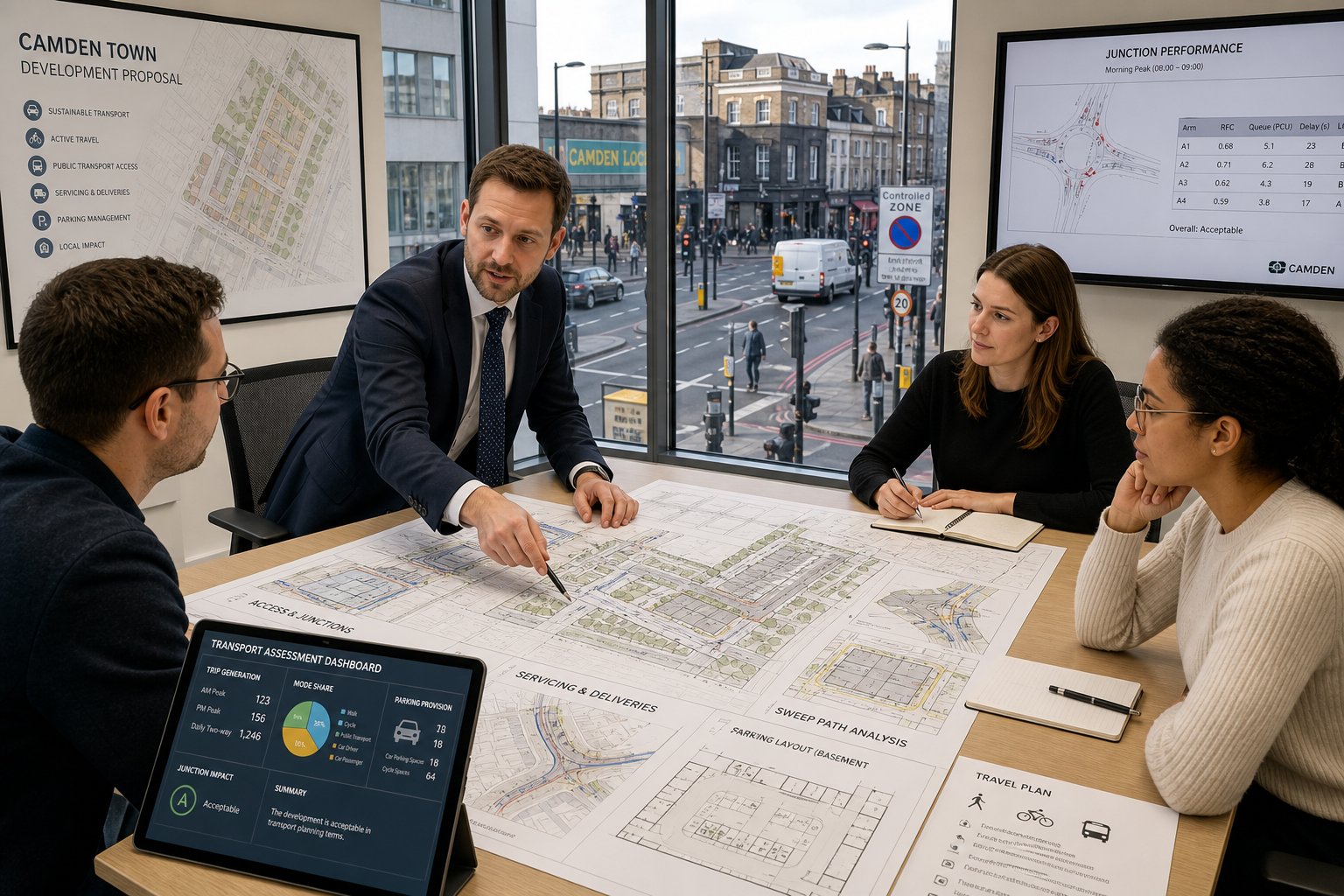
The right time to appoint a traffic engineer is usually before the planning submission is fixed, not after objections land. If a scheme changes access, parking, servicing, traffic generation, or street operation in any meaningful way, transport advice should be part of the design process from the start. That includes pre-application stages, feasibility reviews, and due diligence for site acquisition.
In practical terms, we are often brought in when the project team needs to know whether a development is likely to trigger a Transport Statement, a fuller assessment, a travel plan, delivery and servicing material, swept path analysis, or junction review. Early involvement helps avoid a common planning problem: design teams investing heavily in a layout that later proves weak on access or operation.
For clients comparing roles and deliverables, our article on Traffic Engineering Consultants: explains where transport planning advice sits within the wider planning team.
Planning Applications That Commonly Require Transport Input
Transport input is commonly needed for residential schemes, mixed-use development, commercial units, retail proposals, student accommodation, hotels, health facilities, education uses, and infrastructure-related applications. Even smaller schemes can need technical support if they introduce a new access, alter a crossover, intensify servicing, or affect nearby junctions.
Change-of-use applications are a good example. They are sometimes assumed to be transport-light, yet a shift from one use class profile to another can materially change trip rates, delivery frequency, refuse collection demands, and parking patterns. Likewise, extensions or refurbishments in Camden Town may need evidence even where floorspace growth appears modest, because local street capacity is already under pressure.
The key test is not simply development size. It is whether the proposal changes how people, goods, or vehicles interact with the site and surrounding streets. Where that answer is yes, transport evidence is usually worth preparing properly rather than leaving to assumption.
Core Traffic Engineering Services For Camden Town Developments
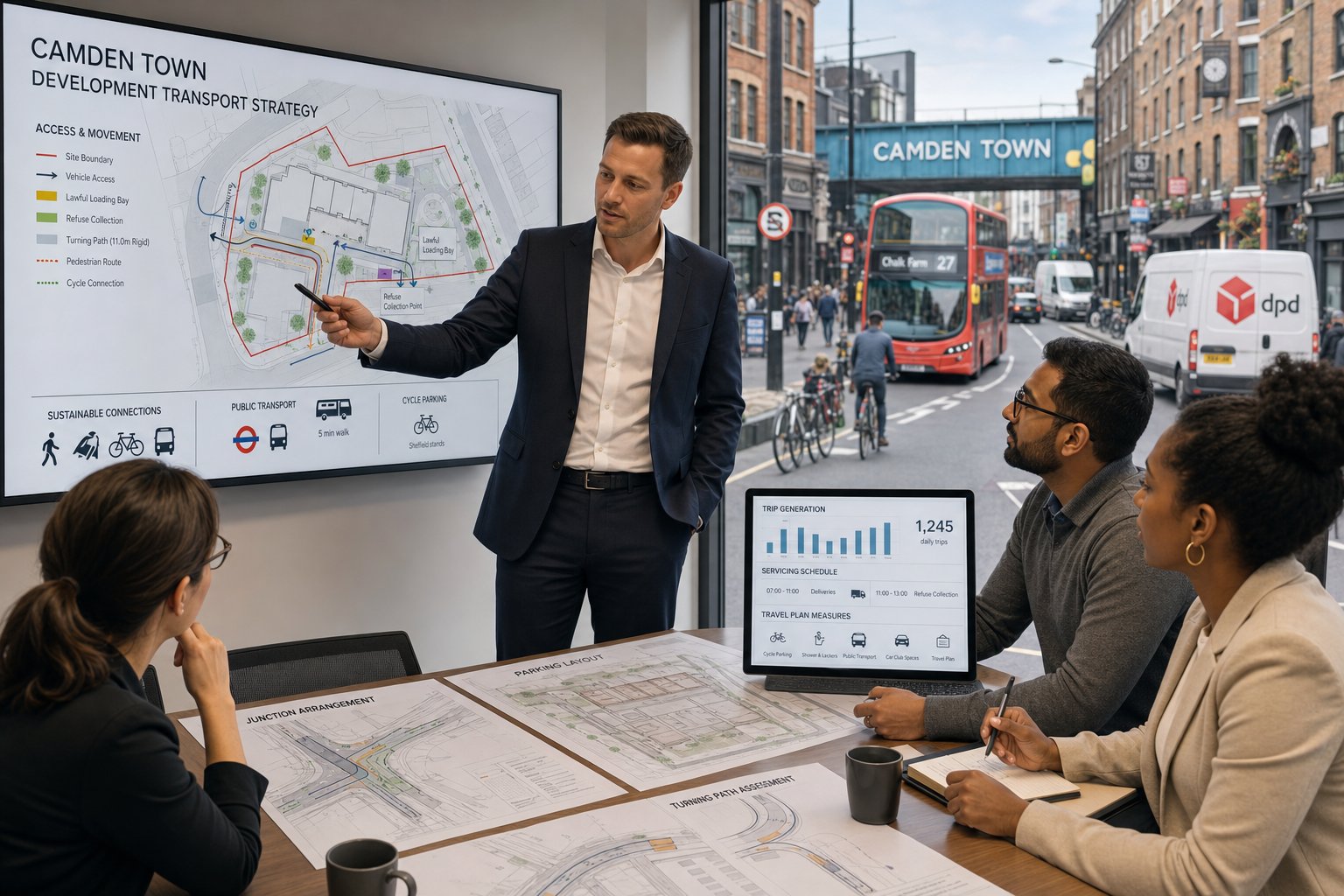
For Camden Town projects, traffic engineering services need to be practical, proportionate, and planning-led. A good report does not bury the reader in data for the sake of it. It answers the authority’s concerns, reflects the actual operation of the site, and gives the wider consultant team something usable.
Our work typically covers transport statements, transport assessments, access appraisals, parking reviews, trip generation, junction capacity testing, delivery and servicing strategy, travel planning, highway design input, and responses to planning comments. On commercial schemes in particular, the transport story often has to tie closely to tenant operation, servicing windows, refuse storage, and kerbside use. We explore those issues in more detail in Commercial Traffic Engineering, especially where site operation is as important as built form.
Transport Assessments And Transport Statements
A Transport Statement is usually used where impacts are expected to be limited but still need to be evidenced. A Transport Assessment goes further, providing a more detailed review of trip generation, mode share, highway effects, accessibility, and mitigation where necessary. The right choice depends on scheme scale, local thresholds, context, and likely planning concern.
In Camden Town, the technical challenge is often less about raw traffic growth and more about demonstrating that access and movement arrangements are workable in a constrained urban setting. We may review census and local travel data, public transport accessibility, accident records where relevant, committed development, traffic surveys, and operational characteristics of the proposed use. The result should be proportionate. Too little evidence invites challenge: too much can obscure the core point.
Travel Plans, Delivery Strategy, And Servicing Reviews
Travel Plans matter because they show how a development will support sustainable travel in operation, not just on opening day. For office, education, hotel, and larger residential schemes, they can be central to policy compliance. We usually set out measures, targets, monitoring arrangements, management responsibility, and realistic actions tied to the actual occupier profile.
Delivery and servicing reviews are especially important in Camden Town. A site may be acceptable in transport terms overall, but still struggle if vans cannot stop lawfully, refuse collection is awkward, or loading demand spills into the general carriageway. We hence test vehicle types, frequency, loading location, turning requirements, and potential conflict with nearby activity. Where needed, servicing management measures can make a proposal both more credible and more deliverable.
For a wider overview of integrated development advice, our guide to Traffic Engineering and Transportation shows how these separate reports fit into one planning strategy.
Parking, Access, And Highway Design Considerations
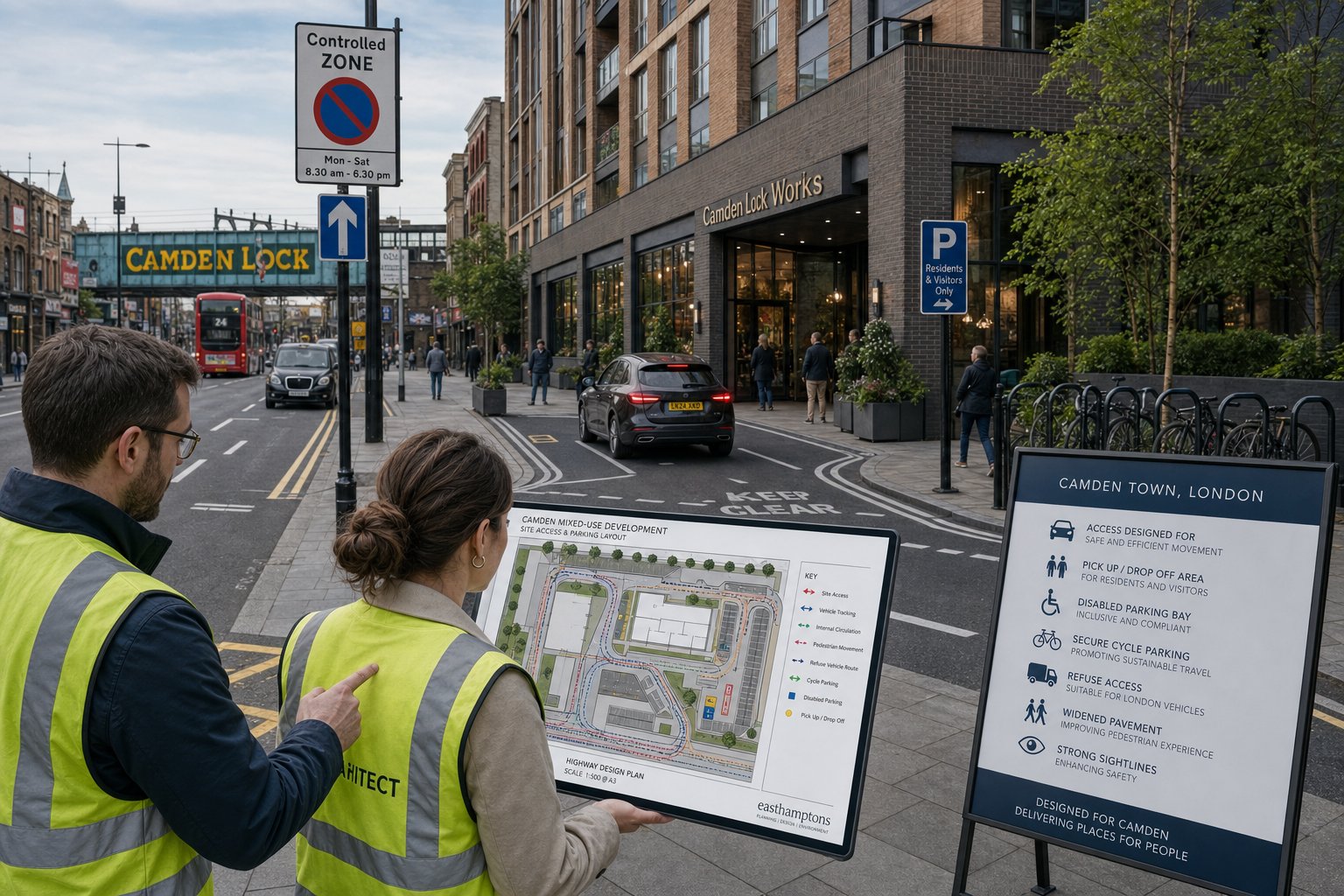
Parking and access are where many schemes become either convincing or vulnerable. In Camden Town, the question is rarely just whether parking is provided. It is whether the provision is justified, policy-aligned, usable, and operationally sensible. The same applies to cycle parking, disabled spaces, pick-up and drop-off needs, motorcycle provision, and visitor demand.
Access design must also reflect real conditions. We look at visibility, kerb geometry, width, gradient, crossing movements, vehicle tracking, and how drivers will actually enter and leave the site in a live urban environment. If there is a gate, a ramp, a basement, or shared pedestrian frontage, that needs proper testing. A technically compliant layout that creates hesitation, overrun, or conflict at the threshold will still attract concern.
Parking strategy is often best handled as part of the planning narrative rather than an afterthought. That means explaining demand assumptions, restraint measures, disabled access, cycle quality, and the relationship with local controls. Our page on parking strategy traffic covers this in more depth, particularly where capacity and compliance need to be evidenced together.
Highway design considerations can include crossover changes, internal circulation, refuse vehicle access, pedestrian priority, and whether any off-site works may be needed. Not every project needs detailed design at planning stage, but many benefit from enough technical clarity to show that the proposal can function safely and lawfully.
Junction Capacity, Trip Generation, And Traffic Impact Analysis
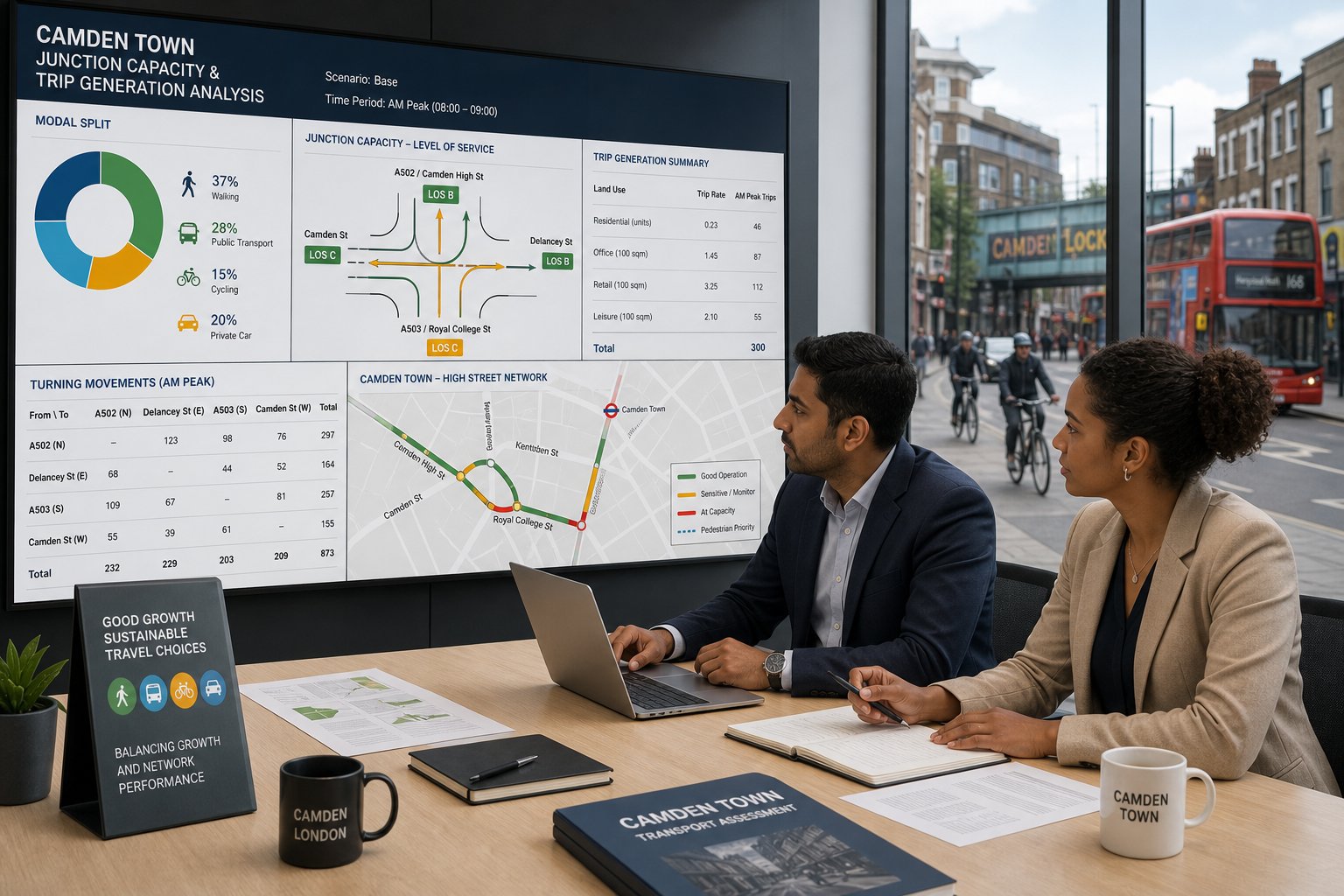
Trip generation and traffic impact analysis are often the backbone of a planning transport case. They help answer straightforward but important questions: how many person trips will the development create, by what modes, at what times, and with what effect on the surrounding network? In Camden Town, the answer is often nuanced because public transport, walking, and cycling can account for a large share of movement, while highway capacity may still be sensitive to servicing or turning activity.
We usually start by defining the development properly. Land use assumptions must match the proposed operation, not a vague label. From there, we review relevant survey databases, local travel behaviour, comparable sites where appropriate, and any sensitivity testing needed for planning confidence. The goal is not to inflate technical complexity. It is to produce assumptions that are reasonable, defensible, and specific enough to survive scrutiny.
Junction capacity analysis may then be required if additional demand could affect nearby priority junctions, signalised nodes, roundabouts, or access points. Sometimes the issue is a strategic junction. Sometimes it is a small side road where turning movements already feel messy at peak periods. We test what matters most, rather than modelling half the borough for dramatic effect.
Where projects need a broader grounding in fundamentals, our explainer on Traffic Engineering: Your Complete outlines how safety, capacity, and movement analysis connect in modern planning submissions.
The strongest impact analysis also acknowledges cumulative conditions. Camden Town rarely operates in isolation. Nearby permissions, changing street design, bus priority, active travel improvements, and kerbside management all influence how much additional activity the network can realistically absorb.
Working With Camden Council And Wider Policy Requirements
A transport submission for Camden Town needs to do two things at once: respond to the specifics of the site and align with the wider planning and transport framework. Even where local guidance is not neatly packaged into one easy checklist, the expectation is clear enough. Reports should be proportionate, evidence-based, policy-aware, and directly relevant to the proposal.
In practice, that means we review the likely local authority requirements around sustainable transport, accessibility, active travel, parking restraint, servicing, safety, and network impact. We also keep an eye on national planning principles and commonly applied transport standards so the submission is coherent from more than one direction. If a scheme relies on reduced car use, for example, the report should explain why that assumption is credible in this location, what supporting infrastructure exists, and what management measures back it up.
Pre-application dialogue can be valuable, especially on more sensitive or complex schemes. It helps identify whether the authority is likely to focus on servicing, cycle provision, disabled parking, junction operation, or another site-specific issue. That is often where time is saved.
For teams working across multiple authorities, comparisons can help frame expectations. Our regional pages such as Traffic Engineer In Manchester: and Traffic Engineer In Leeds: show how transport priorities can shift by place, even when the underlying methodology stays consistent.
The important point is this: local policy compliance is rarely about copying a template. It is about translating a site’s movement impacts into the language the planning authority expects.
How To Prepare A Strong Transport Case For Planning Approval
A strong transport case is built before the report is drafted. The best submissions start with a realistic understanding of how the site will operate day to day. That means who is arriving, by what modes, when deliveries happen, how refuse is moved, whether visitors need parking, and what pressure the proposal will place on the frontage and nearby streets.
We normally begin by pinning down the fundamentals: red line boundary, existing and proposed land uses, floorspace or unit mix, access drawings, parking numbers, cycle provision, servicing assumptions, and any known planning history. Then we test what level of technical work is actually needed. Not every site needs a large assessment, but every site benefits from clear logic.
Good transport evidence is also visual. A concise set of plans, vehicle tracking where relevant, local junction context, parking layouts, and swept paths can answer questions faster than pages of dense narrative. For planning officers and highway officers alike, clarity counts.
Just as importantly, the transport case should anticipate objections before they arrive. If neighbours are likely to raise overspill parking, address parking demand and local controls. If highway officers may question loading, show exactly how it works. If sustainable travel is central, make the travel plan specific rather than generic. The aim is not to sound defensive. It is to remove uncertainty.
We have found that concise, well-targeted reporting often performs better than over-produced submissions. Decision-makers are usually asking a simple question beneath the technical detail: does this development function acceptably on the network? A strong transport case answers yes, and shows why.
What Information To Gather Before Appointing A Traffic Engineer
Projects move faster when the right information is available from the outset. Before appointing a traffic engineer, it helps to gather the basic project details that shape scope, programme, and reporting requirements. That starts with the site address, red line boundary, existing use, proposed use, quantum of development, and stage of design. If there are existing drawings, topographical surveys, parking layouts, and access sketches, those are usually worth sharing early.
We also recommend assembling any known planning history, previous appeal decisions, pre-application feedback, and correspondence touching on highways or transport. These documents often reveal the authority’s likely concerns long before a formal submission. If the scheme has unusual servicing needs, basement access, refuse constraints, or operational peaks, that should be flagged immediately rather than buried later.
Useful supporting information can include:
- existing and proposed parking numbers
- cycle storage details
- likely delivery and refuse vehicle types
- anticipated staff, visitor, or resident profile
- nearby junctions and access constraints
- known highway safety concerns
- target submission date and design freeze date
At appointment stage, the goal is not to provide every answer. It is to give enough for us to identify the likely transport issues, advise on survey needs, and set a proportionate scope. That early clarity often prevents both under-scoping and expensive late revisions.
Conclusion
A Traffic Engineer in Camden Town adds value when a project needs more than broad assumptions about movement, access, and network impact. In a dense urban setting, planning success often depends on whether the transport case is clear, proportionate, and closely tied to the way the site will actually operate.
For architects, planners, developers, surveyors, lawyers, and local authority teams, the most effective approach is usually early coordination. When transport advice is brought in at the right point, access can be tested properly, servicing can be made workable, and supporting reports can be shaped around the planning questions that matter.
That is how we approach projects at ML Traffic: concise technical work, tailored to the proposal, informed by long experience, and designed to help applications move forward with fewer surprises. In Camden Town, where street conditions are rarely forgiving, that level of transport clarity is not a luxury. It is often what turns a scheme from arguable into approvable.
Common Questions About Traffic Engineering in Camden Town
Why is a traffic engineer important for projects in Camden Town?
A traffic engineer is vital in Camden Town due to the area’s dense urban environment and complex street activity. They assess site access, servicing, parking, trip generation, and highway impact to ensure developments function safely and comply with planning requirements.
When should I appoint a traffic engineer for a Camden Town development?
You should appoint a traffic engineer early in the design process, ideally before submitting planning applications. Early involvement helps address access, parking, servicing, and traffic generation issues, preventing costly revisions and objections later on.
What types of planning applications in Camden Town commonly require transport input?
Applications involving residential, mixed-use, commercial, retail, student accommodation, or infrastructure often need transport assessments or statements. Even smaller schemes that affect access, parking, or servicing might require technical traffic input.
How do traffic engineering services support mixed-use and commercial developments in Camden Town?
Traffic engineers develop transport statements, parking reviews, delivery and servicing strategies, and travel plans tailored to site operations. This helps manage loading windows, refuse collection, parking turnover, and cycle provision in the constrained Camden Town streetscape.
What information should be prepared before hiring a traffic engineer for a Camden Town project?
Prepare details like site location, existing and proposed land uses, parking numbers, access arrangements, servicing needs, nearby junctions, and any planning history or known highway constraints. This enables a clear, proportionate scope of work from the start.
How do traffic engineers in Camden Town work with local council policies?
They align transport reports with Camden Council’s expectations, ensuring submissions address sustainable travel, parking restraint, safety, and network impact. This coordination enhances planning success by translating development impacts into the local authority’s required language.