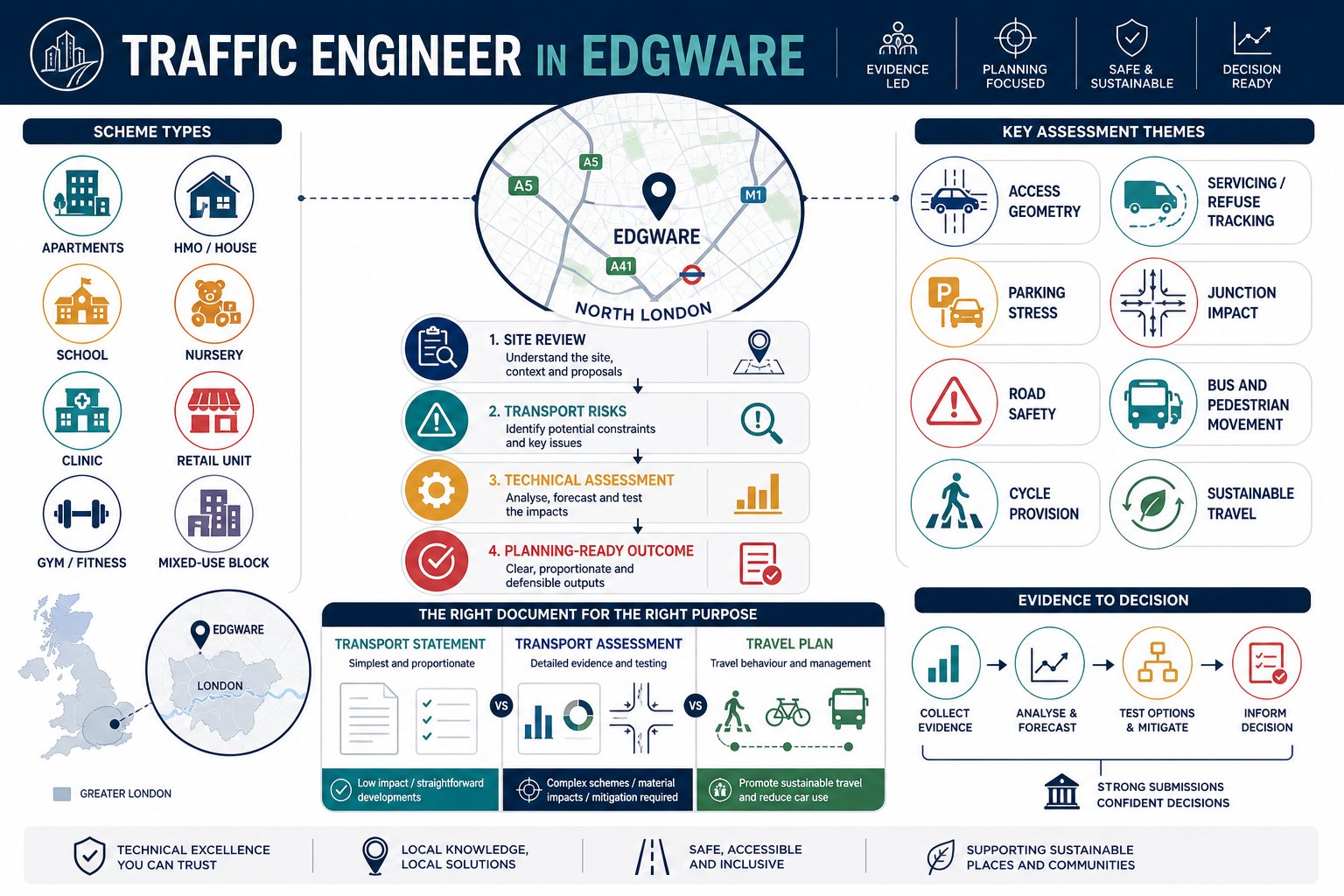
A planning application can look straightforward on paper and still run into trouble the moment transport issues are examined properly. In Edgware, that happens more often than many teams expect. A scheme may fit the site boundary neatly, tick off floor area targets, and even satisfy design objectives, yet still raise concerns about access, servicing, parking stress, road safety or junction impact.
That is where a Traffic Engineer in Edgware becomes essential. We help architects, planners, surveyors, developers and legal teams understand how a proposal interacts with the surrounding highway network before objections harden into delays. In practice, that means translating technical transport risks into clear evidence that supports planning decisions.
Edgware is not a blank canvas. It sits within a busy North London context shaped by strategic roads, local residential streets, bus corridors, pedestrian movement, school traffic, on-street parking pressure and policy expectations around sustainable travel. Even relatively modest developments can trigger questions from planning and highway officers if the transport case is weak.
Our role is to make that case robust, proportionate and locally aware. With more than 30 years of experience across planning-led transport work, we know that speed matters, but accuracy matters more. A concise report that addresses the right issues usually does far more for an application than a bulky document that misses the authority’s real concerns.
Key Takeaways
- A Traffic Engineer in Edgware is essential to assess and mitigate transport impacts on local highway networks for planning applications.
- Early involvement of a Traffic Engineer helps shape designs that comply with Edgware’s local and London-wide transport policies, reducing delays.
- Common schemes needing transport input include residential intensifications, mixed-use developments, change-of-use projects, and sites near busy roads or junctions.
- Transport assessments range from concise Transport Statements to detailed Transport Assessments and Travel Plans, chosen based on development scale and impact.
- Key assessment areas include access, servicing, parking management, highway safety, trip generation, junction impact, and sustainable travel measures.
- A robust, proportionate transport strategy aligned with local conditions and policy expectations significantly improves planning application success in Edgware.
What A Traffic Engineer In Edgware Does And When You Need One
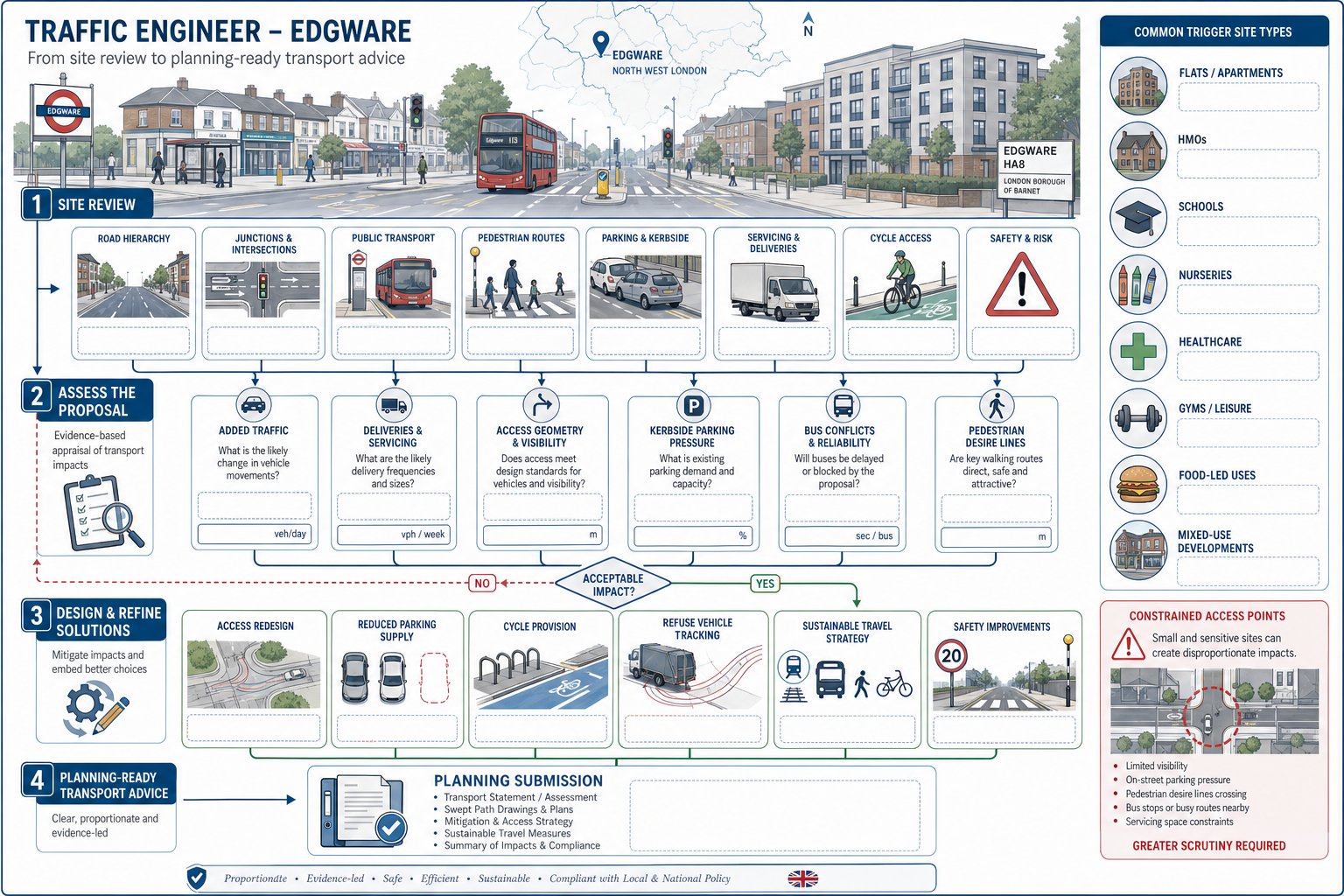
A Traffic Engineer in Edgware assesses how development proposals affect movement, safety and highway operation, then turns that analysis into planning-ready evidence. That sounds simple. It rarely is.
At the earliest stage, we review the site in context: road classification, nearby junctions, public transport links, pedestrian routes, parking conditions, servicing constraints and any obvious safety sensitivities. We then consider the development itself. Will it add vehicle trips? Intensify deliveries? Create awkward access geometry? Put pressure on kerbside parking? Conflict with bus movements or pedestrian desire lines? Those are the questions that shape the level of transport work required.
In many cases, our job is not just to write a report but to help the wider design team avoid foreseeable objections. That may involve refining an access arrangement, reducing parking, improving cycle provision, checking refuse tracking, or setting out a sustainable travel strategy that aligns with policy. Broader Traffic Engineering and Transportation advice is often most valuable before drawings are fixed.
You usually need transport input where a proposal could materially affect traffic, parking demand or highway safety. Common triggers include flatted residential schemes, larger HMOs, schools, nurseries, healthcare uses, gyms, food-led uses, mixed-use redevelopment and sites on or near busy roads. A constrained access point can be enough on its own.
And size is only part of the story. A small scheme in a sensitive location may need more transport scrutiny than a larger one on a forgiving site. That is why experienced Traffic Engineering Consultants: tend to start with local context, not generic thresholds.
Planning Applications That Commonly Require Transport Input In Edgware
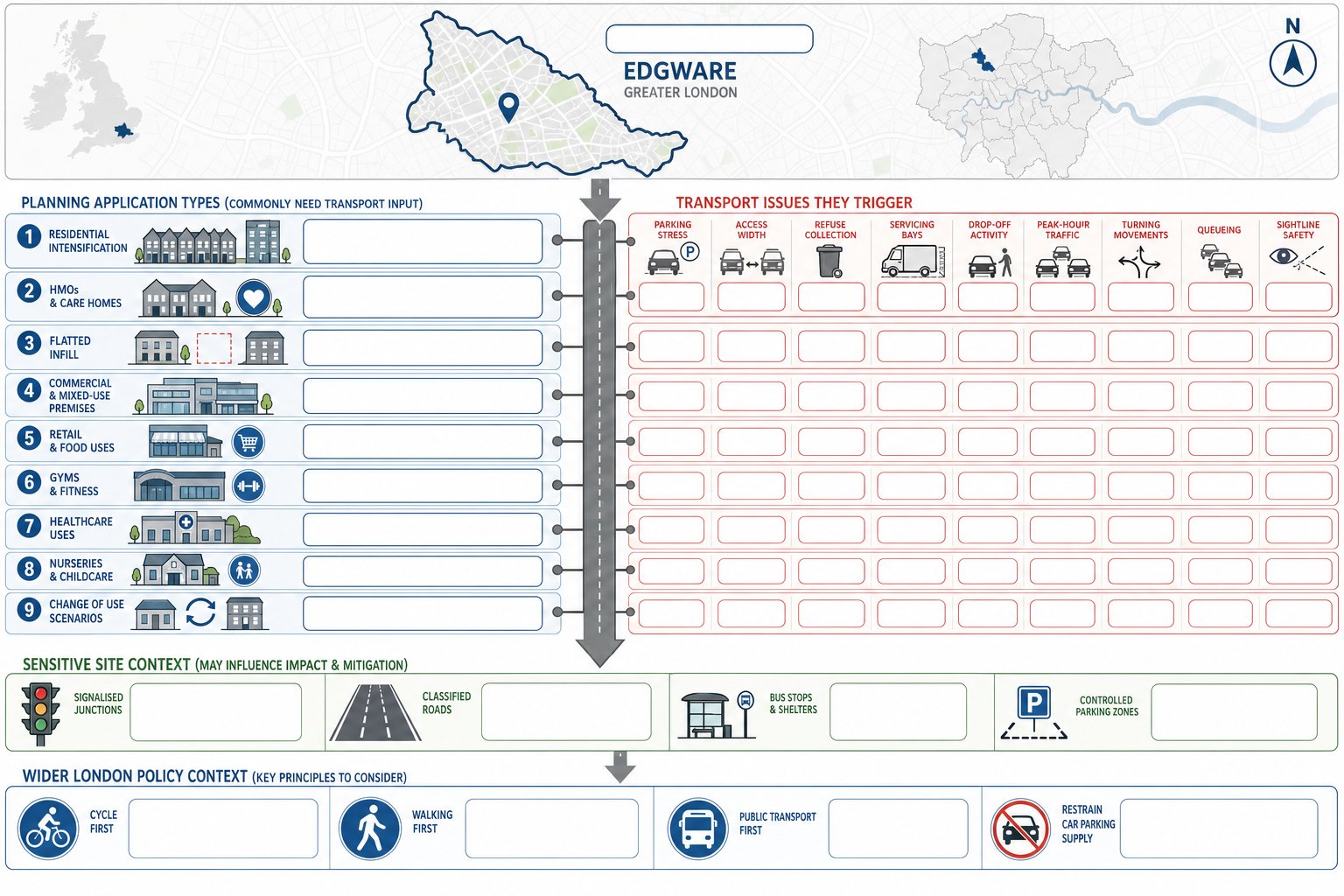
In Edgware, transport input is commonly needed for planning applications where the use, scale or site arrangement could alter how people and vehicles move to and from the development. The most obvious examples are new-build residential schemes, but the list is much wider.
Residential intensification often requires careful assessment, especially where family units, car ownership patterns or servicing needs may increase pressure on already constrained streets. HMOs, care homes and flatted infill developments can all attract scrutiny if parking provision, access width or refuse collection arrangements are unclear.
Commercial and mixed-use schemes are another regular trigger. Retail units, cafés, restaurants, gyms, healthcare premises and nurseries can all generate short-stay traffic, drop-off activity or peak-time demand that sits awkwardly with local road conditions. Change-of-use proposals are particularly important because a seemingly modest shift in planning use can produce a very different transport profile. A former office becoming residential, or a retail unit becoming a takeaway, can raise entirely different servicing and parking questions.
Sites close to signalised junctions, classified roads, bus stops or controlled parking zones also tend to require stronger evidence. On those sites, highway officers usually want confidence that access can operate safely and that queues, turning movements or visibility problems will not worsen.
For developers working across several boroughs, it helps to remember that Edgware schemes sit within a wider London policy environment. The practical overlap with a Traffic Engineer In London: approach is obvious: local detail matters, but so do London-wide expectations on mode share, parking restraint and active travel.
Transport Statement Vs Transport Assessment Vs Travel Plan
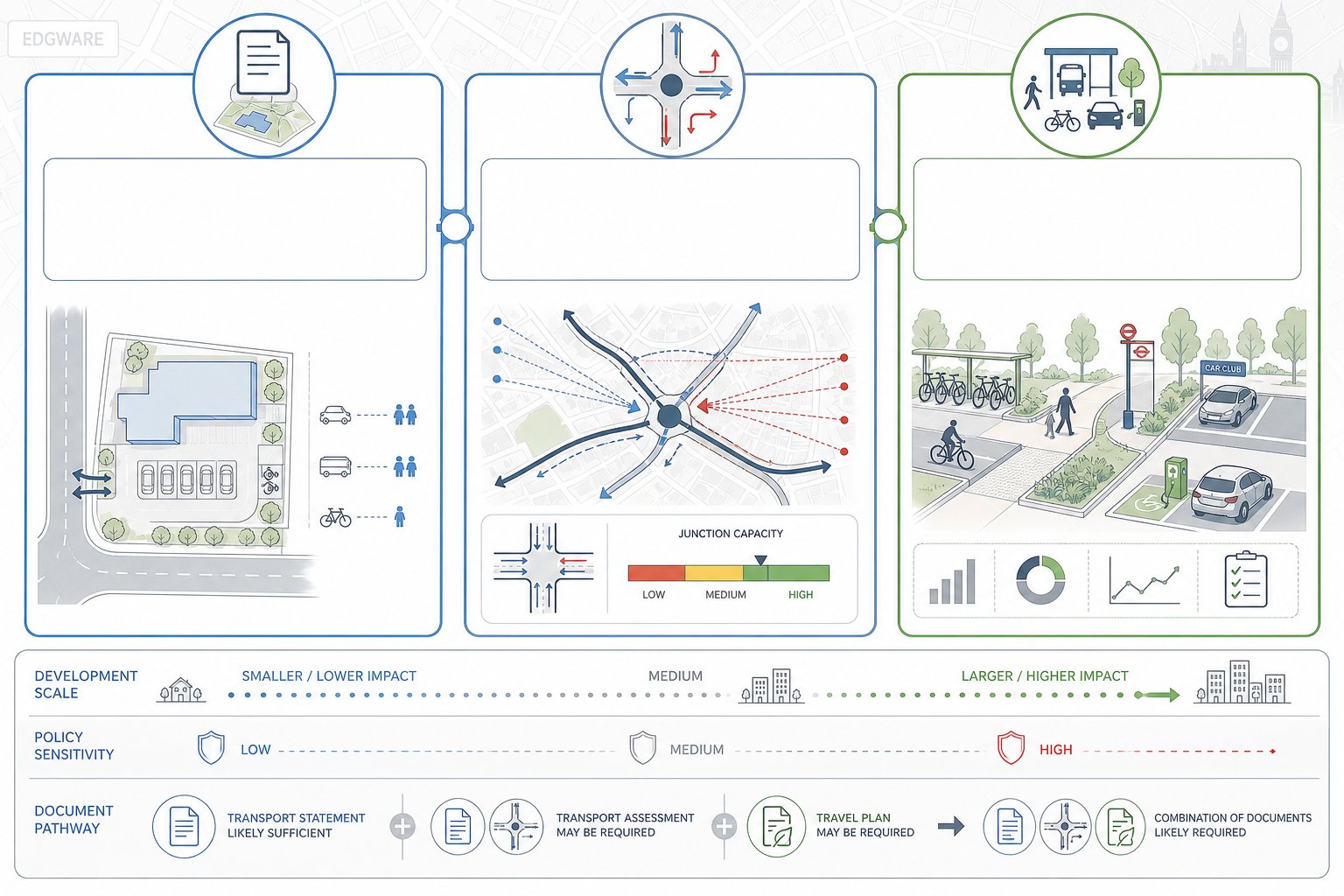
One of the most common points of confusion in planning is the difference between a Transport Statement, a Transport Assessment and a Travel Plan. They are related, but they are not interchangeable.
A Transport Statement is usually the proportionate option for smaller or less impactful schemes. It sets out the site context, existing access conditions, parking provision, likely trip levels and whether the proposal would create any material highway or transport concerns. The emphasis is on concise evidence rather than extensive modelling.
A Transport Assessment goes further. It is used for larger, more sensitive or potentially more impactful developments and typically includes detailed trip generation analysis, trip distribution, network assignment and junction capacity testing where needed. If there is a realistic prospect that the scheme could affect queueing, delay or operation on the surrounding network, a TA is often the appropriate route. This is where Highway And Traffic analysis becomes central to the planning case.
A Travel Plan is different again. It is a strategy document aimed at influencing travel behaviour. Rather than focusing only on predicted traffic effects, it sets out measures to encourage walking, cycling, public transport use, car-sharing and lower-car travel patterns. It may include targets, monitoring arrangements, welcome packs, cycle facilities, EV provision and site management measures.
In practice, schemes may require one of these documents, or a combination. A smaller residential scheme might only need a Transport Statement. A larger mixed-use proposal may need a Transport Assessment and a Travel Plan. The right choice depends on scale, sensitivity, local policy and what the highway authority is likely to ask for.
How Local Highway And Planning Requirements Shape Development In Edgware
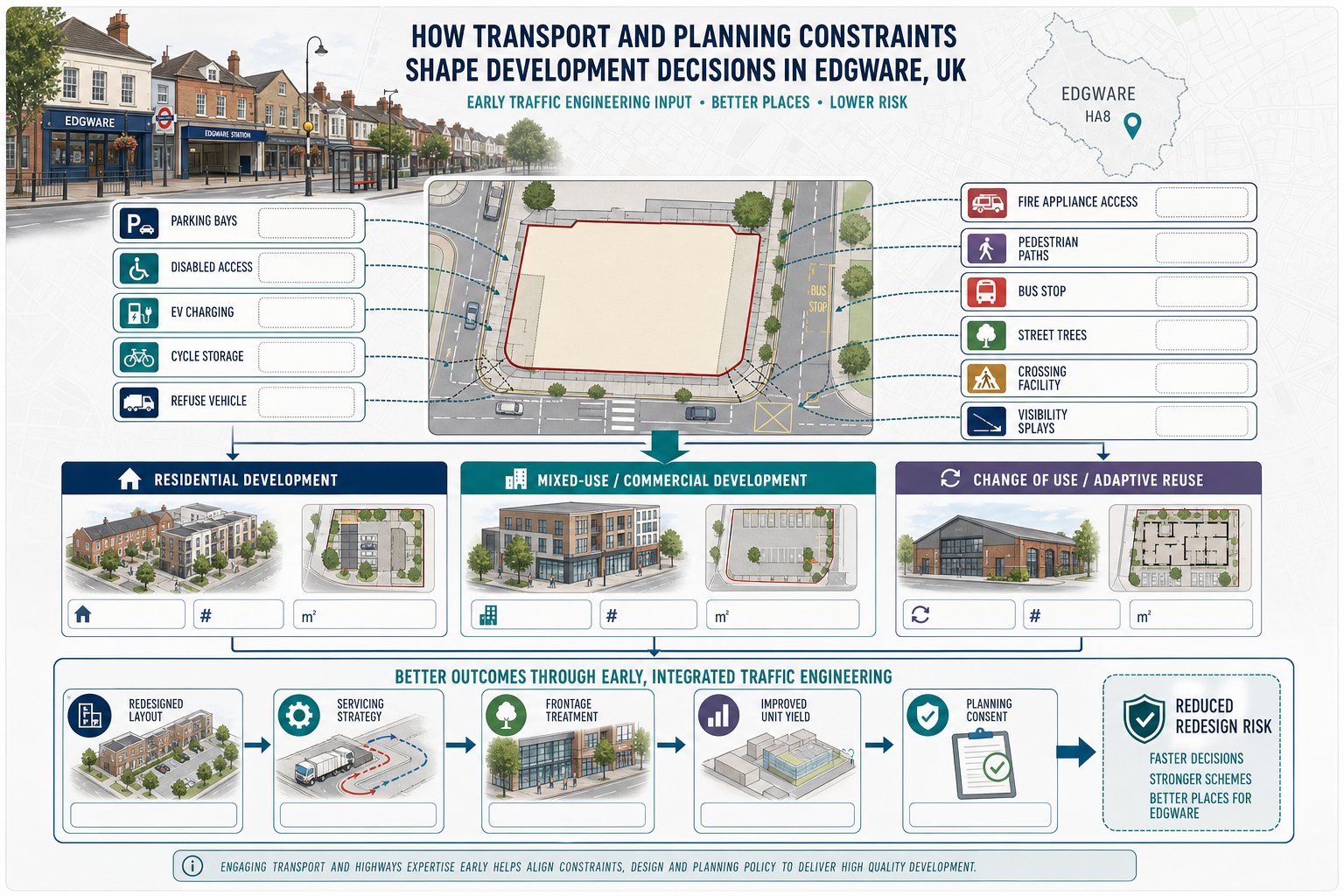
Edgware development is shaped not only by what physically fits on site, but by what local and London-wide transport policy will accept. That distinction matters. A layout may appear efficient from an architectural perspective and still need redesign once highway, parking and sustainable travel requirements are tested.
Parking standards are a good example. In much of London, the direction of travel is clear: developments should not over-rely on private car use, especially where public transport accessibility is reasonable. But low parking is not a free pass either. Authorities still expect robust justification, disabled provision where required, workable servicing and secure cycle parking. Add EV charging expectations, refuse access, fire access and pedestrian movement, and the transport side can quickly reshape a scheme.
Access design is often where policy meets geometry. Tight frontage conditions, existing street trees, nearby crossings, bus stops or visibility constraints can limit what is acceptable. In those situations, early access design highway input can prevent a great deal of redesign later.
The practical point is this: planning and highway requirements are not an afterthought. They influence unit numbers, servicing strategy, basement layouts, frontage treatment and even the viability conversation. A good transport strategy does not simply defend a finished design: it helps shape one that stands a better chance of consent.
Typical Schemes That Need A Traffic Engineer
Some schemes almost announce the need for transport input the moment the red line is drawn. Others look uncomplicated until one local issue changes the picture.
Typical projects include infill residential plots, estate intensification, apartment blocks over ground-floor commercial space, care facilities, schools and nurseries, roadside retail, gym conversions, medical uses and redevelopment of constrained brownfield sites. Change-of-use projects are especially common candidates because transport effects can shift sharply even when the building envelope stays much the same.
Schemes near heavily trafficked routes, signalised junctions or streets with existing parking stress often benefit from an early review. The same is true where servicing is awkward, where refuse collection depends on precise manoeuvring, or where there is a tension between maximising floor area and maintaining safe access.
For planning teams, the value of a traffic engineer is often not the report alone. It is the ability to identify the transport issue that is most likely to delay the application, then deal with it before submission.
Residential Developments
Residential schemes in Edgware vary hugely, but a few recurring themes come up again and again: parking demand, refuse access, emergency vehicle access, cycle storage, pedestrian quality and the relationship between frontage design and highway safety.
A small flatted development on a suburban street may need a concise statement showing that the access works safely, that parking demand is manageable and that local walking and public transport options justify the proposed level of car parking. A larger or denser scheme may require a more detailed assessment of trip generation and wider network effects.
HMOs and care-related uses can be particularly sensitive because occupancy patterns, staff movements, visitor activity and servicing may differ substantially from conventional housing. Even where net trips appear modest, highway officers often want comfort that pick-up, drop-off or informal parking will not create friction on the public highway.
Residential work also increasingly requires attention to car-lite or low-car principles, cycle parking quality and inclusive access. A thoughtful parking strategy traffic approach can be as important as traffic forecasting itself.
Commercial, Mixed-Use, And Change-Of-Use Projects
Commercial and mixed-use projects often generate more varied transport effects than residential schemes because activity patterns are less uniform. Staff arrival peaks, customer turnover, servicing windows and delivery intensity can all matter.
A nursery may create concentrated morning and afternoon drop-off pressure. A restaurant or takeaway may increase short-stay kerbside activity into the evening. A medical use may alter both trip profile and accessibility requirements. Mixed-use schemes add another layer because residential and commercial demand can overlap or compete for the same space.
Change-of-use applications are frequently underestimated. The floorspace may remain identical, yet trip patterns can change completely. That is why comparative appraisal between existing lawful use and proposed use is often central to the planning argument.
In these cases, we usually focus on practical operation as much as headline trip totals: where vehicles stop, how deliveries are managed, whether shared surfaces remain safe, and whether sustainable travel measures are credible. For developer teams, this is where Commercial Traffic Engineering input tends to pay for itself.
What A Traffic Engineer Will Assess For An Edgware Site
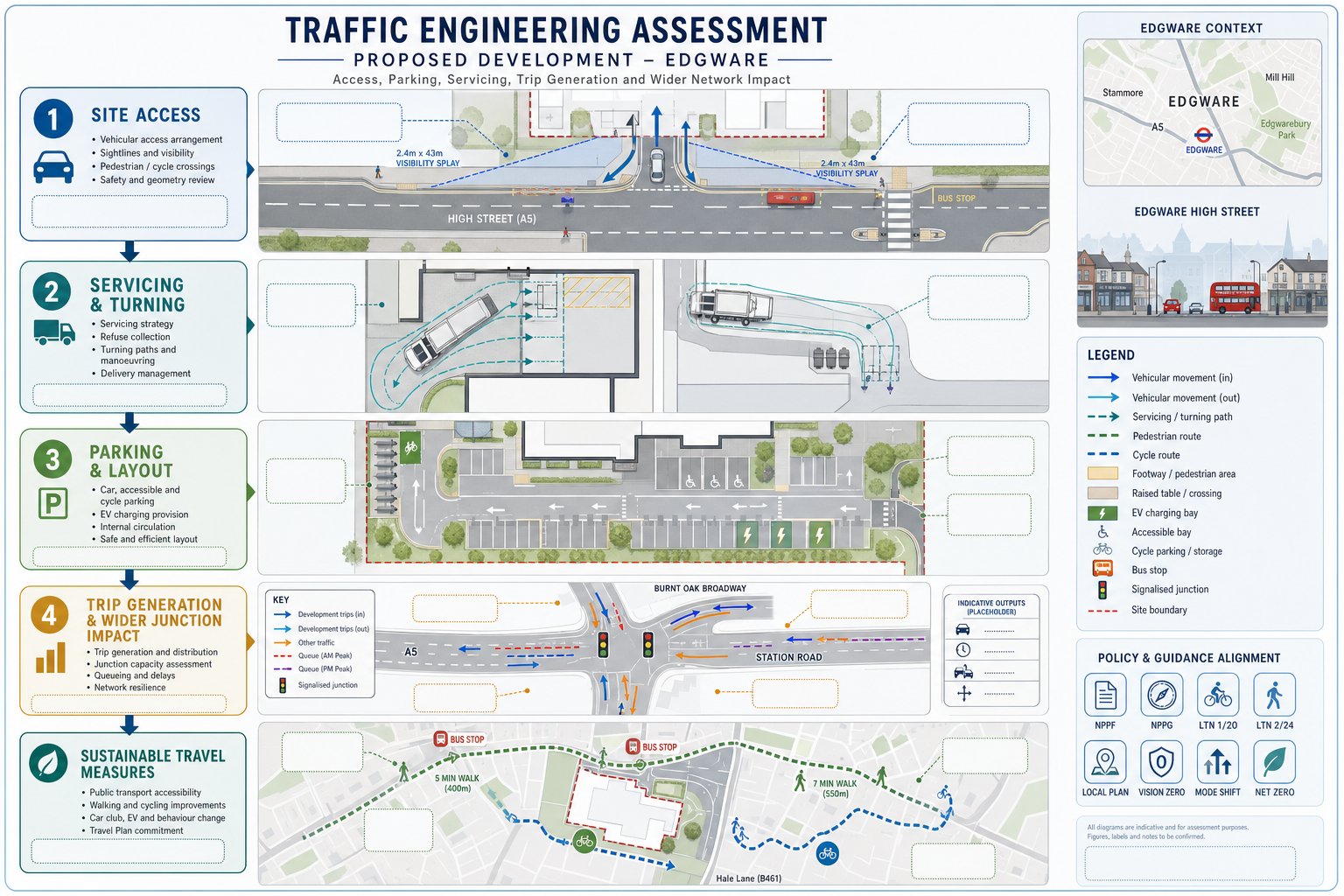
The scope of assessment depends on the proposal, but most Edgware sites call for a structured review of how the development will function in transport terms, both on site and on the surrounding network. We are usually testing two things at once: can the scheme operate safely and efficiently, and can it be justified convincingly within planning policy?
That means looking at physical design, forecast demand and how people are likely to travel in real life rather than in a vacuum. A technically neat drawing is not enough if refuse vehicles cannot turn, if visibility is compromised, or if parking assumptions are clearly detached from local conditions. Equally, a site with some constraints may still be entirely supportable if the evidence is proportionate, transparent and well argued.
Access, Servicing, Parking, And Highway Safety
Access is usually the first issue under the microscope. We assess where vehicles and pedestrians enter and leave the site, whether the geometry is workable, whether visibility is adequate, and whether the location of the access creates avoidable conflict with junctions, crossings, bus stops or existing kerbside activity.
Servicing is equally important. Delivery vans, refuse vehicles and emergency vehicles all have different operational needs. If the scheme relies on large vehicles entering, turning or reversing, swept-path analysis may be needed to demonstrate that manoeuvres can be completed safely. If servicing must occur from the street, we consider whether that arrangement is realistic and acceptable.
Parking is not just about bay numbers. We examine layout efficiency, disabled provision, cycle storage, EV charging expectations and whether the parking strategy aligns with policy and likely demand. For many schemes, the parking case is as sensitive as the traffic case.
Highway safety then pulls these strands together. We review road layout, local movement patterns and any available collision record to understand whether the development could worsen an existing problem or introduce a new one. Sometimes the answer is a design amendment. Sometimes it is a clearer technical justification.
Trip Generation, Junction Impact, And Sustainable Travel
Once site operation is understood, we move to transport demand. Trip generation estimates help us forecast how many person trips and vehicle trips a proposal is likely to create, often using recognised databases such as TRICS and informed professional judgement. Existing lawful use matters here, because net impact is often more relevant than gross numbers.
We then consider where those trips are likely to go and which parts of the local highway network may be affected. For more substantial schemes, that may lead to junction modelling to test capacity, queueing and delay in forecast scenarios. Not every development requires modelling, but where there is a realistic concern about network effect, a robust evidence base is hard to avoid.
Sustainable travel sits alongside this analysis, not after it. We review walking links, bus accessibility, cycling opportunities, local amenities and any measures the scheme can introduce to reduce car dependence. That may include cycle parking improvements, travel information, management plans or targeted Travel Plan measures.
Done properly, this stage is not just a numbers exercise. It is about showing that the development can function within its setting and that the transport strategy supports wider planning objectives. Solid Traffic Engineering: Your judgement is what connects those threads.
How The Transport Assessment Process Works From Start To Submission
A good transport submission is usually the product of an orderly process rather than a last-minute report. In Edgware, that process typically starts with scoping: deciding what level of transport work is proportionate and what issues the local planning and highway authority are most likely to focus on.
First, we review the proposal, the site context and any known policy or highway sensitivities. That allows us to advise whether a Transport Statement, Transport Assessment, Travel Plan or supporting technical note is likely to be needed. On more complex schemes, we may engage early with the authority to agree study junctions, survey requirements or the overall methodology.
Next comes baseline data. Depending on the site, this may include traffic counts, speed surveys, parking beat surveys, collision review, site observations and an audit of walking, cycling and public transport conditions. Good baseline work matters because weak inputs produce weak conclusions.
We then assess trip generation and trip distribution, identify the likely effect on surrounding roads and, where necessary, undertake junction modelling. At the same time, the design often evolves. Access arrangements may be adjusted, servicing may be rationalised, cycle storage refined or parking rebalanced. Transport work is rarely isolated from the design process: it feeds directly into it.
Once the evidence is assembled, we prepare the report and supporting plans in a form that is concise, accurate and aligned with the planning application. The final stage is often overlooked: responding to officer queries. Many applications are won or lost there. A clear, prompt response to transport comments can keep a scheme moving, while a vague or defensive one can cause avoidable delay.
That is why we place so much emphasis on being practical as well as technical. For planning teams, the best outcome is not just a compliant report, but a submission that anticipates questions before they land.
Conclusion
A Traffic Engineer in Edgware adds value long before a planning officer reads the transport report. The real benefit is in spotting pressure points early, shaping a workable design and presenting transport evidence in a way that is proportionate, credible and locally grounded.
For architects, planners, lawyers, surveyors, developers and councils, that can mean fewer revisions, clearer negotiations and a stronger route through the planning process. Edgware schemes are rarely judged on land use alone: they are judged on how safely and sensibly they fit into the surrounding network.
Whether the project involves residential intensification, a mixed-use redevelopment or a sensitive change of use, the transport strategy needs to reflect real conditions on the ground. When it does, planning risk becomes easier to manage. And in 2026, that is often what separates a delayed application from a defensible one.
Frequently Asked Questions about Traffic Engineering in Edgware
What does a Traffic Engineer in Edgware do for planning applications?
A Traffic Engineer in Edgware assesses how developments affect local roads, parking, and safety, preparing Transport Statements, Assessments, and Travel Plans to support planning applications and help avoid delays due to transport objections.
When is a Traffic Engineer required for a development in Edgware?
You usually need a Traffic Engineer when a proposal could noticeably change traffic flow, parking demand, or highway safety, such as with new flats, schools, nurseries, commercial or mixed-use schemes, and sites near busy roads or constrained access points.
What is the difference between a Transport Statement, Transport Assessment, and Travel Plan?
A Transport Statement is a concise review for smaller schemes, a Transport Assessment provides detailed impact analysis including junction modelling for larger developments, and a Travel Plan outlines strategies to promote sustainable travel like walking, cycling, and public transport use.
How do local and London-wide policies affect development transport requirements in Edgware?
Local and London policies prioritise walking, cycling, and public transport over cars, enforcing parking and cycle storage standards, EV charging provision, and safe access design, often leading to scheme redesigns to meet these requirements.
What transport issues are commonly assessed by Traffic Engineers in residential schemes in Edgware?
Key assessments include parking demand, refuse and emergency vehicle access, cycle storage quality, pedestrian safety, and compliance with low-car and inclusive access principles to ensure the development fits safely within the local highway network.
How does a Traffic Engineer in Edgware assess trip generation and junction impact?
They estimate vehicle and person trips using recognised data sources like TRICS, analyse trip distribution on the local network, and perform junction capacity modelling where needed to forecast effects on queues and delays, ensuring developments operate safely and efficiently.