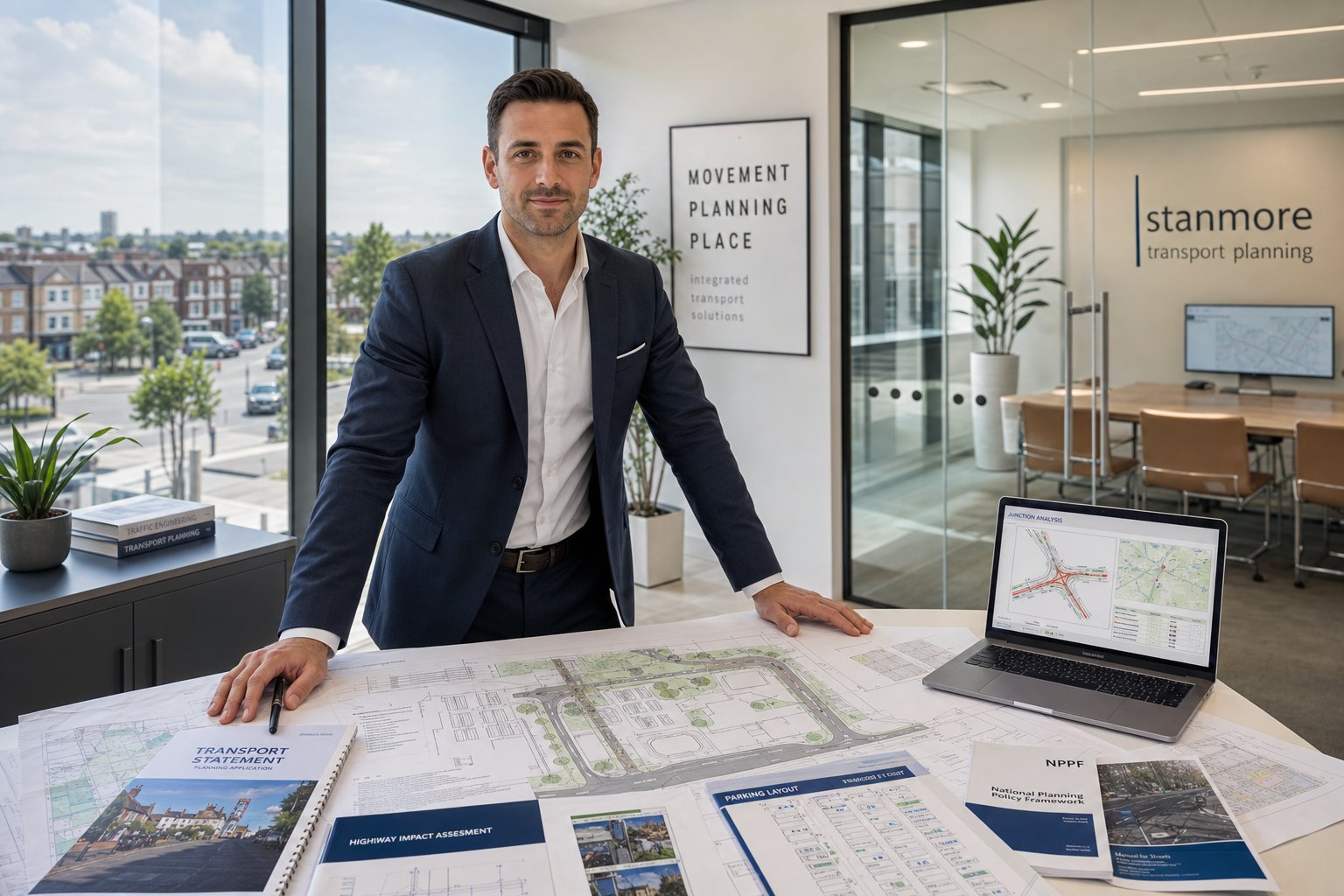
Planning in Stanmore rarely fails on design alone. More often, schemes slow down because access is awkward, parking is contested, servicing looks unresolved, or the likely transport impact has not been explained in a way the local authority can rely on. That is where a traffic engineer in Stanmore becomes central to the planning process rather than a late-stage add-on.
We work with architects, planners, developers, lawyers and project teams who need transport advice that is proportionate, technically sound and genuinely useful in moving an application forward. In practical terms, that means reviewing how a site is reached, how many trips a proposal is likely to generate, whether the local network can absorb those movements, and what mitigation or supporting evidence may be needed to satisfy highways concerns.
Stanmore brings a very particular set of issues. Residential streets can be sensitive to even modest changes in traffic. Parking pressure is often a live local issue. Bus routes, station proximity, visibility constraints and servicing practicality all shape what is realistic. A well-prepared transport strategy needs to respond to those local conditions from the outset.
In this guide, we set out what a traffic engineer in Stanmore actually does for planning applications, when transport input is usually required, what reports may be needed, and how to avoid the common mistakes that lead to objections, requests for further information, or frustrating delay.
Key Takeaways
- A traffic engineer in Stanmore plays a crucial role in planning applications by providing clear, evidence-based transport advice tailored to local conditions and planning policies.
- Early involvement of a traffic engineer helps identify and mitigate key transport risks such as access issues, parking pressures, servicing constraints, and traffic impacts before submission.
- Transport reports for Stanmore developments must use current, robust data and be concise, focused on relevant local and London policies to avoid delays and objections.
- Common triggers for professional transport input include new or intensified access, increased traffic generation, complex land uses, parking variations, and servicing challenges.
- Effective transport strategies in Stanmore respond to specific site constraints like road hierarchy, public transport accessibility, and existing parking demand to ensure realistic and operational layouts.
- Choosing the right traffic engineer means selecting one with local authority knowledge, technical expertise, and the ability to provide candid, timely, and proportionate reporting to support smoother planning outcomes.
What A Traffic Engineer In Stanmore Does For Planning Applications
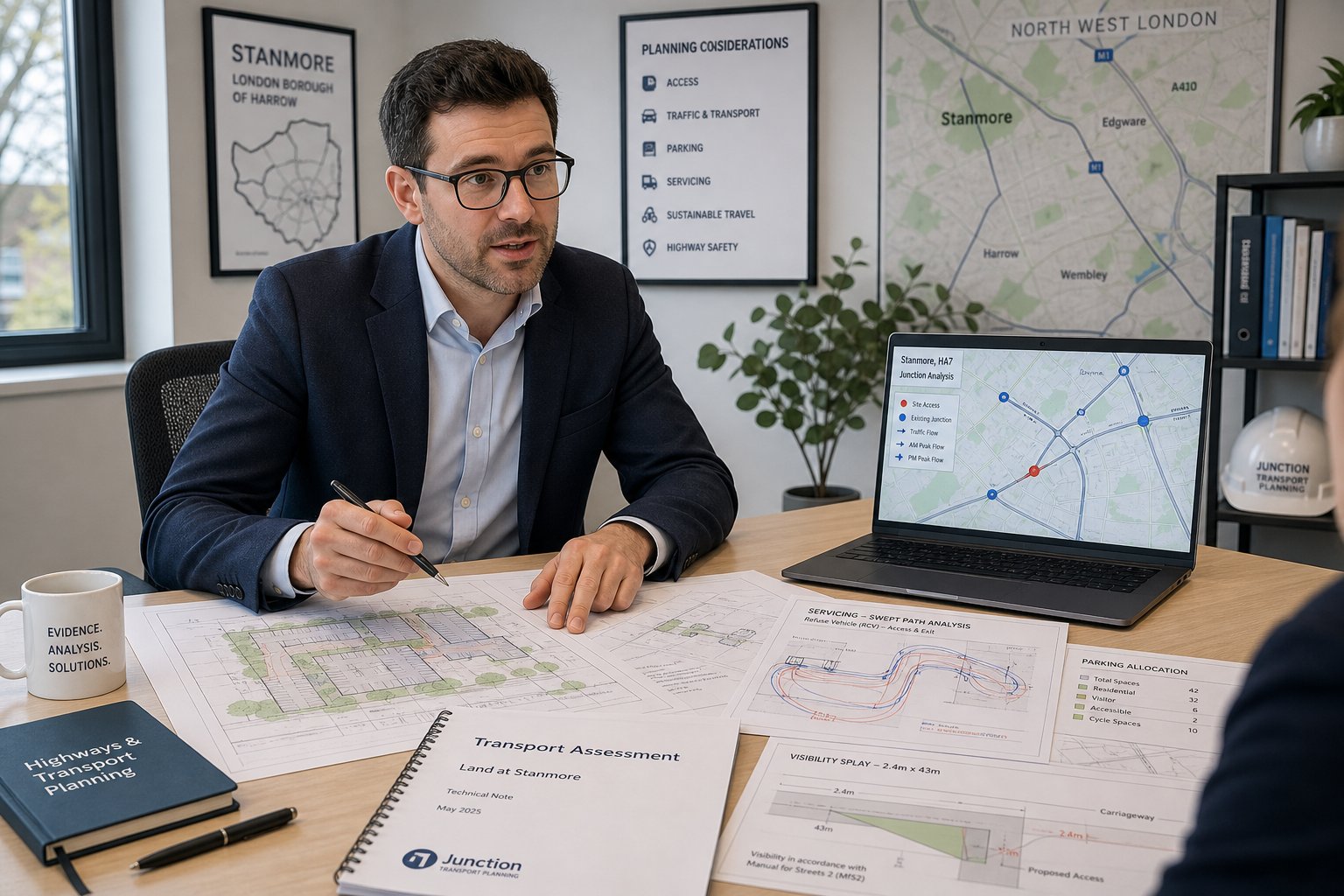
A traffic engineer in Stanmore supports planning applications by turning transport risk into clear, evidence-based advice. That starts with understanding the development proposal in detail: the land use, scale, likely occupiers or users, parking offer, servicing needs, access arrangements and relationship with the surrounding highway network.
We typically review four core issues first: access, trip generation, parking and servicing. If a new or altered access is proposed, we assess whether it can operate safely, whether visibility is acceptable, and whether the road hierarchy makes that arrangement suitable. If the proposal will intensify use of an existing site, we consider whether the increase in movement is material enough to need a Transport Statement or full Transport Assessment.
For many schemes, our role also includes preparing technical planning documents. These may include a Transport Assessment, Transport Statement, access note, travel plan, delivery and servicing strategy, or a response to highways consultation comments. On more constrained or contentious sites, we may undertake junction capacity analysis, swept-path testing, parking accumulation review, or support design changes that improve the prospects of approval.
The key point is this: highways officers do not simply want assurances. They want robust justification. That is why concise reporting matters. Good transport advice explains impacts proportionately, references local and London policy correctly, and gives decision-makers confidence that the proposal has been properly thought through. In broader terms, the role sits within the kind of planning support outlined by Traffic Engineering Consultants: experienced in translating technical transport matters into planning-ready evidence.
When A Development In Stanmore Needs Transport Input
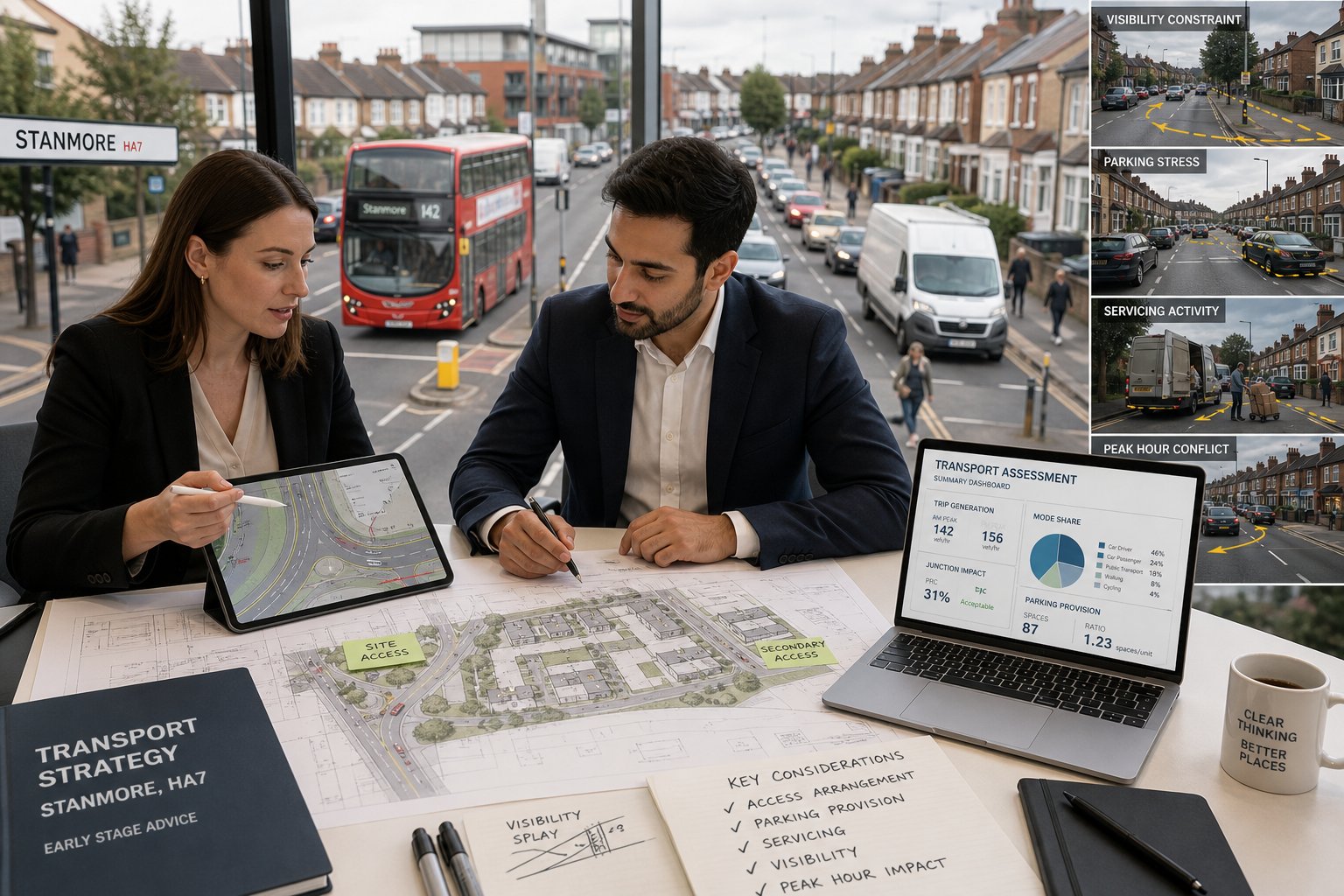
Not every planning application in Stanmore needs a lengthy transport report. But many do need some level of professional transport input much earlier than applicants expect. The usual trigger is not simply size: it is whether the proposal creates transport effects that the planning authority will reasonably want tested or explained.
A small residential scheme can require detailed highways input if the access is poor, the road is heavily parked, or the site sits on a sensitive corner. Equally, a commercial scheme with modest floor area may still need servicing analysis if vans or larger vehicles will arrive regularly. In London borough contexts, transport concerns often arise from site circumstances as much as headline development quantum.
We hence advise project teams to ask an early question: what is most likely to worry highways officers or neighbours? If the answer is vehicle conflict, parking overspill, peak-hour traffic, delivery activity, or pressure on local junctions, transport input is rarely optional.
This is also why early-stage strategy matters. Across urban applications, the same principle appears in Highway And Traffic work more generally: identify the transport risk first, then tailor the reporting level to that risk rather than defaulting to a generic template.
Common Triggers For Professional Transport Advice
Common triggers include:
- New or intensified access onto busy roads, bus routes, or streets with constrained visibility
- Material increases in traffic generation, especially during AM and PM peaks
- Flatted schemes, HMOs, mixed-use, education, healthcare, leisure or commercial uses where activity patterns are more complex
- Car-free or car-lite proposals, or developments with reduced parking compared with typical expectations
- Servicing, refuse or emergency access constraints that need tested vehicle tracking
- Larger applications likely to require a full TA, Framework Travel Plan, or supporting operational plans
There is also the planning politics of transport. Parking stress and road safety can become focal objections even where technical impact is manageable. A proportionate transport note prepared at the right moment can often head off avoidable dispute. And, frankly, it is usually cheaper to redesign access or servicing before submission than to defend a weak layout once objections land.
How Stanmore Site Constraints Shape Traffic And Access Strategy
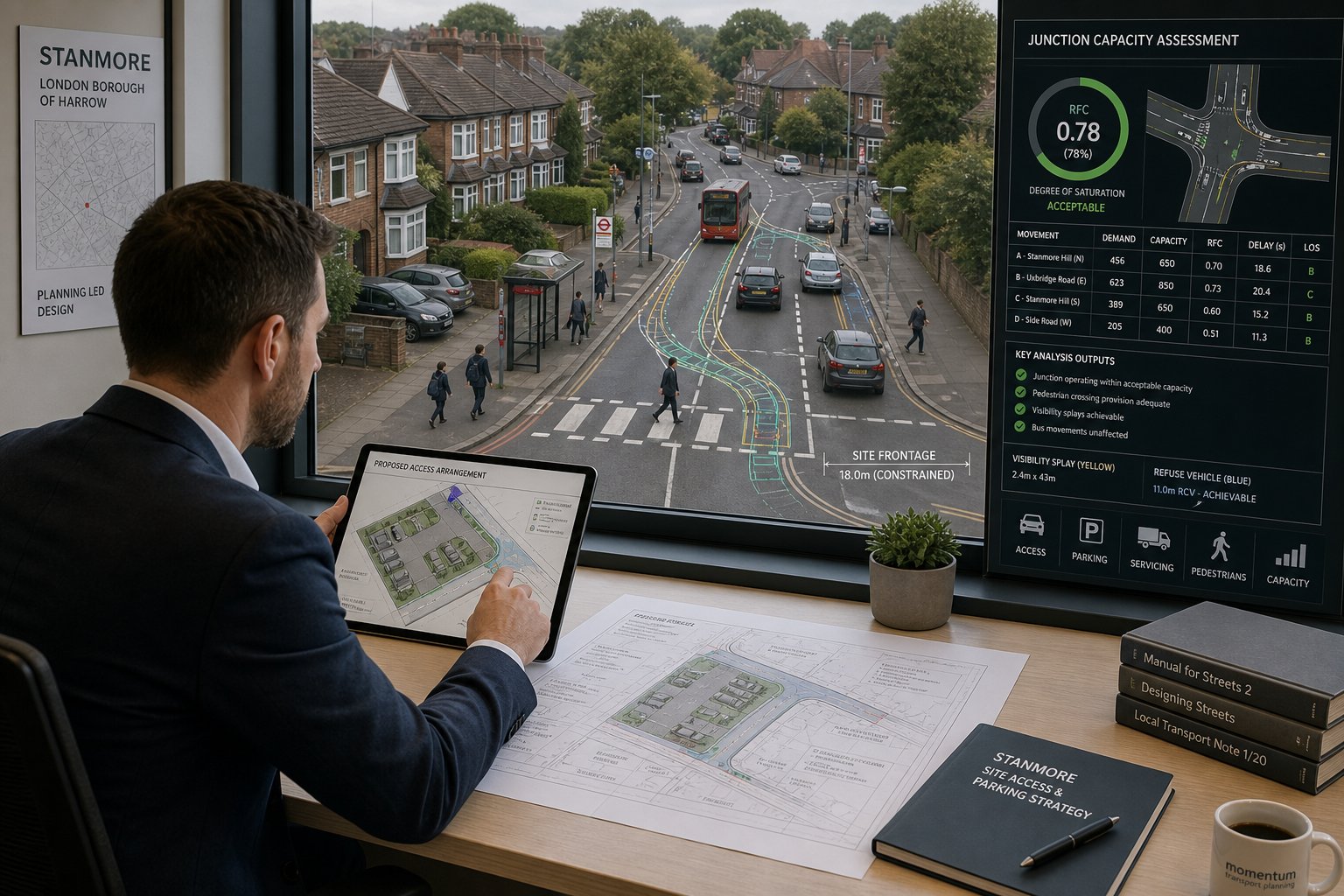
Stanmore is not a blank sheet. Each site sits within a specific pattern of road hierarchy, residential sensitivity, public transport accessibility, topography, frontage conditions and existing parking demand. Those constraints shape transport strategy from the first sketch layout.
In practice, we often find that the most successful planning-led transport solutions are not the ones with the most technical analysis, but the ones that respond honestly to what the site can and cannot do. If a frontage is tight, that affects access width, pedestrian visibility and vehicle waiting space. If neighbouring driveways are close, turning movements and inter-visibility become more important. If the surrounding streets are already heavily parked, the margin for operational friction is much smaller.
For sites near public transport, there may be stronger support for reduced car parking and a more sustainable travel-led narrative. But that does not remove the need to prove servicing practicality, refuse collection arrangements, and safe day-to-day operation. Where layouts are especially constrained, transport advice can influence one-way circulation, internal geometry, service timing restrictions, or whether a proposal needs to be redesigned altogether.
This planning-first approach aligns with wider Traffic Engineering: Your Complete practice: use evidence not just to defend a scheme, but to improve it before it reaches determination.
Local Road Network, Junction Capacity, And Access Considerations
Stanmore schemes often turn on local network performance as much as site access itself. We review the nearby road function, existing turning patterns, bus activity, pedestrian flows and any known pressure points at adjoining junctions. For straightforward schemes, a qualitative assessment may be enough. For others, more formal analysis may be needed using tools such as PICADY, ARCADY or LINSIG where a junction’s operation is genuinely material.
Access design then has to work within that context. Questions usually include:
- Is visibility acceptable for the speed environment?
- Can vehicles enter and leave in forward gear where necessary?
- Will right-turning movements create undue delay or conflict?
- Is the spacing from nearby junctions or crossings acceptable?
- Could the access interrupt bus movement, parking bays or pedestrian desire lines?
Sometimes the answer is not a bigger report but a better layout. Shifting a bellmouth, narrowing a crossover, formalising entry and exit operation, or changing vehicle type assumptions can make a significant difference.
Parking, Servicing, And On-Site Vehicle Movement
Parking arguments in Stanmore are rarely abstract. Residents know local pressure intimately, and planning officers know when a parking shortfall is likely to become a political issue. We hence assess parking provision against policy, local context and realistic demand rather than relying on broad assumptions alone.
That usually means reviewing car parking numbers, disabled bays, EV charging, cycle parking, and how the parking arrangement functions operationally. Can vehicles manoeuvre practically? Is there stacking space? Does a resident or service vehicle need multiple shunts? Those details matter because a compliant drawing can still fail in real use.
Servicing is equally important. Refuse vehicles, delivery vans and emergency access often define whether a layout is acceptable. Swept-path analysis is commonly needed to show that the design works, particularly on tight sites. Where turning space is limited, timed deliveries or smaller vehicle assumptions may help, but they need to be credible and clearly secured if relied upon.
For employment-led or mixed-use proposals, the same issues appear at greater scale, which is why Commercial Traffic Engineering principles are often relevant even on relatively modest urban sites.
Transport Assessments And Statements For Stanmore Projects
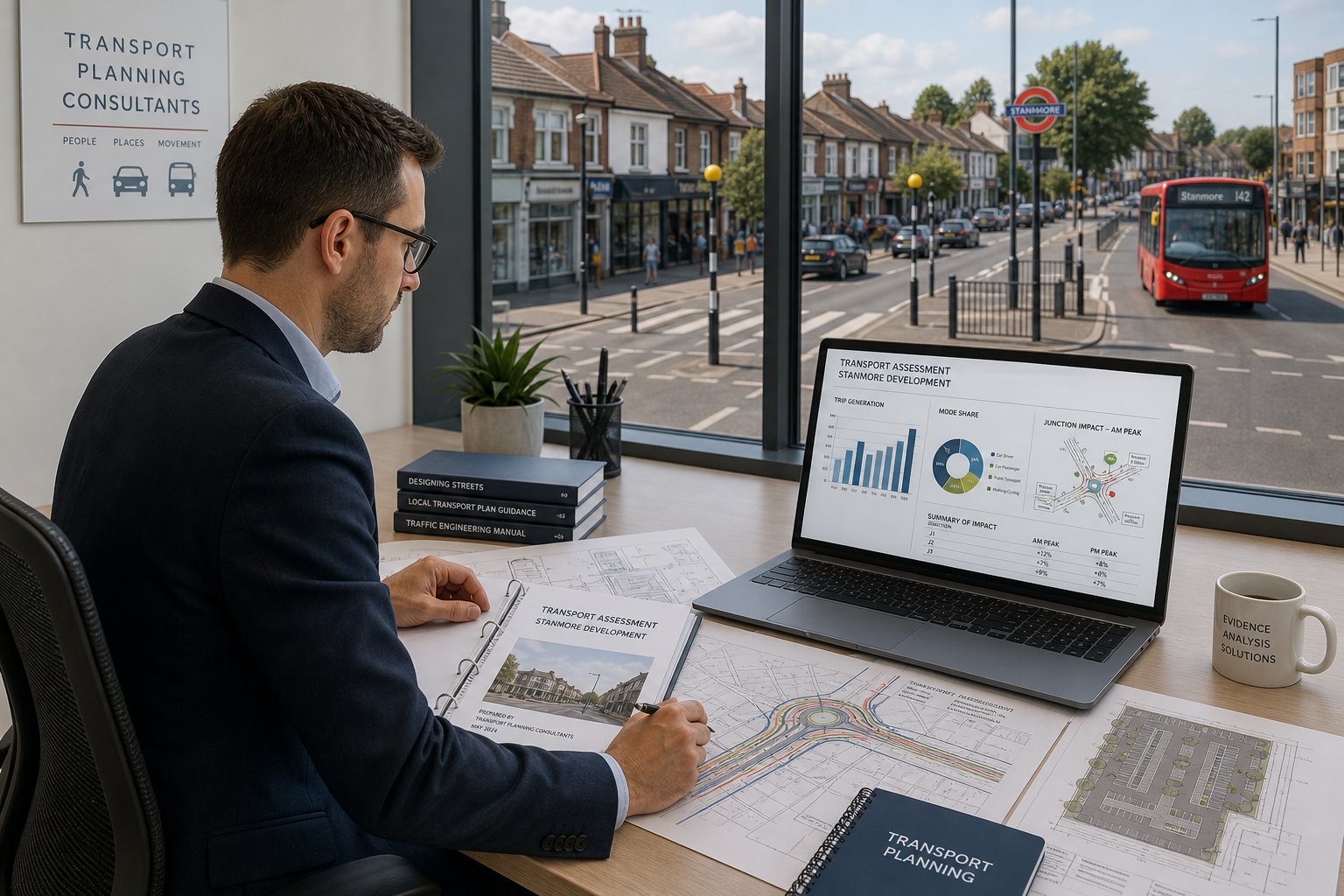
A Transport Assessment (TA) or Transport Statement (TS) is not just a planning formality. It is the main technical narrative explaining how a proposal interacts with the transport network and why that impact is acceptable, manageable, or mitigated.
The choice between a TA and TS depends on scale, complexity and likely impact. A Transport Statement is usually appropriate where impacts are limited but still need structured explanation. A Transport Assessment is more detailed and is typically required for larger or more sensitive developments where trip generation, junction capacity, mode share, parking strategy and mitigation need fuller testing.
For Stanmore projects, a good TA or TS usually covers:
- site location and accessibility
- existing highway and transport conditions
- development proposals
- trip generation and distribution
- traffic impact and, where relevant, capacity analysis
- parking and servicing strategy
- sustainable travel opportunities
- mitigation, if needed
The standard of evidence matters as much as the document title. Survey data should be current and relevant. Assumptions should be transparent. Comparisons with existing lawful use need to be properly handled. And the conclusions should be proportionate rather than over-claimed.
Too many transport reports fall into one of two traps: either they are so thin that they invite challenge, or so inflated that the real planning points get buried. We aim for the middle ground, concise, technically solid, and tailored to local authority expectations. That same approach underpins work delivered across Traffic Engineer In London: planning contexts, where report quality is judged not by length but by clarity, evidence and relevance.
Travel Plans, Delivery Management, And Wider Supporting Reports

Many Stanmore applications need more than a TA or TS. Supporting transport documents can be essential where the planning authority wants confidence that day-to-day operation, construction activity or sustainable travel outcomes will be actively managed.
A Travel Plan sets out how a development will encourage sustainable travel and reduce reliance on private car use. Depending on the scheme, this may be residential, workplace or school-focused. The strongest travel plans are realistic. They reflect actual public transport accessibility, identify practical measures such as cycle facilities, welcome packs, monitoring, car club information or site-specific incentives, and avoid vague promises that nobody can carry out.
A Delivery and Servicing Management Plan becomes important where deliveries, collections or operational servicing could affect neighbours or local roads. This is common for mixed-use, commercial, education and healthcare schemes. It can define delivery hours, vehicle size assumptions, routing expectations and on-site management procedures.
On some projects, a Construction Logistics Plan is also needed, especially where demolition or build activity may affect narrow roads, schools, buses or parking-sensitive streets. And where access design is finely balanced, road safety audit input or additional technical notes may support the package.
These supporting reports often look secondary on a document list, but they can be the difference between a proposal that feels operationally credible and one that appears undercooked. That is particularly true when officers are deciding whether concerns can be managed through condition or need redesign before consent.
Working With Harrow Planning Requirements And Local Policy Context
Transport planning in Stanmore sits within a layered policy framework. Harrow’s local planning requirements matter, but so do the London Plan, relevant TfL guidance, parking standards, cycle standards, and national planning and transport policy. A report that ignores that hierarchy can be technically competent yet still unpersuasive.
We hence frame transport advice around the actual policy tests a scheme is likely to meet: highway safety, residual cumulative impact, sustainable transport, parking justification, servicing practicality and design quality. In London boroughs, the policy direction usually supports sustainable modes strongly, but local decision-making remains highly sensitive to street-level operational realities. That tension needs handling properly.
Early scoping is often valuable. Where a scheme is likely to be borderline in transport terms, discussing methodology, survey scope or report expectations early can reduce later disagreement. It will not eliminate challenge, nothing does, but it often narrows the debate to the points that genuinely matter.
Experience also helps with proportionality. Not every scheme needs every available technical appendix. Harrow officers, like most planning authorities, generally respond better to direct answers than to padded submissions. The objective is to provide enough robust evidence to support determination, not to impress with volume.
And because many projects in Stanmore sit within wider London development dynamics, lessons from other urban authorities can be useful too. We often see similar reporting expectations across city contexts, including those discussed in Traffic Engineer In Leeds: planning-led transport work.
How A Traffic Engineer Supports Architects, Planners, And Developers
Transport input works best when it is integrated early with design and planning strategy rather than commissioned after the layout is fixed. For architects, that means we can test whether access geometry, parking courts, cycle stores, refuse tracking and pedestrian routes are viable before the design hardens. For planners, we help shape a planning narrative that is realistic about transport effects and aligned with policy. For developers, we reduce the risk of costly redesign late in the programme.
The collaboration is usually iterative. An architect issues a concept. We flag access or servicing conflicts. The layout shifts. Parking is reviewed again. A planner refines the planning balance. Then the supporting transport evidence is drafted around a scheme that is already more robust. That process is faster, and usually far cheaper, than trying to rescue a weak proposal after submission.
Lawyers and planning consultants also rely on transport input where appeal risk, committee sensitivity or objection management is in play. A concise technical note can help clarify whether a concern is genuinely substantive or simply asserted.
Our role is not to inflate transport issues, but to resolve them. Sometimes that means confirming a proposal is low impact. Sometimes it means saying a scheme needs a redesign before it is planning-ready. Honest advice tends to save everyone time.
The Typical Process From Initial Review To Planning Submission
Most transport instructions for Stanmore planning applications follow a fairly consistent sequence, even though the level of analysis varies by project.
First, we carry out an initial review. That usually involves examining the site location, proposed land use, access drawings, parking layout, local road context and likely planning triggers. At this point, we identify the probable transport risks and advise what level of reporting may be needed.
Second comes scoping. For straightforward schemes this may be internal. For more sensitive applications, it can involve discussions with the project team and sometimes early engagement on methodology. The aim is to avoid unnecessary work while making sure the final submission answers the right questions.
Third, we arrange the evidence base. That may include traffic counts, parking surveys, pedestrian observations, accessibility review, servicing assumptions or junction modelling inputs. If the site is tight, vehicle tracking can start surprisingly early because layout feasibility may depend on it.
Fourth, we prepare the draft transport package, often a TS or TA, sometimes with a travel plan, servicing plan or technical note. This is then coordinated with the architect, planner and wider application documents so that the story is consistent.
Finally, after submission, there may be highways queries or requests for clarification. Prompt, technically precise responses are often what keep determination moving. Speed matters here. A delayed answer to a simple highways point can hold up an otherwise ready application.
Common Reasons Transport Reports Are Challenged And How To Avoid Delays
Transport reports are usually challenged for predictable reasons. The frustrating part is that most of them are avoidable.
One common issue is poor scoping. A report answers the wrong transport question because nobody identified the real point of concern at the outset. For example, a scheme may focus heavily on trip rates when the authority is actually most concerned about servicing conflict or parking overspill.
Another frequent problem is weak or outdated evidence. Survey data that is too old, unrepresentative, or disconnected from local conditions can quickly undermine confidence. The same applies to generic trip-rate selection without proper justification, or capacity modelling built on assumptions that are not explained clearly.
We also see challenges arise from layout optimism, drawings that technically fit on paper but do not work in practice. If a refuse vehicle can turn only with repeated overruns, or visibility relies on unrealistic conditions, highways officers will spot it.
Parking is another classic pressure point. If proposed provision diverges from expectation, the justification must be careful, location-specific and policy-led. Simply stating that residents will own fewer cars rarely carries much weight on its own.
To avoid delay, we recommend four things:
- Scope early around the actual planning risks.
- Use current, robust data and explain assumptions plainly.
- Test the layout operationally, not just dimensionally.
- Respond quickly and directly to consultation comments.
That practical emphasis is one reason concise planning support tends to outperform bloated reporting. Similar lessons appear in Traffic Engineer In Bristol: work, where local thresholds differ but the causes of delay look very familiar.
Choosing The Right Traffic Engineer In Stanmore For Reliable, Timely Reporting
Choosing the right traffic engineer in Stanmore is partly about technical competence and partly about planning judgement. You need both.
At a minimum, the consultant should understand transport assessment methodology, access design principles, parking standards, servicing review and, where relevant, junction modelling tools. They should also know how London and borough-level planning policy affects transport submissions. But credentials alone are not enough. The real test is whether they can identify what matters on your site, produce evidence proportionate to the risk, and do it within the programme your application actually has.
For project teams, a few questions are worth asking early:
- Have they worked on Harrow or similar London borough applications?
- Can they advise at concept stage, not just write reports later?
- Do they produce concise, planning-focused documents rather than generic templates?
- Can they handle supporting work such as swept-path analysis, travel plans or technical responses to objections?
- Are they realistic about deadlines and information needed from the design team?
We would add one more point: choose someone willing to be candid. If the access is poor, if parking justification is weak, or if servicing is not believable, you want to know before submission. Fast reporting is valuable only when it is also accurate.
For many clients, that combination of local authority awareness, technical clarity and speed is the deciding factor. With more than 30 years of experience behind our work, we focus on exactly that, clear transport advice, tailored to planning thresholds, delivered in time to support smoother development outcomes.
A capable traffic engineer in Stanmore should leave the team with fewer unknowns, not more. When the transport strategy is right, the rest of the planning package tends to stand up much better under scrutiny.
Frequently Asked Questions About Traffic Engineering in Stanmore
What does a traffic engineer in Stanmore do for planning applications?
A traffic engineer in Stanmore reviews access, parking, servicing, and trip generation to provide evidence-based transport advice. They produce Transport Assessments, Statements, and technical notes to support planning applications in line with Harrow Council’s requirements.
When is transport input required for a development in Stanmore?
Transport input is needed when developments propose new or intensified access, generate significant vehicle trips during peak hours, include flats or commercial uses, or have car-free schemes. Early transport advice helps address local concerns and avoid delays in approvals.
How do local site constraints in Stanmore affect traffic and access strategies?
Stanmore’s narrow residential streets, on-street parking, proximity to the station, and road hierarchy impact access design. Traffic engineers consider visibility, parking pressure, and local bus routes to develop practical, safe layouts that align with local transport policies.
What types of reports does a traffic engineer prepare for Stanmore projects?
Depending on scale and impact, reports can include Transport Assessments or Statements, Travel Plans, Delivery and Servicing Management Plans, and Construction Logistics Plans. These documents provide detailed analysis and mitigation strategies tailored to local planning requirements.
How can developers avoid delays related to transport reports in Stanmore?
Delays can be avoided by early scoping with highways officers, using robust and current data, ensuring layouts work operationally not just dimensionally, and responding promptly to consultation comments. Clear, proportionate reporting reduces objections and speeds up approvals.
What should be considered when choosing a traffic engineer in Stanmore?
Choose a traffic engineer with experience in Harrow and TfL policies, ability to produce clear, concise reports on time, competence in modelling tools, and readiness to advise from the design concept stage. Candid advice on access and parking issues is critical to success.