
A planning application can be well designed architecturally and still run into trouble on highways grounds. In Hounslow, that happens more often than many teams expect. A scheme may look straightforward on paper, yet questions quickly surface around access geometry, parking stress, servicing, bus movements, cycle routes, junction capacity, or whether Transport for London needs to be involved. That is usually the point where a traffic engineer in Hounslow stops being a “nice to have” and becomes central to getting the application over the line.
We work with architects, planners, developers, solicitors and land teams who need transport input that is proportionate, technically sound and grounded in local reality. In this borough, generic reporting rarely goes far enough. Hounslow combines town centre pressure, residential parking controls, strategic routes, Heathrow-related movement, school travel patterns and a road network that can change character very quickly from one neighbourhood to the next.
The practical value of a traffic engineer is not just in producing a report. It is in spotting risk early, shaping layouts before they become fixed, and presenting evidence in a form that planning officers, highways officers and TfL can actually use. In the sections below, we explain what that support looks like in 2026, which developments usually need it, what documents may be required, and how the right transport advice can make the planning process noticeably smoother.
Key Takeaways
- A traffic engineer in Hounslow is essential for ensuring planning applications address local highway safety, access, parking, and servicing to meet borough and TfL requirements.
- Early engagement with a traffic engineer helps identify and mitigate transport risks before design finalisation, streamlining the planning process.
- Transport Statements, Assessments, Travel Plans, Delivery and Servicing Plans, and Construction Logistics Plans are tailored documents that address scale and impact of developments in Hounslow.
- Local knowledge is critical in Hounslow due to varied road networks, strategic routes, parking pressures, and proximity to Heathrow, affecting transport assessments and policy compliance.
- The key transport issues often involve junction capacity, parking stress, pedestrian and cyclist safety, and cumulative impact, requiring both qualitative and technical analysis.
- Choosing a traffic engineer with strong local experience, technical expertise, and clear communication skills significantly improves planning outcomes for developments in Hounslow.
What A Traffic Engineer In Hounslow Does For Planning Applications

A traffic engineer in Hounslow assesses how a proposed development will interact with the surrounding highway network and whether that interaction is acceptable in planning terms. In plain English, we look at whether people, vehicles, deliveries and servicing can get to and from the site safely and without creating unreasonable impact on nearby roads.
That starts with the basics: access points, visibility splays, internal circulation, parking provision, cycle parking, refuse collection, servicing arrangements and pedestrian movement. But it rarely ends there. For many schemes, we also review likely trip generation, peak-hour effects, nearby junction performance, sustainable travel options and whether the proposal aligns with borough and London-wide policy.
The formal output depends on the scale and nature of the project. We may prepare a Transport Statement for a smaller site, a more detailed Transport Assessment for a larger or more sensitive one, or supporting documents such as Travel Plans, Delivery and Servicing Plans, and Construction Logistics Plans. Much of this work sits within broader Traffic Engineering Consultants: support, but in Hounslow the local layer matters a lot.
At application stage, our role is also strategic. We identify likely highways objections before submission, advise design teams on revisions, and respond to consultation comments if the council or TfL asks for clarification. Done properly, transport input does not just document a scheme. It improves it.
Why Hounslow Requires A Local Transport And Highways Perspective

Hounslow is not a borough where a standard, off-the-shelf transport report feels convincing for long. The local context is too varied. You have major corridors feeding Heathrow, busy district centres, residential streets under parking pressure, bus-heavy corridors, cycling infrastructure in parts of the borough, and locations where a short distance can mean a completely different highways response.
That matters because planning transport work is not only about national guidance. It is about how local officers apply policy, what existing constraints are already sensitive, and where the real pressure points sit on the network. A site near a strategic road, a controlled parking zone, a school street, or a heavily used bus route may trigger a very different level of scrutiny from an otherwise similar site elsewhere.
A local perspective also helps with judgement. We often find that the strongest reports are not the longest ones: they are the ones that correctly identify what Hounslow and TfL are most likely to focus on. That can include road safety records, parking overspill, turning conflicts, servicing practicality, or cumulative impact with nearby developments.
For teams delivering projects across the capital, broader Traffic Engineer In London: insight is useful, but Hounslow-specific understanding is what usually sharpens the advice. It helps us be proportionate where possible and robust where necessary, which is exactly what planning teams want.
Typical Developments That Need Traffic Engineering Input

Not every proposal in Hounslow needs a lengthy transport package, but many schemes benefit from some level of traffic engineering input far earlier than applicants expect.
Residential development is the most obvious category. That includes flat schemes, estate infill, backland development, conversions, HMOs and care-related housing. Even relatively modest residential proposals can raise concerns around parking demand, refuse collection, access width, emergency vehicle movement and the effect on nearby junctions or bus stops.
Mixed-use and commercial schemes often require more structured analysis because their movement patterns are less predictable. Retail units, employment space, industrial redevelopment, last-mile logistics, healthcare uses, schools, nurseries, places of worship and leisure schemes can all generate questions about peak traffic, delivery activity, pick-up and drop-off behaviour, and interaction with pedestrians or cyclists. On these schemes, elements of Commercial Traffic Engineering become particularly relevant.
Location can make the need for input stronger. A development on or near a TfL road, a signalised junction, a corridor with frequent bus services, or a site with constrained frontage will usually need careful technical review. The same goes for proposals where access changes are required, where parking is reduced, or where servicing has to happen in tight urban conditions.
In practice, if a scheme changes how people or vehicles use a site in any meaningful way, it is worth having a traffic engineer look at it before the design hardens.
Transport Statements, Transport Assessments, And Travel Plans Explained
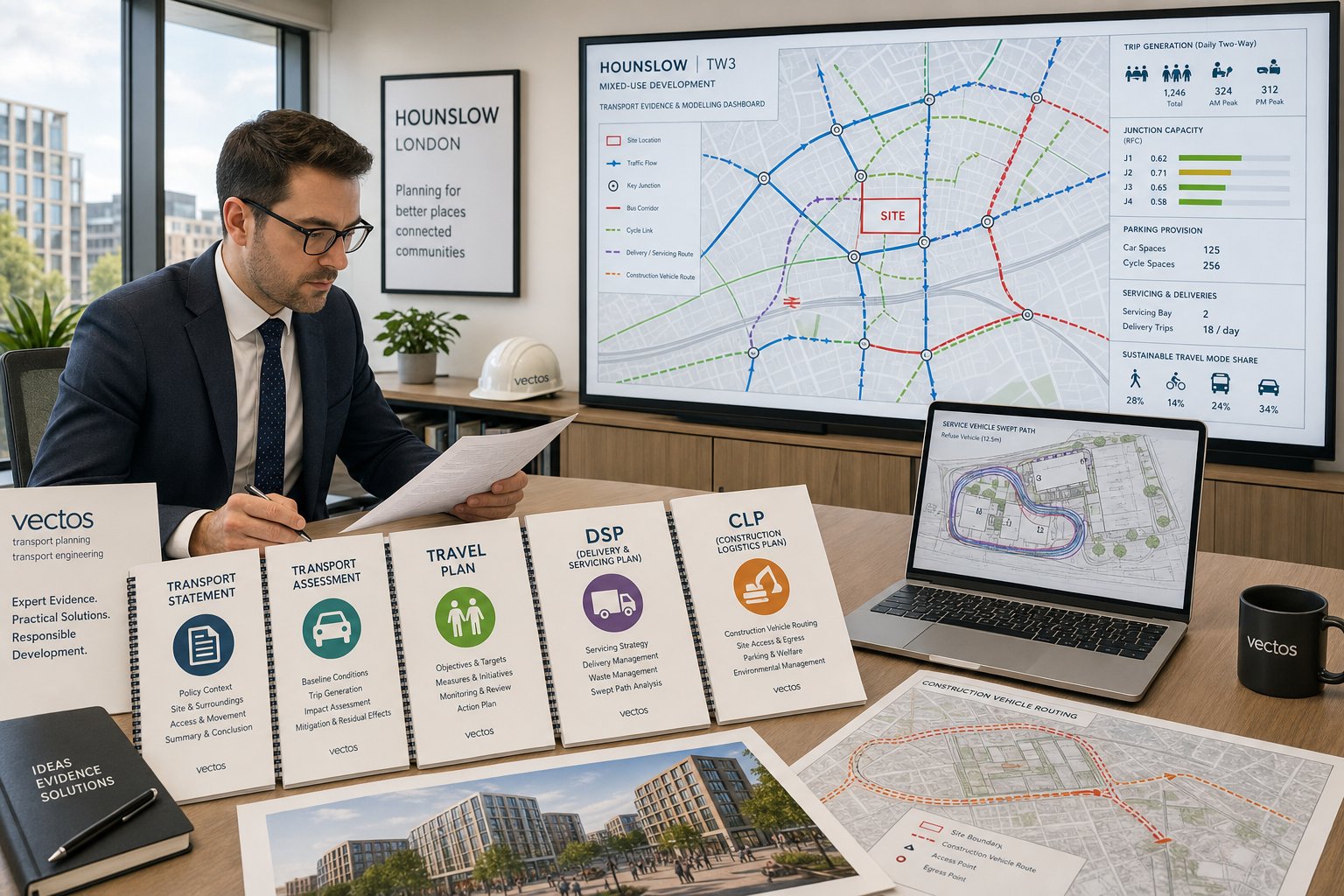
These three documents are often mentioned together, but they serve different functions.
A Transport Statement is usually the proportionate option for smaller or less intensive schemes. Its job is to explain existing conditions, describe the proposed development, estimate likely movement impact at an appropriate level, and demonstrate that access, parking, servicing and safety issues are acceptable. It is concise by design. The point is not to over-model a straightforward scheme: it is to answer the right questions clearly.
A Transport Assessment is more detailed and is typically required where impacts could be greater or where the site context is more sensitive. It may include surveyed baseline conditions, trip generation using TRICS, distribution and assignment, junction capacity modelling, parking analysis, active travel review, and mitigation proposals. Depending on the site, tools such as PICADY, ARCADY, LINSIG, Synchro or VISSIM may be appropriate. This sits within the wider discipline of Traffic Engineering and transportation planning, but the planning focus remains key: the evidence must be useful for decision-making.
A Travel Plan is different again. It is a strategy document aimed at encouraging sustainable travel choices. It sets out measures, targets, monitoring and responsibilities for walking, cycling, public transport, car clubs and, where relevant, low-car or car-free operation. In Hounslow, Travel Plans can carry real weight, especially where mode share is part of the planning balance.
The right document depends on scale, use, location and risk. Getting that call right early saves both time and argument.
When A Delivery And Servicing Plan May Be Needed
A Delivery and Servicing Plan, or DSP, becomes important where routine operational activity could affect the highway or neighbouring uses. That is common with commercial, mixed-use and denser residential schemes where there are regular parcel deliveries, refuse collections, catering supplies, maintenance visits or servicing by vans and rigid vehicles.
In Hounslow, the issue is rarely just whether deliveries happen. Of course they do. The question is whether they can happen safely and practically. Can vehicles enter and leave in forward gear? Is there enough space on site? Will loading happen from the carriageway? Are delivery times likely to clash with school peak periods, bus activity or local congestion? A good DSP deals with routing, management, booking systems where relevant, and operator guidance.
For applicants, the benefit is simple: a DSP shows that the day-to-day life of the development has been thought through. That can reduce officer concern where servicing looks tight on plan.
When A Construction Logistics Plan Becomes Relevant
A Construction Logistics Plan, or CLP, is usually needed when the build phase itself could create material transport impacts. Demolition-heavy schemes, constrained urban sites, developments on busy roads, and projects near schools, shops or cycle routes often fall into this category.
The CLP focuses on temporary but potentially disruptive effects: HGV routing, delivery scheduling, contractor parking, holding areas, vehicle types, site marshals, pedestrian protection and coordination with local restrictions. In some Hounslow locations, this can be as important as the permanent transport case because poorly controlled construction traffic can generate immediate objections.
A strong CLP demonstrates that the applicant understands not just how the finished building will function, but how it can be built responsibly in a live urban environment.
Key Traffic Engineering Issues In Hounslow Developments
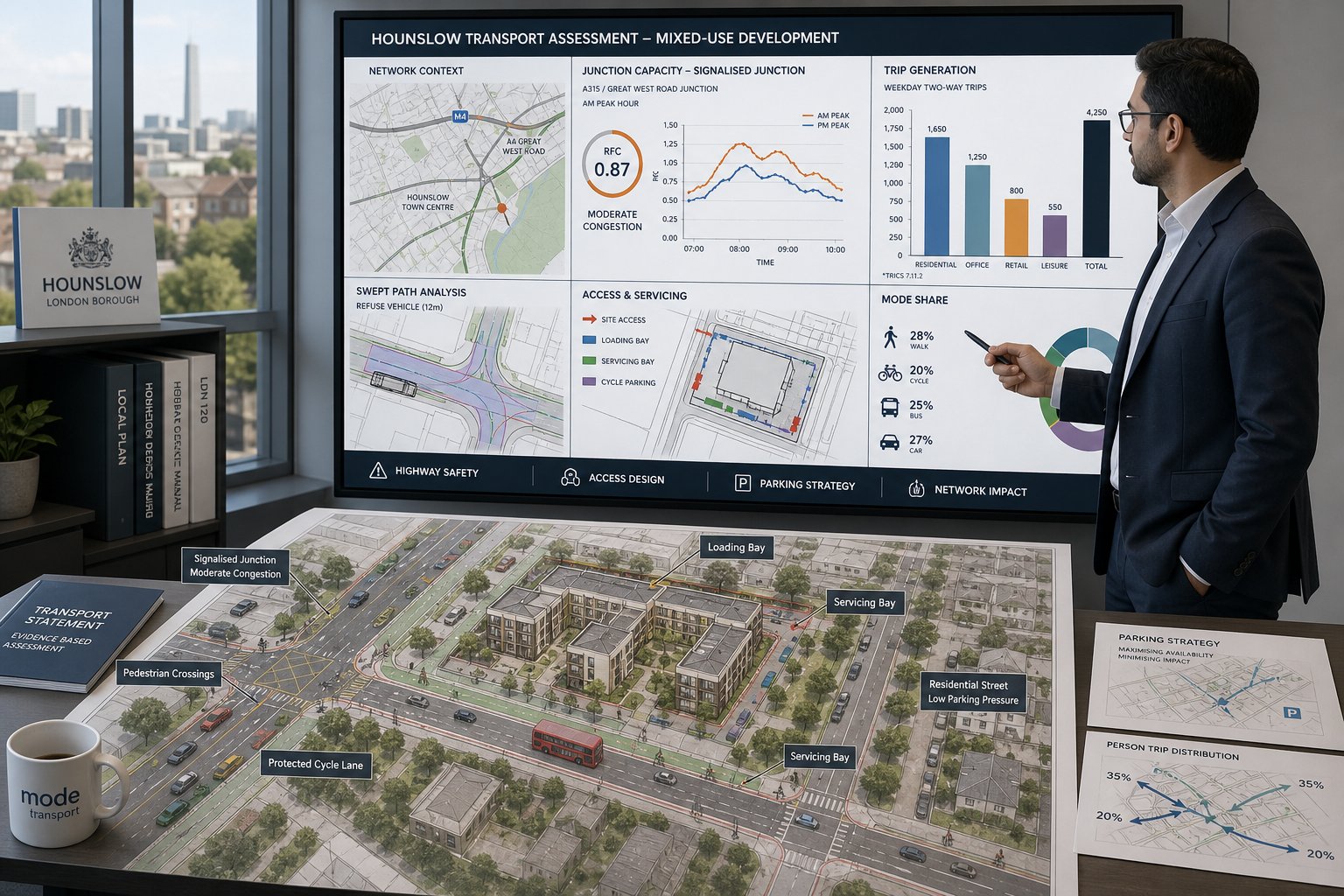
The recurring transport issues in Hounslow are fairly consistent, even though each site has its own nuances. Congestion on strategic corridors and at signalised junctions is one. Parking stress on surrounding residential streets is another. Then there are bus operations, cycle movements, school-related safety concerns, and the simple but crucial question of whether servicing can occur without conflict.
What makes these issues important in planning is cumulative pressure. A single proposal may not seem dramatic in isolation, but if it adds turning movements to an already sensitive junction, removes kerbside capacity, or introduces servicing on a constrained frontage, the local impact can become much more significant than the floor area suggests.
That is why we try to separate perceived risk from actual risk. Some concerns can be addressed by geometry changes, operational controls or clearer evidence. Others require fuller technical analysis and, sometimes, genuine mitigation. The value of experienced Highway And Traffic input is that it helps project teams understand which category they are in before the council tells them.
Below are the two broad groups of issues that most often shape officer comments and the final quality of a planning submission.
Access, Parking, Servicing, And Highway Safety Considerations
Access is usually the first practical test of a scheme. We assess whether the proposed entry and exit arrangement has suitable visibility, width, alignment and relationship to nearby junctions, crossings, bus stops and frontage activity. In urban boroughs like Hounslow, small geometric details can make a big difference.
Parking is rarely just a numerical exercise. We review London Plan and borough standards, likely demand, disabled provision, cycle parking quality, electric vehicle charging, and the risk of overspill into surrounding streets. Where a development is low-car or car-free, the supporting case needs to be particularly clear.
Servicing matters too. Refuse vehicles, delivery vans and occasional larger vehicles must be able to operate safely. That often requires swept-path analysis, loading strategy and evidence that vehicles do not block the highway unreasonably. Schemes with tight access arrangements often benefit from early work on access design highway considerations.
Highway safety cuts across all of this. We look at pedestrian desire lines, crossing points, lighting, visibility, conflict with cyclists, and any nearby collision history that may increase officer concern.
Trip Generation, Junction Capacity, And Network Impact
Where development scale or sensitivity justifies it, we estimate how many trips a scheme is likely to generate and when those trips will occur. TRICS is commonly used for that purpose, although professional judgement remains essential, particularly in London locations with stronger sustainable mode share.
The next step is understanding where those trips go and what they do to the surrounding network. For some sites, a reasoned qualitative review is enough. For others, junction modelling is needed to test whether key nodes continue to operate acceptably with development traffic included. Depending on the junction type, that may involve PICADY, ARCADY, LINSIG, Synchro or more advanced modelling.
Importantly, we do not only focus on private car traffic. In Hounslow, public transport accessibility, bus reliability, cycle access and walkability can materially change the analysis. A scheme beside strong public transport may not produce the same highway effect as an equivalent scheme in a more car-dependent location.
Where impacts are identified, mitigation can range from layout refinements and signal optimisation to travel demand measures, improved cycle provision or servicing controls. The aim is not to bury risk under data. It is to demonstrate that the network can cope, or that practical steps have been taken where it cannot.
How Traffic Engineers Support A Smoother Planning Process
The best traffic engineering input usually happens before the application is submitted. When we are brought in early, we can test whether a proposed access is realistic, whether parking assumptions are likely to be challenged, whether a swept path works in practice, and whether the level of reporting is proportionate. That often prevents avoidable redesign later.
Pre-application support can be especially useful in Hounslow where local highways concerns may not be obvious from planning drawings alone. We help teams prepare for discussion with officers, identify if TfL engagement is likely, and frame transport responses in a way that addresses the real decision points rather than producing generic commentary. This is one reason clients often value concise, decision-focused reporting over bulky appendices.
Once an application is live, our role shifts slightly. We interpret consultation comments, respond to queries, revise technical notes where justified, and explain why a particular impact is either negligible, manageable or mitigated. Speed matters here. Planning timetables rarely pause just because a highways question appears late.
At ML Traffic, our approach is built around accurate, planning-led output delivered quickly, which reflects the same principles discussed in broader Traffic Engineering: Your guidance. In practical terms, smoother planning comes from fewer surprises, better evidence, and transport advice that genuinely supports the design team rather than sitting off to the side.
What To Prepare Before Instructing A Traffic Engineer
A little preparation at the start can save days, sometimes weeks, once technical work begins. The most helpful item is a clear red-line boundary plan together with the latest site layout drawings. If levels, access widths, tracking constraints or servicing bays are likely to matter, those drawings should be as developed as possible.
We also need a straightforward description of the proposal: land use, number of units, GIA, staff numbers, operational assumptions, proposed hours, delivery patterns and any phasing. For residential schemes, unit mix and parking approach are important. For commercial or community uses, peak activity patterns often matter more than floor area alone.
If there has been pre-application feedback, that is gold dust. The same applies to known policy concerns, site allocation material, previous refusals, committee reports on nearby schemes, or any indication that TfL may need to comment. Existing transport evidence is useful too, including traffic counts, parking beat surveys, travel survey data or collision records if already obtained.
Where the project team is still deciding what level of report may be needed, we can usually advise from a concise briefing pack. Many clients first engage us through wider Traffic Engineer In planning support comparisons across authorities, then narrow down the Hounslow-specific requirement.
In short: better inputs mean faster, clearer outputs and fewer assumptions that need revisiting later.
Choosing The Right Traffic Engineer For A Hounslow Project
Not all transport consultants approach planning work in the same way. For a Hounslow project, the right choice is usually someone who combines technical capability with local judgement and a pragmatic understanding of how planning decisions are actually made.
First, look for London experience that goes beyond theory. The consultant should be comfortable with borough standards, London Plan policy, TfL expectations and the difference between a document that is technically correct and one that is persuasive in a planning context. Familiarity with schemes similar to yours matters as well. A town centre mixed-use proposal, for example, raises very different issues from an edge-of-estate residential infill site.
Second, check technical range. If a project may require junction modelling, swept-path work, parking surveys, Travel Plans or servicing strategy, the engineer should be able to handle those in-house or coordinate them efficiently. Competence with recognised tools is part of credibility, especially if objections emerge and assumptions are tested.
Third, assess communication. A strong traffic engineer should explain risk plainly, write concise reports, and respond quickly when comments arrive. That sounds obvious, but it often determines whether the planning team experiences transport input as a help or a headache.
We would also suggest reviewing how the consultant frames its wider Traffic Engineer in Hounslow and London planning support, because it reveals whether they understand local authority thresholds, proportionality and the practical pace of live applications. Those details matter more than glossy wording.
Conclusion
For many schemes, highways issues do not kill an application because they are impossible to solve. They cause delay because they are identified too late, analysed too broadly, or presented without enough local context. In Hounslow, where strategic movement, parking pressure, servicing constraints and TfL interfaces can all affect planning judgement, that distinction matters.
Engaging the right traffic engineer early gives the wider project team something very practical: clarity. Clarity on what level of reporting is needed, where the transport risks sit, how the design may need to adapt, and how to answer officer concerns before they harden into objections.
Whether the scheme is residential, mixed-use, commercial or community-based, well-judged traffic engineering can reduce friction in the planning process and strengthen the application overall. And in 2026, faster support only really helps if it is also accurate, locally informed and built around the realities of Hounslow’s streets.
Frequently Asked Questions About Traffic Engineering in Hounslow
What does a traffic engineer in Hounslow do for planning applications?
A traffic engineer in Hounslow assesses site access, parking, servicing, and highway safety, evaluates trip generation and junction performance using modelling tools, and prepares transport reports to support planning submissions, ensuring schemes align with local policies and highway requirements.
Why is local knowledge important for traffic engineering in Hounslow?
Hounslow’s mix of strategic roads, Heathrow-related traffic, controlled parking zones, and diverse neighbourhoods means local transport policies and conditions vary widely. A traffic engineer with local knowledge can provide accurate advice tailored to borough standards and TfL requirements for effective planning support.
When is a Transport Statement, Transport Assessment, or Travel Plan needed in Hounslow?
Smaller or less intensive developments typically require a Transport Statement to demonstrate acceptable impact, larger or sensitive sites need a detailed Transport Assessment analysing traffic and junction capacity, while Travel Plans promote sustainable travel for schemes seeking to reduce car dependency.
What developments in Hounslow usually need traffic engineering input?
Residential projects like flats, HMOs, or infill schemes; mixed-use and commercial developments such as retail, schools, or healthcare; and any proposal affecting busy junctions, TfL roads, or bus routes generally require traffic engineering support to address access, parking, and highway impact.
How can a traffic engineer help ensure a smoother planning process in Hounslow?
Early involvement enables traffic engineers to identify risks, shape design layouts, and produce clear, proportionate reports addressing local highways concerns. They also liaise with Hounslow council and TfL during consultations, reducing objections and delays to help planning applications proceed more smoothly.
What should be prepared before instructing a traffic engineer in Hounslow?
Applicants should provide detailed site boundary plans, up-to-date layout drawings, description of the proposal including land use and unit counts, any pre-application feedback, policy notes, and available traffic surveys. Clear inputs enable faster, tailored advice and accurate transport reports.