
An airport proposal to increase capacity by 10mppa or more, or one deemed nationally significant, is considered a Nationally Significant Infrastructure Project under the Planning Act 2008. This threshold is a key starting point for a transport assessment for airport expansion, because the planning route shapes how transport effects are examined.
Capacity growth is only one part of the planning case. A clear transport assessment for airport expansion also explains how passengers, staff and freight will travel to and from the airport, and how those journeys may affect the surrounding transport network.
This article explains how national planning policy applies, what transport evidence an expansion assessment covers, and how demand forecasts, access arrangements and travel planning fit together. It also shows how a well-structured assessment supports the planning process by making the transport implications of proposed airport growth clear to decision-makers.
Key Takeaways
- Understand how national planning policy shapes airport expansion decisions, including the Secretary of State’s duty under Section 104 of the Planning Act 2008, as set out by The National Archives (legislation.gov.uk).
- Assess how other developments and existing transport pressures can combine with airport growth to affect the wider network.
- Build passenger, staff and freight forecasts around distinct travel patterns, access choices and development phases.
- Identify the surveys and transport data that can help form a clear, evidence-led assessment.
- See how Transport Assessments, Transport Statements, Parking Surveys and Swept Path Analysis can support the planning evidence for an airport proposal.
Airports National Policy Statement and planning policy
Airport expansion planning depends on the proposal’s scale, consent route and effects on surrounding transport networks. In England, capacity thresholds help distinguish Nationally Significant Infrastructure Projects from other airport proposals.
Planning Policy and Assessment Requirements
A National Policy Statement (NPS) sets national policy for decisions on designated infrastructure proposals. The UK Government designates NPSs under section 5 of the Planning Act 2008, while section 7 consultation and publicity and section 9 parliamentary scrutiny apply before a draft can be designated.
Airport applications to increase capacity by 10mppa or more, or deemed nationally significant, are considered Nationally Significant Infrastructure Projects under the Planning Act 2008. A transport assessment explains how passenger, staff and freight journeys could affect access routes and the wider network. A transport statement may suit a proposal with more limited transport implications, depending on its scale and planning context.
Under Section 104 of the Planning Act 2008, the UK Secretary of State must decide a Development Consent Order application in line with the relevant National Policy Statement, subject to specified exceptions, according to The National Archives (legislation.gov.uk). This makes the NPS a central decision-making reference for proposals using that consent route.
Local Requirements for Major Airports
Local requirements are the transport evidence and mitigation details needed to assess an airport proposal in its planning and network context. Major airports must consider connections to local access roads, public transport and nearby development. The assessment should clearly explain its study area, forecast assumptions and likely effects, showing how airport growth relates to transport conditions around the site.
For major UK airports, requirements depend on the consent route, proposal scale and potential effects on local transport. The assessment should address relevant planning policies and show how its evidence supports the application. Project teams can define the scope by identifying affected junctions, access modes, travel periods and other developments that could influence demand.
Develop mitigation measures and travel plans in response to forecast effects, then assess how well each addresses the identified pressures. Explain each measure’s purpose, delivery approach and relationship to the forecast. Cost estimates can be organised by measure, implementation responsibilities and timing. This creates a clear link between the impact, the proposed response and its estimated cost, rather than presenting mitigation as a disconnected list.
Climate policy also informs airport planning. The UK has a statutory net zero greenhouse gas emissions target for 2050, according to The National Archives (legislation.gov.uk). An assessment should therefore explain how its transport assumptions and proposed measures relate to the proposal’s wider policy context. Clear evidence helps decision-makers understand both local network effects and the national planning framework.
Cumulative impacts of airport expansion proposals
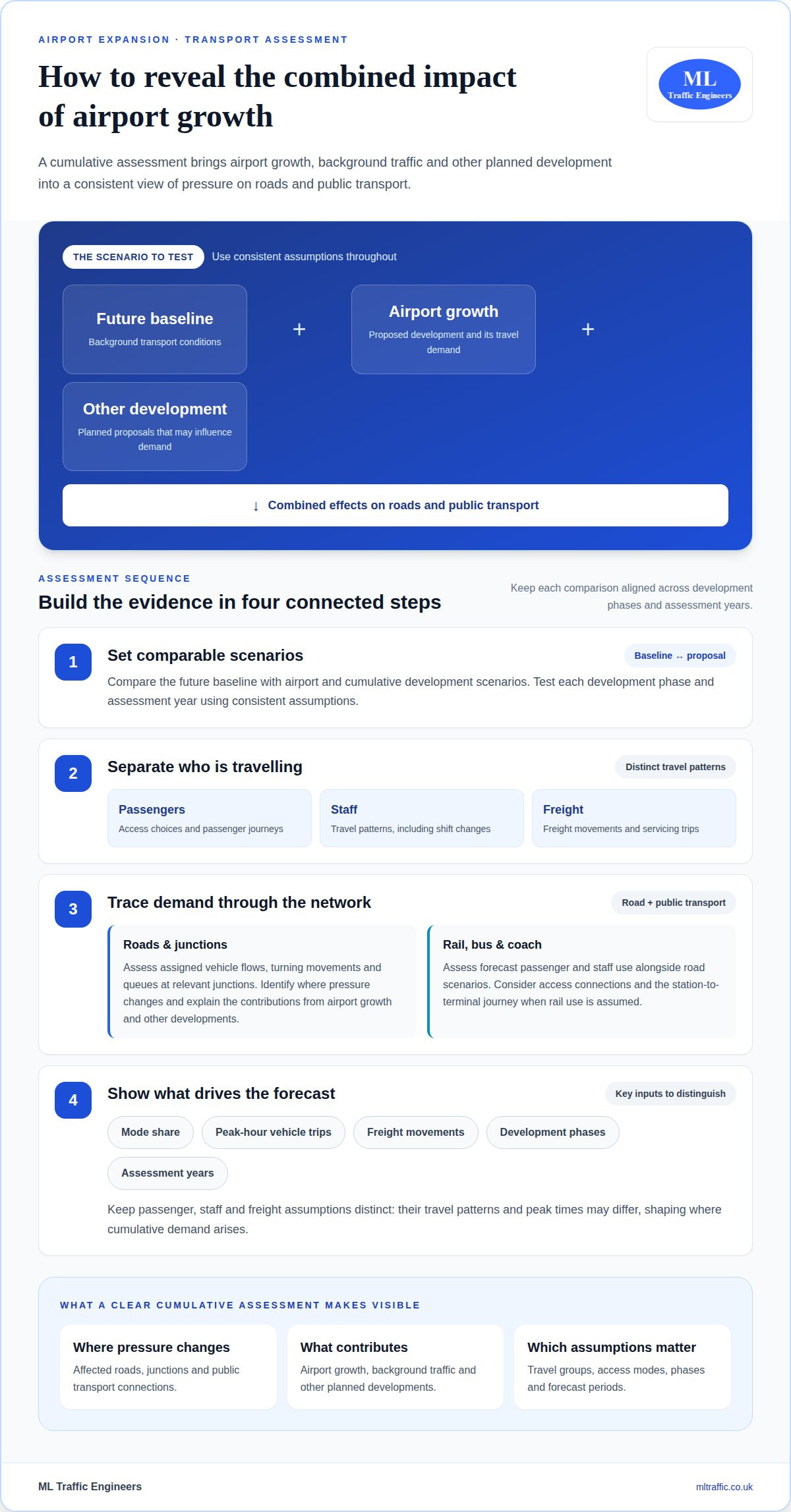
Cumulative assessment examines how airport growth combines with background traffic and other planned development. Compare consistent future scenarios to show the combined effects on roads and public transport.
Forecasting Airport Travel Demand
Travel-demand forecasting estimates journeys by passengers, staff and freight under defined airport growth scenarios. This matters because each group uses different access modes and may affect the network at different times.
Compare a future baseline with the proposed development, then test each development phase and assessment year. Separate passenger and staff travel, mode share, peak-hour vehicle trips and freight movements. For example, passenger journeys to a terminal may peak at different times from staff shift changes or servicing trips. Keeping these groups distinct helps reveal where cumulative demand could arise and which assumptions shape the forecast.
Road Traffic and Junction Impacts
Road impact assessment compares forecast traffic flows with the capacity and operation of affected roads and junctions. This matters because airport-related trips can combine with background traffic and journeys from other proposals.
Compare the future baseline with airport and cumulative development scenarios, using consistent assumptions throughout. Assess how assigned vehicle flows affect each relevant junction, including turning movements and queues. Identify where pressure changes, then explain the contributions from airport growth and other developments. This makes the combined effect visible instead of treating each proposal as an isolated addition to the network.
Public Transport and Sustainable Travel Impacts
Public transport assessment considers whether rail, bus or coach access can accommodate forecast passenger and staff journeys to the airport. This matters because mode-share assumptions influence road demand and cumulative effects on access networks.
Assess forecast public transport use alongside road scenarios, distinguishing passenger and staff journeys. Explain how access connections relate to proposed travel patterns, and test whether assumptions remain consistent across development phases. For example, a forecast relying on increased rail use should account for the station-to-terminal journey as well as the rail leg. This helps decision-makers understand how sustainable travel assumptions affect cumulative road demand.
Assessment years should reflect the proposal’s phasing and forecast years, rather than relying on a single snapshot. Compare each phase with its corresponding future baseline, then include relevant committed developments in the same scenarios. This helps separate background growth from additional airport effects.
Keep the evidence traceable: state the scenario, assessment year, mode-share assumption and resulting trips before explaining network effects. For roads, show how assigned flows affect junctions; for public transport, explain how mode shares shape access demand. A phased comparison shows how cumulative impacts may change as the airport proposal develops.
When is a transport assessment or transport statement required for airport development in England?
For airport proposals in England, the appropriate transport evidence depends on development scale, access changes and likely network effects. Applications to increase capacity by 10mppa or more, or deemed nationally significant, are considered Nationally Significant Infrastructure Projects under the Planning Act 2008. For other proposals, the transport case should still explain the effects relevant to the application.
A Transport Assessment provides fuller analysis of travel demand and transport impacts. A Transport Statement presents proportionate evidence where a proposal’s transport implications are more limited. These descriptions distinguish the documents’ practical roles, but the project’s scale and effects should determine the assessment scope.
Start by describing the airport changes: capacity, facilities, access arrangements and development phases. Then identify who will travel, including passengers, employees, service vehicles and freight. For example, a terminal extension with altered pick-up arrangements raises different transport questions from a proposal that changes both airport capacity and surface access.
Next, define the transport area affected by the proposal. Map the airport’s access roads, nearby junctions, public transport connections and routes used by airport traffic. Explain why each location matters. A road used by passenger traffic may need different analysis from a junction serving staff access or freight movements.
Existing conditions provide the baseline for judging change. Use relevant traffic counts, observed queues, public transport information and airport travel patterns. State the dates and locations represented by each dataset, and explain any limitations. This helps readers distinguish observed conditions from forecasts, without treating a single count as a complete picture of airport demand.
Forecasting should show how the proposal changes journeys over time. Set out assumptions for passenger numbers, staff travel, freight activity, mode choice and peak periods. If the proposal has phases, assess each separately. Compare the proposal scenario with a future baseline to show which changes relate to airport development.
For proposals with more limited effects, a Transport Statement may focus on a specific access or operational change. A parking change, for instance, may require evidence about parking supply, vehicle movements and access arrangements. Where several transport effects interact, a fuller Transport Assessment can connect demand forecasts with road, junction and public transport analysis.
Use the planning application’s scope to keep the evidence proportionate and clear. Describe what the proposal changes, where its journeys go and which effects the assessment examines. This structure helps decision-makers understand the transport case, whether the application concerns one airport facility or a wider expansion programme.
Where the application is a Development Consent Order and no relevant National Policy Statement exists, section 105 of the Planning Act 2008 allows the UK Secretary of State to decide it. The London Luton Airport expansion assessment illustrates why mode-share assumptions should be stated transparently: it uses a 40% public transport share for passengers in the future baseline and in 2027 with development, rising to 45% in 2039 and 2043. For staff, it gives 40% in the future baseline and 2027, and 45% in 2039 and 2043; it also lists 30% in 2027 and 35% in 2039 with development. Explain differing assumptions.
How should an airport expansion transport assessment forecast passenger, staff and freight travel demand?
Forecast each travel group separately before combining their movements in network scenarios. Passengers, employees and freight operators have different trip purposes, access choices and arrival patterns. Treating them as one demand total can conceal where pressure occurs. A clear forecast records assumptions for each group, then explains how those inputs generate journeys on the surrounding network.
Staff forecasts need separate evidence because employee journeys reflect work locations and shift patterns. Identify staff access modes and travel times, then relate these assumptions to the airport’s proposed operation. A staff journey before a passenger peak may affect different network conditions. Keep staff demand separate from passenger travel to avoid applying passenger mode assumptions to employees.
Freight demand should also be modelled separately. Identify the airport-related goods movements, vehicle types, access routes and operating periods relevant to the proposal. Assign those trips to suitable routes and compare their timing with passenger and staff travel. For example, freight entering through a service access should not be treated as terminal drop-off traffic, even if both use part of the same road network.
Use a future baseline to represent conditions without the proposed development, then compare it with the development scenario. If growth is phased, forecast each phase using consistent assumptions for airport activity, mode choice and trip timing. This comparison helps distinguish existing or background travel from additional demand associated with the proposal.
Check that every forecast can be traced to its inputs. State the source of each assumption, explain how it translates into trips, and show how trips are distributed across modes, routes and relevant periods. If a mode-share assumption changes between scenarios, explain which access arrangements or travel measures support the change. This makes the forecast easier to test and review.
A transport assessment for airport expansion should present results by user group, mode, phase and travel period. This structure lets readers follow how passenger, staff and freight assumptions shape network demand. It also helps identify the most influential assumptions, where further analysis is needed and how to interpret the proposal’s transport effects.
What data and survey methods are needed for an airport transport assessment?
Reliable evidence links airport activity with journeys on surrounding networks. Match each dataset to a specific question, such as how passengers reach the terminal or where queues form. A clear survey scope identifies locations, travel periods and the transport effects under examination.
Traffic surveys can record vehicle flows, turning movements and queues at airport access points. Choose locations that connect the airport with affected roads and junctions. Record survey dates, periods, directions and vehicle categories. This detail helps compare observed conditions with forecasts and identify where additional counts may be useful.
Parking surveys show how airport spaces are used and where demand occurs. Record the location and function of each parking area, such as staff, short-stay or long-stay provision. In evaluating broader passenger choices, platforms like Compare Cheap Airport Parking illustrate how dedicated off-site and hub parking options absorb significant vehicle demand. Compare observed occupancy with proposed arrangements to assess how changes could affect vehicle arrivals, departures and parking demand.
Keep passenger and staff travel evidence separate. Passenger data can distinguish drop-off, parking, taxi, bus, coach and rail journeys. Staff data should identify travel modes and relevant work periods. Separating these groups helps prevent passenger assumptions from being applied to employees.
Public transport information adds detail about airport access. Record routes serving the airport, stops or stations used, service patterns and connections to the terminal. Compare these details with passenger and staff travel assumptions. For example, a forecast assigning more journeys to rail should explain the station-to-terminal connection.
Freight evidence should distinguish goods movements from passenger cars and staff vehicles. Record relevant vehicle types, access routes, delivery activity and assessment periods. This makes freight’s contribution visible when trips are assigned to the road network and helps distinguish servicing movements from terminal drop-offs.
Bring the evidence together in a data schedule. For each survey, state its location, collection period, purpose and role in the assessment. Compare observed flows with airport activity and forecast assumptions, explaining any adjustments. This audit trail shows how survey results inform the transport analysis.
Use traffic and parking surveys alongside travel-mode evidence to test how a proposal may affect different users. Keep assumptions consistent across baseline and development scenarios, and show how each dataset informs the assessment. Organise transport evidence for a planning application by linking survey inputs clearly to findings.
ML Traffic Engineers UK: Transport Statements
ML Traffic Engineers UK prepares Transport Statements and Transport Assessments for airport development proposals. Use these services when you need transport evidence explaining proposed changes, travel demand and effects on access networks.
Where an application needs a focused account of transport implications, a Transport Statement can present the relevant evidence. For proposals requiring broader analysis, a Transport Assessment can examine travel demand and network effects. Parking Surveys can provide evidence about parking use, while Swept Path Analysis assesses vehicle movement layouts.
Share the proposal’s scope and available transport information to define the relevant assessment work. The appropriate document depends on the development and the transport questions it raises.
Contact ML Traffic Engineers UK to discuss your airport planning evidence, or visit mltraffic.co.uk.
Set the next stage of your airport proposal in motion
Before advancing an airport scheme, make the transport evidence a practical decision tool. A transport assessment for airport expansion can clarify the information needed to support the proposal and the transport issues to address as plans develop.
ML Traffic Engineers UK supports planning evidence through Transport Statements, Parking Surveys and Swept Path Analysis. These services address defined project needs, from documenting transport considerations to examining parking and vehicle movements. Set out your proposal’s scope and the questions your planning evidence needs to answer, then contact ML Traffic Engineers UK to discuss the relevant support.
Taking that step can help bring greater structure to the transport work ahead. Discuss your airport development requirements with ML Traffic Engineers UK and move forward with a clearer basis for planning.
Frequently Asked Questions
What is a transport assessment for an airport expansion in the UK?
A transport assessment for airport expansion explains how a proposed airport change could affect journeys and transport networks. It translates development details into likely movements and identifies where those movements may have an effect. For example, an assessment can trace passenger access from the terminal forecourt to nearby public roads while examining staff access and servicing separately. This connects the planning case to specific locations and transport issues.
What planning policy and guidance applies to airport transport assessments in the UK?
The applicable planning framework depends on the proposal’s scale and consent route. Airport capacity increases of 10mppa or more, or proposals deemed nationally significant, are considered Nationally Significant Infrastructure Projects under the Planning Act 2008. National Policy Statements are designated under section 5, with consultation and parliamentary scrutiny requirements under sections 7 and 9. Under Section 104, the Secretary of State must decide a Development Consent Order application in line with the relevant statement, subject to exceptions, according to The National Archives (legislation.gov.uk).
What are the main transport risks and cumulative impacts of airport expansion?
Key risks include added pressure on airport access roads, junctions, parking and public transport connections. Cumulative impacts arise when airport-generated journeys coincide with background traffic or journeys from other developments. For instance, separate proposals may affect the same approach road during similar periods, even if each assessment focuses on a different site. Assess shared routes and points of interaction, then explain how combined demand could change access conditions and which measures address the identified effects.

Disclaimer
The content on mltraffic.co.uk, including all technical articles, guides, and resources, is provided for general informational and educational purposes only. It is not intended to constitute professional advice in traffic engineering, transportation planning, development approvals, or any other technical or legal field.
While ML Traffic Engineers makes every reasonable effort to ensure the accuracy, completeness, and timeliness of the information published, we do not provide any warranties or representations (express or implied) regarding its reliability, suitability, or availability for any particular purpose. Any reliance you place on the content is strictly at your own risk.
In no event shall ML Traffic Engineers, its directors, employees, authors, or affiliates be liable for any direct, indirect, incidental, special, consequential, or punitive damages (including, without limitation, loss of profits, data, or business opportunities) arising out of or in connection with the use of, or inability to use, any information provided on this website.
The articles and guides on this site are not a substitute for engaging a qualified, professional traffic engineer to assess your specific project requirements. For tailored advice, compliance assessments, or traffic engineering services, please contact a competent professional.
This disclaimer may be updated from time to time without notice. By accessing or using this website, you agree to be bound by the most current version of this disclaimer.