Planning applications in Coventry rarely succeed on site layout alone. If a proposal changes how people, deliveries, service vehicles or construction traffic move to and from a site, transport evidence quickly becomes central to the conversation. And in 2026, that conversation is shaped not just by traffic impact, but by how well a scheme supports the city’s wider push for safer streets, cleaner air, better public transport, and stronger walking and cycling links.
That is why transport planning Coventry work needs to be practical, proportionate and policy-aware from the start. We regularly see good schemes slowed down because transport scope was agreed too late, survey data was incomplete, or a submission focused too heavily on cars while underplaying sustainable travel. In Coventry, that imbalance can create avoidable friction.
For architects, planners, developers, lawyers and local authorities, the goal is fairly simple: submit transport information that answers the right questions first time. That means understanding when support is likely to be needed, which documents are proportionate, what Coventry City Council is likely to scrutinise, and how local strategy influences the detail.
In this guide, we set out what developers need for a smoother application, from early appraisal through to submission, with a specific focus on Coventry’s planning context and the transport issues most likely to affect decisions.
What Transport Planning Means In The Coventry Planning Context
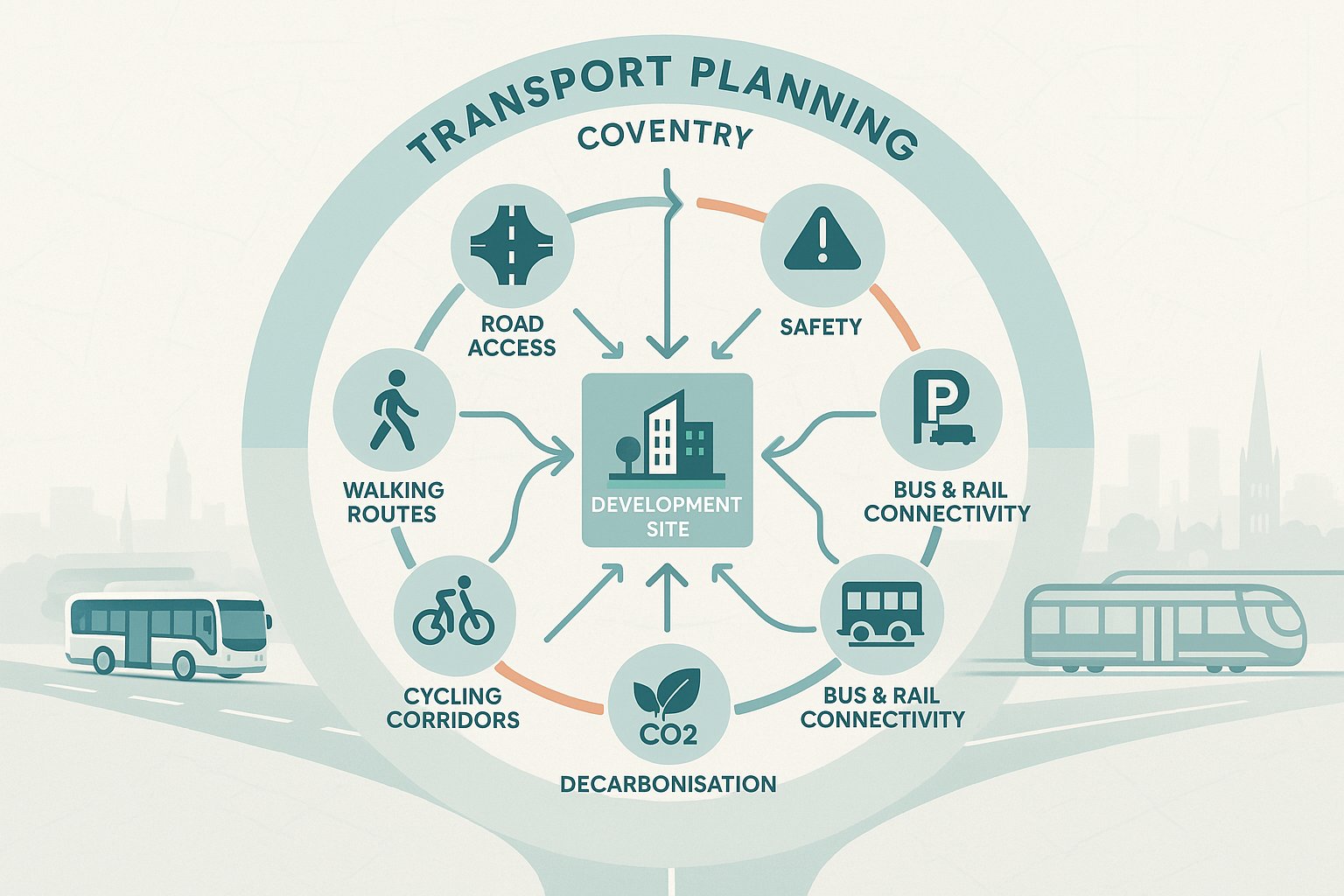
In Coventry, transport planning is not just about counting vehicle trips and checking whether a junction still operates within capacity. It sits within a broader policy direction shaped by Coventry City Council’s Transport Strategy 2022/23–2036/37, which promotes a safe, sustainable, equitable and resilient transport system. That framing matters.
For planning purposes, transport planning is the process of showing how a development will connect to the network, what demand it will create, whether that demand is acceptable, and what measures are needed to make the scheme work safely and sustainably. In practical terms, that can include access design, trip generation, parking demand, servicing arrangements, public transport accessibility, walking and cycling links, and mitigation where impacts are identified.
Coventry’s local context adds another layer. The city has a strong focus on mode shift, decarbonisation, electric buses, active travel corridors and innovation such as Coventry Very Light Rail. So a transport submission that looks technically competent but ignores these wider aims can still feel weak.
This is where proportionate, locally aware advice makes a real difference. At ML Traffic, we find the strongest submissions are those that combine sound technical assessment with a clear understanding of what the local planning and highways teams will expect. In other words, transport planning Coventry work succeeds when it is both rigorous and grounded in place.
When A Development In Coventry Is Likely To Need Transport Planning Support
Not every application needs a full Transport Assessment, but many more schemes need some level of transport input than applicants first assume. In Coventry, support is commonly required where a proposal could materially affect traffic conditions, highway safety, parking pressure, servicing activity or sustainable travel patterns.
The obvious examples are major residential, mixed-use, employment, education and logistics schemes. But smaller developments can also trigger transport concerns, especially where they involve a new or altered access, intensification of use, constrained urban sites, or locations close to busy corridors and junctions. A modest redevelopment can become transport-sensitive very quickly if parking is tight, delivery demand is awkward, or pedestrian routes are poor.
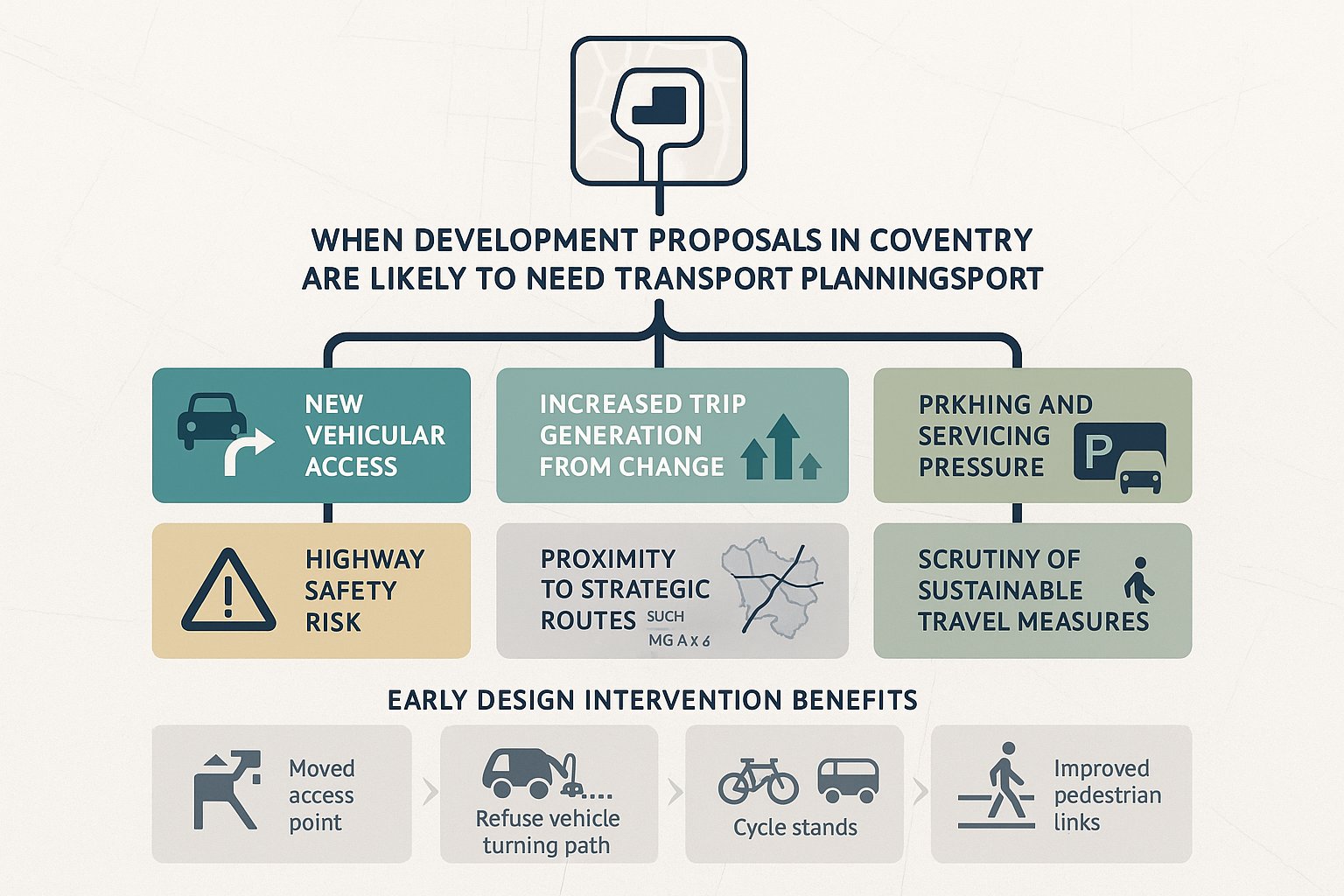
We would usually expect transport planning support to be considered where a site involves:
- new vehicular access onto the public highway:
- changes in use that increase trip generation:
- notable parking or servicing demand:
- highway safety concerns or collision history nearby:
- sites close to strategic routes such as the M6, A46 or key local corridors:
- proposals where sustainable travel credentials will be heavily scrutinised.
There is also a practical point here. Even where a formal TA or TS is not mandatory, early transport advice can prevent design choices that later become difficult to defend. That might mean repositioning an access, reworking refuse collection, improving cycle parking, or showing stronger walking links before the scheme is locked in.
So the question is often not whether transport planning Coventry input is needed, but when it is best brought in. Usually, the answer is earlier than people think.
The Main Transport Documents Required For Planning Applications
The transport documents required for a Coventry planning application will depend on the scale, type and likely impact of the proposal. The key is proportionality. Local authorities want enough evidence to understand effects and mitigation, but not unnecessary paperwork for its own sake.
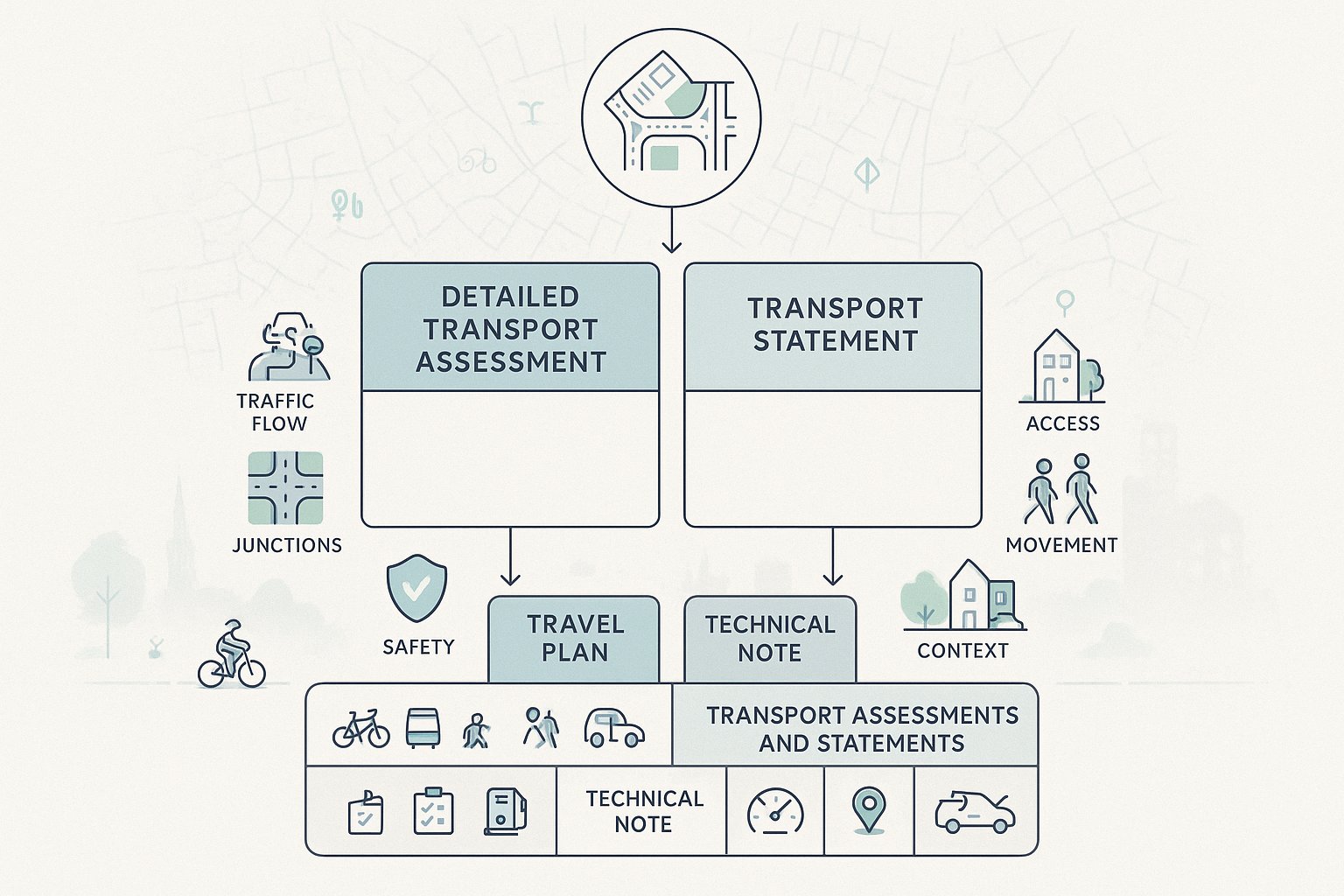
In most cases, the core documents will sit within a familiar range: a Transport Assessment or Transport Statement, often supported by a Travel Plan and, where needed, targeted technical notes or drawings. The scope should reflect both development impact and local sensitivities.
Transport Assessments Vs Transport Statements
A Transport Assessment (TA) is the more detailed route and is usually needed for larger or more impactful development. It typically covers existing conditions, accessibility, trip generation, trip distribution, junction impact, road safety considerations, mitigation, and sustainable transport opportunities. Where required, it may include capacity modelling, committed development review and a fuller appraisal of cumulative effects.
A Transport Statement (TS) is lighter touch. It is generally suitable for smaller schemes with more limited transport effects. That does not mean superficial. A good TS still needs to explain the site context, likely movements, access arrangements and why impacts are acceptable.
The distinction matters because over-scoping wastes time and under-scoping invites challenge. We usually advise agreeing the approach early, particularly for edge cases where the development is not obviously major but still raises local concerns.
Travel Plans, Technical Notes, And Supporting Evidence
In Coventry, a Travel Plan is often more than a box-ticking document. Because local policy emphasises walking, cycling, public transport and lower-emission travel, Travel Plans should include realistic measures that can actually influence behaviour: secure cycle parking, shower facilities where appropriate, public transport information, car club or car share measures, EV charging, and monitoring arrangements.
Technical Notes are commonly used to address specific matters without rewriting the whole transport report. That might include parking strategy, delivery and servicing, response to officer comments, a focused junction review, or clarification of survey assumptions.
Supporting evidence can also be critical: traffic counts, speed surveys, accessibility mapping, swept path analysis, visibility drawings, collision data review and design tracking. Often, these technical pieces decide whether an application feels robust or fragile.
Key Transport Issues That Commonly Affect Sites In Coventry
Coventry sites are shaped by a transport network that is changing, and that creates both opportunity and scrutiny. The city’s strategy is pushing toward cleaner, more integrated movement, while developers still need to respond to everyday realities such as congestion, constrained streets, servicing demands and established travel patterns.
Certain issues come up repeatedly. Network capacity remains important, especially around strategic links and busy urban corridors. So does the relationship between development and planned improvements, whether that is bus priority, active travel investment, or innovation projects like Coventry Very Light Rail. On top of that, air quality and decarbonisation goals increasingly influence how proposals are viewed.
A technically correct submission can still struggle if it treats the site in isolation. Coventry officers are likely to look at how a scheme fits with the surrounding network, existing pressure points and wider transport objectives. The most resilient submissions acknowledge that from the outset.
Access, Highway Safety, Parking, And Servicing Considerations
Access is usually the first test. A development must show safe and suitable access for all users, not just drivers. That means appropriate geometry, visibility, junction operation, pedestrian crossing opportunities, internal circulation, and workable emergency and refuse access.
Parking is another common flashpoint. Too little can create overspill and neighbour objection: too much can undermine sustainability arguments and site quality. The answer is rarely a crude maximum. What matters is evidence: likely demand, local context, availability of alternatives, disabled provision, cycle parking and how spaces will operate in practice.
Servicing is often underestimated. Retail, industrial, student, care and apartment schemes all generate different delivery patterns. If a rigid vehicle cannot turn, if loading blocks parking aisles, or if refuse collection relies on awkward reversing, officers will notice. Swept path analysis and clear management assumptions are often essential.
Sustainable Travel, Public Transport, Walking, And Cycling Links
This is where Coventry’s local strategy becomes particularly important. The city is investing in segregated cycle routes, bus improvements, electric fleets, pedestrian-friendly environments and rail-related enhancements. So transport submissions should not treat sustainable travel as a short appendix at the back.
We need to show how people will actually move without relying solely on the private car. Are there direct footways to key destinations? Are crossings convenient, legible and safe? Is cycle parking secure and attractive? How close are bus stops, and what is the service quality? Does the site connect well to existing or planned corridors such as the city’s expanding cycling infrastructure?
Good submissions go beyond listing nearby bus stops. They explain quality, directness and practicality. If sustainable modes are realistic and well supported by design, that strengthens both the policy case and the transport case.
How Local Policy And Highway Authority Requirements Shape Transport Submissions
Local policy sets the tone: the highway authority applies it in detail. In Coventry, that means transport submissions are influenced heavily by the city’s long-term direction of travel as well as by day-to-day development management requirements.
The Transport Strategy 2022/23–2036/37 is clear about priorities: safer movement, reduced inequality, stronger public transport, improved walking and cycling, decarbonisation, and resilience. That policy backdrop affects what officers expect to see in a TA, TS or Travel Plan. It is no longer enough to demonstrate that a scheme is merely tolerable in traffic terms. Increasingly, applicants are expected to show that development supports broader sustainable transport objectives.
In practice, Coventry City Council as local highway authority is likely to shape submissions through comments on scope, study area, design standards, collision review, accessibility, parking, servicing and Travel Plan measures. The authority may also expect applicants to consider committed schemes and local interventions that could affect future conditions or design integration.
This is why generic reporting can fall flat. A transport report reused from another authority area, with only names changed, tends to be obvious. Coventry-specific policy references, local network understanding and tailored mitigation carry far more weight.
From our perspective, the strongest submissions speak two languages at once: technical evidence for highways officers and clear policy alignment for planning officers. When those line up, the application process usually becomes more straightforward.
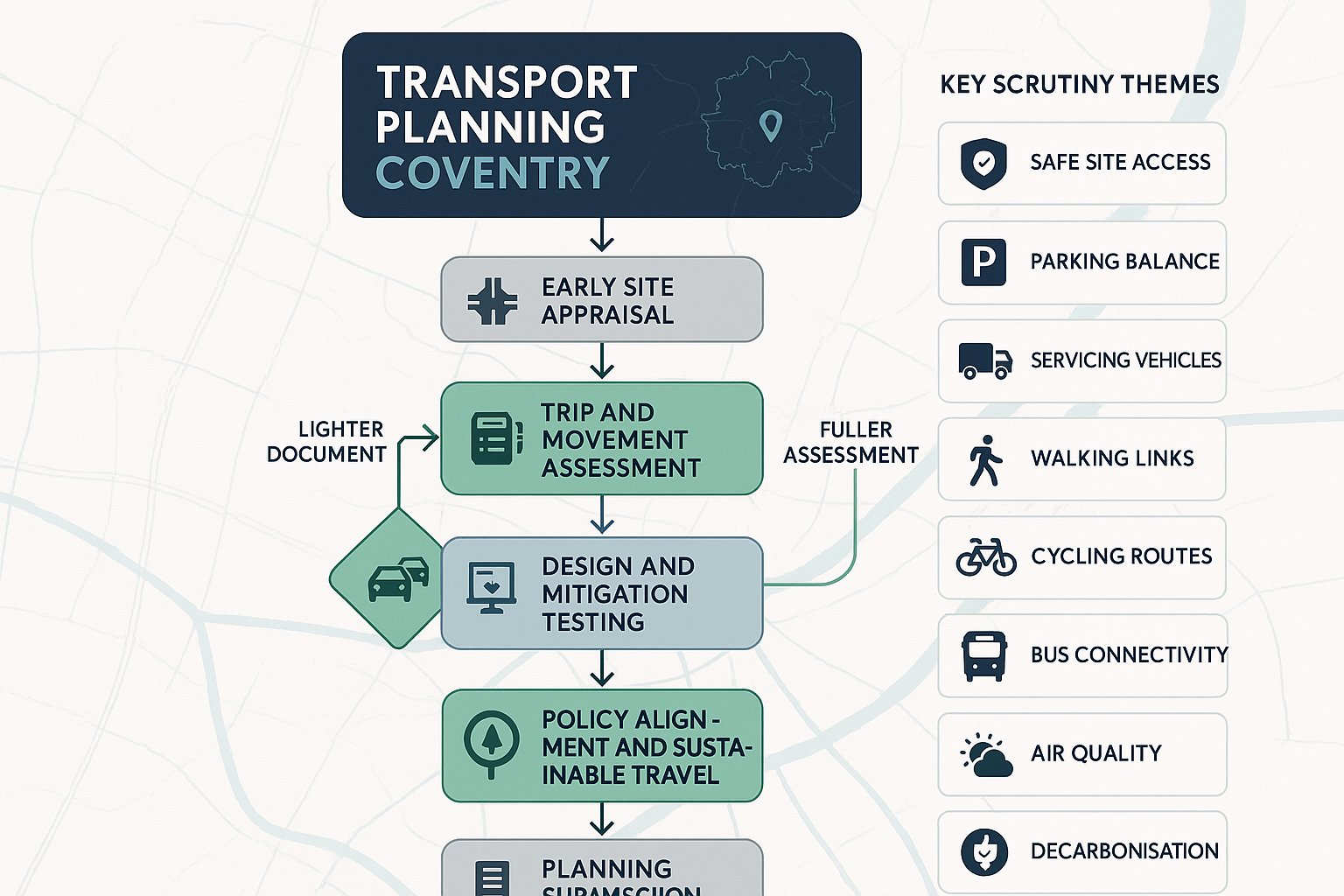
The Typical Transport Planning Process From Early Appraisal To Submission
A smoother planning application usually begins with a disciplined process rather than heroic late-stage fixes. In Coventry, the typical transport planning route follows a fairly recognisable sequence, although the scale of evidence varies by site.
First comes early appraisal. We review the proposal, local highway context, planning history, access constraints and likely documentation needs. At this stage, it is often worth discussing scope with the highway authority, particularly for larger or more sensitive schemes.
Second is baseline data collection. That can include traffic surveys, parking beat surveys, speed data, collision history, site accessibility, nearby public transport, walking and cycling links, and review of committed schemes. Out-of-date or poorly timed survey work is a common weakness, so this stage matters more than people think.
Third is trip generation and distribution. We estimate likely movements and consider how travel patterns may differ given local demographics, site location and policy-driven expectations around sustainable mode share.
Fourth is impact assessment. This may involve junction modelling, link review, safety appraisal, parking demand analysis, servicing checks and sustainable transport assessment.
Fifth comes design and mitigation. Access geometry, internal layout, cycle parking, EV provision, crossing improvements, Travel Plan measures or junction works may all evolve here.
Finally, we prepare the TA, TS, Travel Plan and supporting notes, then manage post-submission dialogue with planning and highways officers. Good transport planning Coventry work is iterative: the report should support the design, not simply describe it after the fact.
Common Reasons Transport Planning Information Is Delayed Or Challenged
Most transport objections are not caused by one dramatic flaw. More often, they arise from a chain of smaller issues that collectively reduce confidence in the submission.
One of the biggest is poor scoping. If applicants do not agree early whether a TA or TS is appropriate, what area should be assessed, or what surveys are needed, the authority may later ask for more information. That creates delay almost by default.
Another frequent problem is weak sustainable transport analysis. In Coventry, reports that focus narrowly on vehicle access and parking while giving only token attention to walking, cycling and public transport can feel out of step with policy. Officers are entitled to ask tougher questions in that scenario.
Data quality is another culprit. Surveys may be out of date, collected in abnormal conditions, or simply too limited to support the conclusions drawn. And if trip rates or distribution assumptions are not transparent, reviewers will often challenge them.
Design issues also trigger delays: substandard visibility, awkward refuse collection, inaccessible cycle parking, inadequate disabled provision, or servicing layouts that look fine on plan but fail under swept path review.
Then there is local integration. Coventry has committed and emerging transport interventions, from cycling infrastructure to wider innovation-led schemes. If a submission ignores how the development relates to those changes, it can appear incomplete.
A lot of this is preventable. The common theme is not lack of effort, but lack of coordination between planning, design and transport inputs early enough in the process.
How To Prepare A Stronger Transport Submission For A Coventry Development Site
A stronger submission usually starts with a simple principle: make it easier for officers to say yes. That does not mean overloading the application with technical material. It means providing the right evidence, in the right level of detail, clearly tied to Coventry’s policy and network context.
Start early. Before site layouts harden, review whether the proposal is likely to need a TA, TS, Travel Plan or supporting notes. Engage with Coventry City Council’s highways team where appropriate, especially on scope, study area and survey expectations. Early alignment saves weeks later.
Be explicit about policy. If Coventry’s strategy prioritises safe, sustainable and low-emission movement, the submission should visibly support that. Reference walking and cycling links, bus accessibility, EV infrastructure, healthy streets principles and realistic Travel Plan measures. Don’t leave those points implied.
Use robust evidence. That means current surveys, transparent assumptions, legible plans and calculations that can be followed without guesswork. A concise report with good evidence is stronger than a long one with vague claims.
Design matters just as much as narrative. Make sure access works for all users, servicing is practical, parking is balanced, cycle facilities are genuinely usable, and internal layouts do not create conflict points. If something is tight, test it properly and explain it honestly.
Finally, build in adaptability. Travel behaviour, fleet technology and local infrastructure will continue to change. Submissions that show flexibility, monitoring and future-readiness tend to be more credible.
For many teams, that is where specialist support helps most. With over 30 years of experience, ML Traffic focuses on concise, accurate transport engineering reports tailored to local authority thresholds and planning contexts, which is exactly what a Coventry application often needs.
Conclusion
Coventry is asking more of transport submissions than a basic traffic impact check, and rightly so. The city’s planning context now expects development to work safely on the highway, respond credibly to parking and servicing realities, and support a wider shift toward public transport, walking, cycling and lower-emission travel.
That means successful transport planning Coventry work is usually proportionate, evidence-led and locally grounded. We need to understand when formal support is required, choose the right reporting pathway, address site-specific risks early, and align the submission with Coventry City Council’s strategic direction rather than treating policy as an afterthought.
For developers, planners, architects and consultants, the practical takeaway is straightforward: start early, scope properly, test the design honestly, and make sustainable travel part of the scheme rather than a last-minute add-on. Done well, transport information does more than satisfy a validation requirement. It helps unlock a smoother planning application and a better development outcome.
Transport Planning Coventry FAQs
What is transport planning in the context of Coventry’s planning system?
Transport planning in Coventry involves demonstrating how a development connects to the transport network, assessing demand impacts, and proposing measures to ensure safe, sustainable, and equitable movement aligned with Coventry City Council’s Transport Strategy 2022/23–2036/37.
When is transport planning support needed for a development in Coventry?
Support is typically required for developments that significantly affect traffic, highway safety, parking, servicing, or sustainable travel, such as major residential, employment schemes, or sites with new or altered highway access close to strategic routes.
What are the differences between a Transport Assessment and a Transport Statement in Coventry?
A Transport Assessment (TA) is a detailed report for larger developments covering trip generation, junction impacts, safety, and mitigation, whereas a Transport Statement (TS) is a proportionate, lighter report suited to smaller schemes with limited transport effects.
How should sustainable travel be addressed in Coventry transport submissions?
Transport submissions must prioritise walking, cycling, and public transport by demonstrating high-quality, safe connections to existing and planned infrastructure, secure cycle parking, EV charging, and realistic Travel Plan measures promoting mode shift aligned with Coventry’s strategy.
What common issues cause delays or challenges in transport planning submissions in Coventry?
Delays often result from poor early scoping, ignoring sustainable transport priorities, outdated or insufficient survey data, inadequate access or parking design, and failure to consider local committed schemes like cycleways or Coventry Very Light Rail.
How can developers prepare stronger transport submissions for Coventry planning applications?
Developers should engage Coventry City Council’s highways team early to agree scope, reference local transport policies explicitly, provide robust evidence and surveys, design for all users’ safety and sustainability, and include effective, monitored Travel Plans supporting mode shift.