
Anyone who has stood outside a nursery at 8:15am knows the pattern: quick arrivals, hurried goodbyes, prams, toddlers, idling cars, a delivery van appearing at exactly the wrong moment, and neighbours already watching from behind curtains. In planning terms, that short window can make or break an application.
A Day Nursery Transport Assessment is the document that turns that real-world activity into evidence. It explains how many trips a nursery is likely to generate, when those trips happen, how parents and staff will arrive, whether the access works safely, and what mitigation is needed so the site can operate without unacceptable pressure on the surrounding highway network. For architects, planning consultants, developers, lawyers and local authorities, it is rarely just a box-ticking exercise. It often becomes one of the most scrutinised technical submissions in the planning pack.
In 2026, planning officers and highway authorities are looking for more than a generic transport note with a few peak-hour numbers. They expect nursery-specific assumptions, a realistic view of parent parking behaviour, proper safeguarding thought, and clear links between the report, the site layout and any travel plan measures. In this guide, we set out what a strong nursery assessment actually includes, where reports commonly fall down, and what applicants should prepare before commissioning one.
Key Takeaways
- A Day Nursery Transport Assessment is essential to demonstrate the likely traffic, parking, and safety impacts of a nursery and how these can be effectively mitigated.
- Nursery transport assessments must reflect real-world behaviours, including peak drop-off and pick-up times, parent parking habits, and safeguarding requirements.
- Local planning thresholds vary, so assessments should be site-specific and aligned with local authority requirements to avoid objections or delays.
- Robust reports combine detailed baseline data, trip generation forecasts, access and safety reviews, and sustainable travel measures tailored to nursery operations.
- Effective transport assessments integrate with site design and travel plans to manage parking turnover, staff shifts, servicing, and pedestrian safety during nursery peak periods.
- Early collaboration between applicants and transport experts leads to more credible assessments that reduce neighbour concerns and support smoother planning approvals.
What A Day Nursery Transport Assessment Is And When It Is Needed
A Day Nursery Transport Assessment is a formal transport planning study prepared to support a planning application. Its purpose is straightforward: to quantify likely traffic, parking and access effects from a proposed nursery and demonstrate whether those effects are acceptable, or can be made acceptable, through design and mitigation.
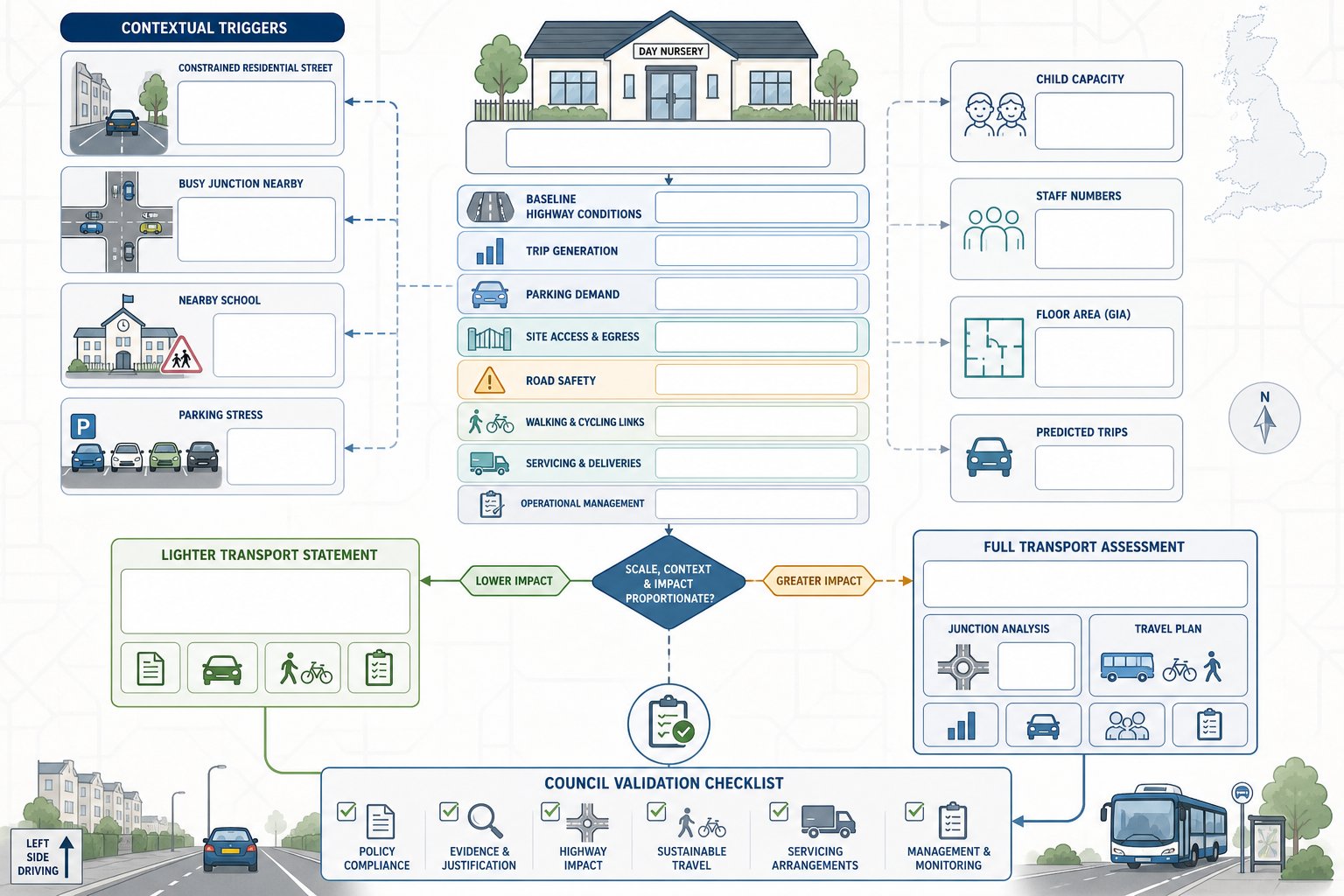
In practice, the document usually covers baseline highway conditions, expected vehicle and person trips, parking demand, access arrangements, road safety, walking and cycling connections, servicing, and operational management. Depending on the scale and sensitivity of the site, the local authority may accept a lighter Transport Statement, or it may require a fuller assessment with junction modelling and a detailed travel plan.
For nursery schemes, the trigger is not always sheer size. A relatively modest proposal can still need a transport submission if it sits on a constrained residential street, near a busy junction, beside a school, or in a location with known parking stress. That is why local validation lists matter so much. They often set thresholds by gross floor area, child places, staff numbers or predicted trip generation, but they also give highway officers room to request more evidence where site-specific concerns exist.
For applicants, the safest approach is to treat the transport scope as a planning risk item early. At ML Traffic, we typically find that nursery proposals move more smoothly when transport input starts alongside layout design rather than after objections appear.
How Local Planning Thresholds And Validation Requirements Affect Nursery Schemes
There is no single national nursery threshold that applies everywhere. One council may ask for a Transport Statement above a certain floorspace: another may refer to child capacity, staff numbers, parking stress, or proximity to sensitive roads. Validation lists can also pull in separate requirements for cycle parking, refuse vehicle tracking, travel plans, electric vehicle charging or swept-path analysis.
That local variation is why a generic template rarely survives scrutiny. A report for a town-centre nursery with strong bus access is framed differently from one on the edge of a village where nearly every family is expected to arrive by car. The same goes for schemes sharing access with another use, conversions of houses in residential streets, or applications near existing schools where cumulative peak pressure is already an issue.
A broader transport assessment for developments can help teams understand how local thresholds are usually interpreted, but nursery schemes still need their own evidence base. Planning officers want to know not just whether a threshold is crossed, but whether the submitted scope actually reflects how the nursery will operate on the ground.
Why Day Nurseries Create Distinct Transport Planning Issues
Nurseries do not behave like standard offices, retail units or even many education uses. Their transport profile is unusually compressed, highly behavioural and closely linked to safeguarding. A lot happens in a very short period of time, and the consequences of poor design show up fast.
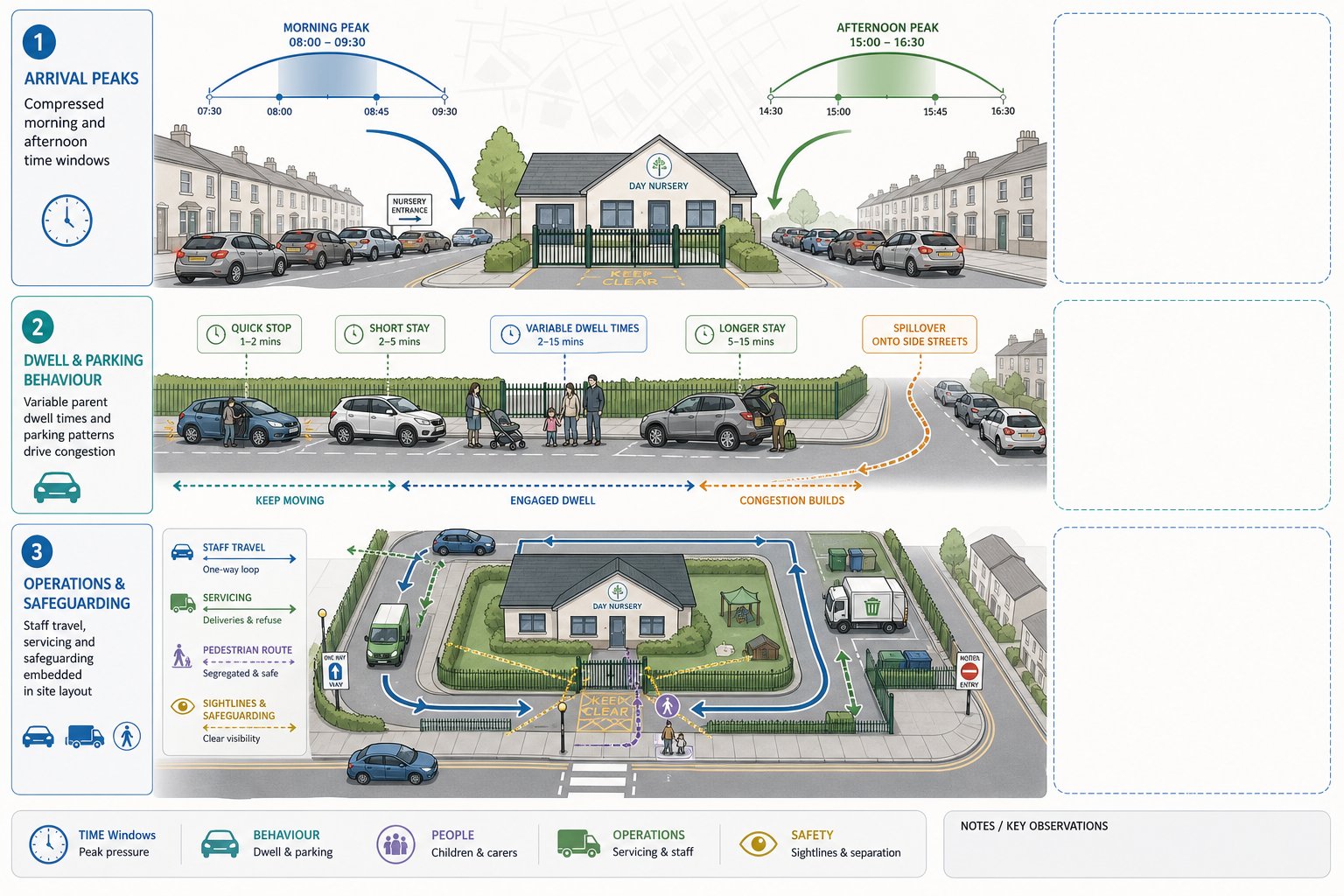
The core issue is concentration. Parent and carer arrivals tend to cluster into short morning and afternoon windows, often with limited flexibility because of work starts, sibling school runs and nursery session times. That creates pulses of demand that can overload an otherwise quiet street. A road that operates comfortably at 10am may feel chaotic at 8:00am if several vehicles stop informally close to the gate.
Then there is the human factor. Very young children move slowly, unpredictably and usually with bags, pushchairs or siblings in tow. Parents prefer to stop as close as possible to the entrance, even when marked spaces exist slightly farther away. So the practical parking demand at a nursery is often different from what a neat site plan implies.
Planning officers know this. They are not just asking whether a car park technically meets standards: they are asking whether the proposal will work during real nursery conditions. That is why a nursery-specific assessment has to move beyond textbook peak-hour ratios and test actual behaviour, including short-stay turnover, kerbside stopping and informal manoeuvring.
Drop-Off And Pick-Up Peaks, Dwell Times, And Parent Parking Behaviour
This is usually the most sensitive part of the assessment. Nursery drop-off and pick-up periods can be intense but brief, often lasting 15 to 30 minutes. During that time, demand is shaped not only by the number of children but by overlap. Some parents are in and out in under two minutes: others need longer because a child is settling in, paperwork needs signing, or a quick handover conversation happens at the door.
Those variable dwell times matter. If a report assumes every vehicle turns over instantly, the parking requirement will look artificially low. Highway officers tend to challenge that, especially where there is no dedicated waiting area, no internal circulation, or no clear management plan for busy periods. The same goes for “kiss and drop” assumptions on narrow roads where stopping blocks opposing traffic.
Parent behaviour is another recurring issue. If on-site capacity is tight, drivers often spill into nearby side streets, stop on bends, mount kerbs, double-park or wait with engines running. None of that is unusual: it is exactly what assessors should test. A robust Development Transport Assessment approach helps, but for nurseries the judgement has to be rooted in observed local conditions and realistic turnover assumptions rather than optimistic headline parking ratios.
Staff Travel, Servicing, And Safeguarding Considerations
Parents dominate discussion, but staff and servicing can quietly shape the acceptability of a nursery scheme. Staff trips are usually more regular and commuter-like, often arriving before the AM drop-off and leaving after the PM pick-up. That can be helpful because peaks do not fully overlap, but only if shift patterns are understood properly. If staff compete for the same limited spaces needed for parents, the site can fail operationally even when the total parking number appears adequate.
Servicing also needs more attention than many reports give it. Deliveries, food supplies, laundry, waste collection and occasional maintenance visits may be infrequent, yet their timing and vehicle size affect access design. A refuse truck reversing near the entrance at collection time is not simply inconvenient: it raises obvious safeguarding concerns.
Safeguarding runs through the whole assessment. Routes from parking spaces to the entrance should be short, legible and segregated from vehicle movements wherever possible. Gates, boundary treatment, crossing points, waiting space at the entrance and visibility between drivers and pedestrians all matter. On some sites, a one-way loop or controlled barrier works well: on others, the answer is tighter management rather than more asphalt. We have found that when safeguarding is embedded into the transport narrative, objections from both highway officers and neighbours tend to reduce.
Core Elements Of A Day Nursery Transport Assessment
A credible nursery transport assessment needs to be evidence-led, site-specific and operationally literate. In other words, it should show that the author understands both transport analysis and how nurseries actually function day to day.
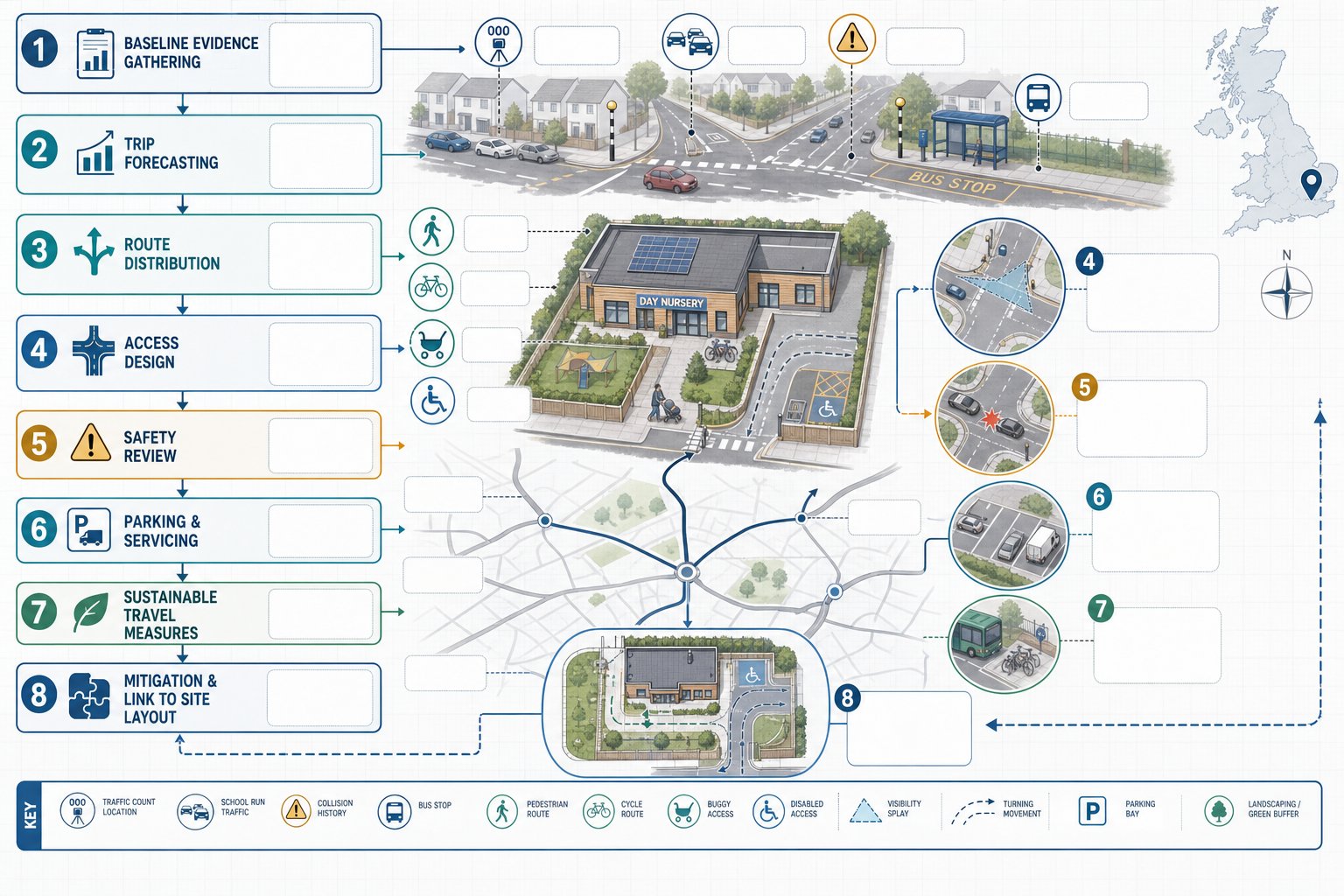
Most strong reports begin with baseline work: traffic counts on nearby roads, parking stress surveys, site observations, photographs, collision data, policy review and an audit of walking, cycling and public transport connections. That baseline gives context for everything else. Without it, assumptions on trip impact and mitigation float in mid-air.
The assessment should then move through trip generation, trip distribution, access review, safety analysis, parking and servicing, and sustainable travel measures. For larger or more sensitive sites, junction capacity modelling may be required. In many authorities, a nursery-specific travel plan is expected too, not as a bolt-on appendix but as part of the mitigation strategy.
The best reports also tie transport findings directly back to the proposed layout. If a site plan shows six parking bays, for example, the assessment should explain whether those bays are for staff, parents, disabled users or dual use, how turnover is managed, and whether manoeuvring works during peak occupancy. That integrated approach is often the difference between a report that informs planning and one that simply fills a validation slot.
Trip Generation, Distribution, And Traffic Impact Forecasting
Trip generation is where many nursery reports either win credibility or lose it. Standard database rates can be a starting point, but nurseries often need bespoke judgement because trips are linked to child places, session patterns, age groups, staffing and parental behaviour. A 30-place baby-focused nursery does not operate the same way as a 90-place mixed-age setting with staggered sessions and wraparound care.
Good forecasting usually combines several inputs: comparable site data where available, TRICS-informed benchmarking, local census or travel pattern evidence, and a clear explanation of assumptions on car share, walk-in catchment, staff mode split and turnover. It should separate parent/carer trips from staff trips and from servicing. And it should explain whether counts represent arrivals, departures or two-way vehicle movements, because confusion there causes endless disagreement.
Distribution matters too. Planning officers want to know which routes vehicles are likely to use, which junctions will experience added pressure, and whether nearby schools or commuter congestion create cumulative impacts. On more technical sites, capacity modelling may be appropriate using tools such as Junctions 11 Software to test priority junctions, mini-roundabouts or signalised nodes affected by nursery peaks.
The traffic impact section should be candid. If a junction is already close to capacity, the assessment needs to show whether the nursery adds a material change and what mitigation is possible.
Access Design, Visibility, And Highway Safety Review
Even a modest nursery can be refused on access and safety grounds if the entry arrangement is weak. That is why the access chapter cannot be a sketch-note afterthought. It should test whether vehicles can enter, wait, turn and leave safely: whether pedestrians are protected: and whether visibility meets the standard expected for the road environment.
Visibility splays are a basic but essential check. Planting, boundary walls, parked cars, bins and gate positions can all interfere with sight lines. On constrained urban sites, the issue is often less about the ideal standard on paper and more about whether observed conditions can operate safely with mitigation. That may include setback gates, relocation of street furniture, revised boundary treatment or formal waiting restrictions.
Swept-path analysis is frequently necessary, particularly where servicing vehicles, emergency access or awkward turning geometry are involved. Highway officers will also look for evidence that disabled access, buggy movement and footway continuity have been considered.
The safety review should draw on recent collision records and on-site observation. If there is already a pattern of shunts, pedestrian conflict or school-run congestion nearby, the report must address it honestly. In more complex cases, the methodology can overlap with wider environmental impact assessment work, particularly where cumulative transport effects and mitigation packages are being considered across a larger planning proposal.
Sustainable Travel And Active Travel Measures For Nursery Sites
Nursery transport planning is often assumed to be car-led, and in many locations that is partly true. But planning officers in 2026 still expect applicants to demonstrate that sustainable travel has been properly assessed and meaningfully supported. A weak paragraph saying “staff may cycle” no longer cuts it.
The starting point is realism. Very young children, weather, work trips and time pressure mean some car dependency will remain. Still, mode choice can be influenced at the margin, and those margins matter during short peak windows. A handful of walking families, staggered staff arrivals or one fewer car parked informally near the gate can materially improve operation and safety.
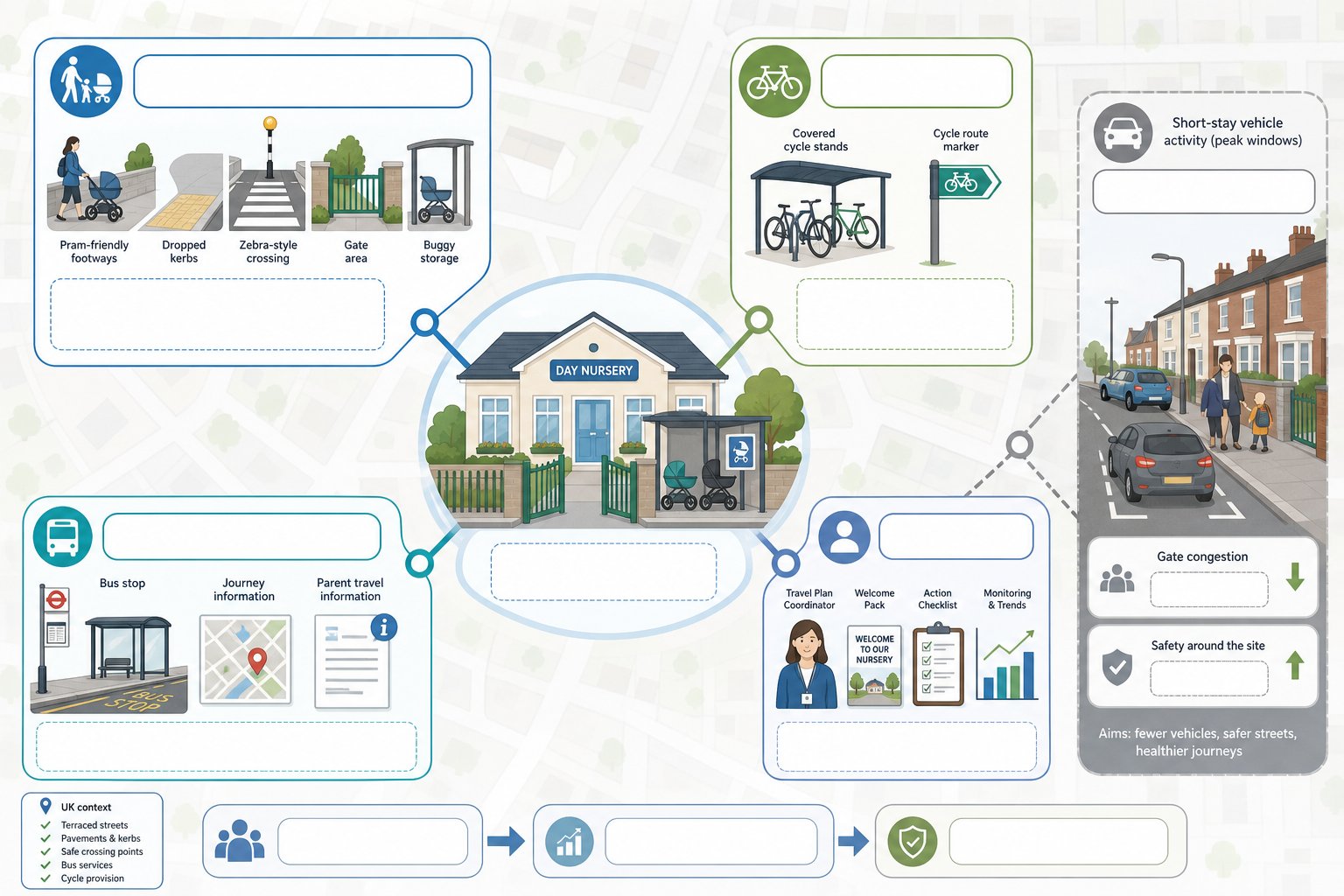
Useful measures vary by context. For walkable neighbourhood sites, safe and direct pedestrian routes, dropped kerbs, pram-friendly footways, crossing points and secure buggy storage may be more valuable than an over-designed car park. In urban settings, covered cycle parking for staff, clear public transport information, and personalised travel information for parents can help. In larger schemes, a travel plan coordinator, promotional packs for new families, and monitoring commitments may be justified.
What matters is that the measures are specific to the nursery. The assessment should show who each measure is for, how it will work operationally, and how success will be monitored. Generic “encourage sustainable travel” wording is easy to write and easy for officers to dismiss.
For mixed-use or phased sites, nursery travel planning may also need to align with broader development commitments. Approaches used in a Residential Development Transport context can be useful where the nursery sits within a wider neighbourhood scheme, but the child-safety and short-stay parking dimension must still be treated separately.
How Transport Assessments Support Planning Applications And Reduce Objections
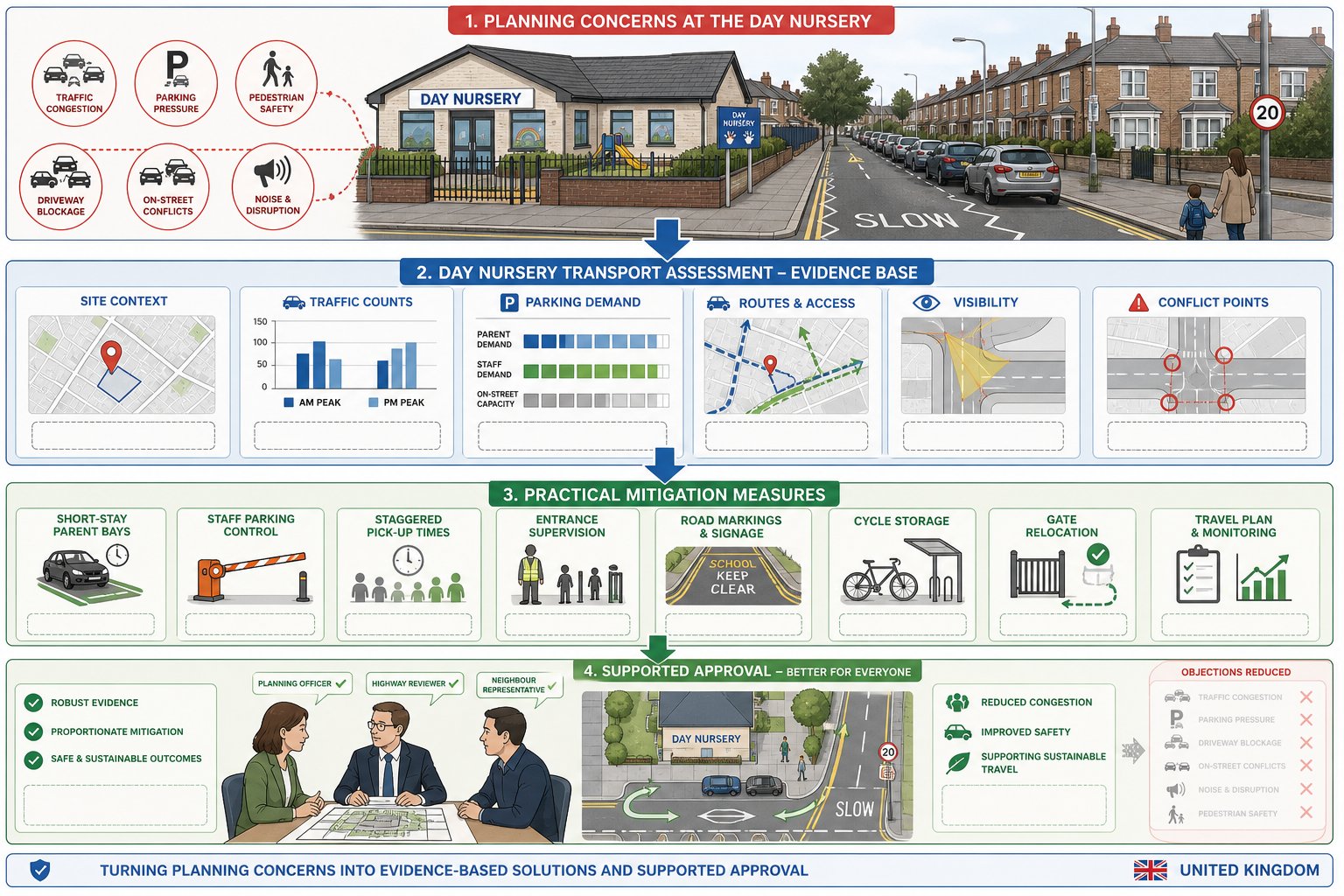
A good transport assessment does more than answer validation requirements. It changes the quality of the planning conversation.
Without one, concerns about a nursery often remain broad and emotional: there will be too much traffic, parents will block driveways, children will be at risk, the road is already dangerous. Those fears may be understandable, but they are difficult to resolve without evidence. A proper assessment translates them into measurable issues: likely peak flows, expected parking demand, route choice, visibility, conflict points, and the effect of proposed mitigation.
That matters to planning officers because it allows balanced decision-making. Highway teams can test assumptions. Neighbours can see whether the site includes enough short-stay management. Design teams can amend layouts before committee. And applicants can show that they have understood local conditions rather than trying to wave them away.
The strongest reports reduce objections by being practical. They might recommend parent waiting bays, staff parking controls, staggered session times, entrance management, road markings, cycle storage, revised gate positions or a monitored travel plan. None of those measures is glamorous. But together they often turn a contentious scheme into one that is demonstrably workable.
Speed and clarity also help. Where transport evidence is prepared early and coordinated with the planning strategy, applications are less likely to stall on repeated requests for clarification. That is one reason specialist teams with local authority experience tend to add value: they understand not just modelling, but what officers actually need to sign off a nursery proposal.
Common Reasons Day Nursery Transport Reports Are Challenged
Most challenged nursery reports fail in familiar ways. Rarely is the issue a dramatic technical blunder: more often it is a pattern of optimistic assumptions, weak site understanding or poor alignment between the report and the drawings.
One common problem is using non-specific trip rates. If the report relies on a generic education or community-use comparator without explaining why it reflects nursery behaviour, highway officers will question the forecast. The same happens when peak periods are defined too broadly, masking the intense 15- to 30-minute pressure that actually causes conflict.
Parking is another regular weak point. Reports are often challenged for underestimating short-stay demand, overlooking parent dwell time variation, or assuming all drivers will use formal spaces even where kerbside stopping is plainly more convenient. Officers and neighbours alike notice that sort of mismatch instantly.
Access sections can also be too light. Missing swept paths, incomplete visibility checks, no discussion of reversing risk, and little thought about gate operation or pedestrian segregation will all attract criticism. So will travel plans that read like generic office templates with no mention of buggies, safeguarding, handover routines or parent communication.
Sometimes the issue is cumulative impact. A nursery next to a school, health centre or busy parade may be acceptable on its own, but not if the report ignores overlapping peaks and existing parking stress. In those cases, the challenge is not that the proposal creates traffic, but that the submitted evidence has understated the network it is joining.
What To Prepare Before Commissioning A Day Nursery Transport Assessment
The quality of a nursery transport assessment depends heavily on what the consultant receives at the start. When the brief is thin, assumptions multiply: when core inputs are available early, the report can be sharper, faster and more defensible.
At minimum, applicants should assemble the proposed child capacity, age split, opening hours, session structure and staffing numbers. Shift patterns matter, not just headcount. A nursery with staggered staff starts behaves differently from one where everyone arrives at once. If the operational model includes flexible drop-off windows, breakfast provision, after-hours collection or shared use of parking, that needs to be clear from day one.
A developing site layout is equally important. Transport planners need to understand access points, internal circulation, pedestrian routes, gate positions, servicing arrangements, boundary treatment and any space reserved for cycle parking, buggy storage or refuse. Pre-application notes from the council, local plan policies, parking standards and validation requirements should be shared as well.
Local intelligence is often gold dust. Nearby traffic counts, photos of school-run conditions, known neighbour concerns, collision history references and details of public transport links can all shape the scope. We usually advise clients to gather more context than they think they need: it is much easier to narrow a scope than to repair one built on missing basics.
And if the nursery forms part of a wider scheme, the transport team should understand that larger planning framework from the outset. Principles used in a broader Day Nursery Transport Assessment strategy may inform the approach, but the nursery element still requires dedicated operational testing.
Conclusion
A nursery may be a relatively small development in floorspace terms, but it can produce transport effects that are sharp, localised and highly visible. That is why planning officers in 2026 expect more than generic trip tables and a standard parking schedule. They want a Day Nursery Transport Assessment that reflects real nursery behaviour: concentrated peaks, short-stay parking turnover, safeguarding, staff patterns, servicing, and the practical way families move through a site.
When that work is done properly, the assessment becomes more than supporting paperwork. It helps shape the layout, informs mitigation, answers neighbour concerns and gives highway authorities confidence that the proposal will function safely. For architects, planners, lawyers, developers and councils, the lesson is simple: start early, use nursery-specific evidence, and make sure the transport story matches the operational reality. That is usually what gets schemes over the line.
Common Questions About Day Nursery Transport Assessments
What is a Day Nursery Transport Assessment and why is it important?
A Day Nursery Transport Assessment is a detailed study that evaluates traffic, parking, and safety impacts of a nursery proposal to support planning applications. It’s crucial for understanding local road pressures, ensuring child safeguarding, and demonstrating that transport effects can be managed effectively.
When is a Day Nursery Transport Assessment required for nursery planning applications?
Such assessments are usually needed when nurseries exceed local thresholds related to child capacity, floorspace, or trip generation, or if the highway authority identifies potential safety or congestion concerns near the site. Each local authority sets its own thresholds and validation requirements.
How do drop-off and pick-up peaks affect nursery transport planning?
Nursery drop-off and pick-up times are short, intense peaks, often 15 to 30 minutes, causing concentrated parking demand and traffic pulses. Variable parent dwell times and informal parking behaviour can increase congestion and require careful assessment in transport reports to ensure safety and smooth operation.
What role does safeguarding play in Day Nursery Transport Assessments?
Safeguarding is integral, influencing access design, pedestrian segregation, gate controls, and boundary treatments. Safe, legible walking routes separating children from vehicles reduce risks, helping to gain highway authority confidence and addressing neighbour concerns in planning.
How are sustainable and active travel measures integrated into nursery transport assessments?
Despite some car dependency, assessments must identify realistic sustainable travel options such as buggy-friendly walking routes, cycle parking, and public transport links. Measures should be specific to nursery needs, operationally sound, and monitored for effectiveness to encourage safer, less congested travel.
What are common reasons Day Nursery Transport Assessments face challenges during planning?
Reports often face scrutiny due to optimistic or generic trip rates, underestimating parking demand and parent behaviour, insufficient access and visibility analysis, and inadequate safeguarding or travel plan details. Cumulative impact from nearby schools or roads can also prompt objections if not properly addressed.