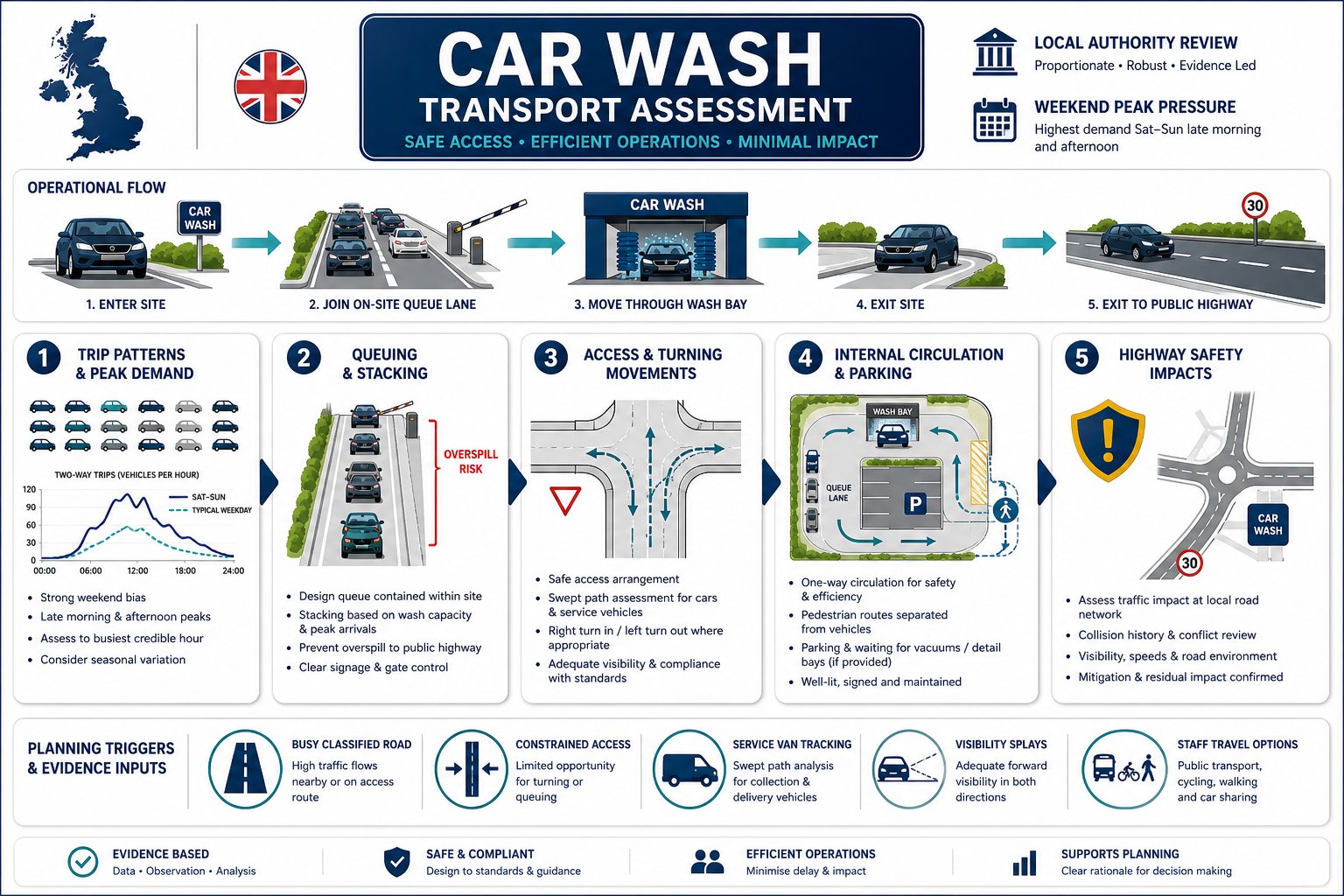
A car wash can look straightforward on a layout plan: a wash lane, a few waiting spaces, an access point, some signs. In practice, planners and highway officers know it is rarely that simple. Car wash schemes create a very particular transport pattern, short stays, sharp peaks, queueing risk, and a constant need to prove that every vehicle can enter, wait, wash, and leave without spilling onto the public highway.
That is exactly why a Car Wash Transport Assessment has become such an important planning document in 2026. For architects, planning consultants, developers, solicitors, surveyors, and local authorities, the issue is not just total traffic generation. It is whether the proposal works operationally, safely, and predictably at the times that matter most.
We see this often in planning work: a modest commercial proposal attracts more scrutiny than expected because the highway authority is less concerned about all-day traffic totals and more concerned about the Saturday lunchtime queue, the awkward right turn, or the van that cannot service the site without blocking circulation. Those are the details that determine whether an application moves forward smoothly or gets delayed by requests for further information.
In this guide, we set out what a car wash transport assessment needs to cover, when it is likely to be required, what local authorities typically expect, and how applicants can prepare evidence that stands up to planning and highways review.
Key Takeaways
- A Car Wash Transport Assessment is essential to ensure a proposed car wash operates safely and efficiently without causing highway congestion or safety issues.
- The assessment focuses on vehicle trip patterns, queueing capacity, access design, internal circulation, parking, and impacts on road safety, with attention to peak demand periods.
- Different car wash formats create unique transport challenges, so assessments must be tailored to the specific operation and site conditions.
- Local authorities often require these assessments when sites front busy roads, have constrained access, or pose a risk of queue spillback onto public highways.
- Successful assessments rely on detailed operational information including opening hours, staffing, vehicle movements, and servicing arrangements to provide realistic and robust evidence.
- Early, clear, and site-specific transport assessments help avoid planning delays by addressing peak queueing, circulation conflicts, and safety risks before submission.
What A Car Wash Transport Assessment Is And When It Is Required
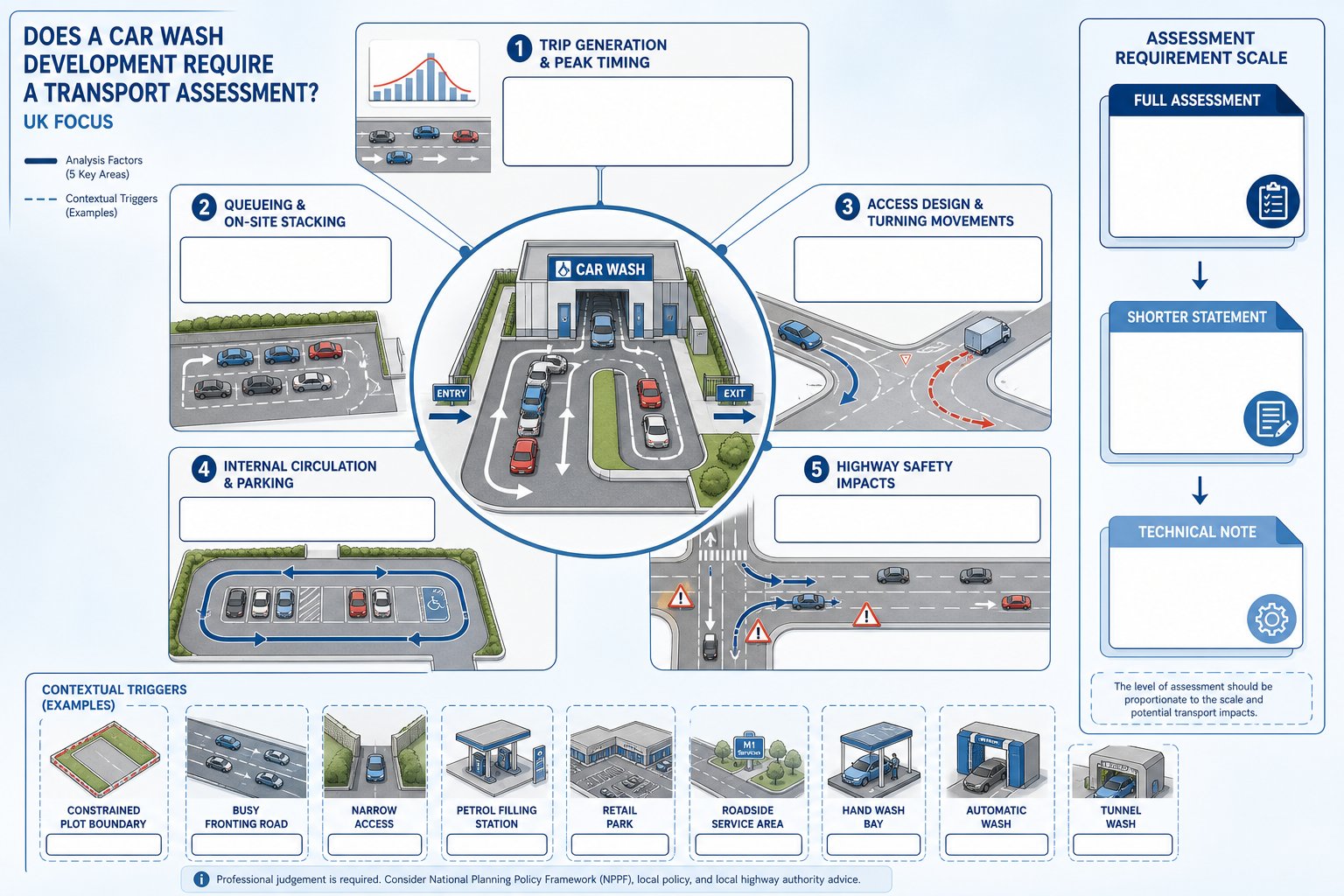
A Car Wash Transport Assessment is a planning and highways document that tests whether a proposed car wash can operate acceptably in transport terms. In plain English, it asks a practical question: will the development function safely on its site and on the surrounding road network, or will it create queueing, access, parking, servicing, or road safety problems?
For car wash proposals, that assessment usually focuses on five linked themes:
- likely vehicle trips and when they occur
- queueing and on-site stacking capacity
- access design and turning movements
- internal circulation and parking arrangements
- impacts on highway safety and nearby roads
It may be required for a new standalone car wash, a hand wash operation, an in-bay automatic wash, a conveyor or tunnel wash, or an ancillary wash facility attached to a petrol filling station, retail park, or roadside service site. Authorities are particularly likely to ask for one where the proposal sits on a constrained plot, fronts a busy road, relies on a substandard access, or has obvious potential for overspill waiting.
In some cases, a full assessment is needed: in others, a shorter transport statement, highway note, or technical addendum may be enough. The trigger depends on local validation requirements, the scale of likely effects, and the judgment of the planning and highway authority. Broader principles used in a transport assessment for other development types still apply, but car washes usually need more operational detail than applicants first expect.
The key point is this: even when the total number of trips appears modest, the authority may still require evidence because concentrated peaks and queue spillback can turn a small site into a highway concern very quickly.
How Car Wash Developments Create Distinct Traffic And Highway Issues
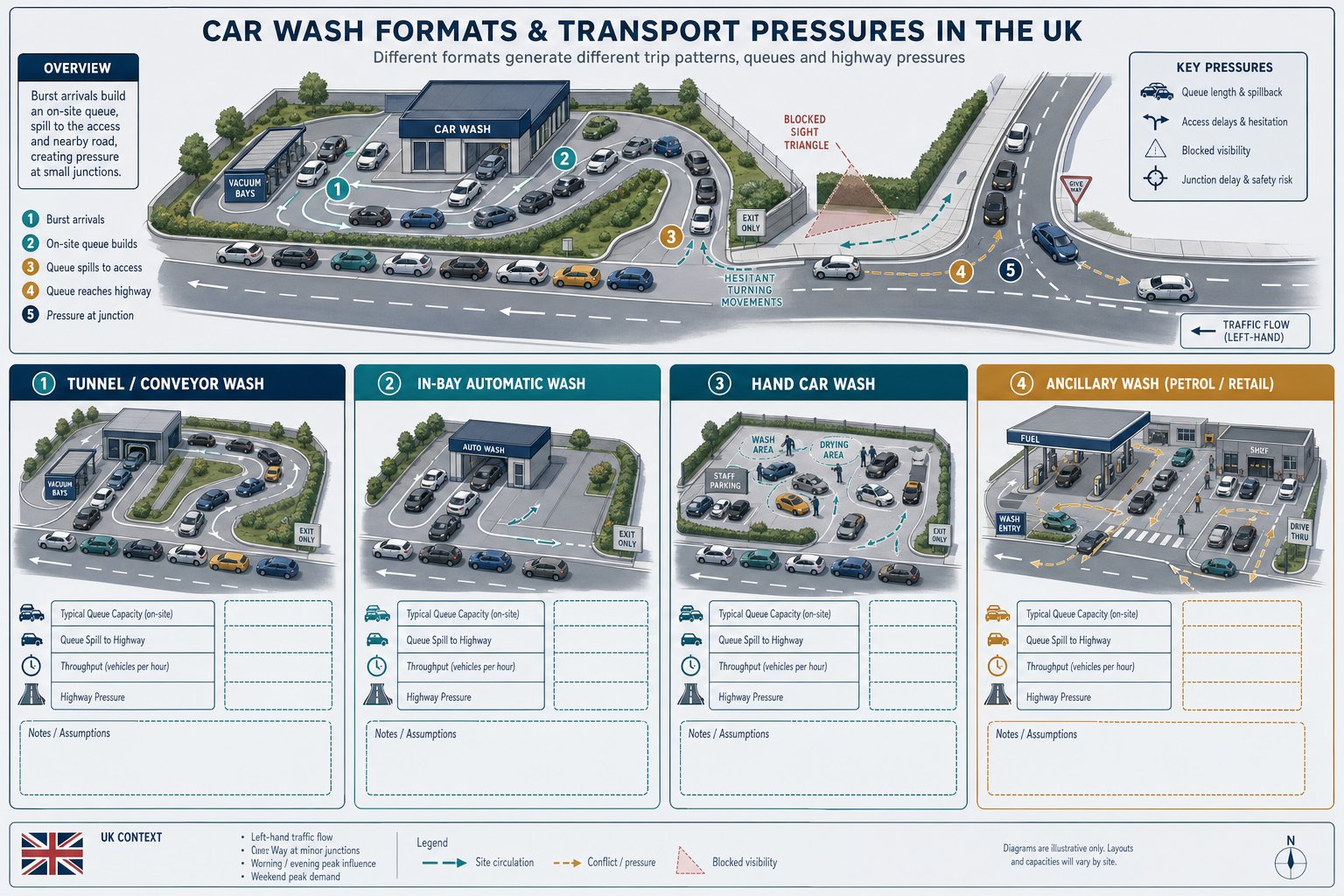
Car wash developments are different from many other commercial uses because demand is rarely smooth and evenly distributed. A customer does not browse for an hour, nor occupy a site all afternoon. They arrive, often in bursts, join a queue if necessary, move through the wash process, and leave. That compressed cycle creates a transport problem that is less about daily traffic volume and more about operational pressure over short periods.
Weekend peaks are often the critical test. Dry weather after a wet spell, school-run gaps, pay-day weekends, and midday retail trips can all concentrate demand. If the site has only limited stacking space, queues can form fast. And once a queue reaches the access throat, everything else starts to unravel, vehicles wait on the highway, sight lines are blocked, turning vehicles hesitate, and neighbouring uses may be obstructed.
Highway officers are alive to this. They will usually look beyond the headline trip rate and ask whether the proposal can contain demand on-site. They also want to know whether access arrangements force awkward turns, whether vehicles can circulate without reversing conflict, and whether the scheme changes conditions at nearby junctions. Where a wider modelling exercise is needed, tools such as Junctions 11 Software can help test operational effects, though many car wash cases are won or lost on queueing and layout evidence rather than classic junction capacity alone.
Typical Car Wash Formats And Their Transport Implications
Different formats produce different transport effects, so the assessment should never treat “car wash” as a single generic use.
Tunnel or conveyor washes generally process more vehicles and hence need stronger stacking provision, clearer lane discipline, and firmer control over entry. If they are paired with vacuum bays or valeting areas, dwell times become more variable, which can complicate circulation.
In-bay automatic or roll-over washes may have lower throughput, but they can still generate notable queues because service time is fixed and customers often arrive in clusters. Smaller sites can struggle if only a few waiting spaces are available.
Hand car washes can be even trickier from a planning perspective. Throughput may vary by staffing levels, weather, and the amount of detailing offered. Space for waiting, staff parking, and wash-related activities must be clearly organised.
Ancillary washes at petrol stations or retail sites bring another complication: linked trips. Some customers are already on-site, while others make a dedicated journey, and the car wash queue can interfere with fuel pumps, drive-through lanes, or parking aisles.
That is why a robust assessment ties transport evidence to the actual operating model, not a broad label.
Planning Triggers, Validation Requirements, And Local Authority Expectations
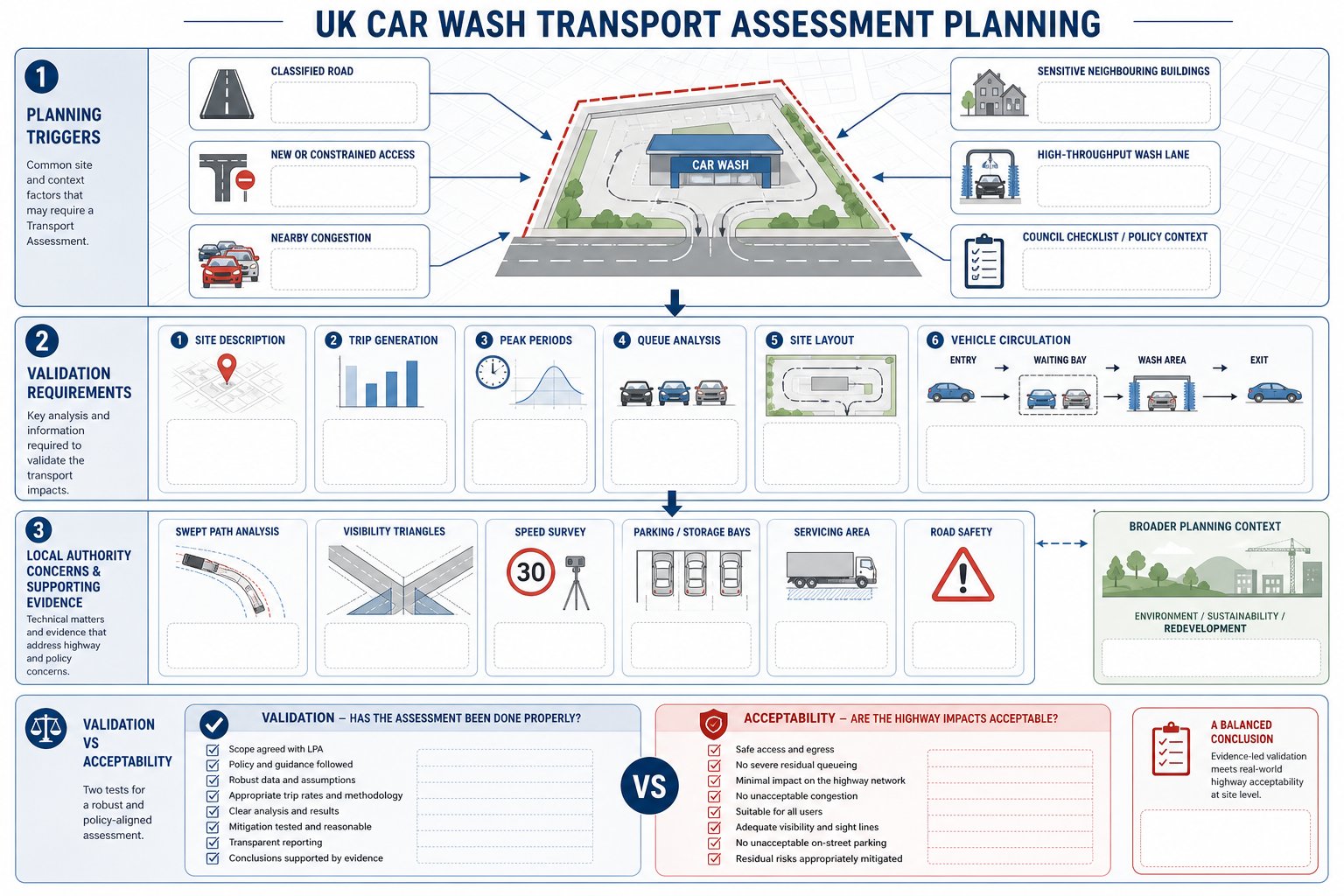
There is no universal national threshold that says every car wash must submit a transport assessment. In the UK planning system, requirements are usually shaped by the scale of the proposal, local validation lists, site conditions, and the professional judgement of the case officer and highway authority.
In practice, a transport document is more likely to be requested where:
- the site fronts a classified or heavily trafficked road
- the access is new, intensified, or constrained
- there is a history of parking or congestion nearby
- neighbouring uses are sensitive to blockage or overspill
- the proposal includes a high-throughput wash format
- the local authority has specific validation triggers for traffic or highways matters
What authorities expect is often quite consistent, even if the label on the document changes. They want a clear description of the proposed use, realistic trip generation assumptions, evidence of peak periods, queueing analysis, a readable site layout, and confidence that vehicles can enter, wait, be washed, and leave without creating highway problems.
They may also ask for swept-path drawings, visibility splays, speed survey information, parking and servicing schedules, and a short review of local road safety conditions. If the site sits within a more complex planning context, perhaps near a larger redevelopment or in an environmentally sensitive location, the transport work may need to align with broader technical material, including an environmental impact assessment.
From our side, one lesson is constant: validation is not the same as acceptability. A report can technically satisfy the submission checklist but still fail to answer the authority’s real concern. For car washes, those concerns are usually operational, visual on plan, and very site-specific.
Core Elements Of A Car Wash Transport Assessment
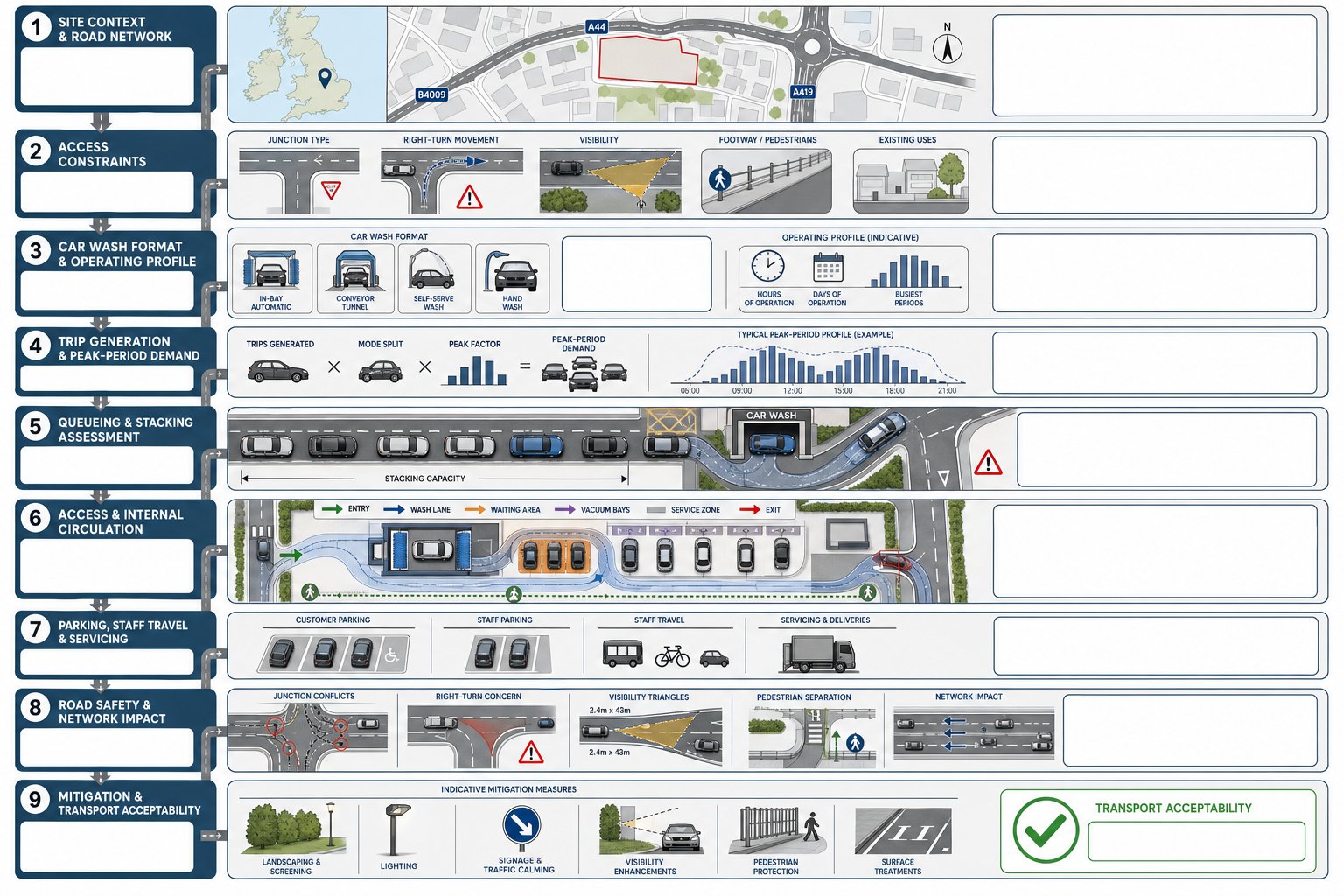
A strong assessment is structured around how the site will work in the real world, not just around standard report headings. That means the analysis should move from context to operation to impact, showing a clear line of reasoning throughout.
Typical core elements include:
- site location and surrounding highway context
- existing access conditions and local constraints
- development description, operating hours, and wash format
- trip generation and likely peak demand
- queueing and stacking analysis
- access design and internal layout review
- parking, waiting, servicing, and staff travel arrangements
- road safety and network impact assessment
- sustainable travel opportunities, where relevant
- conclusions on transport acceptability and any mitigation
The most persuasive reports are grounded in the actual proposal. If the applicant has not settled opening hours, staffing numbers, or whether vacuum bays are included, the assessment quickly becomes vague. Highway officers notice that immediately.
Where applicants need a broader benchmark for how these documents are framed across sectors, a Residential Development Transport report may seem unrelated in land-use terms but is still useful for understanding how evidence, assumptions, and mitigation should be presented clearly for planning review.
For car washes, though, the assessment must go further into operational detail than many standard commercial schemes.
Trip Generation, Peak Periods, And Queueing At Busy Times
Trip generation should reflect the actual format and likely customer behaviour. Generic database rates can help, but they are rarely enough on their own for a car wash. Authorities will want to know how many arrivals are expected in a typical weekday peak, a Saturday peak, and any weather-sensitive busy period that could stress the site.
The most important question is not simply “how many trips?” but “how many vehicles may queue at once?” A site can have moderate total traffic yet still fail because arrivals bunch into short windows. Queueing analysis should hence test wash cycle times, payment delays, staff intervention, lane discipline, and the likely effect of customers waiting for a preferred bay or service option.
It is usually sensible to present a robust scenario rather than a best-case one. If there is uncertainty, we would rather explain and test it openly than understate demand and invite objection later.
Access Design, Internal Circulation, And Vehicle Tracking
Access design should show that vehicles can enter and leave safely, with suitable radii, visibility, and separation from pedestrian routes where possible. For some sites, right-turn entry or exit movements become a central issue, especially on faster roads or near junctions.
Internal circulation matters just as much. The route from entry to queue, wash lane, waiting area, vacuum bay, exit, and any staff or service area should be legible and conflict-free. If vehicles need to reverse in customer areas, or if servicing cuts across the wash queue, the layout will attract criticism.
Vehicle tracking can be crucial, particularly where the site is tight or vans need to access plant, refuse, or maintenance areas. Swept-path evidence should test realistic movements, not idealised manoeuvres performed in empty conditions. That distinction matters more than many applicants realise.
Parking, Waiting Bays, Staff Travel, And Servicing Arrangements
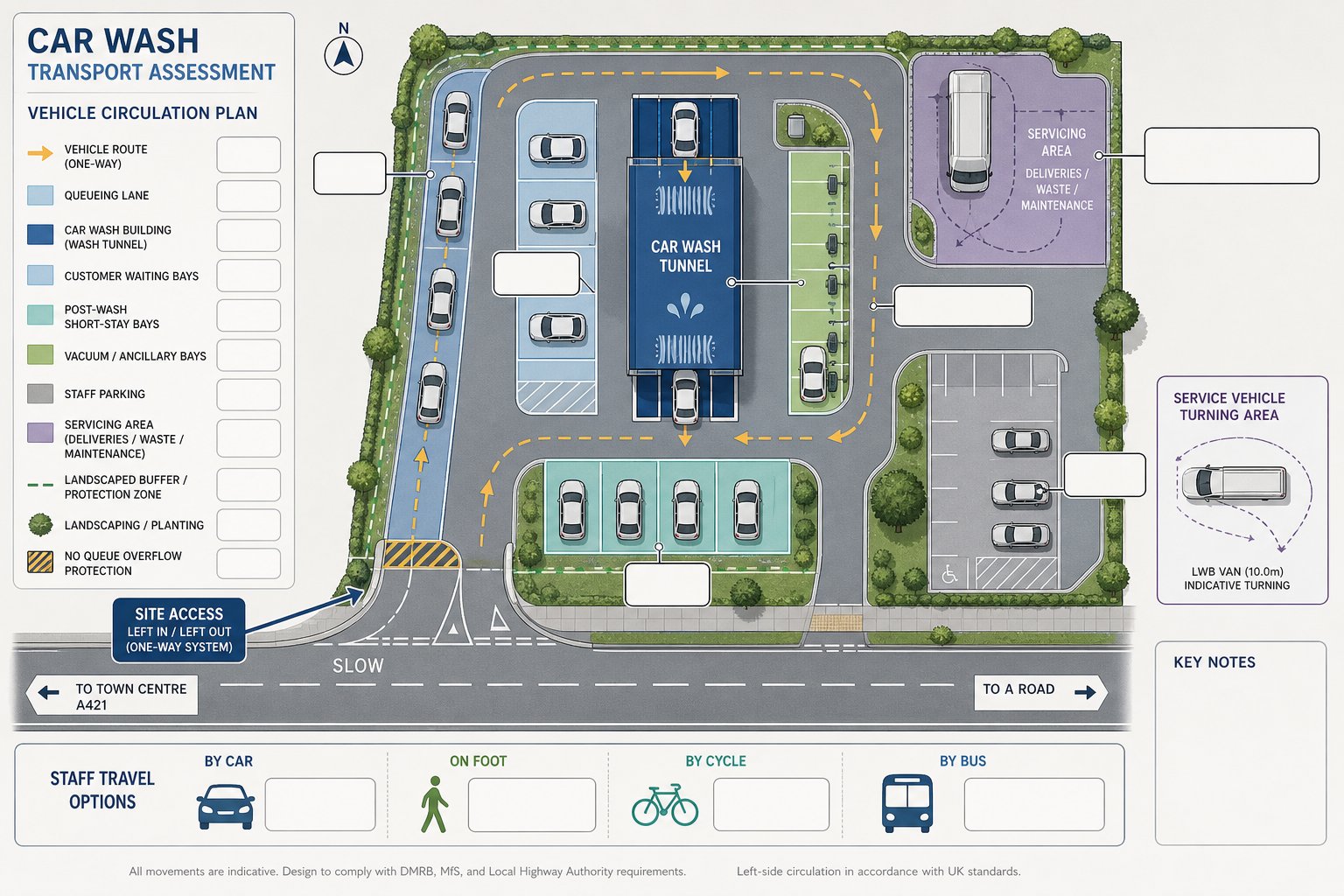
Parking provision for a car wash is not just a standard box-ticking exercise. The layout has to distinguish between several different functions that are often blurred together on poor-quality plans: active queueing space, customer waiting bays, short-stay post-wash spaces, staff parking, and servicing or maintenance access.
The first discipline is to identify what each bay is for. A queue lane is not the same as parking. A vacuum bay is not the same as a waiting space. And an area that doubles as both customer overflow and delivery standing is likely to fail operationally when the site gets busy.
For planning purposes, we normally want to know:
- how many vehicles can wait before reaching the access
- whether any customer spaces are provided outside the active queue
- where staff will park or whether staff arrive by other means
- how deliveries, chemical replenishment, waste collection, and maintenance visits occur
- whether service vehicles can stand and turn without disrupting customer movement
Staff travel often receives less attention than it should. Even a modest operation may have shift overlap, cleaning periods, or supervisor visits outside normal customer peaks. If there is no realistic staff parking or no credible walking, cycling, or public transport option, displacement onto nearby roads can become a planning issue.
Servicing is another frequent weak spot. Chemical deliveries, refuse movements, and equipment maintenance are not daily high-volume events, but they still need space, safe access, and timing that does not clash with the busiest customer periods. A good assessment makes those arrangements explicit rather than leaving them implied on a crowded general arrangement drawing.
Road Safety, Visibility, And Impacts On The Surrounding Network
Road safety is often the point at which a car wash application becomes contentious. A proposal may look acceptable in terms of daily traffic totals yet still create conditions that increase collision risk or day-to-day driver conflict.
Visibility at the access is the starting point. Applicants need to demonstrate that drivers can emerge safely, taking account of road speed, frontage conditions, boundary treatments, parked vehicles, and the practical behaviour of customers who may be focused on joining or leaving a queue rather than reading the road perfectly. On some urban roads the issue is less stopping sight distance and more whether outbound vehicles can see and be seen around waiting traffic near the site entrance.
The assessment should also consider:
- turning conflicts into and out of the site
- likely right-turn holding behaviour
- proximity to junctions, crossings, bus stops, or school routes
- obstruction risk from queue spillback
- interactions with adjacent uses sharing or bordering the access environment
Where there is an existing collision record nearby, that context should be reviewed carefully and fairly. Not every historic incident is relevant, but ignoring a pattern is rarely defensible.
Impacts on the surrounding network are usually local rather than strategic. The key question is whether the proposal worsens conditions on the adjoining road or nearest junctions in a material way. If queueing from the site could block a lane, delay turning traffic, or interfere with neighbouring premises, the authority is likely to object unless the design is amended or demand is more convincingly contained.
This is where clear plans matter. Highway officers often make up their minds by tracing likely vehicle behaviour on a drawing and asking, quite simply, “what happens when it’s full?”
Sustainable Travel, Walking, Cycling, And Public Transport Considerations
A car wash is, by definition, a vehicle-oriented use. That does not mean sustainable travel considerations disappear from the planning assessment. Authorities still expect the proposal to show that staff, visitors, and service activity have been considered in a proportionate way.
For customer trips, the scope for mode shift is often limited. Most customers arrive in the vehicle being washed, and a report should say so plainly rather than forcing generic sustainability wording that convinces no one. But staff travel is different. Even a small operation can support more sustainable access if the site is near bus routes, walkable catchments, and safe cycle connections.
A proportionate review should hence cover:
- nearby footways and crossing opportunities
- cycle parking for staff, where appropriate
- local bus stops, service frequency, and walking distances
- whether shift patterns align with public transport availability
- any staff travel information or simple travel plan measures
The tone matters here. We should neither exaggerate realistic non-car access nor dismiss it. A balanced assessment will acknowledge that customer mode share is intrinsically car-led while still identifying practical steps for employees and occasional visitors.
This section can also help with wider planning credibility. If the application demonstrates that the site is not just operationally efficient but also sensibly connected for staff and ancillary trips, it reads as a more complete piece of planning work. In some urban locations, that can make the difference between a narrow highways discussion and a more rounded recommendation for approval.
Common Planning Risks For Car Wash Schemes And How To Address Them
Most car wash refusals, objections, or late-stage requests for further information come back to a fairly short list of recurring problems.
Underestimated demand is probably the most common. Applicants assume the use is low traffic because each visit is short. Highway officers focus instead on how many vehicles might arrive in a tight window. The fix is straightforward in principle: use realistic assumptions, identify peak periods honestly, and test robust queue scenarios.
Inadequate stacking space comes next. If there is any realistic chance of queue overspill onto the highway, the authority will be uneasy. Additional on-site storage, a revised lane arrangement, or a lower-throughput operating model may be needed.
Poor access geometry is another familiar risk. Tight radii, awkward right turns, and constrained visibility can all undermine an otherwise acceptable scheme. Early layout testing usually saves time here.
Weak operational detail also causes trouble. If the planning submission does not explain opening hours, staffing, service processes, payment arrangements, or whether attendants marshal vehicles, the assessment may feel theoretical rather than credible.
Conflicts with neighbouring uses matter too. Shared forecourts, petrol filling stations, drive-throughs, and retail parks can produce interaction effects that applicants miss.
The practical answer is to front-load the evidence. We find that schemes progress more smoothly when queueing, circulation, and access are tested early, not after the authority has already raised concerns. That is especially true for applicants seeking concise, planning-ready reporting: firms with a long track record in site-specific highways work, including Car Wash Transport Assessment support, tend to avoid the generic assumptions that trigger avoidable objections.
What To Prepare Before Commissioning A Transport Assessment
The best transport assessments start with good project information. If the design team commissions transport work before key operational details are known, the report often ends up relying on placeholders, caveats, and follow-up notes, none of which help a planning timetable.
Before commissioning, we would want the applicant team to pull together the following:
- the proposed car wash format and throughput assumptions
- opening hours, including weekend and seasonal patterns
- a site layout showing queue lanes, wash equipment, bays, parking, and servicing areas
- proposed access points and any highway works
- staffing numbers, shift patterns, and likely staff travel modes
- delivery, waste, and maintenance arrangements
- any pre-application feedback from the local planning or highway authority
- local validation requirements for transport, highways, tracking, or visibility evidence
It also helps to be clear about the planning strategy. Is the proposal standalone? Ancillary to another use? Part of a wider redevelopment? Are there neighbouring uses whose circulation will interact with the scheme? Those questions shape the scope of the assessment from day one.
Good site photos, topographical information, and a measured understanding of local traffic conditions are equally useful. If the authority is likely to ask for queue containment evidence, it is worth identifying that risk early so the design can respond before the application is submitted.
In our experience, the fastest route to a robust report is not rushing the brief. It is defining the operation properly, matching the scope to the authority’s likely concerns, and making sure the layout team and transport team are working from the same assumptions.
Conclusion
A car wash proposal is rarely judged on traffic numbers alone. What matters is whether the site can contain demand, move vehicles safely, and operate without causing avoidable problems on the surrounding highway network. That is why a Car Wash Transport Assessment needs to be practical, site-specific, and honest about peak conditions.
For planners, architects, surveyors, developers, and local authorities, the strongest submissions are the ones that answer operational questions before they are asked: how many vehicles arrive at the busiest times, where they wait, how they circulate, whether servicing works, and what happens when the site is under pressure.
In 2026, that level of clarity is not an optional extra. It is often the difference between a smooth planning process and a delayed one. If the evidence is realistic, the layout is disciplined, and the transport case is prepared early, car wash schemes are far easier to justify and far more likely to secure approval on the first pass.
Frequently Asked Questions about Car Wash Transport Assessment
What is a Car Wash Transport Assessment and why is it required?
A Car Wash Transport Assessment evaluates whether a proposed car wash can operate safely and efficiently in transport terms, focussing on traffic, queueing, access, and highway safety to prevent congestion or safety issues on surrounding roads.
Which transport aspects does a Car Wash Transport Assessment typically cover?
It covers likely vehicle trips and peak demand, on-site queueing and stacking capacity, access and internal circulation design, parking and servicing arrangements, and impacts on local highway safety and nearby road networks.
When is a Car Wash Transport Assessment most likely to be requested by local authorities?
Assessment is needed when a site fronts a busy or classified road, has constrained or new access, a history of congestion nearby, sensitive neighbouring uses, high-throughput wash formats or when local validation requirements specify traffic or highway evidence.
How do car wash operations differ from other commercial developments in transport terms?
Car washes generate short-duration, highly concentrated bursts of traffic rather than smooth flows. This can cause sharp peak queues, on-site stacking needs, and operational risks like queue spillback impacting public highways and neighbouring uses.
What common operational issues should be addressed in the transport assessment for a car wash?
Key issues include accurate peak trip generation, sufficient on-site queueing to avoid overspill, safe access and turning, clear internal vehicle circulation without conflicts, and adequate staffing parking and servicing arrangements.
How can sustainable travel considerations be incorporated into a Car Wash Transport Assessment?
While customer trips are vehicle-based, assessments should consider staff travel modes, proximity to public transport, cycling and walking access, cycle parking, and travel plan measures to promote sustainable staff journeys where practical.