
Roads rarely make the front page unless something has gone wrong. Yet in practice, they shape almost every planning decision we deal with: whether a site can be accessed safely, whether a town centre feels walkable, whether buses move reliably, and whether growth actually works on the ground. That is why public sector highway engineering matters far beyond carriageway widths and lining plans.
In the UK, public sector highway engineering sits at the point where transport policy, design standards, public funding, planning law, and local politics meet. It covers the planning, design, delivery, maintenance, and operation of adopted roads and streets in the public interest, not just the needs of a single landowner or developer. For architects, planners, lawyers, surveyors, builders, developers, and councils, that distinction is more than technical. It affects programme, cost, risk, consultation, and eventually planning success.
We see this every day in development and infrastructure work. A transport assessment may look straightforward until questions arise around junction capacity, a Section 278 agreement, drainage adoption, active travel links, or committee concerns about safety. Then the wider machinery of public sector highway engineering comes into view. In this guide, we set out what it covers, who delivers it, how it interacts with the planning system, and which priorities are defining the sector in 2026.
What Public Sector Highway Engineering Covers
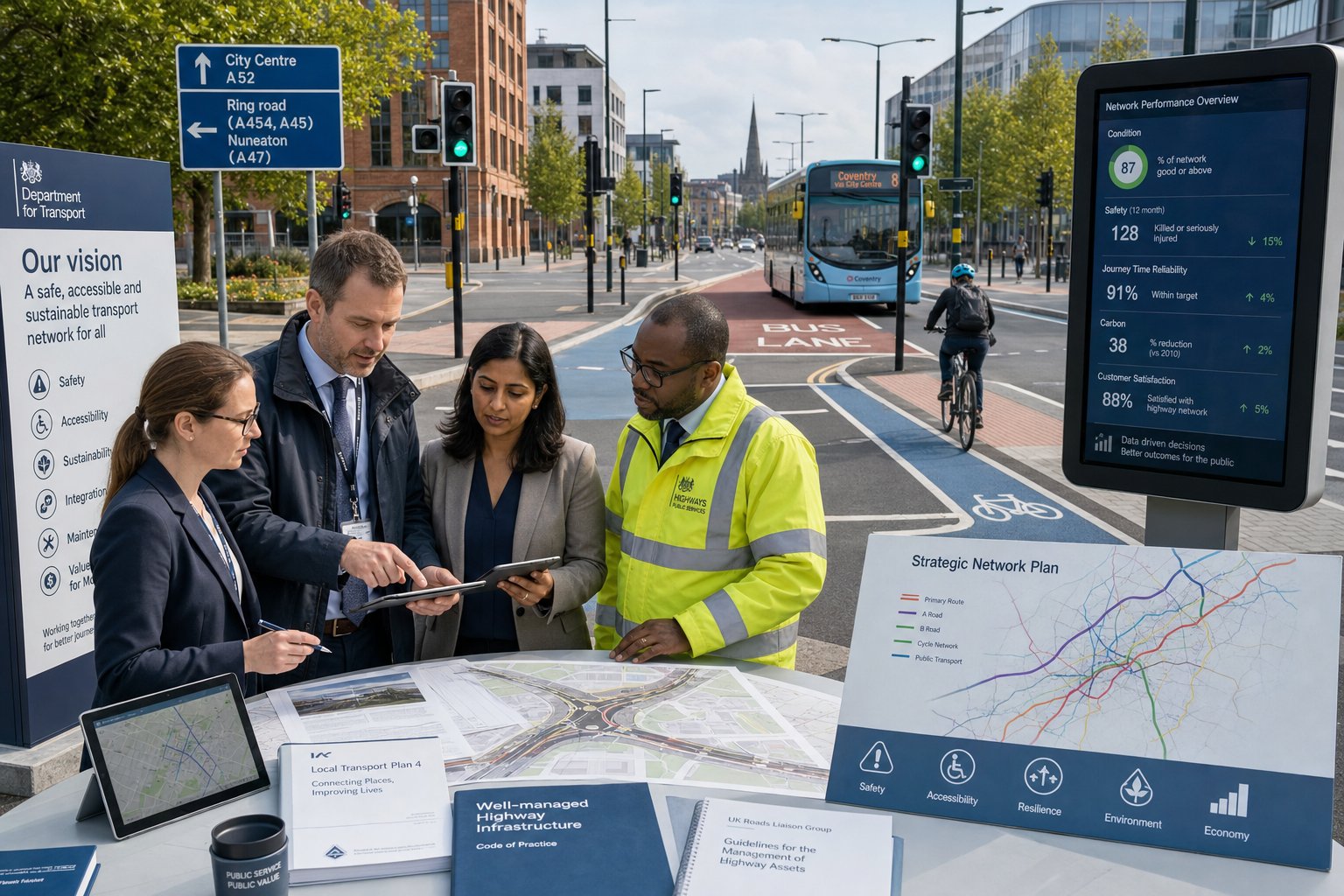
Public sector highway engineering covers the full lifecycle of publicly adopted roads and streets: strategy, design, approvals, delivery, operation, maintenance, renewal, and asset management. In UK terms, that means everything from local residential streets and urban junctions to elements of the strategic road network, along with associated drainage, signs, traffic signals, structures, lighting, and sometimes public realm.
The key point is purpose. The work is undertaken in the wider public interest. So the questions are not only, “Can this junction carry traffic?” but also, “Is it safe?”, “Is it accessible?”, “Does it support economic activity?”, “Will it be maintainable in 20 years?”, and “Does it align with policy on climate, health, and place?”
That makes the discipline broader than pure engineering. It sits alongside transport planning, development management, environmental assessment, network management duties, and local growth strategies. A public authority may be improving a roundabout, introducing bus priority, reviewing a planning application, replacing ageing assets, or redesigning a high street to support walking and trade. All of that falls within the same ecosystem.
In practice, robust highway infrastructure design links engineering detail with policy compliance, which is why highway teams are so often central to planning decisions and capital delivery programmes.
How It Differs From Private Development Highway Work
Private development highway work usually starts with a client brief, a commercial objective, and a site boundary. Public sector highway engineering starts with statutory duties, network performance, public accountability, and budget constraints. That difference changes almost everything.
First, decision-making is slower and more transparent. Local authorities and national bodies must justify spending, consult affected parties, and often secure approvals through committees, governance boards, or published officer decisions. Secondly, procurement is regulated. Consultants and contractors are commonly appointed through frameworks or competitive tendering rather than direct instruction.
Thirdly, the asset usually remains in public ownership or becomes publicly adopted, so whole-life maintenance matters much more. Materials, drainage strategy, visibility standards, road safety audit findings, winter service implications, and inspection access all carry more weight than they might on a private estate road.
And finally, the objectives are wider. A private client may focus on planning consent and site delivery. A highway authority has to think about every user of the network, including pedestrians, cyclists, buses, freight, emergency access, and vulnerable users. That is where specialist support from Highway Engineering Consultants often helps translate development proposals into solutions that public bodies can realistically approve and maintain.
Who Is Involved In Delivering Highway Schemes

Highway schemes are never delivered by one organisation alone. Even a modest public road project can involve a highway authority, planning officers, transport planners, designers, statutory undertakers, drainage teams, elected members, bus operators, emergency services, and local communities. On larger schemes, the cast list gets longer very quickly.
At the strategic level, National Highways manages England’s strategic road network. Local highway authorities manage local roads, ranging from county councils and unitary authorities to metropolitan boroughs and London boroughs. Their responsibilities typically include network management, local safety schemes, maintenance, development control input, parking and traffic regulation functions, and adoption matters.
Then there are funders and policy-makers. The Department for Transport shapes national policy and funding programmes. HM Treasury influences business case expectations and value-for-money tests. Combined authorities and devolved administrations can add another layer, especially where transport powers and local growth funding are linked.
Utilities, of course, appear sooner or later. A seemingly simple kerb realignment can become complicated once telecoms ducts, power supplies, gas mains, and water assets are uncovered. If we sound slightly battle-worn there, it’s because everyone in the sector has lived that moment.
The Role Of Local Highway Authorities, National Bodies, And Consultants
Local highway authorities are usually the most visible players in development-led and urban transport work. They review planning applications, set local design expectations, manage Section 38 and Section 278 processes, promote traffic regulation orders, and maintain adopted networks. They also balance competing pressures: congestion, safety, member priorities, school access, freight, active travel, and constrained budgets.
National bodies set the bigger frame. National Highways leads on the SRN and has its own governance, design requirements, and approval routes for schemes affecting trunk roads and motorways. The Department for Transport influences what gets funded and which policy outcomes matter.
Consultants fill a crucial delivery gap. They provide transport assessments, traffic modelling, feasibility studies, design packages, road safety input, public consultation support, and technical evidence for planning or inquiry work. For development teams, that often means using Highway Design Consultants: who understand not just geometry, but local authority thresholds, adoption requirements, and how technical points land with decision-makers.
For councils and public bodies, external teams add capacity and specialist expertise under framework arrangements, particularly when in-house teams are stretched. The best outcomes usually come when authority officers, consultants, and project sponsors act less like separate silos and more like one delivery team.
How Highway Engineering Supports The Planning System
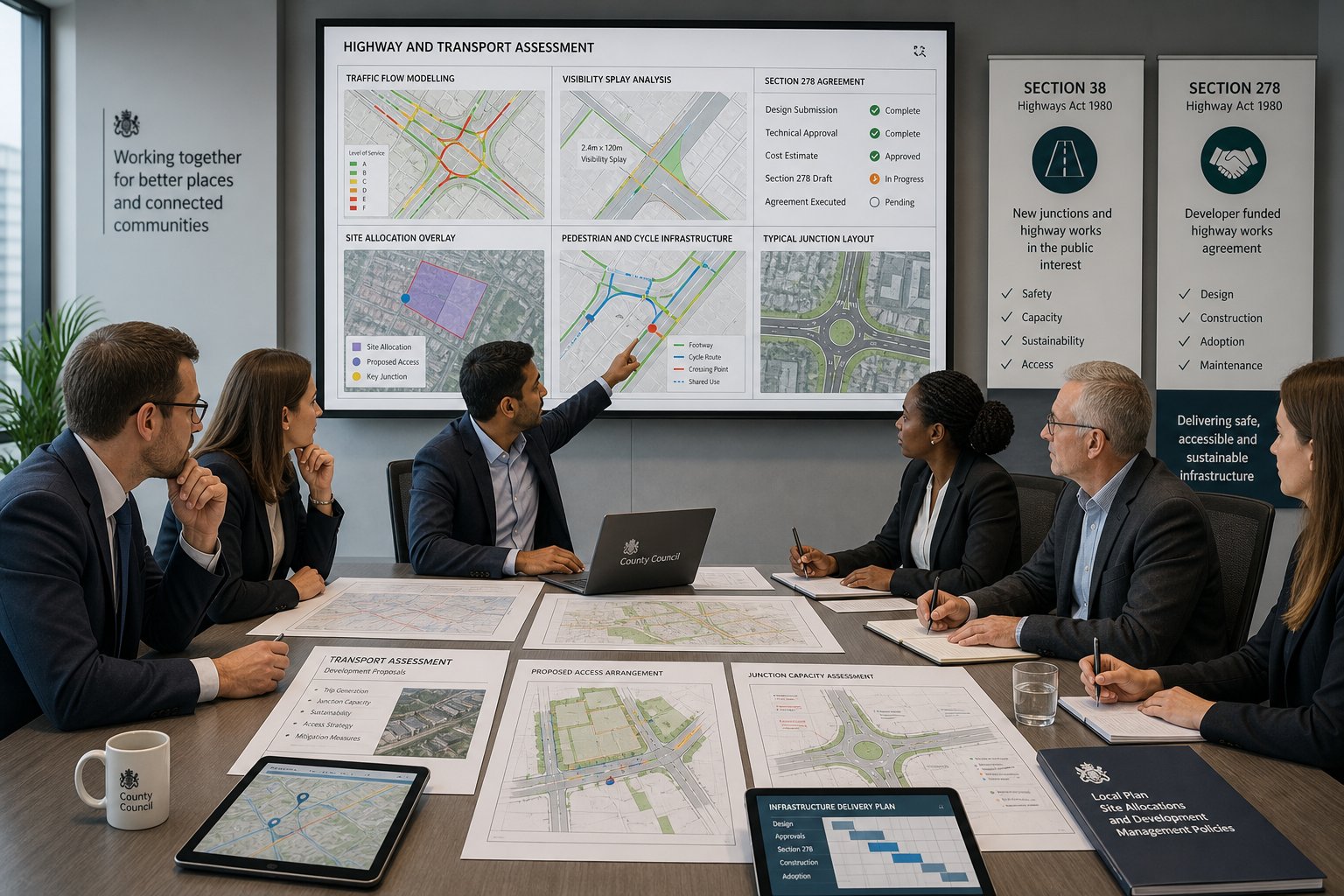
Public sector highway engineering is tightly woven into the planning system. It informs local plans, supports site allocations, tests development impacts, and helps determine whether a proposal offers safe and suitable access for all users. In England, that phrase matters because it mirrors the practical test that often sits behind transport objections and conditions.
At plan-making stage, highway and transport evidence helps authorities understand growth capacity. Can an area absorb new housing or employment land without severe cumulative impacts? What mitigation is needed? Are there pinch points, rat-running risks, school safety issues, or public transport gaps? Those are highway engineering questions as much as planning ones.
At application stage, the role becomes more site-specific. Highway officers and consultants review trip generation, junction modelling, swept paths, visibility, parking, servicing, refuse access, cycle provision, pedestrian links, and off-site mitigation. For applicants, concise and locally attuned reporting often matters as much as technical accuracy, which is why experienced teams such as Manchester Highway Engineering practitioners can be particularly valuable where local expectations differ from generic national assumptions.
The planning system also relies on highway engineering to turn consent into deliverable infrastructure. Conditions, obligations, technical approvals, and adoption routes all need to line up. If they do not, a site may have planning permission on paper but no practical route to implementation.
Transport Assessments, Access Design, And Section Agreements
Transport Assessments and Transport Statements quantify likely travel demand, identify operational impacts, and set out mitigation. Done well, they are not just defensive planning documents. They can genuinely improve a scheme by refining access arrangements, reducing conflict points, and making sustainable travel choices more realistic.
Access design is where policy becomes geometry. Junction form, internal tracking, visibility splays, pedestrian crossings, gradients, tactile paving, cycle connections, refuse movements, and emergency access all need to work together. Depending on the context, the design response may draw on DMRB principles, Manual for Streets, local highway guidance, and authority-specific adoption criteria.
Section agreements then provide the legal and technical route for delivery. A Section 38 agreement typically relates to the adoption of new roads serving development. A Section 278 agreement allows works to the existing public highway. These are not mere paperwork exercises. They affect bond values, timing, land requirements, commuted sums, and construction sequencing.
For applicants and design teams, that is often where early advice from a Traffic Engineer In a local market can save months, because a technically acceptable scheme still needs to be acceptable to the authority’s legal, adoption, and implementation processes.
Core Design Principles For Public Roads And Streets
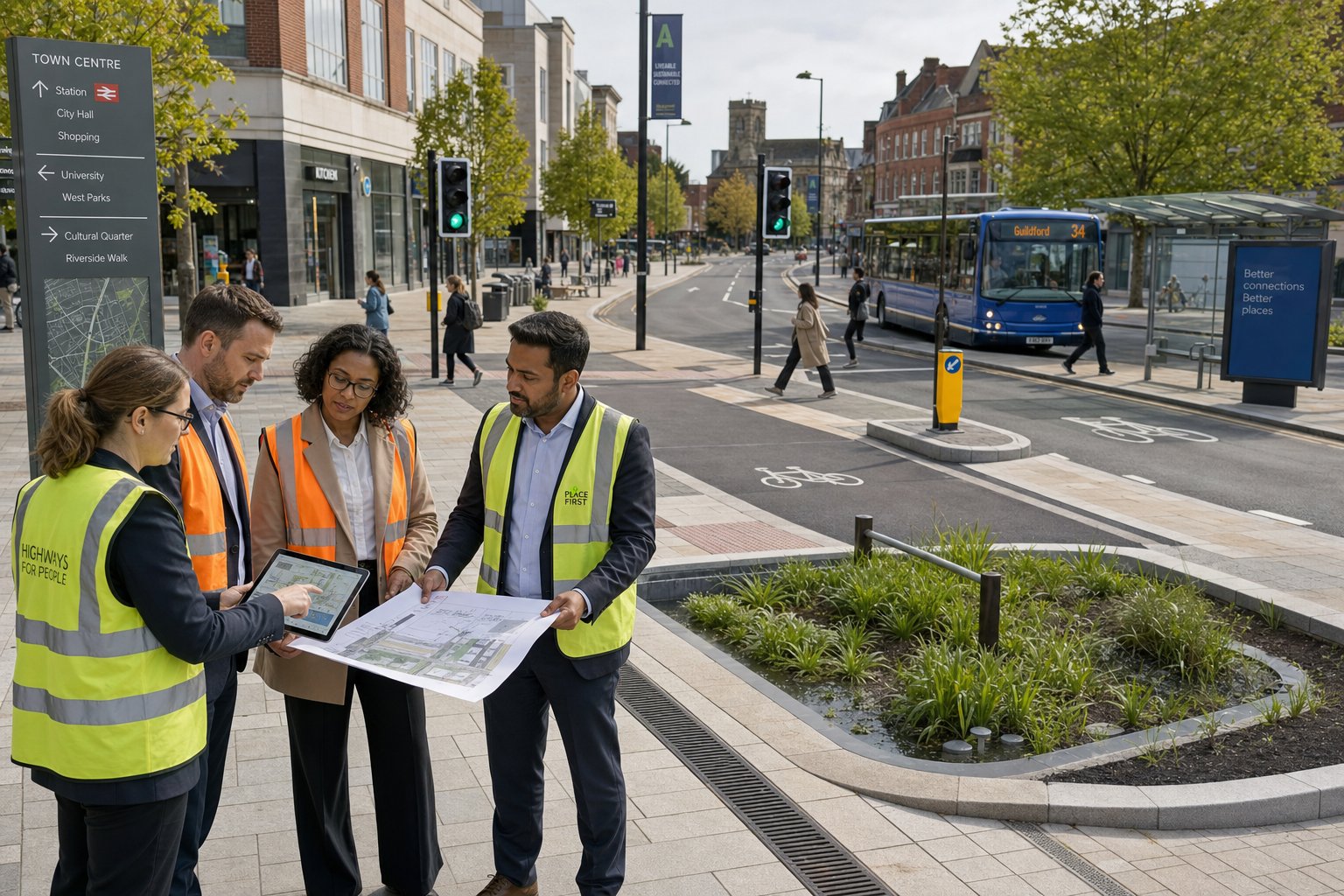
Good public road design is about more than moving vehicles efficiently. In 2026, the strongest schemes start with a simple but often neglected idea: roads and streets are part of places. They connect homes to schools, shops to labour markets, and communities to services. So the best public sector highway engineering balances movement with place, and does so from the outset rather than trying to retrofit urban quality later.
That means understanding street hierarchy, surrounding land use, frontage activity, speed environment, user mix, servicing needs, drainage constraints, and maintenance implications before locking in a layout. A town-centre street, a suburban distributor, and a rural link road should not be designed as if they solve the same problem.
It also means designing for ordinary human behaviour. People cross where it is convenient, not where drawings assume they ought to. Cyclists prefer direct routes. Bus passengers value legibility and shelter. Drivers respond to geometry and visual cues, not policy statements. Engineering that ignores those realities tends to underperform, but tidy the CAD file looks.
Public bodies are also increasingly focused on whole-life value. That includes maintainable materials, efficient drainage, practical inspection access, and layouts that will not generate avoidable safety or maintenance liabilities once adopted.
Safety, Capacity, Accessibility, And Network Resilience
Safety remains the baseline. Designers must consider collision risk, visibility, speeds, conflict points, vulnerable users, and independent road safety audit. But modern public sector highway engineering does not treat safety as separate from capacity or accessibility: it treats them as interdependent.
Capacity still matters, especially on constrained urban networks and key growth corridors. Junctions need to operate acceptably, queues must be managed, and unreliable journey times can damage local economies. Yet maximising vehicular throughput at all costs often creates other failures: poor crossings, hostile cycling conditions, severance, or induced traffic problems elsewhere.
Accessibility widens the lens. Inclusive mobility requires attention to gradients, widths, crossing times, tactile surfaces, dropped kerbs, waiting areas, bus stop interfaces, and the experience of disabled users. This is one reason many teams now bring in highway design consultants early, rather than trying to retrofit accessibility after planning comments arrive.
Network resilience has climbed the agenda too. Authorities are planning for incidents, utility strikes, flooding, overheating, and asset deterioration. A road that works only in ideal conditions is not especially resilient. Redundancy, drainage capacity, diversion strategy, and maintainability are now core design issues, not nice extras.
Standards, Guidance, And Approval Routes In The UK

UK public sector highway engineering operates within a layered system of standards, guidance, and local interpretation. At national level, the Design Manual for Roads and Bridges remains fundamental, particularly for trunk roads, strategic corridors, and situations where DMRB principles are adopted by local authorities. Manual for Streets and related place-based guidance continue to shape urban street design, especially in lower-speed environments.
Alongside those sit the Traffic Signs Regulations and General Directions, the Traffic Signs Manual, Inclusive Mobility, and cycle design guidance including LTN 1/20. Drainage, structures, utilities, and road safety each bring their own technical expectations. None of these documents operates in a vacuum: the challenge is deciding which apply, in what combination, and with what degree of flexibility.
Local authorities then add another layer through design guides, standard details, adoption manuals, and approval procedures. Two neighbouring councils can interpret similar principles quite differently. That catches out project teams more often than it should.
Approval routes vary with scheme type. Smaller local schemes may move through internal design checks, safety audit, drainage approval, TRO processes, and construction sign-off. Major projects can require business cases, environmental assessment, statutory orders, land powers, committee approvals, and external funding assurance. Where the strategic road network is involved, National Highways’ governance and technical approval procedures become critical.
In short, compliance is not a box-ticking exercise. It is a managed process of technical justification, authority engagement, and documented decision-making.
Funding, Procurement, And Project Delivery In The Public Sector
Funding shapes what gets built, how quickly it moves, and sometimes how ambitious a scheme can be. In the public sector, money commonly comes from a blend of central government allocations, local capital budgets, combined authority programmes, developer contributions, maintenance settlements, and ring-fenced funding pots for priorities such as active travel, bus improvements, or safety.
That mixture has consequences. A project may be technically sound but still stall because the funding stream is time-limited, restricted to certain outputs, or dependent on a business case threshold being met. Public sector highway engineering hence involves a lot of staging: feasibility, option sifting, preliminary design, economic appraisal, consultation, detailed design, approvals, procurement, construction, and handover.
Procurement itself is highly structured. Authorities often use frameworks, mini-competitions, or open tenders to appoint consultants and contractors, with NEC forms of contract remaining common because they support programme management, change control, and collaboration. Value for money is essential, but in practice the public sector is also testing risk allocation, social value, programme certainty, and supplier capability.
For development-related work, funding may depend on Section 106 obligations, Section 278 delivery mechanisms, or a package of public and private contributions. The practical question is not just “who pays?” but “who promotes, approves, adopts, and maintains?”
Projects that succeed tend to align funding, scope, approvals, and delivery responsibilities early. Projects that do not… usually spend a long time in meeting rooms with revised risk registers.
Common Highway Schemes Delivered By Public Authorities
Most public authorities are not delivering glamorous mega-projects every month. Their regular work is a steady pipeline of practical interventions that keep networks functioning and support local growth. Junction improvements are a staple: signal upgrades, lane reallocation, roundabout alterations, right-turn bans, pedestrian phases, and safety-led remodelling.
Corridor schemes are equally common. These may combine bus priority, cycle facilities, crossing upgrades, loading changes, parking rationalisation, resurfacing, and public realm improvements along a town or district route. Maintenance and renewals also form a huge part of public sector highway engineering, even if they receive less attention than new-build works. Carriageway patching, drainage renewal, bridge maintenance, retaining wall repairs, lighting replacement, and traffic signal modernisation all sit within the same delivery landscape.
Authorities also promote school street measures, 20mph schemes, low-traffic neighbourhood elements, controlled parking zones, speed management, and casualty reduction packages. In town centres, the boundary between highway engineering and urban design becomes particularly thin, with schemes expected to support footfall, civic quality, accessibility, and servicing all at once.
For planning-led projects, this matters because off-site mitigation often plugs into an existing authority programme or asset strategy. A development may trigger a crossing, a ghost island, bus stop improvements, or a signal review rather than an entirely standalone intervention. Understanding that wider context helps applicants propose measures the authority can actually support and maintain.
Managing Public Consultation, Stakeholders, And Political Scrutiny
Technically sound highway schemes can still fail if consultation is poor or stakeholder management is superficial. Public roads are visible, emotional, and political. People notice lane changes, parking loss, tree removal, altered access, bus stop moves, and changes to crossing arrangements immediately. And they react as road users, residents, traders, parents, and voters all at once.
That is why public sector highway engineering is not just about drawings and models. It is also about explaining trade-offs clearly, testing assumptions in public, and responding to legitimate concerns without letting misinformation drive the whole process. Formal consultation may be statutory, as with certain traffic orders or major scheme processes, but non-statutory engagement often matters just as much.
Done well, public consultation transport work can improve scheme design, reveal operational issues early, and reduce the chance of last-minute objections from members or affected groups. Done badly, it hardens opposition and creates avoidable delay.
Stakeholders usually include ward members, MPs, emergency services, bus operators, freight interests, schools, access groups, utilities, nearby landowners, and local businesses. Their concerns are not identical. Traders may focus on loading: residents on rat-running: accessibility groups on crossing design: members on deliverability and public mood.
Political scrutiny is part of the public-sector deal. Decisions may go to committee, cabinet, or delegated approval, and schemes can be challenged through complaints, call-in, ombudsman routes, judicial review, or audit processes. That is one reason the technical record matters so much: authorities need an evidence trail showing how options were assessed, why decisions were made, and how consultation shaped the final scheme.
For teams working across planning and delivery, the lesson is simple. Never assume a technically correct answer will carry itself.
Current Priorities In 2026: Active Travel, Decarbonisation, And Place-Making
In 2026, three priorities are shaping public sector highway engineering more visibly than any others: active travel, decarbonisation, and place-making. None is entirely new, but all three now sit much closer to the centre of decision-making.
Active travel has moved beyond painted lanes and token crossings. Authorities are under pressure to provide coherent, continuous, and safe walking and cycling networks that ordinary people will actually use. That means route continuity, side-road priority decisions, junction protection, crossing frequency, secure cycle parking, and links to schools, stations, and centres. If a scheme claims to support mode shift, the design now has to prove it.
Decarbonisation is changing project appraisal as well as layout design. Highway teams are expected to support modal shift, reduce unnecessary traffic growth, consider lower-carbon materials, and think more carefully about induced demand. EV infrastructure plays a role, but it is not the whole story. The harder question is how street and transport design can reduce dependence on private car trips, especially for short urban journeys.
Place-making ties those themes together. Streets are increasingly judged by whether they feel safe, attractive, healthy, and economically useful, not simply by how many vehicles they can process per hour. That has implications for carriageway widths, crossing convenience, greening, seating, loading strategy, bus priority, and the design of new development frontages.
For project teams preparing planning submissions or public infrastructure proposals, the practical takeaway is that transport evidence and highway design now need to speak the language of wider outcomes. Capacity still matters. Safety still matters. But so do carbon, health, social value, and the everyday quality of the places people move through.
And that is probably the defining shift in public sector highway engineering today: roads are no longer judged only as transport assets, but as part of the social and economic fabric of a place.
Frequently Asked Questions About Public Sector Highway Engineering
What does public sector highway engineering encompass in the UK?
Public sector highway engineering covers the planning, design, delivery, maintenance, and operation of publicly adopted roads and streets. It involves managing everything from local residential roads to strategic networks, including drainage, traffic signals, and lighting, all in the wider public interest.
How does public sector highway engineering differ from private development highway work?
Unlike private projects driven by commercial objectives, public sector highway engineering is led by statutory duties, public accountability, and budget constraints. It requires regulated procurement, democratic decision-making, and focuses on whole-life asset maintenance for diverse users, not just site-specific needs.
Who are the main organisations involved in delivering public highway schemes?
Delivery involves multiple parties including National Highways managing strategic roads, local highway authorities overseeing local networks, government departments like the DfT and Treasury, consultants, contractors, utilities, emergency services, and community stakeholders working collaboratively.
How does public sector highway engineering support the planning system?
Highway engineering informs local plans and development applications by assessing impacts such as junction capacity, access safety, and mitigation needs. It ensures proposals meet standards for safe and suitable access, aligning transport assessments and design with planning policies and conditions.
What are the current priorities shaping public sector highway engineering in 2026?
The key priorities are active travel, decarbonisation, and place-making. Authorities focus on creating safe continuous walking and cycling networks, reducing traffic and carbon emissions, and designing streets as liveable, people-centred spaces that enhance health, social value, and local economies.
Why is public consultation important in public sector highway engineering projects?
Consultation engages residents, businesses, and stakeholders to explain trade-offs, address concerns, and improve schemes. Effective public consultation transport planning reduces opposition, uncovers local issues early, and strengthens planning outcomes by fostering transparent, inclusive decision-making.