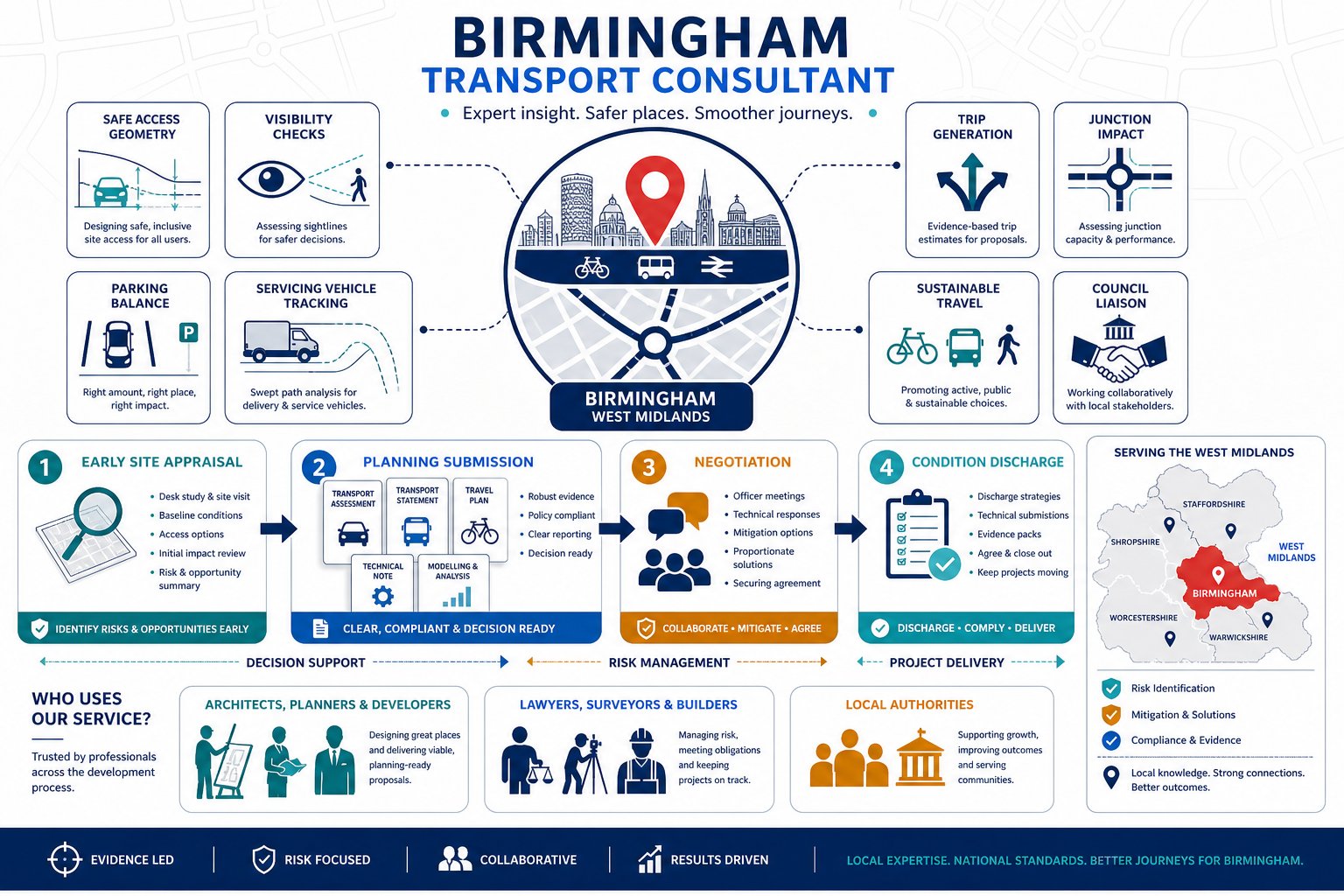
A planning application can be perfectly sensible in land-use terms and still stall because the transport case is thin, late, or poorly framed. In Birmingham, that happens more often than many project teams expect. Highway comments can trigger redesigns, extra surveys, revised parking layouts, fresh tracking, or a full rethink on access strategy, sometimes after the rest of the application has already been assembled.
That’s where a Birmingham transport consultant becomes more than a technical add-on. We help development teams translate transport risk into something manageable early enough to influence the scheme, not just defend it at the eleventh hour. For architects, planners, developers, lawyers, surveyors, and local authorities, the value is usually practical: clearer site constraints, proportionate reporting, better conversations with Birmingham City Council, and fewer surprises during validation or determination.
In 2026, that role is becoming even more planning-led. Sustainable travel expectations are sharper. Parking, servicing, and road safety issues are scrutinised closely. And local thresholds still need careful interpretation rather than box-ticking.
Below, we set out what a Birmingham transport consultant actually does, who typically needs that support, when it should be brought in, which reports are commonly required, and how to choose the right adviser for a scheme in Birmingham and the wider West Midlands.
What A Birmingham Transport Consultant Does For Planning Applications
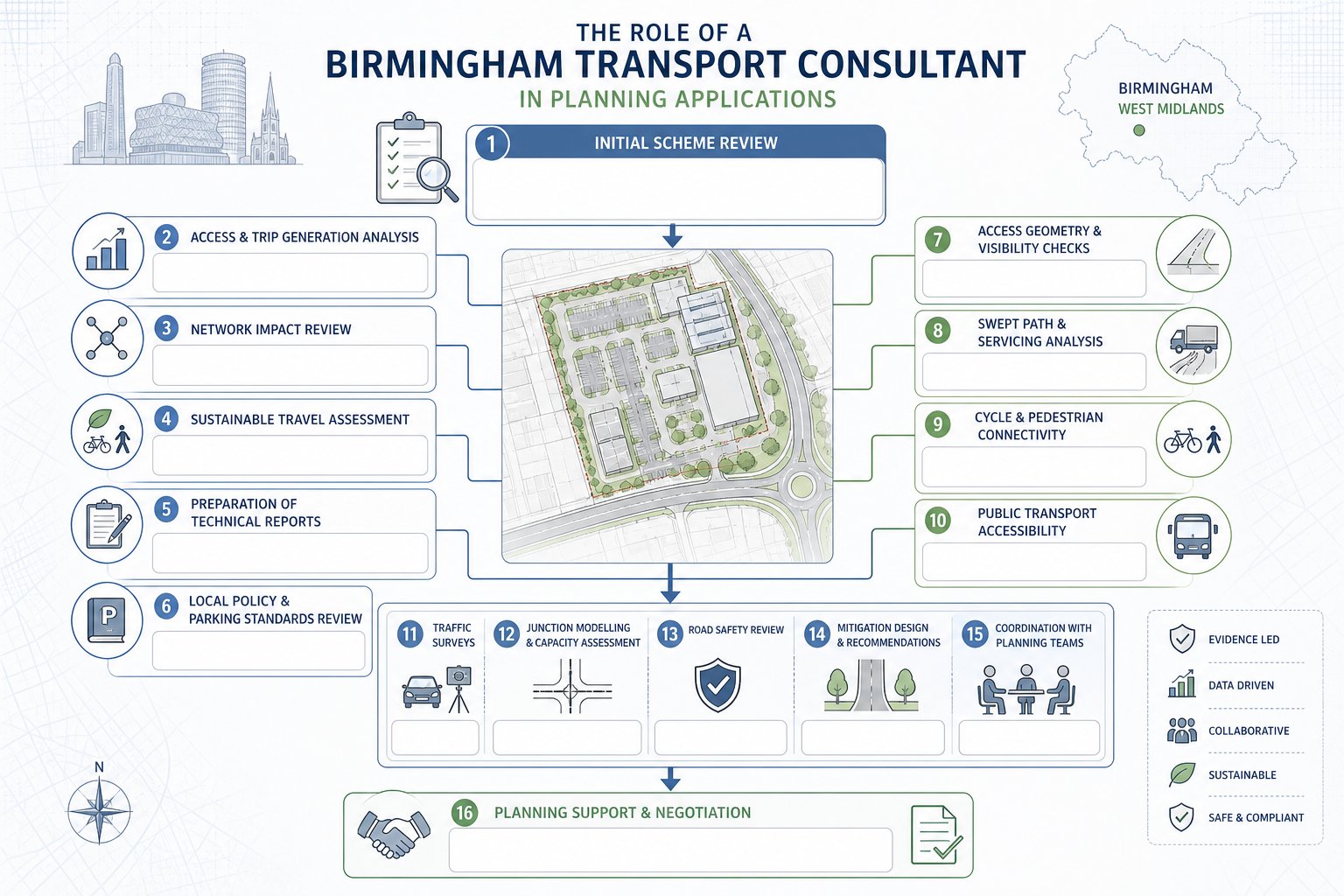
A Birmingham transport consultant provides the transport and highways evidence that helps a planning application stand up technically. In simple terms, we assess how a proposal will be accessed, how many trips it is likely to generate, what effect that movement may have on the surrounding network, and whether the scheme supports safe and sustainable travel.
That work usually results in documents such as a Transport Assessment, Transport Statement, Travel Plan, Technical Note, or junction modelling report. But the documents are only part of the job. The more valuable role is often strategic: identifying issues before they become objections and shaping the scheme so that transport matters are addressed by design rather than explained away later.
In Birmingham, this means applying national guidance alongside local planning policy, parking standards, and practical development management expectations. A consultant may review access geometry, visibility splays, swept paths, servicing arrangements, cycle parking, pedestrian links, and public transport accessibility. On larger or more sensitive schemes, they may also coordinate traffic surveys, capacity modelling, road safety review, and mitigation proposals.
There is also a negotiation function. We often support planning teams in discussions with Birmingham City Council, the local highway authority, and sometimes wider stakeholders across the West Midlands. That can include responses to consultee comments, revisions to access design, agreement of mitigation, and technical support for planning conditions or legal agreements.
Where schemes need linked design input, our transport advice often sits alongside broader engineering work such as highway design consultants support, so the planning narrative and the physical layout move in step rather than in conflict.
Who Typically Needs Transport Advice In Birmingham
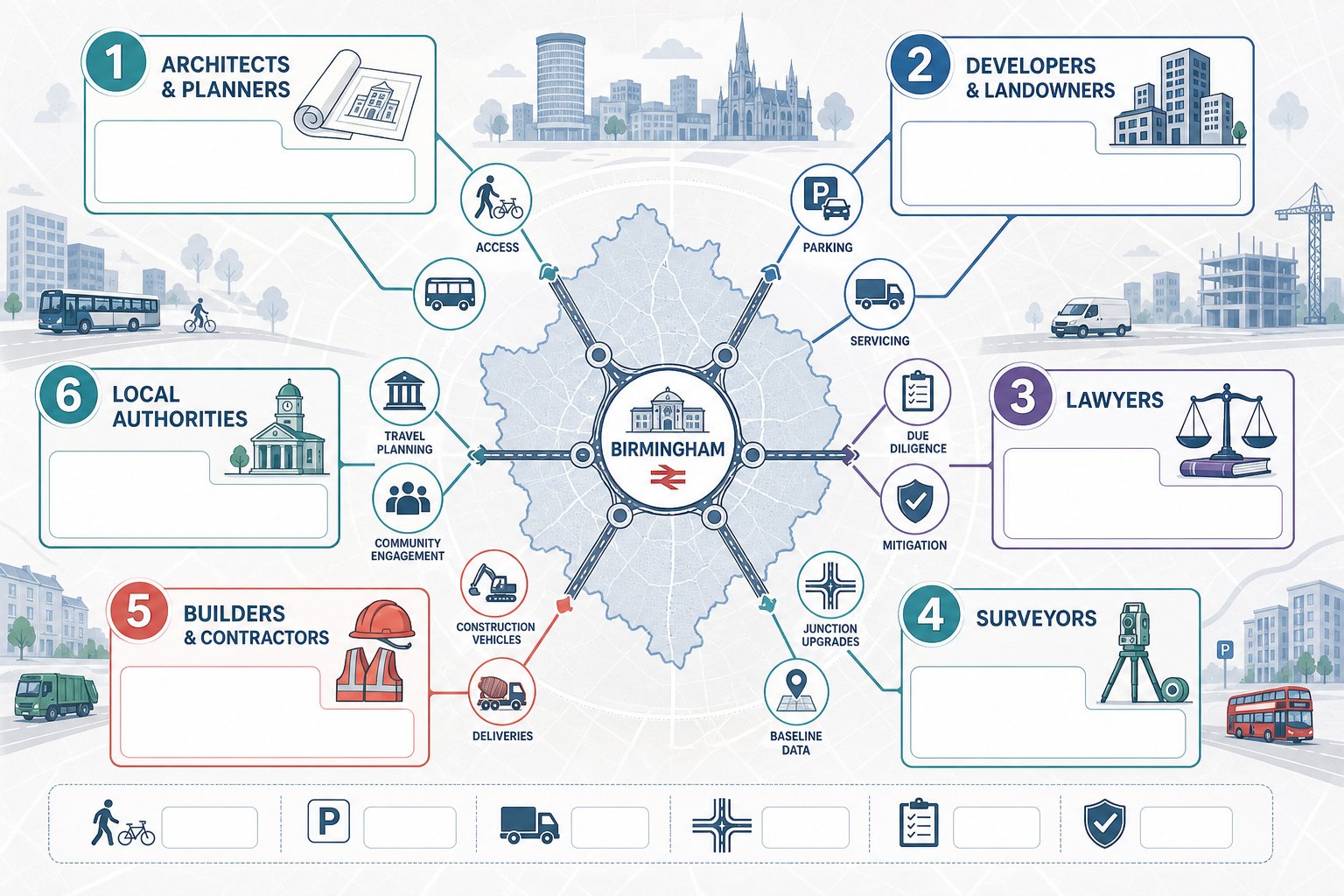
Transport input is rarely limited to one profession. In Birmingham, it tends to be needed by whoever is carrying delivery risk, planning risk, or legal risk on a site.
Architects, Planners, Developers, And Landowners
Architects and planning consultants usually involve us when transport assumptions start to shape the masterplan. That might be as basic as asking whether a site can achieve a safe access, or as scheme-defining as testing whether parking numbers, servicing space, or junction improvements will fit within a constrained urban layout.
Developers and landowners need transport advice for a slightly different reason: deliverability. A site may look attractive on paper, but if it requires major off-site works, struggles to accommodate refuse vehicles, or sits in a location where trip impacts are likely to be challenged, value and programme can change quickly. Early advice gives decision-makers something firmer than optimism.
For planning-led development teams, this work often overlaps with the wider role of Transport Planning Consultants: translating technical transport evidence into planning-ready submissions. And for housebuilders or commercial promoters, specialist Developer Transport Consultants: support can be especially useful where multiple reserved matters, phased delivery, or viability-sensitive mitigation are involved.
Lawyers, Surveyors, Builders, And Local Authorities
Lawyers usually need transport advice during due diligence, option agreements, site disposals, planning appeals, or when obligations and access rights need to be understood properly. A transport issue that seems minor in a brochure can become very material in a contract.
Surveyors often use our input to test whether planning assumptions are realistic. If a scheme needs significant highway mitigation, reduced parking, or operational controls to gain consent, that affects appraisal, negotiations, and sometimes tenancy strategy.
Builders and contractors may need advice later in the process, especially where planning conditions require construction access review, servicing detail, swept path confirmation, or implementation of Travel Plan measures.
Local authorities and public-sector bodies also use transport consultants when promoting schools, civic buildings, housing sites, or regeneration proposals. Sometimes the role is promotional. Sometimes it is review-based. Either way, what matters is a clear technical line that responds to Birmingham’s development context rather than relying on generic assumptions.
When Transport Input Is Needed During The Development Process
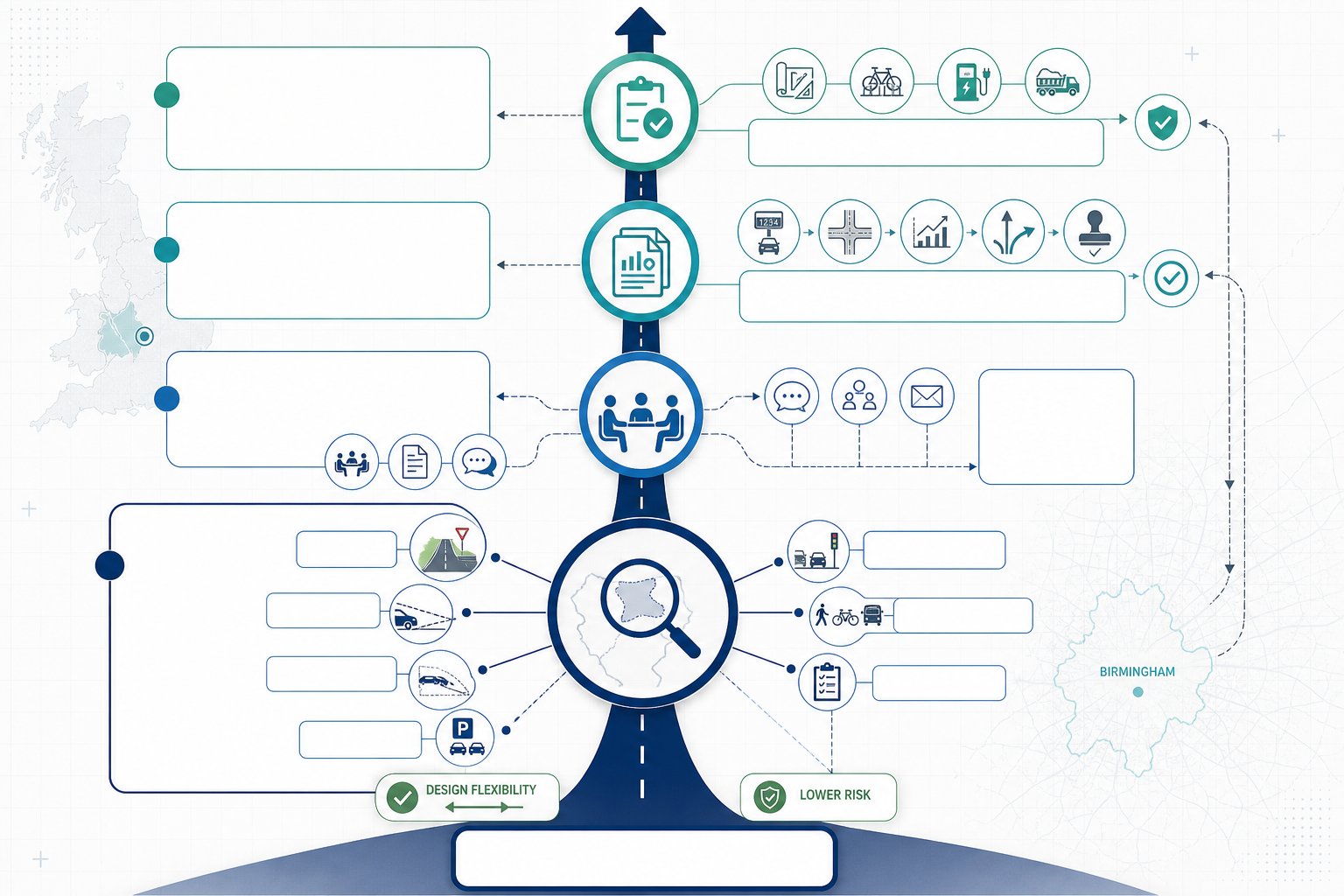
The short answer is: earlier than most teams first think. Transport advice is often most useful before a planning application is drafted, because that is when genuine design flexibility still exists. Once plans are fixed, the consultant’s role becomes more defensive and usually more expensive.
Early Site Appraisal And Pre-Application Support
At appraisal stage, we are typically testing feasibility rather than producing formal evidence. Can vehicles enter and leave safely? Is visibility achievable within land control? Will refuse, delivery, and emergency vehicles turn? Is parking likely to be acceptable? Are there nearby junctions already under pressure? And does the site have a realistic sustainable transport story?
Those early questions matter because they influence land bids, concept layouts, and pre-app strategy. A modest technical note at this stage can save months later. It can also help planning teams decide whether a proposal is likely to need a full Transport Assessment, a shorter statement, or a more focused highways note.
Pre-application support also includes attending meetings, preparing response notes, and framing transport issues in a way officers can engage with quickly. On schemes with wider community sensitivity, transport concerns often appear first through public consultation transport feedback, long before formal consultee comments arrive.
Planning Submission, Negotiation, And Condition Discharge
Once a scheme moves into submission, the transport role becomes more formal. We prepare the agreed reporting package, coordinate surveys, analyse trip rates, assess junction performance, and set out mitigation where needed. For many projects, this is where a transport assessment for planning application either gives confidence to officers or invites further challenge.
But submission is not the end of the story. Negotiation often follows: clarifying assumptions, revising access drawings, refining parking or servicing arrangements, and discussing obligations under Section 106 or works under Section 278.
Then comes condition discharge, which is often underestimated. A permission may require detailed access drawings, cycle parking details, implementation-stage Travel Plan measures, electric vehicle charging provision, construction routing, or verification that visibility splays can be maintained. Good transport input bridges these stages, so the logic in the original application still works when the scheme reaches technical approval and delivery.
Core Transport Reports Commonly Required In Birmingham
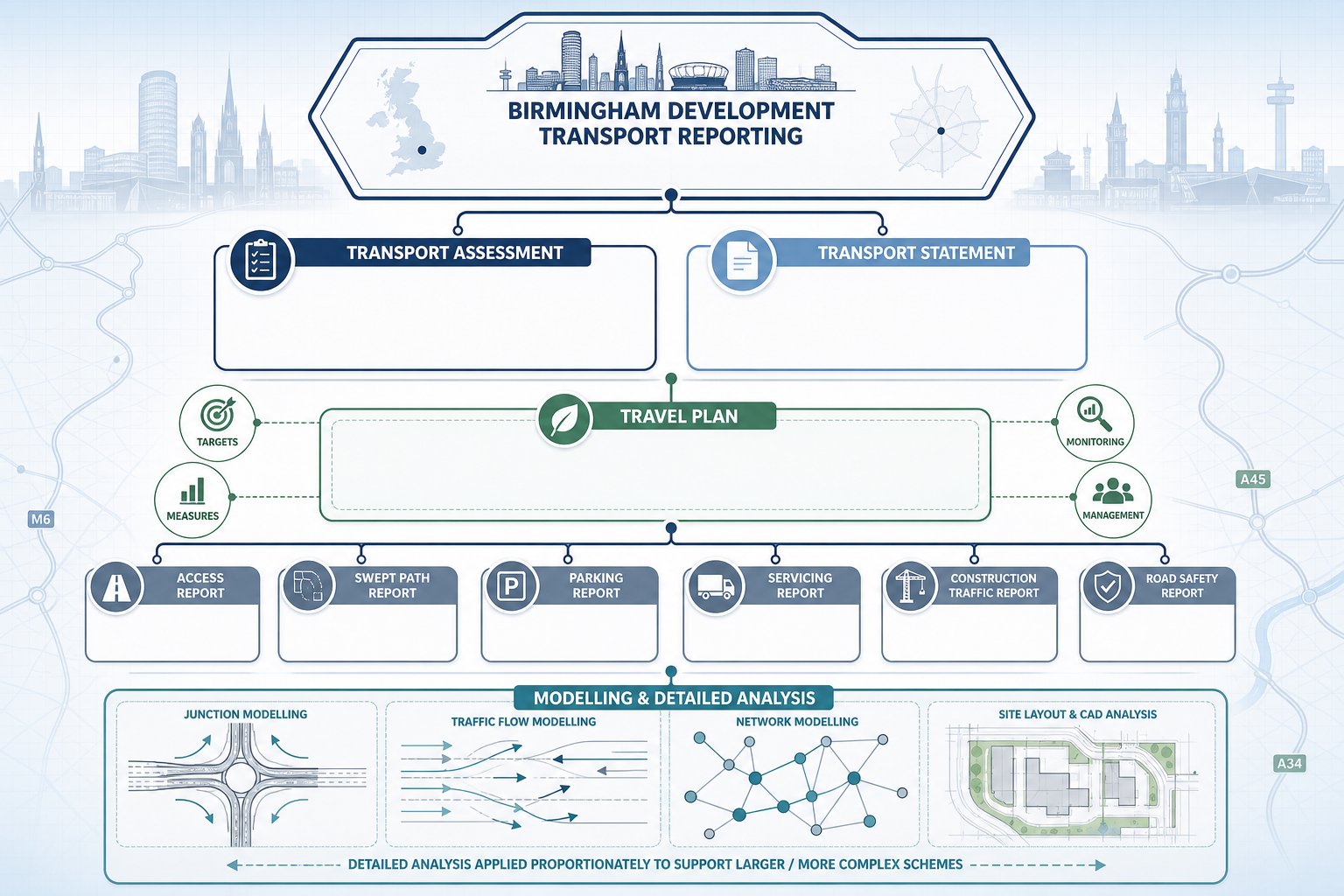
The report package depends on the scale, use, and context of the development, but a few documents come up repeatedly in Birmingham.
A Transport Assessment is typically required for larger or more transport-sensitive proposals. It sets out the existing transport context, predicts trip generation, distributes and assigns those trips across the network, assesses likely impacts, and identifies mitigation where needed. A Transport Statement is usually a lighter-touch version for smaller schemes where impacts are expected to be limited but still need proper explanation.
A Travel Plan, framework or full, may be required for residential, employment, education, healthcare, and mixed-use development. Its purpose is not just to promote sustainable travel in abstract terms: it should identify realistic measures, targets, monitoring arrangements, and management responsibilities that fit the site and user profile.
Then there are more targeted outputs: highways technical notes, access appraisals, swept path analysis, parking strategy notes, servicing and delivery plans, construction traffic notes, and road safety-related assessments. On urban Birmingham sites, these narrower reports can be just as important as the headline assessment because they often deal with the issue that officers focus on most closely: can the scheme actually function day to day?
For more complex proposals, modelling may be needed using tools such as LinSig, TRL Junctions, Vissim, SATURN, or Visum, depending on the scale of impact and the network questions involved. AutoCAD-based drawings often sit alongside this to show access layout, tracking, and junction geometry.
Where local engineering detail becomes critical, coordination with a Traffic Engineer In the city can help align planning evidence with the eventual design deliverables.
The key point is proportionality. Birmingham officers generally expect transport reporting to be robust, but they do not benefit from unnecessary volume. The strongest submissions are usually the ones that answer the right questions clearly, with enough technical depth to be credible and no padding.
How Birmingham Planning Policy And Local Thresholds Shape Requirements
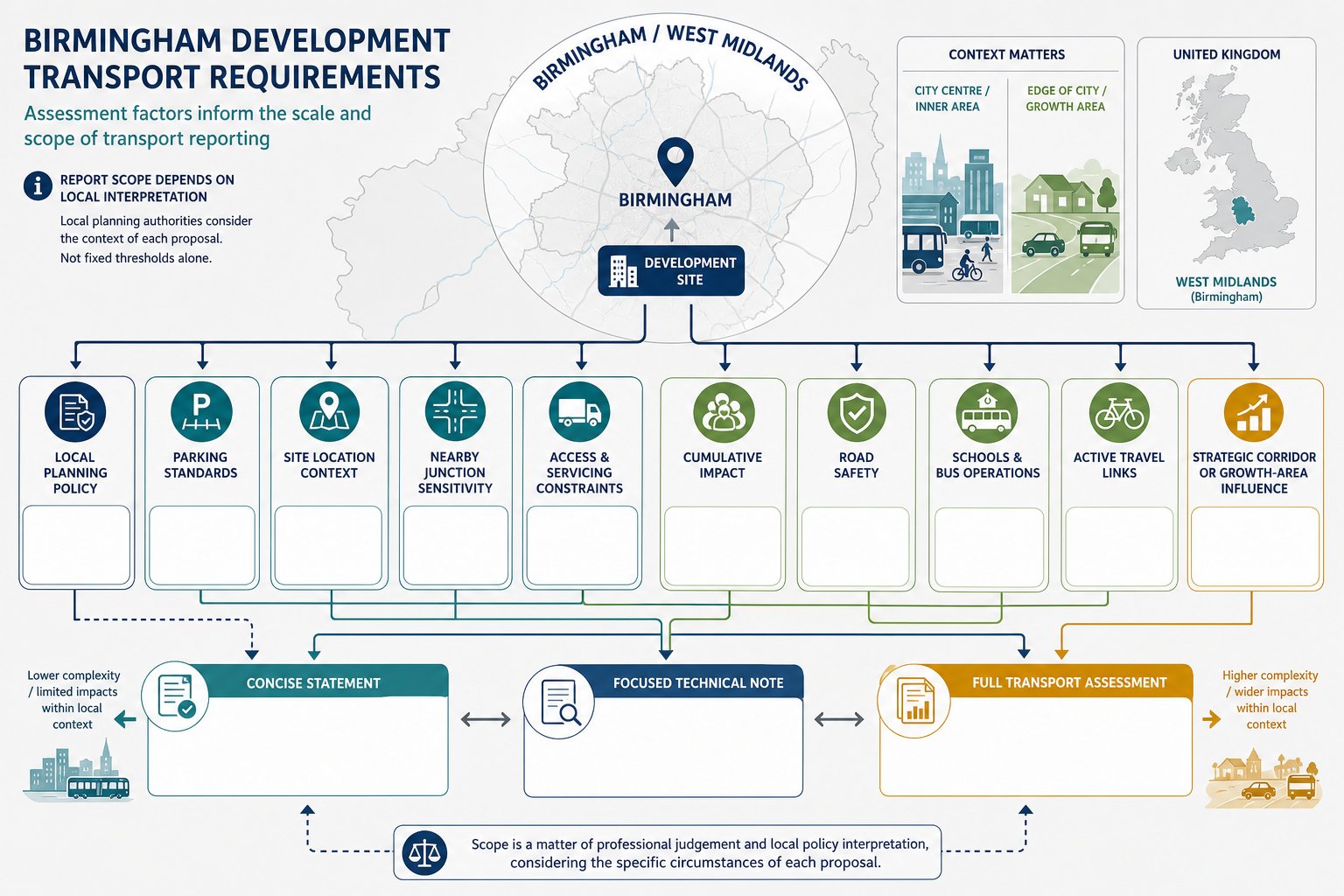
Transport requirements in Birmingham are not determined by national guidance alone. National policy sets the broad framework, but local interpretation matters enormously. That is why a report that feels technically adequate in one authority area may be challenged in another.
In practice, Birmingham planning policy, parking standards, locational context, and the likely sensitivity of nearby junctions all influence what level of transport evidence is expected. A city-centre site with strong public transport access may justify a different parking and trip-generation approach from an edge-of-city employment scheme where car use is more entrenched. Likewise, a modest change of use can still trigger focused technical work if access is constrained or servicing is awkward.
Thresholds are helpful, but they are not mechanical. Officers and highway consultees will still consider the character of the proposal, cumulative impacts, road safety history, nearby schools, bus operations, active travel links, and whether the development aligns with wider movement objectives. That is one reason we spend time interpreting context rather than simply counting floor area or units.
This local dimension also connects to broader regional transport planning pressures across the West Midlands. Schemes near strategic corridors, key junctions, or growth areas may need to demonstrate awareness of network-wide issues, not just their immediate frontage.
The practical outcome is straightforward: the required report type, modelling scope, and mitigation package should flow from Birmingham-specific policy and site conditions. A good consultant knows when a concise statement is enough, when a full assessment is unavoidable, and when a narrowly targeted note will answer the authority’s real concern faster than a generic all-purpose report.
Key Issues A Transport Consultant Assesses On Site
Every site has its own transport pressure points, but most assessments in Birmingham revolve around two broad themes: whether the place works physically, and whether the movement it creates is acceptable.
Access, Visibility, Parking, And Servicing
Physical access is often the first make-or-break issue. We assess whether vehicles can enter and leave the site safely, whether visibility splays meet expected standards, and whether the junction arrangement suits the road hierarchy and local conditions. That sounds simple. It rarely is. Existing street trees, boundary walls, retained buildings, on-street parking, bus stops, level changes, and third-party land can all complicate an otherwise tidy access concept.
Parking is another area where planning ambition and operational reality need balancing. Too much parking can conflict with sustainable travel objectives and design quality. Too little can trigger overspill concerns or undermine occupier confidence. The right answer depends on location, use, trip profile, and enforcement context, not just a spreadsheet.
Servicing matters just as much. We test whether refuse vehicles, delivery vans, and emergency vehicles can manoeuvre safely, whether loading can happen without blocking access or the highway, and whether turning is possible on site. On constrained schemes, these checks often drive meaningful design revisions.
Detailed engineering input from a Traffic Engineer In a comparable authority can be useful by analogy, but Birmingham decisions still turn on local geometry, local standards, and local officer judgement.
Trip Generation, Highway Impact, And Sustainable Travel
The second theme is movement impact. We estimate how many vehicle and person trips a scheme is likely to produce, when those trips occur, and where they are expected to travel. That analysis usually draws on recognised databases, census information, local survey evidence, and professional judgement.
From there, we assess the effect on junction capacity, route operation, and sometimes road safety. For smaller schemes, this may be a reasoned qualitative assessment. For larger proposals, it can require detailed modelling. Either way, the aim is the same: to show whether the residual cumulative impact would be severe, acceptable with mitigation, or likely to prompt concern.
Sustainable travel is no longer a bolt-on paragraph near the end of a report. In Birmingham, it is part of the planning logic from the start. We hence examine walking distances to local facilities, bus and rail accessibility, cycle connections, likely mode share, and practical interventions that could reduce single-occupancy car trips. That might include better cycle parking, pedestrian route upgrades, travel information packs, car club measures, or management commitments within a Travel Plan.
Done well, this part of the work does more than satisfy policy. It helps explain why a scheme belongs in its location.
How To Choose The Right Birmingham Transport Consultant
Not every consultant is the right fit for every scheme. In Birmingham, we would start with one question: do they understand development planning in this authority area, not just transport engineering in the abstract?
A strong consultant should be comfortable advising at different stages, site appraisal, pre-app, submission, negotiation, and condition discharge. They should know when to produce a concise note and when a more detailed Transport Assessment or modelling package is warranted. They should also be able to explain technical issues in plain language to clients, design teams, and officers. That matters more than people sometimes think. Plenty of delay comes from misunderstanding rather than disagreement.
Experience in Birmingham and the wider West Midlands is especially valuable. Local policy interpretation, typical officer concerns, parking expectations, and network sensitivities are not identical to those in other cities. A consultant with that background is usually quicker at spotting what really matters.
It is also worth checking technical capability. If a scheme may require junction modelling, swept path analysis, access design input, or Travel Plan monitoring, make sure the consultant can either deliver those services directly or coordinate them efficiently. Programme reliability matters too. A brilliant report that arrives after the planning deadline is, bluntly, not brilliant.
Finally, look at track record and working style. We would favour a team that is concise, responsive, and commercially aware, with evidence of successful permissions and practical negotiation. For clients who value fast, planning-led reporting, our own approach at ML Traffic is built around clear advice, local threshold awareness, and more than 30 years of transport engineering experience. In a market where some reports feel templated, that combination still makes a difference.
The right Birmingham transport consultant should reduce uncertainty, not add to it. If they can identify risk early, tailor the scope properly, and help the wider team make better decisions, they are likely the right partner.
Frequently Asked Questions about Birmingham Transport Consultants
What services does a Birmingham transport consultant provide for planning applications?
A Birmingham transport consultant prepares Transport Assessments, Travel Plans, and technical notes to support planning applications, assessing site access, trip generation, highway impact, and sustainable travel in line with national guidance and local policies.
Who typically requires the expertise of a Birmingham transport consultant?
Architects, planners, developers, landowners, lawyers, surveyors, builders, and local authorities often need Birmingham transport consultants to address planning, delivery, or legal risks associated with site access, highway impact, and transport matters.
When should transport advice be sought during the development process in Birmingham?
Transport input is most valuable early, during site appraisal and pre-application stages, to influence design and feasibility. It continues through planning submission, negotiation, and condition discharge for reports, modelling, and implementation.
Which core transport reports are commonly required for development schemes in Birmingham?
Common reports include Transport Assessments or Statements, Travel Plans, highways technical notes, access appraisals, swept path analyses, parking strategies, servicing plans, and junction modelling using specialist software suited to local conditions.
How do Birmingham’s planning policies and local thresholds influence transport requirements?
Local planning policies, parking standards, site context, and network sensitivities shape the level of transport evidence needed, with consultants interpreting thresholds to decide when full assessments, statements, or focused notes best address local concerns.
What factors should be considered when choosing the right Birmingham transport consultant?
Choose a consultant with experience in Birmingham’s development planning, strong stakeholder negotiation skills, knowledge of local policy, appropriate technical capabilities like junction modelling, and a track record of timely, clear, planning-led advice.