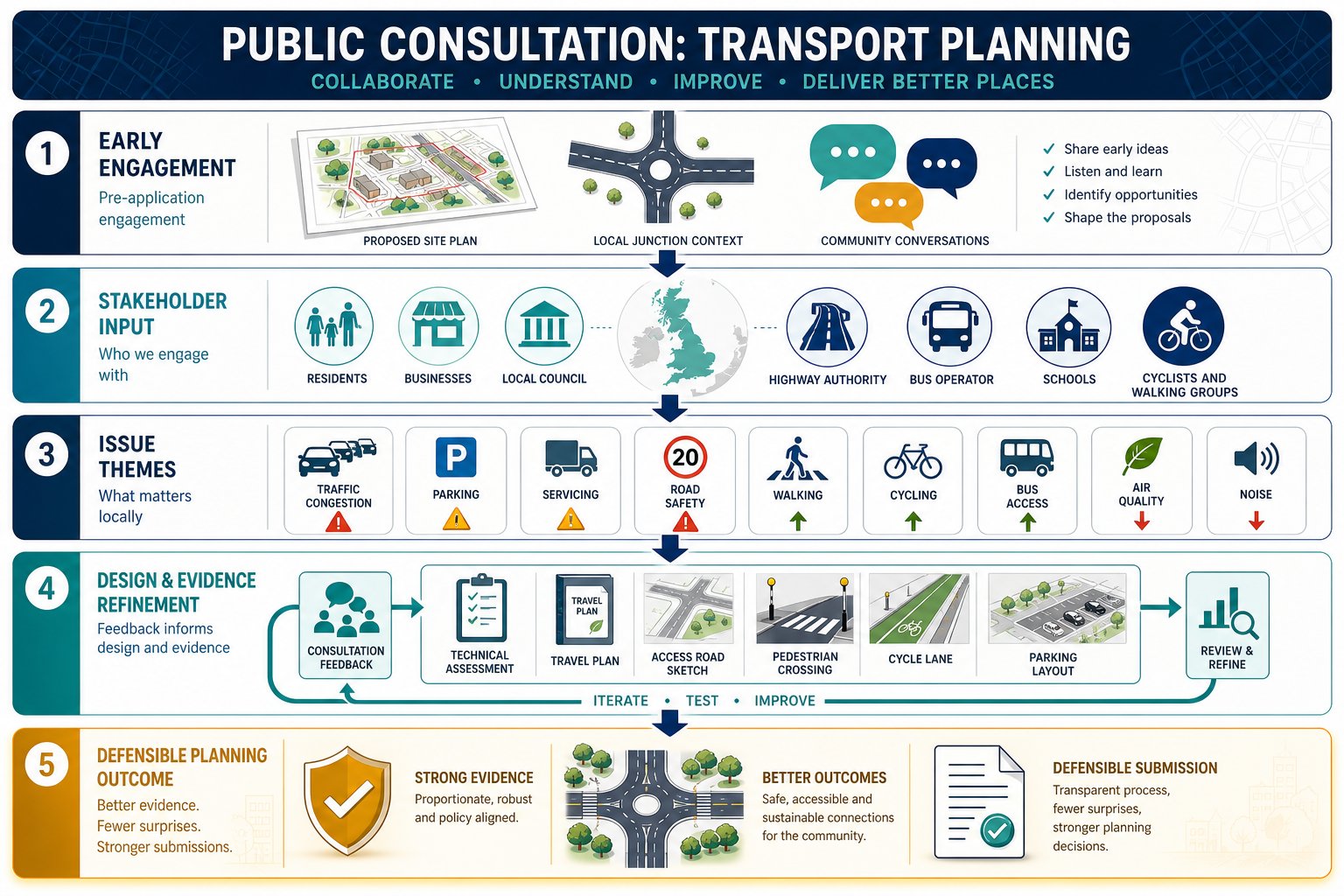
A transport proposal can look technically sound on paper and still run into avoidable resistance once real people start reading the drawings. That usually happens when the scheme has been modelled, assessed and justified, but not properly tested against local experience. Residents know where drivers rat-run at school drop-off. Businesses know when loading really happens. Councils know which junctions are politically sensitive, and which travel plan promises have fallen flat before.
That is why public consultation transport planning matters. Done well, it is not a late-stage exercise in defending a fixed design. It is a structured way to understand how a scheme will actually function, what concerns are likely to surface, and how those concerns should influence access, parking, servicing, road safety, active travel and network performance before positions harden.
For architects, planners, lawyers, surveyors, developers and local authorities, the practical value is straightforward: better evidence, fewer surprises, and planning submissions that are easier to explain and more robust under scrutiny. In our experience, consultation is strongest when it is proportionate, early and clearly connected to transport assessments, statements and travel plans rather than treated as a separate communications task.
In this guide, we set out what consultation means in transport planning, when it should happen, who should be involved, what issues usually arise, and how to turn feedback into defensible planning outcomes in 2026.
What Public Consultation Means In Transport Planning
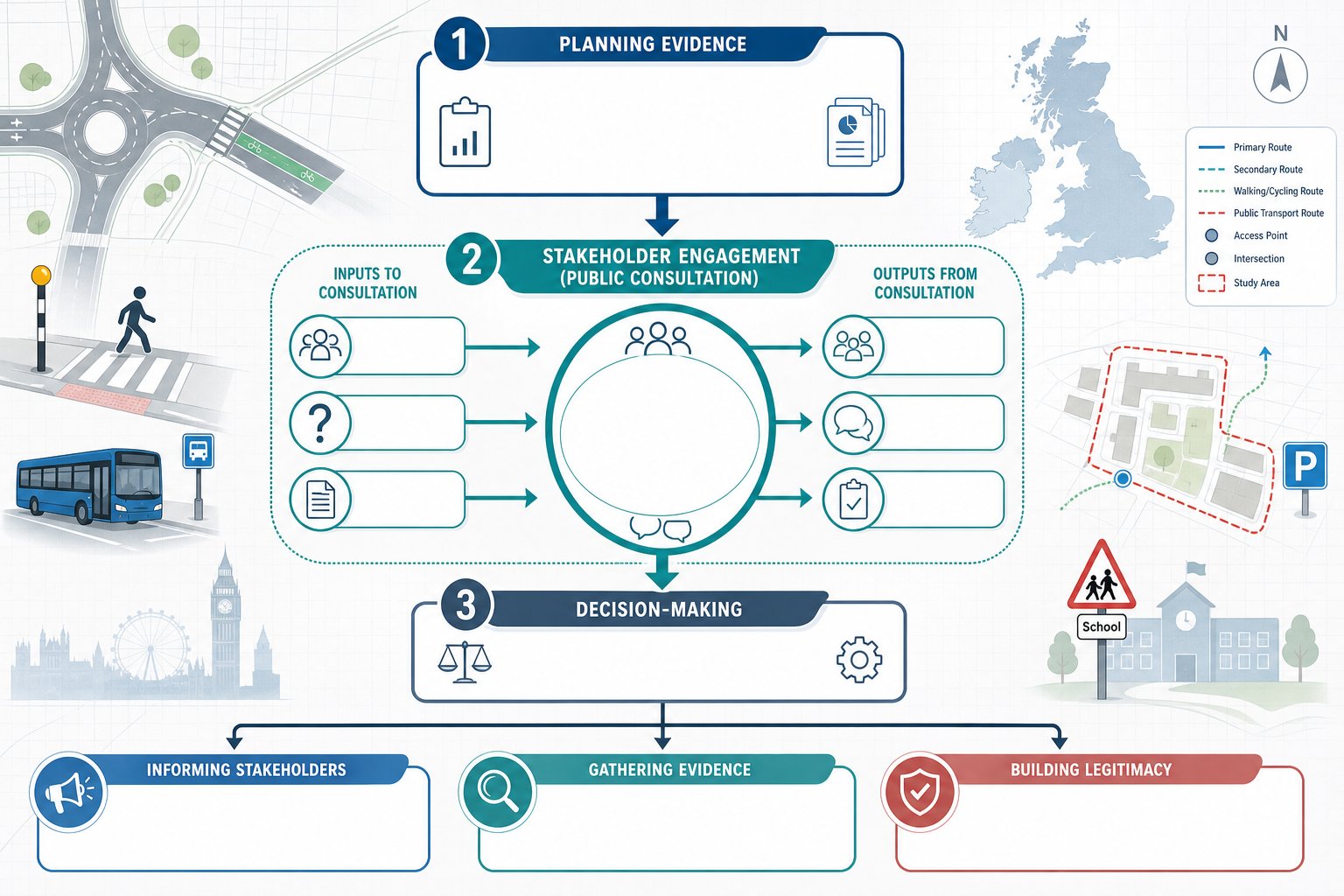
Public consultation in transport planning is the structured process of involving stakeholders and the wider public in shaping transport policy, development proposals and supporting planning material, then demonstrating how that input has informed decisions. The key word is structured. This is not a vague request for opinions. It is a planned exercise with defined audiences, clear questions, an evidence base, and a record of how responses were considered.
In planning terms, consultation often sits alongside transport assessments, transport statements, access strategies, travel plans and broader design development. It helps us test assumptions that desktop analysis alone can miss. A junction may operate within capacity in a model, for instance, but local users may highlight informal pedestrian crossings, school arrival peaks, bus reliability issues or parking displacement that changes how the proposal is perceived.
That practical link is why consultation should not be separated from technical work. A good engagement process improves the scheme as much as it improves messaging around the scheme. On more complex sites, it also helps align transport evidence with wider planning strategy, particularly where land use intensity, access arrangements and phased delivery need careful explanation. In that context, wider Private Sector Transport Planning often benefits from consultation that starts before the application pack is fully locked down.
At its best, consultation does three things at once: it informs stakeholders, gathers useful evidence, and builds legitimacy around the final recommendation.
Why Consultation Matters For Planning Applications And Transport Assessments
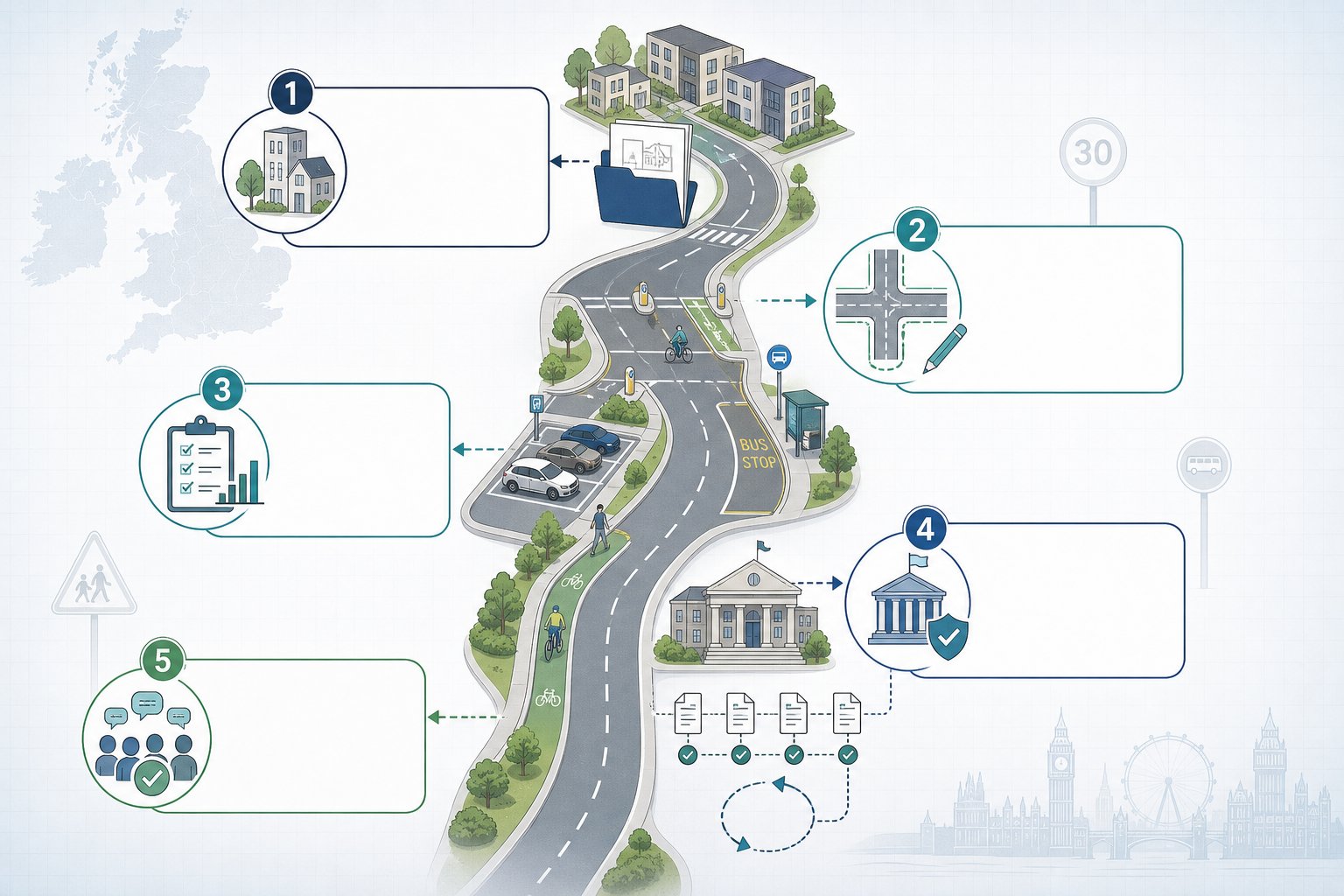
Consultation matters because planning decisions are rarely made on technical numbers alone. Highway impacts, accessibility, parking pressure and safety concerns are all judged in a local context. A proposal that addresses those local concerns openly is usually in a much stronger position than one that appears to have arrived fully formed.
For planning applications, consultation can improve both quality and acceptability. It can identify problems early enough to fix them, whether that means amending a site access, revising servicing hours, strengthening walking and cycling links or adding monitoring commitments to a travel plan. It can also reveal where objections are likely to focus, giving the applicant time to prepare proportionate evidence rather than scrambling after submission.
For transport assessments specifically, consultation often sharpens the baseline. Local people may point to peak periods that differ from standard assumptions, hidden conflict points for cyclists, informal parking patterns, or bus stop usage that is not obvious from mapping. Those insights can influence surveys, design testing and mitigation.
There is also a governance point. In many planning systems, and especially on larger or more sensitive schemes, consultation is a policy expectation or legal requirement. Decision-makers want to see transparency: who was engaged, what issues were raised, and what changed as a result. That audit trail can be as important as the engineering detail.
And, frankly, trust matters. Consultation does not eliminate opposition, but it does reduce the sense that transport evidence was prepared in isolation from the people who live with the network every day.
The Main Stages Of Consultation Across A Transport Planning Project
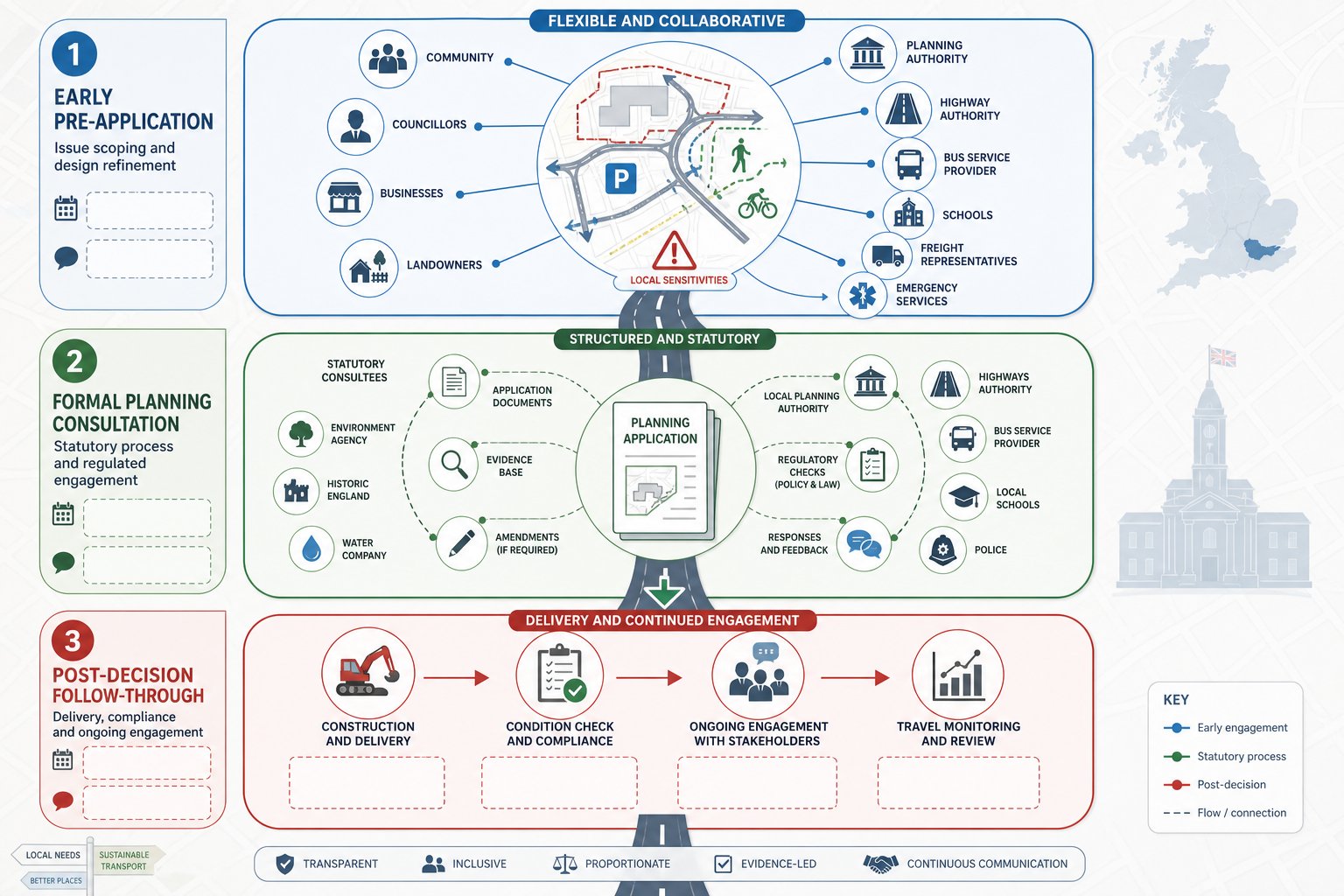
Consultation in transport planning usually unfolds in stages rather than one single event. Each stage has a different purpose, audience and level of detail, and confusion often starts when those stages are blurred together.
Pre-Application Engagement
Pre-application engagement is where the biggest gains usually sit. At this point, the scheme is still flexible enough for meaningful changes to be made. We can discuss likely trip patterns, access principles, servicing constraints, parking demand, active travel opportunities and local sensitivities before the design hardens.
This stage commonly involves early dialogue with local communities, ward members, businesses, landowners, the local planning authority and the highway authority. On more involved schemes, it may also include bus operators, schools, freight interests or emergency services. The aim is not to resolve every objection in advance. It is to scope the transport issues correctly, agree an appropriate assessment methodology where possible, and identify obvious red flags before they become formal reasons for delay.
For many developments, this pre-application work connects directly with access planning. A weak point of access can dominate the whole transport debate, so early thinking around Access Strategy Transport often benefits from targeted local input.
Statutory Consultation During The Planning Process
Once an application is submitted, consultation becomes more formal. The planning authority will publicise the application and consult prescribed bodies within set timescales. Depending on the scheme, that can include the highway authority, transport authority, environmental consultees, heritage bodies and others with a statutory role.
At this stage, the documents matter. The transport assessment, transport statement, framework travel plan, plans and technical notes need to be clear enough for consultees to understand the proposal and its likely effects. Ambiguity creates friction.
Formal consultation is not a box to tick after the real work is done. It is the point at which technical evidence is tested by decision-makers and affected parties. Good teams remain responsive here, issuing clarifications, agreeing amendments where justified and recording changes carefully. Post-decision engagement then often continues through discharge of conditions, construction management and travel plan monitoring, even if it sits outside the formal planning consultation window.
Who Should Be Consulted And How Stakeholders Differ
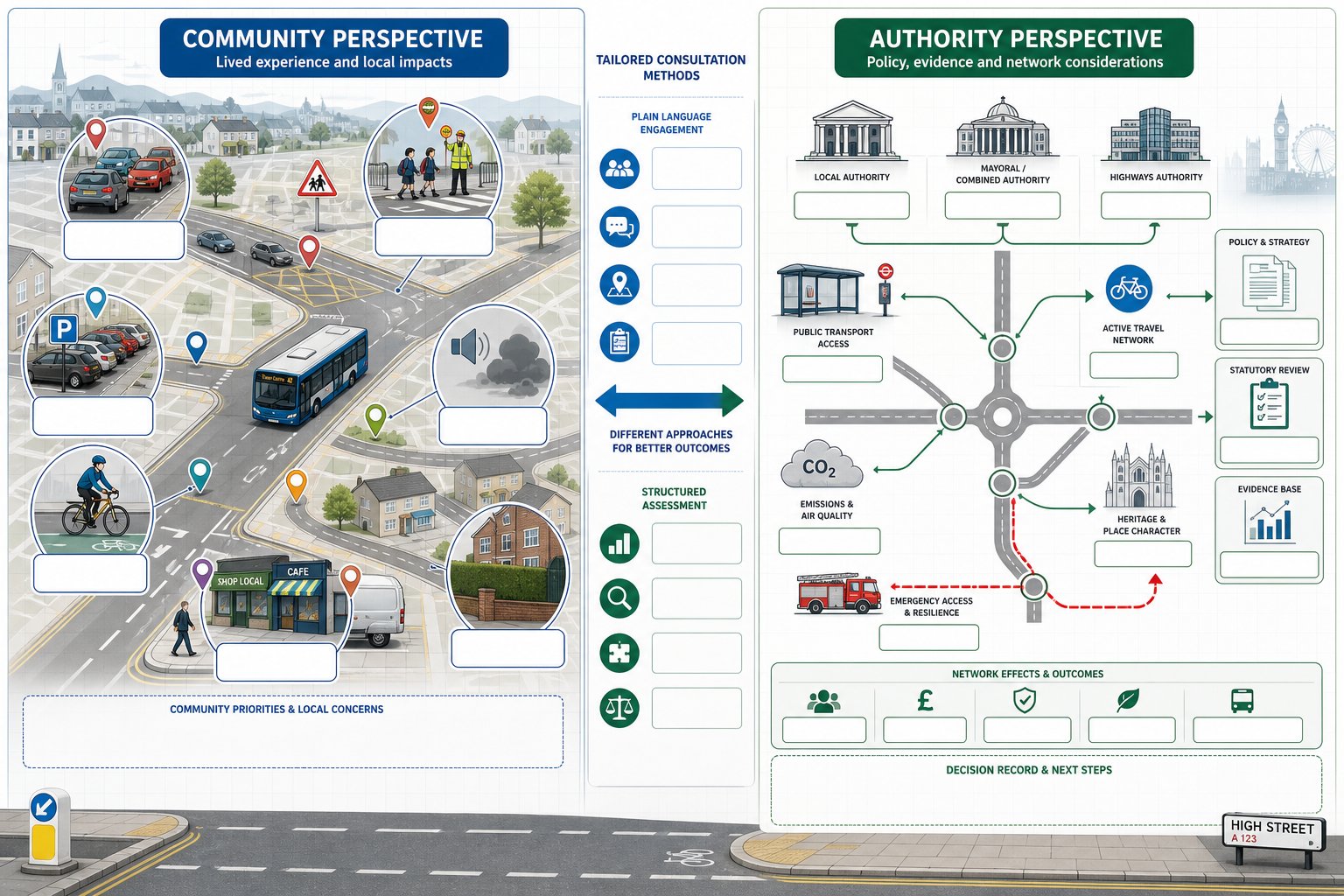
One reason consultation fails is that all stakeholders are treated as if they want the same thing. They do not. Their interests, knowledge and influence are different, so the consultation approach has to reflect that.
Local Communities, Businesses, And Landowners
Local communities tend to focus on lived experience: congestion at certain times, road safety around schools, parking stress, bus reliability, walking routes, noise, air quality and whether a new development will make everyday movement harder. Those concerns are not peripheral. They often point directly to the issues most likely to appear in objections.
Businesses and freight operators usually bring a different lens. They care about servicing access, delivery timings, employee travel, customer turnover, curbside pressure and network resilience. Landowners may focus on rights, boundary treatments, access relationships and how highway changes affect future use or value.
In practice, these groups respond best to plain language, local mapping and specific questions. A generic questionnaire about transport impacts is less useful than asking how people currently move, where conflict happens, and what would make the proposal work better. On larger regeneration or mixed use masterplan sites, different user groups may need different engagement tools altogether.
Highway Authorities, Local Planning Authorities, And Statutory Bodies
Authorities and statutory consultees typically focus on compliance, evidence quality and network consequences. The highway authority will want to understand trip generation, distribution, junction effects, safety, servicing, parking, active travel provision and whether mitigation is deliverable. The local planning authority will look more broadly at whether the transport case supports policy objectives, placemaking and sustainable access.
Other statutory or strategic bodies may scrutinise air quality, environmental effects, public transport integration, emergency access, heritage impacts or impacts on the strategic road network. Their concerns are usually less anecdotal and more procedural, but they can still be shaped by early engagement.
We find these consultees respond best when the scope is explicit: what is being assessed, what assumptions are used, what is fixed, and where there is room to adapt. For schemes with a strong decarbonisation narrative, alignment with Net Zero Transport Planning can also help show that transport consultation is tied to wider planning outcomes, not just traffic capacity.
How To Design An Effective Transport Consultation Strategy
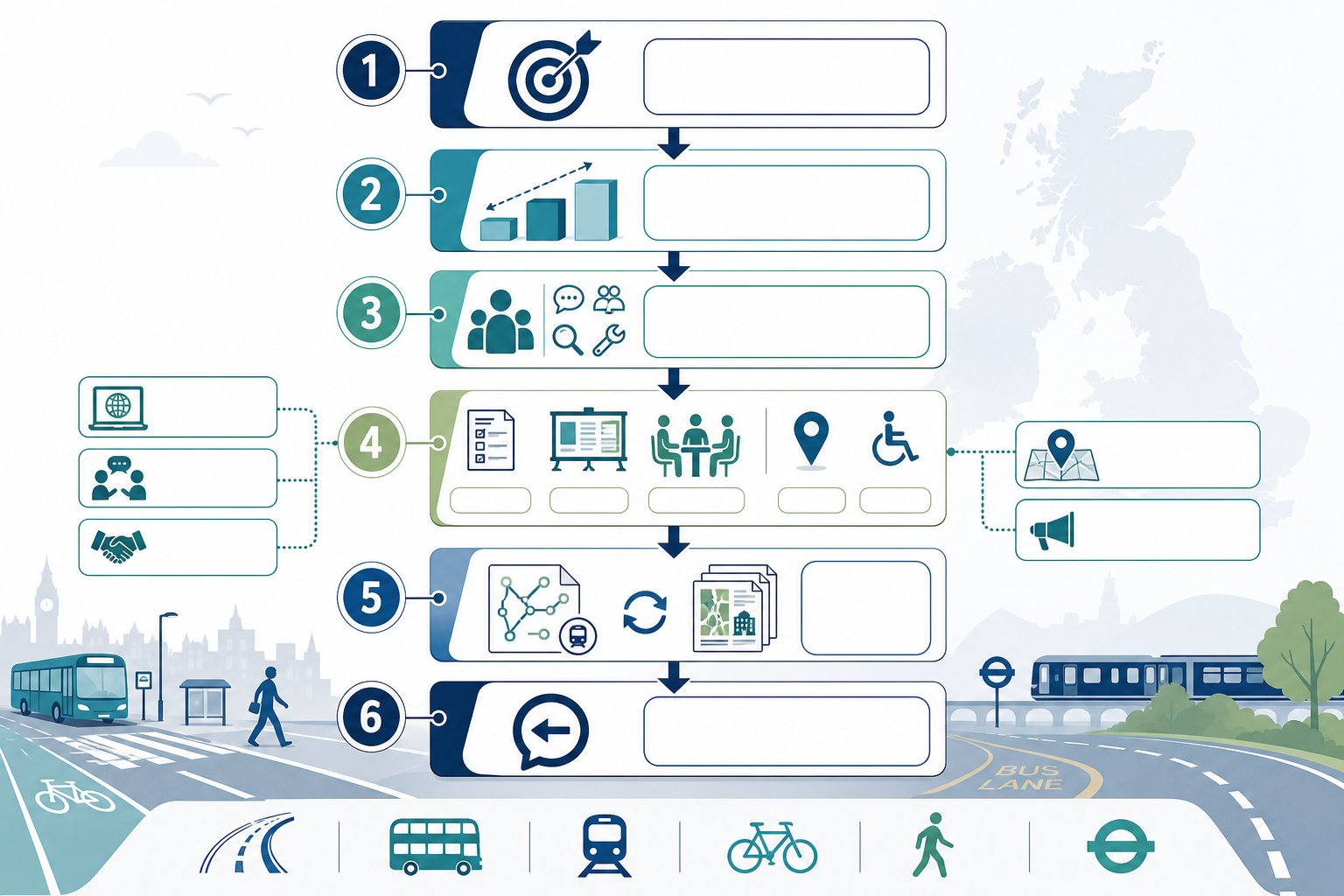
An effective transport consultation strategy starts with objectives, not channels. We need to know whether the purpose is to inform, test options, gather baseline evidence, resolve technical concerns, or co-design parts of the scheme. Without that, consultation drifts into noise: lots of comments, very little insight.
The next step is proportionality. A modest infill scheme does not need the same programme as a major mixed-use allocation, but both still need a method suited to their context. That usually means identifying key stakeholders, choosing the right engagement tools, setting a realistic timetable, and preparing materials that are understandable to non-specialists without diluting technical accuracy.
Methods should be mixed. Online surveys are useful, but they are not enough on their own. Public exhibitions, workshops, targeted meetings, stakeholder briefings, interactive mapping and drop-in sessions often capture different kinds of evidence. Hard-to-reach groups may need evening events, accessible venues, translated materials or direct engagement through local organisations.
The materials matter as much as the format. People need to understand the proposal, the transport context, the constraints and the choices. If the trade-offs are hidden, feedback will be less informed and objections more entrenched. That is especially true where parking restraint, mode shift or servicing controls are part of the strategy.
For developers, the strongest results usually come when technical teams and planning advisers work together from the outset. That is one reason many schemes benefit from early involvement by Developer Transport Consultants: experienced in local authority thresholds, reporting standards and consultation risk.
Finally, build in the feedback loop before consultation starts. People are far more likely to engage seriously if they know they will later be shown what changed and why.
Common Issues Raised In Transport Consultations
The same themes come up repeatedly in transport consultations, but the detail is always local. That local detail is exactly what makes consultation valuable.
Traffic generation and congestion are usually first. People want to know how many additional vehicle movements a proposal will create, where those trips will go, and whether nearby junctions are already close to failure. They often describe conditions in practical terms rather than modelled ones: queues outside a primary school, blocked side roads, weekend spikes, or rat-running through residential streets.
Road safety is next, especially where children, older people or disabled users are affected. Stakeholders may raise concerns about visibility, turning movements, speed, crossing points, footway width, cycle conflict or construction traffic. These observations can materially change mitigation design.
Parking and servicing are another frequent flashpoint. Residents worry about overspill. Businesses worry about loading. Councils worry about whether restrictions can be enforced. A scheme can be technically compliant and still trigger strong opposition if these concerns are brushed aside.
Then there is sustainable transport. Bus availability, walking routes, cycle links, secure parking, end-of-trip facilities and links to local centres all shape whether a proposal feels realistic rather than aspirational. On development-led schemes, that often ties into broader Property Development Transport advice, particularly when mode share assumptions are under scrutiny.
Finally, environmental and quality-of-life impacts matter: noise, air quality, severance and the cumulative effect of multiple schemes. These are rarely side issues. In many consultations, they are the lens through which all transport evidence is judged.
How Consultation Feedback Shapes Transport Assessments And Travel Plans
Consultation is only useful if it changes something. In transport planning, that “something” is often the assessment methodology, the scheme design, the mitigation package or the travel plan.
At baseline stage, feedback can improve the evidence base. Local users may identify real peak conditions, unofficial walking routes, problem parking locations, delivery patterns or bus stop behaviour that standard datasets miss. That can lead to additional surveys, revised observation periods or sharper assumptions around trip distribution and network effects.
At design stage, consultation can influence access geometry, pedestrian crossings, cycle connections, junction layout, servicing strategy, internal circulation, parking controls or construction routing. Sometimes the change is modest but important: moving a crossing to match desire lines, widening a footway, adjusting gate positions, or clarifying blue badge provision. Those details often make the difference between “technically acceptable” and “genuinely workable”.
Travel plans are particularly sensitive to consultation feedback because they fail when they are generic. If local schools have known peak pressures, if staff rely on a specific bus corridor, or if cycling uptake is held back by one missing link, the travel plan should respond to that reality. Effective measures might include personalised travel information, workplace incentives, school engagement, car club provision, cycle infrastructure, monitoring triggers or phased review points.
In our work, this is where experience counts. Whether a scheme is supported by a regional team or a Traffic Engineer In London: context with more complex authority expectations, feedback has to be translated into evidence the decision-maker can actually use.
Best Practice For Recording Responses, Evidence, And Decision-Making
Recording consultation properly is not administrative housekeeping. It is part of the planning evidence. If objections, comments and technical responses are not tracked in a disciplined way, it becomes much harder to show that consultation was meaningful.
Best practice starts with a clear audit trail. We should be able to show who was consulted, when, how they were contacted, what information they received, what they said, and how the project team responded. That does not mean publishing every comment verbatim, but it does mean being able to trace themes back to source material if challenged.
Structured coding helps. Responses can be grouped by topic such as access, parking, safety, walking, cycling, public transport, construction traffic or air quality. That allows us to quantify patterns without losing the nuance of individual comments. On larger projects, digital consultation platforms and spreadsheets with issue logs are essential rather than optional.
The next step is the decision link. For each significant issue, the record should state whether the scheme changed, whether further assessment was carried out, or why no change was made. That “issue-response-outcome” chain is what turns consultation from narrative into evidence.
A concise consultation report can then summarise the process, the participants, the main themes and the resulting amendments to the proposal or transport documents. For location-specific schemes, local authority expectations may vary, which is why practical input from a Traffic Engineer In the relevant planning context can be valuable.
Most importantly, keep the record contemporaneous. Reconstructing months of engagement after objections land is slow, messy and less persuasive.
Common Mistakes That Undermine Public Consultation In Transport Planning
The biggest mistake is consulting too late. Once access points, layout, parking numbers and mitigation assumptions are effectively fixed, consultation becomes defensive. Stakeholders can tell when there is no genuine room for influence, and trust drops quickly.
Another common problem is treating consultation as a communications exercise rather than a design and evidence exercise. Nice boards and polished visuals will not compensate for a transport strategy that has not engaged with local reality. If people raise recurring issues about safety, servicing or walking routes and nothing in the technical work responds, the process looks cosmetic.
A third mistake is poor explanation of scope and constraints. Not every concern can be solved within a planning application boundary, but that needs to be stated clearly. If consultees do not understand what is fixed, what is flexible, and what sits with another authority or future phase, frustration grows.
Over-reliance on a single engagement channel is another weakness. Online-only consultation can exclude older residents, shift workers, people with limited digital access and some small businesses. Equally, a single in-person event may miss commuters or parents. Consultation should be accessible, not merely available.
Then there is the failure to close the loop. If no one is told what changed, why some suggestions were adopted, and why others were not, the process feels performative. A simple “you said, we did” summary goes a long way.
For firms handling multiple applications, speed can tempt shortcuts. But robust consultation nearly always saves time later by reducing avoidable objections, requests for clarification and redesign under pressure. That is the part many teams only appreciate after a scheme runs into trouble.
Frequently Asked Questions on Public Consultation Transport Planning
What is public consultation in transport planning and why is it important?
Public consultation in transport planning is a structured process involving stakeholders and the public in shaping transport policies and proposals. It improves planning quality, reveals local issues like safety and parking, and builds trust by showing how feedback influences decisions.
When should public consultation take place during transport planning projects?
Effective consultation occurs in stages: early pre-application engagement to scope issues before designs are fixed, formal statutory consultation during the planning process, and ongoing post-decision engagement to refine details and monitor travel plans.
Who are the key stakeholders involved in public consultation for transport planning?
Key consultees include local communities, businesses, landowners, highway and planning authorities, and statutory bodies such as environmental agencies and public transport operators, each bringing different concerns and expertise to the process.
How can consultation feedback influence transport assessments and travel plans?
Feedback can improve baseline data accuracy, refine scheme design elements like junction layouts and pedestrian crossings, and strengthen travel plans with realistic measures tailored to local conditions, ensuring more effective and accepted outcomes.
What are common mistakes to avoid in public consultation transport planning?
Common errors include consulting too late when key decisions are fixed, treating engagement as a mere formality, poor communication of scope and constraints, relying on a single consultation channel, and failing to provide clear feedback on how input was used.
How should a transport consultation strategy be designed for best results?
A successful strategy starts with clear objectives and uses a mix of accessible methods like workshops and surveys. It targets key stakeholders proportionately, ensures transparency about constraints, and includes feedback loops to show participants their input influenced decisions.