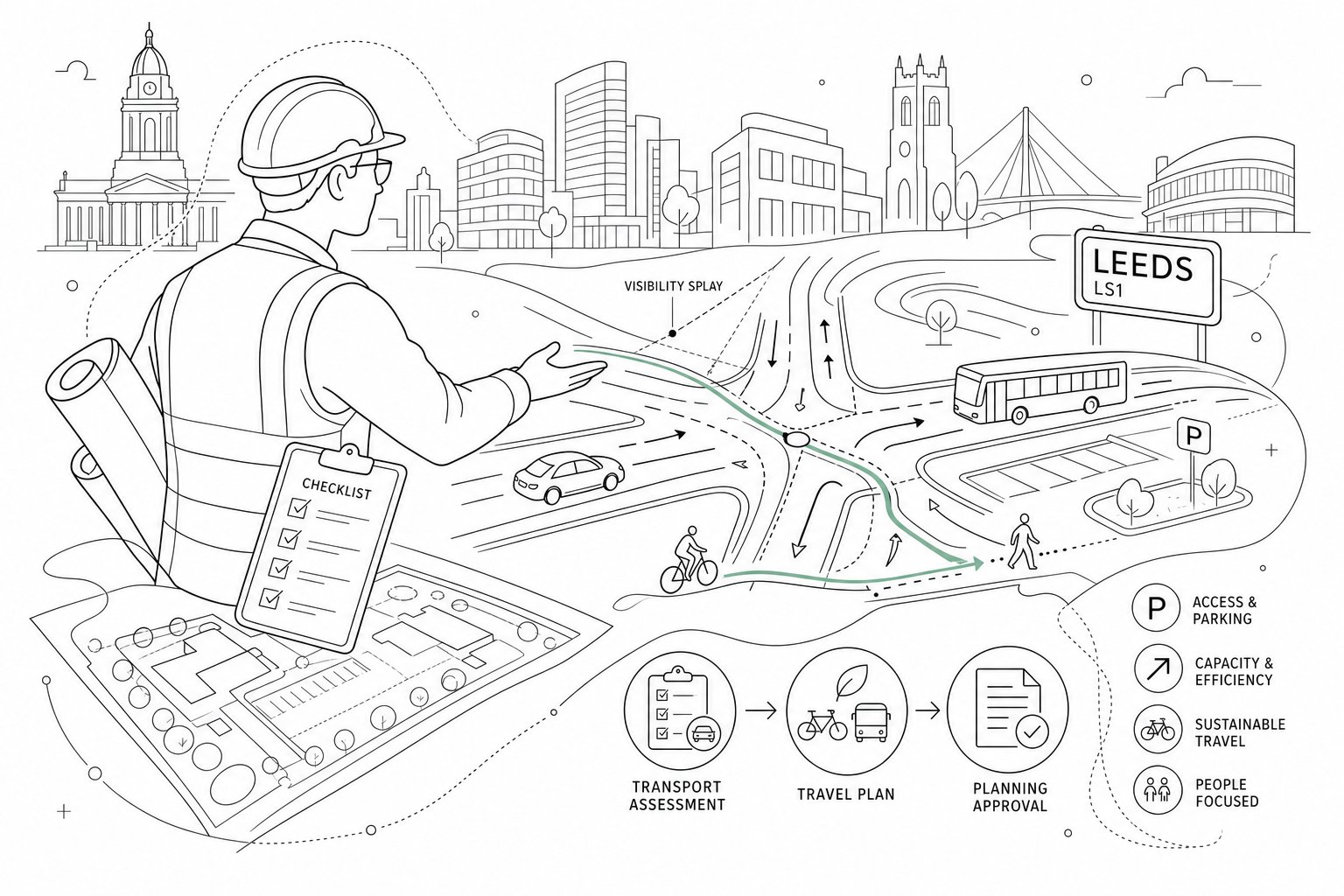
Planning in Leeds rarely falls over on architecture alone. More often, it stalls on the practical questions: can vehicles enter and leave safely, will a nearby junction cope, is parking realistic, and does the proposal align with local transport policy? That is exactly where a traffic engineer in Leeds becomes central to the application strategy, not just a technical add-on.
For architects, planning consultants, lawyers, developers and local authorities, transport input has become more exacting. Leeds City Council wants evidence, not assumptions. Highway comments now tend to focus on access geometry, visibility, servicing, sustainable travel, cumulative traffic effects and whether the level of assessment matches the scale of development. A weak report can delay validation, trigger rounds of objections, or leave a scheme negotiating from a poor position.
We approach transport engineering as part of the planning case from day one. That means understanding the site, the proposed use, the local network, and the policy framework before deciding whether a Transport Assessment, Transport Statement, Travel Plan or concise technical note is the right tool. Done properly, the work is straightforward, proportionate and persuasive.
In this guide, we set out what a traffic engineer in Leeds actually does, when technical transport documents are needed, what Leeds-specific issues commonly arise, and how planning-led advice can help move applications through the system with fewer surprises.
What A Traffic Engineer In Leeds Does For Planning And Development Projects
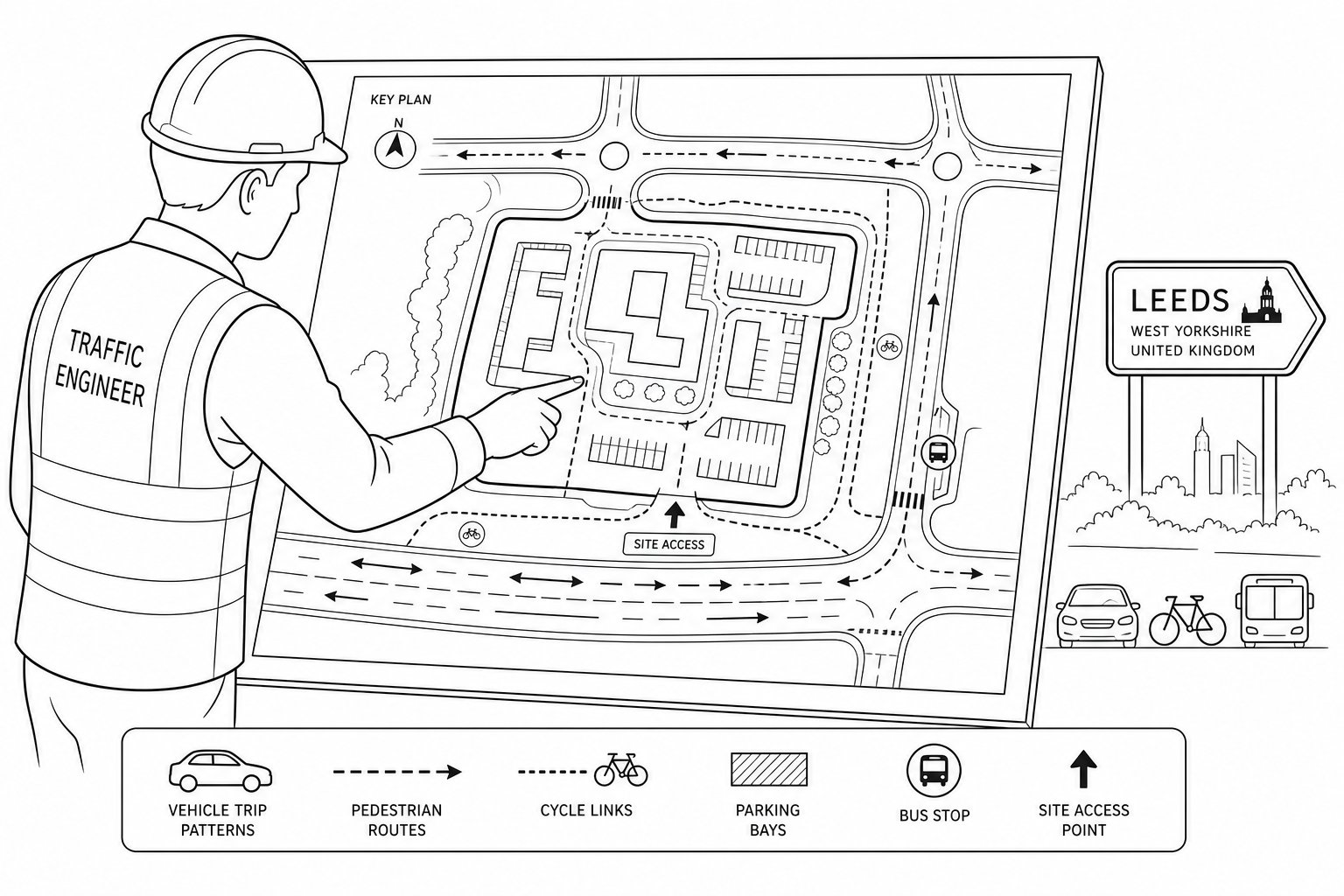

A traffic engineer in Leeds translates a development proposal into transport evidence that planners, highway officers and consultees can test. In practical terms, we assess how people and vehicles are likely to reach the site, how the proposal interacts with the surrounding highway network, and whether the design is safe, workable and policy-compliant.
That usually starts with the basics: existing conditions, site constraints and likely trip patterns. We review access arrangements, nearby junctions, traffic speeds, pedestrian routes, cycle links, parking supply, servicing needs and public transport availability. If the proposal is larger or more sensitive, we may also commission traffic counts, interrogate survey data, review collision records and model future-year conditions.
But the role is broader than report writing. We often shape layouts before they harden into planning drawings. A small adjustment to an access width, a better refuse route, or a more credible cycle parking arrangement can remove problems before they become formal objections.
For clients working across regions, our advice in Leeds often mirrors lessons seen on comparable schemes in Traffic Engineer In Manchester: and other major authorities, but local interpretation still matters. Leeds has its own development patterns, corridor pressures and expectations around sustainable access.
At its best, transport engineering reduces uncertainty. It gives a scheme a defensible technical position and, just as importantly, helps the wider consultant team make better planning decisions early.
How Local Planning Policy And Highway Requirements Shape Transport Advice In Leeds
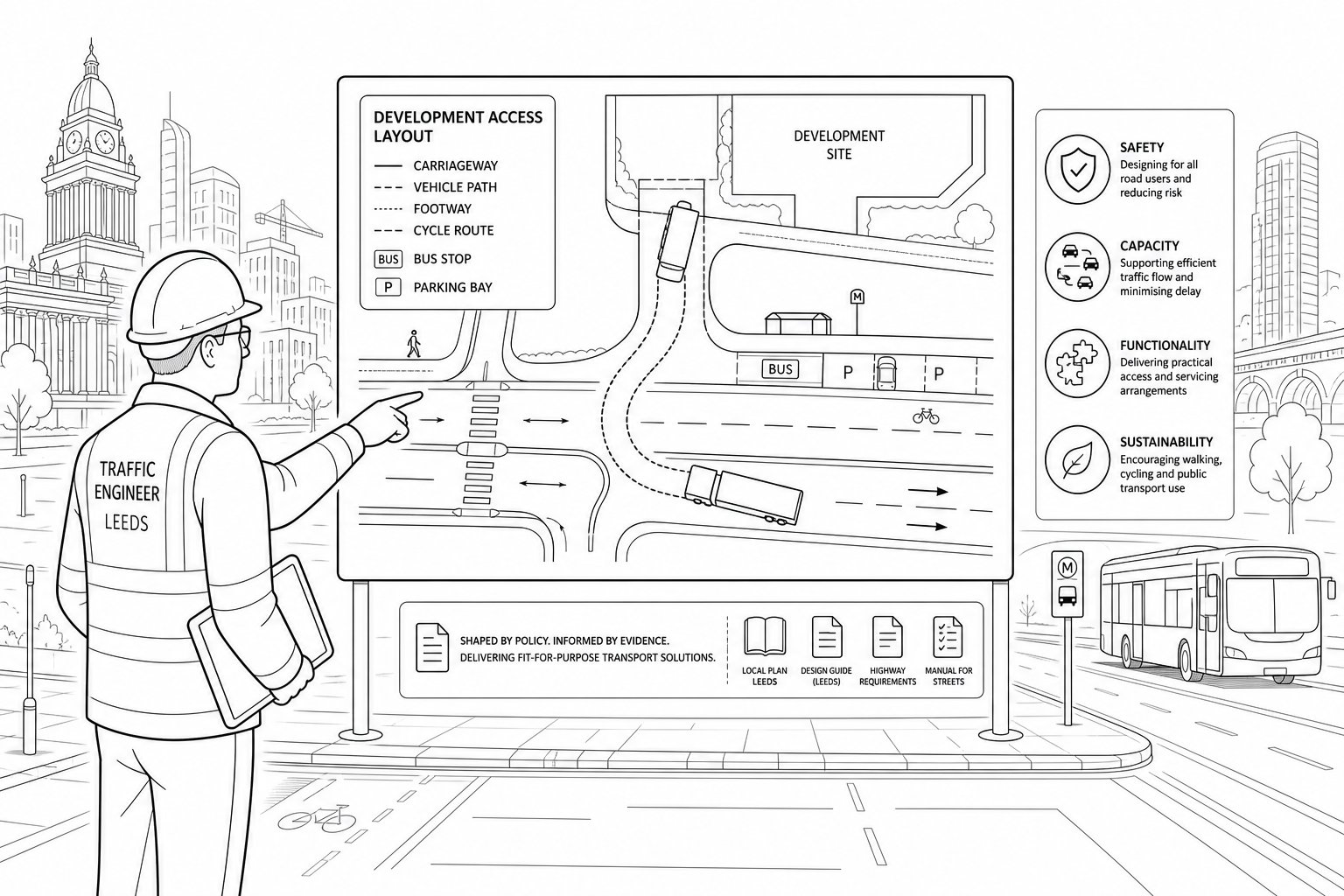
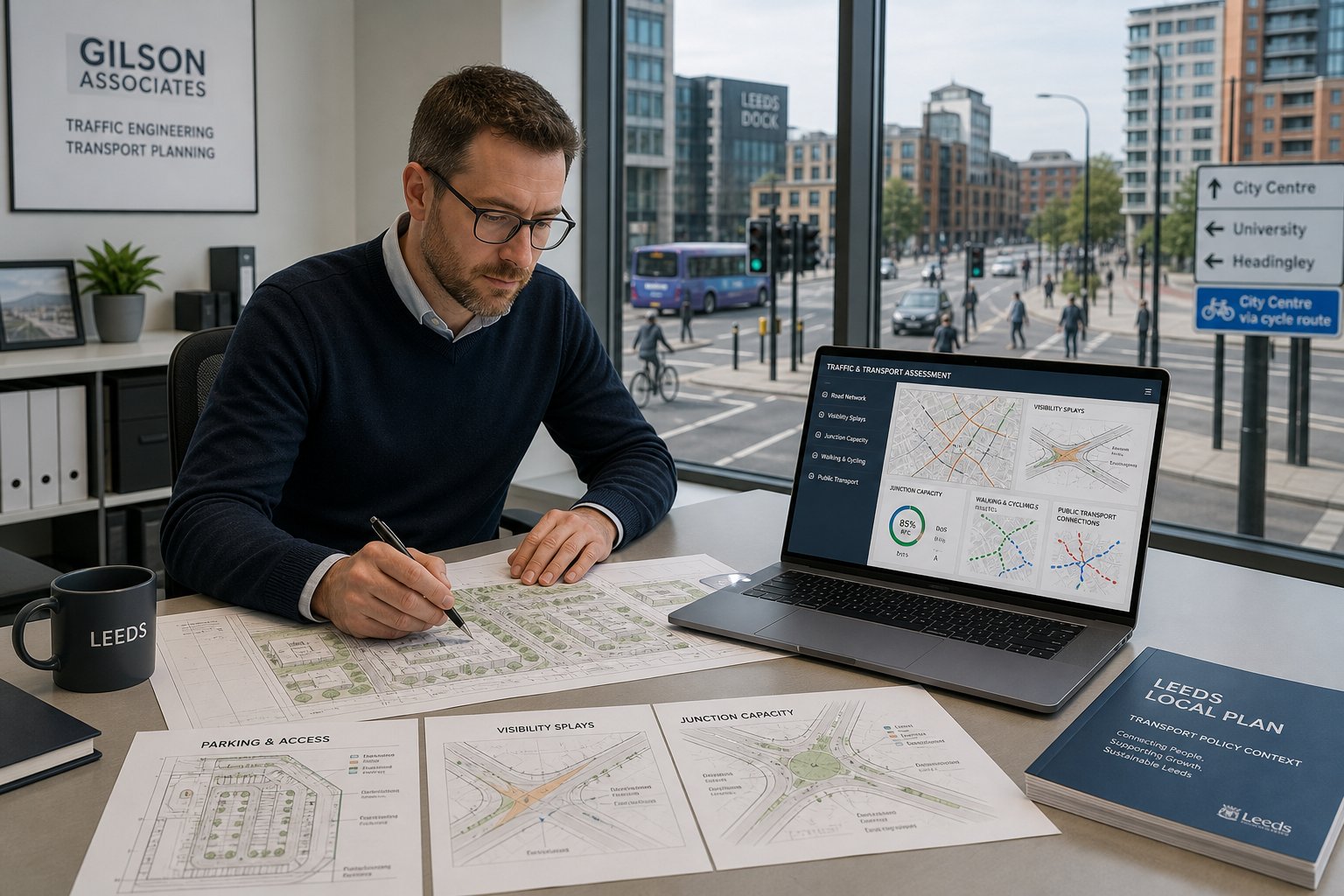
Transport advice in Leeds is never produced in a vacuum. It sits within the Leeds Local Plan, local parking and design expectations, the Street Design Guide, West Yorkshire standards and national guidance such as Manual for Streets and, where relevant, DMRB. The point is not to cite policy for the sake of it. The point is to show that a proposal has been thought through in the same terms the decision-maker will use.
Leeds City Council, acting through its highways function, typically looks for four things. First, safety: can all users move around the site and access point without creating undue risk? Second, capacity: will the local network operate acceptably, especially at known pressure points? Third, functionality: are parking, turning, servicing and refuse movements realistic? And fourth, sustainability: does the scheme support walking, cycling and public transport rather than relying solely on private car use?
Those requirements directly shape the scope of our work. A dense city-centre scheme near frequent bus routes may need a stronger sustainable travel narrative and parking justification. A suburban site fronting a faster road may hinge on visibility splays, right-turn risk and footway continuity. A change-of-use scheme may turn less on peak-hour traffic growth and more on delivery patterns or parking stress.
The key is proportionality. Policy compliance in Leeds is rarely about producing the longest report: it is about producing the right evidence, targeted to the authority’s concerns, and doing so in a format that is clear enough to support a planning judgment.
When A Development In Leeds Needs A Transport Assessment, Statement, Or Technical Note
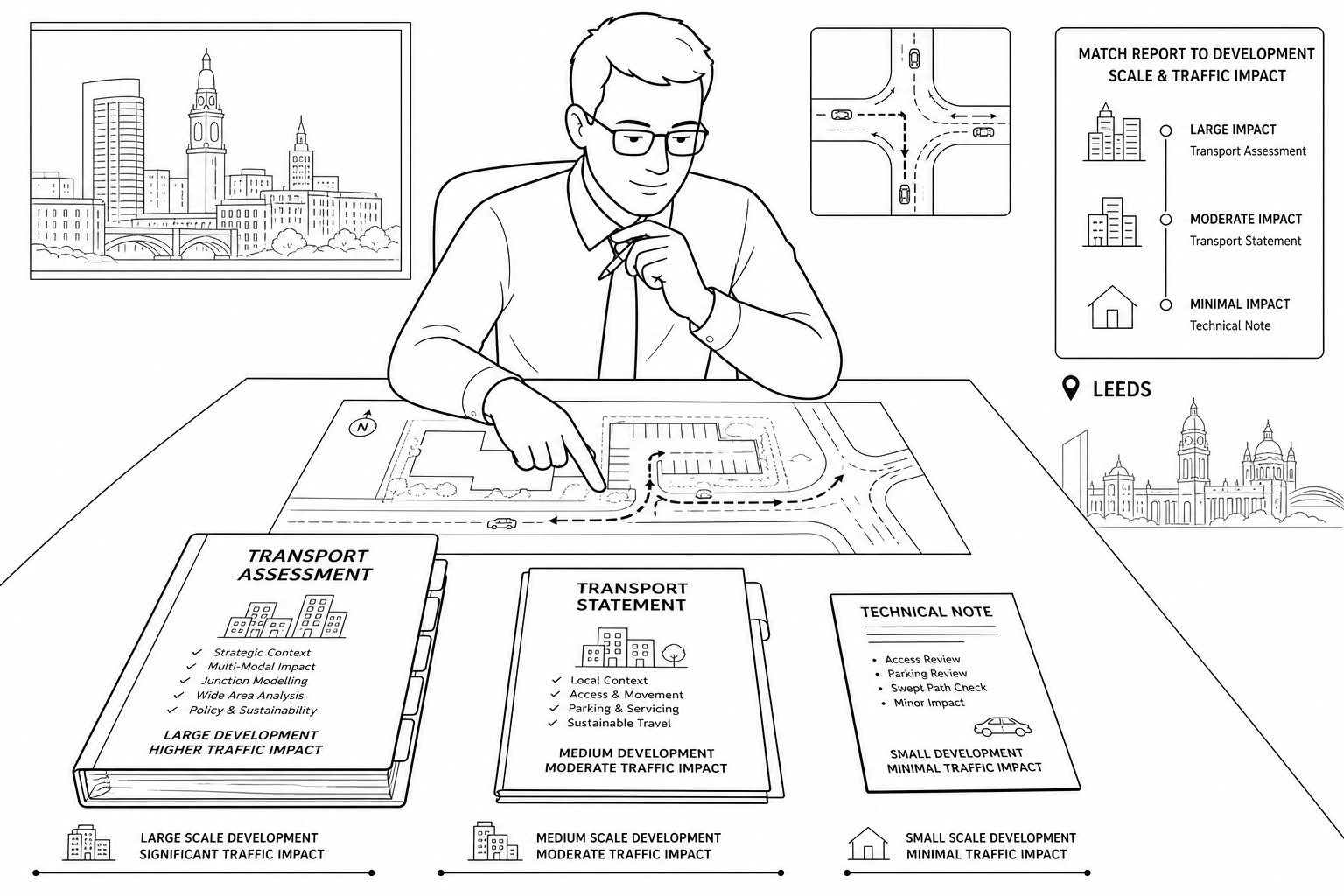
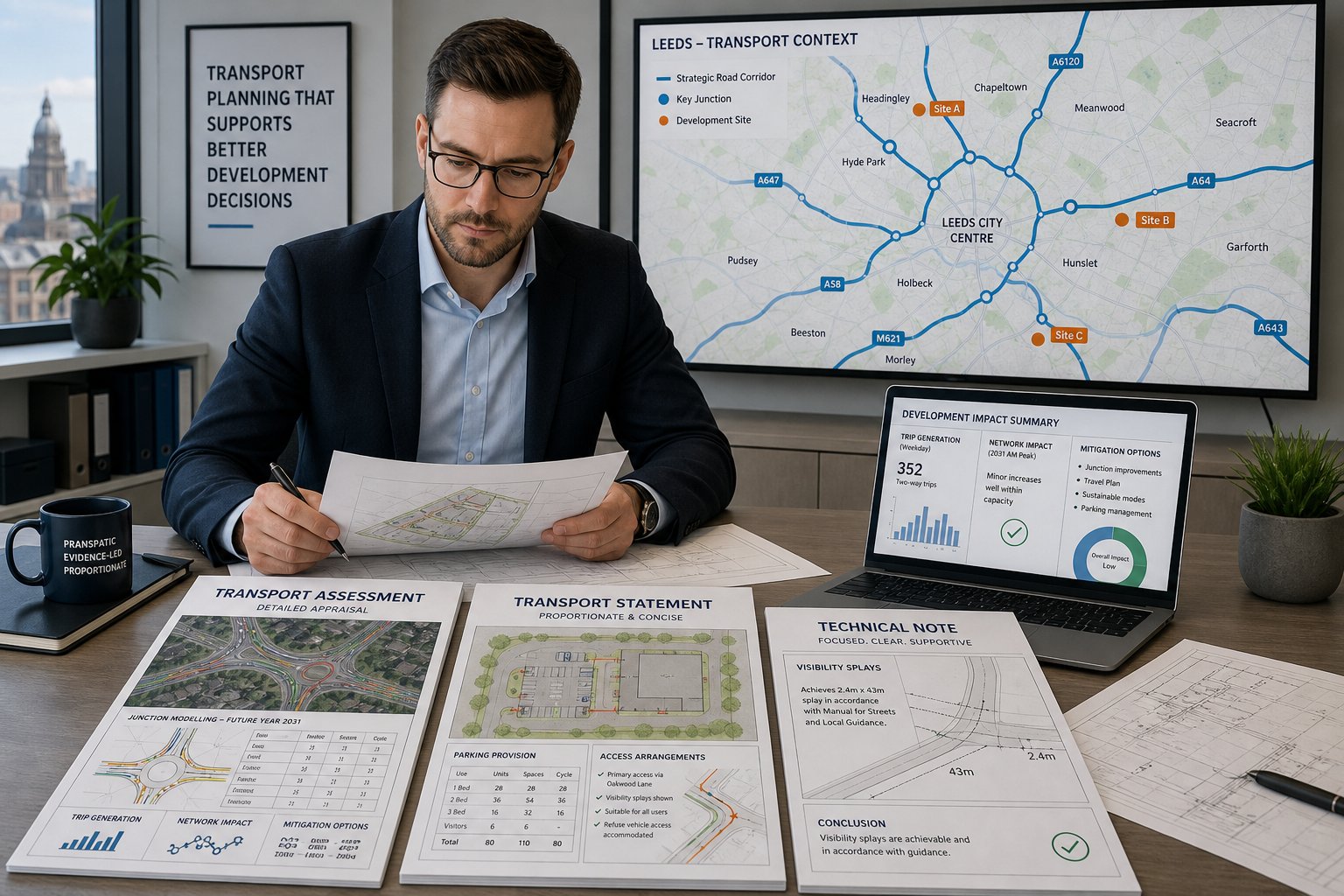
Not every application needs a full Transport Assessment. In Leeds, the correct document depends on scale, use, network sensitivity and the likely degree of traffic impact.
A Transport Assessment is typically required for larger or more traffic-intensive proposals where junction performance, route impacts or cumulative effects need detailed examination. Think major residential allocations, substantial food retail, larger employment schemes or proposals on constrained corridors. Here, we would usually estimate trip generation, assign trips across the network, test junctions and set out mitigation where necessary.
A Transport Statement is more proportionate for medium-scale developments with limited but still material transport implications. It still addresses access, parking, servicing and sustainable travel, but the analytical burden is lighter. In many cases, that is enough to give officers comfort that the impacts are understood and acceptable.
A technical note or letter is often the right response where the issue is narrow: access visibility, a swept path query, parking justification, or a rebuttal to a consultee comment. We use these frequently where an application is otherwise straightforward but needs one point resolved clearly and quickly.
Across nearby authorities, thresholds and expectations vary slightly, which is why experience from places such as Traffic Engineer In Liverpool: can be useful context, though Leeds-specific scoping remains essential.
If there is one rule, it is this: match the document to the likely effect of the development. Over-reporting wastes time. Under-reporting invites objections.
Typical Leeds Projects That Benefit From Traffic Engineering Input
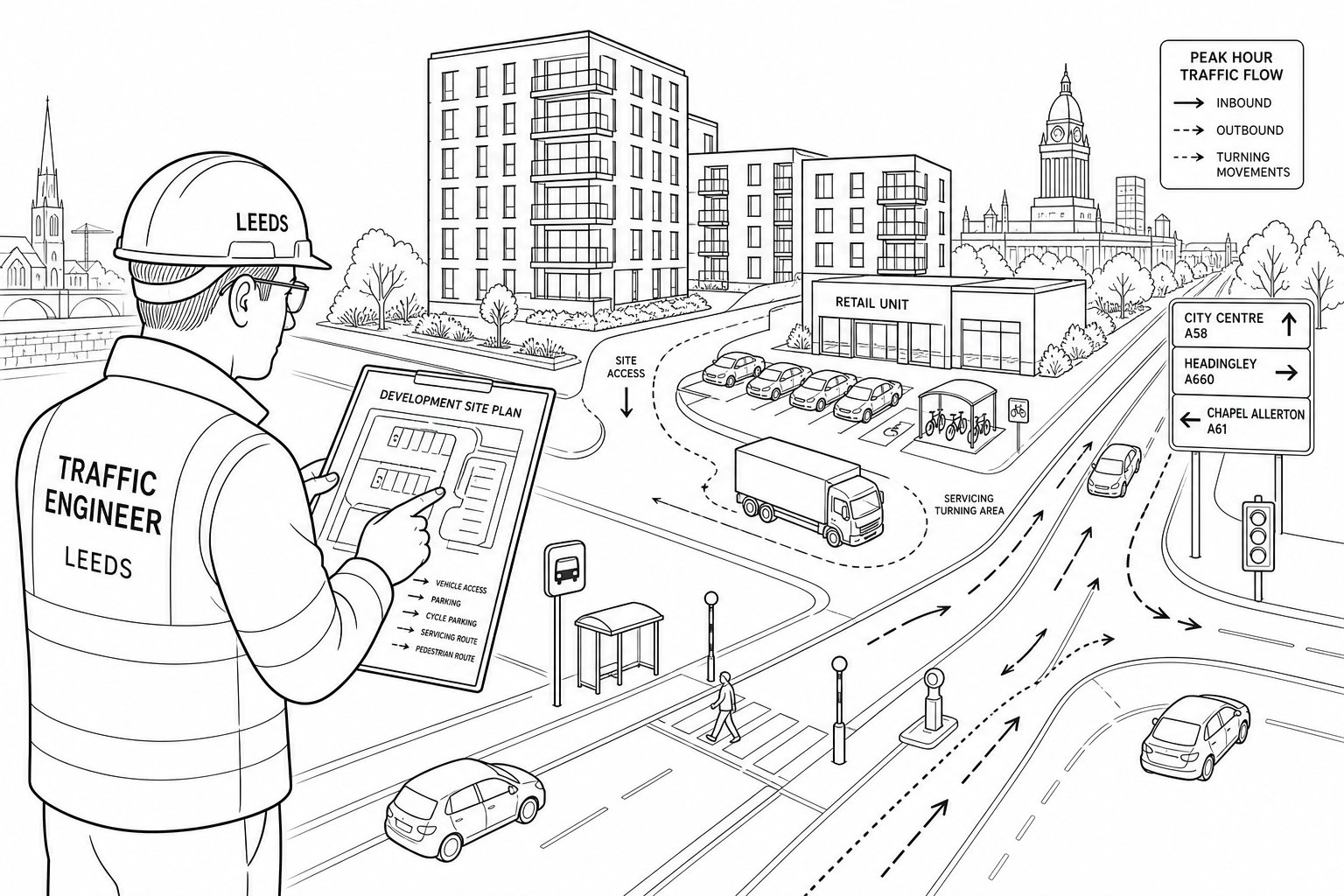
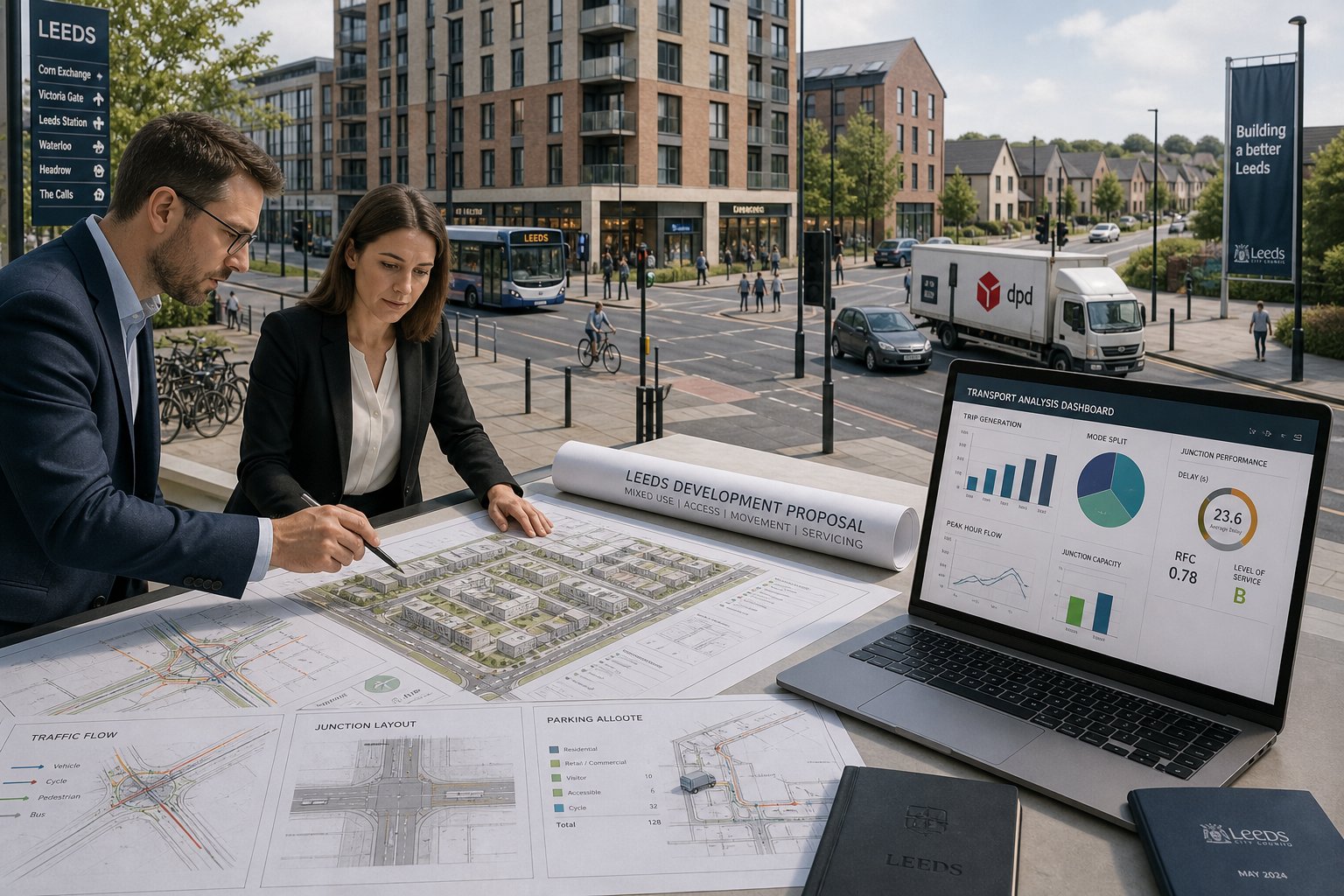
Leeds has a wide development mix, from tight urban conversions to edge-of-settlement residential parcels. The projects that benefit most from traffic engineering input are usually those where access, parking, servicing or local network pressure could become planning issues.
Residential Schemes
Residential work in Leeds covers everything from single infill plots and small apartment blocks to suburban estates, build-to-rent schemes and purpose-built student accommodation. The transport questions vary accordingly. On a small infill site, the issue may be as simple as whether a new driveway can achieve visibility and avoid awkward reversing onto the highway. On a larger housing site, attention shifts to peak-hour trip generation, internal street hierarchy, refuse tracking, pedestrian connections and the performance of nearby junctions.
City-centre living adds another layer. Parking restraint may be acceptable, but only if the location genuinely supports non-car travel and the evidence is robust. Student schemes often need careful explanation around mode share and servicing. Family housing on outer corridors may require more detailed junction testing and school-run sensitivity.
Commercial, Mixed-Use, And Change-Of-Use Developments
Commercial and mixed-use projects tend to generate more nuanced transport debates. Offices may have modest traffic peaks but strong expectations around cycle parking and public transport accessibility. Retail, leisure and drive-thru schemes often trigger concern about queueing, turning movements and weekend demand. Industrial and logistics sites bring servicing geometry, HGV routing and operational safety to the foreground.
Change-of-use applications are especially interesting because the planning argument can hinge on whether the proposed use actually intensifies traffic compared with the lawful fallback. That comparison has to be evidence-based. A former office becoming a gym, or a restaurant becoming another active use, may not always produce the traffic effect objectors assume.
In all these cases, early transport input helps define what needs to be proved and what can be resolved through design rather than debate.
Core Traffic Engineering Services For Leeds Planning Applications
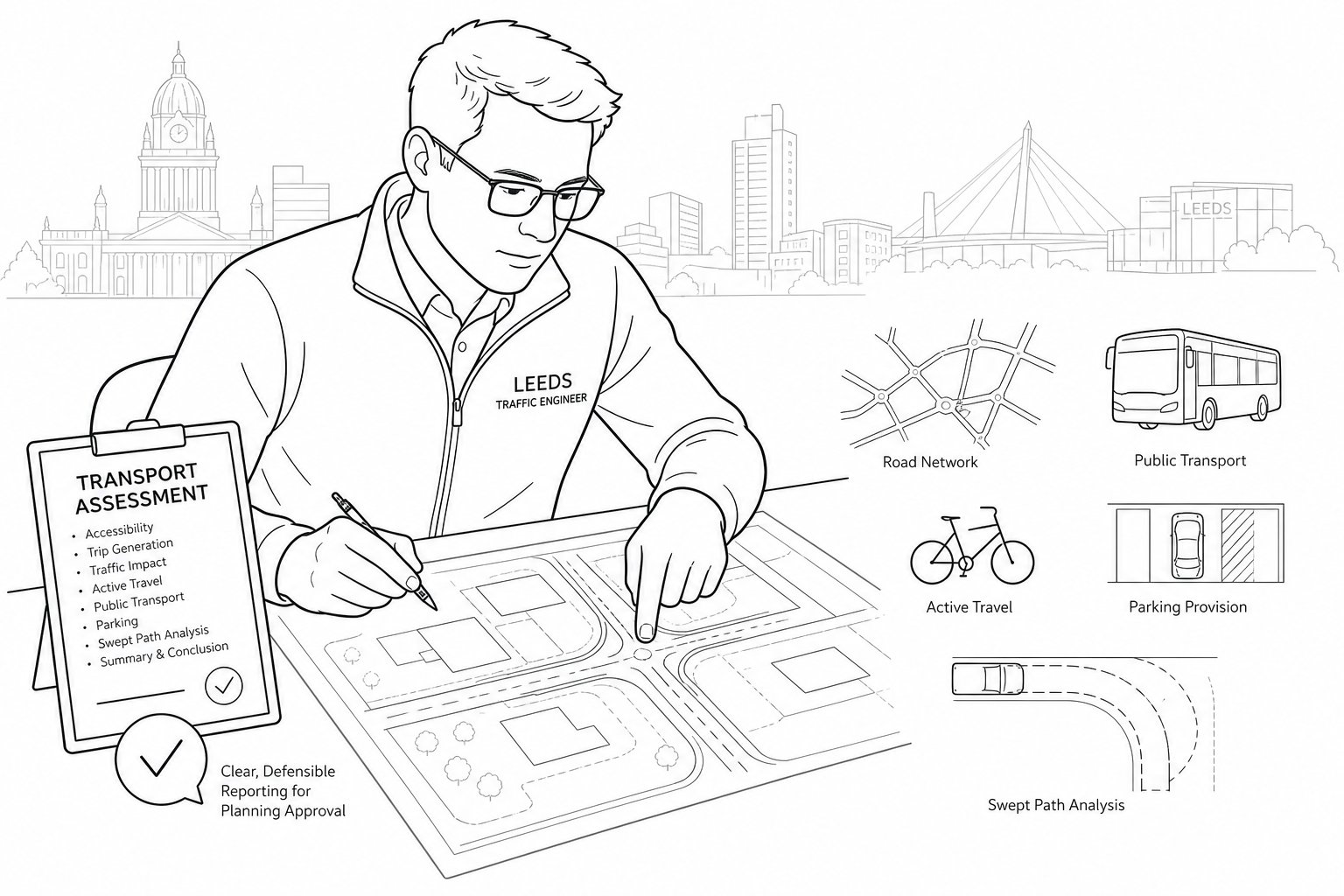
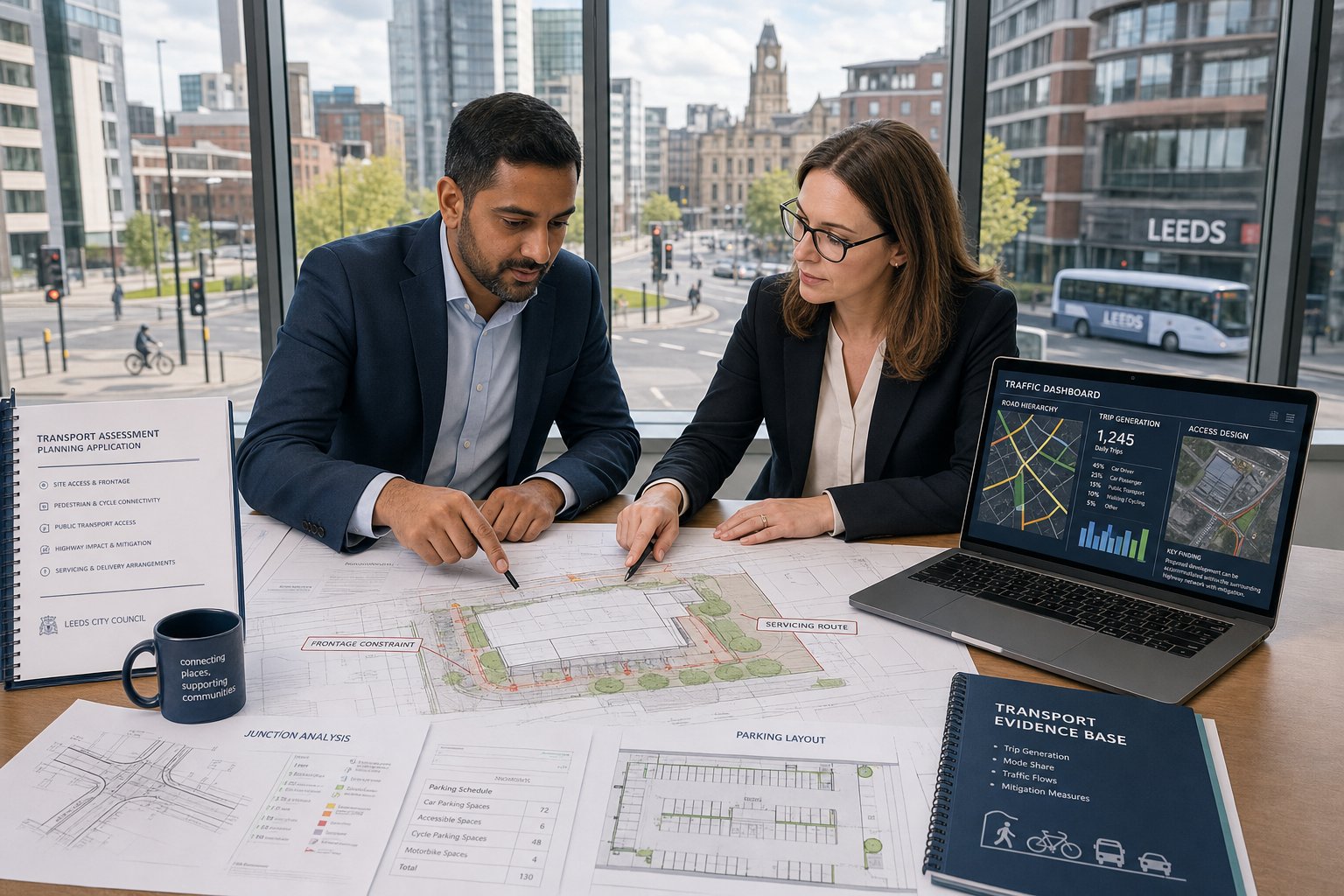
For most Leeds planning applications, the core traffic engineering services are fairly consistent, even though the emphasis changes from scheme to scheme.
We typically begin with a desktop and site review: surrounding road hierarchy, traffic conditions, public transport provision, active travel links, collision history, parking context and the physical constraints of the frontage. From there, we advise whether surveys are needed and what level of reporting is proportionate.
The main workstreams usually include Transport Assessments or Statements, Travel Plans, junction capacity analysis, trip generation forecasting, parking analysis, access design, servicing strategy, swept path assessment and responses to highways comments. For some projects, we also prepare standalone technical notes on specific matters such as visibility, bin collection access or operational impacts.
What matters is integration with the rest of the design team. A planning submission works better when transport advice informs the layout, rather than trying to defend a fixed arrangement that never really worked. That is one reason concise, planning-aware reporting often performs better than overly theoretical analysis.
Clients with portfolios outside Yorkshire often value consistency of approach across cities. Comparable work in Traffic Engineer In Birmingham: and other metropolitan areas shows how similar technical tools can still be applied differently depending on local policy and officer focus.
In short, the service is not just about numbers. It is about producing clear, defensible transport evidence that helps an application progress.
Transport Assessments, Transport Statements, And Travel Plans Explained
These documents are often mentioned together, but they do different jobs.
A Transport Assessment is the full technical narrative. It explains the site context, proposed development, accessibility, baseline traffic conditions, expected trip generation, traffic distribution, junction impacts, parking and servicing, and any mitigation required. Where impacts are material, it is the main evidence base for highway consideration.
A Transport Statement is shorter and more proportionate. It still covers the essential transport characteristics of the scheme, but without the same depth of modelling or network analysis. For many modest applications, that is exactly what is needed: enough evidence to support a sound planning judgment, without dressing the proposal up as something more complex than it is.
A Travel Plan has a different purpose. It is not primarily about proving that traffic impacts are acceptable: it is about setting out practical measures that encourage sustainable travel. That might include cycle facilities, welcome packs, public transport information, car club membership, shower provision, management measures or monitoring commitments. In Leeds, a Travel Plan can be particularly important for developments where parking is restrained or where policy emphasis falls strongly on non-car mode share.
The quality of these documents matters more than the label on the front. Officers tend to respond well to reports that are concise, locally grounded and honest about impacts. A bloated assessment can still be unconvincing if it avoids the real issue. A sharp statement, by contrast, can unlock progress quickly if it answers the right questions.
Junction Capacity, Trip Generation, And Parking Analysis In Practice
This is where transport work becomes quantifiable. We estimate how many trips a development is likely to generate, where those trips will go, and whether the surrounding network can accommodate them.
Trip generation is commonly derived using TRICS, adjusted for the proposal type, local context and realistic mode share assumptions. That sounds mechanical, but it is not. The judgement lies in selecting sensible comparator sites and avoiding lazy assumptions. A city-centre apartment scheme near strong bus corridors should not be treated like a car-dependent suburban estate. Equally, optimistic mode share claims need evidence.
Once trips are established, we assess the key junctions. Depending on the layout, that may involve priority junction assessment, roundabout modelling or signal analysis using tools such as ARCADY, PICADY or LinSig. The output is only useful if tied back to planning reality: Are delays minor? Are queues likely to block another arm? Does mitigation actually fit on the ground?
Parking analysis is often just as contentious as junction capacity. We examine likely demand, local restraint policies, comparable sites, operational needs and the relationship between parking supply and sustainable travel options. In Leeds, parking debates can be finely balanced, particularly in urban areas where overspill concerns sit beside policy pressure to reduce car dependency.
A good analysis is practical rather than theatrical. We are not trying to “win” with software: we are trying to show, transparently, whether the scheme works and what changes may be needed if it does not.
Access Design, Swept Path Analysis, And Highway Safety Considerations
Many planning disputes in Leeds come down to one deceptively simple question: can the site be accessed safely and operate properly day to day? That is why access design often carries more weight than clients expect.
We review the proposed access geometry, kerb radii, width, gradient, pedestrian crossing points and visibility splays, always in the context of the frontage conditions. On a constrained urban road, the issue might be pedestrian conflict and servicing practicality. On a faster route, it may be visibility, right-turn movements and the consequences of vehicles slowing to enter.
Swept path analysis then tests whether the design actually works for the vehicles that need to use it. Refuse wagons, fire appliances, delivery vans and articulated vehicles all have different requirements. Tracking software can quickly reveal whether a neat-looking layout is, in truth, forcing overruns, awkward reverses or impossible turns.
Safety is broader than geometry. We also consider collision history, likely user conflict, crossing demand, cycle interaction and the operational pattern of the site. In some cases the answer is a design revision: in others it is management, such as controlled delivery hours or revised servicing arrangements.
For multi-city developers, patterns repeat. Issues raised on schemes akin to Traffic Engineer In London: often reappear in Leeds, although local standards and street character will change the appropriate response.
The point is simple enough: a safe access strategy can steady an application: a doubtful one can dominate it.
How A Traffic Engineer Supports The Planning Application Process From Start To Decision
The most effective transport input starts before submission. At pre-application stage, we help define the likely highways issues, advise on survey requirements, review early layouts and, where appropriate, support discussions with Leeds City Council highways officers. That early scoping is often what prevents expensive redesign later.
During preparation of the application, we coordinate with architects, planners and drainage or civil teams so the transport narrative aligns with the drawings. There is little value in a polished Transport Statement if the site plan still shows an access that cannot accommodate a refuse vehicle. Consistency matters.
Once submitted, our role usually shifts to clarification and response. Highway consultees may ask for extra modelling, revised tracking, further parking justification or stronger Travel Plan measures. Sometimes the issue is substantive: sometimes it is simply that an officer wants a point evidenced in a different way. Quick, focused responses can stop these queries turning into long delays.
We also assist with planning conditions and legal or highway agreements where required. That can include wording around Travel Plan monitoring, off-site works, delivery and servicing plans, or the scope of a Section 278 package. None of that is glamorous, but it is often where projects either maintain momentum or lose months.
From start to finish, the value of the traffic engineer is continuity: one technical thread running from first feasibility advice through to determination and, if needed, post-permission discharge.
What To Prepare Before Instructing A Traffic Engineer In Leeds
Clients can save time, cost and needless iteration by assembling a few essentials before instruction.
The starting point is a clear red-line boundary plan and the latest draft site layout. Without those, any transport advice is provisional at best. We also need a defined development schedule: number of dwellings, GIA, unit mix, employment floorspace, servicing assumptions, parking aspirations and likely phasing if relevant.
Previous planning history is extremely useful. Earlier refusal reasons, highways comments, appeal decisions or pre-application correspondence can tell us where the real pressure points are. If the site has a known access problem, local objection history or a difficult frontage, it is better to know that on day one than after the report is drafted.
Useful supporting information includes topographical surveys, speed survey data if already available, collision concerns raised locally, public transport context, and any design constraints imposed by ownership or existing structures. Where a scheme is design-led, an honest explanation of the non-negotiables helps us focus on workable solutions rather than theoretical ones.
And one practical point: if a planning deadline is tight, say so early. Transport work can often be streamlined, but only when the scope is agreed promptly and surveys or modelling requirements are identified upfront.
Common Planning And Highways Issues In Leeds And How They Are Addressed
Some highways issues come up again and again in Leeds, regardless of sector.
Access safety objections are probably the most common. These usually relate to restricted visibility, awkward alignment, pedestrian conflict or concern about reversing movements. The response may involve revised geometry, additional land take, a different access arrangement, clearer tracking evidence or a more precise speed-based visibility assessment.
Junction capacity and congestion concerns often arise where a site sits near an already sensitive node. Here, the answer is not always a larger model. Sometimes it is better scoping, realistic trip assumptions and targeted mitigation. In other cases, signal optimisation, lane reallocation, a ghost island right-turn lane or modest off-site works may be justified.
Parking pressure is another familiar issue, especially on urban schemes. We address it through demand analysis, local parking accumulation evidence where needed, management measures, and a stronger sustainable travel case. If parking is restrained, the rest of the transport strategy must carry that decision credibly.
Servicing and refuse collection problems can be surprisingly decisive. A development may be acceptable in traffic terms but fail operationally if larger vehicles cannot enter, turn and leave safely.
Eventually, most Leeds highways issues are solvable when identified early. The common thread is proportionate evidence, responsive design and a planning strategy that treats transport as part of the scheme’s viability, not an afterthought.
For teams handling projects across several authorities, that same planning-led discipline tends to be what separates smooth approvals from slow, avoidable stand-offs.
Frequently Asked Questions about Traffic Engineering in Leeds
What does a traffic engineer in Leeds do for planning applications?
A traffic engineer in Leeds assesses site access, traffic interactions, and highway safety to provide robust transport evidence that aligns with local policies, helping planners and consultees understand and approve development proposals effectively.
When is a Transport Assessment required for a Leeds development?
A Transport Assessment is needed for larger or high-traffic developments in Leeds, such as significant housing or retail projects, to evaluate junction performance, traffic impacts, and necessary mitigation comprehensively.
How do local Leeds policies influence traffic engineering advice?
Traffic engineering in Leeds must comply with the Leeds Local Plan, Street Design Guide, and West Yorkshire standards, ensuring developments meet safety, capacity, parking, and sustainability requirements set by Leeds City Council.
What are common transport issues in Leeds that a traffic engineer can resolve?
Frequent issues include access safety concerns, junction congestion, parking shortages, and servicing logistics. Engineers address these through revised designs, traffic modelling, demand analysis, and sustainable travel strategies.
How can early traffic engineering input benefit a Leeds planning application?
Early involvement helps identify potential highway concerns, align transport layouts with policy, and coordinate with Leeds Highways, reducing costly redesigns and speeding up planning approval.
What should clients prepare before hiring a traffic engineer in Leeds?
Clients should provide a clear site boundary, draft layouts, development details, previous planning correspondence, and any known access or highway concerns to enable accurate, efficient transport advice.