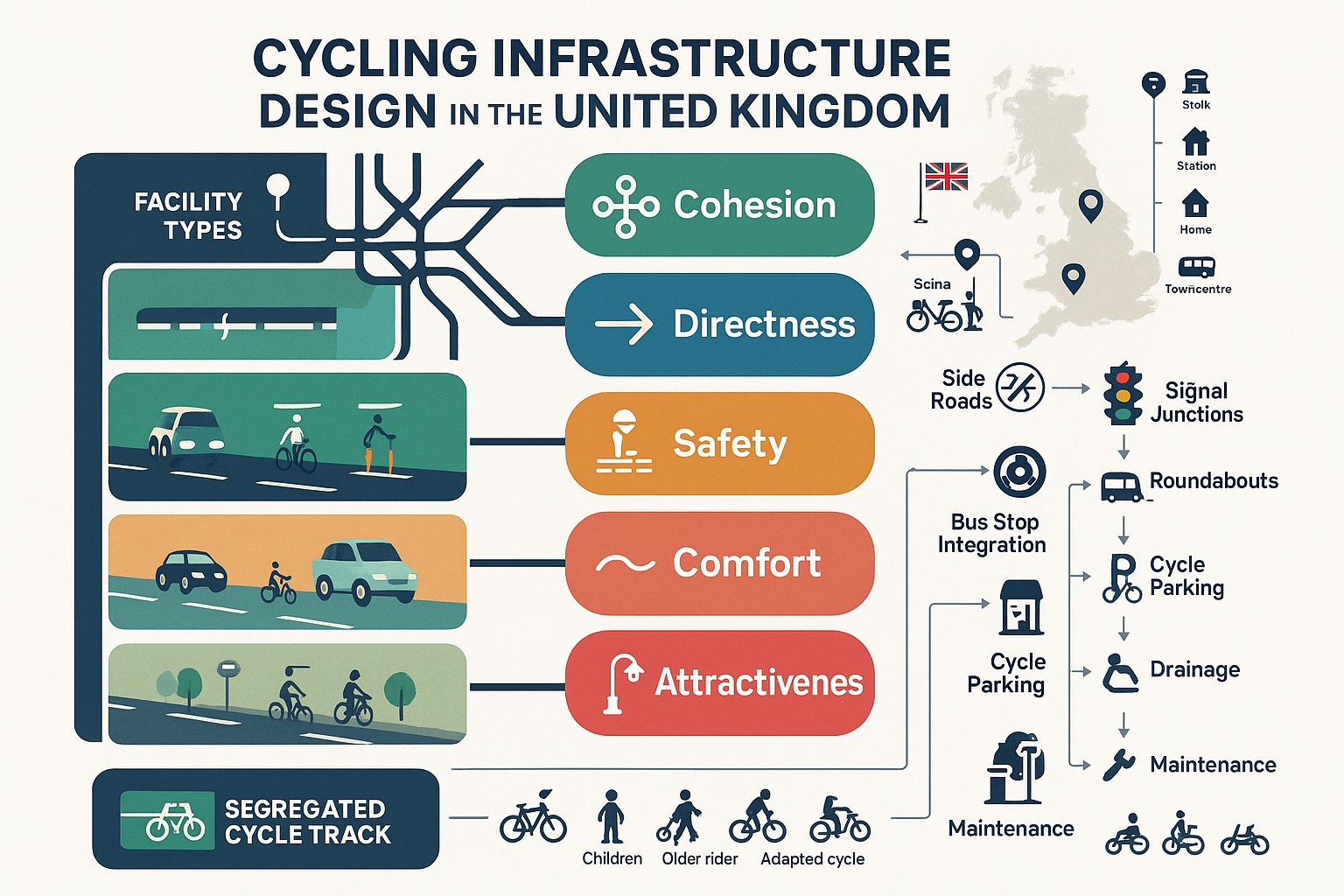
Good cycling infrastructure design is no longer a ‘nice to have’ in planning. For architects, developers, councils and transport consultants, it has become one of the clearest tests of whether a scheme is genuinely future-ready. If a route feels unsafe, indirect or awkward at junctions, people simply won’t use it. And that has consequences far beyond transport: weaker sustainability credentials, poorer accessibility, tougher planning negotiations and, often, avoidable redesign.
We’re seeing this shift across the UK. Local authorities are leaning more heavily on active travel policy, while applicants are under greater pressure to show how developments support low-carbon movement, healthier streets and realistic alternatives to private car use. High-quality cycle provision can help unlock mode shift, reduce pressure on parking, improve access to town centres and public transport, and strengthen the overall planning case.
But quality is the operative word. A painted lane squeezed into the door zone or a shared path that disappears at every side road won’t meet modern expectations. The benchmark is now much clearer, shaped by LTN 1/20, local policy, collision evidence and lessons from successful Dutch-style networks.
In this guide, we set out what good cycling infrastructure design gets right from the earliest planning stages through to delivery and long-term operation, with a focus on the issues that matter most in planning applications, transport assessments and development-led street design.
Why Cycling Infrastructure Design Matters In Planning And Development
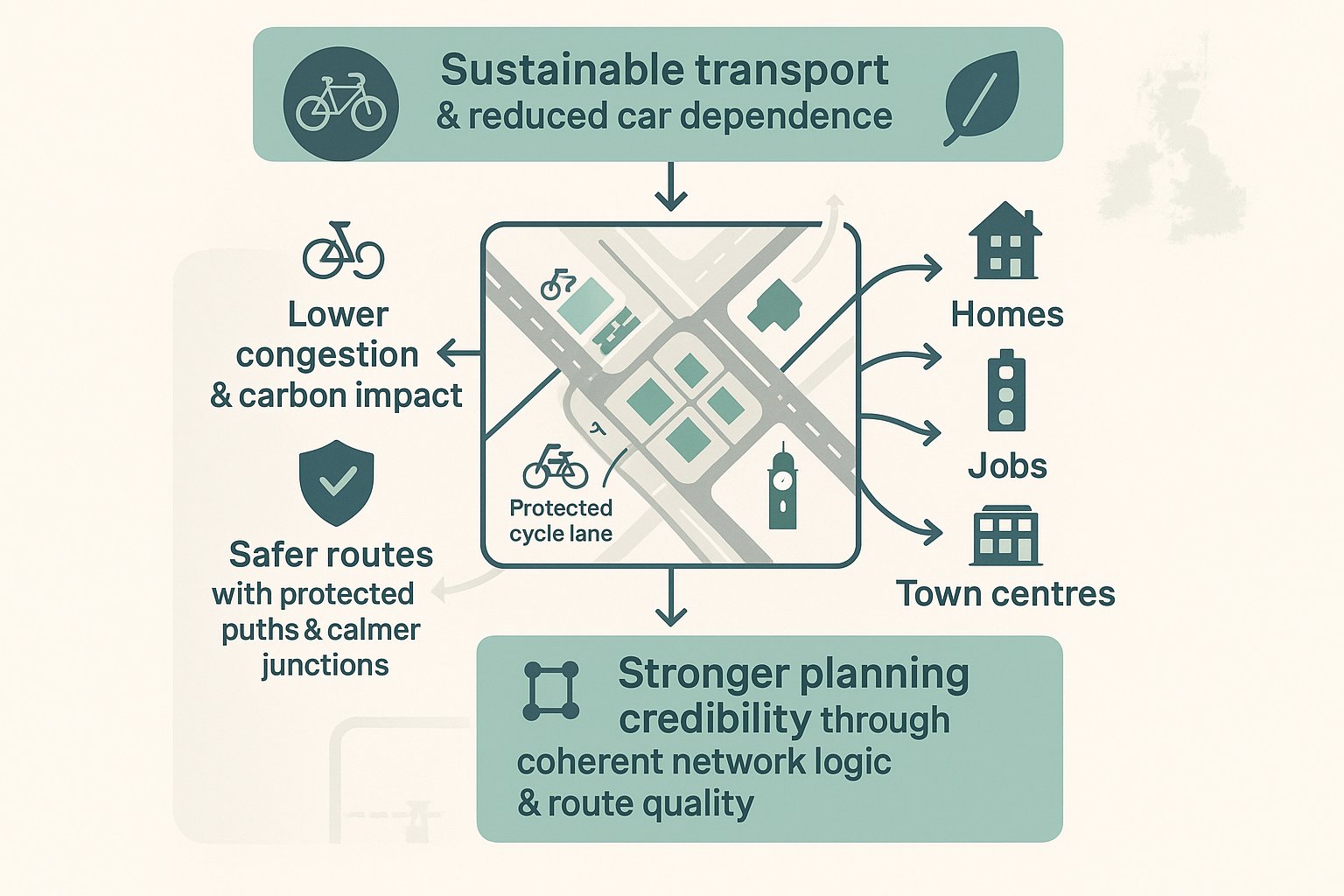
Cycling infrastructure design matters because it sits at the intersection of transport, placemaking, public health and policy compliance. In practical planning terms, it helps answer a basic question: can people reach the site safely and conveniently without relying on a car?
That question now carries real weight. National and local planning policy increasingly expects development to support sustainable travel, cut emissions and create healthier communities. Proper cycle provision helps schemes do all three. It can reduce local congestion, lower carbon impacts and improve access to jobs, schools, centres and interchanges. For compact urban extensions and mixed-use sites especially, that is central rather than peripheral.
There is also a safety dimension. Evidence is fairly consistent: where routes are protected from fast or heavy traffic, and where junctions are designed to reduce conflict, cycling levels rise and perceived risk falls. That combination matters in development planning because uptake depends as much on comfort as on technical connectivity.
From our side of the industry, we also know this is where planning applications can strengthen or weaken quickly. A transport statement that mentions cycling in broad terms but shows no coherent network logic, no desire-line analysis and no realistic route quality will attract scrutiny. By contrast, a scheme that embeds cycling from the outset tends to present a much more credible case for sustainable access, often making wider transport discussions easier to resolve.
The Core Principles Of Safe, Direct And Attractive Cycle Networks
Good cycle networks are not defined by a single facility type. They are defined by whether the whole journey works.
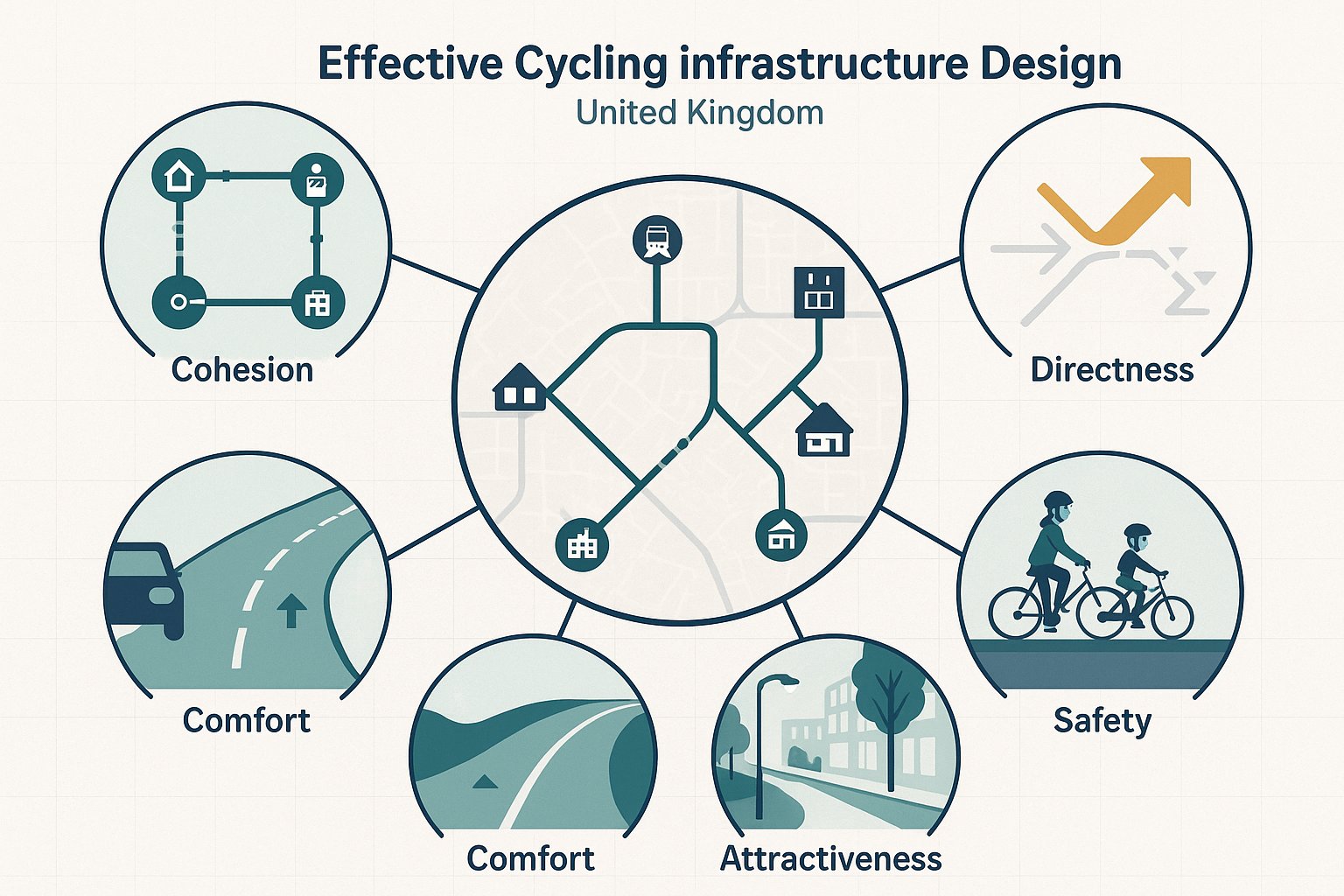
LTN 1/20 and established Dutch practice broadly converge around five principles: cohesion, directness, safety, comfort and attractiveness. Those are not abstract ideals: they are practical tests we can apply to any route or development frontage.
Cohesion means the network joins up. Homes should connect to schools, employment areas, local centres and stations without awkward breaks or sudden downgrades. A 300-metre missing link can undermine an otherwise decent corridor.
Directness is about time and effort. Cyclists should not be sent on unnecessary detours, forced to give way repeatedly at side roads, or delayed by cumbersome two-stage crossings where motor traffic gets the straight line.
Safety includes both objective risk and subjective confidence. A route may technically exist, but if it places a parent with a child beside 40 mph traffic with no protection, it fails the real-world test.
Comfort covers width, surface quality, gradients, drainage and the ability to overtake or use adapted cycles. And attractiveness matters more than some teams admit. Well-lit, legible, overlooked routes with decent public realm are more likely to be used.
When these principles are applied consistently, cycling infrastructure design stops being a bolt-on and starts functioning as part of a serious movement network.
Understanding User Needs Across Different Trip Types And Rider Groups
One of the most common design errors is to imagine a confident commuter on a road bike and treat that as the default user. Real networks need to work for many more people than that.
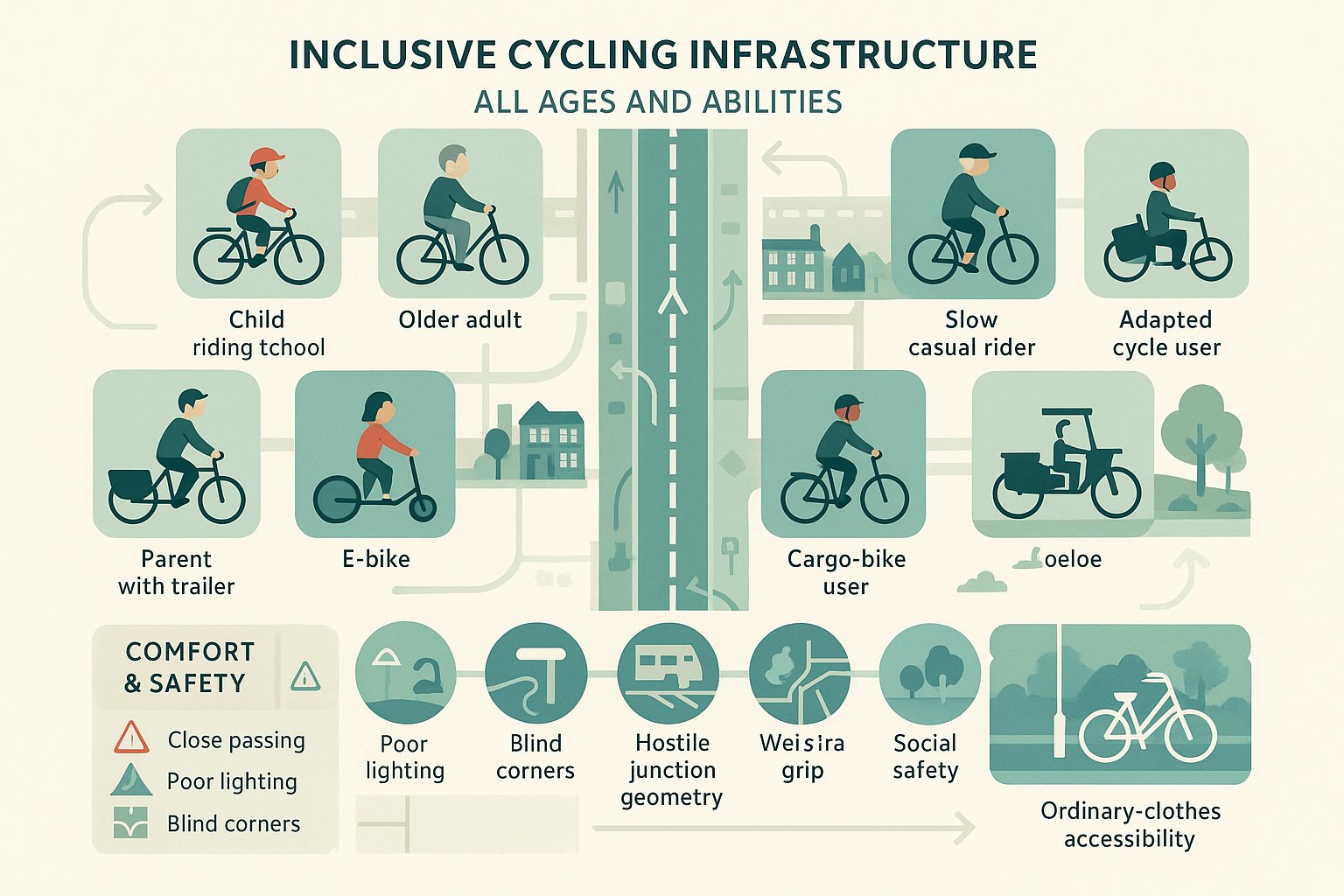
We should be designing for all ages and abilities: children travelling to school, older riders, people cycling slowly, users of adapted cycles, parents with trailers, and the growing number of e-bike and cargo-bike users. Their needs are not fringe cases. In many locations, they are the users who determine whether a route has broad appeal or remains niche.
Trip purpose matters too. A commute into a city centre has different patterns from school drop-off, shopping trips, station access or leisure travel. Utility cycling often depends on direct local links, secure parking and routes that feel safe in ordinary clothes, not just at peak hour.
This is where user comfort becomes decisive. Less confident riders are especially sensitive to close passing, poor lighting, blind corners, hostile junction geometry and surfaces that feel unreliable in wet weather. Social safety matters as well: isolated routes hidden behind buildings or landscaping may look neat on a plan but perform badly after dark.
For planning work, that means we need to test routes against realistic users, not idealised ones. If an eight-year-old, an older resident or someone using a wider cycle cannot reasonably make the trip, the scheme probably needs another look.
Choosing The Right Facility Type For Street Context And Traffic Conditions
There is no universal cross-section that suits every street. The right answer depends on traffic speed, traffic volume, frontage activity, bus movements, available width and the strategic role of the corridor.
As a rule, segregated cycle tracks are the preferred option on busier or faster roads. Where motor traffic volumes are significant, asking cyclists to mix with general traffic usually suppresses uptake, even if speeds are technically within limits at certain times of day.
Light segregation can be useful where budgets or physical constraints are tighter and where a scheme needs quick deliverability. But it is not a magic fix. If the route becomes ambiguous at side roads, loading areas or bus stops, users still experience conflict.
Mixed-traffic streets can work well, but only in genuinely low-speed, low-volume environments. In practice that often means 20 mph streets with traffic calming, filtered permeability or low-traffic neighbourhood principles, not simply a posted speed limit with unchanged geometry.
Shared-use space tends to be over-prescribed. It may have a role in parks, green corridors or lower-footfall locations, but on busy urban desire lines it often transfers conflict from carriageway to footway rather than resolving it.
The key is to match facility type to context honestly, not optimistically.
Segregated Cycle Tracks, Light Segregation And Mixed-Traffic Streets
Fully segregated tracks generally offer the strongest safety case and the highest level of user confidence. They are especially appropriate on strategic corridors, around major development frontages and on roads carrying heavier vehicles or higher speeds. If the objective is genuine mode shift, this is often where we need to land.
Light segregation, using wands, bolt-down kerbs or similar separators, can provide a meaningful interim step. It is faster to carry out and sometimes the only realistic short-term option. Still, it needs careful detailing at every crossing point, otherwise protection evaporates exactly where risk increases.
Mixed-traffic streets can be excellent when they are designed, not merely labelled, for cycle priority. Filtered permeability, narrow entry treatments, reduced turning speeds and low volumes can create streets where cycling feels normal. That is very different from expecting cyclists to “take the lane” in hostile conditions.
Junction Design: The Critical Point For Safety, Capacity And Compliance
If links are important, junctions are decisive. Most serious conflicts for cyclists happen where paths cross, turn or merge with motor traffic. A route that feels comfortable mid-block but becomes stressful at every major node will underperform, but attractive it appears on a plan.
Good junction design reduces conflict, lowers turning speeds and clarifies priority. That can include protected junction layouts, set-back crossings, dedicated cycle signals, early-release stages, low-level signal heads, waiting islands and two-stage turn provision where appropriate. The precise arrangement varies, but the objective is consistent: remove ambiguity and minimise exposure.
From a planning and compliance perspective, this is also where schemes often come unstuck. Reviewers tend to look closely at whether cyclists retain priority, whether crossing distances are reasonable, whether signal staging causes excessive delay, and whether design vehicles have been prioritised at the expense of rider safety.
Capacity matters too. Narrow waiting areas, tight radii and poor alignment can create pinch points just where cycle flows are likely to be highest. With e-bikes and cargo bikes becoming more common, assumptions based on older, narrower user profiles are increasingly outdated.
In short, if a development claims to support active travel, its junctions need to prove it.
Designing For Side Roads, Signal-Controlled Junctions And Roundabouts
At side roads, continuous footway and cycleway treatments or raised tables can make priority legible and physically slow turning traffic. Without that, drivers tend to treat cycle crossings as optional interruptions.
At signal-controlled junctions, we should be looking carefully at dedicated cycle stages, early starts, separate turning movements and detection technology that reduces unnecessary delay. Riders are much less likely to comply with convoluted staging if the direct route feels withheld for no clear reason.
Roundabouts require particular care. Large, multi-lane, high-speed forms are generally poor for cycling and difficult to justify where safer alternatives exist. Compact roundabouts with low entry speeds, or perimeter cycle tracks with clear priority crossings, tend to perform far better. This is one area where design ambition really shows.
Width, Alignment, Visibility And Surface Quality Requirements
These are sometimes treated as technical details to be tidied up later. They are not. Width, alignment, visibility and surface quality shape whether a route feels usable every day.
Width must reflect actual operation, not a bare minimum squeezed between other priorities. Two-way movement, overtaking, cargo bikes, adapted cycles and occasional maintenance access all affect what is workable. A route that is technically compliant on paper can still fail in practice if users cannot pass comfortably or if edge constraints reduce effective width.
Alignment should be intuitive and forgiving. Sudden deflections, awkward chicanes, unnecessary vertical changes and sharp turns near conflict points create discomfort and risk. They also make cycle movement feel like an afterthought compared with the straighter path given to cars.
Visibility is critical at side roads, private accesses, bends and crossing points. Parking bays, planting, cabinets and signage can all create hidden conflicts if not managed carefully. We often see layouts where visibility splays for drivers are considered meticulously while cyclists are screened from view at exactly the wrong moment.
And then there is the surface. Cycles are far less tolerant than cars of cracking, ponding, utility covers, poor reinstatements or slippery materials. Smooth, machine-laid asphalt is often the benchmark for good reason. If the route is uncomfortable in winter or after heavy rain, people notice immediately, and planning promises about active travel start to ring hollow.
Integrating Cycling With Walking, Public Transport And Accessibility Duties
Cycling should not be planned in isolation. The strongest schemes are the ones that work as part of a wider access strategy, complementing walking routes, public transport and inclusive design obligations.
The relationship with walking is especially important. In busy centres and around schools, hospitals or stations, defaulting to shared-use can generate friction rather than convenience. Pedestrians need clear, legible footways, safe crossings and confidence that cycle movement will not intrude into space intended primarily for walking. Where cycling and walking are brought together, delineation and low-conflict design become essential.
Integration with public transport is another planning priority. Safe cycle access to bus stops, rail stations and mobility hubs extends the reach of public transport and helps solve the “last mile” problem. That may involve careful bus stop bypass design, direct links to station entrances and secure parking at interchanges.
Then there are accessibility and equality duties. Designers need to account for disabled people, visually impaired users, wheelchair users and others who depend on clarity in the street environment. Tactile paving, step-free movement, controlled crossing points, kerb upstands and unambiguous route delineation all matter. This is not just good design practice: it is part of legal and policy compliance.
When these layers are considered together, schemes become more robust and much easier to defend through planning review.
Cycle Parking, End-Of-Trip Facilities And Development Site Layout
A high-quality route to a site is only half the job. If people arrive and find nowhere secure or convenient to leave a bike, the journey chain breaks.
Cycle parking should be secure, accessible and close to destinations. For many schemes, that means well-placed Sheffield stands for visitors, covered long-stay parking for staff and residents, and secure stores for higher-value bikes and e-bikes. Spacing matters. So does ease of use. Two-tier systems can be efficient, but they are not ideal for everyone, especially where heavy bikes or adapted cycles are expected.
End-of-trip facilities are often overlooked in commercial development yet can make a real difference to commuting by bike. Showers, lockers, drying rooms and changing space are not glamorous planning items, but on office, education and larger employment sites they can materially improve uptake.
The wider site layout is just as important. Internal roads should not force cyclists into secondary, indirect routes behind servicing yards or parking courts. Good masterplanning gives cycle movement direct access through the site, priority where possible, and clear links to surrounding streets and off-site networks.
This is an area where we often advise clients early. At ML Traffic, much of the value in transport reporting comes from identifying these layout issues before they harden into planning constraints or expensive redesign later.
Drainage, Maintenance, Materials And Long-Term Operational Performance
Delivery is not the finish line. A route that opens well but deteriorates quickly will lose users and attract complaints, sometimes within a single winter.
Drainage is one of the most underestimated issues. Poor crossfalls, badly placed gullies and low spots on the cyclist desire line create ponding, debris build-up and skid risk. Because cycles track a narrower line than cars, defects that seem minor in a general highway audit can be disproportionately harmful.
Materials also matter more than many budgets initially assume. Durable, smooth surfaces with good skid resistance tend to offer the best long-term value, even if upfront costs are slightly higher. Colour contrast can help with legibility, but it should not come at the expense of ride quality or maintenance practicality.
Then there is maintenance. Sweeping, vegetation control, winter treatment and timely repairs are essential if a route is to remain attractive and safe. Debris in a cycle track is not a cosmetic issue: it pushes riders into conflict areas or deters use altogether. Likewise, faded markings and damaged separators can undo the clarity that the original design intended.
For planning submissions, long-term operational thinking can be surprisingly persuasive. It shows the scheme has been designed not just to secure consent, but to function properly once handed over and used in real conditions.
Using Policy, Standards And Transport Evidence To Support Planning Applications
Strong planning applications do not simply state that cycling has been considered: they show how design choices are grounded in policy, standards and evidence.
In the UK, LTN 1/20 remains the key technical reference point for cycling infrastructure design. Depending on context, proposals should also align with the National Planning Policy Framework, local transport plans, design guides, active travel strategies and site-specific allocation policies. The exact mix varies by authority, which is why local interpretation matters almost as much as national guidance.
Evidence is what turns policy aspiration into a defensible planning case. Useful inputs often include traffic counts, speed data, collision records, desire-line analysis, school and employment catchments, census travel data, and tools that estimate cycling propensity. Health, carbon and placemaking benefits can also help frame the wider value of the proposal.
This is where transport assessments and statements need to do more than tick a box. We should be explaining why a chosen facility type is appropriate, how it links into the surrounding network, what constraints have been balanced and where the design accords with accepted standards.
For developers and consultants, a concise, authority-aware report often carries more weight than a bulky generic one. That is very much the approach we favour: accurate evidence, tailored to threshold requirements and local planning context, with no unnecessary padding.
Common Design Mistakes That Lead To Objections, Rework Or Poor Uptake
Most weak schemes do not fail because cycling was ignored entirely. They fail because it was acknowledged late, designed inconsistently or diluted at the points that mattered most.
A frequent problem is the incomplete network: a strong frontage treatment that ends abruptly at the site boundary, or a route that never properly reaches the school, centre or station it is meant to serve. Another is the door-zone lane, narrow painted provision beside parked cars on roads where users plainly need protection.
Junctions are a repeat offender. We still see designs where cyclists lose priority at every side road, wait through multiple signal stages, or negotiate large-radius turns designed mainly for vehicular convenience. Those details tend to trigger justified objections because they expose the gap between policy language and actual user experience.
Over-reliance on shared-use paths is another issue, especially in busy town centres where pedestrian conflict is predictable. Poor drainage, rough surfaces, inconsistent widths and cluttered alignments also come up again and again.
And increasingly, schemes run into trouble when inclusive design has not been thought through, whether that means inaccessible parking, weak delineation, or layouts that create new barriers for disabled users.
If there is a common thread, it is this: good cycling infrastructure design depends on continuity and honest appraisal. The schemes that succeed are usually the ones that confront real conditions early, coordinate planning and engineering properly, and keep the user journey in view from first sketch to final delivery.
Done well, that pays off. Applications are easier to support, streets function better, and the infrastructure actually gets used, which, after all, is the point.
Cycling Infrastructure Design FAQs
Why is good cycling infrastructure design important in urban planning?
Good cycling infrastructure fosters safe, direct, and attractive routes that encourage people to choose cycling over cars. It reduces congestion, lowers emissions, improves public health, and supports access to jobs and services, making developments more sustainable and future-ready.
What are the core principles that define safe and effective cycling networks?
Effective cycling networks follow five key principles: cohesion (continuous routes), directness (minimal detours), safety (protection from fast traffic), comfort (adequate width and surfaces), and attractiveness (well-lit, legible, and pleasant routes). These ensure journeys work smoothly from origin to destination.
How does cycling infrastructure design accommodate different types of users and trip purposes?
Designs must serve all ages and abilities, including children, older adults, and users of adapted or cargo bikes. They should suit varied trip purposes like commuting, school runs, shopping, and leisure, prioritising comfort, security, and social safety to appeal beyond confident cyclists.
What types of cycling facilities are recommended based on street traffic conditions?
Segregated cycle tracks are preferred on busier or faster roads to enhance safety. Light segregation suits moderate traffic with space or budget limits. Mixed-traffic streets work only where speeds and volumes are very low, usually under 20 mph with traffic calming and filtering measures.
How critical is junction design in cycling infrastructure, and what features improve safety there?
Junctions are where most cycling collisions happen, so design must minimise conflicts by clarifying priority with protected junction layouts, cycle-only signal phases, advanced stop lines, waiting islands, and low vehicle turning speeds. Good junctions maintain safety and smooth cycling flow.
What common mistakes in cycling infrastructure lead to poor usage or planning objections?
Common errors include incomplete networks that fail to connect key destinations, narrow or unprotected lanes next to parked cars, poor junction priority treatments, overuse of shared-use paths causing pedestrian conflict, neglect of surface quality and drainage, and ignoring inclusive design for disabled users.