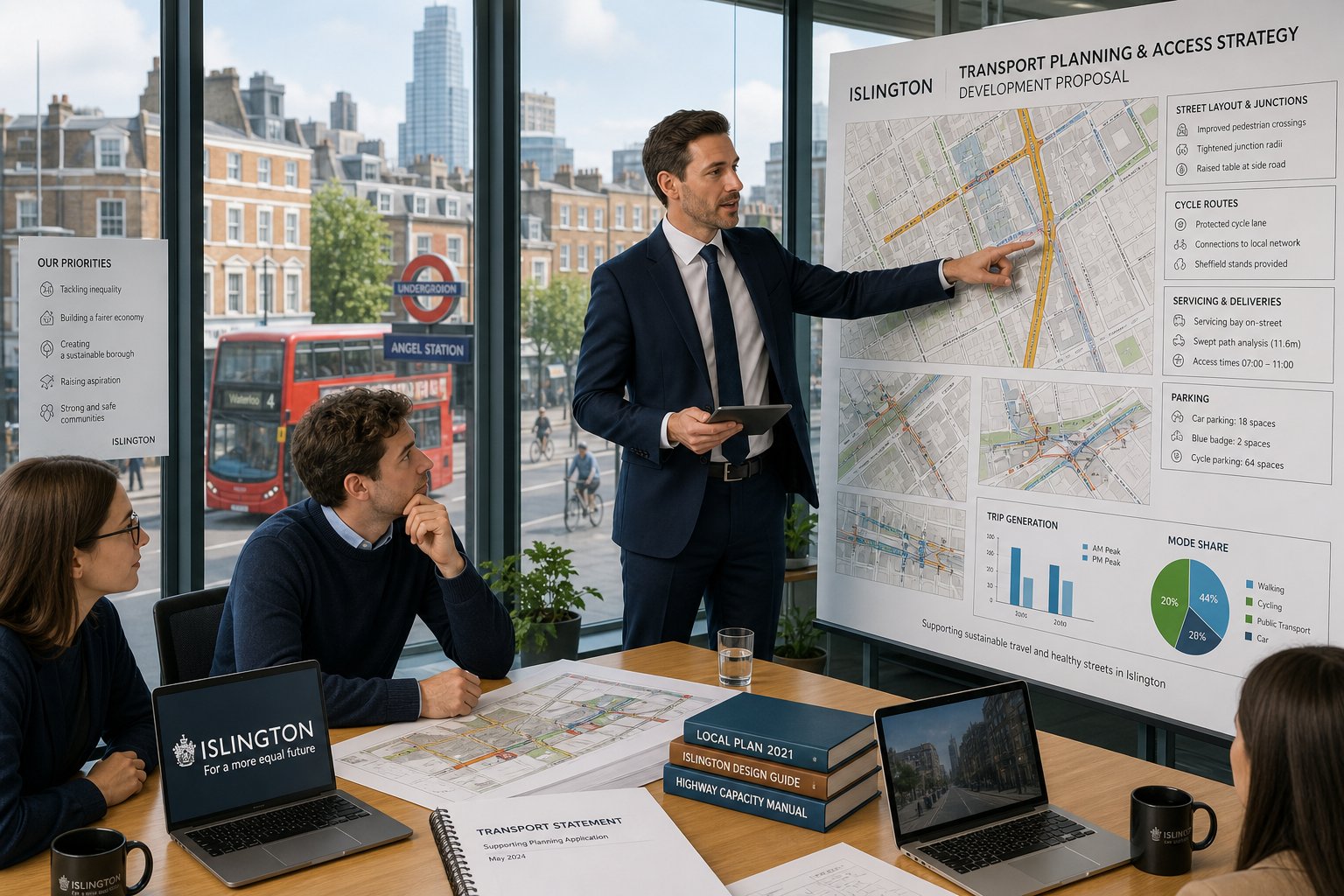
In Islington, transport planning is rarely a box-ticking exercise. A proposal can look perfectly sensible on the drawing board, then run into trouble once questions start landing about servicing, cycle parking, junction safety, car-free compliance, or how residents and staff will actually travel to and from the site. In a borough with constrained streets, heavy pedestrian movement, dense development patterns, and strong policy pressure toward active and sustainable travel, those questions matter early.
That’s where a Traffic Engineer in Islington becomes valuable. We help development teams turn a transport risk into a planning strength: identifying likely objections, shaping layouts around local highway realities, and producing evidence that stands up to scrutiny from planning officers, highways officers, TfL, and, where relevant, local residents.
For architects, planners, lawyers, surveyors, developers, and councils, the practical challenge is usually the same. You need concise, technically sound transport input that fits the scale of the scheme, reflects current London and local policy, and doesn’t cause unnecessary delay. The strongest submissions are rarely the longest: they’re the ones that address the right issues clearly and early.
In this guide, we explain what a traffic engineer does for planning applications in Islington, which reports are commonly needed, what local considerations tend to shape outcomes, and how early advice can make the planning process noticeably smoother in 2026.
Key Takeaways
- A Traffic Engineer in Islington provides essential, site-specific transport advice that goes beyond trip counting to address local highway realities and sustainable travel policies.
- Early involvement of a Traffic Engineer can identify and resolve transport-related planning risks, smoothing the approval process for developments in Islington’s constrained urban environment.
- Residential and commercial developments must comply with car-free or low-car policies, ensure adequate cycle parking, and demonstrate safe servicing and access arrangements tailored to Islington’s high-demand kerbside conditions.
- Transport reports such as transport statements, assessments, travel plans, and technical notes should be proportionate, focused, and responsive to local planning and highway expectations.
- Understanding Islington’s unique street functions, including bus routes, cycle paths, and loading restrictions, is crucial to designing compliant and effective transport strategies.
- Providing clear, concise, and evidence-based transport submissions helps development teams minimize objections and accelerate planning permissions in Islington.
What A Traffic Engineer In Islington Does For Planning Applications
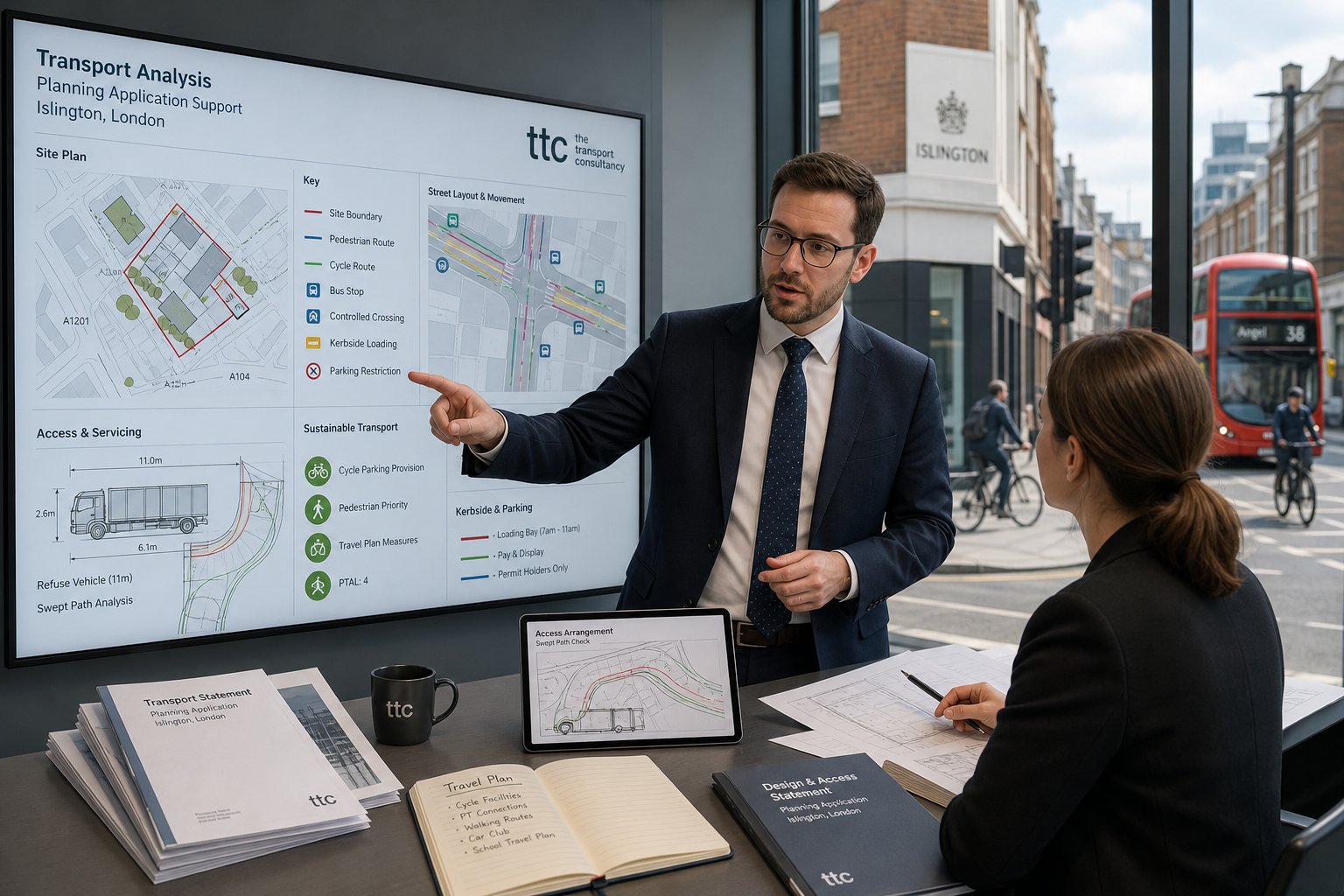
A Traffic Engineer in Islington provides the technical transport case behind a development proposal. In practice, that means more than counting vehicle trips. We assess how a scheme will interact with streets, people, servicing activity, public transport, cycle movement, and local restrictions, then translate that into planning-ready evidence.
For some projects, the task is strategic: advising whether the proposal should be car-free, how much cycle parking is likely to be acceptable, or whether access needs redesign before an application is lodged. For others, it’s more analytical: reviewing trip generation, comparing mode share assumptions, checking visibility and swept paths, or preparing a transport statement that aligns with borough and London-wide policy.
In a place like Islington, vehicle impact is only part of the story. Pedestrian conditions, cycle routes, kerbside pressure, loading patterns, and nearby bus operations can all carry real weight in planning decisions. So we often review site context in detail, including controlled parking zones, loading restrictions, school street arrangements, low-traffic measures, crossing locations, and the practical behaviour of the street at different times of day.
That broader planning role is why many project teams involve Traffic Engineering Consultants: early rather than waiting for a consultee objection. The earlier transport advice comes in, the easier it is to avoid a design that looks neat on paper but fails under highway review.
We also prepare and coordinate the documents submitted with the application: transport statements, transport assessments, travel plans, delivery and servicing material, parking notes, and technical responses. And when comments come back, we help the wider team answer them in a way that is proportionate, evidence-led, and specific to the site rather than generic.
Why Islington Requires A Site-Specific Transport Strategy
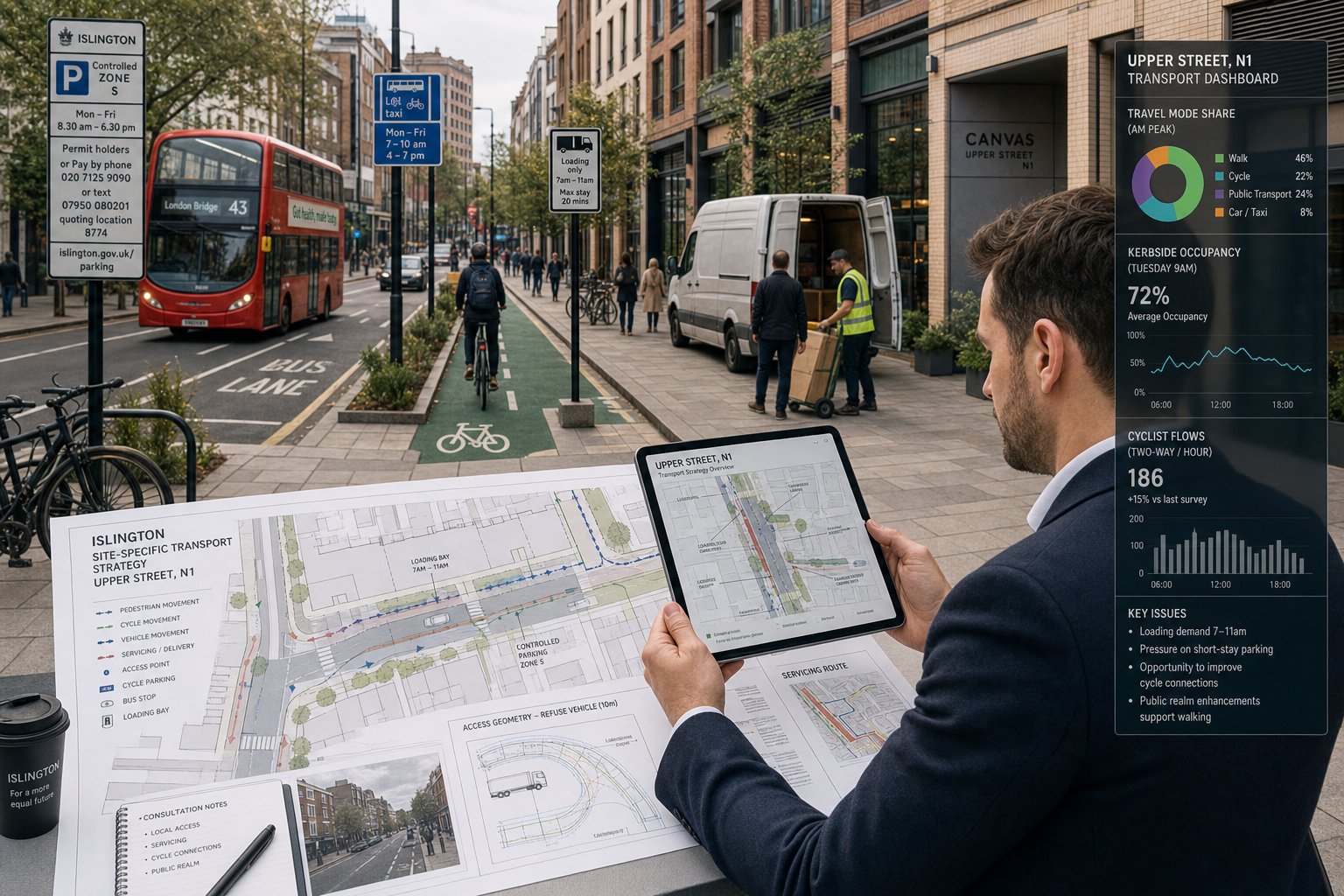
Islington is one of those boroughs where “standard” transport assumptions can quickly fall apart. The urban form is tight, road space is limited, and the competition for kerbside and carriageway space is intense. A site may sit on a bus corridor, around the corner from a cycle route, inside a controlled parking zone, beside a school street, or on a street already affected by servicing pressure. Two sites with the same land use quantum can hence present completely different planning risks.
That’s why a site-specific transport strategy matters. We’re not simply asking whether a development generates trips: we’re asking how those trips happen, where servicing takes place, and whether the proposal supports the borough’s wider priorities around walking, cycling, road danger reduction, and lower car dependence.
A good strategy usually pulls together several threads: local policy, surrounding street function, realistic mode share, access geometry, parking restraint, cycle provision, refuse collection arrangements, and delivery activity. In Islington, these points need to work together. A scheme cannot claim sustainable travel benefits while leaving unresolved problems at the kerbside or forcing awkward servicing manoeuvres.
This is where broader Traffic Engineering and Transportation planning principles become very local very quickly. Borough context affects whether a drop-off arrangement is likely to be resisted, whether a blue badge strategy is robust, or whether a modest increase in delivery demand could trigger officer concern.
We hence shape transport strategy around the actual street, not a template. That usually produces better design decisions, a stronger planning narrative, and fewer surprises once highways and planning officers start reviewing the details.
Common Development Types That Need Traffic Engineering Input
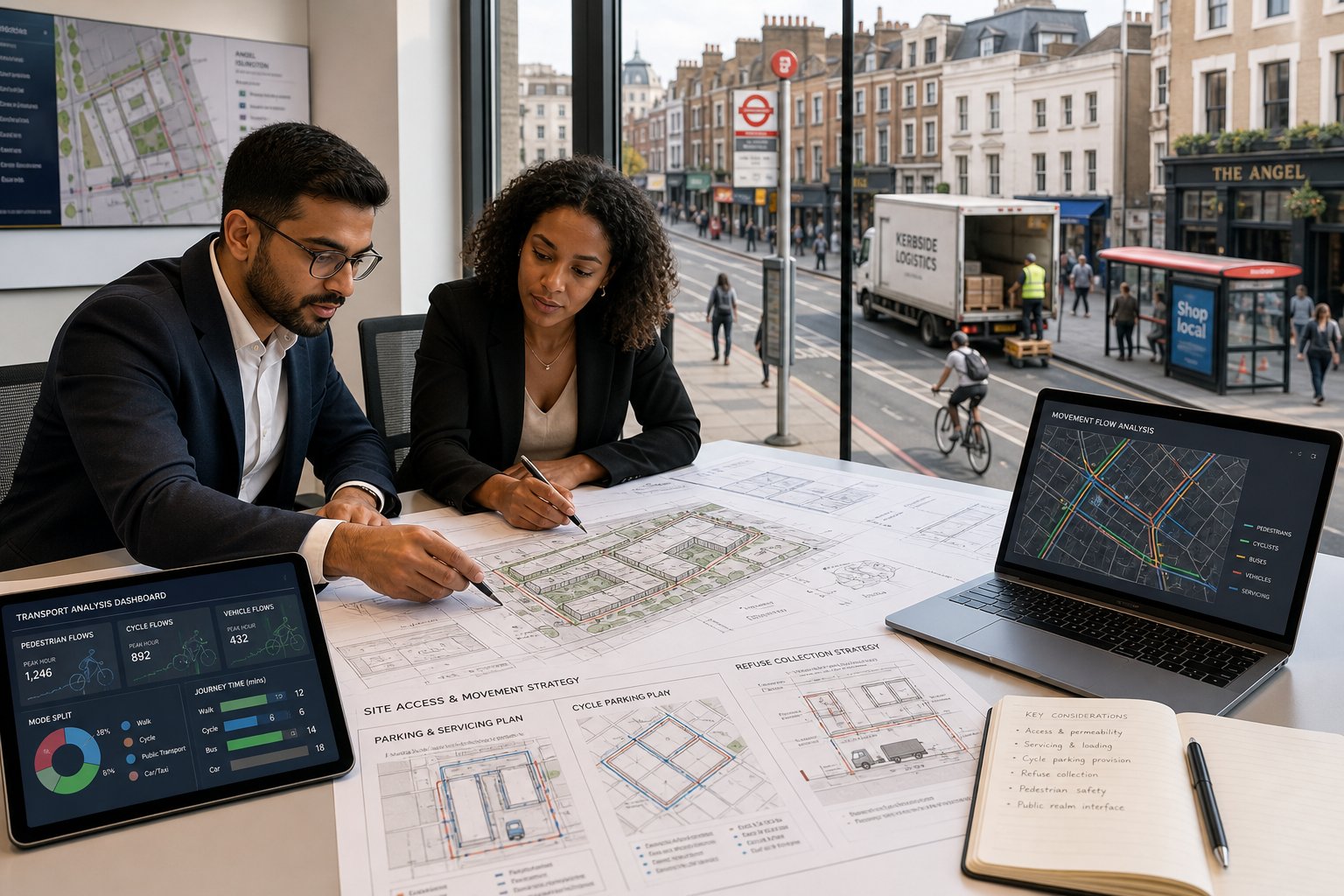
Not every project needs a full transport assessment, but a surprisingly wide range of schemes in Islington benefit from traffic engineering input. The threshold is not just development size. It’s also about sensitivity: location, servicing complexity, parking implications, existing road safety conditions, and the likelihood of highway or neighbour concerns.
Even small or medium-sized proposals can attract detailed transport questions if they alter access, intensify deliveries, remove on-street space, rely on constrained kerbside activity, or sit in a particularly pressured urban context. A change of use can do it. So can estate infill, a new crossover, a revised refuse strategy, or a scheme next to a heavily used walking and cycling route.
In our experience, the projects that most often need support are those where transport is intertwined with layout and operation. Once access, servicing, parking, and movement are part of the planning debate, technical input becomes hard to avoid.
Residential Schemes
Residential development in Islington often raises transport questions well beyond car trip generation. Flatted blocks, estate renewal, infill sites, PBSA, later living, and build-to-rent schemes are commonly expected to demonstrate low-car or car-free compliance, adequate cycle parking, workable refuse collection, and safe, realistic servicing.
That sounds straightforward until the site is on a narrow street, beside waiting restrictions, or within an area where on-street demand is already tightly controlled. Then details matter: where couriers stop, how move-ins happen, whether emergency access is acceptable, and whether blue badge arrangements are practical rather than nominal.
Residential schemes also need careful forecasting of person trips, not just vehicle movements. In many Islington locations, walking, cycling, and public transport will dominate. The transport case should reflect that honestly while still dealing properly with taxis, deliveries, and occasional servicing demand.
Commercial, Mixed-Use, And Community Developments
Commercial and community schemes often trigger more operational transport questions than residential ones. Offices, retail units, health facilities, schools, leisure space, and mixed-use proposals can create concentrated arrival patterns, delivery windows, staff travel demand, and visitor movement that spill into the surrounding network in noticeable ways.
A small foodstore can be sensitive because of servicing frequency. A workspace scheme may need a stronger travel plan than expected. A school or health use may raise concerns about pick-up activity, crossing demand, and peak-hour interaction with nearby streets. And mixed-use development adds another layer, because different uses often compete for the same access and kerbside space.
For those schemes, we typically test not only the volume of trips but the operational fit of the proposal. Commercial Traffic Engineering input is often most valuable where the risk lies in servicing, turnover, timing, or street management rather than in headline traffic growth alone.
Core Transport Reports Often Required In Islington
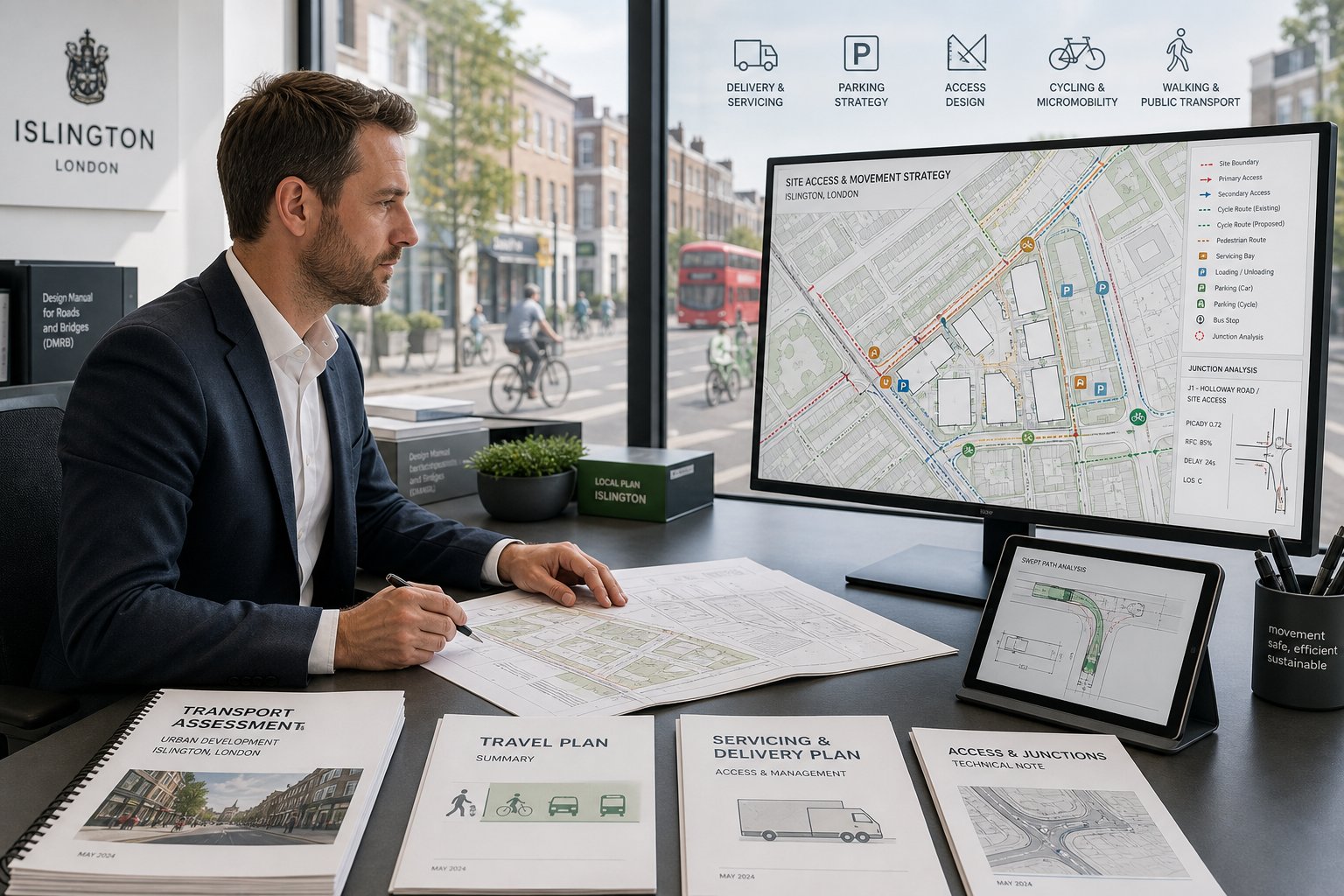
The exact reporting package depends on the scale and nature of the development, but Islington applications often need more than one transport document. The goal is not to overwhelm officers with paper. It is to provide a clear and proportionate evidence base that answers likely planning and highway questions before they turn into delays.
The most common reports fall into two groups: the main planning transport documents that assess movement and impact, and the supporting technical notes that deal with operational detail such as servicing, parking, tracking, and access design. Getting the right combination matters. Too little information creates uncertainty: too much generic reporting can obscure the real issues.
Transport Statements, Transport Assessments, And Travel Plans
A transport statement is usually suitable where impacts are limited but still need explanation. It sets out site context, accessibility, expected trips, access arrangements, parking and cycle provision, servicing assumptions, and whether material network effects are anticipated. A transport assessment goes further, with deeper analysis of trips, junction or network implications, and mitigation where required.
Travel plans are especially important in Islington because they show how a development will support non-car travel in practice. That may include cycle facilities, welcome information, freight and delivery management, car club membership, monitoring arrangements, and targets linked to mode share.
The key is proportionality. Officers tend to respond better to a focused, site-aware report than to a bloated document full of standard text. That’s one reason many teams draw on wider Traffic Engineering: Your experience when deciding what level of reporting is genuinely needed.
Delivery, Servicing, Parking, And Highway Technical Notes
These supporting documents are often where difficult planning questions are actually resolved. A delivery and servicing note can explain vehicle types, frequency, time windows, bay usage, refuse collection, and how conflicts with pedestrians or cyclists are minimised. A parking note may justify car-free status, blue badge provision, motorcycle spaces, cycle parking numbers, or any deviation from standard assumptions.
Highway technical notes are also commonly used for access geometry, swept path analysis, visibility, tracking, and proposed on-street changes. In Islington, where kerbside arrangements are highly sensitive, a short but precise technical note can be more useful than pages of generic narrative.
Where proposals involve crossovers, changes to waiting/loading controls, or alterations affecting buses and cycling, technical coordination becomes even more important. Input from Highway And Traffic Engineering specialists can help tie those operational details back to the planning case in a coherent way.
Key Local Planning And Highway Considerations In Islington
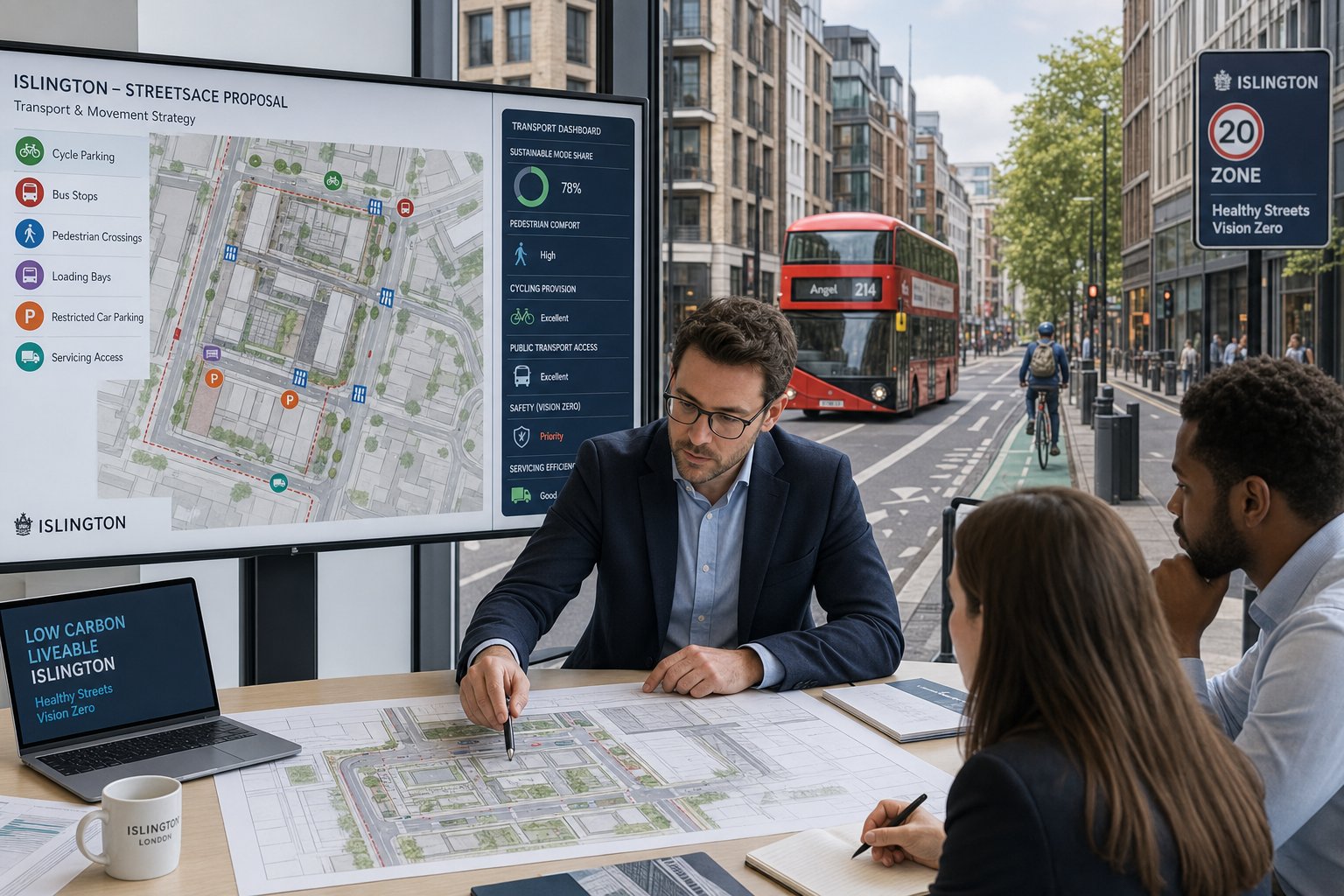
Islington transport work sits inside a layered policy context. At the top level, the London Plan shapes expectations around sustainable travel, parking restraint, cycle parking, freight, Healthy Streets, and good growth. At borough level, local plan policy and development management practice sharpen those requirements for Islington’s specific street conditions and land use patterns.
A few themes come up again and again.
First, car use is strongly constrained. Many schemes are expected to be car-free or low-car, with clear reasoning around disabled parking, operational need, and how future users will travel. Second, cycle parking is not an afterthought. Quantity, quality, accessibility, security, and routeing into the building all matter. A technically compliant number can still attract concern if the layout is awkward or unrealistic.
Third, street function matters. Nearby bus stops, cycle routes, crossings, loading bays, school access, and existing traffic management can all affect what is acceptable. A servicing arrangement that might pass elsewhere in London can struggle in Islington if it blocks a key movement corridor or adds pressure to an already stressed kerbside.
Healthy Streets and Vision Zero principles also influence design expectations. Officers are rightly alert to proposals that increase conflict with pedestrians and cyclists, create poor visibility, rely on reversing in sensitive locations, or weaken public realm quality. In practical terms, that means transport advice should engage with safety and street usability, not just theoretical capacity.
For teams working across several boroughs, this is often where local knowledge saves time. A scheme that was acceptable in outer London may need a different access or servicing approach here. The same is true when comparing urban contexts beyond the capital: the planning logic behind a Traffic Engineer In London: role is similar, but Islington’s constraints make precision more important.
And yes, tiny design decisions can have outsized consequences. A few metres of bay positioning, a poor cycle store entrance, or an over-optimistic loading assumption can become the issue that stalls progress.
How A Traffic Engineer Supports A Smoother Planning Process
The best transport input usually saves time before anyone notices it has done so. We say that because the real value often appears in the problems that never materialise: the access arrangement that gets fixed before submission, the servicing plan that avoids a late objection, the cycle parking layout that doesn’t need a redesign after comments from officers.
Early review is a big part of that. We can test whether the developing layout aligns with likely transport expectations, flag weak points, and advise on what evidence the application should carry. That helps architects and planners avoid spending weeks refining a plan that will later be challenged on highway grounds.
Once the application is moving, our role becomes part technical author, part interpreter. We explain transport matters in a way that is clear to planning teams, while also presenting enough rigour for highways officers and, where relevant, TfL. If objections arise, we prepare targeted responses rather than broad reassurance. That distinction matters: local authorities usually want proof, not promises.
There’s also a coordination function. Transport decisions affect architecture, servicing strategy, waste management, public realm, and legal drafting. When these strands are aligned, the planning process tends to move more cleanly.
For many clients, the practical benefit is speed without sloppiness. That’s very much the ethos behind Traffic Engineer In planning support across different city contexts: concise reporting, local authority awareness, and technical input aimed at getting applications over the line rather than adding unnecessary bulk.
A smoother process doesn’t mean a guaranteed approval. It means fewer avoidable issues, better evidence, and a more credible case when the transport aspects of the proposal come under scrutiny.
What To Prepare Before Instructing A Traffic Engineer
The quality of transport advice is directly linked to the quality of the information we receive at the outset. That doesn’t mean everything must be fully resolved before instruction. Quite the opposite. We’re often most useful while options are still open. But a few core items make a noticeable difference.
Start with the red-line boundary, site address, and the most current draft drawings. A schedule of accommodation is essential, because unit mix, floor areas, staff numbers, operational assumptions, and phasing all shape trip generation and servicing needs. If the scheme may evolve, flag that too. It’s better for us to understand the likely range than to prepare a report around a version that immediately changes.
Pre-application advice is especially valuable. Comments from planning or highways officers often reveal what the authority is already worried about. Existing site photographs, collision history concerns, nearby bus stops, crossings, waiting restrictions, CPZ information, and any known servicing constraints are also useful.
We also recommend sharing the planning strategy. Is the application aiming to establish principle? Is it addressing a previous refusal? Is there likely neighbour sensitivity around traffic, parking, or road safety? Those points affect how the transport case should be framed.
A concise briefing usually works better than a long email trail. If the team can clearly set out the proposal, programme, and known risks, we can identify the likely reporting scope quickly. That kind of disciplined preparation is what tends to separate routine report production from genuinely effective Traffic Engineer in Islington support.
And one practical note: don’t wait until submission week. If transport input is needed, a little lead-in time often prevents a lot of expensive redesign later.
Conclusion
In 2026, securing planning permission in Islington means treating transport as part of design and planning strategy, not as a late technical add-on. A well-judged transport submission can clarify impacts, support sustainable travel objectives, answer likely highway concerns, and make the overall proposal easier for officers to assess.
For residential, commercial, mixed-use, and community schemes alike, the strongest results usually come when traffic engineering input is brought in early enough to influence layout, access, servicing, parking, and reporting scope. That early coordination reduces friction, sharpens the planning narrative, and helps the application stand up to detailed review.
As a Traffic Engineer in Islington, our role is eventually practical: to give development teams concise, accurate, locally aware transport advice that helps projects move forward with fewer surprises and stronger technical foundations.
Frequently Asked Questions about Traffic Engineering in Islington
What role does a Traffic Engineer in Islington play in planning applications?
A Traffic Engineer in Islington assesses how a development impacts vehicles, pedestrians, and cyclists. They provide technical transport advice, prepare transport reports, and ensure proposals comply with local and London policies to support smooth planning approvals.
Why is a site-specific transport strategy important for developments in Islington?
Islington’s dense urban layout and limited road space mean each site has unique transport challenges. A site-specific strategy addresses local street function, parking, servicing, and active travel priorities to ensure developments integrate smoothly with existing conditions and policies.
What kinds of developments commonly require traffic engineering input in Islington?
Residential, commercial, mixed-use, and community projects often need traffic engineering support in Islington. This includes flatted blocks, office buildings, schools, and retail units where access, servicing, parking, and local road safety require detailed transport assessment.
How can early involvement of a Traffic Engineer improve the planning process in Islington?
Engaging a Traffic Engineer early helps identify and resolve transport issues before submission, reducing redesign and objections. Early advice on layout, access, and reporting scope streamlines reviews by highways officers and TfL, making the planning process smoother and faster.
What transport reports are typically required for planning applications in Islington?
Common reports include Transport Statements, Transport Assessments, and Travel Plans that evaluate trip generation and network impact. Supporting notes like Delivery & Servicing Plans, Parking Notes, and Highway Technical Notes provide detailed operational and design information tailored to site needs.
How does a Traffic Engineer in Islington support sustainable travel goals?
Traffic Engineers ensure developments prioritise walking, cycling, and public transport by designing adequate cycle parking, minimising car use, and aligning proposals with Healthy Streets and Vision Zero principles. They integrate local restrictions and improve street safety to support sustainable travel.