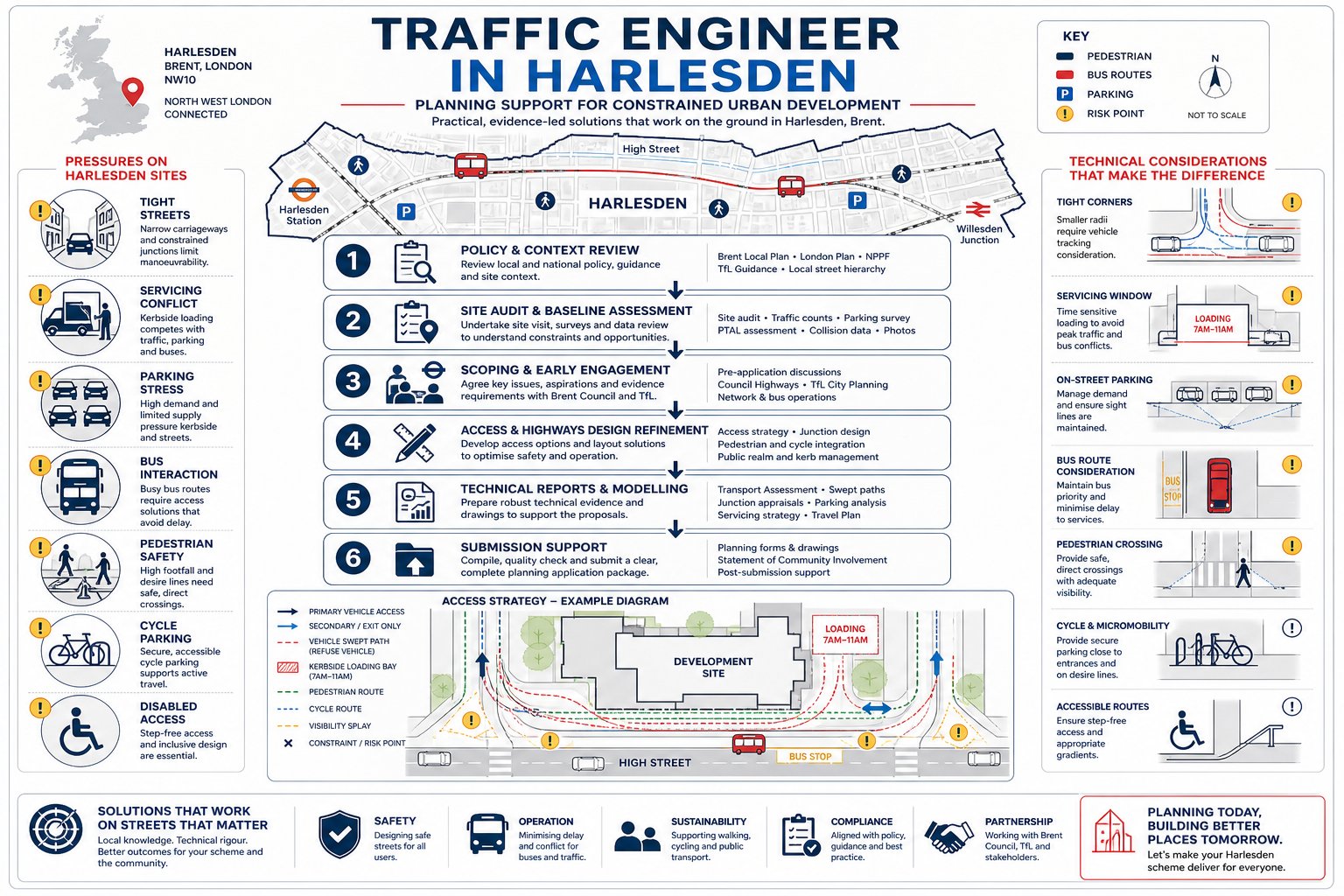
Harlesden rarely gives transport teams an easy ride. Streets are tight, bus movements are constant, pedestrian activity is high, and many development plots come with awkward access, limited visibility, or very little room to absorb mistakes. For architects, planners, lawyers, surveyors, builders, developers, and council teams, that means transport evidence can’t be treated as a late-stage add-on. It has to work from the start.
A good Traffic Engineer in Harlesden does more than produce a report for a planning file. We help shape layouts, pressure-test access ideas, identify likely objections from Brent or TfL, and build the technical case that a proposal will operate safely and acceptably. In a dense London location, that early input can make the difference between a smooth determination and a long trail of highways comments.
In this guide, we set out where traffic engineering fits into Harlesden planning work in 2026, which schemes usually need formal transport input, what reports and drawings are commonly required, and how the process typically runs from first review to submission. The focus is practical: what matters on real sites, what local authorities expect, and how to reduce planning risk while keeping the application moving.
Key Takeaways
- A skilled Traffic Engineer in Harlesden is essential from the early planning stages to ensure proposals meet Brent and TfL transport policies and operate safely on constrained streets.
- Transport assessments, transport statements, and travel plans must be tailored to scheme size and context, focusing on practical issues like access, servicing, parking, and active travel support.
- Vehicle tracking and swept-path analysis are critical for demonstrating safe manoeuvres of refuse, fire, and servicing vehicles on tight, busy Harlesden sites.
- Early engagement with local highways and transport authorities can streamline planning applications by ensuring transport evidence addresses all material concerns upfront.
- A Traffic Engineer adds value by shaping layouts to minimise highways objections, supporting planning narratives, and advising on operational strategies that reduce risk and delays.
- Choosing a Traffic Engineer experienced in London’s specific policies and local conditions leads to clearer communication, faster responses, and more persuasive transport evidence.
Why Transport Engineering Matters For Development In Harlesden
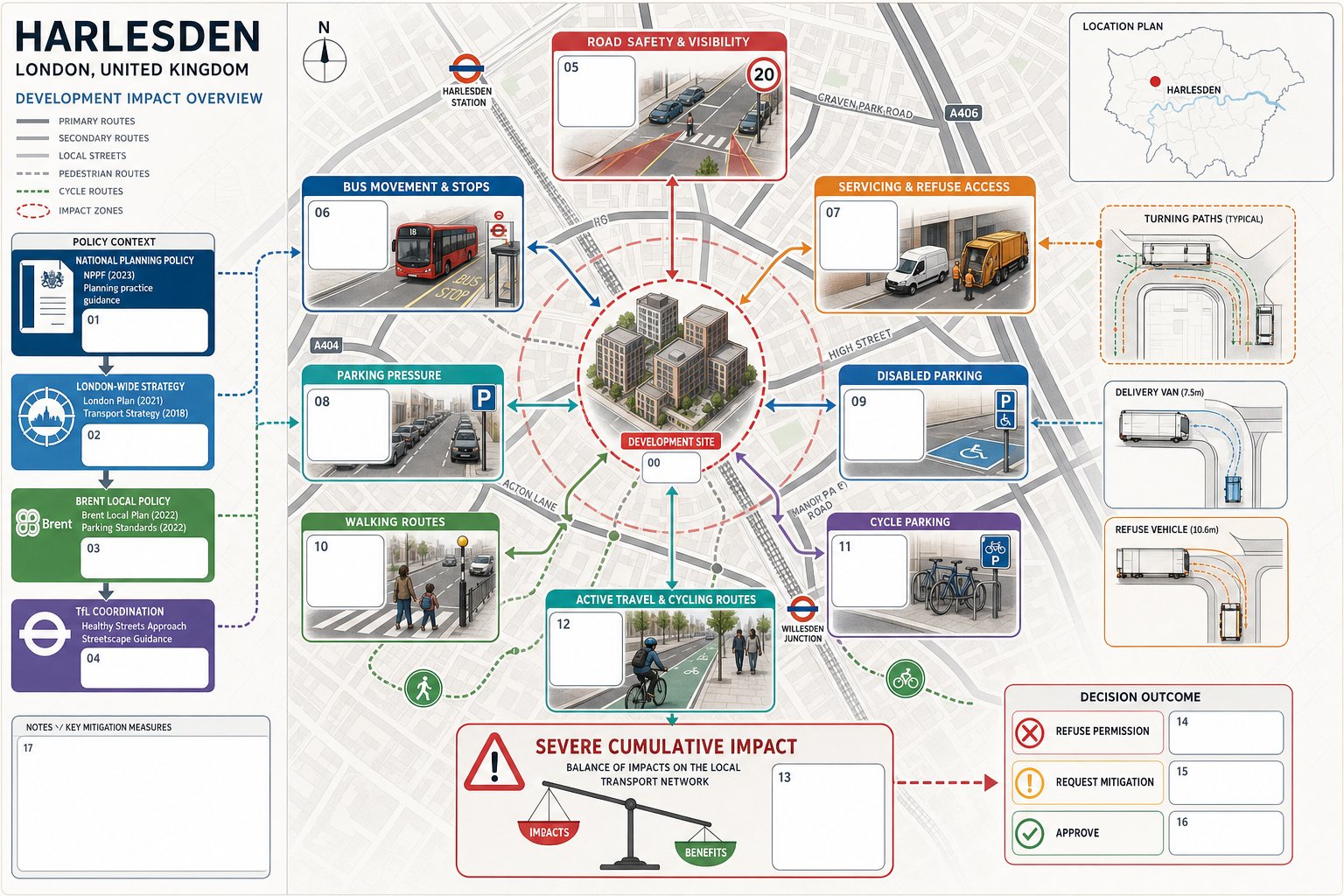
Harlesden sits in a part of Brent where development pressure meets a busy, constrained street network. That combination makes transport engineering central to planning strategy, not just technical compliance. On many sites, the main issue is not whether a proposal generates any traffic at all, but whether the local network can accommodate it without unacceptable effects on safety, servicing, bus reliability, parking stress, or walking conditions.
Under the NPPF, the test is often whether the residual cumulative impact would be severe. In London, that sits alongside the London Plan, Healthy Streets principles, active travel expectations, and local Brent policy. So when we assess a scheme in Harlesden, we’re usually looking beyond simple trip numbers. We’re asking how people will arrive, where deliveries will happen, whether an access works in reality, and how the site relates to the street outside.
This is especially important in town-centre locations and on former commercial plots being brought forward for residential or mixed use. A design that looks efficient on paper can run into trouble if refuse vehicles can’t manoeuvre cleanly, if visibility is compromised by parked cars, or if a nominally car-free scheme hasn’t properly addressed servicing and disabled parking.
That is why early technical input matters. We often find that modest changes to access geometry, internal layout, cycle parking, or servicing strategy remove major planning friction. Broader strategic support can also help teams frame evidence in line with Traffic Engineer In London: expectations, especially where Brent and TfL policies overlap. And where scheme typologies are more complex, advice from experienced Traffic Engineering Consultants: helps keep transport matters proportionate, evidence-led, and planning focused.
When A Traffic Engineer Is Needed For A Planning Application
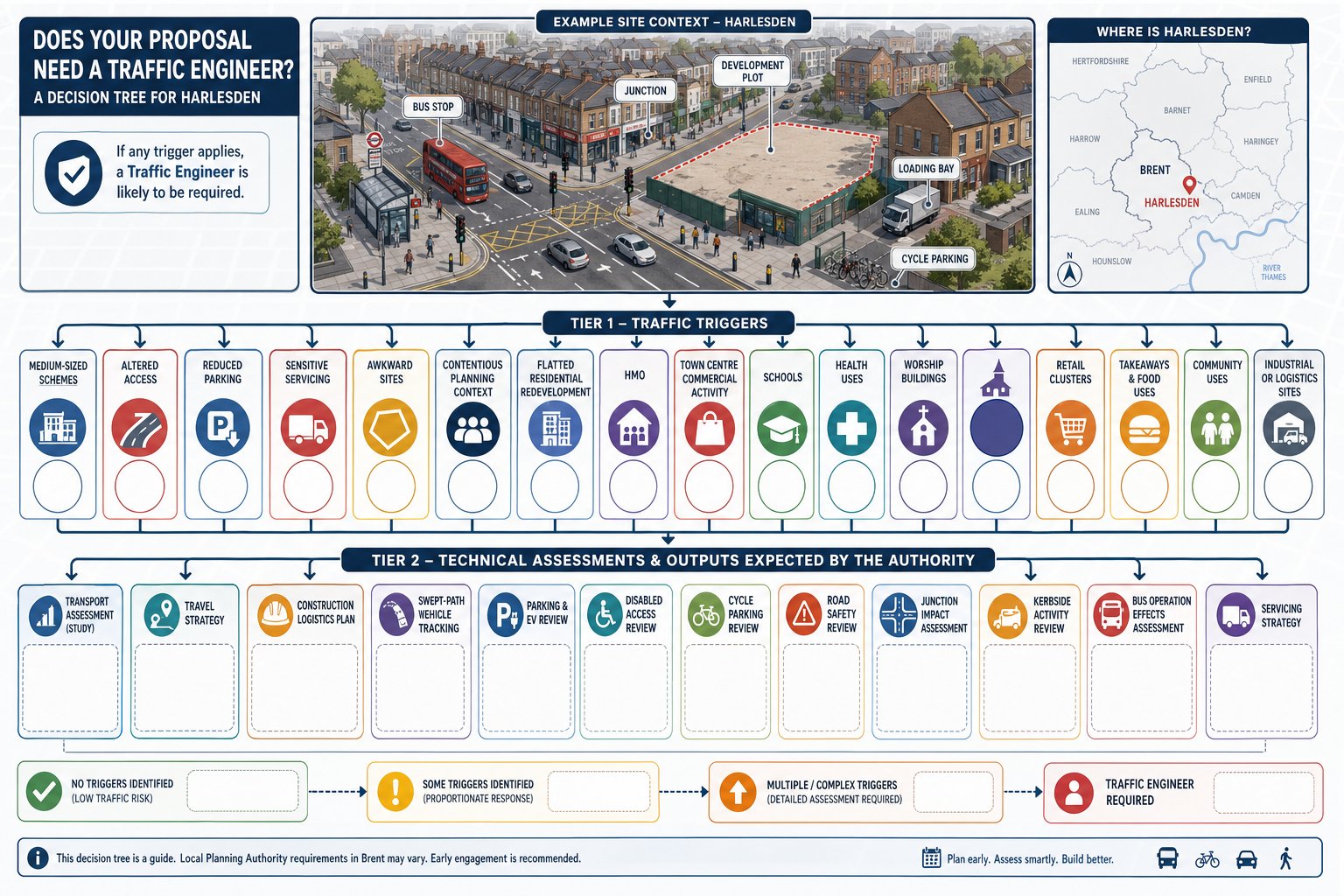
Not every proposal in Harlesden needs a full Transport Assessment, but plenty need more than a brief transport note. The risk in leaving traffic input too late is that a seemingly manageable issue becomes embedded in the design. By the time comments come back from highways officers, changing the layout may affect unit numbers, servicing, bin strategy, frontage treatment, or viability.
In practice, we’re commonly instructed where a scheme is medium-sized, sits on a busy route, alters an access, reduces parking significantly, or relies on a sensitive servicing arrangement. Even smaller developments can justify specialist input if the site is awkward or the planning context is contentious.
Typical Schemes That Require Traffic Input In Harlesden
Residential flatted schemes are a frequent trigger, particularly where they replace light industrial, garage, storage, or mixed commercial uses. HMOs can also need review where turnover, parking demand, or servicing arrangements may become a concern. In Harlesden‘s denser streets, town-centre commercial proposals often require transport input too, especially where cumulative activity matters more than the impact of one unit in isolation.
We also regularly see a need for technical support on schools, nurseries, health uses, places of worship, retail clusters, takeaways, and community buildings with peaking arrival patterns. Industrial and logistics sites need especially careful attention because servicing is often the issue that decides whether the proposal is workable. Car-free or car-lite schemes can be entirely policy-compliant, but they still need a credible operational strategy.
For wider context on how these instructions typically sit within planning workstreams, pages covering Highway And Traffic Engineering and Commercial Traffic Engineering reflect the same principle: the more constrained the site and the more sensitive the use, the earlier transport review should happen.
Common Planning Triggers And Local Authority Expectations
The obvious trigger is trip generation, but it’s rarely the only one. Brent and, where relevant, TfL will also focus on whether a scheme introduces a new or altered access, changes kerbside activity, relies on short-stay loading on a busy frontage, or proposes reduced or zero parking in an area already under pressure.
In Harlesden, common expectations include a Transport Assessment or Transport Statement scaled to the proposal, a Travel Plan for uses that justify mode-shift commitments, and often a Construction Logistics Plan where build-stage impacts could affect nearby streets, buses, schools, or pedestrian movement. Swept-path analysis is regularly needed to show that refuse, fire, and servicing vehicles can enter, turn, and exit safely.
We also advise clients to expect scrutiny of cycle parking quality, disabled parking provision, EV charging, road safety conditions near the site, and the effect on neighbouring junctions or crossings. When schemes front strategic corridors or influence bus operations, TfL interest can increase quickly. That’s why a proportionate but properly scoped submission tends to perform better than a thin report that leaves obvious questions unanswered.
Core Traffic Engineering Services For Harlesden Projects
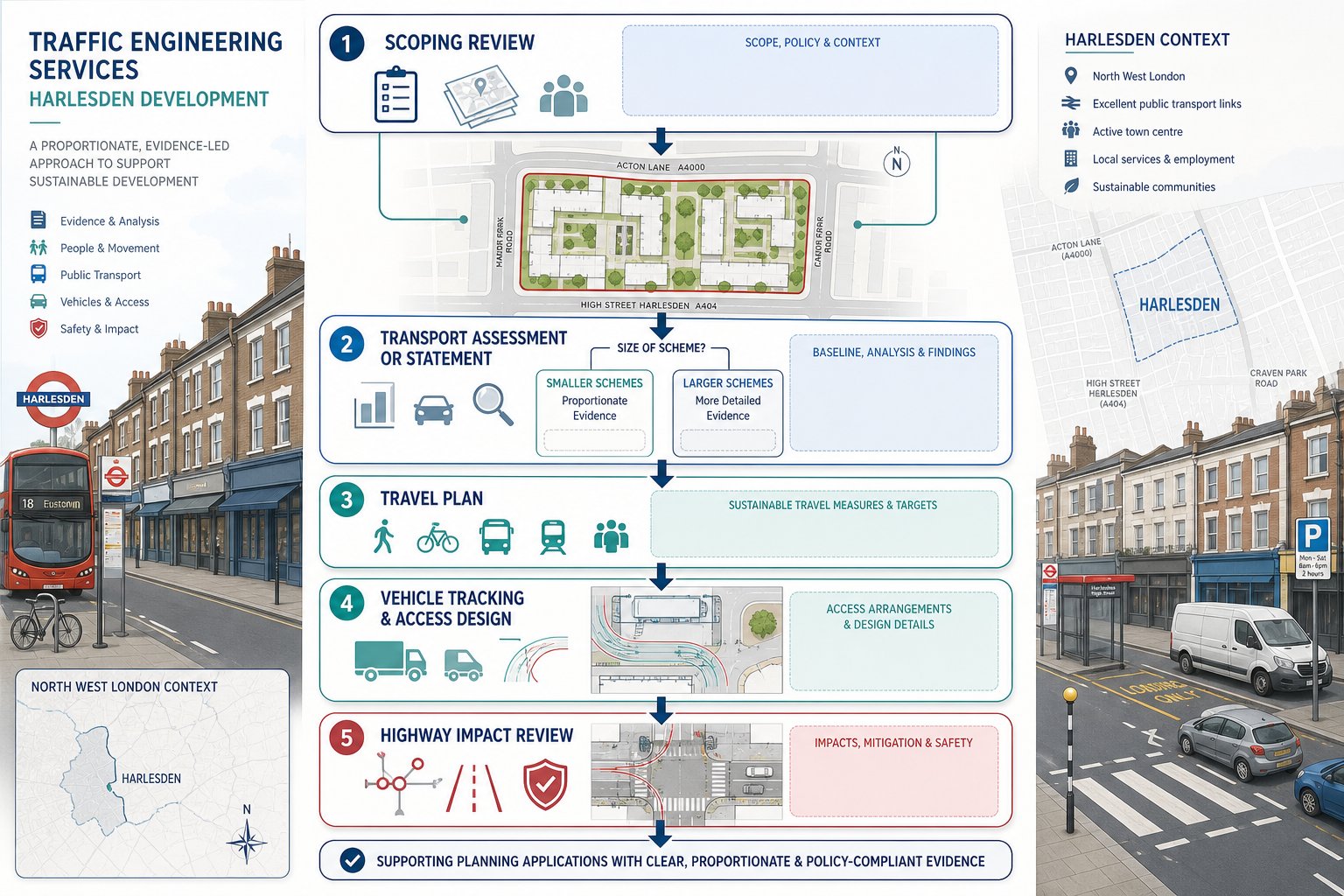
Transport engineering for planning in Harlesden usually combines strategic reporting with practical design review. The right package depends on the site, but the core aim stays the same: demonstrate that the proposal is safe, functional, policy-aligned, and realistically deliverable.
Our work often starts with scoping. That means reviewing the land use, layout, planning history, local policy context, and likely transport concerns before deciding exactly what evidence is needed. For some schemes, a concise statement and robust drawings are enough. For others, a fuller assessment, tracking, servicing strategy, collision review, and mitigation package are essential.
Transport Assessments, Transport Statements, And Travel Plans Explained
A Transport Assessment is the fuller document, usually needed for larger or more sensitive proposals. It examines existing conditions, trip generation, modal split, parking, servicing, highway safety, sustainable travel opportunities, and where necessary the operation of nearby junctions or site access points. The point is not just to present data, but to explain why the proposal is acceptable and what mitigation, if any, should accompany it.
A Transport Statement is a more proportionate version for smaller schemes. It still needs to be evidence-based, but the level of analysis is lighter. In Harlesden, a well-judged TS can be more persuasive than an oversized TA that buries the practical issues.
Travel Plans are often misunderstood as generic templates. In reality, they work best when they are tailored to the site and user group, with realistic targets for walking, cycling, and public transport use, plus monitoring and management commitments. That aligns with broader Traffic Engineering: Your principles and with London’s push toward healthier, lower-car travel patterns.
Vehicle Tracking, Access Design, And Highway Impact Reviews
On constrained plots, vehicle tracking is often one of the most important pieces of evidence. Swept-path analysis shows whether cars, delivery vans, refuse vehicles, fire appliances, and other design vehicles can actually use the access and internal layout without unsafe manoeuvres or repeated overruns.
Access design is about more than drawing a crossover. We assess geometry, visibility, gradients, pedestrian conflict, gate positions, waiting space, and how the access performs in relation to parking controls and adjacent activity. Good access design highway work can resolve objections before they appear.
Highway impact reviews then consider the wider picture: nearby junctions, bus stops, crossings, loading behaviour, collision history, and whether any mitigation is appropriate. Sometimes that means minor amendments to kerbside arrangements or internal servicing. Sometimes it means reframing the entire access strategy. Either way, the technical evidence needs to show that the proposal will function on a real Harlesden street, not just on a tidy layout drawing.
Key Transport And Highways Issues On Harlesden Sites
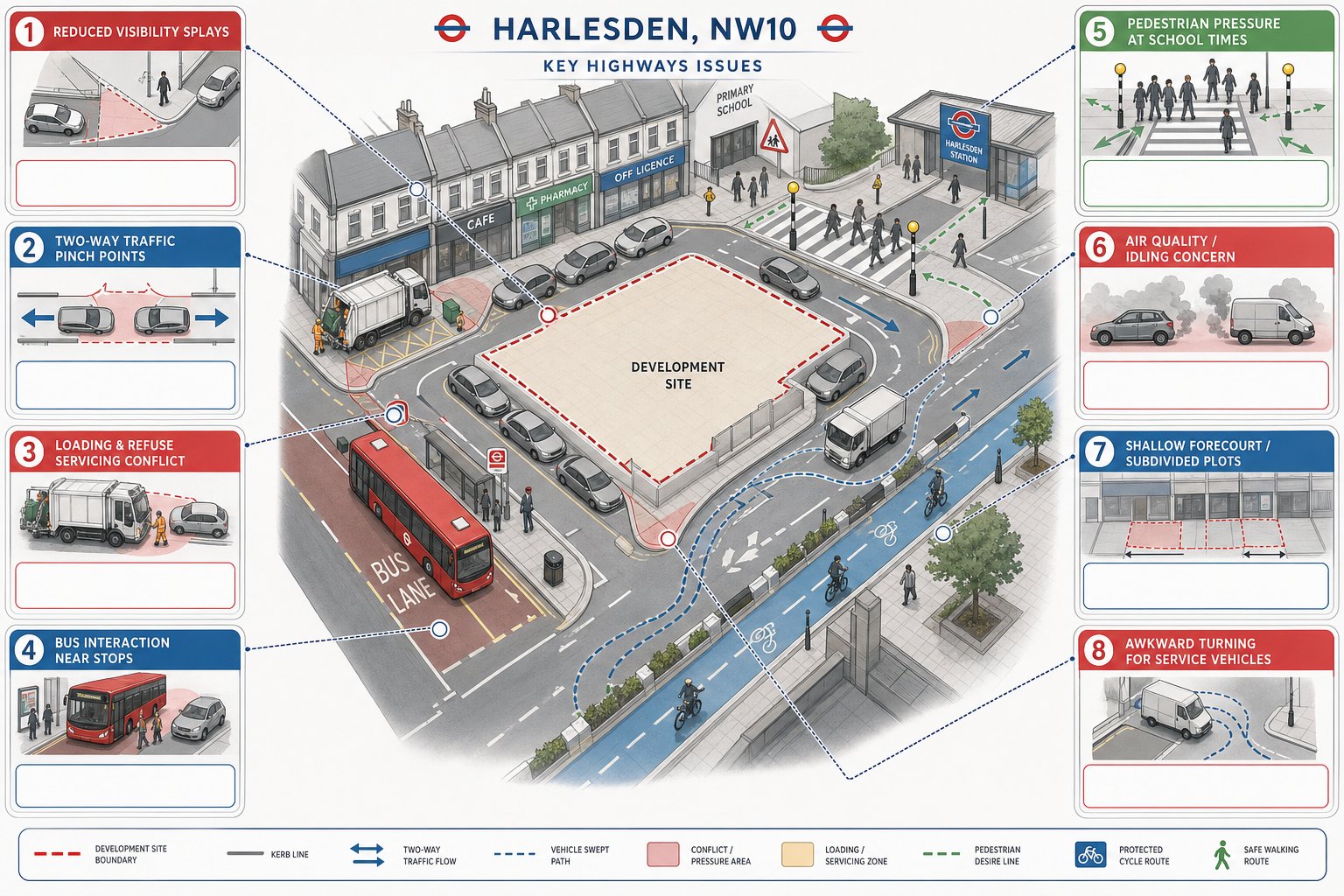
Harlesden sites tend to share a familiar set of transport problems, but they show up in slightly different combinations. One plot may be dominated by parking stress and visibility: another by servicing conflict: another by school-time pedestrian pressure or bus interaction. Understanding which issue is genuinely critical is half the job.
Narrow streets are a recurring challenge. On-street parking can compress available carriageway width, affect visibility splays, and make two-way movement awkward, especially for larger vehicles. If a development depends on regular refuse or servicing activity, that has to be tested honestly. Drawings that assume clear kerbspace all day rarely survive contact with reality.
Bus routes matter as well. Harlesden‘s public transport accessibility is a planning advantage, but it also means vehicle access points and loading activity need to avoid undermining bus reliability or creating conflict at stops and pinch points. On busy frontages, a seemingly small kerbside change can trigger outsized concern.
Pedestrian safety is another major issue, particularly near schools, local centres, stations, and heavily used crossing points. Brent and TfL will expect active travel to be prioritised, which means layouts should not simply accommodate vehicles but support safe walking and cycling. Air quality also remains part of the picture, especially where proposals may intensify servicing or encourage idling.
Historic or tightly subdivided plots often create poor visibility, awkward turning, or very shallow forecourts. And high-street sites can struggle with delivery strategy because there is no spare space to absorb loading informally. In those cases, a robust evidence base and realistic operational plan are essential. We’ve found that comparing assumptions against wider urban examples, including approaches discussed for Traffic Engineer In Manchester:, helps reinforce a simple point: constrained streets need disciplined, site-specific transport thinking, not generic reporting.
How A Traffic Engineer Supports Architects, Planners, And Developers
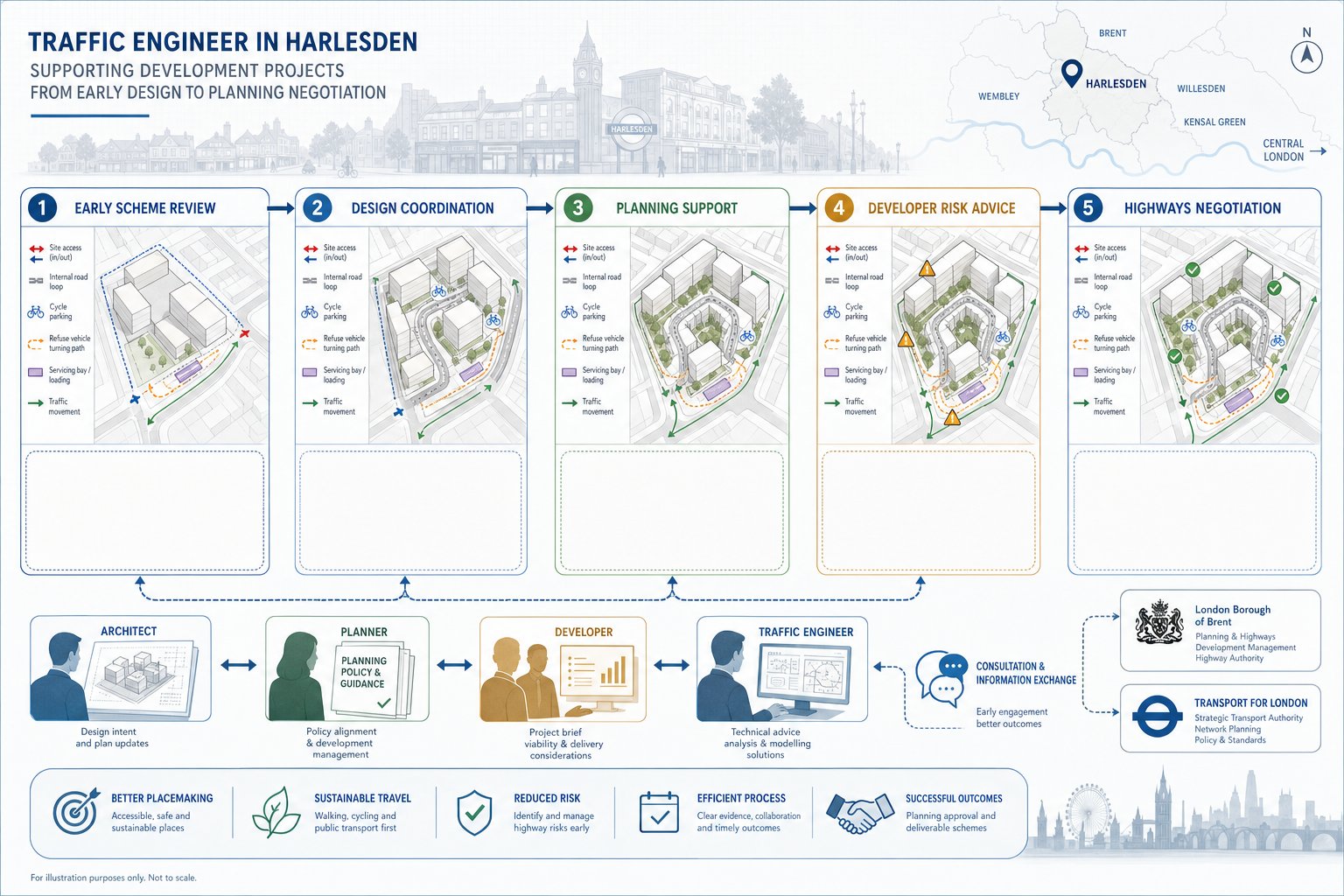
The best transport input improves the scheme before the application is submitted. That is why our role usually starts well before the final report stage. We work with architects on access positioning, internal circulation, cycle parking, refuse movement, and the layout consequences of servicing assumptions. Those discussions can be surprisingly influential. A few metres of adjustment to a ramp, gate, or bin store can remove pages of highways risk.
For planners and planning consultants, we provide the technical narrative that supports the application strategy. That might mean scoping whether a TS is enough rather than a TA, framing a car-free position in a way Brent can accept, or setting out why a modest intensification does not create a severe impact. We also supply wording, drawings, and evidence that sit neatly alongside Design and Access Statements and wider planning submissions.
Developers often value something slightly different: speed, clarity, and a direct view on risk. We try to give that early. If an access won’t work, it’s better to say so before the design team spends weeks polishing it. If the likely issue is servicing rather than trip generation, we focus effort there.
Then there is negotiation. Highways comments can be technical, but the response shouldn’t be defensive. We help teams engage with Brent and TfL pragmatically, refine mitigation where needed, and answer consultee concerns in a way that keeps the application moving. That kind of joined-up support is a big part of what experienced transport specialists bring, whether on local schemes or in other city contexts such as Traffic Engineer In Leeds:. The location changes: the value of early, clear technical advice does not.
The Process From Site Review To Planning Submission
A smooth planning submission usually follows a structured transport process, even if the final output looks simple. In Harlesden, we generally move through six stages.
First comes the initial briefing and policy review. We look at the proposal, land use mix, red-line boundary, planning history, local street context, and the policy framework that will shape the transport response. This is where we decide whether the likely route is a statement, a full assessment, a Travel Plan, tracking, or a combination.
Second is the site visit and audit. We review access conditions, parking stress, crossing points, servicing behaviour, bus activity, visibility, and the practical constraints that drawings alone miss. These observations often shape the eventual recommendation more than desktop assumptions do.
Third, where appropriate, comes scoping with Brent and TfL. Early agreement on the level of reporting and the main matters to be covered can save time later, though not every scheme needs a formal scoping exercise.
Fourth is design input. We work with the team to refine access, parking, servicing, and internal movement so that the transport case and the physical layout support each other.
Fifth is preparation of the technical package: TA or TS, Travel Plan, swept-path analysis, collision review, parking and servicing strategy, and any mitigation proposals.
Finally, we support submission and determination. That can include clarifications, responses to consultee comments, and revisions where officers want additional comfort. The applications that progress most efficiently are usually the ones where transport evidence has been integrated with design from the outset, not stitched on at the end.
What To Prepare Before Instructing A Traffic Engineer
A traffic engineer can start with limited information, but the process is faster and more precise when the basics are ready. At minimum, we usually want the red-line boundary, an emerging site layout, the proposed land uses, floorspace figures or unit numbers, and any early thinking on access, parking, cycle storage, and servicing.
If the scheme has already been through pre-application discussions, officer feedback is especially useful. So are any comments from Brent highways, TfL, or neighbouring stakeholders that hint at likely transport objections. Those points help us shape the scope properly from day one rather than doubling back later.
Collision data, if available, can also be valuable, particularly where there are existing safety concerns near the site access or at nearby junctions. The same goes for survey information, topographical drawings, parking beat surveys, and site photos. None of this needs to be perfect. It just needs to be enough to avoid guesswork.
We also recommend that teams prepare a realistic statement of operational intent. Will the scheme be car-free, car-lite, or conventionally parked? Where will refuse wait? How will deliveries happen? Is there a managed move-in process for residential use? Small unanswered operational questions often become large planning questions.
The more coherent the early brief, the more concise and targeted the transport output can be. And for time-sensitive applications, that matters. A quick start is only genuinely useful if it is built on enough information to avoid rework.
Choosing The Right Traffic Engineer For A Harlesden Project
Not all transport support is equal, especially in London. A Harlesden project needs someone who understands how local streets actually operate and how planning officers, highways teams, and TfL tend to review evidence. Purely generic reporting is easy to spot and rarely persuasive.
The first thing we’d look for is relevant London experience, ideally including Brent-facing work or similar outer-London urban sites. The policy context matters: the London Plan, Mayor’s Transport Strategy, Healthy Streets approach, London Cycling Design Standards, and Brent’s local planning framework all influence what is likely to be acceptable.
Second, the consultant should be comfortable across both strategy and detail. A team that can write a clear TA but cannot resolve access geometry, servicing, or tracking issues leaves a gap in the planning process. Equally, strong technical design without planning judgement can produce documents that are correct but unconvincing.
Third, communication matters more than people sometimes expect. Architects need practical advice they can draw. Planning consultants need concise evidence that supports the application narrative. Developers need plain speaking on risk, programme, and likely consultee reaction. Councils and legal teams need clarity and defensible reasoning.
Finally, look for responsiveness. In planning, timing is often as important as technical quality. At ML Traffic, our focus is on concise, accurate transport reports delivered quickly and shaped around local authority thresholds and real planning contexts. That combination of speed, experience, and local judgement is usually what makes the difference on constrained Harlesden schemes.
Conclusion
In Harlesden, transport planning is rarely a box-ticking exercise. Constrained streets, active frontages, bus priority, pedestrian pressure, and tight development plots mean even modest proposals can raise detailed highways questions. Bringing in a traffic engineer early helps us spot those issues before they harden into objections.
The real value is not just producing a Transport Assessment or a tracking drawing. It is shaping access, parking, servicing, and movement strategy so the application is credible from the start and aligned with Brent and TfL expectations. For architects, planners, developers, surveyors, and local authorities, that usually means lower planning risk, fewer surprises during determination, and a scheme that functions better once built.
For 2026 applications, that early, practical, policy-aware input is exactly what gives a Harlesden project a stronger route to consent.
Frequently Asked Questions About Traffic Engineering in Harlesden
Why is a traffic engineer important for developments in Harlesden?
A traffic engineer ensures that new developments in Harlesden do not create severe safety or congestion issues, aligning proposals with the NPPF, London Plan, and local Brent policies to support safe, functional access and sustainable transport.
When should I involve a traffic engineer in my Harlesden planning application?
Traffic engineers should be engaged early, especially for medium or larger schemes, changes to vehicle access, reduced parking, or sites with tight access, to address potential issues before design finalisation and planning submission.
What types of projects in Harlesden typically require traffic engineering input?
Projects like residential flats, HMOs, town-centre commercial developments, schools, nurseries, places of worship, and car-free or industrial sites commonly need specialised traffic assessments in Harlesden.
What transport documents might be required for a Harlesden planning application?
Depending on scheme size and impact, Transport Assessments or Statements, Travel Plans, Construction Logistics Plans, and swept-path analyses are often necessary to demonstrate safe and acceptable transport operations.
How does a traffic engineer help with access design and vehicle movement for Harlesden developments?
They conduct swept-path analysis and access design reviews to ensure vehicles like buses, refuse trucks, and fire appliances can manoeuvre safely within narrow or constrained streets, supporting practical layouts aligned with local policy and safety standards.
What should I prepare before instructing a traffic engineer for a Harlesden project?
Prepare the site red-line boundary, preliminary layouts, land use details, parking and servicing plans, plus any pre-application feedback and incident data to enable targeted, efficient transport assessments and design input.